

World Cervical Cancer Day 2026: HPV Vaccine, Early Detection & Prevention

World Cervical Cancer Day 2026 : Date: 17 November 2026
Cervical cancer is a serious health concern worldwide. However, many cases can be prevented through HPV vaccination, regular screening and timely medical care.
World Cervical Cancer Day 2026 highlights the importance of awareness, prevention and early detection. Moreover, WHO estimates that 604,000 new cases and 280,000 deaths occurred worldwide in 2024, showing why timely action is essential.
Fortunately, vaccination, recommended screening and appropriate treatment can help save lives. Therefore, this article explains cervical cancer causes, symptoms, HPV vaccination, screening and prevention in simple English and Hindi.
हिंदी में समझें
सर्वाइकल कैंसर दुनिया भर में महिलाओं के स्वास्थ्य से जुड़ी एक गंभीर समस्या है। हालांकि, HPV वैक्सीन, नियमित जाँच और समय पर इलाज से इसके कई मामलों को रोका जा सकता है।
World Cervical Cancer Day 2026 महिलाओं को जागरूक करने और इस बीमारी की रोकथाम के महत्व को समझाने का अवसर है। WHO के अनुसार, वर्ष 2024 में दुनिया भर में इसके लगभग 6,04,000 नए मामले और 2,80,000 मौतें अनुमानित थीं।
इसलिए सही जानकारी, समय पर जाँच और उचित उपचार बेहद जरूरी हैं। इस लेख में हम सर्वाइकल कैंसर के कारण, लक्षण, HPV वैक्सीन, स्क्रीनिंग और बचाव के तरीकों को सरल भाषा में समझेंगे।
What You Will Learn About World Cervical Cancer Day 2026
- What Is World Cervical Cancer Day 2026?
- Why Is 17 November Important?
- What Is Cervical Cancer?
- World Cervical Cancer Day 2026: Global Statistics
- HPV Infection: The Major Cause of Cervical Cancer
- Common Risk Factors for Cervical Cancer
- World Cervical Cancer Day 2026: Early Warning Signs and Symptoms
- HPV Vaccine: How Can It Prevent Cervical Cancer?
- World Cervical Cancer Day 2026: Screening and Early Detection
- WHO’s 90–70–90 Strategy for Cervical Cancer Elimination
- World Cervical Cancer Day 2026: 10 Prevention Measures
- Common Myths and Facts About Cervical Cancer
- When Should You Consult a Doctor?
- How Families and Communities Can Support Cervical Cancer Prevention
- Important Cervical Cancer Facts at a Glance
- Frequently Asked Questions
- World Cervical Cancer Day 2026: Health Awareness Quiz
- Final Message: Prevention Begins With Awareness
1. What Is World Cervical Cancer Day 2026?
World Cervical Cancer Elimination Day is observed every year on 17 November to raise awareness about cervical cancer prevention, HPV vaccination, screening and timely treatment.
The observance encourages governments, healthcare professionals, communities and individuals to work together to reduce the global burden of cervical cancer.
In 2026, this message remains particularly important because hundreds of thousands of women continue to be affected by this disease worldwide.
However, there is hope. Effective preventive measures and improvements in healthcare have made it possible to prevent many cases and identify abnormal cervical changes before they develop into cancer.

Why Is World Cervical Cancer Day 2026 Important?
This awareness day highlights several important goals:
- Increase awareness about cervical cancer.
- Encourage eligible girls to receive HPV vaccination.
- Promote regular cervical screening.
- Help women recognise possible warning signs.
- Encourage early diagnosis and timely treatment.
- Improve access to preventive healthcare.
- Support the global goal of eliminating cervical cancer as a public health problem.
English Explanation: World Cervical Cancer Elimination Day encourages people to understand that many cases of cervical cancer can be prevented when vaccination, screening and appropriate treatment are accessible.
हिंदी में समझें: विश्व सर्वाइकल कैंसर उन्मूलन दिवस महिलाओं में होने वाले गर्भाशय ग्रीवा के कैंसर के प्रति जागरूकता बढ़ाने के लिए मनाया जाता है। इसका मुख्य उद्देश्य HPV वैक्सीन, नियमित जाँच और समय पर उपचार के महत्व को समझाना है।
2. World Cervical Cancer Day 2026: Why Is 17 November Important?
The date 17 November is recognised by the WHO as World Cervical Cancer Elimination Day.
It provides an opportunity to strengthen international cooperation and encourage countries to expand vaccination, screening and treatment services.
WHO’s updated cervical cancer fact sheet, published on 10 November 2026, highlights the continuing need for global action.
This observance also reminds us that women should not lose their lives simply because they lack access to reliable information, preventive healthcare or timely medical services.
A simple message for everyone: Awareness encourages prevention, while early medical attention can help save lives.
3. World Cervical Cancer Day 2026: What Is Cervical Cancer?
Cervical cancer is a disease in which abnormal cells grow uncontrollably in the cervix.
The cervix is the lower, narrow part of the uterus (womb) that connects the uterus to the vagina.
In many cases, cervical cancer develops following a persistent infection with certain high-risk types of Human Papillomavirus (HPV).
This process usually takes several years. During this time, abnormal changes may develop in cervical cells. Fortunately, screening can identify many precancerous changes before they become cancer.
Understanding the Cervix: Important Medical Terms
| Term | Meaning |
| Uterus | The organ where a baby develops during pregnancy |
| Cervix | The lower part of the uterus |
| HPV | Human Papillomavirus |
| Infection | Entry and multiplication of harmful microorganisms or viruses in the body |
| Screening | Testing to identify possible disease or precancerous changes |
| Early detection | Identifying a disease at an earlier stage |
Hindi Explanation:
गर्भाशय ग्रीवा (Cervix) गर्भाशय का निचला और संकरा हिस्सा होता है, जो गर्भाशय को योनि से जोड़ता है।
जब इस हिस्से की कोशिकाओं में असामान्य बदलाव होते हैं और वे अनियंत्रित रूप से बढ़ने लगती हैं, तब सर्वाइकल कैंसर विकसित हो सकता है।
हालाँकि, अधिकांश मामलों में यह प्रक्रिया धीरे-धीरे होती है। इसलिए सही समय पर जाँच कराने से कैंसर बनने से पहले ही असामान्य कोशिकाओं का पता लगाया जा सकता है।
4. World Cervical Cancer Day 2026: Global Statistics and Facts
Understanding health statistics helps us recognise the scale of a public health challenge.
According to the WHO cervical cancer fact sheet updated in November 2026, the following figures highlight the global impact of this disease.
Cervical Cancer: Important Global Data
| Indicator | WHO Reported Estimate |
| New cervical cancer cases in 2024 | 604,000 |
| Cervical cancer deaths in 2024 | 280,000 |
| Global ranking among cancers diagnosed in women | Fifth |
| Countries where cervical cancer is the leading cause of cancer death in women | 26 |
| Higher risk among women living with HIV | 6 times |
| Estimated proportion of cervical cancer cases attributable to HIV | 5% |
Source: WHO Cervical Cancer Fact Sheet, updated 10 November 2026.
What Do These World Cervical Cancer Day 2026 Statistics Tell Us?
1. Cervical cancer remains a major global health concern
More than 600,000 new cases were estimated in 2024. This demonstrates the importance of strengthening prevention and healthcare services.
2. Healthcare inequality matters
The highest incidence and mortality rates occur in low- and middle-income countries. Limited access to HPV vaccination, screening and treatment contributes to this inequality.
3. Prevention can make a difference
Vaccination, screening and timely treatment can prevent many cases and reduce deaths.
4. Awareness must reach every community
Women should have access to reliable health information regardless of their income, location or educational background.
5. World Cervical Cancer Day 2026: Understanding HPV, the Major Cause

Human Papillomavirus (HPV) is a common group of viruses that can infect the skin and certain areas of the body, including the genital region.
There are many types of HPV. Most infections clear naturally through the body’s immune system without causing serious health problems.
However, persistent infection with certain high-risk HPV types can cause abnormal changes in cervical cells. If these changes remain untreated, they may eventually develop into cervical cancer.
According to WHO, almost all cervical cancer cases are linked to persistent infection with cancer-causing HPV types.
Important Facts About HPV Infection
- HPV is a very common viral infection.
- Many HPV infections do not cause noticeable symptoms.
- Most infections clear naturally.
- Certain high-risk HPV types can cause cervical cancer.
- HPV vaccination can prevent infections caused by important cancer-causing HPV types.
- HPV can also cause other cancers.
Hindi Explanation:
HPV यानी Human Papillomavirus एक सामान्य वायरस है। इसके कई प्रकार होते हैं। अधिकांश संक्रमण शरीर की प्रतिरक्षा प्रणाली द्वारा अपने आप समाप्त हो जाते हैं।
लेकिन कुछ उच्च जोखिम वाले HPV प्रकार लंबे समय तक शरीर में बने रहने पर गर्भाशय ग्रीवा की कोशिकाओं में असामान्य बदलाव पैदा कर सकते हैं। समय पर जाँच और उचित उपचार से इस प्रक्रिया को रोकने में मदद मिल सकती है।
6. World Cervical Cancer Day 2026: Common Risk Factors
Persistent infection with high-risk HPV is the main cause of cervical cancer. However, certain factors can increase the likelihood of an infection progressing into cancer.
Important Cervical Cancer Risk Factors
| Risk Factor | Why It Matters |
| Persistent high-risk HPV infection | The primary cause of cervical cancer |
| Weakened immune system | Makes it harder for the body to control HPV infection |
| HIV infection | Significantly increases cervical cancer risk |
| Smoking | Can increase the risk of progression |
| Lack of screening | Precancerous changes may remain undetected |
| Limited access to healthcare | Delays vaccination, diagnosis and treatment |
It is important to remember that having a risk factor does not mean someone will definitely develop cervical cancer.
Similarly, women without obvious risk factors can also develop the disease. Therefore, recommended vaccination and screening remain important.
7. World Cervical Cancer Day 2026: Early Warning Signs and Symptoms

One of the biggest challenges with cervical cancer is that early-stage disease and precancerous changes may not cause noticeable symptoms.
Therefore, regular screening is important even when a woman feels completely healthy.
As the disease progresses, certain symptoms may appear.
Possible Warning Signs of Cervical Cancer
| Symptom | What to Notice |
| Unusual vaginal bleeding | Bleeding between periods or after sexual intercourse |
| Postmenopausal bleeding | Any vaginal bleeding after menopause |
| Unusual vaginal discharge | Increased or foul-smelling discharge |
| Pelvic pain | Persistent discomfort in the pelvic region |
| Back or leg pain | Persistent or unexplained pain |
| Swelling in the legs | Unusual swelling that requires medical assessment |
| Unexplained weight loss | Significant weight loss without a clear reason |
| Fatigue | Persistent tiredness or weakness |
Important: These symptoms can occur due to several health conditions. They do not automatically indicate cervical cancer. However, persistent or unusual symptoms should be evaluated by a qualified healthcare professional.
Why Should Women Never Ignore Unusual Bleeding?
Unusual vaginal bleeding may have several possible causes. Nevertheless, bleeding after sexual intercourse, between periods or after menopause should not be ignored.
Early medical evaluation helps identify the underlying cause and allows appropriate treatment when necessary.

हिंदी में समझें:
मासिक धर्म के बीच रक्तस्राव, संभोग के बाद रक्तस्राव, रजोनिवृत्ति के बाद रक्तस्राव या असामान्य योनि स्राव जैसे लक्षणों को नजरअंदाज नहीं करना चाहिए।
इनका अर्थ हमेशा कैंसर नहीं होता, लेकिन सही कारण जानने के लिए डॉक्टर से जाँच कराना जरूरी है।
8. World Cervical Cancer Day 2026: HPV Vaccine and Cancer Prevention
Yes. HPV vaccination is one of the most effective ways to prevent cervical cancer.
The HPV vaccine protects against important cancer-causing HPV types, particularly types 16 and 18, which are responsible for approximately 76% of cervical cancers.
WHO recommends HPV vaccination for girls aged 9–14 years.
Vaccination is most effective before exposure to HPV. Depending on national guidelines and individual health circumstances, the recommended number of doses may differ.
HPV Vaccine: Important Information
| Question | Explanation |
| What does HPV stand for? | Human Papillomavirus |
| Why is the vaccine given? | To prevent infection with important cancer-causing HPV types |
| Who is the primary target group? | Girls aged 9–14 years |
| When is vaccination most effective? | Before exposure to HPV |
| Can the vaccine prevent every HPV infection? | No |
| Is screening still necessary after vaccination? | Yes |
| Can vaccination replace medical advice? | No |
Why Is HPV Vaccination Important at a Young Age?
Vaccination before exposure to HPV provides the best protection.
Therefore, parents and guardians should discuss HPV vaccination with qualified healthcare professionals and follow the recommended national immunisation schedule.
World Cervical Cancer Day 2026: What About India?
India has a large and diverse population, so awareness about women’s preventive healthcare is especially important.
Parents, schools, healthcare workers and communities can help by sharing accurate information about HPV vaccination and encouraging families to consult qualified medical professionals.
Hindi Explanation:
HPV वैक्सीन सर्वाइकल कैंसर की रोकथाम का एक महत्वपूर्ण उपाय है। WHO के अनुसार 9–14 वर्ष की लड़कियों के लिए HPV टीकाकरण विशेष रूप से महत्वपूर्ण है।
माता-पिता को अपने बच्चों के टीकाकरण के बारे में डॉक्टर से सलाह लेनी चाहिए। वैक्सीन लगने के बाद भी निर्धारित आयु और दिशानिर्देशों के अनुसार सर्वाइकल स्क्रीनिंग जरूरी रहती है।
9. World Cervical Cancer Day 2026: Screening and Early Detection
Screening is a medical process that helps identify precancerous changes or early signs of disease before serious symptoms develop.
For cervical cancer, screening plays a particularly important role because abnormal cervical cells can often be identified before they become cancerous.
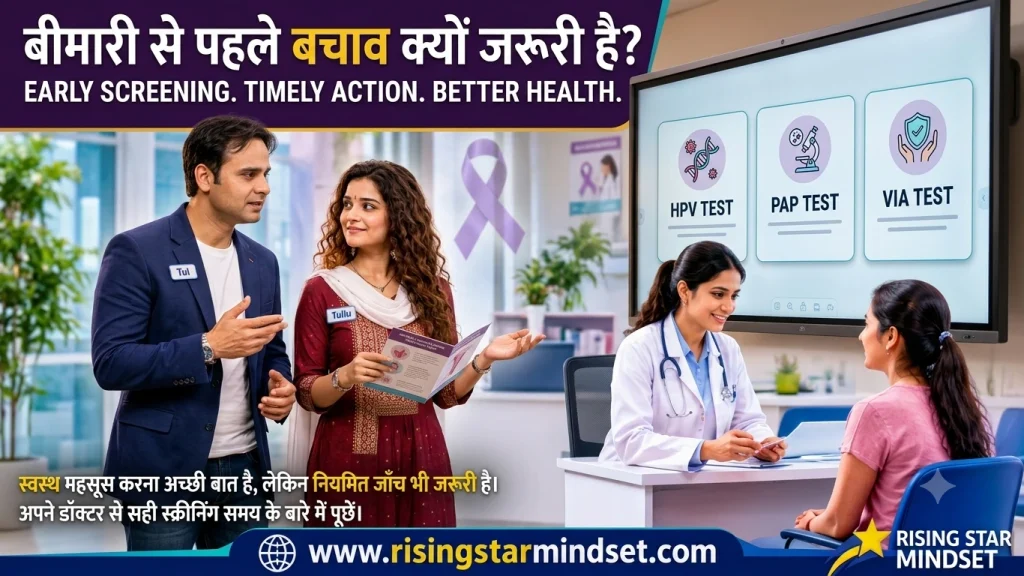
Common Cervical Cancer Screening Methods
| Screening Method | How It Works |
| HPV Test | Checks for high-risk HPV infection |
| Pap Test | Examines cervical cells for abnormal changes |
| VIA Test | Uses visual inspection after applying acetic acid |
The appropriate screening method depends on national guidelines, age, medical history and available healthcare services.
When Should Women Get Screened?
WHO recommends high-performance cervical screening beginning at age 30 for women in the general population.
For women living with HIV, screening should begin at age 25.
WHO recommends screening with a high-performance test every 5–10 years for the general population and every 3–5 years for women living with HIV.
However, the recommended schedule may vary according to national guidelines and individual circumstances. Women should consult a qualified healthcare professional for advice.
Does a Vaccinated Woman Still Need Cervical Screening?
Yes.
HPV vaccines do not protect against every cancer-causing HPV type. Therefore, vaccinated women should still follow recommended cervical screening guidelines.
Hindi Explanation:
सर्वाइकल स्क्रीनिंग के माध्यम से गर्भाशय ग्रीवा की कोशिकाओं में असामान्य बदलावों का पता लगाया जा सकता है।
इसका सबसे बड़ा फायदा यह है कि कैंसर बनने से पहले ही कई समस्याओं की पहचान हो सकती है। इसलिए स्वस्थ महसूस करने वाली महिलाओं को भी अपनी आयु और स्वास्थ्य स्थिति के अनुसार स्क्रीनिंग के बारे में डॉक्टर से सलाह लेनी चाहिए।
10. World Cervical Cancer Day 2026: WHO’s 90–70–90 Global Strategy
One of the most important global initiatives against cervical cancer is WHO’s 90–70–90 strategy.
It provides measurable targets to help countries move towards eliminating cervical cancer as a public health problem.
Understanding WHO’s 90–70–90 Targets
| Target | WHO Goal by 2030 |
| 90% | Girls fully vaccinated with HPV vaccine by age 15 |
| 70% | Women screened with a high-performance test by age 35 and again by age 45 |
| 90% | Women identified with cervical precancer or cancer receive appropriate treatment |
Why Is the 90–70–90 Strategy Important?
90% Vaccination: Protecting girls against important cancer-causing HPV types can prevent future disease.
70% Screening: Identifying abnormal cervical changes early makes timely treatment possible.
90% Treatment: Women diagnosed with precancer or cancer should have access to appropriate medical care.
WHO defines elimination as reducing new cervical cancer cases to four or fewer per 100,000 women annually.
This does not mean the disease will disappear completely overnight. Instead, it means reducing its occurrence to a level where it is no longer a major public health problem.
11. World Cervical Cancer Day 2026: 10 Important Prevention Measures
Prevention requires a combination of medical services, informed decisions and healthy practices.
Here are ten important steps that can help reduce risk.
10 Practical Steps to Help Prevent Cervical Cancer
- Follow recommended HPV vaccination guidelines. Discuss eligibility and the appropriate schedule with a healthcare professional.
- Discuss cervical screening with a healthcare professional. Follow the recommended screening schedule for your age and health circumstances.
- Do not ignore unusual vaginal bleeding. Seek medical advice to understand its cause.
- Avoid smoking. Seek professional support to quit if necessary.
- Seek timely medical advice for persistent symptoms. Do not delay an examination.
- Maintain regular healthcare appointments. Preventive care helps identify health concerns.
- Follow appropriate treatment. If screening identifies abnormalities, complete the recommended follow-up.
- Protect your health through reliable information. Avoid unverified medical claims.
- Encourage family members to learn about women’s health. Support open and respectful conversations.
- Avoid misinformation on social media. Use trusted medical sources for health decisions.
World Cervical Cancer Day 2026: Women’s Health Awareness Checklist
| Health Action | Why It Matters |
| HPV vaccination consultation | Helps understand vaccine eligibility |
| Cervical screening | Detects precancerous changes |
| Medical check-up | Helps assess individual health needs |
| Symptom awareness | Encourages timely consultation |
| Follow-up appointments | Ensures appropriate monitoring |
| Reliable health information | Reduces confusion and misinformation |
Remember that these are general awareness steps, not a substitute for individual medical advice.
12. World Cervical Cancer Day 2026: Common Myths and Facts
Incorrect information can delay vaccination, screening and treatment. Therefore, understanding the difference between myths and facts is essential.
Cervical Cancer Myths vs Facts
| Myth | Fact |
| Cervical cancer cannot be prevented. | HPV vaccination and screening can prevent many cases. |
| HPV infection always causes cancer. | Most HPV infections clear naturally. |
| Only women with symptoms need screening. | Precancerous changes often cause no symptoms. |
| HPV vaccination is unnecessary after childhood. | Vaccination is most effective before exposure; eligibility should be discussed with a healthcare professional. |
| A vaccinated woman never needs screening. | Screening remains necessary according to guidelines. |
| Unusual bleeding always means cancer. | Several conditions can cause unusual bleeding; medical evaluation identifies the cause. |
| Cervical cancer affects only older women. | It can affect women at different ages. |
Why Must We Talk Openly About Women’s Health?
In many communities, reproductive and sexual health topics are still surrounded by embarrassment and misinformation.
However, silence can prevent people from seeking important healthcare services.
A supportive family environment and respectful communication can make it easier for women to discuss symptoms, vaccination and screening.
Remember: Discussing women’s health is not something to feel embarrassed about. It is an important part of protecting health and well-being.
13. World Cervical Cancer Day 2026: When Should You Consult a Doctor?
Medical advice should be sought whenever unusual or persistent symptoms appear.
Consider consulting a qualified healthcare professional if you experience:
- Unusual bleeding between periods.
- Bleeding after sexual intercourse.
- Any bleeding after menopause.
- Persistent pelvic pain.
- Unusual or foul-smelling vaginal discharge.
- Persistent back or leg pain.
- Unexplained weight loss or ongoing fatigue.
Do not wait for symptoms to become severe before seeking help.
If a screening result is abnormal, it does not automatically mean cancer is present. However, the recommended follow-up tests and medical appointments should not be ignored.
Important Medical Disclaimer
This article is intended for general health education and awareness. It does not provide a diagnosis, prescribe medicines or replace professional medical consultation. HPV vaccination, screening intervals and treatment decisions should be discussed with qualified healthcare professionals according to national guidelines and individual medical circumstances.
14. World Cervical Cancer Day 2026: How Families and Communities Can Help
Cervical cancer prevention is not only an individual responsibility. Families, educational institutions, healthcare organisations and communities can contribute significantly.
Parents: How to Support Prevention
- Learn about HPV vaccination.
- Discuss preventive healthcare without embarrassment.
- Encourage daughters to receive recommended medical advice.
- Support regular healthcare appointments.
Schools and Colleges: Spreading Awareness
- Organise women’s health awareness sessions.
- Share medically verified educational materials.
- Encourage respectful discussions about reproductive health.
- Invite qualified healthcare professionals for educational programmes.
Healthcare Professionals: Improving Preventive Care
- Provide accurate information about vaccination.
- Improve access to screening services.
- Explain screening results clearly.
- Encourage timely follow-up and treatment.
Society: Building a Supportive Environment
- Challenge misinformation.
- Reduce stigma around women’s health.
- Support affordable healthcare services.
- Promote awareness in rural and underserved communities.
When families and communities work together, reliable health information can reach more women and encourage preventive care.
15. World Cervical Cancer Day 2026: Important Facts at a Glance
| Question | Answer |
| What is cervical cancer? | Cancer that develops in the cervix |
| What is the main cause? | Persistent infection with high-risk HPV |
| When is World Cervical Cancer Elimination Day? | 17 November |
| Which organisation leads the global elimination effort? | World Health Organization |
| What does HPV stand for? | Human Papillomavirus |
| Which HPV types are particularly important? | Types 16 and 18 |
| Who is the primary target group for HPV vaccination? | Girls aged 9–14 years |
| What are common screening methods? | HPV Test, Pap Test and VIA |
| Can cervical cancer be prevented? | Many cases can be prevented |
| Can early-stage cervical cancer be cured? | It can be cured with appropriate early diagnosis and treatment |
| What are WHO’s global targets? | 90–70–90 by 2030 |

16. World Cervical Cancer Day 2026: Frequently Asked Questions (FAQs)
Q1. What is World Cervical Cancer Day 2026?
It is a global health awareness observance held on 17 November to promote cervical cancer prevention, HPV vaccination, screening and treatment.
Q2. What causes cervical cancer?
Almost all cervical cancer cases are associated with persistent infection with certain high-risk types of Human Papillomavirus (HPV).
Q3. Is cervical cancer preventable?
Yes. HPV vaccination, regular screening and timely treatment of precancerous changes can prevent many cases.
Q4. What is the HPV vaccine used for?
The HPV vaccine protects against important HPV types responsible for cervical cancer and some other HPV-related cancers.
Q5. At what age should girls receive the HPV vaccine?
WHO recommends HPV vaccination for girls aged 9–14 years. The exact schedule should follow national recommendations and medical advice.
Q6. What are the early symptoms of cervical cancer?
Early cervical cancer may not cause symptoms. Possible warning signs include unusual vaginal bleeding, abnormal discharge and persistent pelvic pain.
Q7. What is a Pap test?
A Pap test is a screening procedure that examines cervical cells for abnormal changes.
Q8. What is an HPV test?
An HPV test checks for high-risk HPV infection that can lead to cervical cell changes.
Q9. Can a woman develop cervical cancer after HPV vaccination?
Yes, although vaccination significantly reduces the risk. It does not protect against every cancer-causing HPV type, so recommended screening remains important.
Q10. What is WHO’s 90–70–90 strategy?
It aims for 90% HPV vaccination of girls by age 15, 70% screening of women by ages 35 and 45, and 90% appropriate treatment of women with precancer or cancer.
Q11. Is cervical cancer contagious?
Cancer itself is not contagious. However, HPV, the virus responsible for almost all cervical cancer cases, can spread through intimate skin-to-skin contact.
Q12. Can cervical cancer be treated?
Yes. Treatment depends on the stage and individual medical condition. Options can include surgery, radiotherapy and chemotherapy.
Q13. Should women without symptoms get screened?
Yes. Precancerous cervical changes often cause no symptoms. Screening should follow the recommended age and healthcare guidelines.
Q14. What should someone do after an abnormal screening result?
Consult a qualified healthcare professional and complete the recommended follow-up tests. An abnormal screening result does not automatically mean cancer.
Q15. What is the main message of World Cervical Cancer Day 2026?
The main message is that many cases of cervical cancer can be prevented through vaccination, screening, early detection and timely treatment.
17. World Cervical Cancer Day 2026: Health Awareness Quiz
Test your understanding with these ten multiple-choice questions.
Q1. When is World Cervical Cancer Elimination Day observed?
A. 14 November
B. 17 November
C. 1 December
D. 7 April
Correct Answer: B. 17 November
Q2. What is the primary cause of cervical cancer?
A. Vitamin deficiency
B. Persistent high-risk HPV infection
C. Lack of sleep
D. Common cold
Correct Answer: B. Persistent high-risk HPV infection
Q3. What does HPV stand for?
A. Human Protection Virus
B. Healthy Papilloma Vaccine
C. Human Papillomavirus
D. Human Prevention Vaccine
Correct Answer: C. Human Papillomavirus
Q4. Which HPV types cause a large proportion of cervical cancers?
A. 1 and 2
B. 6 and 11
C. 16 and 18
D. 20 and 22
Correct Answer: C. 16 and 18
Q5. What is the primary target age group for HPV vaccination according to WHO?
A. 1–4 years
B. 9–14 years
C. 30–40 years
D. 60–70 years
Correct Answer: B. 9–14 years
Q6. Which test examines cervical cells for abnormal changes?
A. Blood pressure test
B. Pap test
C. Eye test
D. Hearing test
Correct Answer: B. Pap test
Q7. Can precancerous cervical changes occur without symptoms?
A. Yes
B. No
C. Only in older women
D. Only during pregnancy
Correct Answer: A. Yes
Q8. What does the 90–70–90 strategy promote?
A. Sports and fitness
B. Vaccination, screening and treatment
C. School attendance
D. Food production
Correct Answer: B. Vaccination, screening and treatment
Q9. Does HPV vaccination eliminate the need for cervical screening?
A. Yes
B. No
C. Only after age 50
D. Only during pregnancy
Correct Answer: B. No
Q10. Which organisation leads the global cervical cancer elimination initiative?
A. FIFA
B. WHO
C. WTO
D. UNESCO
Correct Answer: B. WHO
World Cervical Cancer Day 2026: Your Preventive Action Checklist
Prevention becomes more effective when we take small but important steps. Therefore, follow this simple checklist to support cervical health:
Preventive Action Checklist
- Discuss HPV vaccination with a healthcare professional and understand the recommended schedule.
- Get regular cervical cancer screening, even if you feel healthy.
- Never ignore unusual symptoms such as abnormal bleeding, discharge or persistent pelvic pain.
- Avoid smoking.
- Complete all recommended medical follow-ups after abnormal screening results.
- Share reliable information about cervical cancer prevention.
हिंदी में:
- HPV वैक्सीन की जानकारी लें और डॉक्टर से सही समय व डोज़ के बारे में पूछें।
- स्वस्थ महसूस करने पर भी नियमित सर्वाइकल कैंसर जाँच कराएँ।
- असामान्य रक्तस्राव, डिस्चार्ज या लगातार पेल्विक दर्द को नज़रअंदाज़ न करें।
- धूम्रपान से बचें।
- जाँच में असामान्य परिणाम आने पर डॉक्टर की सलाह के अनुसार आगे की जाँच और इलाज पूरा कराएँ।
- सर्वाइकल कैंसर से बचाव की सही जानकारी दूसरों तक पहुँचाएँ।
A Message From Rising Star Mindset
At Rising Star Mindset, we believe that knowledge is one of the strongest foundations of a healthy and responsible society.
Our aim is to share useful educational information, health awareness, motivational ideas and practical knowledge that can help people make informed decisions.
Don’t Ignore. Don’t Hesitate. Know the Facts. Protect Your Health.
जागरूक बनें, सही जानकारी अपनाएँ और अपने स्वास्थ्य को प्राथमिकता दें।
Visit: https://risingstarmindset.com
World Cervical Cancer Day 2026 – Awareness Today, A Healthier Tomorrow!
References and Trusted Health Resources
Readers can explore these authoritative sources for further information:
- World Health Organization – Cervical Cancer Fact Sheet
- WHO – Cervical Cancer Elimination Initiative
- WHO – HPV Vaccination
- International Agency for Research on Cancer – Global Cancer Observatory
Medical information in this article is based primarily on WHO guidance. Individual vaccination and screening decisions should follow current national guidelines and professional medical advice.