

A Complete Guide for Parents, Teachers and Students | Updated: 3 November 2026 ( How to Keep Your Child Safe Online )
Introduction ( How to Keep Your Child Safe Online )
How to Keep Your Child Safe Online is a question every parent should ask before handing a smartphone or tablet to their child. You may know where your child goes after school, but do you really know who they meet, what they watch or whom they talk to online?
Today, the internet offers children endless opportunities to learn, explore and communicate. However, it can also expose them to cyberbullying, online scams, privacy threats and harmful content.
As a result, keeping children safe online has become an important responsibility for every family. Simply taking away their devices is not the answer; instead, children need awareness, guidance and healthy digital habits.
In this article, discover 15 practical tips to help parents protect their children online while allowing them to enjoy the positive benefits of technology.
Table of Contents ( How to Keep Your Child Safe Online )
- What Is Child Digital Safety?
- Why Is Online Safety Important in 2026?
- Latest Development: India’s Air Force Schools Initiative
- Important Research and Data About Online Safety
- The Four Major Categories of Online Risks
- 15 Practical Ways to Protect Children Online
- Artificial Intelligence and New Digital Threats
8. A Digital Safety Guide for Different Age Groups
- Responsibilities of Parents and Teachers
- What Should Children Do During an Online Safety Incident?
- Indian Cyber Safety Laws and Reporting Resources
- Digital Safety Checklist
- Important Digital Safety Vocabulary
- Student Knowledge Test: MCQs and Answers
- Frequently Asked Questions
- Conclusion: Building a Safer Digital Generation
- RELATED POST : AI vs Traditional Study: Which Learning Method is Better ?
1. What Is Child Digital Safety?
Child Digital Safety refers to the practices, knowledge and protective measures that help children use the internet, digital devices and online platforms safely and responsibly.
It is not about stopping children from using technology. Instead, it is about helping them understand possible dangers and make sensible decisions.
For example, a child should know how to:
- Recognise suspicious messages and websites.
- Protect passwords and personal information.
- Identify cyberbullying and online harassment.
- Avoid unsafe communication with strangers.
- Recognise fake photographs, videos and AI-generated content.
- Report inappropriate online behaviour.
- Use digital platforms in a healthy and balanced way.
English Explanation ( How to Keep Your Child Safe Online )
Digital safety is an essential part of digital literacy. A digitally responsible child understands that every online activity may have consequences, including the information shared, photographs uploaded, messages sent and websites visited.
हिंदी में समझें ( How to Keep Your Child Safe Online )
बच्चों की डिजिटल सुरक्षा का अर्थ है उन्हें इंटरनेट की दुनिया में सुरक्षित रहना सिखाना।
उन्हें यह समझना जरूरी है कि मोबाइल और कंप्यूटर का उपयोग केवल मनोरंजन के लिए नहीं, बल्कि जिम्मेदारी के साथ करना चाहिए।
किसी अनजान व्यक्ति को निजी जानकारी देना, संदिग्ध लिंक खोलना या बिना जांचे किसी खबर को आगे भेजना नुकसानदायक हो सकता है।
Remember: Digital literacy teaches children how to use technology, while digital safety teaches them how to use it responsibly.
2. Why Is Online Safety Important in 2026?

The digital environment is changing rapidly. Children are now interacting with technologies that were not commonly available to earlier generations.
Consider these developments:
1. Online Education: Students increasingly depend on digital platforms for lessons, assignments and educational resources.
2. Social Media: Children may encounter unfamiliar people, opinions, advertisements and content through social networking platforms.
3. Online Gaming: Multiplayer games allow players to communicate with strangers, exchange messages and sometimes make digital purchases.
4. Artificial Intelligence: AI can generate realistic-looking photographs, videos, voices and messages, making it harder to distinguish genuine information from manipulated content.
5. Digital Payments: Children may encounter payment links, gaming purchases, fake rewards and financial scams.
हिंदी में समझें ( How to Keep Your Child Safe Online )
आज बच्चों की पढ़ाई, मनोरंजन और बातचीत का बड़ा हिस्सा डिजिटल माध्यमों से जुड़ रहा है।
इसलिए डिजिटल सुरक्षा अब केवल तकनीकी विषय नहीं रह गई है। यह बच्चों की शिक्षा, व्यक्तिगत गोपनीयता, मानसिक स्वास्थ्य और सामाजिक सुरक्षा से भी जुड़ी हुई है।
A safe digital environment should allow children to explore opportunities without exposing them to unnecessary risks.
3. Latest Development: India’s Air Force Schools Adopt a Child Digital Safety Programme
An important development took place on 2 November 2026.
The Ministry of Defence announced that the Indian Air Force Educational and Cultural Society had brought 42 Air Force Schools across India under the ScrollControl Child Digital Safety Programme.
The programme is being implemented through the Information Sharing and Analysis Center Foundation (ISAC).
Important Facts ( How to Keep Your Child Safe Online )
| Particular | Information |
| Announcement date | 2 November 2026 |
| Participating schools | 42 Air Force Schools |
| Teachers certified | 261 |
| Programme | ScrollControl Child Digital Safety Programme |
| Implementing organisation | ISAC Foundation |
| Main objective | Strengthening children’s online safety |
| Training focus | Cybercrime awareness and intervention |
What Will the Programme Do?
The initiative aims to strengthen the ability of schools to identify and respond to online safety problems.
Its major activities include:
- Training teachers to respond to cyber-related incidents.
- Creating cyber safety clubs in schools.
- Providing cyber safety awareness sessions for students.
- Organising awareness activities for parents and school staff.
- Helping students understand online grooming and exploitation.
- Addressing AI misuse, gaming-related risks and financial fraud.
- Supporting the preservation of digital evidence.
The programme also includes a multidisciplinary support ecosystem involving cyber lawyers, cyber psychologists and forensic experts.
Why Is This Initiative Important?
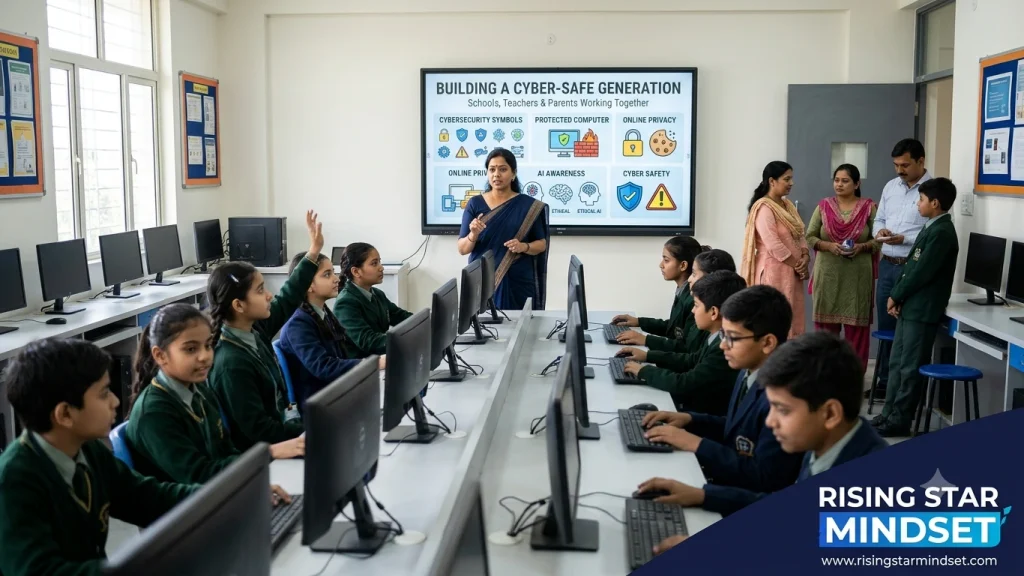
Schools are not only places where children learn mathematics, science and languages. They also play an important role in teaching responsible behaviour.
When teachers understand cyber risks, they can identify warning signs, guide students and help them reach appropriate support systems.
हिंदी में समझें ( How to Keep Your Child Safe Online )
भारतीय वायु सेना के 42 स्कूलों में शुरू की गई यह पहल बच्चों की ऑनलाइन सुरक्षा को मजबूत करने की दिशा में महत्वपूर्ण कदम है।
इसमें 261 शिक्षकों को साइबर अपराध से संबंधित समस्याओं पर प्रतिक्रिया देने के लिए प्रशिक्षित किया गया है।
इसका उद्देश्य बच्चों, शिक्षकों और माता-पिता को डिजिटल खतरों के प्रति जागरूक बनाना है।
A safer school environment must also include a safer digital environment.
4. Important Research and Data About Online Safety
Understanding research findings helps us recognise why child digital safety deserves attention.
Here are some useful findings from published research and official sources.
A. UNICEF India’s Adolescent Online Safety Poll
UNICEF India conducted a Knowledge, Attitudes and Practices (KAP) poll through its U-Report India platform between June and July 2024.
The poll collected 25,626 responses.
Some important findings included:
| Research Finding | Reported Result |
| Total responses | 25,626 |
| Respondents under 18 | 38% |
| Respondents spending over four hours online daily | 40% |
| Respondents identifying strangers as cyberbullying perpetrators | 70% |
| Respondents identifying peers as perpetrators | 41% |
| Supporting awareness campaigns and school programmes | 59% |
| Identifying strong passwords as a safety strategy | 79% |
| Supporting avoidance of strangers online | 68% |
Important research note: These are findings from a U-Report poll, not a nationally representative survey of every child in India. They should be interpreted in the context of the respondents who participated.
What Do These Findings Tell Us?
The findings highlight three important areas:
- Online safety awareness should begin at an early age.
- Children need guidance about interactions with strangers.
- Schools and families both have an important role in digital education.
हिंदी में समझें ( How to Keep Your Child Safe Online )
UNICEF India के U-Report सर्वे में 25,626 प्रतिक्रियाएं प्राप्त हुईं।
इसमें 40% उत्तरदाताओं ने बताया कि वे प्रतिदिन चार घंटे से अधिक समय ऑनलाइन बिताते हैं।
इसके अलावा, 79% उत्तरदाताओं ने मजबूत पासवर्ड को ऑनलाइन सुरक्षा की महत्वपूर्ण रणनीति माना।
इन आंकड़ों से यह समझ आता है कि बच्चों और युवाओं को इंटरनेट के सुरक्षित उपयोग के बारे में व्यावहारिक शिक्षा देना कितना जरूरी है।
B. UNICEF’s Four Categories of Online Risks
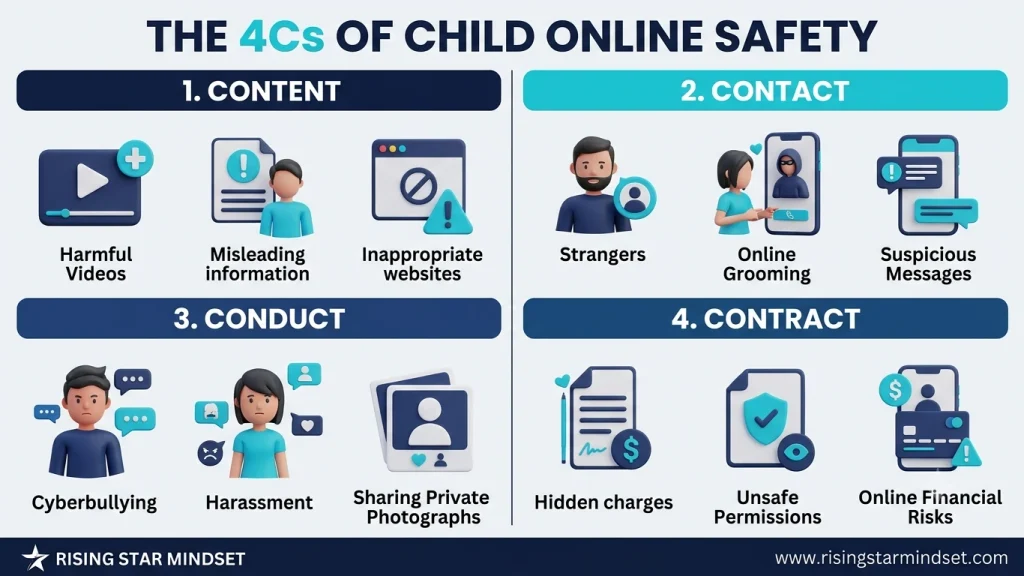
UNICEF’s child online safety resources explain four broad categories of digital risks, commonly known as the 4Cs.
| Category | Meaning | Example |
| Content | Harmful material seen online | Violent or age-inappropriate videos |
| Contact | Harmful interaction with others | Grooming or online harassment |
| Conduct | Harmful behaviour by or towards children | Cyberbullying or sharing embarrassing images |
| Contract | Risks involving digital agreements and data | Hidden costs or misuse of personal information |
This framework is useful because it explains that online dangers do not come only from strangers. Sometimes children may also experience harm through content, platform design, digital purchases or their own online behaviour.
C. Why Digital Safety Needs Attention in Schools
A UNICEF publication on children’s online safety in education discusses risks associated with digital learning environments, including data privacy, online behaviour and the need for stronger digital literacy.
It highlights the importance of teacher training, school policies and child protection measures.
The lesson is simple: providing computers and internet access is not enough. Schools must also teach students how to use these facilities safely.
5. The Four Major Categories of Online Risks
Let’s understand the 4Cs framework through practical examples.
1. Content Risk ( How to Keep Your Child Safe Online )
Children may accidentally encounter harmful, misleading or age-inappropriate information.
Example: A student searches for a science experiment but encounters a dangerous or misleading video.
हिंदी: इंटरनेट पर बच्चों को ऐसी सामग्री दिखाई दे सकती है जो उनकी उम्र या समझ के अनुकूल न हो।
2. Contact Risk ( How to Keep Your Child Safe Online )
This happens when another person uses digital communication to manipulate, threaten or exploit a child.
Example: An unknown person gradually builds trust with a child and then asks for private photographs.
हिंदी: जब कोई अनजान व्यक्ति ऑनलाइन दोस्ती करके बच्चे से निजी जानकारी या तस्वीरें मांगने लगे, तो यह गंभीर खतरे का संकेत हो सकता है।
3. Conduct Risk
Conduct risk involves harmful behaviour by children or towards children.
Example: A group of students shares an embarrassing photograph of a classmate in a school messaging group.
हिंदी: किसी दूसरे बच्चे का मजाक उड़ाना, अपमानजनक संदेश भेजना या उसकी तस्वीर बिना अनुमति साझा करना गलत ऑनलाइन व्यवहार है।
4. Contract Risk
Some digital platforms may involve hidden costs, unclear permissions or inappropriate collection of personal information.
Example: A child unknowingly agrees to an online purchase or grants an application unnecessary access to personal information.
हिंदी: किसी ऐप को बिना समझे अनुमति देना या ऑनलाइन खरीदारी के नियमों को जाने बिना सहमति देना नुकसानदायक हो सकता है।
6. Fifteen Practical Ways to Protect Children Online

Here are 15 practical habits that parents, teachers and students can follow.
1. Never Share Personal Information
Children should avoid sharing their home address, phone number, school details, passwords and live location with unknown people.
हिंदी: अपनी निजी जानकारी अनजान लोगों के साथ साझा न करें।
2. Create Strong Passwords
Use long, unique passwords for different accounts. A password should not be based on easily guessed information such as a child’s name or date of birth.
हिंदी: मजबूत और अलग-अलग पासवर्ड बनाएं। अपना पासवर्ड दोस्तों के साथ भी साझा न करें।
3. Enable Two-Factor Authentication
Where available, enable two-factor authentication (2FA) to add an additional security step to important accounts.
हिंदी: टू-फैक्टर ऑथेंटिकेशन अकाउंट की सुरक्षा की एक अतिरिक्त परत प्रदान करता है।
4. Avoid Suspicious Links
Do not click unexpected links promising prizes, free mobile phones, gaming rewards or urgent account verification.
हिंदी: मुफ्त इनाम या पुरस्कार के लालच में अनजान लिंक पर क्लिक न करें।
5. Keep Social Media Accounts Private
Review who can see photographs, posts, contact information and personal updates.
हिंदी: सोशल मीडिया अकाउंट की प्राइवेसी सेटिंग जांचें और अनजान लोगों से जानकारी छिपाकर रखें।
6. Be Careful With Online Games
Children should avoid sharing personal information through gaming chats and should never trust suspicious requests for money or account credentials.
हिंदी: ऑनलाइन गेम में अनजान खिलाड़ियों को अपना फोन नंबर, पासवर्ड या अन्य निजी जानकारी न दें।
7. Recognise Cyberbullying
Repeated insults, threats, humiliation and the sharing of embarrassing content can be forms of cyberbullying.
हिंदी: इंटरनेट पर किसी को बार-बार परेशान करना, धमकाना या अपमानित करना साइबर बुलिंग कहलाता है।
8. Verify Information Before Sharing
Check the source of news, images and videos before forwarding them.
हिंदी: किसी भी खबर को आगे भेजने से पहले उसकी सच्चाई जांचें।
9. Learn About AI-Generated Content
A photograph, voice message or video may be created or altered using AI. Do not assume that everything online is genuine.
हिंदी: AI से बनाई गई तस्वीर या आवाज असली व्यक्ति की ही हो, यह जरूरी नहीं है।
10. Never Meet an Online Stranger Alone
Children should not arrange private meetings with people they know only through online platforms.
हिंदी: इंटरनेट पर मिले अनजान व्यक्ति से अकेले मिलने न जाएं।
11. Update Devices and Applications
Install security updates and review application permissions regularly.
हिंदी: मोबाइल और ऐप्स को अपडेट रखें तथा गैर-जरूरी परमिशन बंद करें।
12. Avoid Unnecessary Public Wi-Fi Activities
Avoid entering sensitive account details or making important financial transactions on untrusted public networks.
हिंदी: सार्वजनिक और अनजान Wi-Fi नेटवर्क पर संवेदनशील जानकारी साझा करने से बचें।
13. Do Not Share OTPs
An OTP should never be shared with someone who contacts you unexpectedly, even if that person claims to represent a bank, gaming company or government office.
हिंदी: OTP किसी अनजान व्यक्ति को बिल्कुल न बताएं।
14. Maintain a Healthy Screen-Time Routine
Balance online learning and entertainment with outdoor games, reading, exercise and family interaction.
हिंदी: मोबाइल के साथ-साथ खेलकूद, व्यायाम और पढ़ाई के लिए भी समय निर्धारित करें।
15. Talk to a Trusted Adult ( How to Keep Your Child Safe Online)
If something online makes a child uncomfortable, frightening or confused, the child should talk to a parent, teacher or another trusted adult.
हिंदी: इंटरनेट पर कोई भी घटना परेशान करे, तो उसे छिपाने के बजाय भरोसेमंद बड़े व्यक्ति को बताएं।
7. Artificial Intelligence and New Digital Threats
Artificial Intelligence is changing the way people learn, communicate and create content.
Children can use AI tools to understand difficult subjects, practise languages and explore creative ideas.
However, AI can also be misused.
Important AI-Related Risks ( How to Keep Your Child Safe Online )
| Risk | Explanation |
| Deepfakes | Artificially generated or manipulated videos and images |
| Voice Cloning | Creating a synthetic voice that imitates another person |
| Fake Profiles | Using misleading identities online |
| AI Misinformation | Presenting incorrect information as genuine |
| Image Manipulation | Altering photographs without permission |
| Impersonation | Pretending to be a trusted person through digital communication |
Example: A Fake Emergency Message ( How to Keep Your Child Safe Online )
Imagine a parent receives an audio message that sounds like their child asking for urgent money.
The voice may appear genuine, but it could have been artificially generated.
What should the parent do? ( How to Keep Your Child Safe Online )
- Do not immediately transfer money.
- Call the child using a known phone number.
- Verify the situation through another trusted channel.
- Do not share banking details or OTPs.
- Report suspected fraud through appropriate official channels.
हिंदी में समझें ( How to Keep Your Child Safe Online )
AI की मदद से किसी की आवाज और तस्वीर जैसी दिखने वाली नकली सामग्री बनाई जा सकती है।
इसलिए केवल आवाज सुनकर या वीडियो देखकर किसी संदेश को सच नहीं मानना चाहिए। महत्वपूर्ण जानकारी की पुष्टि हमेशा दूसरे विश्वसनीय माध्यम से करें।
Digital awareness must evolve as technology evolves.
8. A Digital Safety Guide for Different Age Groups ( How to Keep Your Child Safe Online )
Every child has different levels of understanding. Therefore, digital safety education should be age-appropriate.
| Age Group | Recommended Focus |
| Below 6 years | Supervised device use and age-appropriate content |
| 6–9 years | Basic privacy, safe browsing and asking adults for help |
| 10–12 years | Password protection, gaming safety and cyberbullying awareness |
| 13–15 years | Social media privacy, digital footprints and AI awareness |
| 16–18 years | Digital identity, online relationships, scams and responsible communication |
These are general educational suggestions, not fixed legal age classifications.
What Is a Digital Footprint? ( How to Keep Your Child Safe Online )
A digital footprint is the trail of information that a person leaves behind while using the internet.
It may include:
- Social media posts.
- Photographs and videos.
- Comments and messages.
- Online searches.
- Account information.
- Website interactions.
हिंदी में समझें ( How to Keep Your Child Safe Online )
डिजिटल फुटप्रिंट का अर्थ है इंटरनेट पर हमारे द्वारा छोड़े गए डिजिटल निशान।
हम जो तस्वीरें अपलोड करते हैं, कमेंट लिखते हैं या जानकारी साझा करते हैं, वे हमारी ऑनलाइन पहचान का हिस्सा बन सकते हैं।
इसलिए पोस्ट करने से पहले सोचना जरूरी है कि क्या यह जानकारी सार्वजनिक होनी चाहिए।
9. Responsibilities of Parents and Teachers
Child digital safety cannot be achieved by technology alone. Families and educational institutions must work together.
Responsibilities of Parents ( How to Keep Your Child Safe Online )
- Discuss online safety regularly.
- Establish age-appropriate device rules.
- Review privacy settings with children.
- Understand the applications children use.
- Encourage children to report uncomfortable experiences.
- Avoid unnecessary punishment when children seek help.
- Set a positive example through responsible device use.
Responsibilities of Teachers ( How to Keep Your Child Safe Online )
- Organise cyber awareness sessions.
- Explain cyberbullying and online privacy.
- Teach students how to verify online information.
- Establish safe reporting procedures.
- Guide students about responsible AI use.
- Encourage respectful digital communication.
- Inform appropriate authorities when serious safeguarding concerns arise.
हिंदी में समझें ( How to Keep Your Child Safe Online )
माता-पिता को बच्चों की ऑनलाइन गतिविधियों के बारे में जागरूक रहना चाहिए, जबकि शिक्षकों को स्कूल में साइबर सुरक्षा से संबंधित शिक्षा देनी चाहिए।
सबसे जरूरी बात यह है कि बच्चे अपनी ऑनलाइन समस्याओं को बिना डर के साझा कर सकें।
Trust and communication are as important as parental controls.
10. What Should Children Do During an Online Safety Incident?

Knowing how to respond is just as important as knowing how to prevent online problems.
Consider this situation:
A student receives a threatening message from an unknown social media account. The sender asks for personal photographs and warns the student not to tell anyone.
What should the student do?
Step-by-Step Response ( How to Keep Your Child Safe Online )
Step 1: Stop communicating.
Do not continue the conversation or respond to threats.
Step 2: Do not share anything.
Never send photographs, passwords, OTPs or private information.
Step 3: Preserve evidence safely.
Save relevant messages, account details and screenshots where safe and appropriate. Do not forward harmful images of children to others.
Step 4: Inform a trusted adult.
Tell a parent, teacher or another responsible adult immediately.
Step 5: Block and report the account.
Use the platform’s reporting and blocking features when appropriate.
Step 6: Seek official assistance.
For serious incidents, contact the appropriate cybercrime reporting authorities or law enforcement.
हिंदी में समझें ( How to Keep Your Child Safe Online )
यदि किसी बच्चे को इंटरनेट पर धमकी, ब्लैकमेल या परेशान करने वाले संदेश मिलते हैं, तो उसे डरकर चुप नहीं रहना चाहिए।
उसे बातचीत बंद करनी चाहिए, सुरक्षित तरीके से सबूत संभालने चाहिए और तुरंत माता-पिता या शिक्षक को बताना चाहिए।
Never blame a child for reporting an online safety problem.
11. Indian Cyber Safety Laws and Reporting Resources ( How to Keep Your Child Safe Online )
India has several laws and official mechanisms relevant to digital safety and child protection.
Important Legal Frameworks (How to Keep Your Child Safe Online)
| Law / Framework | Relevance |
| Information Technology Act, 2000 | Addresses various cyber offences and electronic records |
| POCSO Act, 2012 | Protects children against sexual offences |
| Digital Personal Data Protection Act, 2023 | Provides a framework for personal data protection |
| IT Intermediary Rules, 2021, as amended | Provides obligations for intermediaries and grievance mechanisms |
The application of a particular law depends on the facts and circumstances of the incident. This article provides general awareness, not legal advice.
Where Can Online Crime Be Reported?
1. National Cyber Crime Reporting Portal
Website: https://cybercrime.gov.in/
The official portal provides a mechanism for reporting cybercrime, including incidents involving women and children.
2. Cyber Fraud Helpline: 1930
For financial cyber fraud, call 1930 as quickly as possible and follow the official reporting process.
3. Child Helpline: 1098
Children who need protection or assistance can seek help through the Child Helpline 1098.
4. Emergency Assistance: 112
For immediate emergencies, contact the emergency response number 112.
Important Note ( How to Keep Your Child Safe Online )
In situations involving child sexual abuse material or exploitation, do not download, circulate or redistribute the material. Report it through appropriate official channels and follow the guidance of authorities.
हिंदी में समझें ( How to Keep Your Child Safe Online )
भारत में साइबर अपराध की शिकायत के लिए National Cyber Crime Reporting Portal उपलब्ध है।
वित्तीय साइबर धोखाधड़ी होने पर तुरंत 1930 पर संपर्क करना चाहिए। बच्चों को सुरक्षा या सहायता की आवश्यकता होने पर 1098 और आपातकालीन स्थिति में 112 का उपयोग किया जा सकता है।
12. Digital Safety Checklist for Every Family
Parents can use this simple checklist to review their family’s digital safety habits.
| Safety Question | Yes / No |
| Does the child know not to share passwords? | Yes / No |
| Are important accounts protected with strong passwords? | Yes / No |
| Are privacy settings reviewed regularly? | Yes / No |
| Does the child know how to identify suspicious links? | Yes / No |
| Does the child know how to report cyberbullying? | Yes / No |
| Are applications and devices updated? | Yes / No |
| Are screen-time boundaries established? | Yes / No |
| Does the child know how to contact a trusted adult? | Yes / No |
| Are online gaming interactions discussed? | Yes / No |
| Does the family discuss AI-generated misinformation? | Yes / No |
If several answers are No, use them as starting points for a family discussion rather than reasons to blame anyone.
13. Important Digital Safety Vocabulary ( How to Keep Your Child Safe Online )
Understanding common terminology makes it easier for students to follow cyber safety discussions.
| Term | Full Form / Meaning | हिंदी अर्थ |
| AI | Artificial Intelligence | कृत्रिम बुद्धिमत्ता |
| OTP | One-Time Password | एक बार उपयोग होने वाला पासवर्ड |
| PIN | Personal Identification Number | व्यक्तिगत पहचान संख्या |
| URL | Uniform Resource Locator | इंटरनेट पते का प्रारूप |
| 2FA | Two-Factor Authentication | दो-स्तरीय प्रमाणीकरण |
| VPN | Virtual Private Network | वर्चुअल प्राइवेट नेटवर्क |
| MFA | Multi-Factor Authentication | बहु-स्तरीय प्रमाणीकरण |
| Phishing | Fraudulent attempt to steal information | धोखाधड़ी से जानकारी चुराना |
| Deepfake | AI-generated or manipulated media | AI से बनाई या बदली गई नकली सामग्री |
| Cyberbullying | Online harassment | ऑनलाइन उत्पीड़न |
| Digital Footprint | Online activity trail | डिजिटल गतिविधियों के निशान |
| Encryption | Converting information into protected coded form | जानकारी को सुरक्षित कोड में बदलना |
14. Student Knowledge Test: MCQs and Answers
Test what you have learned about child digital safety.
Question 1
What is the main purpose of child digital safety?
A. To stop children from using the internet
B. To help children use technology safely
C. To avoid all digital devices
D. To increase gaming time
Correct Answer: B. To help children use technology safely.
Question 2
What should you do if an unknown person asks for your OTP?
A. Share it immediately
B. Send it to your friends
C. Never share it
D. Post it online
Correct Answer: C. Never share it.
Question 3
What does cyberbullying mean?
A. Online education
B. Harassment through digital platforms
C. Reading digital books
D. Learning computer programming
Correct Answer: B. Harassment through digital platforms.
Question 4
What is a digital footprint?
A. A computer virus
B. A type of password
C. The trail of information left by online activities
D. A mobile application
Correct Answer: C. The trail of information left by online activities.
Question 5
What should you do before forwarding a suspicious news video?
A. Forward it immediately
B. Verify the information
C. Add a caption
D. Share it in every group
Correct Answer: B. Verify the information.
Question 6
What is the purpose of two-factor authentication?
A. To make an account less secure
B. To add an extra layer of security
C. To share passwords
D. To delete an account
Correct Answer: B. To add an extra layer of security.
Question 7
Which Indian portal is used to report cybercrime?
A. cybercrime.gov.in
B. example.com
C. wikipedia.org
D. youtube.com
Correct Answer: A. cybercrime.gov.in.
Question 8
What should a child do after receiving threatening online messages?
A. Keep everything secret
B. Send personal information
C. Inform a trusted adult
D. Meet the sender alone
Correct Answer: C. Inform a trusted adult.
Question 9
What does AI stand for?
A. Automated Internet
B. Artificial Intelligence
C. Advanced Information
D. Active Interface
Correct Answer: B. Artificial Intelligence.
Question 10
Which is the best approach to online safety?
A. Avoid all technology
B. Trust every online person
C. Use technology with awareness and responsibility
D. Share everything publicly
Correct Answer: C. Use technology with awareness and responsibility.
15. Frequently Asked Questions (FAQs) ( How to Keep Your Child Safe Online )
Q1. What is child digital safety?
Child digital safety means protecting children from online threats while teaching them to use internet services, applications and digital devices responsibly.
Q2. Why is online safety important for students?
It helps students protect personal information, recognise scams, avoid cyberbullying and make responsible decisions while using digital platforms.
Q3. What are the four main categories of online risks?
The UNICEF 4Cs framework describes Content, Contact, Conduct and Contract risks.
Q4. What is the ScrollControl Child Digital Safety Programme?
It is a child digital safety initiative adopted by 42 Air Force Schools in India. The Ministry of Defence announced on 2 November 2026 that 261 teachers had completed certification as Cyber Crime Intervention Officers.
Q5. How can parents protect children from cyberbullying?
Parents should maintain open communication, teach privacy awareness, review online safety settings and encourage children to report harmful behaviour.
Q6. Can artificial intelligence create fake videos and voices?
Yes. AI tools can generate or manipulate images, videos and voices. Therefore, important digital information should be verified through reliable sources.
Q7. What is the cybercrime reporting website in India?
The official National Cyber Crime Reporting Portal is https://cybercrime.gov.in/.
Q8. What should a child do if someone threatens them online?
The child should stop communicating, preserve relevant evidence safely, inform a trusted adult and seek appropriate official assistance.
Q9. Should parents completely stop children from using smartphones?
Not necessarily. Technology can support education and creativity. The focus should be on age-appropriate use, supervision, privacy and healthy digital habits.
Q10. What is the most important rule of online safety?
Think before sharing. Never disclose sensitive personal information, passwords or OTPs to unknown people, and ask for help when something feels unsafe.
16. Conclusion: Building a Safer Digital Generation
Technology will continue to transform education, communication, entertainment and professional life.
Children who understand how to use digital tools responsibly will be better prepared to participate in this changing world.
However, digital development should never come at the cost of children’s safety, privacy or well-being.
The responsibility is shared by parents, teachers, schools, technology companies and society.
We should not create an environment where children are afraid of technology. Instead, we should give them the knowledge and confidence to recognise risks and make informed decisions.
The recent initiative involving 42 Air Force Schools and 261 trained teachers is an important reminder that digital safety education deserves attention at the institutional level as well.
A Message for Every Parent, Teacher and Student
“Don’t just teach children how to use the internet. Teach them how to protect themselves in the digital world.”
हिंदी संदेश: ( How to Keep Your Child Safe Online )
बच्चों को केवल इंटरनेट चलाना न सिखाएं, बल्कि उन्हें यह भी सिखाएं कि डिजिटल दुनिया में अपनी सुरक्षा कैसे करनी है।
क्योंकि एक जागरूक बच्चा ही सुरक्षित और जिम्मेदार डिजिटल भविष्य की नींव रख सकता है।
About Rising Star Mindset ( How to Keep Your Child Safe Online )
At Rising Star Mindset, we believe that knowledge should be useful, accessible and meaningful.
Our aim is to share educational resources, motivational ideas, real-life lessons, current affairs and awareness-based information that help readers learn something valuable every day.
Whether you are a student, parent, teacher or lifelong learner, there is always something new to discover.
Explore more useful knowledge and inspiration:
https://www.risingstarmindset.com/