
English Tenses : Complete Guide for Beginners
Table of Contents ( English Tenses )
- Introduction
- What are Tenses?
- Why are Tenses Important?
- Types of Tenses
- Present Tense
- Past Tense
- Future Tense
- Structure of All 12 Tenses
- Daily Use Examples
- Common Mistakes
- Speaking Tips
- Summary Chart
- Practice Exercises
- MCQs
- HOTS Questions
- FAQs
- Conclusion
- Previous post : Parts Of Speech
Introduction ( English Tenses )
Learning English Tenses is one of the most important steps toward speaking English confidently. Every sentence we speak refers to an action that happens now, happened in the past, or will happen in the future. Tenses help us express these actions clearly and accurately.
Whether you are a school student, a competitive exam aspirant, or someone who wants to improve spoken English, understanding tenses is essential. They make your communication more natural, improve your grammar, and help you avoid common mistakes.
In this complete guide, you will learn all the English tenses with simple explanations, formulas, examples, practice exercises, and real-life sentences. By the end of this lesson, you will have a strong foundation for speaking and writing English correctly.
Key Points ( English Tenses )
- Explains all English tenses in simple language.
- Builds a strong grammar foundation for beginners.
- Improves speaking and writing accuracy.
- Includes easy formulas and practical examples.
- Covers daily use conversations and common mistakes.
- Provides revision tables, MCQs, and practice exercises.
- Helps students prepare for school and competitive exams.
- Boosts confidence in real-life English communication.
What are Tenses?
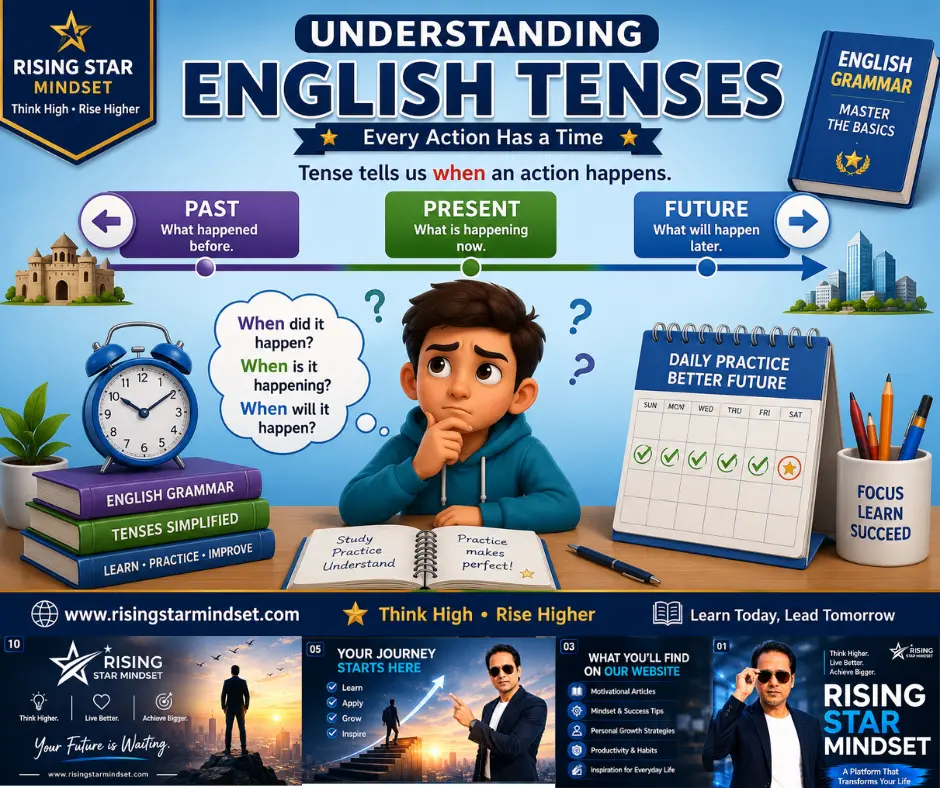
A tense tells us when an action happens. It shows whether an action takes place in the present, happened in the past, or will happen in the future.
Examples
- I play cricket every Sunday. (Present)
- I played cricket yesterday. (Past)
- I will play cricket tomorrow. (Future)
Why are Tenses Important?
- Make communication clear and meaningful.
- Help express time accurately.
- Improve spoken and written English.
- Reduce grammar mistakes.
- Build confidence in conversations.
- Essential for exams and interviews.
Types of English Tenses
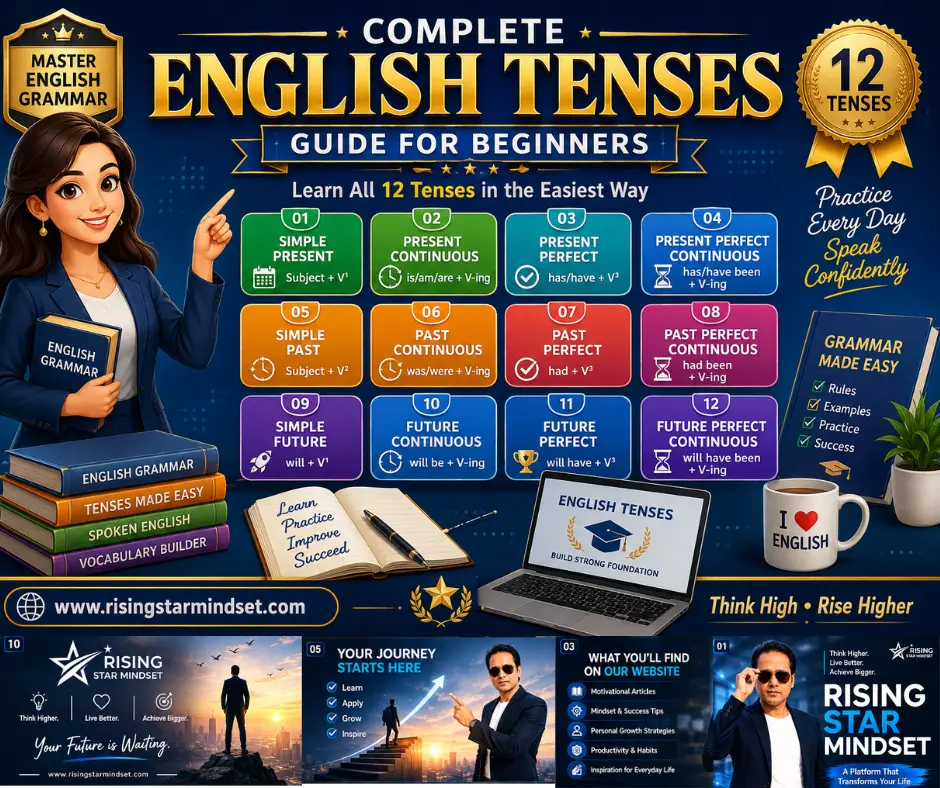
English Grammar has three main tenses, and each tense is further divided into four forms. Altogether, there are 12 English Tenses. These tenses help us express actions happening at different times and in different situations.
Understanding all twelve tenses makes speaking and writing English more accurate and natural. Whether you are talking about your daily routine, sharing past experiences, or discussing future plans, choosing the correct tense is essential.
The Three Main Tenses
1. Present Tense
The Present Tense describes actions that happen now, occur regularly, or express general truths.
Examples
- I study English every day.
- She is reading a book.
- They have completed the project.
2. Past Tense
The Past Tense describes actions that happened in the past.
Examples
- I visited Delhi last month.
- She was cooking dinner.
- They had finished the work.
3. Future Tense
The Future Tense describes actions that will happen in the future.
Examples
- I will travel tomorrow.
- She will be studying tonight.
- They will have completed the project.
The 12 Types of English Tenses
| Main Tense | Type | Example |
| Present | Simple Present | I play cricket. |
| Present | Present Continuous | I am playing cricket. |
| Present | Present Perfect | I have played cricket. |
| Present | Present Perfect Continuous | I have been playing cricket for two hours. |
| Past | Simple Past | I played cricket yesterday. |
| Past | Past Continuous | I was playing cricket. |
| Past | Past Perfect | I had played cricket. |
| Past | Past Perfect Continuous | I had been playing cricket for two hours. |
| Future | Simple Future | I will play cricket. |
| Future | Future Continuous | I will be playing cricket. |
| Future | Future Perfect | I will have played cricket. |
| Future | Future Perfect Continuous | I will have been playing cricket for two hours. |
Easy Trick to Remember 12 Tenses
Learning all twelve tenses becomes much easier when you remember their simple pattern.
Formula
3 Main Tenses × 4 Forms = 12 English Tenses
The four forms are:
- Simple
- Continuous
- Perfect
- Perfect Continuous
So,
- Present → 4 Forms
- Past → 4 Forms
- Future → 4 Forms
Total = 12 Tenses
Why Should You Learn All 12 Tenses?
Learning English tenses is essential because they help you communicate clearly and correctly in every situation.
Benefits
- Improve spoken English naturally.
- Make writing more accurate.
- Build confidence during conversations.
- Perform better in school examinations.
- Prepare effectively for BPSC, SSC, Banking, Railway, and other competitive exams.
- Answer interview questions confidently.
- Avoid common grammar mistakes.
- Understand English books, newspapers, and conversations more easily.
Common Mistakes Beginners Make
❌ I am go to school.
✅ I go to school.
❌ She go to market.
✅ She goes to the market.
❌ They was playing football.
✅ They were playing football.
❌ I have saw him.
✅ I have seen him.
❌ He will goes tomorrow.
✅ He will go tomorrow.
Present Tense ( English Tenses )
Present Tense is one of the most commonly used tenses in English. It describes actions that happen now, occur regularly, express facts, or show ongoing situations. Whether you are talking about your daily routine, habits, or universal truths, the Present Tense helps you communicate clearly and naturally.
A strong understanding of the Present Tense is the first step toward speaking fluent English. Most daily conversations, classroom discussions, and competitive exam questions use different forms of the Present Tense.
What is Present Tense?
Definition (English):
The Present Tense describes an action that happens now, happens regularly, or expresses a general truth.
परिभाषा (हिन्दी):
Present Tense उस कार्य को दर्शाता है जो वर्तमान समय में हो रहा हो, नियमित रूप से होता हो, या किसी सामान्य सत्य को व्यक्त करता हो।
Examples
- I study English every day.
- She drinks milk every morning.
- Birds fly in the sky.
- The Earth revolves around the Sun.
- We are learning English.
Types of Present Tense ( English Tenses )
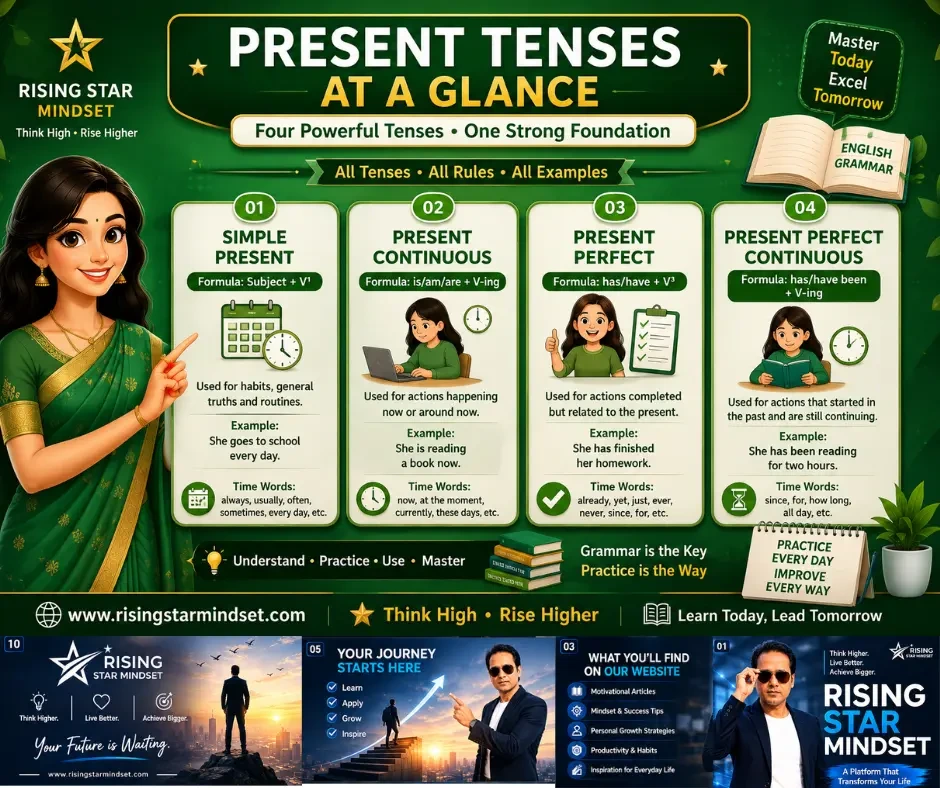
The Present Tense has four forms.
| Type | Main Use |
| Simple Present | Habits, routines, facts |
| Present Continuous | Action happening now |
| Present Perfect | Action completed recently |
| Present Perfect Continuous | Action continuing for a period of time |
1. Simple Present Tense
Simple Present Tense is used to describe daily routines, habits, universal truths, scheduled events, and permanent situations.
Formula
| Sentence Type | Formula |
| Affirmative | Subject + V¹(s/es) + Object |
| Negative | Subject + do/does + not + V¹ + Object |
| Interrogative | Do/Does + Subject + V¹ + Object? |
| WH Question | WH + do/does + Subject + V¹? |
When Do We Use Simple Present Tense?
Simple Present Tense is commonly used in the following situations:
Daily Routine
- I wake up at 5 a.m.
- She goes to school every day.
Habits
- He drinks tea every morning.
- We exercise regularly.
Universal Truths
- The Sun rises in the east.
- Water boils at 100°C.
Permanent Facts
- India is a democratic country.
- Patna is the capital of Bihar.
Timetables
- The train leaves at 7:00 a.m.
- The class starts at 9:00 a.m.
Time Expressions ( English Tenses )
The following words are frequently used with the Simple Present Tense:
- Every day
- Every month
- Always
- Usually
- Often
- Sometimes
- Rarely
- Never
- Daily
Examples ( English Tenses )
Affirmative
- I play cricket.
- She reads books.
- They study English.
- Rahul helps his friends.
- My mother cooks delicious food.
Negative
- I do not play football.
- She does not watch TV.
- We do not waste time.
- He does not smoke.
- They do not argue.
Interrogative
- Do you speak English?
- Does Rahul play cricket?
- Do they like music?
- Does she cook well?
- Do we have class today?
Common Mistakes ( English Tenses )
❌ He go to school.
✅ He goes to school.
❌ She don’t know.
✅ She doesn’t know.
❌ They goes home.
✅ They go home.
❌ Rahul study English.
✅ Rahul studies English.
❌ I goes to college.
✅ I go to college.
Easy Trick to Identify Simple Present Tense
Ask yourself these questions:
- Is it a daily habit?
- Does the action happen regularly?
- Is it a universal truth?
- Is it part of a routine?
- Does it describe a permanent fact?
If the answer is Yes, the sentence usually uses the Simple Present Tense.
Daily Conversation ( English Tenses )
Student
Good morning, sir.
Teacher
Good morning. How are you today?
Student
I am fine. I study English every morning.
Teacher
Excellent! Regular practice improves your confidence.
Student
Thank you, sir.
Quick Practice ( English Tenses )
Choose the correct answer.
- She ____ to school every day.
- go
- goes ✅
- going
- gone
- Birds ____ in the sky.
- flies
- fly ✅
- flying
- flew
- Rahul ____ English daily.
- study
- studies ✅
- studied
- studying
2. Present Continuous Tense
The Present Continuous Tense describes an action that is happening right now, at the present moment, or around the current period. It is also used to talk about temporary situations and planned future events.
This tense is very common in everyday conversations because people often describe what they are doing at the moment.
What is Present Continuous Tense?
Definition (English)
The Present Continuous Tense is used to describe an action that is happening now or is in progress at the present time.
परिभाषा (हिन्दी)
Present Continuous Tense उस कार्य को दर्शाता है जो इस समय हो रहा है या वर्तमान समय में जारी है।
Formula ( English Tenses )
| Sentence Type | Formula |
| Affirmative | Subject + am/is/are + Verb + ing + Object |
| Negative | Subject + am/is/are + not + Verb + ing + Object |
| Interrogative | Am/Is/Are + Subject + Verb + ing + Object? |
| WH Question | WH + am/is/are + Subject + Verb + ing? |
When Do We Use Present Continuous Tense?
Action Happening Right Now
- I am reading a book.
- She is cooking dinner.
- They are playing football.
Temporary Situation
- He is staying in Patna this week.
- We are living in Delhi for a few months.
Planned Future Event
- I am meeting my teacher tomorrow.
- She is travelling next Monday.
Changing Situation
- The weather is getting colder.
- Technology is improving rapidly.
Time Expressions ( English Tenses )
These words are commonly used with the Present Continuous Tense.
- Now
- Right now
- At the moment
- Currently
- Today
- This week
- This month
- Nowadays
- At present
Examples ( English Tenses )
Affirmative
- I am learning English.
- She is writing a letter.
- They are watching a movie.
- Rahul is preparing for BPSC.
- We are practicing grammar.
Negative
- I am not sleeping.
- She is not singing.
- They are not fighting.
- Rahul is not wasting time.
- We are not playing today.
Interrogative
- Are you studying English?
- Is she cooking dinner?
- Are they playing cricket?
- Is Rahul reading a newspaper?
- Are we improving every day?
Common Mistakes ( English Tenses )
❌ I reading a book.
✅ I am reading a book.
❌ She cooking food.
✅ She is cooking food.
❌ They is playing.
✅ They are playing.
❌ He are studying.
✅ He is studying.
❌ We am learning English.
✅ We are learning English.
Easy Trick to Identify Present Continuous Tense
Check these clues before choosing the tense:
- Look for an action happening right now.
- Notice whether someone is busy doing something at the moment.
- Check if the situation is temporary.
- See whether the action is still in progress.
If your answer is Yes, the sentence usually uses the Present Continuous Tense.
Signal Words ( English Tenses )
These words often indicate the Present Continuous Tense.
- Now
- Right now
- At the moment
- Currently
- Look!
- Listen!
- At present
Daily Conversation ( English Tenses )
Student
Hello, sir. What are you doing?
Teacher
I am preparing today’s English lesson.
Student
I am studying grammar now.
Teacher
Very good. Keep practicing every day.
Student
Thank you, sir.
Real-Life Examples ( English Tenses )
🏠 At Home
- My mother is cooking dinner.
- My father is watching the news.
📚 At School
- The teacher is explaining grammar.
- Students are listening carefully.
🏢 At Office
- The manager is attending a meeting.
- Employees are working on a project.
🚆 While Travelling
- We are waiting for the train.
- They are boarding the bus.
Quick Practice ( English Tenses )
Choose the correct answer.
1. She ____ a letter now.
- write
- writes
- is writing ✅
- wrote
2. They ____ football at the moment.
- play
- played
- are playing ✅
- plays
3. Rahul ____ for his examination.
- study
- studies
- is studying ✅
- studied
Speaking Challenge ( English Tenses )
Speak these sentences aloud.
- I am learning English.
- I am improving every day.
- My confidence is growing.
- I am speaking without fear.
- I am achieving my goals.
💡 Learning Tip
When describing what is happening now, always remember the pattern:
Subject + am/is/are + Verb-ing + Object
Practising this structure daily will help you speak English more naturally and confidently.
3. Present Perfect Tense
The Present Perfect Tense is used to describe an action that has already been completed, but its result or effect is still connected to the present. It is also used to talk about life experiences, recently finished actions, and achievements.
This tense is commonly used in spoken English, interviews, examinations, and everyday conversations.
What is Present Perfect Tense?
Definition (English)
The Present Perfect Tense describes an action that has been completed recently or at an unspecified time before now, and its effect continues in the present.
परिभाषा (हिन्दी)
Present Perfect Tense उस कार्य को दर्शाता है जो वर्तमान से पहले पूरा हो चुका है, लेकिन उसका प्रभाव अभी भी वर्तमान में मौजूद है।
Formula
| Sentence Type | Formula |
|---|---|
| Affirmative | Subject + has/have + V³ + Object |
| Negative | Subject + has/have + not + V³ + Object |
| Interrogative | Has/Have + Subject + V³ + Object? |
| WH Question | WH + has/have + Subject + V³ + Object? |
When Do We Use Present Perfect Tense?
Recently Completed Action
- I have finished my homework.
- She has cleaned her room.
Life Experience
- I have visited Delhi.
- They have travelled by airplane.
Achievement
- Rahul has won the competition.
- She has passed the examination.
Action with Present Result
- He has lost his wallet.
- We have completed the project.
Time Expressions ( English Tenses )
These words are commonly used with the Present Perfect Tense.
- Already
- Just
- Yet
- Ever
- Never
- Recently
- So far
- Till now
- Up to now
- Since then
Examples ( English Tenses )
Affirmative
- I have completed my assignment.
- She has written a letter.
- They have finished the project.
- Rahul has bought a new laptop.
- We have learned English grammar.
Negative
- I have not eaten breakfast.
- She has not called me.
- They have not completed the work.
- Rahul has not arrived yet.
- We have not watched the movie.
Interrogative
- Have you finished your homework?
- Has she cooked dinner?
- Have they reached home?
- Has Rahul submitted the project?
- Have we completed the task?
Common Mistakes ( English Tenses )
❌ I have went to school.
✅ I have gone to school.
❌ She has write a letter.
✅ She has written a letter.
❌ They have did the work.
✅ They have done the work.
❌ He have finished the task.
✅ He has finished the task.
❌ We has completed the project.
✅ We have completed the project.
Easy Trick to Identify Present Perfect Tense
Ask yourself these questions:
- Has the action already finished?
- Is the result important now?
- Has something happened recently?
- Is the exact time unknown?
If the answer is Yes, the sentence usually uses the Present Perfect Tense.
Signal Words ( English Tenses )
Look for these words:
- Already
- Just
- Yet
- Ever
- Never
- Recently
- So far
- Till now
- Up to now
Daily Conversation ( English Tenses )
Student
Good morning, sir.
Teacher
Good morning. Have you completed your homework?
Student
Yes, I have finished it.
Teacher
Excellent! Have you revised today’s lesson?
Student
Yes, I have revised all the important topics.
Real-Life Examples ( English Tenses )
🏠 At Home
- My mother has prepared breakfast.
- My brother has cleaned his room.
📚 At School
- The teacher has checked our notebooks.
- Students have completed the test.
💼 At Office
- The manager has approved the report.
- Employees have submitted their work.
✈️ While Travelling
- We have reached the station.
- The train has already left.
Quick Practice ( English Tenses )
Choose the correct answer.
1. She ____ her homework.
- has completed ✅
- have completed
- completed
- completing
2. They ____ the meeting.
- has attended
- have attended ✅
- attended
- attending
3. Rahul ____ a new bicycle.
- has bought ✅
- have bought
- bought
- buying
Speaking Challenge ( English Tenses )
Read these sentences aloud.
- I have learned many new words.
- Today, I have improved my English skills. So far, I have completed today’s lesson.
- Every day, I have practiced with dedication. Now, I have become more confident in speaking English.
Memory Tip ( English Tenses )
Remember this simple formula:
Has/Have + Verb (Third Form) = Present Perfect Tense
Examples
I have finished my homework.
She has written a letter.
They have completed the work.
4. Present Perfect Continuous Tense
The Present Perfect Continuous Tense is used to describe an action that started in the past and is still continuing in the present. It emphasizes the duration (how long the action has been happening).
हिन्दी में
Present Perfect Continuous Tense उस कार्य को दर्शाता है जो भूतकाल में शुरू हुआ था और अभी भी वर्तमान में जारी है। यह बताता है कि कार्य कितने समय से चल रहा है।
What is Present Perfect Continuous Tense?
Definition (English)
The Present Perfect Continuous Tense describes an action that began in the past, has continued up to the present, and may continue in the future.
परिभाषा (हिन्दी)
Present Perfect Continuous Tense उस कार्य को व्यक्त करता है जो भूतकाल में शुरू हुआ, वर्तमान तक लगातार चलता रहा और आगे भी जारी रह सकता है।
Formula
| Sentence Type | Formula |
| Affirmative | Subject + has/have + been + Verb + ing + Object + Since/For + Time |
| Negative | Subject + has/have + not + been + Verb + ing + Object + Since/For + Time |
| Interrogative | Has/Have + Subject + been + Verb + ing + Object + Since/For + Time? |
| WH Question | WH + has/have + Subject + been + Verb + ing + Object + Since/For + Time? |
When Do We Use Present Perfect Continuous Tense?
1. Action Started in the Past and Still Continues
English: The action started earlier and is still happening.
हिन्दी: कार्य पहले शुरू हुआ था और अभी भी जारी है।
Examples
- I have been studying for three hours.
- मैं तीन घंटे से पढ़ रहा हूँ।
- She has been working since morning.
- वह सुबह से काम कर रही है।
2. To Show Duration
English: It tells us how long an action has continued.
हिन्दी: यह बताता है कि कार्य कितने समय से चल रहा है।
Examples
- They have been playing cricket for two hours.
- वे दो घंटे से क्रिकेट खेल रहे हैं।
- We have been living here since 2020.
- हम 2020 से यहाँ रह रहे हैं।
Since vs For ( English Tenses )
One of the most important topics in this tense is Since and For.
| Since | For |
| Used for a starting point | Used for a period of time |
| Since Monday | For two days |
| Since 2023 | For five years |
| Since morning | For three hours |
| Since January | For one month |
Examples
- I have been waiting since 8 a.m.
- मैं सुबह 8 बजे से इंतजार कर रहा हूँ।
- She has been teaching for five years.
- वह पाँच वर्षों से पढ़ा रही है।
Time Expressions ( English Tenses )
These expressions are commonly used with the Present Perfect Continuous Tense.
- Since
- For
- All day
- All week
- Recently
- Lately
- For a long time
- Since yesterday
- Since childhood
Examples ( English Tenses )
Affirmative
- I have been learning English for six months.
- मैं छह महीने से अंग्रेज़ी सीख रहा हूँ।
- She has been reading a novel since morning.
- वह सुबह से उपन्यास पढ़ रही है।
- Rahul has been preparing for BPSC for one year.
- राहुल एक वर्ष से BPSC की तैयारी कर रहा है।
- We have been practicing grammar every evening.
- हम हर शाम व्याकरण का अभ्यास कर रहे हैं।
- They have been waiting for the bus for thirty minutes.
- वे तीस मिनट से बस का इंतजार कर रहे हैं।
Negative
- I have not been sleeping well for a week.
- मैं एक सप्ताह से अच्छी नींद नहीं ले रहा हूँ।
- She has not been attending classes since Monday.
- वह सोमवार से कक्षाओं में शामिल नहीं हो रही है।
- They have not been working on the project lately.
- वे हाल ही में परियोजना पर काम नहीं कर रहे हैं।
Interrogative
- Have you been studying since morning?
- क्या तुम सुबह से पढ़ रहे हो?
- Has she been working here for five years?
- क्या वह यहाँ पाँच वर्षों से काम कर रही है?
- Have they been waiting for a long time?
- क्या वे काफी समय से इंतजार कर रहे हैं?
Common Mistakes ( English Tenses )
❌ I have been study for two hours.
✅ I have been studying for two hours.
❌ She has been work since morning.
✅ She has been working since morning.
❌ They have been played for an hour.
✅ They have been playing for an hour.
❌ He have been reading.
✅ He has been reading.
❌ We has been learning English.
✅ We have been learning English.
Easy Trick to Identify Present Perfect Continuous Tense
Ask yourself these questions:
- Did the action start in the past?
क्या कार्य भूतकाल में शुरू हुआ था? - Is the action still continuing now?
क्या कार्य अभी भी जारी है? - Does the sentence mention “since” or “for”?
क्या वाक्य में “since” या “for” का प्रयोग हुआ है? - Is the duration of the action important?
क्या कार्य की अवधि (कितने समय से) महत्वपूर्ण है?
If your answer is Yes, the sentence is usually in the Present Perfect Continuous Tense.
यदि इन प्रश्नों का उत्तर हाँ है, तो वाक्य सामान्यतः Present Perfect Continuous Tense में होगा।
Daily Conversation ( English Tenses )
Teacher: How long have you been learning English?
शिक्षक: तुम कब से अंग्रेज़ी सीख रहे हो?
Student: I have been learning English for one year.
विद्यार्थी: मैं एक वर्ष से अंग्रेज़ी सीख रहा हूँ।
Teacher: Have you been practicing every day?
शिक्षक: क्या तुम हर दिन अभ्यास कर रहे हो?
Student: Yes, I have been practicing regularly.
विद्यार्थी: जी हाँ, मैं नियमित रूप से अभ्यास कर रहा हूँ।
Memory Tip ( English Tenses )
Formula
Has/Have + Been + Verb-ing + Since/For = Present Perfect Continuous Tense
Remember
- Since → Starting Point (Monday, 2024, morning)
- For → Duration (2 hours, 5 years, 10 days)
Quick Practice ( English Tenses )
Choose the correct answer.
1. She ____ English for three years.
- has been learning ✅
- has learned
- is learning
- learned
2. They ____ since morning.
- have been working ✅
- are working
- worked
- have worked
3. Rahul ____ for the examination for six months.
is preparing
has been preparing ✅
prepared
prepares
Past Tense ( English Tenses )
The Past Tense is used to describe actions that happened or were completed in the past. It helps us talk about yesterday, last week, last year, or any time before the present.
हिन्दी में
Past Tense उस कार्य को व्यक्त करता है जो भूतकाल में हुआ या पूरा हो चुका है। इसका प्रयोग बीती घटनाओं, अनुभवों और कहानियों को बताने के लिए किया जाता है।
What is Past Tense?
Definition (English)
The Past Tense describes an action that happened or was completed before the present time.
परिभाषा (हिन्दी)
Past Tense उस कार्य को दर्शाता है जो वर्तमान समय से पहले घटित हुआ या समाप्त हो गया।
Types of Past Tense
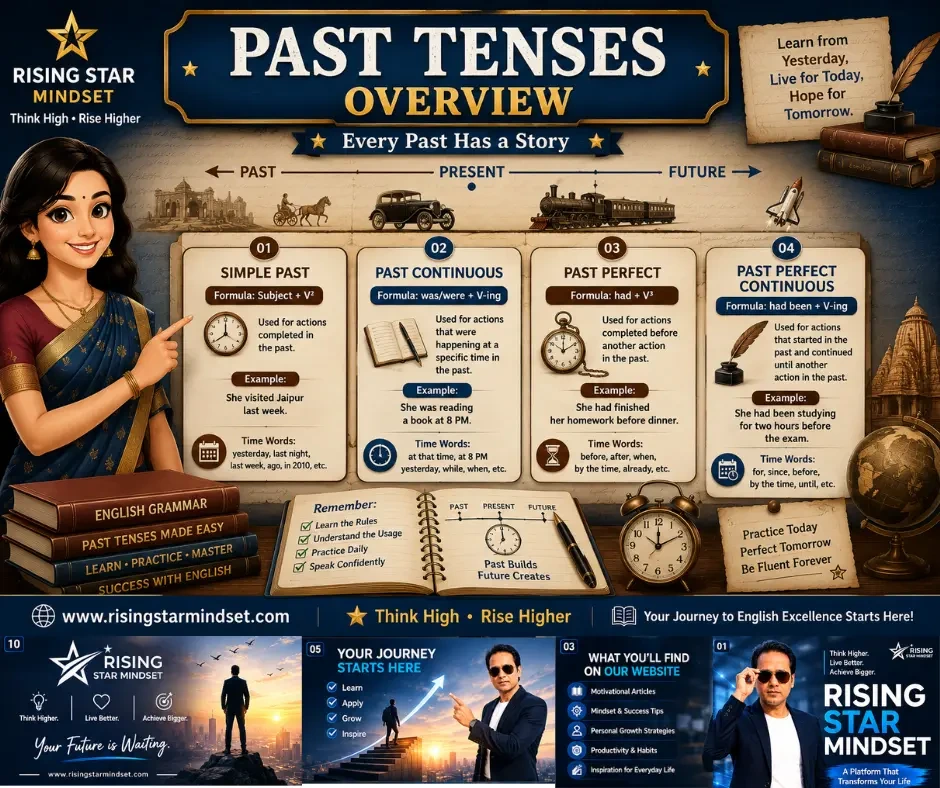
There are four types of Past Tense.
| Type | Main Use |
| Simple Past | Completed action in the past |
| Past Continuous | Action in progress in the past |
| Past Perfect | Action completed before another past action |
| Past Perfect Continuous | Action continuing before another past action |
Simple Past Tense
The Simple Past Tense is used to describe an action that started and finished in the past.
हिन्दी में
Simple Past Tense का प्रयोग उस कार्य के लिए किया जाता है जो भूतकाल में शुरू हुआ और वहीं समाप्त हो गया।
Formula
| Sentence Type | Formula |
| Affirmative | Subject + Verb² + Object |
| Negative | Subject + did not + Verb¹ + Object |
| Interrogative | Did + Subject + Verb¹ + Object? |
| WH Question | WH + did + Subject + Verb¹ + Object? |
When Do We Use Simple Past Tense?
1. Completed Action
English: The action started and finished in the past.
हिन्दी: कार्य भूतकाल में शुरू होकर समाप्त हो गया।
Examples
- I visited Patna yesterday.
- मैंने कल पटना का दौरा किया।
- She watched a movie last night.
- उसने कल रात एक फिल्म देखी।
2. Past Habit
English: It describes a habit in the past.
हिन्दी: यह भूतकाल की आदत बताता है।
Examples
- We played cricket every evening.
- हम हर शाम क्रिकेट खेलते थे।
- My grandfather walked every morning.
- मेरे दादाजी हर सुबह टहलते थे।
3. Past Facts
English: It tells about facts that were true in the past.
हिन्दी: यह उन तथ्यों को बताता है जो पहले सत्य थे।
Examples
- India won the World Cup in 2011.
- भारत ने 2011 में विश्व कप जीता।
- Dr. A.P.J. Abdul Kalam inspired millions.
- डॉ. ए.पी.जे. अब्दुल कलाम ने लाखों लोगों को प्रेरित किया।
Time Expressions ( English Tenses )
The Simple Past Tense is commonly used with words and phrases that refer to completed actions in the past. These time expressions help identify that an event happened before the present.
| Time Expression | Example Sentence |
|---|---|
| Yesterday | I visited my uncle yesterday. |
| Last night | She studied English last night. |
| Last week | We completed the assignment last week. |
| Last month | They travelled to Jaipur last month. |
| Last year | He graduated last year. |
| Ago | I met him two days ago. |
| In 2024 | The company opened a new branch in 2024. |
| Once | She once lived in Mumbai. |
| Earlier | I finished my homework earlier. |
| Previously | The report was submitted previously. |
Examples ( English Tenses )
Affirmative
- I completed my homework yesterday.
- मैंने कल अपना गृहकार्य पूरा किया।
- Rahul visited his grandmother.
- राहुल अपनी दादी से मिलने गया।
- She bought a new dress.
- उसने नई ड्रेस खरीदी।
- They played football after school.
- उन्होंने स्कूल के बाद फुटबॉल खेला।
- We enjoyed the picnic.
- हमने पिकनिक का आनंद लिया।
Negative
- I did not watch television yesterday.
- मैंने कल टीवी नहीं देखा।
- She did not attend the meeting.
- वह बैठक में शामिल नहीं हुई।
- They did not finish the project.
- उन्होंने परियोजना पूरी नहीं की।
Interrogative
- Did you complete your homework?
- क्या तुमने अपना गृहकार्य पूरा किया?
- Did Rahul call you?
- क्या राहुल ने तुम्हें फोन किया?
- Did they visit Delhi?
- क्या वे दिल्ली गए थे?
Common Mistakes ( English Tenses )
❌ I did went to school.
✅ I did go to school.
❌ She didn’t wrote a letter.
✅ She didn’t write a letter.
❌ They did played football.
✅ They played football.
❌ He goed to market.
✅ He went to the market.
❌ We didn’t completed the work.
✅ We didn’t complete the work.
Easy Trick to Identify Simple Past Tense
Ask yourself these questions:
- Did the action happen in the past?
क्या कार्य भूतकाल में हुआ था? - Has the action already finished?
क्या कार्य पूरी तरह समाप्त हो चुका है? - Does the sentence mention yesterday, last week, or ago?
क्या वाक्य में yesterday, last week या ago जैसे शब्द हैं? - Is the second form of the verb used?
क्या क्रिया का दूसरा रूप (V²) प्रयोग हुआ है?
If your answer is Yes, the sentence is usually in the Simple Past Tense.
यदि उत्तर हाँ है, तो वाक्य सामान्यतः Simple Past Tense में होगा।
Daily Conversation ( English Tenses )
Teacher: Where did you go yesterday?
शिक्षक: तुम कल कहाँ गए थे?
Student: I visited my uncle’s house.
विद्यार्थी: मैं अपने चाचा के घर गया था।
Teacher: Did you complete your homework?
शिक्षक: क्या तुमने अपना गृहकार्य पूरा किया?
Student: Yes, I completed it before dinner.
विद्यार्थी: जी हाँ, मैंने रात के खाने से पहले पूरा कर लिया था।
Memory Tip ( English Tenses )
Formula
Subject + Verb² + Object = Simple Past Tense
Remember
- Affirmative → Verb²
- Negative → did not + Verb¹
- Question → Did + Verb¹
Quick Practice ( English Tenses )
Choose the correct answer.
1. She ____ a letter yesterday.
- writes
- wrote ✅
- written
- writing
2. They ____ the match last Sunday.
- won ✅
- win
- winning
- wins
3. Rahul ____ to Delhi last month.
going
went ✅
goes
gon
Past Progressive or Continuous Tense
It is also used to describe two actions happening at the same time in the past or an action interrupted by another action.. It is also used to describe two actions happening at the same time in the past or an action interrupted by another action.
हिन्दी में
यह Tense उस कार्य को दर्शाता है जो भूतकाल के किसी निश्चित समय पर जारी था। यह Tense उस स्थिति को भी दर्शाता है जब दो कार्य एक साथ हो रहे हों या एक कार्य के दौरान दूसरा कार्य हुआ हो।
What is Past Progressive or Continuous Tense?
Definition (English)
This is used to describe an action that was continuing at a particular moment in the past.
परिभाषा (हिन्दी)
यह Tense उस कार्य को व्यक्त करता है जो भूतकाल के किसी विशेष समय पर लगातार चल रहा था।
Formula
| Sentence Type | Formula |
| Affirmative | Subject + was/were + Verb + ing + Object |
| Negative | Subject + was/were + not + Verb + ing + Object |
| Interrogative | Was/Were + Subject + Verb + ing + Object? |
| WH Question | WH + was/were + Subject + Verb + ing + Object? |
When Do We Use Past Progressive or Continuous Tense?
1. Action in Progress at a Particular Time
English: The action was happening at a specific time in the past.
हिन्दी: कार्य भूतकाल के किसी विशेष समय पर जारी था।
Examples
- I was reading a book at 8 p.m.
- मैं रात 8 बजे एक किताब पढ़ रहा था।
- She was cooking dinner at that time.
- वह उस समय रात का खाना बना रही थी।
2. Two Actions Happening Together
English: Two actions were happening at the same time.
हिन्दी: दो कार्य एक ही समय पर हो रहे थे।
Examples
- I was studying while my brother was watching TV.
- मैं पढ़ रहा था जबकि मेरा भाई टीवी देख रहा था।
- They were talking while we were working.
- वे बात कर रहे थे जबकि हम काम कर रहे थे।
3. Interrupted Action
English: One action was in progress when another action happened.
हिन्दी: एक कार्य चल रहा था तभी दूसरा कार्य हुआ।
Examples
- I was sleeping when the phone rang.
- मैं सो रहा था तभी फोन बजा।
- She was walking when it started to rain.
- वह चल रही थी तभी बारिश शुरू हो गई।
Time Expressions ( English Tenses )
These words are commonly used with the Past Progressive or Continuous Tense.
- While
- When
- At that time
- All day yesterday
- At 7 p.m.
- Yesterday evening
- Last night
- During the meeting
Examples
Affirmative
- I was studying English yesterday evening.
- मैं कल शाम अंग्रेज़ी पढ़ रहा था।
- She was writing a letter.
- वह एक पत्र लिख रही थी।
- Rahul was preparing for the examination.
- राहुल परीक्षा की तैयारी कर रहा था।
- We were playing cricket.
- हम क्रिकेट खेल रहे थे।
- They were waiting for the bus.
- वे बस का इंतजार कर रहे थे।
Negative
- I was not sleeping.
- मैं नहीं सो रहा था।
- She was not cooking.
- वह खाना नहीं बना रही थी।
- They were not arguing.
- वे बहस नहीं कर रहे थे।
Interrogative
- Were you studying at 9 p.m.?
- क्या तुम रात 9 बजे पढ़ रहे थे?
- Was Rahul reading the newspaper?
- क्या राहुल अखबार पढ़ रहा था?
- Were they playing football?
- क्या वे फुटबॉल खेल रहे थे?
Common Mistakes ( English Tenses )
❌ I was study yesterday.
✅ I was studying yesterday.
❌ She were cooking.
✅ She was cooking.
❌ They was playing.
✅ They were playing.
❌ He were sleeping.
✅ He was sleeping.
❌ We was waiting.
✅ We were waiting.
Easy Trick to Identify Past Continuous Tense
Ask yourself these questions:
- Was the action continuing in the past?
क्या कार्य भूतकाल में जारी था? - Did the action happen at a specific past time?
क्या कार्य भूतकाल के किसी निश्चित समय पर हो रहा था? - Do you see “while” or “when” in the sentence?
क्या वाक्य में “while” या “when” का प्रयोग है? - Is the structure “was/were + Verb-ing” used?
क्या “was/were + Verb-ing” का प्रयोग हुआ है?
If your answer is Yes, the sentence is usually in the Past Continuous Tense.
यदि उत्तर हाँ है, तो वाक्य सामान्यतः Past Continuous Tense में होगा।
Daily Conversation
Teacher: What were you doing at 8 o’clock yesterday?
शिक्षक: कल रात 8 बजे तुम क्या कर रहे थे?
Student: I was studying English grammar.
विद्यार्थी: मैं अंग्रेज़ी व्याकरण पढ़ रहा था।
Teacher: Was your brother studying with you?
शिक्षक: क्या तुम्हारा भाई भी तुम्हारे साथ पढ़ रहा था?
Student: No, he was watching television.
विद्यार्थी: नहीं, वह टेलीविजन देख रहा था।
Memory Tip ( English Tenses )
Formula
Subject + was/were + Verb-ing + Object = Past Continuous Tense
Remember
- I / He / She / It → was
- You / We / They → were
- Always use Verb + ing
Quick Practice ( English Tenses )
Choose the correct answer.
1. She ____ dinner at 8 p.m.
- was cooking ✅
- cooked
- is cooking
- has cooked
2. They ____ football when it started raining.
- were playing ✅
- played
- have played
- play
3. Rahul ____ for the exam yesterday evening.
- was preparing ✅
- prepared
- prepares
- has prepared
Speaking Challenge ( English Tenses )
Read these sentences aloud.
My confidence was improving every day.
I was reading a story yesterday.
She was learning English.
We were practicing grammar.
They were playing football.
Past ( पूर्ण भूतकाल ) Perfect Tense
This is used to describe an action that was completed before another action happened in the past. It helps us show the correct sequence of two past events.
हिन्दी में
यह Tense का प्रयोग उस कार्य के लिए किया जाता है जो भूतकाल में किसी दूसरे कार्य से पहले पूरा हो चुका था। यह दो भूतकालीन घटनाओं का क्रम स्पष्ट करता है।
What is Past ( पूर्ण भूतकाल ) Perfect Tense?
Definition (English)
This tense describes an action that had already been completed before another action took place in the past.
परिभाषा (हिन्दी)
यह Tense उस कार्य को दर्शाता है जो भूतकाल में किसी अन्य कार्य के होने से पहले ही पूरा हो चुका था।
Formula
| Sentence Type | Formula |
| Affirmative | Subject + had + Verb³ + Object |
| Negative | Subject + had + not + Verb³ + Object |
| Interrogative | Had + Subject + Verb³ + Object? |
| WH Question | WH + had + Subject + Verb³ + Object? |
When Do We Use Of This Tense?
1. One Action Happened Before Another
English: One action was completed before another action happened in the past.
हिन्दी: भूतकाल में एक कार्य दूसरे कार्य से पहले पूरा हो गया था।
Examples
- I had finished my homework before my friend arrived.
- मेरे मित्र के आने से पहले मैं अपना गृहकार्य पूरा कर चुका था।
- She had left the office before it started raining.
- बारिश शुरू होने से पहले वह कार्यालय छोड़ चुकी थी।
2. Completed Action Before a Specific Time
English: The action was completed before a certain time in the past.
हिन्दी: कार्य भूतकाल के किसी निश्चित समय से पहले पूरा हो चुका था।
Examples
- They had completed the project before Monday.
- उन्होंने सोमवार से पहले परियोजना पूरी कर ली थी।
- Rahul had reached the station before 8 a.m.
- राहुल सुबह 8 बजे से पहले स्टेशन पहुँच चुका था।
3. Reported Speech
English: Past ( Pluperfect ) Perfect is often used in reported speech.
हिन्दी: Reported Speech में भी पूर्ण भूतकाल का प्रयोग किया जाता है।
Example
- She said that she had completed the assignment.
- उसने कहा कि वह असाइनमेंट पूरा कर चुकी थी।
Time Expressions ( English Tenses )
These expressions are commonly used with the Pluperfect Tense.
- Before
- After
- By the time
- Already
- Until then
- Earlier
- Previously
Examples ( English Tenses )
Affirmative
- I had completed my work before dinner.
- मैंने रात के खाने से पहले अपना काम पूरा कर लिया था।
- She had written the letter before leaving home.
- घर से निकलने से पहले उसने पत्र लिख लिया था।
- Rahul had prepared all the notes.
- राहुल सभी नोट्स तैयार कर चुका था।
- We had finished the meeting.
- हमने बैठक समाप्त कर ली थी।
- They had reached the airport early.
- वे समय से पहले हवाई अड्डे पहुँच चुके थे।
Negative
- I had not seen the movie before.
- मैंने पहले वह फिल्म नहीं देखी थी।
- She had not completed the project.
- उसने परियोजना पूरी नहीं की थी।
- They had not arrived before sunset.
- वे सूर्यास्त से पहले नहीं पहुँचे थे।
Interrogative
- Had you finished your homework?
- क्या तुमने अपना गृहकार्य पूरा कर लिया था?
- Had Rahul reached the station?
- क्या राहुल स्टेशन पहुँच चुका था?
- Had they completed the project?
- क्या उन्होंने परियोजना पूरी कर ली थी?
Common Mistakes ( English Tenses )
❌ I had went to school.
✅ I had gone to school.
❌ She had wrote a letter.
✅ She had written a letter.
❌ They had did the work.
✅ They had done the work.
❌ Rahul had ate lunch.
✅ Rahul had eaten lunch.
❌ We had saw the match.
✅ We had seen the match.
Easy Trick to Identify
Ask yourself these questions:
- Did one action finish before another past action?
क्या एक कार्य दूसरे भूतकालीन कार्य से पहले पूरा हुआ था? - Does the sentence compare two past events?
क्या वाक्य में दो भूतकालीन घटनाओं की तुलना हो रही है? - Do you see words like “before”, “after”, or “by the time”?
क्या वाक्य में “before”, “after” या “by the time” जैसे शब्द हैं? - Is the structure “had + Verb³” used?
क्या “had + Verb³” का प्रयोग हुआ है?
If your answer is Yes, the sentence is usually in the Past ( Perfect Tense)
Daily Conversation
Teacher: Had you completed your homework before the class started?
शिक्षक: क्या कक्षा शुरू होने से पहले तुमने अपना गृहकार्य पूरा कर लिया था?
Student: Yes, I had finished it at home.
विद्यार्थी: जी हाँ, मैंने उसे घर पर ही पूरा कर लिया था।
Teacher: Had your friend arrived before you?
शिक्षक: क्या तुम्हारा मित्र तुमसे पहले आ गया था?
Student: Yes, he had already reached the classroom.
विद्यार्थी: जी हाँ, वह पहले ही कक्षा में पहुँच चुका था।
Memory Tip
Formula
Subject + Had + Verb³ + Object = Past Perfect Tense
Remember
- Had सभी Subjects (I, You, He, She, It, We, They) के साथ समान रहता है।
- हमेशा Verb की Third Form (V³) का प्रयोग करें।
- दो Past Actions हों तो पहले पूरा हुए कार्य के लिए Past Perfect का प्रयोग करें।
Quick Practice
Choose the correct answer.
1. She ____ the report before the meeting started.
- had completed ✅
- completed
- has completed
- completes
2. Rahul ____ the train before it left the station.
- had boarded ✅
- boarded
- boards
- has boarded
3. They ____ dinner before the guests arrived.
- had cooked ✅
- cooked
- have cooked
- cook
Speaking Challenge
Read these sentences aloud.
Rahul had learned the lesson before the test.
I had completed my assignment before dinner.
She had reached school before the bell rang.
We had prepared well for the examination.
They had cleaned the classroom before the teacher arrived.
2. Past Perfect Continuous Tense
This Tense is used to describe an action that started in the past, continued for some time, and ended before another action happened in the past. It focuses on the duration of the action before another past event.
हिन्दी में
यह उस कार्य को दर्शाता है जो भूतकाल में शुरू हुआ, कुछ समय तक चलता रहा और फिर भूतकाल की किसी दूसरी घटना से पहले समाप्त हो गया। यह मुख्य रूप से कार्य की अवधि (Duration) पर जोर देता है।
What is Past Perfect Continuous Tense?
Definition (English)
Use the Past Perfect Continuous Tense to describe an action that had been in progress for a specific period before another event happened in the past. This tense highlights the duration of the earlier action.
परिभाषा (हिन्दी)
Past Perfect Continuous Tense का प्रयोग ऐसे कार्य के लिए किया जाता है जो भूतकाल में किसी अन्य घटना से पहले कुछ समय से लगातार चल रहा था। यह Tense कार्य की अवधि (Duration) को विशेष रूप से दर्शाता है।
Formula
| Sentence Type | Formula |
| Affirmative | Subject + had been + Verb + ing + Object + Since/For + Time |
| Negative | Subject + had not been + Verb + ing + Object + Since/For + Time |
| Interrogative | Had + Subject + been + Verb + ing + Object + Since/For + Time? |
| WH Question | WH + had + Subject + been + Verb + ing + Object + Since/For + Time? |
When Do We Use Past Perfect Continuous Tense?
1. Action Continued Before Another Past Action
English: The action continued for some time before another action happened.
हिन्दी: कोई कार्य कुछ समय तक चलता रहा और फिर दूसरी भूतकालीन घटना हुई।
Examples
- I had been studying for two hours before my friend arrived.
- मेरे मित्र के आने से पहले मैं दो घंटे से पढ़ रहा था।
- She had been working since morning before she took a break.
- वह सुबह से काम कर रही थी, फिर उसने विश्राम लिया।
2. To Show Duration
English: It emphasizes how long the action continued.
हिन्दी: यह बताता है कि कार्य कितने समय तक चलता रहा।
Examples
- They had been playing cricket for three hours before it rained.
- बारिश होने से पहले वे तीन घंटे से क्रिकेट खेल रहे थे।
- Rahul had been preparing for BPSC for one year before the exam.
- परीक्षा से पहले राहुल एक वर्ष से BPSC की तैयारी कर रहा था।
Since vs For ( English Tenses )
| Since | For |
| Starting point | Period of time |
| Since Monday | For two days |
| Since 2024 | For one year |
| Since morning | For five hours |
| Since January | For six months |
Examples
- She had been teaching since 2020.
- वह 2020 से पढ़ा रही थी।
- They had been waiting for two hours.
- वे दो घंटे से इंतजार कर रहे थे।
Time Expressions ( English Tenses )
These expressions are commonly used:
- Before
- Since
- For
- By the time
- Until
- All day
- All night
- For a long time
Examples ( English Tenses )
Affirmative
- I had been reading for two hours before dinner.
- मैं रात के खाने से पहले दो घंटे से पढ़ रहा था।
- She had been cooking since morning.
- वह सुबह से खाना बना रही थी।
- Rahul had been practicing English for six months.
- राहुल छह महीने से अंग्रेज़ी का अभ्यास कर रहा था।
- We had been waiting for the bus.
- हम बस का इंतजार कर रहे थे।
- They had been working on the project all week.
- वे पूरे सप्ताह परियोजना पर काम कर रहे थे।
Negative
- I had not been sleeping well for a week.
- मैं एक सप्ताह से अच्छी नींद नहीं ले रहा था।
- She had not been attending classes regularly.
- वह नियमित रूप से कक्षाओं में शामिल नहीं हो रही थी।
- They had not been using the computer.
- वे कंप्यूटर का उपयोग नहीं कर रहे थे।
Interrogative
- Had you been studying since morning?
- क्या तुम सुबह से पढ़ रहे थे?
- Had Rahul been working there for five years?
- क्या राहुल वहाँ पाँच वर्षों से काम कर रहा था?
- Had they been waiting for a long time?
- क्या वे काफी समय से इंतजार कर रहे थे?
Common Mistakes ( English Tenses )
❌ I had been study for two hours.
✅ I had been studying for two hours.
❌ She had been work since morning.
✅ She had been working since morning.
❌ They had been played for an hour.
✅ They had been playing for an hour.
❌ Rahul had been prepare for the exam.
✅ Rahul had been preparing for the exam.
❌ We had been wait for the bus.
✅ We had been waiting for the bus.
Easy Trick to Identify Past Perfect Continuous Tense
Ask yourself these questions:
- Had the action started before another past event?
क्या कार्य किसी दूसरी भूतकालीन घटना से पहले शुरू हुआ था? - Did it continue for some time?
क्या वह कुछ समय तक लगातार चलता रहा? - Is the duration important?
क्या कार्य की अवधि महत्वपूर्ण है? - Do you see “since” or “for” in the sentence?
क्या वाक्य में “since” या “for” का प्रयोग है? - Is the structure “had been + Verb-ing” used?
क्या “had been + Verb-ing” का प्रयोग हुआ है?
If your answer is Yes, the sentence is usually in the Past Perfect Continuous Tense.
यदि उत्तर हाँ है, तो वाक्य सामान्यतः Past Perfect Continuous Tense में होगा।
Daily Conversation ( English Tenses )
Teacher: Had you been studying before the electricity went off?
शिक्षक: क्या बिजली जाने से पहले तुम पढ़ रहे थे?
Student: Yes, I had been studying for two hours.
विद्यार्थी: जी हाँ, मैं दो घंटे से पढ़ रहा था।
Teacher: Had your brother been helping you?
शिक्षक: क्या तुम्हारा भाई तुम्हारी मदद कर रहा था?
Student: Yes, he had been helping me with grammar.
विद्यार्थी: जी हाँ, वह व्याकरण में मेरी मदद कर रहा था।
Memory Tip ( English Tenses )
Formula
Subject + Had Been + Verb-ing + Since/For + Time = Past Perfect Continuous Tense
Remember
- Had been सभी Subjects के साथ समान रहता है।
- हमेशा Verb + ing का प्रयोग करें।
- Since → Starting Point
- For → Duration
- यह Tense Duration + Past Event को दर्शाता है।
Quick Practice ( English Tenses )
Choose the correct answer.
1. She ____ for three hours before the guests arrived.
- had been cooking ✅
- had cooked
- was cooking
- has been cooking
2. Rahul ____ for the examination before the test began.
- had been preparing ✅
- prepared
- has prepared
- was preparing
3. They ____ for the bus before it finally arrived.
- had been waiting ✅
- waited
- were waiting
- have waited
Speaking Challenge
Practice these sentences aloud:
Rahul had been preparing for BPSC before the examination.
I had been learning English for one year before joining this course.
She had been working since morning before taking a break.
We had been practicing grammar every day.
They had been waiting for the train for an hour.
Future Tense
The Future Tense is used to describe actions that will happen after the present time. It helps us talk about future plans, predictions, promises, decisions, and scheduled events.
हिन्दी में
Future Tense उस कार्य को दर्शाता है जो भविष्य में होगा। इसका प्रयोग भविष्य की योजनाओं, वादों, भविष्यवाणियों और आने वाली घटनाओं को व्यक्त करने के लिए किया जाता है।
What is Future Tense?
Definition (English)
The Future Tense describes an action that will happen after the present time.
परिभाषा (हिन्दी)
Future Tense उस कार्य को व्यक्त करता है जो वर्तमान समय के बाद भविष्य में होगा।

Types of Future Tense
There are four types of Future Tense.
| Type | Main Use |
| Simple Future | Future action or decision |
| Future Continuous | Action in progress at a future time |
| Future Perfect | Action completed before a future time |
| Future Perfect Continuous | Action continuing up to a future time |
1. Simple Future Tense
The Simple Future Tense is used to describe an action that will happen in the future. It is commonly used for future plans, promises, predictions, offers, and instant decisions.
हिन्दी में
Simple Future Tense का प्रयोग उस कार्य के लिए किया जाता है जो भविष्य में होगा। इसका उपयोग भविष्य की योजना, वादा, भविष्यवाणी और तत्काल लिए गए निर्णयों के लिए किया जाता है।
Formula
| Sentence Type | Formula |
| Affirmative | Subject + will + Verb¹ + Object |
| Negative | Subject + will not (won’t) + Verb¹ + Object |
| Interrogative | Will + Subject + Verb¹ + Object? |
| WH Question | WH + will + Subject + Verb¹ + Object? |
When Do We Use Simple Future Tense?
1. Future Action
English: An action that will happen in the future.
हिन्दी: ऐसा कार्य जो भविष्य में होगा।
Examples
- I will visit Delhi next month.
- मैं अगले महीने दिल्ली जाऊँगा।
- She will join college next year.
- वह अगले वर्ष कॉलेज में प्रवेश लेगी।
2. Promise
English: To make a promise.
हिन्दी: वादा करने के लिए।
Examples
- I will always help you.
- मैं हमेशा तुम्हारी मदद करूँगा।
- We will support our parents.
- हम अपने माता-पिता का साथ देंगे।
3. Prediction
English: To predict future events.
हिन्दी: भविष्य की संभावना बताने के लिए।
Examples
- It will rain tomorrow.
- कल बारिश होगी।
- India will become more developed.
- भारत और अधिक विकसित होगा।
4. Instant Decision
English: A decision made at the moment of speaking.
हिन्दी: बोलते समय लिया गया निर्णय।
Examples
- I am thirsty. I will drink some water.
- मुझे प्यास लगी है। मैं पानी पीऊँगा।
- The phone is ringing. I will answer it.
- फोन बज रहा है। मैं उठाता हूँ।
Time Expression
The Simple Future Tense often appears with words and phrases that refer to upcoming actions or events. These expressions help indicate that something will happen after the present time.
| Time Expression | Example Sentence |
|---|---|
| Tomorrow | I will visit my grandparents tomorrow. |
| Next week | We will start the new project next week. |
| Next month | She will move to Delhi next month. |
| Next year | They will complete the course next year. |
| Soon | The train will arrive soon. |
| Later | I will call you later. |
| In the future | Technology will become more advanced in the future. |
| One day | One day, I will become a successful engineer. |
| Tonight | We will watch a movie tonight. |
| This evening | My parents will return home this evening. |
Examples
Affirmative
- I will learn English.
- मैं अंग्रेज़ी सीखूँगा।
- She will become a doctor.
- वह डॉक्टर बनेगी।
- Rahul will prepare for BPSC.
- राहुल BPSC की तैयारी करेगा।
- We will attend the seminar.
- हम सेमिनार में भाग लेंगे।
- They will win the match.
- वे मैच जीतेंगे।
Negative
- I will not waste my time.
- मैं अपना समय बर्बाद नहीं करूँगा।
- She will not miss the class.
- वह कक्षा नहीं छोड़ेगी।
- They will not forget the meeting.
- वे बैठक नहीं भूलेंगे।
Interrogative
- Will you help me?
- क्या तुम मेरी मदद करोगे?
- Will Rahul come tomorrow?
- क्या राहुल कल आएगा?
- Will they join the competition?
- क्या वे प्रतियोगिता में भाग लेंगे?
Common Mistakes
❌ I will goes tomorrow.
✅ I will go tomorrow.
❌ She will studies English.
✅ She will study English.
❌ They will playing cricket.
✅ They will play cricket.
❌ Rahul will comes soon.
✅ Rahul will come soon.
❌ We will went there.
✅ We will go there.
Easy Trick to Identify Simple Future Tense
Ask yourself these questions:
- Will the action happen in the future?
क्या कार्य भविष्य में होगा? - Does the sentence describe a plan or prediction?
क्या वाक्य किसी योजना या भविष्यवाणी के बारे में है? - Do you see words like tomorrow, next week, or soon?
क्या वाक्य में tomorrow, next week या soon जैसे शब्द हैं? - Is the structure “will + Verb¹” used?
क्या “will + Verb¹” का प्रयोग हुआ है?
If your answer is Yes, the sentence is usually in the Simple Future Tense.
यदि उत्तर हाँ है, तो वाक्य सामान्यतः Simple Future Tense में होगा।
Daily Conversation
Teacher: What will you do after school?
शिक्षक: स्कूल के बाद तुम क्या करोगे?
Student: I will complete my homework and practice English.
विद्यार्थी: मैं अपना गृहकार्य पूरा करूँगा और अंग्रेज़ी का अभ्यास करूँगा।
Teacher: Will you join tomorrow’s speaking session?
शिक्षक: क्या तुम कल की स्पीकिंग क्लास में शामिल होगे?
Student: Yes, I will join on time.
विद्यार्थी: जी हाँ, मैं समय पर शामिल होऊँगा।
Memory Tip
Formula
Subject + Will + Verb¹ + Object = Simple Future Tense
Remember
- Will सभी Subjects (I, You, He, She, It, We, They) के साथ समान रहता है।
- Will के बाद हमेशा Verb की First Form (V¹) आती है। = Future Action
Quick Practice
Choose the correct answer.
1. She ____ English next year.
- will learn ✅
- learns
- learned
- learning
2. Rahul ____ the examination tomorrow.
- will attend ✅
- attends
- attended
- attending
3. They ____ us next week.
visiting
will visit ✅
visited
visits
2. Future Continuous Tense
The Future Continuous Tense is used to describe an action that will be in progress at a particular time in the future. It is also used to talk about planned future activities and actions that are expected to continue.
हिन्दी में
Future Continuous Tense उस कार्य को दर्शाता है जो भविष्य के किसी निश्चित समय पर जारी होगा। इसका प्रयोग भविष्य में चल रहे कार्यों और पहले से तय योजनाओं को व्यक्त करने के लिए किया जाता है।
What is Future Continuous Tense?
Definition (English)
The Future Continuous Tense describes an action that will be continuing at a specific time in the future.
परिभाषा (हिन्दी)
Future Continuous Tense उस कार्य को व्यक्त करता है जो भविष्य के किसी विशेष समय पर लगातार चल रहा होगा।
Formula
| Sentence Type | Formula |
| Affirmative | Subject + will be + Verb + ing + Object |
| Negative | Subject + will not be + Verb + ing + Object |
| Interrogative | Will + Subject + be + Verb + ing + Object? |
| WH Question | WH + will + Subject + be + Verb + ing + Object? |
When Do We Use Future Continuous Tense?
1. Action in Progress at a Future Time
English: An action that will be happening at a particular time in the future.
हिन्दी: ऐसा कार्य जो भविष्य के किसी निश्चित समय पर चल रहा होगा।
Examples
- I will be studying at 8 p.m.
- मैं रात 8 बजे पढ़ रहा होऊँगा।
- She will be travelling tomorrow morning.
- वह कल सुबह यात्रा कर रही होगी।
2. Planned Future Activity
English: An activity already planned for the future.
हिन्दी: भविष्य के लिए पहले से बनाई गई योजना।
Examples
- We will be attending the seminar next week.
- हम अगले सप्ताह सेमिनार में भाग ले रहे होंगे।
- Rahul will be preparing for the examination this evening.
- राहुल आज शाम परीक्षा की तैयारी कर रहा होगा।
3. Parallel Future Actions
English: Two actions happening at the same time in the future.
हिन्दी: भविष्य में दो कार्य एक साथ हो रहे होंगे।
Examples
- I will be reading while my brother will be writing.
- मैं पढ़ रहा होऊँगा जबकि मेरा भाई लिख रहा होगा।
- They will be working while we will be travelling.
- वे काम कर रहे होंगे जबकि हम यात्रा कर रहे होंगे।
Note: सामान्य अंग्रेज़ी में दूसरी Clause में अक्सर Simple Present भी प्रयोग किया जाता है, जैसे:
I will be reading while my brother writes.
Time Expressions
These expressions are commonly used with the Future Continuous Tense.
- At this time tomorrow
- Tomorrow morning
- Tomorrow evening
- Next week
- Next month
- At 10 o’clock
- This time next year
- In the evening
- Soon
Examples
Affirmative
- I will be learning English tomorrow.
- मैं कल अंग्रेज़ी सीख रहा होऊँगा।
- She will be cooking dinner.
- वह रात का खाना बना रही होगी।
- Rahul will be attending the online class.
- राहुल ऑनलाइन कक्षा में भाग ले रहा होगा।
- We will be travelling to Delhi.
- हम दिल्ली की यात्रा कर रहे होंगे।
- They will be playing cricket in the evening.
- वे शाम को क्रिकेट खेल रहे होंगे।
Negative
- I will not be sleeping at midnight.
- मैं आधी रात को नहीं सो रहा होऊँगा।
- She will not be attending the meeting.
- वह बैठक में शामिल नहीं हो रही होगी।
- They will not be watching television.
- वे टेलीविजन नहीं देख रहे होंगे।
Interrogative
- Will you be studying tonight?
- क्या तुम आज रात पढ़ रहे होगे?
- Will Rahul be coming tomorrow?
- क्या राहुल कल आ रहा होगा?
- Will they be waiting for us?
- क्या वे हमारा इंतजार कर रहे होंगे?
Common Mistakes
❌ I will be study tomorrow.
✅ I will be studying tomorrow.
❌ She will studying English.
✅ She will be studying English.
❌ They will be play football.
✅ They will be playing football.
❌ Rahul will be goes to school.
✅ Rahul will be going to school.
❌ We will be write a letter.
✅ We will be writing a letter.
Easy Trick to Identify Future Continuous Tense
Ask yourself these questions:
- Will the action be continuing in the future?
क्या कार्य भविष्य में जारी रहेगा? - Is a specific future time mentioned?
क्या भविष्य का कोई निश्चित समय बताया गया है? - Do you see words like tomorrow, next week, or at 8 p.m.?
क्या वाक्य में tomorrow, next week या at 8 p.m. जैसे शब्द हैं? - Is the structure “will be + Verb-ing” used?
क्या “will be + Verb-ing” का प्रयोग हुआ है?
If your answer is Yes, the sentence is usually in the Future Continuous Tense.
यदि उत्तर हाँ है, तो वाक्य सामान्यतः Future Continuous Tense में होगा।
Daily Conversation
Teacher: What will you be doing tomorrow evening?
शिक्षक: कल शाम तुम क्या कर रहे होगे?
Student: I will be preparing for my English test.
विद्यार्थी: मैं अपनी अंग्रेज़ी की परीक्षा की तैयारी कर रहा होऊँगा।
Teacher: Will you be attending the online class?
शिक्षक: क्या तुम ऑनलाइन कक्षा में शामिल होगे?
Student: Yes, I will be attending it at 7 p.m.
विद्यार्थी: जी हाँ, मैं शाम 7 बजे उसमें शामिल हो रहा होऊँगा।
Memory Tip
Formula
Subject + Will Be + Verb-ing + Object = Future Continuous Tense
Remember
- Will be सभी Subjects के साथ समान रहता है।
- Verb + ing का प्रयोग हमेशा करें।
- यह Tense भविष्य में चल रहे कार्य (Action in Progress) को दर्शाता है।
Quick Practice
Choose the correct answer.
1. She ____ dinner at 8 p.m. tomorrow.
- will cook
- will be cooking ✅
- cooked
- has cooked
2. Rahul ____ for the examination tomorrow evening.
- will prepare
- will be preparing ✅
- prepared
- prepares
3. They ____ to Patna next week.
- will travel
- will be travelling ✅
- travelled
- have travelled
Speaking Challenge
Read these sentences aloud.
Rahul will be attending the speaking class.
I will be studying English tomorrow evening.
She will be working at the office.
We will be travelling next month.
They will be practicing grammar.
3. Future Perfect Tense
The Future Perfect Tense is used to describe an action that will be completed before a specific time or another action in the future. It emphasizes that the action will finish before a future deadline.
हिन्दी में
Future Perfect Tense उस कार्य को दर्शाता है जो भविष्य के किसी निश्चित समय या किसी दूसरी भविष्य की घटना से पहले पूरा हो जाएगा।
What is Future Perfect Tense?
Definition (English)
The Future Perfect Tense describes an action that will have been completed before a particular time or another action in the future.
परिभाषा (हिन्दी)
Future Perfect Tense उस कार्य को व्यक्त करता है जो भविष्य के किसी निश्चित समय या किसी अन्य भविष्य की घटना से पहले पूरा हो चुका होगा।
Formula
| Sentence Type | Formula |
| Affirmative | Subject + will have + Verb³ + Object |
| Negative | Subject + will not have + Verb³ + Object |
| Interrogative | Will + Subject + have + Verb³ + Object? |
| WH Question | WH + will + Subject + have + Verb³ + Object? |
When Do We Use Future Perfect Tense?
1. Action Completed Before a Future Time
English: The action will be finished before a specific future time.
हिन्दी: कार्य भविष्य के किसी निश्चित समय से पहले पूरा हो जाएगा।
Examples
- I will have completed my homework by 8 p.m.
- मैं रात 8 बजे तक अपना गृहकार्य पूरा कर चुका होऊँगा।
- She will have reached home before sunset.
- वह सूर्यास्त से पहले घर पहुँच चुकी होगी।
2. Action Completed Before Another Future Action
English: One future action will finish before another future action happens.
हिन्दी: भविष्य का एक कार्य, दूसरे भविष्य के कार्य से पहले पूरा हो जाएगा।
Examples
- Rahul will have submitted the project before the meeting starts.
- बैठक शुरू होने से पहले राहुल परियोजना जमा कर चुका होगा।
- We will have finished dinner before the guests arrive.
- मेहमानों के आने से पहले हम रात का खाना खा चुके होंगे।
3. Achievements by a Future Deadline
English: To talk about goals or achievements that will be completed by a future deadline.
हिन्दी: भविष्य की किसी समय-सीमा तक पूरी होने वाली उपलब्धियों के लिए।
Examples
- I will have learned 1,000 English words by the end of this year.
- मैं इस वर्ष के अंत तक 1,000 अंग्रेज़ी शब्द सीख चुका होऊँगा।
- They will have completed the training by next month.
- वे अगले महीने तक प्रशिक्षण पूरा कर चुके होंगे।
Time Expressions
| Time Expression | Example |
|---|---|
| By tomorrow | I will have finished my homework by tomorrow. |
| By next week | She will have completed the project by next week. |
| By next month | We will have shifted to Delhi by next month. |
| By next year | He will have graduated by next year. |
| Before | They will have left before sunset. |
| By the time | By the time you arrive, I will have finished dinner. |
| Before noon | She will have submitted the report before noon. |
| By 10 o’clock | We will have reached home by 10 o’clock. |
| By the end of the day | I will have replied to all emails by the end of the day. |
| By the end of this year | They will have built the new bridge by the end of this year. |
Examples
Affirmative
- I will have completed my assignment by tomorrow.
- मैं कल तक अपना असाइनमेंट पूरा कर चुका होऊँगा।
- She will have written the report before noon.
- वह दोपहर से पहले रिपोर्ट लिख चुकी होगी।
- Rahul will have prepared all the notes.
- राहुल सभी नोट्स तैयार कर चुका होगा।
- We will have reached Delhi by evening.
- हम शाम तक दिल्ली पहुँच चुके होंगे।
- They will have finished the project.
- वे परियोजना पूरी कर चुके होंगे।
Negative
- I will not have completed the work by tonight.
- मैं आज रात तक काम पूरा नहीं कर चुका होऊँगा।
- She will not have arrived before 6 p.m.
- वह शाम 6 बजे से पहले नहीं पहुँची होगी।
- They will not have finished the task.
- वे कार्य पूरा नहीं कर चुके होंगे।
Interrogative
- Will you have completed your homework by tomorrow?
- क्या तुम कल तक अपना गृहकार्य पूरा कर चुके होगे?
- Will Rahul have reached the station by 7 a.m.?
- क्या राहुल सुबह 7 बजे तक स्टेशन पहुँच चुका होगा?
- Will they have submitted the report before Monday?
- क्या वे सोमवार से पहले रिपोर्ट जमा कर चुके होंगे?
Common Mistakes
❌ I will have went home.
✅ I will have gone home.
❌ She will have wrote the report.
✅ She will have written the report.
❌ They will have did the work.
✅ They will have done the work.
❌ Rahul will have ate dinner.
✅ Rahul will have eaten dinner.
❌ We will have saw the movie.
✅ We will have seen the movie.
Easy Trick to Identify Future Perfect Tense
Ask yourself these questions:
- Will the action be completed before a future time?
क्या कार्य भविष्य के किसी निश्चित समय से पहले पूरा हो जाएगा? - Does the sentence include “by” or “before”?
क्या वाक्य में “by” या “before” का प्रयोग है? - Is the structure “will have + Verb³” used?
क्या “will have + Verb³” का प्रयोग हुआ है? - Does the sentence describe a future deadline?
क्या वाक्य भविष्य की किसी समय-सीमा का वर्णन करता है?
If your answer is Yes, the sentence is usually in the Future Perfect Tense.
यदि उत्तर हाँ है, तो वाक्य सामान्यतः Future Perfect Tense में होगा।
Daily Conversation
Teacher: Will you have completed your project by Friday?
शिक्षक: क्या तुम शुक्रवार तक अपना प्रोजेक्ट पूरा कर चुके होगे?
Student: Yes, I will have completed it before Friday evening.
विद्यार्थी: जी हाँ, मैं इसे शुक्रवार शाम से पहले पूरा कर चुका होऊँगा।
Teacher: Will your team have finished the presentation before the seminar?
शिक्षक: क्या तुम्हारी टीम सेमिनार से पहले प्रस्तुति तैयार कर चुकी होगी?
Student: Yes, we will have finished everything on time.
विद्यार्थी: जी हाँ, हम सब कुछ समय पर पूरा कर चुके होंगे।
Memory Tip
Formula
Subject + Will Have + Verb³ + Object = Future Perfect Tense
Remember
- Will have सभी Subjects के साथ समान रहता है।
- हमेशा Verb की Third Form (V³) का प्रयोग करें।
- By और Before जैसे शब्द इस Tense की पहचान में बहुत मदद करते हैं।
Quick Practice
Choose the correct answer.
1. She ____ the report by tomorrow morning.
- will write
- will have written ✅
- writes
- has written
2. Rahul ____ all the chapters before the examination.
- will study
- will have studied ✅
- studied
- has studied
3. They ____ the building by next year.
- will complete
- will have completed ✅
- completed
- have completed
Speaking Challenge
Read these sentences aloud.
Rahul will have prepared well for the examination.
I will have completed my homework by tonight.
She will have finished the report before the meeting.
We will have reached our destination by evening.
They will have achieved their goals by next year.
4. Future Perfect Continuous Tense
The Future Perfect Continuous Tense is used to describe an action that will have been continuing for a period of time before a specific time or another action in the future. It emphasizes the duration of the action up to a future point.
हिन्दी में
Future Perfect Continuous Tense उस कार्य को दर्शाता है जो भविष्य के किसी निश्चित समय या किसी दूसरी भविष्य की घटना तक लगातार चलता रहेगा। यह मुख्य रूप से कार्य की अवधि (Duration) पर जोर देता है।
What is Future Perfect Continuous Tense?
Definition (English)
The Future Perfect Continuous Tense describes an action that will have been continuing for a certain period before a specific future time or event.
परिभाषा (हिन्दी)
Future Perfect Continuous Tense उस कार्य को व्यक्त करता है जो भविष्य के किसी निश्चित समय या घटना तक कुछ समय से लगातार चलता रहेगा।
Formula
| Sentence Type | Formula |
| Affirmative | Subject + will have been + Verb + ing + Object + Since/For + Time |
| Negative | Subject + will not have been + Verb + ing + Object + Since/For + Time |
| Interrogative | Will + Subject + have been + Verb + ing + Object + Since/For + Time? |
| WH Question | WH + will + Subject + have been + Verb + ing + Object + Since/For + Time? |
When Do We Use Future Perfect Continuous Tense?
1. Action Continuing Until a Future Time
English: The action will continue up to a specific time in the future.
हिन्दी: कार्य भविष्य के किसी निश्चित समय तक लगातार चलता रहेगा।
Examples
- I will have been studying for three hours by 8 p.m.
- मैं रात 8 बजे तक तीन घंटे से पढ़ रहा होऊँगा।
- She will have been working since morning by evening.
- वह शाम तक सुबह से काम कर रही होगी।
2. To Show Duration Before a Future Event
English: It shows how long an action will continue before another future event.
हिन्दी: यह बताता है कि भविष्य की किसी दूसरी घटना से पहले कार्य कितने समय से जारी रहेगा।
Examples
- Rahul will have been preparing for BPSC for two years before the examination.
- परीक्षा से पहले राहुल दो वर्षों से BPSC की तैयारी कर रहा होगा।
- They will have been living in Patna for ten years by next June.
- अगले जून तक वे पटना में दस वर्षों से रह रहे होंगे।
3. Long-Term Future Activities
English: It describes long-duration activities that will continue in the future.
हिन्दी: यह भविष्य में लंबे समय तक चलने वाले कार्यों को दर्शाता है।
Examples
- We will have been learning English for one year by December.
- दिसंबर तक हम एक वर्ष से अंग्रेज़ी सीख रहे होंगे।
- My sister will have been teaching for fifteen years by 2030.
- 2030 तक मेरी बहन पंद्रह वर्षों से पढ़ा रही होगी।
Since vs For
| Since | For |
| Starting point | Period of time |
| Since 2025 | For two years |
| Since January | For six months |
| Since morning | For five hours |
| Since Monday | For one week |
Examples
- I will have been working since 9 a.m.
- मैं सुबह 9 बजे से काम कर रहा होऊँगा।
- She will have been studying for four hours.
- वह चार घंटे से पढ़ रही होगी।
Time Expressions
These expressions are commonly used with the Future Perfect Continuous Tense.
- By tomorrow
- By next week
- Since
- For
- By the time
- By 10 o’clock
Examples
Affirmative
- I will have been studying for five hours by evening.
- मैं शाम तक पाँच घंटे से पढ़ रहा होऊँगा।
- She will have been teaching for ten years by next month.
- वह अगले महीने तक दस वर्षों से पढ़ा रही होगी।
- Rahul will have been practicing English for one year.
- राहुल एक वर्ष से अंग्रेज़ी का अभ्यास कर रहा होगा।
- We will have been travelling since morning.
- हम सुबह से यात्रा कर रहे होंगे।
- They will have been waiting for two hours.
- वे दो घंटे से इंतजार कर रहे होंगे।
Negative
- I will not have been working for long.
- मैं लंबे समय से काम नहीं कर रहा होऊँगा।
- She will not have been studying since morning.
- वह सुबह से पढ़ नहीं रही होगी।
- They will not have been living here for five years.
- वे पाँच वर्षों से यहाँ नहीं रह रहे होंगे।
Interrogative
- Will you have been studying for three hours by 9 p.m.?
- क्या तुम रात 9 बजे तक तीन घंटे से पढ़ रहे होगे?
- Will Rahul have been working here for five years?
- क्या राहुल यहाँ पाँच वर्षों से काम कर रहा होगा?
- Will they have been waiting for a long time?
- क्या वे काफी समय से इंतजार कर रहे होंगे?
Common Mistakes
❌ I will have been study for two hours.
✅ I will have been studying for two hours.
❌ She will have been work since morning.
✅ She will have been working since morning.
❌ They will have been played for an hour.
✅ They will have been playing for an hour.
❌ Rahul will have been prepare for the exam.
✅ Rahul will have been preparing for the exam.
❌ We will have been wait for the train.
✅ We will have been waiting for the train.
Easy Trick to Identify Future Perfect Continuous Tense
Ask yourself these questions:
- Will the action continue until a future time?
क्या कार्य भविष्य के किसी निश्चित समय तक जारी रहेगा? - Is the duration important?
क्या कार्य की अवधि महत्वपूर्ण है? - Do you see “since” or “for” in the sentence?
क्या वाक्य में “since” या “for” का प्रयोग है? - Is the structure “will have been + Verb-ing” used?
क्या “will have been + Verb-ing” का प्रयोग हुआ है?
If your answer is Yes, the sentence is usually in the Future Perfect Continuous Tense.
यदि उत्तर हाँ है, तो वाक्य सामान्यतः Future Perfect Continuous Tense में होगा।
Daily Conversation
Teacher: Will you have been preparing for the examination for six months by December?
शिक्षक: क्या दिसंबर तक तुम छह महीने से परीक्षा की तैयारी कर रहे होगे?
Student: Yes, I will have been preparing regularly.
विद्यार्थी: जी हाँ, मैं नियमित रूप से तैयारी कर रहा होऊँगा।
Teacher: Will your brother have been working here for five years by next month?
शिक्षक: क्या अगले महीने तक तुम्हारा भाई यहाँ पाँच वर्षों से काम कर रहा होगा?
Student: Yes, he will have been working here for five years.
विद्यार्थी: जी हाँ, वह अगले महीने तक यहाँ पाँच वर्षों से काम कर रहा होगा।
Memory Tip
Formula
Subject + Will Have Been + Verb-ing + Since/For + Time = Future Perfect Continuous Tense
Remember
- Will have been सभी Subjects के साथ समान रहता है।
- हमेशा Verb + ing का प्रयोग करें।
- Since → Starting Point
- For → Duration
- यह Tense भविष्य में किसी समय तक लगातार चल रहे कार्य (Duration) को दर्शाता है।
Quick Practice
Choose the correct answer.
1. She ____ for five years by next month.
- will teach
- shall have taught
- will have been teaching ✅
- teaches
2. Rahul ____ English for one year by December.
- will learn
- will have been learning ✅
- learned
- has learned
3. They ____ for three hours by noon.
- will wait
- waited
- will have been waiting ✅
- waited
Speaking Challenge
Read these sentences aloud.
Rahul will have been preparing for the examination for six months.
I will have been studying English for one year by December.
She will have been working since morning.
We will have been practicing grammar every day.
They will have been travelling for five hours.
Final Revision – All 12 English Tenses
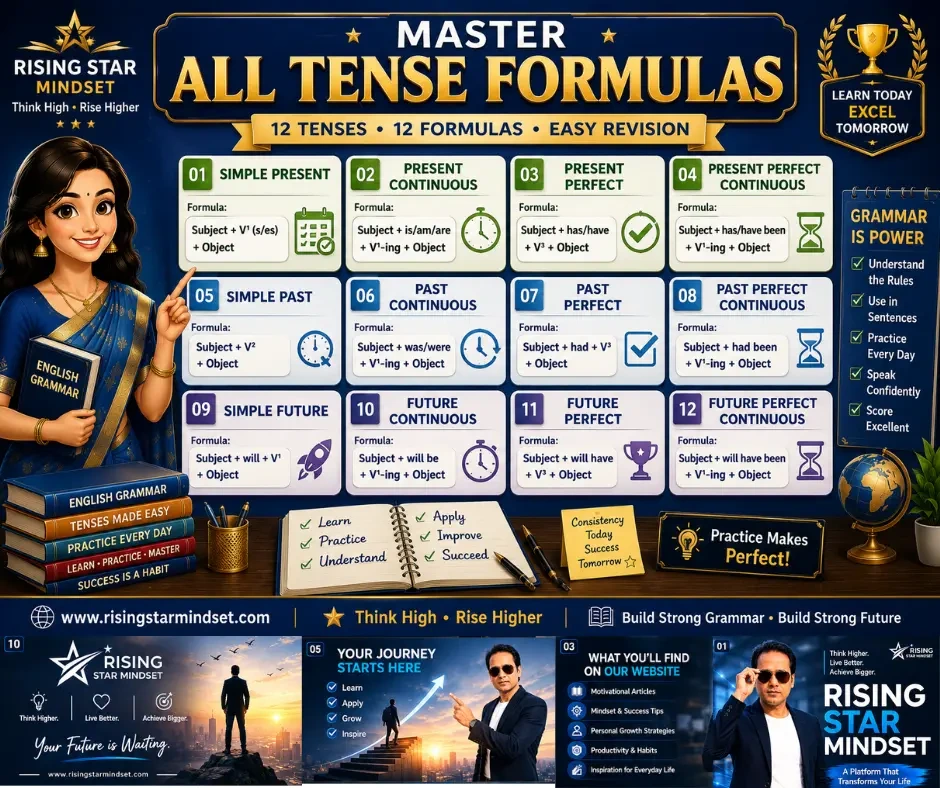
| Tense | Formula |
|---|---|
| Present Simple | Subject + V¹ |
| Present Continuous | Subject + is/am/are + V-ing |
| Present Perfect | Subject + has/have + V³ |
| Present Perfect Continuous | Subject + has/have been + V-ing |
| Simple Past | Subject + V² |
| Past Continuous | Subject + was/were + V-ing |
| Past Perfect | Subject + had + V³ |
| Past Perfect Continuous | Subject + had been + V-ing |
| Simple Future | Subject + will + V¹ |
| Future Continuous | Subject + will be + V-ing |
| Future Perfect | Subject + will have + V³ |
| Future Perfect Continuous | Subject + will have been + V-ing |
Multiple Choice Questions (MCQs) (1–60)
Question 1
She ____ English every day.
A. learn
B. learns ✅
C. learned
D. learning
Question 2
Rahul ____ cricket yesterday.
A. play
B. played ✅
C. playing
D. plays
Question 3
They ____ dinner now.
A. eat
B. ate
C. are eating ✅
D. will eat
Question 4
I ____ my homework.
A. have completed ✅
B. completed
C. completing
D. complete
Question 5
She ____ to school tomorrow.
A. goes
B. went
C. will go ✅
D. going
Question 6
Rahul ____ for the examination now.
A. prepares
B. prepared
C. is preparing ✅
D. prepare
Question 7
We ____ the match last Sunday.
A. win
B. won ✅
C. winning
D. wins
Question 8
He ____ already finished his work.
A. have
B. has ✅
C. had
D. will
Question 9
They ____ to Delhi next month.
A. go
B. went
C. will go ✅
D. going
Question 10
I ____ English for two years.
A. have been learning ✅
B. learned
C. learn
D. learning
11. She ____ a letter yesterday.
A. write
B. wrote ✅
C. written
D. writes
12. They ____ football now.
A. play
B. played
C. are playing ✅
D. will play
13. Rahul ____ the homework.
A. has completed ✅
B. completed
C. completing
D. complete
14. I ____ English tomorrow.
A. learn
B. learned
C. will learn ✅
D. learning
15. We ____ dinner when the phone rang.
A. ate
B. were eating ✅
C. eat
D. have eaten
16. She ____ the report before the meeting.
A. had finished ✅
B. finishes
C. finish
D. finishing
17. He ____ here since 2023.
A. lives
B. has been living ✅
C. lived
D. living
18. They ____ by next week.
A. finish
B. will finish
C. will have finished ✅
D. finishing
19. I ____ TV every evening.
A. watch ✅
B. watched
C. watching
D. will watch
20. Rahul ____ to school every day.
A. go
B. goes ✅
C. going
D. gone
21.
She ____ tea now.
A. drinks
B. drank
C. is drinking ✅
D. drink
22.
They ____ the work yesterday.
A. finish
B. finished ✅
C. finishing
D. finishes
23.
He ____ English for five years.
A. has been learning ✅
B. learned
C. learns
D. learning
24.
I ____ the exam next month.
A. will take ✅
B. take
C. took
D. taking
25.
She ____ before I arrived.
A. had left ✅
B. left
C. leaves
D. leaving
26.
They ____ dinner at 8 p.m. tomorrow.
A. will cook
B. will be cooking ✅
C. cooked
D. cook
27.
Rahul ____ his work by tomorrow.
A. will complete
B. will have completed ✅
C. completed
D. completes
28.
We ____ since morning.
A. have been waiting ✅
B. waited
C. wait
D. waiting
29.
The train ____ already.
A. has left ✅
B. left
C. leaves
D. leaving
30.
He ____ cricket every Sunday.
A. plays ✅
B. played
C. playing
D. play
31.
She ____ for two hours.
A. has been reading ✅
B. read
C. reads
D. reading
32.
I ____ to Delhi last year.
A. went ✅
B. go
C. gone
D. going
33.
They ____ lunch now.
A. have
B. are having ✅
C. had
D. having
34.
Rahul ____ for the exam yesterday evening.
A. was preparing ✅
B. prepares
C. prepare
D. prepared
35.
We ____ English next year.
A. learn
B. will learn ✅
C. learned
D. learning
36.
She ____ the homework before dinner.
A. had completed ✅
B. completed
C. completes
D. completing
37.
I ____ here for five years.
A. have lived ✅
B. lived
C. living
D. live
38.
They ____ by 9 p.m.
A. will have arrived ✅
B. arrive
C. arrived
D. arriving
39.
Rahul ____ a book now.
A. reads
B. is reading ✅
C. read
D. reading
40.
We ____ the meeting yesterday.
A. attended ✅
B. attend
C. attending
D. attends
41.
She ____ her breakfast already.
A. has eaten ✅
B. ate
C. eat
D. eating
42.
They ____ for the bus when I saw them.
A. were waiting ✅
B. waited
C. wait
D. waiting
43.
He ____ tomorrow morning.
A. will arrive ✅
B. arrives
C. arrived
D. arriving
44.
I ____ for three hours before dinner.
A. had been studying ✅
B. studied
C. study
D. studying
45.
Rahul ____ by next month.
A. will have graduated ✅
B. graduates
C. graduated
D. graduating
46.
She ____ every morning.
A. exercises ✅
B. exercised
C. exercising
D. exercise
47.
They ____ television now.
A. watch
B. are watching ✅
C. watched
D. watching
48.
We ____ the museum yesterday.
A. visited ✅
B. visit
C. visiting
D. visits
49.
He ____ English since childhood.
A. has known ✅
B. knew
C. knows
D. knowing
50.
I ____ my project tomorrow.
A. will submit ✅
B. submit
C. submitted
D. submitting
51.
She ____ by 6 p.m.
A. will have arrived ✅
B. arrives
C. arrived
D. arriving
52.
They ____ for five hours by noon.
A. will have been travelling ✅
B. travelled
C. travel
D. travelling
53.
Rahul ____ homework now.
A. is doing ✅
B. does
C. did
D. doing
54.
We ____ the match last Sunday.
A. won ✅
B. win
C. winning
D. wins
55.
She ____ the report.
A. has completed ✅
B. completed
C. completing
D. complete
56.
They ____ to Mumbai next week.
A. will travel ✅
B. travel
C. travelled
D. travelling
57.
I ____ before the bell rang.
A. had arrived ✅
B. arrived
C. arrive
D. arriving
58.
Rahul ____ English for one year by December.
A. will have been learning ✅
B. learned
C. learns
D. learning
59.
We ____ dinner now.
A. are having ✅
B. have
C. had
D. having
60.
She ____ the competition.
A. won ✅
B. win
C. winning
D. wins
HOTS (Higher Order Thinking Skills)
HOTS 1
Explain the difference between:
- I finished my homework.
- I have finished my homework.
HOTS 2
Why do we use Past Perfect when two actions happened in the past?
HOTS 3
Differentiate between Simple Future and Future Continuous with examples.
HOTS 4
Explain the difference between Present Perfect and Present Perfect Continuous.
HOTS 5
Why is Verb Third Form (V³) necessary in Perfect Tenses?
Fill in the Blanks (1–50)
Choose the correct form of the verb to complete each sentence.
1.
She ____ (go) to school every day.
Answer: goes ✅
2.
I ____ (read) a book now.
Answer: am reading ✅
3.
They ____ (play) football yesterday.
Answer: played ✅
4.
Rahul ____ (complete) his homework already.
Answer: has completed ✅
5.
We ____ (visit) Delhi next month.
Answer: will visit ✅
6.
She ____ (cook) dinner when I called her.
Answer: was cooking ✅
7.
I ____ (finish) the project before the meeting.
Answer: had finished ✅
8.
They ____ (wait) here for two hours.
Answer: have been waiting ✅
9.
He ____ (write) a letter tomorrow.
Answer: will write ✅
10.
The train ____ (arrive) by 8 p.m.
Answer: will have arrived ✅
11.
She ____ (watch) television every evening.
Answer: watches ✅
12.
We ____ (learn) English now.
Answer: are learning ✅
13.
Rahul ____ (win) the match yesterday.
Answer: won ✅
14.
I ____ (see) this movie already.
Answer: have seen ✅
15.
They ____ (travel) to Jaipur next week.
Answer: will travel ✅
16.
She ____ (study) for the exam when I visited.
Answer: was studying ✅
17.
He ____ (eat) dinner before his parents arrived.
Answer: had eaten ✅
18.
We ____ (live) here since 2020.
Answer: have been living ✅
19.
I ____ (buy) a new laptop tomorrow.
Answer: will buy ✅
20.
Rahul ____ (complete) the course by next month.
Answer: will have completed ✅
21.
The baby ____ (sleep) now.
Answer: is sleeping ✅
22.
My father ____ (go) for a walk every morning.
Answer: goes ✅
23.
We ____ (meet) our teacher yesterday.
Answer: met ✅
24.
She ____ (finish) her work already.
Answer: has finished ✅
25.
They ____ (visit) us tomorrow.
Answer: will visit ✅
26.
Rahul ____ (prepare) for BPSC now.
Answer: is preparing ✅
27.
The children ____ (play) in the park yesterday evening.
Answer: played ✅
28.
I ____ (learn) English for three years.
Answer: have been learning ✅
29.
She ____ (leave) before I reached home.
Answer: had left ✅
30.
They ____ (finish) the work by tomorrow evening.
Answer: will have finished ✅
31.
The students ____ (write) the test now.
Answer: are writing ✅
32.
He ____ (drive) to Patna yesterday.
Answer: drove ✅
33.
We ____ (complete) the assignment.
Answer: have completed ✅
34.
She ____ (teach) in this school since 2022.
Answer: has been teaching ✅
35.
Rahul ____ (join) college next year.
Answer: will join ✅
36.
I ____ (sleep) when the alarm rang.
Answer: was sleeping ✅
37.
They ____ (leave) before sunrise.
Answer: had left ✅
38.
The workers ____ (repair) the road for three hours by noon.
Answer: will have been repairing ✅
39.
She ____ (dance) beautifully.
Answer: dances ✅
40.
We ____ (watch) a movie now.
Answer: are watching ✅
41.
Rahul ____ (score) 95 marks last year.
Answer: scored ✅
42.
I ____ (complete) my homework already.
Answer: have completed ✅
43.
She ____ (help) you tomorrow.
Answer: will help ✅
44.
They ____ (work) when I entered the office.
Answer: were working ✅
45.
He ____ (finish) the report before lunch.
Answer: had finished ✅
46.
We ____ (practice) English for six months.
Answer: have been practicing ✅
47.
Rahul ____ (call) you tomorrow morning.
Answer: will call ✅
48.
The train ____ (leave) by 10 p.m.
Answer: will have left ✅
49.
She ____ (sing) a song now.
Answer: is singing ✅
50.
I ____ (visit) my grandparents every Sunday.
Answer: visit ✅
✅ Tick the Correct Answer (1–50)
Choose the correct option.
1. She ____ to school every day.
☐ go
☑ goes ✅
☐ going
☐ gone
2. Rahul ____ cricket yesterday.
plays
played ✅
play
playing
3. They ____ dinner now.
eat
are eating ✅
ate
eating
4. I ____ my homework already.
completed
have completed ✅
complete
completing
5. We ____ Delhi next month.
visit
will visit ✅
visited
visiting
6. She ____ TV when I called her.
watches
was watching ✅
watch
watched
7. Rahul ____ before I arrived.
leaves
had left ✅
leaving
leave
8. They ____ English for two years.
learned
have been learning ✅
learn
learning
9. I ____ the report tomorrow.
submit
will submit ✅
submitted
submitting
10. She ____ the work by evening.
complete
will have completed ✅
completed
completing
11. We ____ football every Sunday.
play ✅
played
playing
plays
12. He ____ a letter now.
writes
is writing ✅
wrote
writing
13. They ____ the museum yesterday.
visit
visited ✅
visiting
visits
14. Rahul ____ lunch already.
has eaten ✅
ate
eats
eating
15. I ____ your help tomorrow.
need
will need ✅
needed
needing
16. She ____ when the bell rang.
studies
was studying ✅
studied
study
17. We ____ the match before sunset.
finish
had finished ✅
finished
finishing
18. They ____ here since morning.
wait
have been waiting ✅
waited
waiting
19. Rahul ____ to Patna next week.
goes
will go ✅
went
going
20. I ____ by 8 p.m.
☐ arrive
☑ will have arrived ✅
☐ arrived
☐ arriving
21. She ____ English every evening.
studies ✅
studying
studied
study
22. We ____ breakfast now.
have
are having ✅
had
having
23. Rahul ____ first prize last year.
won ✅
wins
winning
win
24. They ____ the assignment.
have finished ✅
finished
finish
finishing
25. I ____ a new phone next month.
☐ buy
☑ will buy ✅
☐ bought
☐ buying
26. She ____ dinner at 8 p.m. tomorrow.
☐ cooks
☑ will be cooking ✅
☐ cooked
☐ cooking
27. Rahul ____ all chapters before the exam.
studies
will have studied ✅
studied
studying
28. They ____ for five years by next June.
☐ work
☑ will have been working ✅
☐ worked
☐ working
29. We ____ a book now.
☐ read
☑ are reading ✅
☐ reading
☐ reads
30. She ____ her homework yesterday.
☐ do
☑ did ✅
☐ does
☐ doing
31. I ____ English every day.
☑ practice ✅
practiced
practices
32. They ____ in the park now.
☐ played
☑ are playing ✅
☐ play
☐ playing
33. Rahul ____ the exam successfully.
☑ has passed ✅
passed
pass
passing
34. We ____ Jaipur next week.
☑ will visit ✅
visited
visit
35. She ____ when I entered the room.
☑ was sleeping ✅
slept
sleep
36. They ____ the report before lunch.
☑ had submitted ✅
submitted
submit
submitting
37. I ____ here since 2022.
☑ have lived ✅
lived
living
live
38. Rahul ____ by tomorrow morning.
☑ will have finished ✅
finished
finishes
finishing
39. She ____ every morning.
☑ exercises ✅
exercised
exercising
exercise
40. We ____ dinner now.
☑ are having ✅
have
had
having
41. The teacher ____ the lesson yesterday.
☑ explained ✅
explains
explain
42. I ____ this movie already.
☑ have watched ✅
watched
watch
watching
43. Rahul ____ you tomorrow.
☑ will call ✅
called
calls
calling
44. They ____ when I reached home.
☑ were sleeping ✅
slept
sleep
sleeping
45. She ____ the work before dinner.
☑ had completed ✅
completed
completes
completing
46. We ____ English for one year.
☑ have been studying ✅
studied
study
studying
47. I ____ the exam next year.
☑ will appear in ✅
appeared in
appear in
appearing in
48. Rahul ____ the project by Friday.
☑ will have submitted ✅
submitted
submits
submitting
49. They ____ for three hours by noon.
☑ will have been waiting ✅
waited
wait
waiting
50. She ____ English fluently.
☑ speaks ✅
spoke
Talking
speak
Match the Following (1–25)
Instructions: Match Column A with the correct answer in Column B.
| No. | Column A | Column B |
| 1 | Simple Present | a. will have + V³ |
| 2 | Present Continuous | b. had + V³ |
| 3 | Present Perfect | c. is/am/are + V-ing |
| 4 | Present Perfect Continuous | d. V¹ / V¹+s |
| 5 | Simple Past | e. has/have + V³ |
| 6 | Past Continuous | f. has/have been + V-ing |
| 7 | Past Perfect | g. V² |
| 8 | Past Perfect Continuous | h. was/were + V-ing |
| 9 | Simple Future | i. had been + V-ing |
| 10 | Future Continuous | j. will + V¹ |
| 11 | Future Perfect | k. will be + V-ing |
| 12 | Future Perfect Continuous | l. will have been + V-ing |
| 13 | Yesterday | m. Simple Past |
| 14 | Every day | n. Simple Present |
| 15 | Now | o. Present Continuous |
| 16 | Since | p. Starting Point |
| 17 | For | q. Duration |
| 18 | Tomorrow | r. Future Tense |
| 19 | Already | s. Present Perfect |
| 20 | By next year | t. Future Perfect |
| 21 | While | u. Continuous Tense |
| 22 | Before | v. Perfect Tense |
| 23 | Verb Third Form | w. Perfect Tenses |
| 24 | Verb + ing | x. Continuous Tenses |
| 25 | Will | y. Future Action |
Answer Key
1-d, 2-c, 3-e, 4-f, 5-g, 6-h, 7-b, 8-i, 9-j, 10-k, 11-a, 12-l, 13-m, 14-n, 15-o, 16-p, 17-q, 18-r, 19-s, 20-t, 21-u, 22-v, 23-w, 24-x, 25-y
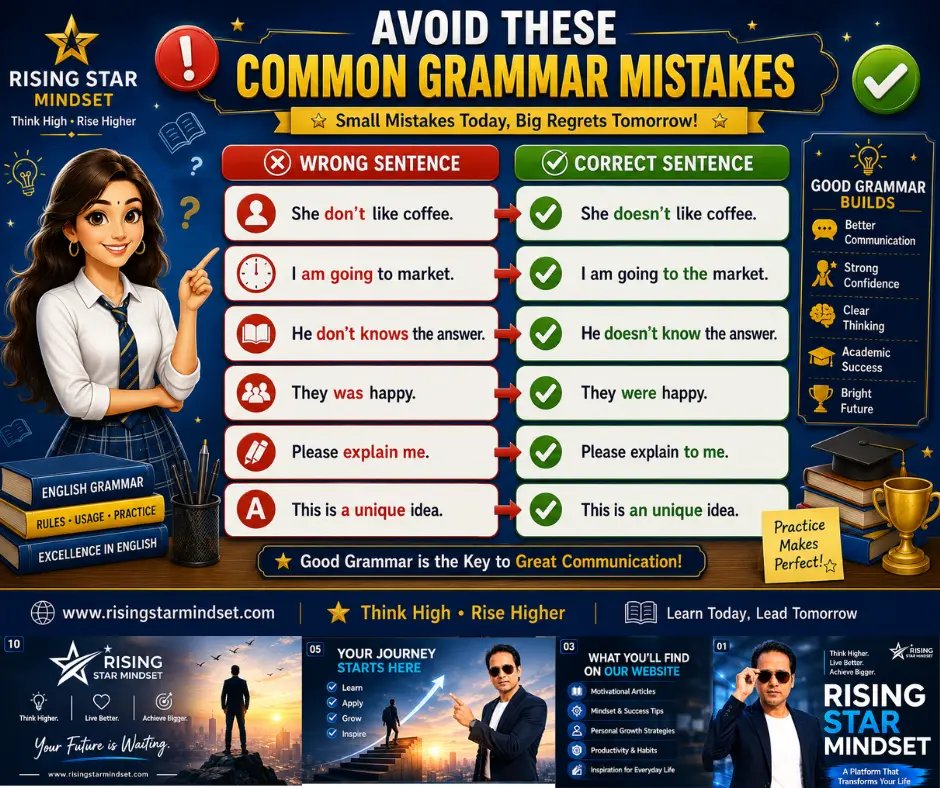
Error Spotting (1–30)
Find the mistake and write the correct sentence.
1.
❌ She go to school every day.
✅ She goes to school every day.
2.
❌ He don’t play cricket.
✅ He doesn’t play cricket.
3.
❌ I has completed my homework.
✅ I have completed my homework.
4.
❌ They is playing football.
✅ They are playing football.
5.
❌ She were cooking dinner.
✅ She was cooking dinner.
6.
❌ Rahul have finished the project.
✅ Rahul has finished the project.
7.
❌ I am know the answer.
✅ I know the answer.
8.
❌ They has been waiting.
✅ They have been waiting.
9.
❌ She did not wrote the letter.
✅ She did not write the letter.
10.
❌ He will goes tomorrow.
✅ He will go tomorrow.
11.
❌ We was watching TV.
✅ We were watching TV.
12.
❌ I had went there.
✅ I had gone there.
13.
❌ Rahul is read a book.
✅ Rahul is reading a book.
14.
❌ She have a car.
✅ She has a car.
15.
❌ They will be play football.
✅ They will be playing football.
16.
❌ He has ate breakfast.
✅ He has eaten breakfast.
17.
❌ I am agree with you.
✅ I agree with you.
18.
❌ She doesn’t likes coffee.
✅ She doesn’t like coffee.
19.
❌ They was happy.
✅ They were happy.
20
❌ Rahul will have wrote the report.
✅ Rahul will have written the report.
21.
❌ I did not knew the answer.
✅ I did not know the answer.
22.
❌ We has finished our work.
✅ We have finished our work.
23.
❌ She is knowing English.
✅ She knows English.
24.
❌ They had ate dinner.
✅ They had eaten dinner.
25.
❌ He don’t understand.
✅ He doesn’t understand.
26.
❌ I am belonging to this club.
✅ I belong to this club.
27.
❌ She have been working.
✅ She has been working.
28.
❌ Rahul was went home.
✅ Rahul went home.
29.
❌ They will have finish the task.
✅ They will have finished the task.
30.
❌ We is ready.
✅ We are ready.
Sentence Transformation (1–30)
Instructions: Change the sentence as directed.
A. Change into Negative
1.
She plays cricket.
✅ She does not play cricket.
2.
Rahul studies English.
✅ Rahul does not study English.
3.
They are watching TV.
✅ They are not watching TV.
4.
I have completed my homework.
✅ I have not completed my homework.
5.
He will come tomorrow.
✅ He will not come tomorrow.
6.
She was cooking dinner.
✅ She was not cooking dinner.
7.
They had finished the work.
✅ They had not finished the work.
8.
We will have completed the project.
✅ We will not have completed the project.
9.
Rahul is preparing for BPSC.
✅ Rahul is not preparing for BPSC.
10.
The students are writing the test.
✅ The students are not writing the test.
B. Change into Interrogative
11.
She plays badminton.
✅ Does she play badminton?
12.
Rahul completed the assignment.
✅ Did Rahul complete the assignment?
13.
They are learning English.
✅ Are they learning English?
14.
She has finished the report.
✅ Has she finished the report?
15.
He will visit Patna tomorrow.
✅ Will he visit Patna tomorrow?
16.
They were waiting for the bus.
✅ Were they waiting for the bus?
17.
Rahul had submitted the form.
✅ Had Rahul submitted the form?
18.
She will have completed the task.
✅ Will she have completed the task?
19.
They have been practicing English.
✅ Have they been practicing English?
20.
The children are playing outside.
✅ Are the children playing outside?
C. Change into WH Questions
21.
She is reading a book.
(What)
✅ What is she reading?
22.
Rahul went to Delhi yesterday.
(Where)
✅ Where did Rahul go yesterday?
23.
They will arrive tomorrow.
(When)
✅ When will they arrive?
24.
She has completed the project.
(What)
✅ What has she completed?
25.
The students are writing the examination.
(Who)
✅ Who is writing the examination?
D. Change Active Voice to Passive Voice
26.
She writes a letter.
✅ A letter is written by her.
27.
Rahul completed the homework.
✅ The homework was completed by Rahul.
28.
They will organize the seminar.
✅ The seminar will be organized by them.
29.
The teacher explained the lesson.
✅ The lesson was explained by the teacher.
30.
She has finished the report.
✅ The report has been finished by her.
True or False (1–25)
Instructions: Read each statement carefully and write True or False.
| No. | Statement | Answer |
| 1 | English has 12 Tenses. | ✅ True |
| 2 | Present Perfect uses has/have + V³. | ✅ True |
| 3 | Simple Past uses will + V¹. | ❌ False |
| 4 | Future Continuous uses will be + Verb-ing. | ✅ True |
| 5 | “Yesterday” is used with Simple Present. | ❌ False |
| 6 | Past Perfect uses had + V³. | ✅ True |
| 7 | “Since” shows a duration of time. | ❌ False |
| 8 | “For” shows a period of time. | ✅ True |
| 9 | Present Continuous uses is/am/are + Verb-ing. | ✅ True |
| 10 | Future Perfect uses will have + V³. | ✅ True |
| 11 | “Tomorrow” usually indicates Future Tense. | ✅ True |
| 12 | “Already” is often used with Present Perfect. | ✅ True |
| 13 | Every sentence must contain a tense. | ✅ True |
| 14 | “Did” is used with Verb Second Form. | ❌ False |
| 15 | After “did”, we use Verb First Form. | ✅ True |
| 16 | Continuous Tenses use Verb-ing. | ✅ True |
| 17 | Perfect Tenses use Verb Third Form. | ✅ True |
| 18 | “Will” is used for past actions. | ❌ False |
| 19 | “Was/Were” belong to Past Continuous. | ✅ True |
| 20 | “Has” is used with “I”. | ❌ False |
| 21 | “Have” is used with I, You, We, They. | ✅ True |
| 22 | Future Perfect Continuous uses will have been + Verb-ing. | ✅ True |
| 23 | Every verb has only one form. | ❌ False |
| 24 | Practice improves grammar skills. | ✅ True |
| 25 | Reading and speaking daily improve English fluency. | ✅ True |
Assertion & Reason Questions (1–20)
Instructions: Read the Assertion (A) and Reason (R) carefully.
Choose the correct option.
A. Both A and R are true, and R is the correct explanation of A.
B. Both A and R are true, but R is not the correct explanation of A.
C. A is true, but R is false.
D. A is false, but R is true.
1.
Assertion (A):
Simple Present Tense is used for daily habits.
Reason (R):
Daily habits happen regularly.
✅ Answer: A
2.
Assertion (A):
Present Continuous Tense uses Verb Third Form.
Reason (R):
Present Continuous uses is/am/are + Verb-ing.
✅ Answer: D
3.
Assertion (A):
Past Perfect describes an action completed before another past action.
Reason (R):
It uses had + Verb Third Form.
✅ Answer: A
4.
Assertion (A):
Future Perfect uses will have + Verb Third Form.
Reason (R):
It describes a completed action before a future time.
✅ Answer: A
5.
Assertion (A):
Simple Past uses Verb Second Form.
Reason (R):
It describes completed past actions.
✅ Answer: A
6.
Assertion (A):
Present Perfect uses has/have + Verb Third Form.
Reason (R):
It talks about completed actions connected to the present.
✅ Answer: A
7.
Assertion (A):
“Yesterday” is used with Future Tense.
Reason (R):
Yesterday refers to the past.
✅ Answer: D
8.
Assertion (A):
Continuous Tenses always use Verb-ing.
Reason (R):
They describe ongoing actions.
✅ Answer: A
9.
Assertion (A):
“Since” shows the starting point.
Reason (R):
“Since” tells when an action began.
✅ Answer: A
10.
Assertion (A):
“For” shows the duration of time.
Reason (R):
It tells how long an action continues.
✅ Answer: A
11.
Assertion (A):
“Will” is used for future actions.
Reason (R):
It refers to actions after the present time.
✅ Answer: A
12.
Assertion (A):
Verb Third Form is used in Perfect Tenses.
Reason (R):
Perfect Tenses show completed actions.
✅ Answer: A
13.
Assertion (A):
Past Continuous uses was/were + Verb-ing.
Reason (R):
It describes an action in progress in the past.
✅ Answer: A
14.
Assertion (A):
Present Continuous is used for actions happening now.
Reason (R):
It uses is/am/are + Verb-ing.
✅ Answer: A
15.
Assertion (A):
Simple Future uses will + Verb First Form.
Reason (R):
It expresses future actions.
✅ Answer: A
16.
Assertion (A):
Present Perfect Continuous emphasizes duration.
Reason (R):
It uses has/have been + Verb-ing.
✅ Answer: A
17.
Assertion (A):
Future Continuous describes an ongoing future action.
Reason (R):
It uses will be + Verb-ing.
✅ Answer: A
18.
Assertion (A):
Past Perfect Continuous uses had been + Verb-ing.
Reason (R):
It shows duration before another past event.
✅ Answer: A
19.
Assertion (A):
Every English sentence contains a tense.
Reason (R):
The verb indicates the time of an action.
✅ Answer: A
20.
Assertion (A):
Regular practice improves English grammar.
Reason (R):
Grammar becomes stronger through daily use.
✅ Answer: A
Case Study Questions (CBSE Pattern)
Case Study – 1
Rahul is preparing for his English examination. Every morning he studies grammar for one hour. Yesterday he revised all twelve tenses. At this moment, he is solving practice questions. By next week, he will have completed the entire grammar book.
Answer the following questions.
1.
Which tense is used in
“Rahul studies grammar every morning.”
A. Simple Present ✅
B. Simple Past
C. Future
D. Present Perfect
2.
Which tense is used in
“He revised all twelve tenses yesterday.”
A. Present Perfect
B. Simple Past ✅
C. Future
D. Past Perfect
3.
Which tense is used in
“He is solving practice questions.”
A. Present Continuous ✅
B. Future Continuous
C. Simple Present
D. Past Continuous
4.
Which tense is used in
“He will have completed the grammar book.”
A. Future Perfect ✅
B. Future Continuous
C. Present Perfect
D. Past Perfect
5.
Why is Rahul likely to score well?
Answer:
Because he studies regularly and practices grammar every day.
Case Study – 2
Priya wants to improve her spoken English. She practices speaking every evening. Last month, she joined an English-speaking course. Now, she is speaking more confidently. By the end of this year, she will have completed the course and will have been practicing English for one year.
Questions
- Determine the tense in “She practices speaking every evening.”
- Find the tense used in “She joined an English-speaking course.“
- Name the tense in “She is speaking more confidently.”
- Select the correct tense for “She will have completed the course.”
- State the tense used in “She will have been practicing English for one year.”
Answer Key
- Simple Present
- Simple Past
- Present Continuous
- Future Perfect
- Future Perfect Continuous
Final Mock Test (100 Marks)
Time: 90 Minutes
Maximum Marks: 100
Instructions
- Attempt all questions.
- Choose the correct answer carefully.
- No negative marking.
- Check your answers after completing the test.
Section A
Multiple Choice Questions (20 × 1 = 20 Marks)
1.
She ____ English every day.
A. learn
B. learns ✅
C. learned
D. learning
2.
Rahul ____ homework yesterday.
A. do
B. did ✅
C. does
D. doing
3.
They ____ television now.
A. watch
B. watched
C. are watching ✅
D. watches
4.
I ____ my homework already.
A. completed
B. have completed ✅
C. complete
D. completing
5.
She ____ tomorrow.
A. goes
B. went
C. will go ✅
D. going
6.
Rahul ____ when I called him.
A. studied
B. was studying ✅
C. studies
D. studying
7.
They ____ before I arrived.
A. left
B. had left ✅
C. leave
D. leaving
8.
She ____ here for three years.
A. lives
B. has been living ✅
C. lived
D. living
9.
I ____ by tomorrow.
A. finish
B. will finish
C. will have finished ✅
D. finished
10.
We ____ for five hours by noon.
A. waited
B. wait
C. will have been waiting ✅
D. waiting
Section B
Fill in the Blanks (10 × 1 = 10 Marks)
- She ____ (go) to school every day.
- Rahul ____ (play) football yesterday.
- They ____ (study) now.
- I ____ (finish) my work already.
- We ____ (visit) Delhi next month.
- She ____ (cook) when I called her.
- Rahul ____ (leave) before I arrived.
- They ____ (wait) for two hours.
- I ____ (buy) a laptop tomorrow.
- She ____ (complete) the project by next week.
Section C
Error Spotting (10 × 1 = 10 Marks)
Correct the following sentences.
- He don’t play football.
- She go to school.
- They is waiting.
- Rahul have finished the work.
- I has completed my homework.
- She did not wrote the letter.
- They will goes tomorrow.
- He has ate breakfast.
- We was playing cricket.
- She doesn’t likes coffee.
Section D
Match the Following (10 Marks)
| Column A | Column B |
| Simple Present | V¹ |
| Present Continuous | is/am/are + V-ing |
| Past Perfect | had + V³ |
| Future Perfect | will have + V³ |
| Future Continuous | will be + V-ing |
| Since | Starting Point |
| For | Duration |
| Already | Present Perfect |
| Tomorrow | Future |
| Yesterday | Past |
Section E
True / False (10 Marks)
- English has 12 Tenses.
- Present Perfect uses Verb Third Form.
- Future Continuous uses will + Verb First Form.
- Past Continuous uses was/were + Verb-ing.
- “Yesterday” is used with Future Tense.
- Since shows Starting Point.
- For shows Duration.
- Perfect Tenses use Verb Third Form.
- Continuous Tenses use Verb-ing.
- Grammar improves with daily practice.
Section F
Short Answer Questions (10 × 2 = 20 Marks)
- What is Tense?
- Name the three main Tenses.
- Define Present Perfect Tense.
- Write the formula of Past Continuous.
- Difference between Since and For.
- What is Future Perfect Tense?
- Write two examples of Simple Present.
- Write two examples of Present Continuous.
- Why do we use Past Perfect?
- Which tense is used for future plans?
Section G
Long Answer Questions (3 × 10 = 30 Marks)
Q1.
Explain all four Present Tenses with examples.
Q2.
Differentiate between
Simple Past
Past Perfect
Past Continuous
Past Perfect Continuous
Q3.
Explain all Future Tenses with formulas and examples.
One-Page Revision Sheet (Quick Formula Chart)
| Tense | Formula |
| Simple Present | Subject + V¹ |
| Present Continuous | Subject + is/am/are + V-ing |
| Present Perfect | Subject + has/have + V³ |
| Present Perfect Continuous | Subject + has/have been + V-ing |
| Simple Past | Subject + V² |
| Past Continuous | Subject + was/were + V-ing |
| Past Perfect | Subject + had + V³ |
| Past Perfect Continuous | Subject + had been + V-ing |
| Simple Future | Subject + will + V¹ |
| Future Continuous | Subject + will be + V-ing |
| Future Perfect | Subject + will have + V³ |
| Future Perfect Continuous | Subject + will have been + V-ing |
🏆 7-Day English Speaking Challenge
| Day | Challenge |
| Day 1 | Introduce Yourself in English |
| Day 2 | Talk About Your Family |
| Day 3 | Describe Your School or College |
| Day 4 | Explain Your Daily Routine |
| Day 5 | Speak About Your Favourite Book |
| Day 6 | Describe Your Future Goals |
| Day 7 | Speak for 2 Minutes Without Reading |
🎯 Viewer Assignment
Complete the following tasks:
- Write 10 sentences in the Simple Present Tense.
- Write 10 sentences in the Simple Future Tense.
- Translate 10 Hindi sentences into English.
- Write a 100-word paragraph about your daily routine using at least five different tenses.
💬 Comment below: Which tense was the most difficult for you, and why?
100 Most Common English Verbs (V1 • V2 • V3)
100 Most Common English Verbs (V1 • V2 • V3)
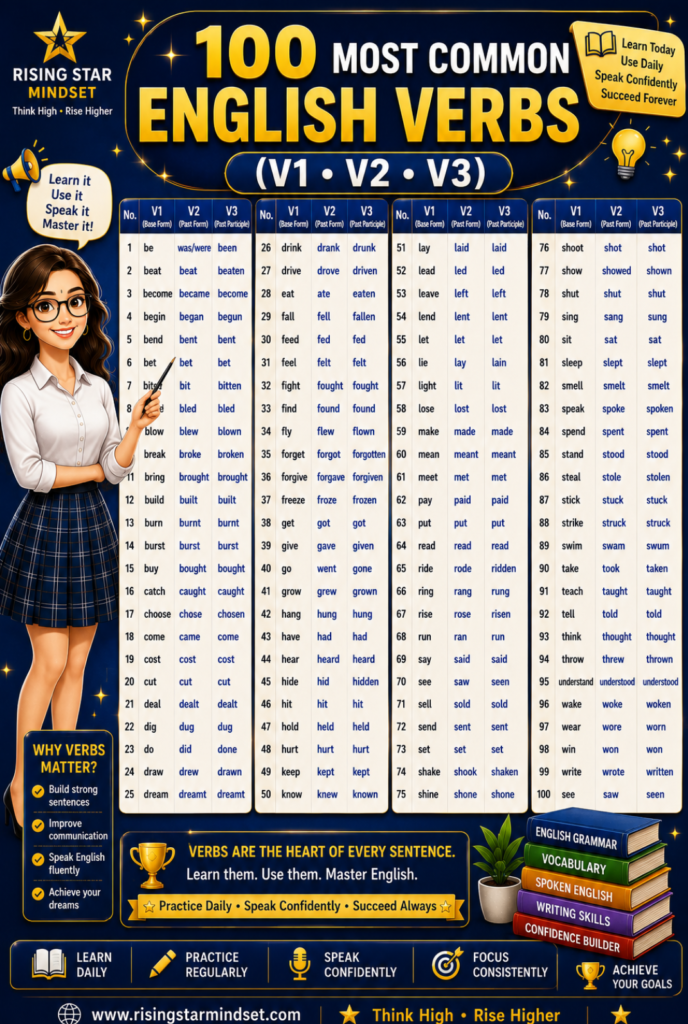
Daily Use English Sentences with Hindi Meaning
1.
Good morning.
सुप्रभात।
2.
How are you?
आप कैसे हैं?
3.
I am fine.
मैं ठीक हूँ।
4.
Thank you.
धन्यवाद।
5.
You’re welcome.
आपका स्वागत है।
6.
Please help me.
कृपया मेरी मदद करें।
7.
I don’t understand.
मुझे समझ नहीं आया।
8.
Can you repeat it?
क्या आप इसे दोहरा सकते हैं?
9.
What is your name?
आपका नाम क्या है?
10.
My name is Rahul.
मेरा नाम राहुल है।
11.
Where are you from?
आप कहाँ से हैं?
12.
I am from Bihar.
मैं बिहार से हूँ।
13.
Nice to meet you.
आपसे मिलकर खुशी हुई।
14.
See you tomorrow.
कल मिलते हैं।
15.
Have a nice day.
आपका दिन शुभ हो।
Top 10 Common Grammar Mistakes
| Wrong ❌ | Correct ✅ |
| He don’t know. | He doesn’t know. |
| She go to school. | She goes to school. |
| I has a book. | I have a book. |
| They is playing. | They are playing. |
| He have finished. | He has finished. |
| She did not wrote. | She did not write. |
| I am agree. | I agree. |
| We was happy. | We were happy. |
| He has ate. | He has eaten. |
Daily Speaking Practice Sentences
- • I am learning English. – मैं अंग्रेजी सीख रहा हूँ।
- • I want to improve my speaking skills. – मैं अपनी बोलने की क्षमता सुधारना चाहता हूँ।
- • I practice English every day. – मैं हर दिन अंग्रेजी का अभ्यास करता हूँ।
- • I can speak English confidently. – मैं आत्मविश्वास से अंग्रेजी बोल सकता हूँ।
- • Please speak in English. – कृपया अंग्रेजी में बोलिए।
- • Can you help me learn English? – क्या आप मेरी अंग्रेजी सीखने में मदद कर सकते हैं?
- • I am trying my best. – मैं अपनी पूरी कोशिश कर रहा हूँ।
- • Don’t be afraid of making mistakes. – गलतियाँ करने से मत डरिए।
- • I will improve day by day. – मैं हर दिन बेहतर बनूंगा।
- • Let me try. – मुझे कोशिश करने दीजिए।
- • Could you please explain this? – क्या आप कृपया इसे समझा सकते हैं?
- • I need more practice. – मुझे और अभ्यास की जरूरत है।
- • I am ready for the challenge. – मैं चुनौती के लिए तैयार हूँ।
- • I believe in myself. – मुझे खुद पर विश्वास है।
- • I can do it. – मैं यह कर सकता हूँ।
- • What do you mean? – आपका क्या मतलब है?
Final English Challenge
Translate into English
- मैं रोज़ अंग्रेज़ी पढ़ता हूँ।
- वह कल बाज़ार गया।
- हम अभी खाना खा रहे हैं।
- क्या तुम मेरी मदद करोगे?
- मैं दो वर्षों से अंग्रेज़ी सीख रहा हूँ।
- उसने अपना काम पूरा कर लिया है।
- वे अगले महीने दिल्ली जाएँगे।
- क्या तुमने यह किताब पढ़ी है?
- वह परीक्षा की तैयारी कर रही है।
- मैं कल तक यह प्रोजेक्ट पूरा कर दूँगा।
Final Motivation
“Grammar is not difficult. Daily practice makes it simple, confidence makes it powerful, and consistency makes you fluent.”
Think High • Rise Higher
Frequently Asked Questions (FAQs)
Q1. What is Tense?
Answer (English):
A tense is the form of a verb that shows the time of an action.
उत्तर (हिन्दी):
Tense क्रिया का वह रूप है जो किसी कार्य के समय को दर्शाता है।
Q2. How many tenses are there in English Grammar?
Answer:
There are 12 tenses in English Grammar.
Q3. What are the three main types of Tenses?
Answer:
- Present Tense
- Past Tense
- Future Tense
Q4. Which tense is the easiest for beginners?
Answer:
Simple Present Tense is usually the easiest because it is used in daily conversations.
Q5. Which tense is used for daily routine?
Answer:
Simple Present Tense.
Example:
I go to school every day.
Q6. Which tense is used for actions happening now?
Answer:
Present Continuous Tense.
Example:
She is reading a book.
Q7. How can I identify the correct tense?
Answer:
Look for:
- Time words (today, yesterday, tomorrow)
- Helping verbs
- Main verb form
- Sentence meaning
Q8. What is the difference between Since and For?
Answer:
Since → Starting point
For → Duration
Q9. Which tense is most important for spoken English?
Answer:
- Simple Present
- Present Continuous
- Present Perfect
- Simple Past
These four tenses are used most often in everyday conversations.
Q10. How can I improve my English Grammar?
Answer:
- Practice every day.
- Read English books.
- Watch English videos.
- Speak in English daily.
- Solve grammar exercises regularly.
Common Interview Questions
1.
Tell me about yourself.
2.
Why do you want to improve your English?
3.
Describe your daily routine.
4.
What are your future goals?
5.
What is your biggest strength?
6.
Describe your hometown.
7.
Introduce your family.
8.
Talk about your favorite teacher.
9.
Why should we hire you?
10.
Where do you see yourself in five years?
Mini Project
Write a Paragraph (150 Words)
Choose any one topic.
- My Mother
- Daily Routine
- Dream Career
- Favorite Book
- Importance of Education
- Importance of English
- Digital India
- Healthy Lifestyle
Use at least five different tenses.
Self-Evaluation Checklist
- Identify all 12 tenses?
- Write tense formulas without looking?
- Speak in Simple Present?
- Make negative sentences?
- Ask questions correctly?
- Translate Hindi into English?
- Identify verb forms?
- Use Since and For correctly?
- Solve grammar questions confidently?
- Explain all 12 tenses to someone else?
Score Yourself:
- 9–10 ✔️ Excellent
- 7–8 ✔️ Very Good
- 5–6 ✔️ Good
- Below 5 ✔️ Practice More
Related Articles You Should Read
- Parts of Speech – Complete Guide
- Sentence Structure in English
- Active and Passive Voice
- Direct and Indirect Speech
- Articles (A, An, The)
- Prepositions Made Easy
- Modal Verbs Explained
- Subject–Verb Agreement
- Common English Vocabulary
- Spoken English for Beginners
🎁 Bonus Challenge
30-Day English Grammar Challenge
| Day | Task |
| 1 | Learn Simple Present |
| 2 | Practice Present Continuous |
| 3 | Study Present Perfect |
| 4 | Study Present Perfect Continuous |
| 5 | Revise Present Tenses |
| 6 | Learn Simple Past |
| 7 | Practice Past Continuous |
| 8 | Learn Past Perfect |
| 9 | Learn Past Perfect Continuous |
| 10 | Revise Past Tenses |
| 11 | Learn Simple Future |
| 12 | Practice Future Continuous |
| 13 | Learn Future Perfect |
| 14 | Learn Future Perfect Continuous |
| 15 | Revise Future Tenses |
| 16–20 | Solve MCQs |
| 21–25 | Speaking Practice |
| 26–28 | Mock Test |
| 29 | Revision |
| 30 | Final Assessment |
Conclusion (English)
Congratulations! 🎉
You have successfully completed this Complete English Tenses Guide for Beginners.
In this guide, you learned the concept of all 12 English Tenses, their formulas, rules, sentence structures, examples, common mistakes, and practical exercises. You also practiced through MCQs, fill-in-the-blanks, error spotting, sentence transformation, HOTS questions, case studies, and a final mock test.
Learning English grammar is not about memorizing rules—it is about using them correctly in real-life communication. The more you read, write, listen, and speak in English, the more confident and fluent you will become.
Remember, consistency is the key to success. Even 20–30 minutes of daily practice can significantly improve your grammar and communication skills.
We hope this guide helps you build a strong foundation in English and prepares you for school exams, competitive exams, and everyday conversations.
Keep Learning. Keep Growing.
“Success in English doesn’t come from perfection. It comes from daily practice, patience, and confidence.”
H2
निष्कर्ष (Conclusion in Hindi)
बधाई हो! 🎉
आपने Complete English Tenses Guide for Beginners सफलतापूर्वक पूरा कर लिया है।
इस गाइड में आपने English Grammar के सभी 12 Tenses को विस्तार से समझा। आपने उनके Rules, Formulas, Sentence Structures, Examples, Common Mistakes, MCQs, Fill in the Blanks, Error Spotting, Sentence Transformation, HOTS Questions, Case Studies और Final Mock Test के माध्यम से अभ्यास भी किया।
याद रखें, अंग्रेज़ी सीखने का सबसे अच्छा तरीका केवल नियम याद करना नहीं, बल्कि उन्हें रोज़ पढ़ना, लिखना, बोलना और वास्तविक जीवन में प्रयोग करना है। नियमित अभ्यास से आपकी Grammar, Vocabulary और Spoken English तीनों में निरंतर सुधार होगा।
प्रतिदिन केवल 20–30 मिनट का अभ्यास भी आपको आत्मविश्वास के साथ अंग्रेज़ी बोलने और लिखने में सक्षम बना सकता है।
हमें आशा है कि यह गाइड आपकी स्कूल परीक्षाओं, प्रतियोगी परीक्षाओं, इंटरव्यू और दैनिक जीवन में अंग्रेज़ी के प्रभावी उपयोग में महत्वपूर्ण सहायता करेगी।
सीखते रहें • अभ्यास करते रहें • आगे बढ़ते रहें।
“सफलता एक दिन में नहीं मिलती, लेकिन हर दिन किया गया छोटा प्रयास आपको सफलता के और करीब ले जाता है। अंग्रेज़ी सीखने की शुरुआत आज करें, क्योंकि हर नया शब्द आपके उज्ज्वल भविष्य की ओर एक नया कदम है।”

🌟 Final Call to Action
Did this guide help you?
- Share it with your friends and classmates.
- Bookmark this page for quick revision.
- Practice the exercises regularly.
- Explore more English Grammar lessons on www.risingstarmindset.com.
Keep Learning, Keep Growing! 🚀
P Kumar | Rising Star Mindset
www.risingstarmindset.com
Together We Will Make The Difference
.