
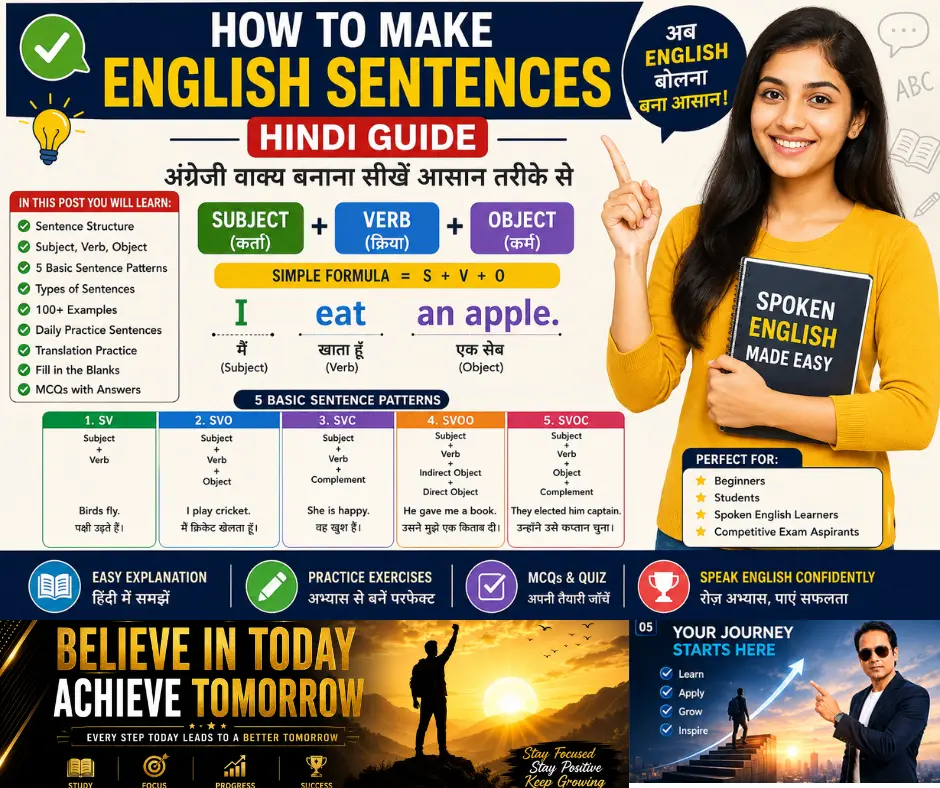
Basic Sentence Structure in English with Hindi | Subject, Verb & Object Guide ( How to Make English Sentences )
Introduction ( How to Make English Sentences )
Do you know many English words but still hesitate to speak English? ( How to Make English Sentences )
Have you ever understood English grammar but found it difficult to make correct sentences?
If your answer is yes, you are not alone. Many English learners face this challenge because they know vocabulary but are unsure how to arrange words correctly.
Basic Sentence Structure is the foundation of spoken and written English. It teaches you how to organize words in the correct order so that your ideas become clear and meaningful.
A strong sentence structure helps you speak confidently, write accurately, and communicate effectively. It also makes grammar easier to understand and reduces common mistakes.
When you understand the roles of Subject, Verb, and Object, creating English sentences becomes much simpler. Even beginners can start speaking naturally with regular practice.
In this lesson, you will learn the basic structure of English sentences step by step. You will also understand the most common sentence patterns, practical grammar rules, and plenty of real-life examples with Hindi explanations.
By the end of this guide, you will be able to make correct English sentences with confidence and build a strong foundation for your spoken English journey.
परिचय
क्या आपको बहुत सारे English words याद हैं, लेकिन फिर भी सही English बोलने में कठिनाई होती है?
क्या आपको Grammar समझ आती है, लेकिन Sentence बनाना मुश्किल लगता है?
यदि आपका उत्तर हाँ है, तो आप अकेले नहीं हैं। अधिकांश विद्यार्थी शब्द तो सीख लेते हैं, लेकिन उन्हें सही क्रम में व्यवस्थित करना नहीं जानते।
Basic Sentence Structure Spoken English की मजबूत नींव है। यह सिखाता है कि शब्दों को सही क्रम में कैसे रखा जाए ताकि वाक्य स्पष्ट, सही और अर्थपूर्ण बन सके।
जब Sentence Structure सही होता है, तो English बोलना, लिखना और समझना तीनों आसान हो जाते हैं। साथ ही Grammar की गलतियाँ भी कम होती हैं और आत्मविश्वास बढ़ता है।
इस अध्याय में आप Subject, Verb और Object की भूमिका, महत्वपूर्ण Sentence Patterns, आसान नियम और अनेक उदाहरण हिन्दी व English दोनों में सीखेंगे।
इस पाठ के अंत तक आप आत्मविश्वास के साथ सही English Sentences बना सकेंगे और Spoken English की मजबूत शुरुआत कर पाएँगे।
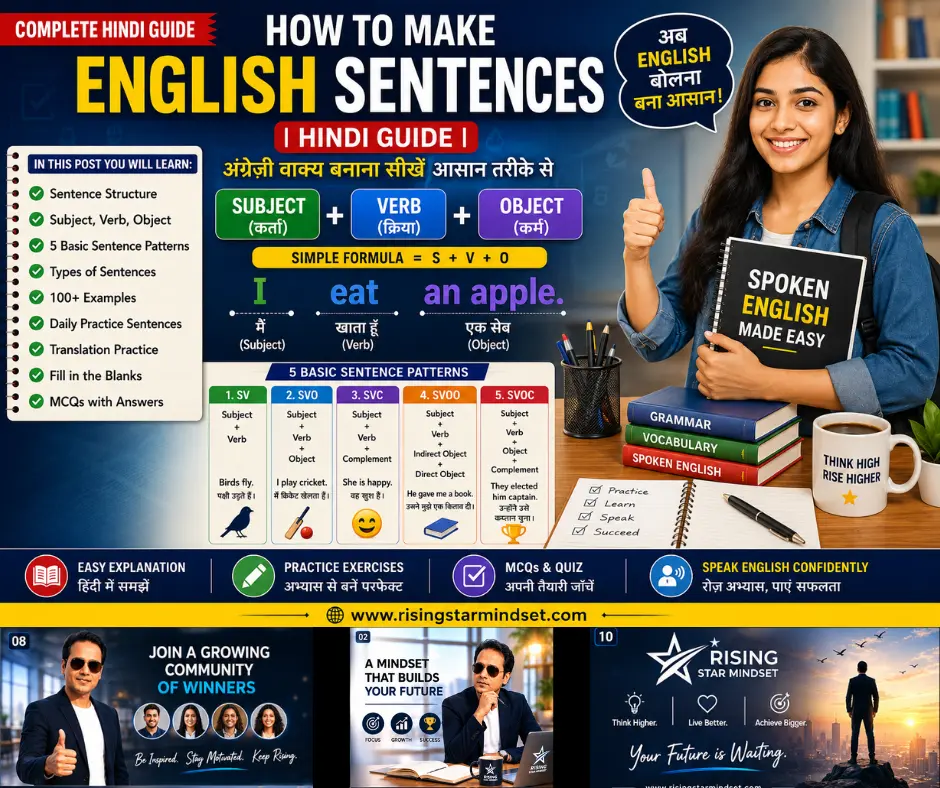
Table of Contents
- What is a Sentence?
- What is Sentence Structure?
- Why Sentence Structure is Important?
- Elements of a Sentence
- Subject
- Verb
- Object
- Rules of Sentence Formation
- Subject Explained
- Verb Explained
- Object Explained
- Difference Between Subject, Verb and Object
- Easy Examples
- Summary
- Related post : Complete TENSE
Learning Objectives ( How to Make English Sentences )
After completing this lesson, you will be able to—
- Understand Sentence Structure
- Identify Subject, Verb and Object
- Make Simple English Sentences
- Avoid Common Mistakes
- Speak Correct English Naturally
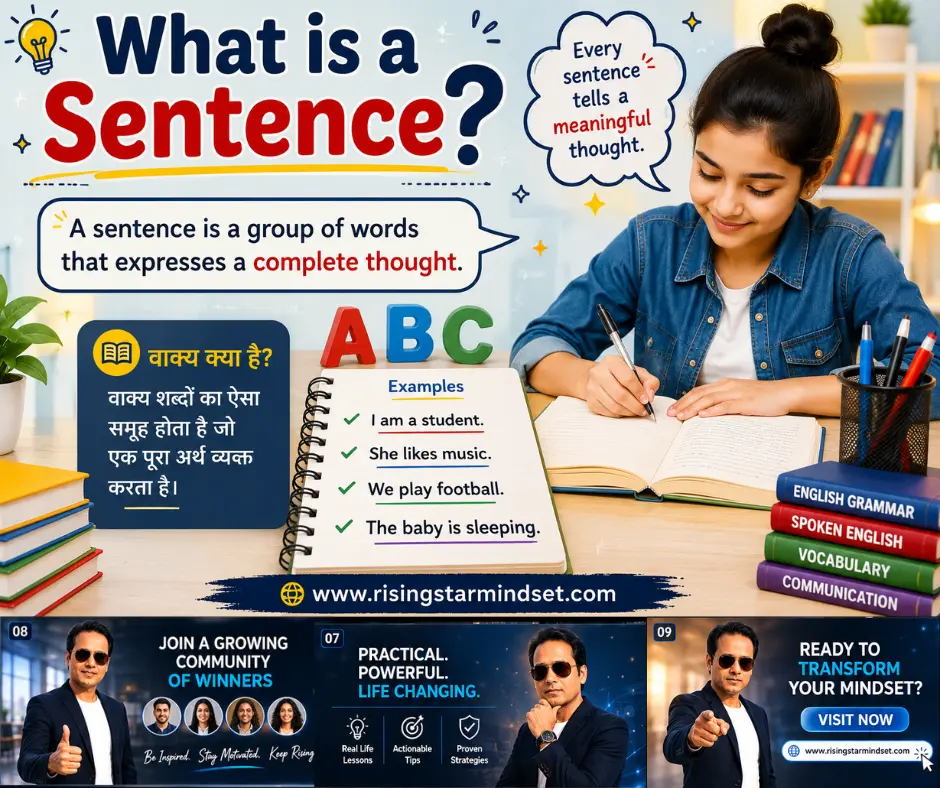
What is a Sentence?
Definition (English)
A sentence is a group of words that expresses a complete idea or thought.
Every sentence begins with a capital letter and ends with a full stop, question mark, or exclamation mark.
Examples
I am a student.
She likes music.
They play football.
The baby is sleeping.
We love our country.
परिभाषा (हिन्दी)
Sentence शब्दों का ऐसा समूह होता है जो एक पूरा अर्थ व्यक्त करता है।
हर Sentence का पहला अक्षर Capital Letter से शुरू होता है तथा अंत में Full Stop (.), Question Mark (?) या Exclamation Mark (!) लगाया जाता है।
उदाहरण
मैं एक विद्यार्थी हूँ।
वह संगीत पसंद करती है।
वे फुटबॉल खेलते हैं।
बच्चा सो रहा है।
हम अपने देश से प्रेम करते हैं।
What is Sentence Structure?
Definition (English)
Sentence Structure means the correct arrangement of words in a sentence.
Every English sentence follows a particular order.
When words are arranged correctly, the sentence becomes meaningful.
When words are arranged incorrectly, the sentence becomes grammatically wrong.
Definition (Hindi)
Sentence Structure का अर्थ है—
Sentence के शब्दों को सही क्रम में व्यवस्थित करना।
यदि शब्द सही क्रम में होंगे, तो Sentence सही होगा।
यदि शब्द गलत क्रम में होंगे, तो पूरा Sentence गलत हो जाएगा।
Correct Example
I play cricket.
यह सही Sentence है।
Incorrect Example
Play I cricket.
यह गलत Sentence है क्योंकि शब्दों का क्रम गलत है।
Why is Sentence Structure Important?
Sentence Structure is the backbone of Spoken English.
It helps you—
- Speak confidently
- Write correctly
- Understand English easily
- Improve communication
- Avoid grammar mistakes
- Score better in exams
- Build fluency
हिन्दी में ( How to Make English Sentences )
Sentence Structure सीखने के फायदे—
- सही English बोल पाएँगे।
- Grammar आसान लगेगी।
- Translation आसान होगी।
- Confidence बढ़ेगा।
- Speaking Fluency बेहतर होगी।
Elements of a Sentence
Every English sentence has some important parts.
These parts are called the Elements of a Sentence.
The three basic elements are—
- Subject
- Verb
- Object
Let’s understand them one by one.
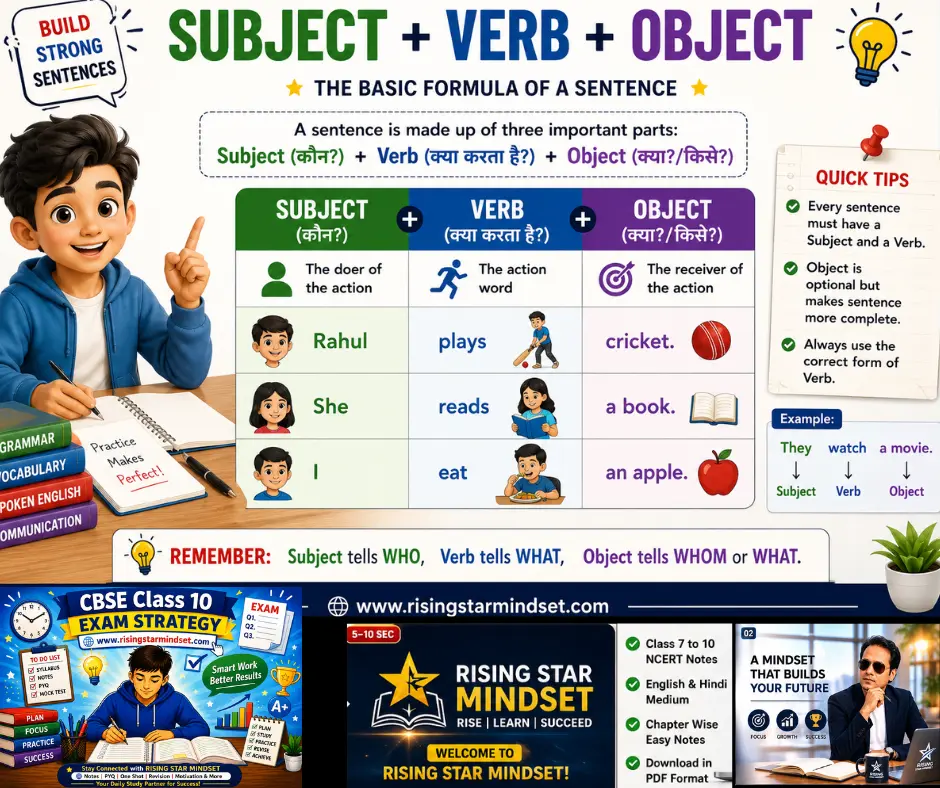
What is Subject?
Definition (English)
The Subject is the person, animal, place or thing that performs the action or about whom the sentence tells something.
In simple words,
Subject tells us WHO or WHAT the sentence is about.
Definition (Hindi)
Subject वह व्यक्ति, वस्तु, स्थान या जानवर होता है जिसके बारे में Sentence में बात की जाती है।
सरल शब्दों में—
Sentence किसके बारे में है, वही Subject होता है।
Examples ( How to Make English Sentences )
Ram plays cricket.
Ram = Subject
She is beautiful.
She = Subject
The dog is barking.
The dog = Subject
My father teaches English.
My father = Subject
The sun rises in the east.
The sun = Subject
पहचान कैसे करें? ( How to Make English Sentences )
Sentence में पहले यह पूछिए—
Who?
या
What?
जिसका उत्तर मिलेगा वही Subject होगा।
Example
Rahul eats mangoes.
Who eats?
Rahul
Therefore,
Subject = Rahul
Quick Tip ( How to Make English Sentences )
Subject अक्सर Sentence की शुरुआत में आता है।
हालाँकि Advanced English में इसकी Position बदल भी सकती है।
Types of Subject
Simple Subject
Only one noun or pronoun.
Example
Riya sings.
Compound Subject
Two or more subjects.
Example
Ram and Shyam play cricket.
Hidden Subject
Mostly in Imperative Sentences.
Example
Sit down.
Subject = You (Hidden)
What is Verb? ( How to Make English Sentences )
Definition (English)
A Verb is an action word.
It tells us what the Subject does.
Sometimes it also tells us the state of the Subject.
Definition (Hindi)
Verb वह शब्द है जो कार्य (Action) या अवस्था (State) को बताता है।
Examples
He runs.
Runs = Verb
She writes a letter.
Writes = Verb
Birds fly.
Fly = Verb
The baby sleeps.
Sleeps = Verb
They are happy.
Are = Verb
Types of Verbs ( How to Make English Sentences )
Action Verb
Run
Eat
Play
Read
Write
State Verb
Be
Seem
Know
Believe
Love
Need
पहचान कैसे करें? ( How to Make English Sentences )
Sentence में जो कार्य हो रहा है वही Verb होता है।
Example
Aman studies every day.
What does Aman do?
Studies
Therefore,
Verb = Studies
Quick Tip ( How to Make English Sentences )
हर Complete English Sentence में कम से कम एक Verb अवश्य होता है।
What is Object?
Definition (English)
The Object receives the action of the Verb.
It answers the questions—
Whom?
What?
Definition (Hindi)
Object वह होता है जिस पर Subject द्वारा किया गया कार्य प्रभाव डालता है।
Examples
Rahul plays cricket.
Object = Cricket
She reads a book.
Object = Book
They eat mangoes.
Object = Mangoes
The teacher teaches English.
Object = English
I drink milk.
Object = Milk
पहचान कैसे करें?
पहले Verb पहचानिए।
अब पूछिए—
What?
या
Whom?
जो उत्तर मिलेगा वही Object होगा।
Example
Ram kicked the ball.
Verb = Kicked
What did Ram kick?
The ball
Object = The ball
Quick Revision Table ( How to Make English Sentences )
| Element | English | हिन्दी |
| Subject | Who does the action | कार्य करने वाला |
| Verb | Action or State | कार्य या अवस्था |
| Object | Receives the action | जिस पर कार्य होता है |
Remember
Subject + Verb + Object (SVO) अंग्रेज़ी के सबसे सामान्य और महत्वपूर्ण Sentence Pattern की नींव है। जब आप इन तीन तत्वों को सही ढंग से पहचानना सीख जाते हैं, तो सही English Sentence बनाना बहुत आसान हो जाता है।
Sentence Patterns in English
अब तक आपने Subject, Verb और Object के बारे में सीखा। अब समय है यह समझने का कि इनका उपयोग करके सही English Sentences कैसे बनाए जाते हैं।
English में अधिकांश वाक्य कुछ निश्चित Sentence Patterns का पालन करते हैं। यदि आप इन Patterns को अच्छी तरह सीख लेते हैं, तो आप आसानी से हजारों सही English Sentences बना सकते हैं।
आइए एक-एक करके सभी महत्वपूर्ण Sentence Patterns को विस्तार से समझते हैं।
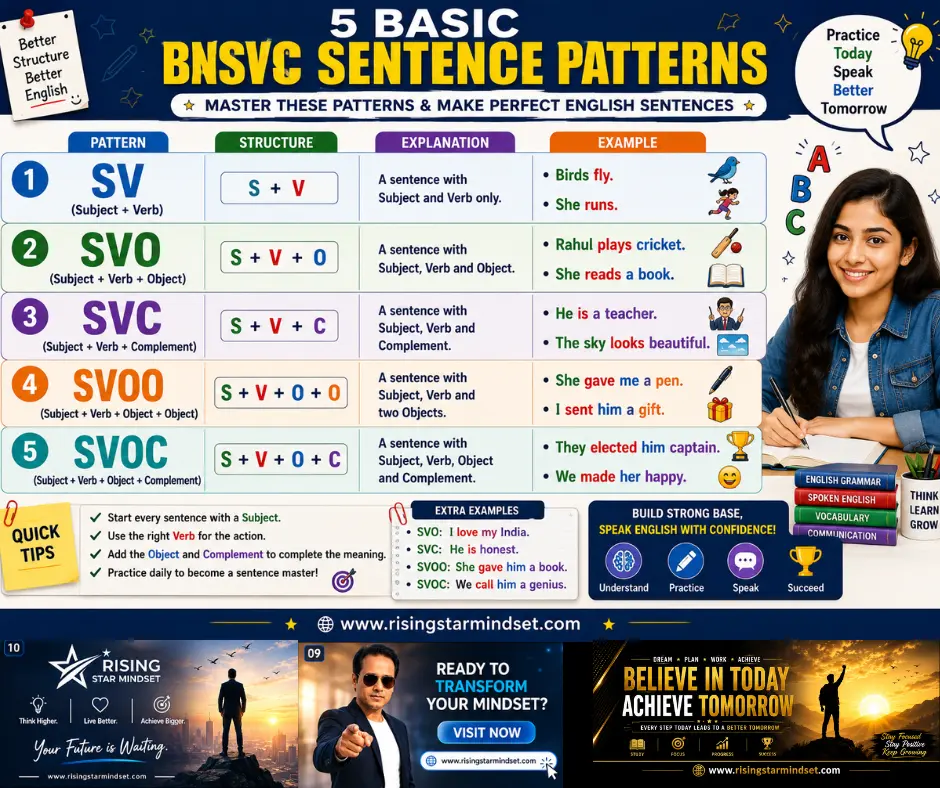
1. Subject + Verb (SV)
Definition (English)
This is the simplest sentence pattern.
It contains only a Subject and a Verb.
No object is required.
परिभाषा (हिन्दी)
यह सबसे सरल Sentence Pattern है।
इसमें केवल Subject और Verb होते हैं।
Object की आवश्यकता नहीं होती।
Structure
Subject + Verb
Examples
| English | Hindi |
| Birds fly. | पक्षी उड़ते हैं। |
| The baby cries. | बच्चा रोता है। |
| He smiled. | वह मुस्कुराया। |
| The sun rises. | सूर्य उगता है। |
| The students laughed. | विद्यार्थी हँसे। |
| She danced. | वह नाची। |
| The train arrived. | ट्रेन पहुँची। |
| My father works. | मेरे पिता काम करते हैं। |
| Children sleep. | बच्चे सोते हैं। |
| We laughed. | हम हँसे। |
Quick Tip 💡
यदि Verb के बाद किसी व्यक्ति या वस्तु की आवश्यकता नहीं है, तो वह SV Pattern हो सकता है।
2. Subject + Verb + Object (SVO)
यह Spoken English का सबसे अधिक उपयोग होने वाला Sentence Pattern है।
Definition (English)
The Subject performs an action on an Object.
हिन्दी
Subject कोई कार्य करता है और उसका प्रभाव Object पर पड़ता है।
Structure
Subject + Verb + Object
Examples
| English | Hindi |
| I eat rice. | मैं चावल खाता हूँ। |
| She reads a book. | वह किताब पढ़ती है। |
| Rahul plays cricket. | राहुल क्रिकेट खेलता है। |
| We watch TV. | हम टीवी देखते हैं। |
| They drink tea. | वे चाय पीते हैं। |
| He writes a letter. | वह पत्र लिखता है। |
| Mother cooks food. | माँ खाना बनाती है। |
| Students solve questions. | विद्यार्थी प्रश्न हल करते हैं। |
| The teacher explains grammar. | शिक्षक व्याकरण समझाते हैं। |
| I love my parents. | मैं अपने माता-पिता से प्रेम करता हूँ। |
पहचान कैसे करें?
पहले Subject पहचानिए।
फिर Verb पहचानिए।
अब पूछिए—
What?
या
Whom?
जो उत्तर मिले वही Object होगा।
Example
She bought a laptop.
Who bought?
She = Subject
What did she buy?
Laptop = Object
Bought = Verb
Common Mistake ⚠️
❌ I eat.
(यदि संदर्भ स्पष्ट नहीं है तो Sentence अधूरा लग सकता है।)
✅ I eat an apple.
3. Subject + Verb + Complement (SVC)
Definition (English)
A Complement gives more information about the Subject.
It usually comes after linking verbs like:
- is
- am
- are
- was
- were
- become
- seem
- look
हिन्दी
Complement Subject के बारे में अतिरिक्त जानकारी देता है।
Structure
Subject + Linking Verb + Complement
Examples
| English | Hindi |
| She is beautiful. | वह सुंदर है। |
| He is honest. | वह ईमानदार है। |
| They are happy. | वे खुश हैं। |
| The sky became dark. | आकाश अंधेरा हो गया। |
| My father is a doctor. | मेरे पिता डॉक्टर हैं। |
| The food smells delicious. | खाना स्वादिष्ट महकता है। |
| The room looks clean. | कमरा साफ दिखाई देता है। |
| I am tired. | मैं थका हुआ हूँ। |
| She became famous. | वह प्रसिद्ध हो गई। |
| The child seems innocent. | बच्चा मासूम लगता है। |
Quick Tip 💡 ( How to Make English Sentences )
Complement कभी-कभी Adjective होता है।
कभी-कभी Noun भी होता है।
Object और Complement में अंतर
Object पर कार्य किया जाता है।
Complement केवल Subject के बारे में जानकारी देता है।
Example
She is intelligent.
“Intelligent” पर कोई कार्य नहीं हो रहा।
इसलिए यह Complement है।
4. Subject + Verb + Indirect Object + Direct Object (SVOO)
यह Pattern थोड़ा Advanced है लेकिन Daily English में बहुत उपयोग होता है।
Definition
Subject gives something to someone.
Structure
Subject + Verb + Indirect Object + Direct Object
हिन्दी
Subject किसी व्यक्ति को कोई वस्तु देता है।
Examples ( How to Make English Sentences )
| English | Hindi |
| My father gave me a pen. | मेरे पिता ने मुझे एक पेन दिया। |
| She sent me a message. | उसने मुझे संदेश भेजा। |
| I bought him a gift. | मैंने उसके लिए उपहार खरीदा। |
| The teacher taught us English. | शिक्षक ने हमें अंग्रेज़ी पढ़ाई। |
| He offered me tea. | उसने मुझे चाय दी। |
| Mother cooked us dinner. | माँ ने हमारे लिए खाना बनाया। |
| They showed us the museum. | उन्होंने हमें संग्रहालय दिखाया। |
| She told me the truth. | उसने मुझे सच बताया। |
| Rahul lent me his bike. | राहुल ने मुझे अपनी बाइक दी। |
| The company offered him a job. | कंपनी ने उसे नौकरी दी। |
पहचान कैसे करें?
पहले देखें—
किसे?
और
क्या?
Example
She gave me a gift.
Whom?
Me
What?
Gift
Quick Tip 💡 ( How to Make English Sentences )
Indirect Object अक्सर व्यक्ति होता है।
Direct Object अक्सर वस्तु होती है।
5. Subject + Verb + Object + Complement (SVOC)
यह सबसे Advanced Basic Pattern है।
Definition
The Complement describes the Object.
Structure
Subject + Verb + Object + Complement
हिन्दी
Complement Object के बारे में अतिरिक्त जानकारी देता है।
Examples
| English | Hindi |
| They elected him captain. | उन्होंने उसे कप्तान चुना। |
| We found the movie interesting. | हमें फिल्म रोचक लगी। |
| The teacher made me confident. | शिक्षक ने मुझे आत्मविश्वासी बनाया। |
| They painted the wall blue. | उन्होंने दीवार को नीला रंग दिया। |
| I consider him my best friend. | मैं उसे अपना सबसे अच्छा मित्र मानता हूँ। |
| We named our dog Tommy. | हमने अपने कुत्ते का नाम टॉमी रखा। |
| They kept the room clean. | उन्होंने कमरा साफ रखा। |
| The news made everyone happy. | समाचार ने सभी को खुश कर दिया। |
| The coach declared him fit. | कोच ने उसे फिट घोषित किया। |
| The manager appointed Ravi team leader. | मैनेजर ने रवि को टीम लीडर नियुक्त किया। |
पाँचों Patterns एक साथ
| Pattern | Example |
| SV | Birds fly. |
| SVO | I play cricket. |
| SVC | She is beautiful. |
| SVOO | Father gave me money. |
| SVOC | They elected him captain. |
Golden Rules of English Sentence Structure
Rule 1
Sentence हमेशा Capital Letter से शुरू करें।
✅ He is a doctor.
❌ he is a doctor.
Rule 2
Sentence के अंत में उचित Punctuation लगाएँ।
.
?
!
Rule 3
हर Sentence में कम से कम एक Verb होना चाहिए।
Rule 4
Subject और Verb में Agreement होना चाहिए।
✅ He plays football.
❌ He play football.
Rule 5
Word Order न बदलें।
✅ I like tea.
❌ Like I tea.
Rule 6
Unnecessary Words का प्रयोग न करें।
✅ She sings well.
❌ She well sings.
Common Mistakes Made by Beginners
❌ He go to school.
✅ He goes to school.
❌ I am agree.
✅ I agree.
❌ She don’t like coffee.
✅ She doesn’t like coffee.
❌ I have 20 years.
✅ I am 20 years old.
❌ Discuss about the problem.
✅ Discuss the problem.
Speaking Practice
नीचे दिए गए वाक्यों को रोज़ ज़ोर से बोलने का अभ्यास करें—
- She reads a newspaper.
- My father goes to work.
- The children play in the park.
- Birds sing sweetly.
- Our teacher explains grammar clearly.
- Practice makes perfect.
- Reading books builds knowledge.
- Hard work leads to success.
- Everyone can learn English.
Remember This
English में अधिकांश सही वाक्य इन्हीं पाँच Sentence Patterns पर आधारित होते हैं। यदि आप इन Patterns का नियमित अभ्यास करते हैं, तो आप बिना अनुवाद के भी स्वाभाविक और सही English बोलना शुरू कर सकते हैं।
Types of Sentences in English
English में वाक्यों का उद्देश्य अलग-अलग हो सकता है। कोई वाक्य जानकारी देता है, कोई प्रश्न पूछता है, कोई आदेश देता है और कोई भावनाएँ व्यक्त करता है। इन्हीं उद्देश्यों के आधार पर Sentences पाँच मुख्य प्रकार के होते हैं।
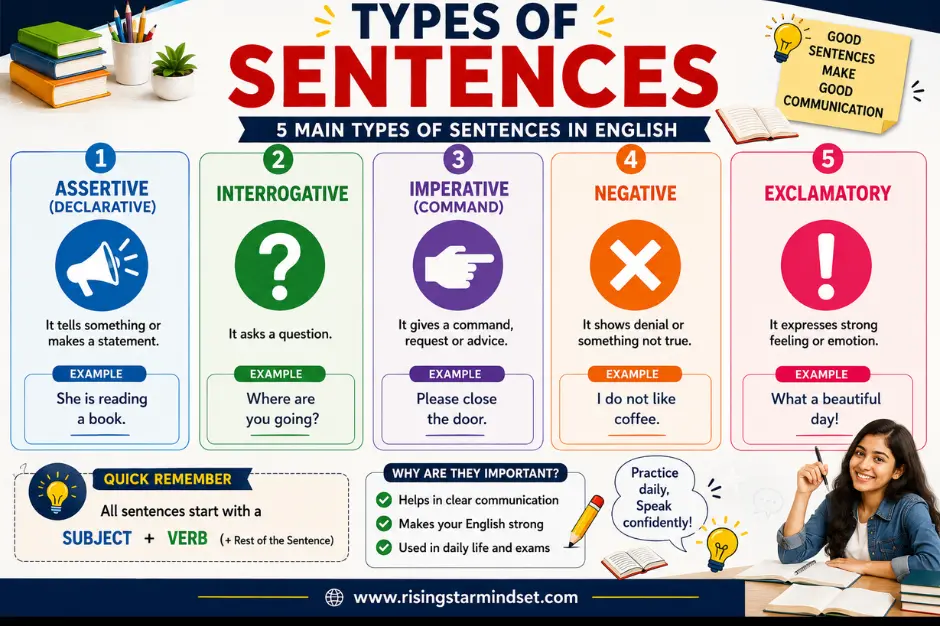
1. Assertive (Declarative) Sentence
Definition (English)
An Assertive Sentence gives information, states a fact, or expresses an opinion.
परिभाषा (हिन्दी)
Assertive Sentence किसी तथ्य, जानकारी या विचार को व्यक्त करता है।
Examples
| English | Hindi |
| I am a student. | मैं एक विद्यार्थी हूँ। |
| She lives in Delhi. | वह दिल्ली में रहती है। |
| We love our country. | हम अपने देश से प्रेम करते हैं। |
| The Earth revolves around the Sun. | पृथ्वी सूर्य के चारों ओर घूमती है। |
| My father is a teacher. | मेरे पिता शिक्षक हैं। |
2. Interrogative Sentence
Definition (English)
An Interrogative Sentence asks a question.
परिभाषा (हिन्दी)
Interrogative Sentence प्रश्न पूछने के लिए प्रयोग किया जाता है।
Examples
- What is your name?
- Where do you live?
- Are you ready?
- Do you like English?
- Why are you late?
3. Imperative Sentence
Definition (English)
An Imperative Sentence gives an order, request, advice, or instruction.
परिभाषा (हिन्दी)
Imperative Sentence आदेश, अनुरोध, सलाह या निर्देश देने के लिए प्रयोग किया जाता है।
Examples
- Open the door.
- Please help me.
- Sit down.
- Read carefully.
- Speak slowly.
4. Exclamatory Sentence
Definition (English)
An Exclamatory Sentence expresses strong feelings or emotions.
परिभाषा (हिन्दी)
Exclamatory Sentence आश्चर्य, खुशी, दुख या अन्य भावनाएँ व्यक्त करता है।
Examples
- What a beautiful flower!
- How wonderful!
- Wow!
- What a great idea!
- Hurrah! We won the match.
5. Negative Sentence
Definition (English)
A Negative Sentence expresses denial using words like not, never, no.
परिभाषा (हिन्दी)
Negative Sentence किसी बात का नकार (इनकार) व्यक्त करता है।
Examples
- I do not smoke.
- She is not busy.
- They never lie.
- He does not play cricket.
- We are not tired.
Daily Speaking Practice (30 Sentences)
इन वाक्यों को रोज़ ज़ोर से पढ़ें और बोलने का अभ्यास करें।
- Every morning, I wake up early.
- After waking up, I drink a glass of water.
- Reading English every day improves my skills.
- My parents always support my learning.
- She goes to school regularly.
- We play together after class.
- They work hard to achieve success.
- Our teacher explains every topic clearly.
- Respecting elders is a good habit.
- Practice makes perfect.
- Confidence grows with regular practice.
- Learning English is fun and interesting.
- Never give up on your dreams.
- Success comes with patience.
- Today is a beautiful day.
- Everyone should help others.
- Reading books increases knowledge.
- Time is very valuable.
- Speak English every day.
- Try to learn something new daily.
- Honesty is the best policy.
- Good health is real wealth.
- My biggest dream is to become fluent in English.
- Enjoy reading English books every day.
- English becomes easier with regular practice.
- Every mistake teaches a valuable lesson.
- Confidence comes from daily practice.
- Small steps lead to great success.
- Keep smiling every day.
- Never stop learning..
Translation Practice
नीचे दिए गए हिन्दी वाक्यों का अंग्रेज़ी में अनुवाद करने का प्रयास करें।
- मैं रोज़ अंग्रेज़ी सीखता हूँ।
- वह क्रिकेट खेलती है।
- हम समय का सम्मान करते हैं।
- मेरे पिता डॉक्टर हैं।
- बच्चे पार्क में खेल रहे हैं।
- क्या तुम मेरी मदद कर सकते हो?
- दरवाज़ा बंद करो।
- आज मौसम अच्छा है।
- वह बहुत मेहनत करता है।
- मैं अपने देश से प्रेम करता हूँ।
Fill in the Blanks
- She ______ English every day.
- We ______ football on Sunday.
- The baby ______ loudly.
- My father ______ tea every morning.
- They ______ in Patna.
Rearrange the Words
- cricket / play / I
- school / goes / She / to
- English / learning / We / are
- beautiful / is / The / garden
- book / reads / Rahul / a
Common Mistakes
Mistake 1
❌ He go to school.
✅ He goes to school.
Mistake 2
❌ I am agree.
✅ I agree.
Mistake 3
❌ She don’t know.
✅ She doesn’t know.
Mistake 4
❌ I have two brothers and one sister are.
✅ I have two brothers and one sister.
Mistake 5
❌ He is knowing me.
✅ He knows me.
Speaking Challenge
आज ही नीचे दिए गए विषयों पर पाँच-पाँच वाक्य अंग्रेज़ी में बोलने का प्रयास करें।
- My Family
- School
- Best Friend
- My Daily Routine
- My Village / City
यह अभ्यास आपकी Fluency और Confidence दोनों को बढ़ाएगा।
Practice Exercise
नीचे दिए गए प्रत्येक वाक्य में Subject, Verb और Object पहचानिए।
- Rahul plays football.
- My mother cooks food.
- They watch television.
- We love our country.
- The teacher teaches English.
25 MCQs
1. Which part of a sentence performs the action?
A. Object
B. Subject
C. Complement
D. Article
Answer: B
2. Which word is the Verb?
She sings beautifully.
A. She
B. Sings
C. Beautifully
D. None
Answer: B
3. Which pattern is “I read a book”?
A. SV
B. SVO
C. SVC
D. SVOC
Answer: B
4. Which sentence is correct?
A. He go to school.
B. He goes to school.
C. He going school.
D. He gone school.
Answer: B
5. Which sentence is Imperative?
A. I am happy.
B. Open the window.
C. She sings well.
D. They are students.
Answer: B
6. Which sentence follows the SVO pattern?
A. Birds fly.
B. She is happy.
C. I play football.
D. Sit down.
Answer: C. I play football.
7. Identify the Subject in the sentence:
The teacher teaches English.
A. Teacher
B. Teaches
C. English
D. The
Answer: A. Teacher
8. Identify the Verb in the sentence:
My brother plays cricket.
A. Brother
B. Plays
C. Cricket
D. My
Answer: B. Plays
9. Identify the Object in the sentence:
She reads a newspaper.
A. She
B. Reads
C. Newspaper
D. A
Answer: C. Newspaper
10. Which sentence has no Object?
A. She sings.
B. I eat rice.
C. He reads a book.
D. We watch television.
Answer: A. She sings.
11. Which sentence is grammatically correct?
A. He go to school.
B. He goes to school.
C. He going to school.
D. He gone school.
Answer: B. He goes to school.
12. Choose the correct sentence.
A. They is playing.
B. They are playing.
C. They am playing.
D. They was playing.
Answer: B. They are playing.
13. Which word is the Subject?
The cat caught the mouse.
A. Cat
B. Caught
C. Mouse
D. The
Answer: A. Cat
14. Which word is the Object?
We drink milk.
A. We
B. Drink
C. Milk
D. None
Answer: C. Milk
15. Which of the following is a Verb?
A. Beautiful
B. Quickly
C. Run
D. Happiness
Answer: C. Run
16. Which sentence is an Assertive Sentence?
A. What is your name?
B. Open the door.
C. I live in Patna.
D. What a beautiful day!
Answer: C. I live in Patna.
17. Which sentence is an Interrogative Sentence?
A. She is happy.
B. Please sit down.
C. Where do you live?
D. What a nice idea!
Answer: C. Where do you live?
18. Which sentence is an Imperative Sentence?
A. I am a student.
B. Please close the window.
C. She likes tea.
D. They play football.
Answer: B. Please close the window.
19. Which sentence is an Exclamatory Sentence?
A. He is a doctor.
B. What a wonderful view!
C. Do you know him?
D. She studies hard.
Answer: B. What a wonderful view!
20. Which sentence is Negative?
A. She is a nurse.
B. I do not like coffee.
C. Where are you?
D. Open your book.
Answer: B. I do not like coffee.
21. Choose the correct word order.
A. Football play I.
B. I football play.
C. I play football.
D. Play football I.
Answer: C. I play football.
22. Which sentence contains a Complement?
A. She reads books.
B. He is honest.
C. We play cricket.
D. I drink water.
Answer: B. He is honest.
23. Which sentence follows the SVC pattern?
A. She became famous.
B. I eat an apple.
C. Birds fly high.
D. We play football.
Answer: A. She became famous.
24. Which sentence follows the SVOO pattern?
A. She is beautiful.
B. My father gave me a gift.
C. Birds fly.
D. They laughed loudly.
Answer: B. My father gave me a gift.
25. Why is Basic Sentence Structure important?
A. It helps us draw pictures.
B. It helps us cook food.
C. It helps us speak and write correct English.
D. It helps us solve Mathematics.
Answer: C. It helps us speak and write correct English.
🎯 Practice Challenge
Identify the Subject (S), Verb (V), and Object (O) in the following sentences:
- The boy kicked the ball.
- My mother cooked dinner.
- We watched a movie yesterday.
- She bought a new laptop.
- The teacher explained the lesson.
- Rahul opened the door.
- They cleaned the classroom.
- I completed my homework.
- The baby drank milk.
- My friend wrote a letter.
⭐ Test Your Score
Calculate Your Score
Count your correct answers and check your performance below:
| Correct Answers | Performance | Remark |
| 23–25 | 🏆 Excellent | Your sentence structure is excellent. Keep practicing every day. |
| 19–22 | 🌟 Very Good | You have a strong understanding. Revise a few concepts for perfection. |
| 15–18 | 👍 Good | Your basics are clear, but regular practice will improve your accuracy. |
| 10–14 | 📘 Average | Revise this lesson carefully and practice more examples. |
| 0–9 | 📖 Needs Improvement | Read the lesson again and practice daily before moving to the next chapter. |
🎯 Challenge Yourself
Did you score 23 or above?
✅ Yes → Congratulations! You are ready for the next lesson.
❌ No → Revise this chapter once more and retake the quiz.
Frequently Asked Questions (FAQs)
Q1. What is Sentence Structure?
Sentence Structure is the correct arrangement of words to make a meaningful sentence.
हिन्दी: Sentence Structure का अर्थ है शब्दों को सही क्रम में व्यवस्थित करना।
Q2. What are the basic parts of a sentence?
The three basic parts are Subject, Verb, and Object.
Q3. What is the most common sentence pattern?
Subject + Verb + Object (SVO) is the most common pattern in English.
Q4. Why should beginners learn Sentence Structure first?
Because correct sentence formation is the foundation of spoken and written English.
Q5. How can I improve my Sentence Structure?
Read English daily, practice speaking, write simple sentences, and identify Subject, Verb, and Object regularly.
Key Takeaways
- A sentence expresses a complete thought.
- Every sentence has a proper structure.
- Subject tells who performs the action.
- Verb tells what happens.
- Object receives the action.
- The SVO pattern is the most common in English.
- Daily practice is the key to fluent spoken English.
Conclusion
Learning Basic Sentence Structure is the first step toward speaking English confidently. Once you understand how Subject, Verb, and Object work together, creating meaningful sentences becomes much easier.
Do not try to memorize hundreds of rules at once. Instead, practice a few simple sentence patterns every day. With regular reading, writing, and speaking, your confidence will grow naturally.
Remember, fluency does not come from knowing difficult words—it comes from making correct sentences consistently.
🌟 Final Call to Action
Did this guide help you?
- Share it with your friends and classmates.
- Bookmark this page for quick revision.
- Practice the exercises regularly.
- Explore more English Grammar lessons on www.risingstarmindset.com.
Keep Learning, Keep Growing! 🚀
P Kumar | Rising Star Mindset
www.risingstarmindset.com
Together We Will Make The Difference
Nice