
For Students of CBSE, State Boards & Competitive Exams
Website: www.risingstarmindset.com ( How Do Organisms Reproduce )
Table of Contents ( How Do Organisms Reproduce )
- Introduction
- Why is Reproduction Important?
- What is Reproduction?
- Types of Reproduction
- Asexual Reproduction
- Methods of Asexual Reproduction
- Sexual Reproduction
- Reproductive Health
- Human Male Reproductive System
- Human Female Reproductive System
- Fertilization
- Reproduction in Flowering Plants
- Advantages and Disadvantages of Reproduction Methods
- Key Differences: Asexual vs Sexual Reproduction
- Abbreviations
- Key Points
- Frequently Asked Questions (FAQs)
- Conclusion
Introduction ( How Do Organisms Reproduce )
Every living organism has a life cycle. They are born, grow, reproduce, and eventually die. If organisms did not reproduce, life on Earth would come to an end.
Reproduction is therefore one of the most important characteristics of living organisms.
हिंदी में
प्रत्येक जीव का एक जीवन चक्र होता है। वे जन्म लेते हैं, बढ़ते हैं, प्रजनन करते हैं और अंततः मर जाते हैं। यदि जीव प्रजनन नहीं करेंगे, तो पृथ्वी पर जीवन समाप्त हो जाएगा।
इसलिए प्रजनन (Reproduction) जीवों की सबसे महत्वपूर्ण विशेषताओं में से एक है।
What is Reproduction? ( How Do Organisms Reproduce )
English
Reproduction is the biological process by which organisms produce new individuals of their own kind.
Hindi
वह जैविक प्रक्रिया जिसके द्वारा जीव अपने समान नई संतानों का निर्माण करते हैं, प्रजनन (Reproduction) कहलाती है।
Example
- Human → Human baby
- Mango tree → New mango plant
- Bacteria → New bacteria
Why is Reproduction Important?
English
Reproduction helps:
- Continuation of species
- Transfer of genetic information
- Evolution of organisms
- Maintaining population balance
Hindi
प्रजनन के लाभ:
- प्रजातियों की निरंतरता
- आनुवंशिक जानकारी का स्थानांतरण
- विकास (Evolution) में सहायता
- जनसंख्या संतुलन बनाए रखना
Types of Reproduction ( How Do Organisms Reproduce )
There are two major types:
1. Asexual Reproduction
2. Sexual Reproduction
Asexual Reproduction
Definition
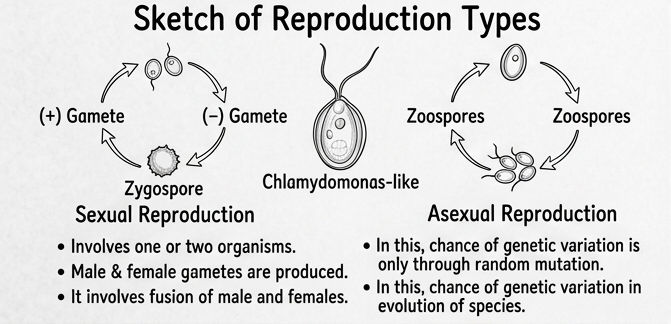
A type of reproduction involving only one parent and no fusion of gametes.
Hindi
जिस प्रजनन में केवल एक जनक भाग लेता है तथा युग्मकों का संलयन नहीं होता, उसे अलैंगिक प्रजनन कहते हैं।
Characteristics
- One parent
- Faster process
- No fertilization
- Offspring are genetically identical
Methods of Asexual Reproduction ( How Do Organisms Reproduce )
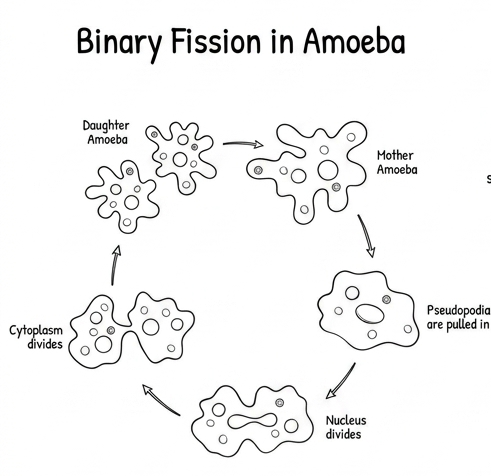
1. Binary Fission
One organism divides into two identical organisms.
Example
- Amoeba
- Paramecium
Hindi
एक कोशिका दो समान कोशिकाओं में विभाजित हो जाती है।
2. Multiple Fission
One parent produces many daughter cells simultaneously.
Example
- Plasmodium
3. Budding
A small outgrowth called bud develops and separates.
Example
- Hydra
- Yeast
Hindi
जनक के शरीर पर कली (Bud) बनती है जो बाद में अलग होकर नया जीव बनाती है।
4. Fragmentation
The body breaks into fragments and each fragment grows into a new organism.
Example
- Spirogyra
5. Regeneration
Lost body parts regenerate into complete organisms.
Example
- Planaria
6. Vegetative Propagation
New plants grow from roots, stems, or leaves.
Examples
- Potato
- Sugarcane
- Bryophyllum
- Rose
Advantages
- Rapid multiplication
- Desired traits preserved
Sexual Reproduction ( How Do Organisms Reproduce )
Definition
Reproduction involving fusion of male and female gametes.
Hindi
नर एवं मादा युग्मकों के संलयन द्वारा होने वाला प्रजनन लैंगिक प्रजनन कहलाता है।
Why Sexual Reproduction?
English
Sexual reproduction creates genetic variation.
Hindi
लैंगिक प्रजनन नई आनुवंशिक विविधताएँ उत्पन्न करता है जो विकास (Evolution) का आधार हैं।
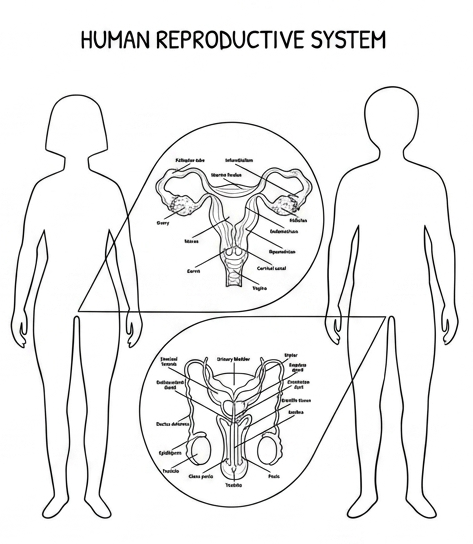
Human Male Reproductive System
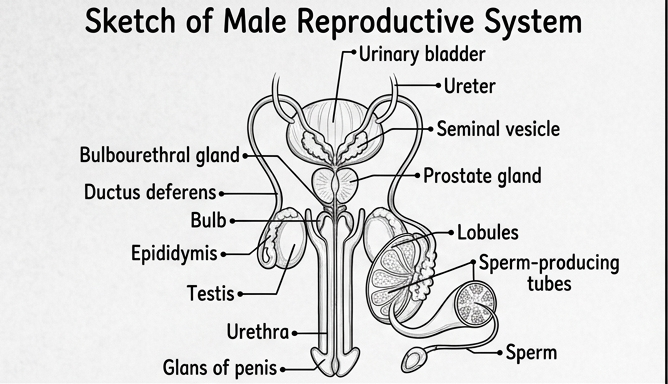
Main Parts
- Testes
- Scrotum
- Vas deferens
- Urethra
- Penis
Functions
Testes
Produce:
- Sperm
- Testosterone hormone
Hindi
वृषण (Testes) शुक्राणुओं तथा टेस्टोस्टेरोन हार्मोन का निर्माण करते हैं।
Human Female Reproductive System
Main Parts
- Ovaries
- Fallopian Tubes
- Uterus
- Cervix
- Vagina
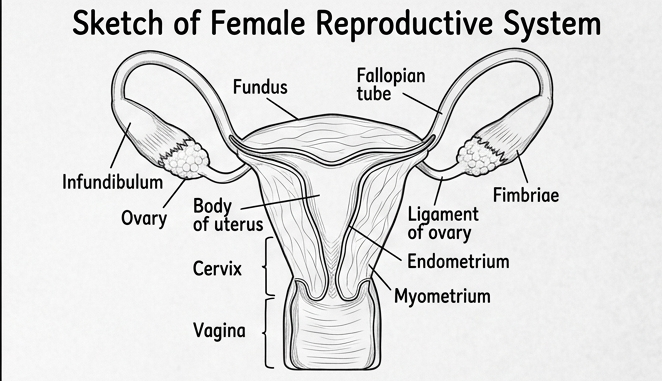
Functions
Ovaries
Produce:
- Ovum (Egg)
- Female hormones
Hindi
अंडाशय अंडाणु तथा स्त्री हार्मोन बनाते हैं।
Fertilization
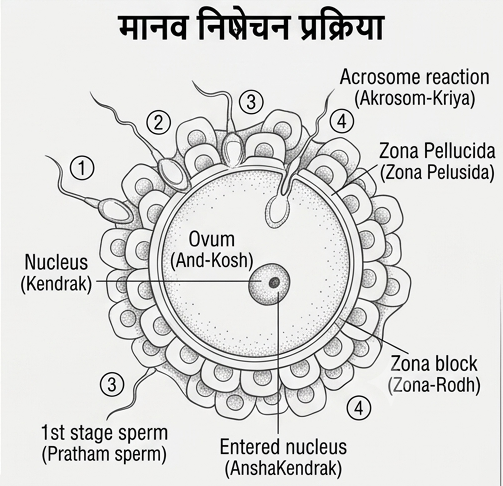
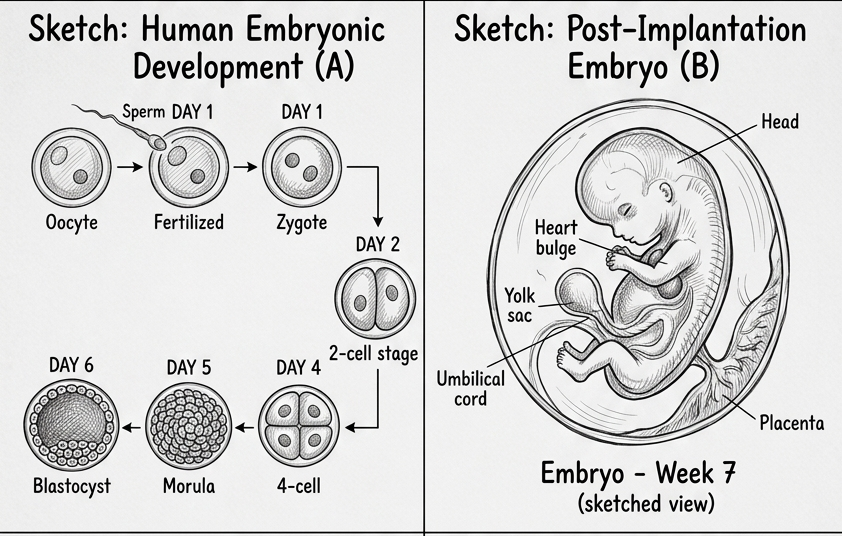
Definition
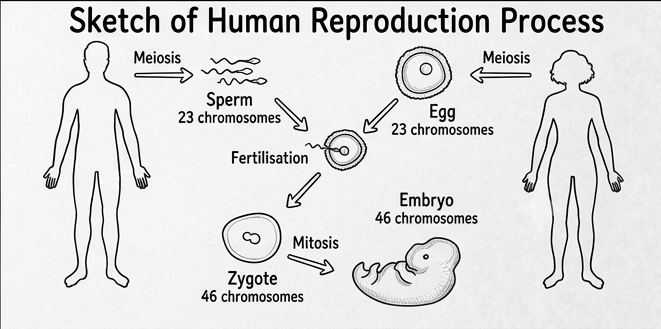
Fusion of sperm and ovum forms a zygote.
Hindi
शुक्राणु और अंडाणु के संलयन से युग्मनज (Zygote) बनता है।
Process
- Ovulation
- Fertilization
- Zygote formation
- Embryo formation
- Foetus development
- Birth
Reproduction in Flowering Plants
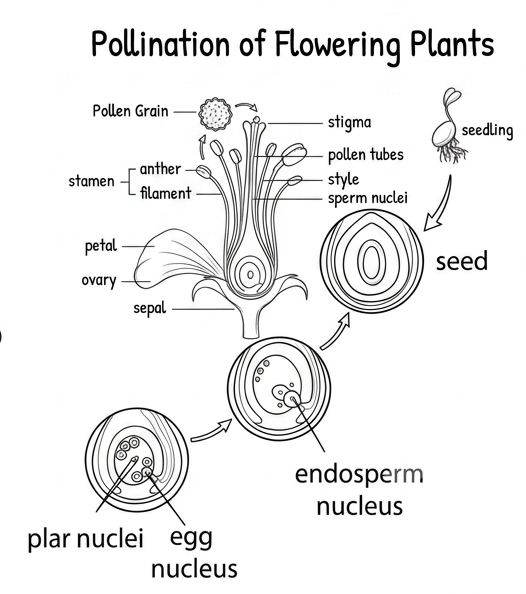
Reproductive Parts of Flower
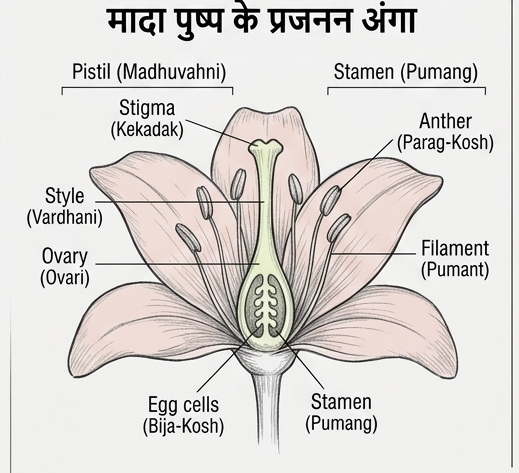
Male Part
Stamen
Contains:
- Anther
- Filament
Female Part
Pistil (Carpel)
Contains:
- Stigma
- Style
- Ovary
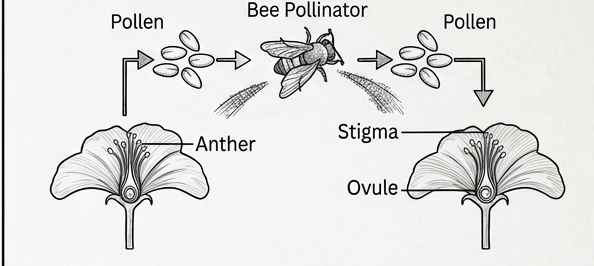
Pollination
Transfer of pollen grains from anther to stigma.
Types
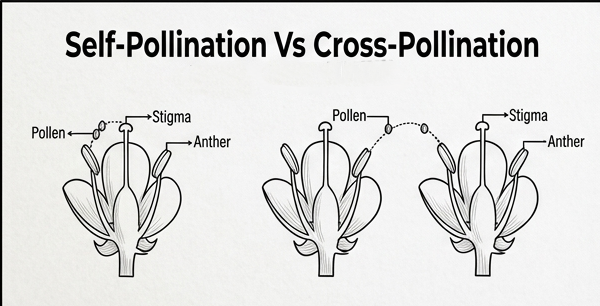
Self-Pollination
Same flower or same plant.
Cross-Pollination
Different plants of same species.
Agents
- Wind
- Water
- Insects
- Birds
Fertilization in Plants
After pollination:
- Pollen tube develops.
- Male gamete reaches ovule.
- Fertilization occurs.
- Zygote forms.
- Seed develops.
- Ovary becomes fruit.
Hindi
परागण के बाद पराग नलिका बनती है। नर युग्मक बीजांड तक पहुँचकर निषेचन करता है। इसके बाद बीज और फल बनते हैं।
Reproductive Health
Meaning
Maintaining physical, mental, and social well-being related to reproduction.
Important Measures
- Personal hygiene
- Balanced diet
- Awareness about STDs
- Medical consultation when required
Hindi
प्रजनन स्वास्थ्य का अर्थ है प्रजनन से संबंधित शारीरिक, मानसिक एवं सामाजिक स्वास्थ्य का संरक्षण।
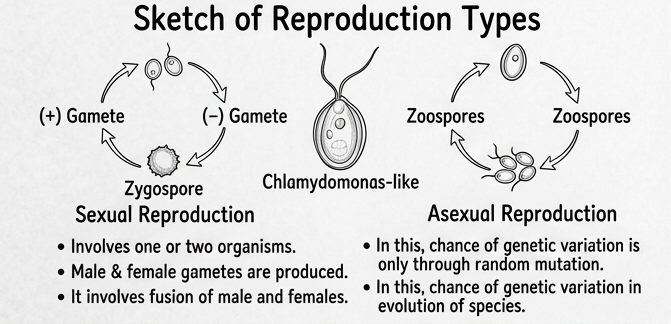
Difference Between Asexual and Sexual Reproduction
| Feature | Asexual | Sexual |
|---|---|---|
| Parents | One | Two |
| Gametes | Absent | Present |
| Variation | Very Less | High |
| Speed | Fast | Slow |
| Examples | Amoeba, Hydra | Humans, Flowering Plants |
Abbreviations
| Abbreviation | Full Form |
|---|---|
| DNA | Deoxyribonucleic Acid |
| RNA | Ribonucleic Acid |
| STD | Sexually Transmitted Disease |
| HIV | Human Immunodeficiency Virus |
| AIDS | Acquired Immunodeficiency Syndrome |
| CBSE | Central Board of Secondary Education |
Key Points for Quick Revision
- Reproduction ensures continuity of species.
- Two types: Asexual and Sexual.
- Binary fission occurs in Amoeba.
- Budding occurs in Hydra and Yeast.
- Vegetative propagation is common in plants.
- Sexual reproduction creates variation.
- Fertilization forms a zygote.
- Testes produce sperm.
- Ovaries produce ova.
- Pollination is transfer of pollen grains.
- Fertilization leads to seed formation.
- Variations are important for evolution.
Exam-Oriented Questions
Very Short Answer
Q1. What is reproduction?
Ans: The process of producing new individuals of the same species.
Q2. Name one organism reproducing by budding.
Ans: Hydra.
Short Answer
Q3. Differentiate between asexual and sexual reproduction.
Ans:
Asexual reproduction involves one parent and no gamete fusion, while sexual reproduction involves two parents and fusion of gametes.
Long Answer
Q4. Explain fertilization in humans.
Ans:
Fertilization occurs when sperm fuses with ovum in the fallopian tube forming a zygote. The zygote develops into an embryo and later into a foetus.
Frequently Asked Questions (FAQs)
Q1. Why is reproduction necessary?
It ensures survival and continuity of species.
Q2. What is vegetative propagation?
A method of producing new plants from stems, roots, or leaves.
Q3. What is fertilization?
Fusion of male and female gametes.
Q4. Why is variation important?
It helps organisms adapt and evolve.
Conclusion
Reproduction is the fundamental process that ensures the continuity of life on Earth. From simple binary fission in Amoeba to complex sexual reproduction in humans and flowering plants, every organism follows a reproductive strategy for survival. Understanding this chapter helps students build a strong foundation in Biology and prepares them for board examinations as well as future competitive exams.
हिंदी निष्कर्ष
प्रजनन पृथ्वी पर जीवन की निरंतरता का आधार है। अमीबा के द्विखंडन से लेकर मनुष्य और पुष्पीय पौधों के जटिल लैंगिक प्रजनन तक, सभी जीव अपनी प्रजाति को बनाए रखने के लिए प्रजनन करते हैं। यह अध्याय बोर्ड परीक्षा एवं प्रतियोगी परीक्षाओं दोनों के लिए अत्यंत महत्वपूर्ण है।
Motivational Line
“Life continues through reproduction, but progress continues through knowledge.”
© PKumar | Rising Star Mindset
Visit: Rising Star Mindset
3 thoughts on “How Do Organisms Reproduce Class 10 Complete Notes”