
Table of Contents
- Introduction
- Background of Quit India Movement
- Quit India Movement (1942)
- Major Features of Quit India Movement
- Revolutionary Activities During Freedom Struggle
- Important Revolutionaries
- Role of INA (Indian National Army)
- Events Leading to Independence
- Indian Independence Act 1947
- Partition of India
- Key Facts & Timeline
- Abbreviations
- Frequently Asked Questions
- Conclusion
- Related Post : Quit India Day 2026: Why Is 8 August Important?
1. Introduction ( Quit India Movement )
The final phase of India’s freedom struggle witnessed mass movements ( Quit India Movement ), revolutionary activities, armed resistance, and political negotiations that eventually led to India’s independence on 15 August 1947.
भारत के स्वतंत्रता संग्राम का अंतिम चरण जन आंदोलनों, क्रांतिकारी गतिविधियों, सशस्त्र संघर्ष और राजनीतिक वार्ताओं से भरा हुआ था, जिसके परिणामस्वरूप 15 अगस्त 1947 को भारत स्वतंत्र हुआ।
2. Background of Quit India Movement
English
During World War II, Britain involved India in the war without consulting Indian leaders. The failure of the Cripps Mission (1942) convinced Indian leaders that complete independence was the only solution.
हिंदी
द्वितीय विश्व युद्ध के दौरान ब्रिटेन ने भारतीय नेताओं से सलाह लिए बिना भारत को युद्ध में शामिल कर दिया। 1942 में क्रिप्स मिशन की विफलता ने भारतीय नेताओं को यह विश्वास दिलाया कि पूर्ण स्वतंत्रता ही एकमात्र समाधान है।
3. Quit India Movement (1942)
English
The Quit India Movement was launched by Mahatma Gandhi on 8 August 1942 at Bombay (Mumbai).
Famous Slogan:
“Do or Die”
Objectives:
- End British rule immediately.
- Achieve complete independence.
- Unite Indians against colonial rule.
Major Events:
- Congress leaders were arrested.
- Students and workers participated actively.
- Railways, communication systems, and government offices became targets of protests.
- Underground movements emerged across India.
हिंदी
भारत छोड़ो आंदोलन की शुरुआत महात्मा गांधी ने 8 अगस्त 1942 को बॉम्बे (मुंबई) में की।
प्रसिद्ध नारा:
“करो या मरो”
उद्देश्य:
- ब्रिटिश शासन को तुरंत समाप्त करना।
- पूर्ण स्वतंत्रता प्राप्त करना।
- भारतीयों को एकजुट करना।
प्रमुख घटनाएँ:
- कांग्रेस नेताओं को गिरफ्तार कर लिया गया।
- छात्रों और श्रमिकों ने सक्रिय भागीदारी की।
- रेलवे, संचार तंत्र और सरकारी संस्थानों के खिलाफ आंदोलन हुए।
- भूमिगत आंदोलन विकसित हुए।
4. Major Features of Quit India Movement
| English | हिंदी |
|---|---|
| Mass participation | जनसामान्य की भागीदारी |
| Leaderless phase after arrests | गिरफ्तारियों के बाद नेतृत्वहीन चरण |
| Spread across India | पूरे भारत में विस्तार |
| Strong British repression | ब्रिटिश दमन |
| Rise of underground networks | भूमिगत संगठनों का विकास |
5. Revolutionary Activities
English
Apart from non-violent movements, revolutionary groups continued their struggle against British rule.
Important Activities:
- Secret organizations.
- Armed resistance.
- Distribution of nationalist literature.
- Underground radio broadcasts.
- Youth mobilization.
हिंदी
अहिंसक आंदोलनों के साथ-साथ क्रांतिकारी संगठनों ने भी ब्रिटिश शासन के विरुद्ध संघर्ष जारी रखा।
प्रमुख गतिविधियाँ:
- गुप्त संगठन।
- सशस्त्र प्रतिरोध।
- राष्ट्रवादी साहित्य का प्रचार।
- भूमिगत रेडियो प्रसारण।
- युवाओं का संगठन।
6. Important Revolutionaries
| Revolutionary | Contribution |
|---|---|
| Bhagat Singh | Revolutionary nationalism |
| Chandrashekhar Azad | Hindustan Socialist Republican Association |
| Ram Prasad Bismil | Kakori Movement |
| Ashfaqulla Khan | Revolutionary activities |
| Surya Sen | Chittagong Armoury Raid |
हिंदी
इन क्रांतिकारियों ने युवाओं में देशभक्ति और बलिदान की भावना को मजबूत किया तथा स्वतंत्रता आंदोलन को नई दिशा दी।
7. Role of INA (Indian National Army)
English
Subhas Chandra Bose reorganized the INA and inspired Indians with the slogan:
“Give Me Blood and I Will Give You Freedom”
The INA fought against British forces and significantly influenced Indian soldiers.
हिंदी
सुभाष चंद्र बोस ने आजाद हिंद फौज (INA) का पुनर्गठन किया और भारतीयों को प्रेरित किया।
प्रसिद्ध नारा:
“तुम मुझे खून दो, मैं तुम्हें आजादी दूंगा”
INA ने ब्रिटिश शासन के विरुद्ध संघर्ष में महत्वपूर्ण भूमिका निभाई।
8. Events Leading to Independence
Timeline
| Year | Event |
|---|---|
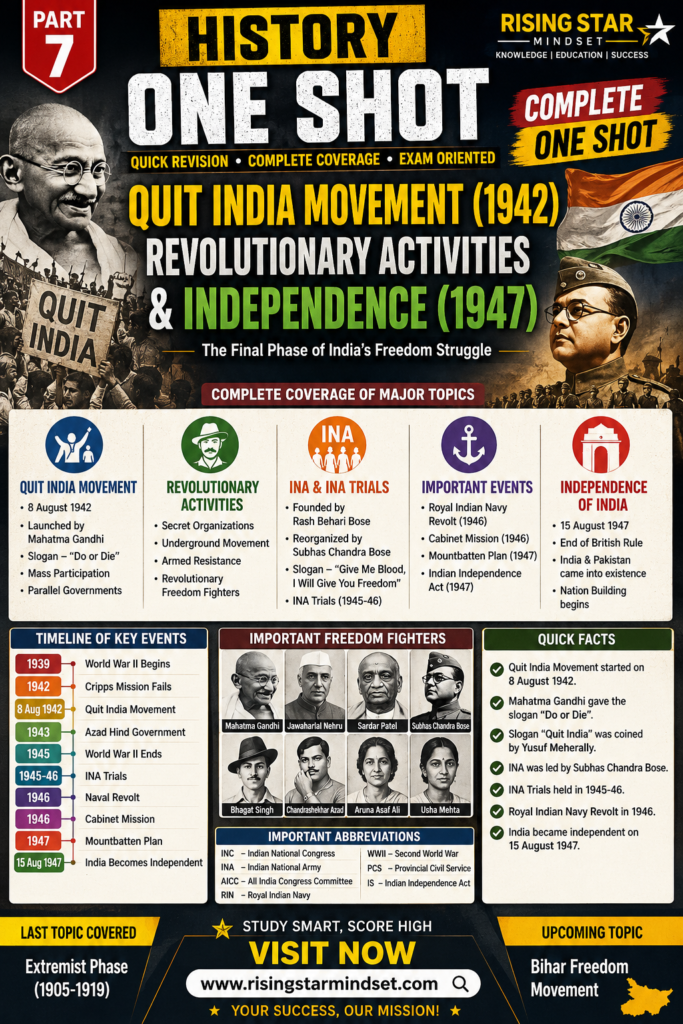
| 1942 | Quit India Movement |
| 1945 | End of World War II |
| 1945–46 | INA Trials |
| 1946 | Royal Indian Navy Revolt |
| 1946 | Cabinet Mission |
| 1947 | Mountbatten Plan |
| 1947 | Independence Act |
| 15 August 1947 | India became independent |
9. Indian Independence Act 1947
English
The British Parliament passed the Indian Independence Act in July 1947.
Main Provisions:
- Creation of India and Pakistan.
- End of British authority.
- Transfer of power to Indian leaders.
हिंदी
ब्रिटिश संसद ने जुलाई 1947 में भारतीय स्वतंत्रता अधिनियम पारित किया।
मुख्य प्रावधान:
- भारत और पाकिस्तान का गठन।
- ब्रिटिश शासन का अंत।
- भारतीय नेताओं को सत्ता का हस्तांतरण।
10. Partition of India
English
India was divided into India and Pakistan. Partition caused large-scale migration and communal violence.
हिंदी
भारत का विभाजन भारत और पाकिस्तान में हुआ। विभाजन के दौरान बड़े पैमाने पर जन-स्थानांतरण और सांप्रदायिक हिंसा हुई।
11. Key Facts for Exams ( Quit India Movement )
English
- Quit India Movement launched on 8 August 1942.
- Gandhi gave the slogan “Do or Die.”
- INA was led by Subhas Chandra Bose.
- Royal Indian Navy Revolt occurred in 1946.
- India became independent on 15 August 1947.
हिंदी
- भारत छोड़ो आंदोलन 8 अगस्त 1942 को शुरू हुआ।
- गांधीजी ने “करो या मरो” का नारा दिया।
- INA का नेतृत्व सुभाष चंद्र बोस ने किया।
- 1946 में नौसेना विद्रोह हुआ।
- भारत 15 अगस्त 1947 को स्वतंत्र हुआ।
12. Abbreviations
| Abbreviation | Full Form |
|---|---|
| INC | Indian National Congress |
| INA | Indian National Army |
| RIN | Royal Indian Navy |
| WWII | Second World War |
| AICC | All India Congress Committee |
| PCS | Provincial Civil Service |
13. Frequently Asked Questions (FAQ)
Q1. Quit India Movement was launched in which year?
Answer: 1942
Q2. Who gave the slogan “Do or Die”?
Answer: Mahatma Gandhi
Q3. Who led the INA?
Answer: Subhas Chandra Bose
Q4. When did India become independent?
Answer: 15 August 1947
Q5. Which event is considered the final mass movement against British rule?
Answer: Quit India Movement
Quick Revision Box ( Quit India Movement )
- Quit India Movement – 1942
- Slogan – Do or Die
- INA – Subhas Chandra Bose
- RIN Revolt – 1946
- Independence Act – 1947
- Independence Day – 15 August 1947
- Partition – India & Pakistan
Conclusion
The Quit India Movement, revolutionary activities, INA struggle, and political negotiations together weakened British authority and accelerated India’s path toward independence. These events form one of the most important chapters in modern Indian history and remain highly relevant for competitive examinations.
हिंदी निष्कर्ष:
भारत छोड़ो आंदोलन, क्रांतिकारी गतिविधियाँ, आजाद हिंद फौज का संघर्ष तथा राजनीतिक वार्ताएँ मिलकर ब्रिटिश शासन को कमजोर करने में सफल रहीं। इन घटनाओं ने भारत की स्वतंत्रता का मार्ग प्रशस्त किया और आधुनिक भारतीय इतिहास में अत्यंत महत्वपूर्ण स्थान प्राप्त किया।
© Rising Star Mindset
Knowledge • Education • Competitive Exam Preparation
🌐 Visit: www.risingstarmindset.com
Upcoming Part No. 8
Bihar Freedom Movement – Role of Bihar in India’s Independence Struggle 🇮🇳
4 thoughts on “Complete Notes on Quit India Movement and Independence 1947”