
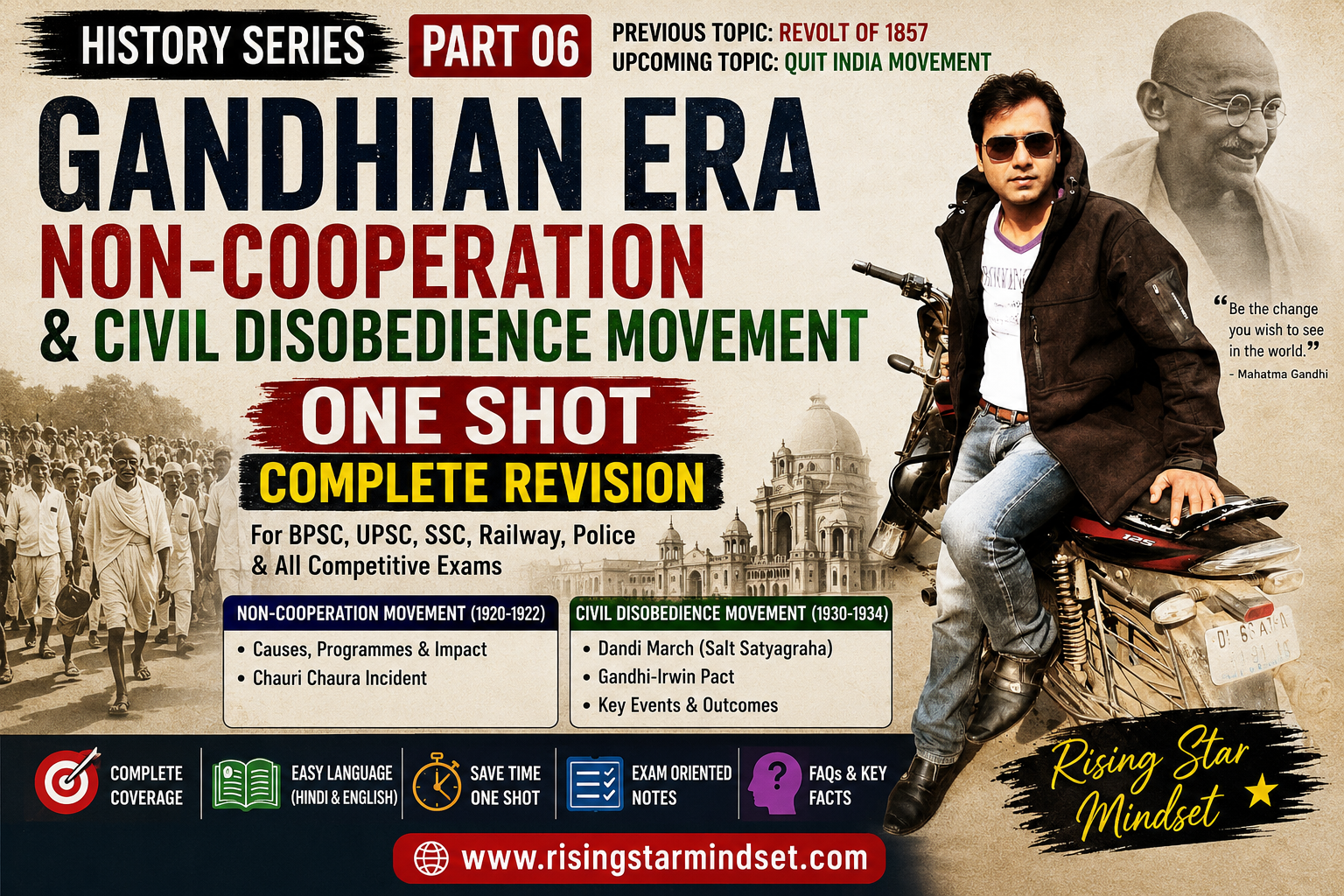
📚 History Series – Part 06
Previous Topic Covered
✅ Revolt of 1857 ( Gandhian Movements: Most Important Notes )
Current Topics
| Gandhian Era |
| Non-Cooperation Movement (1920–1922) |
| Civil Disobedience Movement (1930–1934) |
Upcoming Topic
➡ Quit India Movement (1942)
Table of Contents ( Gandhian Movements: Most Important Notes )
- Introduction to Gandhian Era
- Arrival of Mahatma Gandhi in India
- Principles of Gandhian Philosophy
- Non-Cooperation Movement
- Causes of Non-Cooperation Movement
- Features and Programmes
- Chauri Chaura Incident
- Civil Disobedience Movement
- Dandi March (Salt Satyagraha)
- Gandhi-Irwin Pact
- Importance of Gandhian Movements
- Key Facts for Exams
- Timeline
- FAQs
- Conclusion
Introduction to Gandhian Era ( Gandhian Movements: Most Important Notes )
English
The Gandhian Era marks one of the most important phases of the Indian National Movement. After returning from South Africa in 1915, Mahatma Gandhi transformed India’s freedom struggle into a mass movement involving peasants, workers, women, and students.
हिंदी
गांधी युग भारतीय स्वतंत्रता आंदोलन का सबसे महत्वपूर्ण चरण माना जाता है। 1915 में दक्षिण अफ्रीका से भारत लौटने के बाद महात्मा गांधी ने स्वतंत्रता संघर्ष को जन-आंदोलन का रूप दिया जिसमें किसान, मजदूर, महिलाएँ और विद्यार्थी बड़ी संख्या में शामिल हुए।
Arrival of Mahatma Gandhi in India ( Gandhian Movements: Most Important Notes )
English
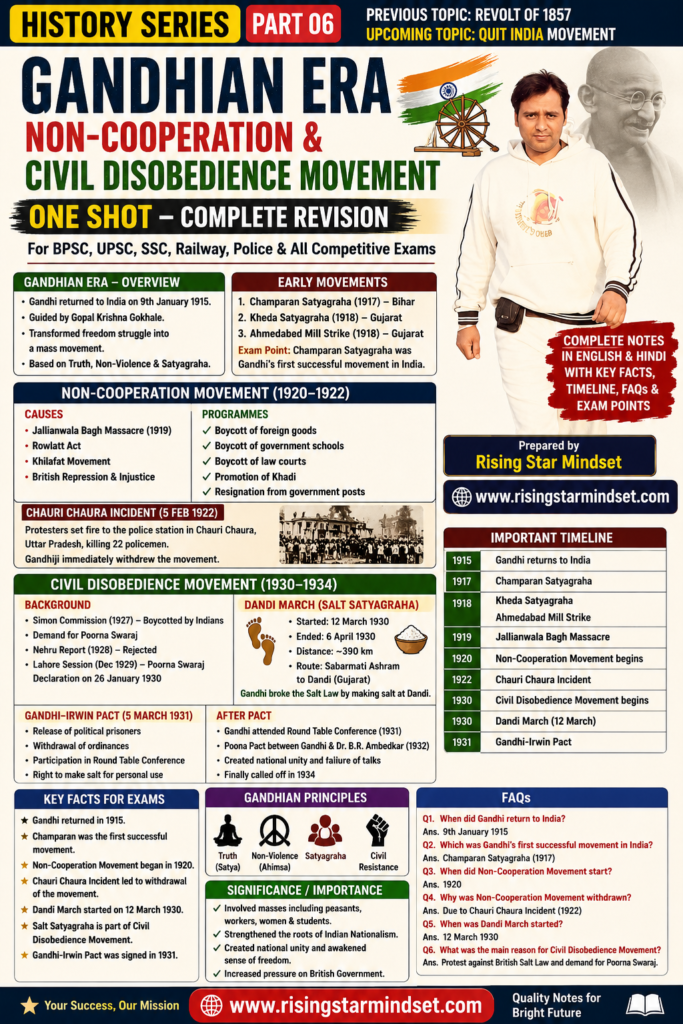
- Gandhi returned to India on 9 January 1915.
- He was guided by Gopal Krishna Gokhale.
- Initially, Gandhi studied Indian society before entering active politics.
हिंदी
- गांधी जी 9 जनवरी 1915 को भारत लौटे।
- उनके राजनीतिक गुरु गोपाल कृष्ण गोखले थे।
- उन्होंने प्रारंभ में भारतीय समाज और समस्याओं का अध्ययन किया।
Major Early Movements of Gandhi ( Gandhian Movements: Most Important Notes )
| Movement | Year | Place |
|---|---|---|
| Champaran Satyagraha | 1917 | Bihar |
| Kheda Satyagraha | 1918 | Gujarat |
| Ahmedabad Mill Strike | 1918 | Gujarat |
Exam Point
Champaran Satyagraha was Gandhi’s first successful movement in India.
परीक्षा बिंदु
चंपारण सत्याग्रह भारत में गांधीजी का पहला सफल आंदोलन था।
Principles of Gandhian Philosophy ( Gandhian Movements: Most Important Notes )
English
- Truth (Satya)
- Non-Violence (Ahimsa)
- Satyagraha
- Civil Resistance
- Peaceful Protest
हिंदी
- सत्य
- अहिंसा
- सत्याग्रह
- सविनय अवज्ञा
- शांतिपूर्ण विरोध
Non-Cooperation Movement (1920–1922) ( Gandhian Movements: Most Important Notes )
Introduction
The Non-Cooperation Movement was launched by Mahatma Gandhi in 1920 against British rule.
हिंदी
असहयोग आंदोलन 1920 में महात्मा गांधी द्वारा ब्रिटिश शासन के विरोध में शुरू किया गया था।
Causes of Non-Cooperation Movement
English
- Jallianwala Bagh Massacre (1919)
- Rowlatt Act
- Khilafat Movement
- British repression
हिंदी
- जलियांवाला बाग हत्याकांड
- रॉलेट एक्ट
- खिलाफत आंदोलन
- ब्रिटिश दमनकारी नीतियाँ
Programmes of Non-Cooperation Movement
English
- Refrain from using foreign goods
- Boycott of government schools
- Boycott of law courts
- Promotion of Khadi
- Resignation from government posts
हिंदी
- विदेशी वस्तुओं का बहिष्कार
- सरकारी विद्यालयों का बहिष्कार
- न्यायालयों का बहिष्कार
- खादी का प्रचार
- सरकारी पदों से त्यागपत्र
Chauri Chaura Incident (1922)
English
In February 1922, protesters set fire to a police station in Chauri Chaura, Uttar Pradesh, resulting in the death of policemen.
Gandhi immediately withdrew the Non-Cooperation Movement.
हिंदी
फरवरी 1922 में चौरी-चौरा (उत्तर प्रदेश) में प्रदर्शनकारियों ने पुलिस थाने में आग लगा दी, जिससे कई पुलिसकर्मियों की मृत्यु हो गई।
गांधीजी ने तुरंत असहयोग आंदोलन वापस ले लिया।
Civil Disobedience Movement (1930–1934)
Introduction
The Civil Disobedience Movement was launched in 1930 to challenge unjust British laws.
हिंदी
सविनय अवज्ञा आंदोलन 1930 में ब्रिटिश सरकार के अन्यायपूर्ण कानूनों के विरोध में शुरू किया गया।
Dandi March (Salt Satyagraha)
English
- Started: 12 March 1930
- Ended: 6 April 1930
- Distance: Approximately 390 km
- Route: Sabarmati Ashram to Dandi
Gandhi broke the Salt Law by making salt at Dandi.
हिंदी
- प्रारंभ: 12 मार्च 1930
- समाप्ति: 6 अप्रैल 1930
- दूरी: लगभग 390 किमी
- मार्ग: साबरमती आश्रम से दांडी
गांधीजी ने दांडी पहुँचकर नमक कानून तोड़ा।
Gandhi-Irwin Pact (1931)
English
Key Provisions:
- Release of political prisoners
- Participation in Round Table Conference
- Peaceful protests allowed
हिंदी
मुख्य प्रावधान:
- राजनीतिक कैदियों की रिहाई
- गोलमेज सम्मेलन में भागीदारी
- शांतिपूर्ण आंदोलनों की अनुमति
Significance of Civil Disobedience Movement
English
- Mass participation of people
- Strengthened nationalism
- Increased pressure on British government
हिंदी
- जनता की व्यापक भागीदारी
- राष्ट्रवाद को मजबूती
- ब्रिटिश सरकार पर दबाव
Important Timeline
| Year | Event |
| 1915 | Gandhi returned to India |
| 1917 | Champaran Satyagraha |
| 1918 | Kheda Satyagraha |
| 1919 | Jallianwala Bagh Massacre |
| 1920 | Non-Cooperation Movement |
| 1922 | Chauri Chaura Incident |
| 1930 | Civil Disobedience Movement |
| 1930 | Dandi March |
| 1931 | Gandhi-Irwin Pact |
Key Facts for Competitive Exams
English
- Gandhi returned in 1915.
- Champaran was Gandhi’s first successful movement.
- Non-Cooperation Movement began in 1920.
- Chauri Chaura led to withdrawal of the movement.
- Dandi March started on 12 March 1930.
- Salt Satyagraha is part of Civil Disobedience Movement.
हिंदी
- गांधीजी 1915 में भारत लौटे।
- चंपारण गांधीजी का पहला सफल आंदोलन था।
- असहयोग आंदोलन 1920 में शुरू हुआ।
- चौरी-चौरा घटना के बाद आंदोलन वापस लिया गया।
- दांडी मार्च 12 मार्च 1930 को शुरू हुआ।
- नमक सत्याग्रह सविनय अवज्ञा आंदोलन का हिस्सा था।
Frequently Asked Questions (FAQs)
Q1. Gandhi returned to India in which year?
Answer
1915
Q2. Which movement was launched in 1920?
Answer
Non-Cooperation Movement
Q3. Why was the Non-Cooperation Movement withdrawn?
Answer
Due to the Chauri Chaura Incident.
Q4. What is Dandi March?
Answer
A protest march led by Gandhi against the British Salt Law.
Q5. What was the Gandhi-Irwin Pact?
Answer
An agreement signed between Mahatma Gandhi and Lord Irwin in 1931.
Conclusion
English
The Gandhian Era transformed India’s freedom struggle into a mass movement. Through Non-Cooperation and Civil Disobedience Movements, Gandhi mobilized millions of Indians and laid the foundation for the final phase of India’s independence movement.
हिंदी
गांधी युग ने भारतीय स्वतंत्रता संघर्ष को जन-आंदोलन का रूप दिया। असहयोग आंदोलन और सविनय अवज्ञा आंदोलन ने लाखों भारतीयों को स्वतंत्रता संग्राम से जोड़ा और स्वतंत्रता प्राप्ति का मार्ग प्रशस्त किया।
Next Topic in History Series
➡ Quit India Movement (1942)
Previous Topic
⬅ Revolt of 1857
© Rising Star Mindset
www.risingstarmindset.com
BPSC | UPSC | SSC | School Education Notes
3 thoughts on “Gandhian Movements: Most Important Notes”