
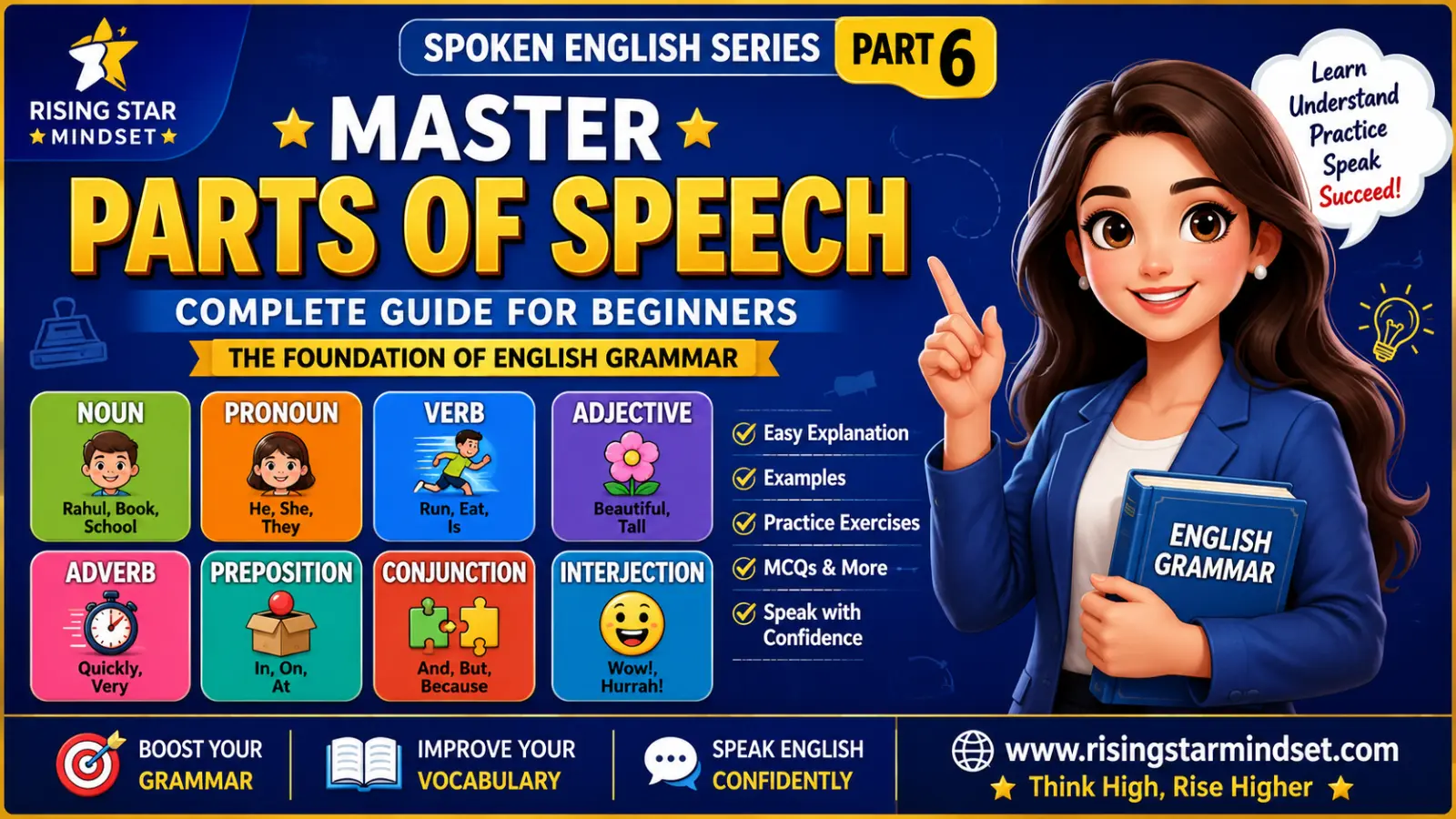
Parts of Speech in English: Complete Guide for Beginners
Table of Contents ( Parts of Speech in English )
- Introduction
- What are Parts of Speech?
- Why are Parts of Speech Important?
- Abbreviations
- Key Points
- Types of Parts of Speech
- Noun
- Pronoun
- Verb
- Adjective
- Adverb
- Preposition
- Conjunction
- Interjection
- Memory Tricks
- Common Mistakes
- Practice Exercises
- Summary Table
- MCQs
- HOTS Questions
- Fill in the Blanks
- Match the Following
- Daily Speaking Challenge
- Viewer Assignment
- FAQs
- Conclusion
- Previous post : Daily Use English Words: 700+ Most Important for Beginners
Introduction ( Parts of Speech in English )
English
Grammar is the backbone of every language, and Parts of Speech are the building blocks of English grammar. Every sentence you speak, read, or write is made up of different kinds of words, and each word has a specific role. ( Parts of Speech in English )
Understanding Parts of Speech helps you create grammatically correct sentences, improve your spoken English, write more effectively, and communicate with confidence. Whether you are a beginner, a school student, or preparing for competitive exams, mastering these eight categories will make learning English much easier.
In this complete guide, you will learn all eight Parts of Speech with simple explanations, Hindi meanings, rules, real-life examples, memory tricks, and practice questions.
हिन्दी
Grammar (व्याकरण) किसी भी भाषा की मजबूत नींव होती है और Parts of Speech अंग्रेज़ी व्याकरण के सबसे महत्वपूर्ण आधार हैं। हम जो भी अंग्रेज़ी बोलते, पढ़ते या लिखते हैं, उसमें प्रत्येक शब्द का एक अलग कार्य होता है। इन्हीं कार्यों के आधार पर शब्दों को Parts of Speech कहा जाता है।
यदि आप सही अंग्रेज़ी बोलना, लिखना और समझना चाहते हैं, तो Parts of Speech सीखना बहुत आवश्यक है। यह विषय स्कूल के विद्यार्थियों, प्रतियोगी परीक्षा की तैयारी करने वाले अभ्यर्थियों और Spoken English सीखने वाले सभी लोगों के लिए समान रूप से उपयोगी है।
इस लेख में हम आठों Parts of Speech को आसान भाषा, हिन्दी अर्थ, नियम, उदाहरण, याद रखने की ट्रिक और अभ्यास प्रश्नों के साथ विस्तार से समझेंगे।
Abbreviations ( Parts of Speech in English )
| Abbreviation | Full Form |
| N. | Noun |
| Pro. | Pronoun |
| V. | Verb |
| Adj. | Adjective |
| Adv. | Adverb |
| Prep. | Preposition |
| Conj. | Conjunction |
| Interj. | Interjection |
Key Points ( Parts of Speech in English )
- Help in making correct and meaningful English sentences.
- Build a strong foundation in English grammar.
- Improve speaking, writing, reading, and communication skills.
- Make sentence formation easier and more accurate.
- Increase confidence in everyday English conversations.
- Support better performance in school, competitive exams, and interviews.
- Enable learners to understand grammar rules more effectively.
- Provide the essential base for learning advanced English topics
- Regular practice makes them easy to understand.
What are Parts of Speech?
English
Words perform different jobs in a sentence. Based on their functions, they are divided into different categories known as Parts of Speech.
Simply put, Parts of Speech tell us what a word does in a sentence rather than just what it means.
Example
Riya reads an interesting book every day.
Here,
- Riya → Noun
- reads → Verb
- interesting → Adjective
- book → Noun
- every → Adjective
- day → Noun
Each word performs a different function.
हिन्दी
वाक्य में प्रत्येक शब्द का अपना एक अलग कार्य होता है। शब्द के इसी कार्य के आधार पर उसे अलग–अलग श्रेणियों में रखा जाता है। इन्हीं श्रेणियों को Parts of Speech कहते हैं।
सरल शब्दों में,
“किसी शब्द का वाक्य में क्या कार्य है, वही उसका Part of Speech कहलाता है।“
Why are Parts of Speech Important?
Learning Parts of Speech helps you:
| Speak grammatically correct English. |
| Write better sentences. |
| Improve communication skills. |
| Understand English books easily. |
| Perform well in interviews. |
| Score higher in school examinations. |
| Prepare for competitive exams like BPSC, SSC, Banking, UPSC, and Railways. |
| Build a strong grammar foundation. |
Types of Parts of Speech
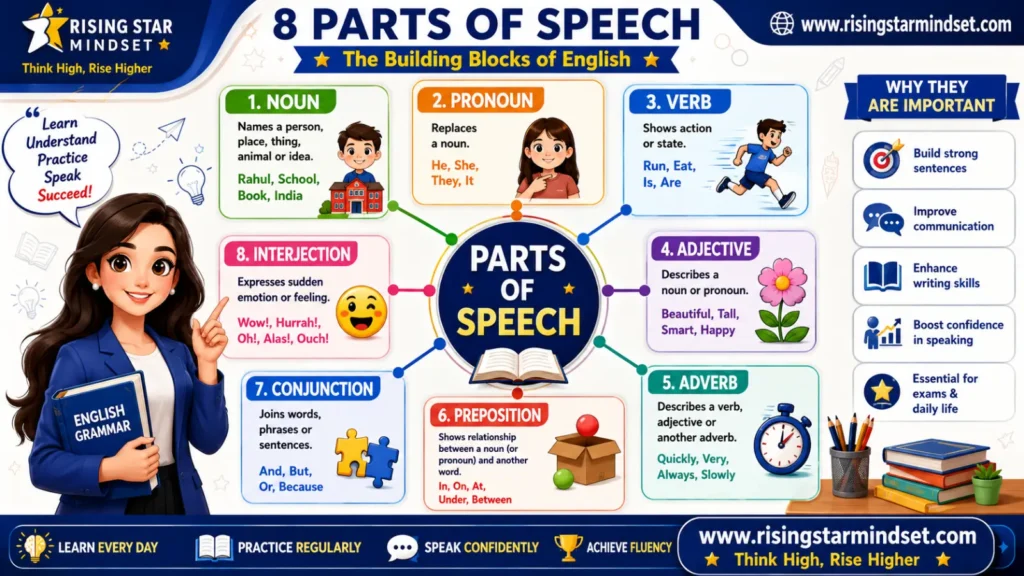
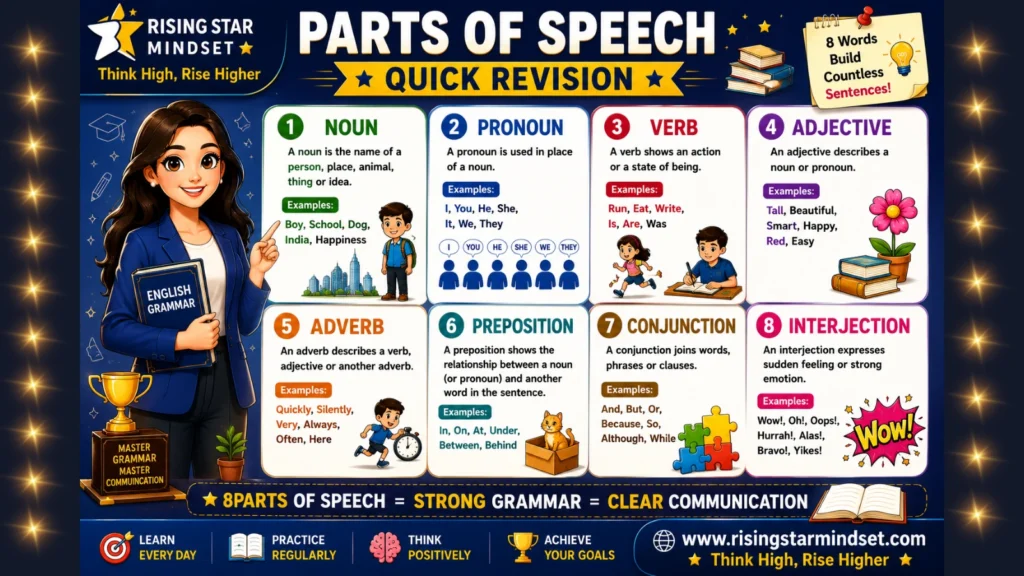
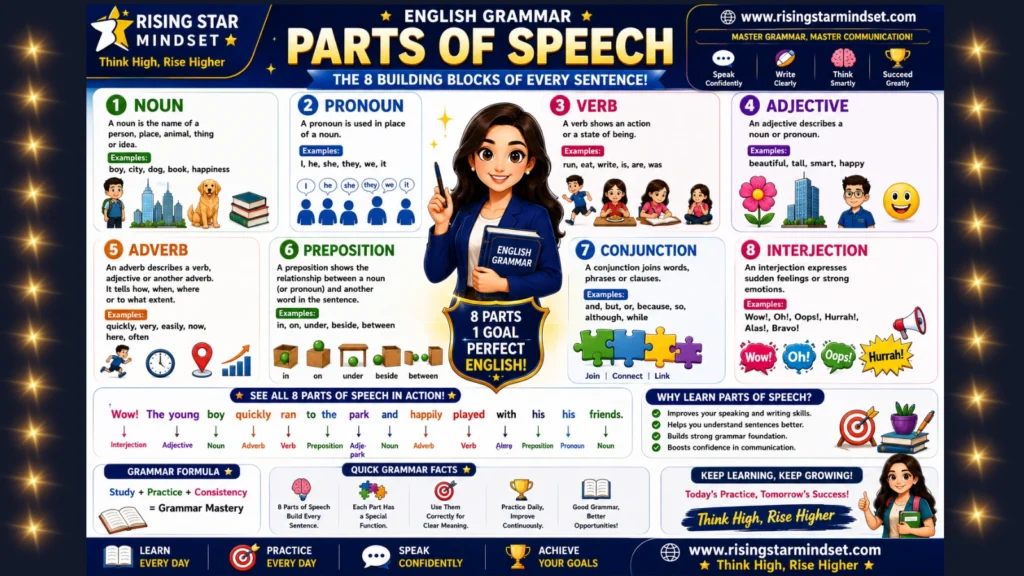
There are Eight Parts of Speech in English Grammar.
| No. | Part of Speech | Function |
| 1 | Noun | Names a person, place, thing, or idea |
| 2 | Pronoun | Replaces a noun |
| 3 | Verb | Shows action or state |
| 4 | Adjective | Describes a noun or pronoun |
| 5 | Adverb | Describes a verb, adjective, or another adverb |
| 6 | Preposition | Shows relationship between words |
| 7 | Conjunction | Joins words or sentences |
| 8 | Interjection | Expresses sudden feelings or emotions |
What is a Noun?
English
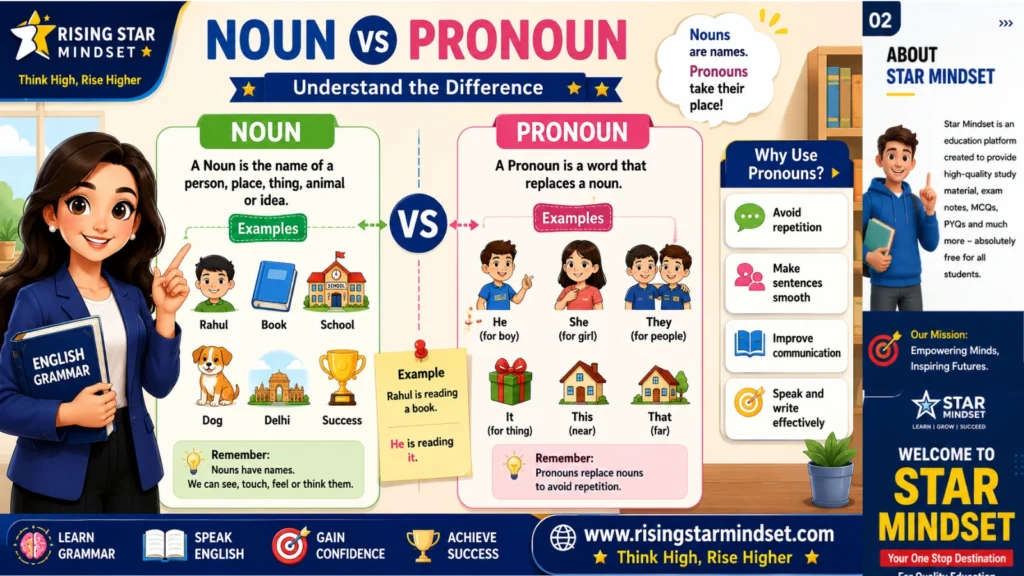
A Noun is a word that names a person, place, animal, thing, idea, quality, or feeling. It is one of the most important Parts of Speech because every sentence usually contains at least one noun.
In simple words, a noun tells us who, what, or where.
Definition
A Noun is the name of a person, place, animal, thing, or idea.
हिन्दी
Noun (संज्ञा) वह शब्द है जो किसी व्यक्ति, स्थान, वस्तु, पशु, भावना, गुण या विचार का नाम बताता है।
सरल भाषा में,
जिस शब्द से किसी व्यक्ति, स्थान, वस्तु, जीव, भावना या विचार का बोध हो, उसे Noun कहते हैं।
Easy Trick to Identify a Noun
यदि किसी शब्द के पहले आप पूछ सकते हैं—
- Who? (कौन?)
- What? (क्या?)
- Which place? (कहाँ?)
- Whose name? (किसका नाम?)
तो वह शब्द अक्सर Noun होता है।
Examples ( Parts of Speech in English )
| Sentence | Noun |
| Rahul is reading a book. | Rahul, book |
| Delhi is the capital of India. | Delhi, capital, India |
| The dog is barking. | Dog |
| My mother is cooking food. | Mother, food |
| Honesty is the best policy. | Honesty, policy |
Where Do We Use Nouns?
Nouns are used everywhere.
- At home
- At school
- In offices
- In newspapers
- During conversations
- While writing essays
- In examinations
Without nouns, meaningful sentences cannot be formed.
Types of Nouns ( Parts of Speech in English )
English Grammar has five main types of nouns.
| Type | Meaning |
| Proper Noun | Specific Name |
| Common Noun | General Name |
| Collective Noun | Group Name |
| Material Noun | Material/Substance |
| Abstract Noun | Quality or Feeling |
Let’s understand each one in detail.
1. Proper Noun
Definition
A Proper Noun is the specific name of a person, place, organization, river, mountain, country, or anything unique.
A Proper Noun always begins with a capital letter.
Hindi
किसी विशेष व्यक्ति, स्थान, संस्था या वस्तु के नाम को Proper Noun कहते हैं।
Examples
- Rahul
- Patna
- Bihar
- India
- Mount Everest
- River Ganga
- Taj Mahal
- Monday
- January
- Diwali
Sentences
Rahul lives in Patna.
India is a beautiful country.
The Ganga is a sacred river.
I visited the Taj Mahal.
Monday is my favourite day.
Rule
Always begin Proper Nouns with Capital Letters.
✅ Rahul
❌ rahul
2. Common Noun
Definition
A Common Noun is the general name of a person, place, animal, or thing.
Hindi
किसी सामान्य व्यक्ति, स्थान, पशु या वस्तु के नाम को Common Noun कहते हैं।
Examples
- boy
- girl
- city
- teacher
- school
- river
- country
- doctor
- student
- car
Sentences
The boy is playing.
The teacher is teaching.
A doctor helps patients.
The student is studying.
The city is crowded.
Proper vs Common Noun
| Proper | Common |
| Rahul | Boy |
| Delhi | City |
| India | Country |
| Ganga | River |
| Himalayas | Mountain |
3. Collective Noun
Definition
A Collective Noun refers to a group of people, animals, or things considered as one unit.
Hindi
जो शब्द किसी समूह का नाम बताए, उसे Collective Noun कहते हैं।
Examples
- Team
- Family
- Class
- Army
- Committee
- Crowd
- Audience
- Jury
- Fleet
- Bouquet
Sentences
The team won the match.
My family is very supportive.
The class is silent.
The army protects the nation.
The audience clapped loudly.
Common Collective Nouns
| Group | Collective Noun |
| Players | Team |
| Students | Class |
| Flowers | Bouquet |
| Soldiers | Army |
| Birds | Flock |
4. Material Noun
Definition
A Material Noun names a substance or material from which things are made.
Hindi
जिस शब्द से किसी पदार्थ या सामग्री का बोध हो, उसे Material Noun कहते हैं।
Examples
- Gold
- Silver
- Water
- Iron
- Wood
- Plastic
- Cotton
- Milk
- Oil
- Glass
Sentences
Gold is expensive.
The chair is made of wood.
Milk is healthy.
Water is essential for life.
Plastic should be recycled.
5. Abstract Noun
Definition
An Abstract Noun refers to a quality, feeling, idea, emotion, or state that cannot be seen or touched.
Hindi
जो शब्द गुण, भाव, विचार या अवस्था का बोध कराए और जिसे देखा या छुआ न जा सके, उसे Abstract Noun कहते हैं।
Examples
- Honesty
- Kindness
- Beauty
- Wisdom
- Happiness
- Love
- Courage
- Friendship
- Freedom
- Success
Sentences
Honesty is the best policy.
Love makes life beautiful.
Success requires hard work.
Kindness wins hearts.
Friendship is valuable.
Memory Trick ( Parts of Speech in English )
P C C M A
Remember this sequence:
P → Proper
C → Common
C → Collective
M → Material
A → Abstract
👉 PCCMA = All Five Types of Nouns.
Common Mistakes ( Parts of Speech in English )
❌ Rahul is a boy. (Rahul written as “rahul”)
✅ Rahul is a boy.
❌ gold is costly.
✅ Gold is costly.
❌ honesty is important.
✅ Honesty is important.
❌ The Team are winning. (जब Team को एक इकाई माना जाए)
✅ The team is winning.
Spoken English Examples ( Parts of Speech in English )
A: Who is your favourite teacher?
B: Mr. Sharma.
(Proper Noun)
A: Where do you live?
B: I live in Patna.
(Proper Noun)
A: What is on the table?
B: A book.
(Common Noun)
A: What is your biggest strength?
B: Honesty.
(Abstract Noun)
Exam Tips ( Parts of Speech in English )
- Proper Noun हमेशा Capital Letter से शुरू होता है।
- Abstract Noun को देखा या छुआ नहीं जा सकता।
- Material Noun किसी पदार्थ का नाम बताता है।
- Collective Noun समूह का नाम बताता है।
- Common Noun सामान्य नाम होता है।
Practice Exercise ( Parts of Speech in English )
Identify the Nouns
- Mohan lives in Delhi.
- The dog is sleeping.
- Gold is precious.
- Honesty is admired.
- Our team played well.
Answers:
- Mohan, Delhi
- Dog
- Gold
- Honesty
- Team
What is a Pronoun?
English
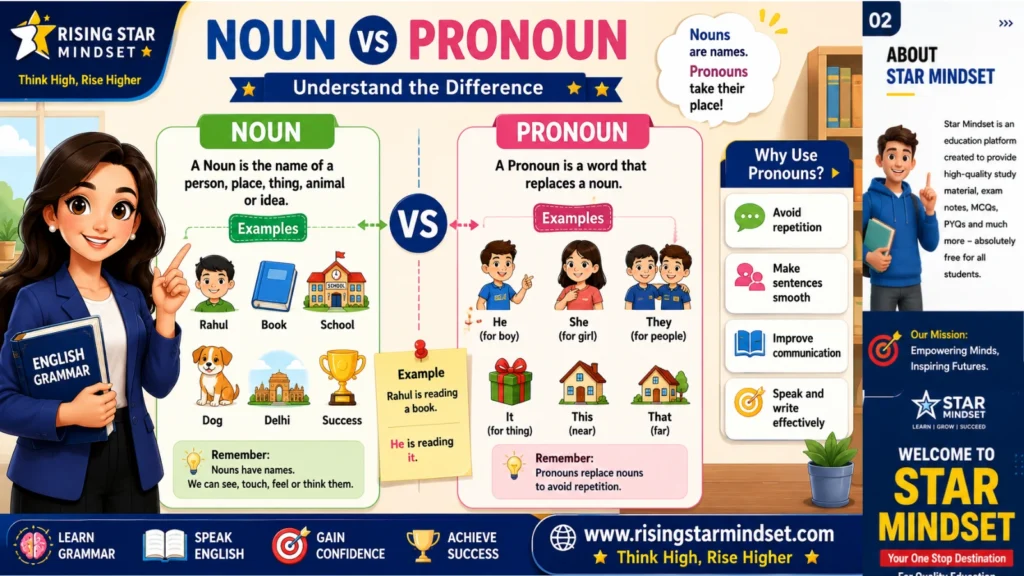
A Pronoun is a word that is used instead of a noun. It helps us avoid repeating the same noun again and again, making our sentences smoother and easier to understand.
Definition
A Pronoun is a word used in place of a noun.
हिन्दी
Pronoun (सर्वनाम) वह शब्द है जो Noun (संज्ञा) के स्थान पर प्रयोग किया जाता है।
यदि किसी वाक्य में एक ही Noun बार-बार आए, तो उसकी जगह Pronoun का प्रयोग किया जाता है। इससे वाक्य अधिक सरल, स्पष्ट और प्रभावशाली बनता है।
Why Do We Use Pronouns?
Without pronouns, English sentences become repetitive.
Incorrect
Rahul is a good student. Rahul studies every day.
Correct
Rahul is a good student. He studies every day. He helps his friends.
Pronouns make English natural and fluent.
Examples ( Parts of Speech in English )
| Noun | Pronoun |
| Rahul | He |
| Sita | She |
| Book | It |
| Students | They |
| Ravi and Mohan | They |
| My sister | She |
| My parents | They |
| Dog | It |
Types of Pronouns
There are many kinds of pronouns. The most common ones are:
| Type | Example |
| Personal Pronoun | I, You, He |
| Possessive Pronoun | Mine, Yours |
| Demonstrative Pronoun | This, That |
| Interrogative Pronoun | Who, Which |
| Relative Pronoun | Who, Which, That |
| Reflexive Pronoun | Myself, Yourself |
| Indefinite Pronoun | Someone, Anyone |
| Distributive Pronoun | Each, Either, Neither |
1. Personal Pronouns
These refer to specific people or things.
| Person | Singular | Plural |
| First | I | We |
| Second | You | You |
| Third | He, She, It | They |
Examples
I am a student.
She is reading.
They are playing.
We love English.
Subject Pronouns
| Subject | Example |
| I | I study daily. |
| You | You are smart. |
| He | He is a teacher. |
| She | She sings well. |
| It | It is raining. |
| We | We are friends. |
| They | They play football. |
Object Pronouns
| Subject | Object |
| I | Me |
| You | You |
| He | Him |
| She | Her |
| It | It |
| We | Us |
| They | Them |
Examples
She helped me.
I know him.
The teacher praised them.
2. Possessive Pronouns
These show ownership.
Examples
Mine
Yours
His
Hers
Ours
Theirs
Sentences
This pen is mine.
That house is theirs.
The victory is ours.
3. Demonstrative Pronouns
These point to specific people or things.
| Pronoun | Usage |
| This | Near (Singular) |
| That | Far (Singular) |
| These | Near (Plural) |
| Those | Far (Plural) |
Examples
This is my bag.
That is your school.
These are flowers.
Those are mountains.
4. Interrogative Pronouns
These are used to ask questions.
Examples
Who
Whom
Whose
Which
What
Examples
Who is your teacher?
Which book do you like?
What is your name?
Whose bag is this?
5. Relative Pronouns
Examples
Who
These join two clauses.
Whom
Whose
Which
That
Examples
The boy who won the race is my brother.
The book that I bought is interesting.
The teacher whom we met was kind.
6. Reflexive Pronouns
These refer back to the subject.
Examples
Myself
Yourself
Himself
Herself
Itself
Ourselves
Yourselves
Themselves
Sentences
I completed the work myself.
She prepared herself.
They enjoyed themselves.
7. Indefinite Pronouns
These refer to people or things in a general way.
Examples
Someone
Anyone
Everyone
Nobody
Nothing
Everything
Something
Sentences
Someone is waiting.
Everyone enjoyed the program.
Nothing is impossible.
8. Distributive Pronouns
These refer to members of a group individually.
Examples
Each
Either
Neither
Sentences
Each of the students received a prize.
Either of the roads is safe.
Neither answer is correct.
Memory Trick ( Parts of Speech in English )
Remember:
P P D I R R I D
| Personal |
| Possessive |
| Demonstrative |
| Interrogative |
| Relative |
| Reflexive |
| Indefinite |
| Distributive |
Common Mistakes ( Parts of Speech in English )
❌ Me am a student.
✅ I am a student.
❌ Him is my friend.
✅ He is my friend.
❌ This books are good.
✅ These books are good.
❌ Everyone have arrived.
✅ Everyone has arrived.
❌ Their is my house.
✅ That is my house.
Spoken English Examples ( Parts of Speech in English )
Conversation 1
A: Where is Rahul?
B: He is in the classroom.
Conversation 2
A: Whose notebook is this?
B: It is mine.
Conversation 3
A: Who is calling you?
B: My brother is calling me.
Conversation 4
A: Are these your books?
B: Yes, they are mine.
Quick Comparison ( Parts of Speech in English )
| Noun | Pronoun |
| Rahul | He |
| Sita | She |
| Dog | It |
| Students | They |
| Ravi and Mohan | They |
| My father | He |
| My mother | She |
| My friends | They |
Practice Exercise ( Parts of Speech in English )
Identify the Pronouns
- He is reading a newspaper.
- They are playing cricket.
- She is my best friend.
- This is my laptop.
- Everyone is happy.
Answers
- He
- They
- She
- This
- Everyone
Mini Quiz ( Parts of Speech in English )
Q1. Which is a Personal Pronoun?
A. Book
B. He ✅
C. Beautiful
D. Quickly
Q2. Which is a Demonstrative Pronoun?
A. Mine
B. This ✅
C. Who
D. Anyone
Q3. Which Pronoun shows ownership?
A. Yours ✅
B. Which
C. They
D. Who
Exam Tips
- Personal Pronouns replace the names of people or things.
- Possessive Pronouns show ownership without repeating the noun.
- Demonstrative Pronouns point to specific people or objects.
- Interrogative Pronouns are used to ask questions.
- Relative Pronouns connect clauses.
- Reflexive Pronouns end with -self or -selves.
- Indefinite Pronouns refer to non-specific people or things.
- Distributive Pronouns refer to members of a group one by one.
What is a Verb?
English
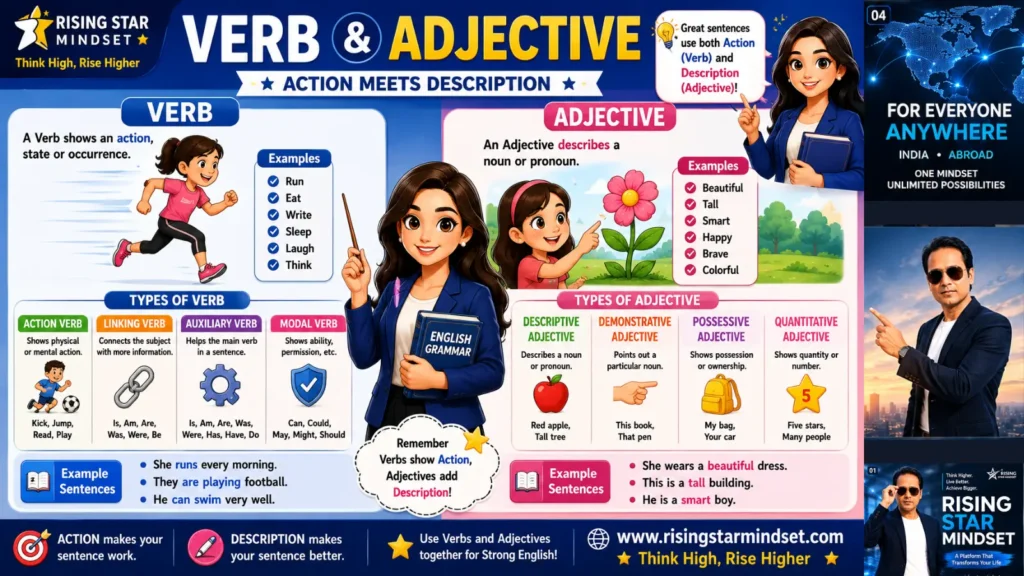
A Verb is a word that shows an action, occurrence, or state of being. Every complete sentence needs a verb because it tells us what the subject does, what happens, or what the subject is.
Definition
A Verb is a word that expresses an action, a state, or an occurrence.
Without a verb, a sentence is incomplete.
Example:
❌ Rahul a student.
✅ Rahul is a student.
हिन्दी
Verb (क्रिया) वह शब्द है जो किसी कार्य (Action), अवस्था (State), या घटना (Occurrence) को व्यक्त करता है।
सरल शब्दों में,
जो शब्द बताए कि कोई क्या कर रहा है, क्या हुआ है, या उसकी क्या अवस्था है, उसे Verb कहते हैं।
Easy Trick to Identify a Verb
अपने आप से पूछिए:
- What action is taking place?
- In what state does the subject remain?
- Which activity is the subject performing?
जिस शब्द से इन प्रश्नों का उत्तर मिले, वही Verb है।
Examples
| Sentence | Verb |
| Rahul plays cricket. | plays |
| She is happy. | is |
| Birds fly in the sky. | fly |
| They study every day. | study |
| The baby slept peacefully. | slept |
Why are Verbs Important?
A sentence cannot express a complete idea without a verb.
Compare these:
❌ The students in the classroom.
✅ The students are studying in the classroom.
The second sentence clearly tells us what the students are doing.
Types of Verbs ( Parts of Speech in English )
English Grammar has several types of verbs.
| Type | Function |
| Main Verb | Shows the main action |
| Helping Verb | Helps the main verb |
| Action Verb | Shows physical or mental action |
| Linking Verb | Connects subject with information |
| Transitive Verb | Needs an object |
| Intransitive Verb | Does not need an object |
| Regular Verb | Forms past tense with -ed |
| Irregular Verb | Changes form differently |
1. Main Verb
A Main Verb tells the primary action in a sentence.
Examples
Rahul writes letters.
They play football.
She reads books.
The baby cried.
The birds fly.
2. Helping Verb (Auxiliary Verb)
Helping verbs support the main verb and help express tense, voice, mood, or possibility.
Common Helping Verbs
- am
- is
- are
- was
- were
- has
- have
- had
- do
- does
- did
- will
- shall
- can
- could
- may
- might
- must
- should
- would
Examples
She is reading a book.
They have completed the project.
We will visit Delhi tomorrow.
3. Action Verbs
These describe an action that can often be seen or imagined.
Physical Actions
- run
- jump
- swim
- dance
- write
- cook
- clean
- sing
- drive
- walk
Mental Actions
- think
- know
- believe
- understand
- remember
- imagine
- forget
- decide
- learn
- plan
Sentences
The boy runs fast.
She thinks carefully.
I remember your advice.
4. Linking Verbs
A linking verb connects the subject with additional information rather than showing an action.
Common Linking Verbs
- am
- is
- are
- was
- were
- become
- seem
- appear
- look
- feel
- sound
- remain
Examples
She is a doctor.
The soup tastes delicious.
The weather became cold.
He looks tired.
5. Transitive Verbs
A transitive verb requires an object to complete its meaning.
Examples
She wrote a letter.
I bought a laptop.
They watched a movie.
The teacher explained the lesson.
6. Intransitive Verbs
An intransitive verb does not need an object.
Examples
The baby cried.
The sun rises.
The students laughed.
Birds fly.
He slept peacefully.
Transitive vs Intransitive
| Transitive | Intransitive |
| Read a book | Sleep |
| Eat food | Laugh |
| Buy a phone | Cry |
| Write a letter | Run |
| Watch a movie | Arrive |
7. Regular Verbs
These form their past tense by adding -ed.
| Present | Past |
| Play | Played |
| Walk | Walked |
| Cook | Cooked |
| Watch | Watched |
| Clean | Cleaned |
8. Irregular Verbs
These do not follow the -ed rule.
| Present | Past | Past Participle |
| Go | Went | Gone |
| Eat | Ate | Eaten |
| Write | Wrote | Written |
| Speak | Spoke | Spoken |
| See | Saw | Seen |
| Give | Gave | Given |
| Come | Came | Come |
| Take | Took | Taken |
| Break | Broke | Broken |
| Begin | Began | Begun |
Memory Trick ( Parts of Speech in English )
Remember this sequence:
M H A L T I R I
- Main
- Helping
- Action
- Linking
- Transitive
- Intransitive
- Regular
- Irregular
Common Mistakes ( Parts of Speech in English )
❌ She go to school.
✅ She goes to school.
❌ They is playing.
✅ They are playing.
❌ He don’t know.
✅ He doesn’t know.
❌ I am agree.
✅ I agree.
❌ She have finished.
✅ She has finished.
Spoken English Examples ( Parts of Speech in English )
Conversation 1
A: What are you doing?
B: I am studying English.
Conversation 2
A: Can you swim?
B: Yes, I can.
Conversation 3
A: Have you completed your homework?
B: Yes, I have completed it.
Conversation 4
A: Where did you go yesterday?
B: I went to the market.
Daily Use Verbs ( Parts of Speech in English )
Read
Write
Speak
Listen
Walk
Run
Eat
Drink
Sleep
Study
Teach
Learn
Open
Close
Help
Call
Meet
Buy
Sell
Watch
Cook
Clean
Drive
Work
Travel
Think
Remember
Forget
Understand
Explain
Practice Exercise ( Parts of Speech in English )
Identify the Verbs
- The children are playing in the park.
- My father drives carefully.
- We have completed the work.
- The baby cried loudly.
- She became a doctor.
Answers
- are playing
- drives
- have completed
- cried
- became
Mini Quiz
Q1. Which is a Verb?
A. Beautiful
B. Quickly
C. Run ✅
D. Happiness
Q2. Which is a Helping Verb?
A. Walk
B. Is ✅
C. Book
D. Boy
Q3. Which sentence contains a Linking Verb?
A. She runs fast.
B. He is a doctor. ✅
C. They play cricket.
D. Birds fly high.
Exam Tips
- Every complete sentence needs a verb.
- Helping verbs work with main verbs.
- Linking verbs connect the subject with additional information.
- Transitive verbs require an object.
- Intransitive verbs do not require an object.
- Learn common irregular verbs because they are frequently used in speaking and writing.
What is an Adjective?
English
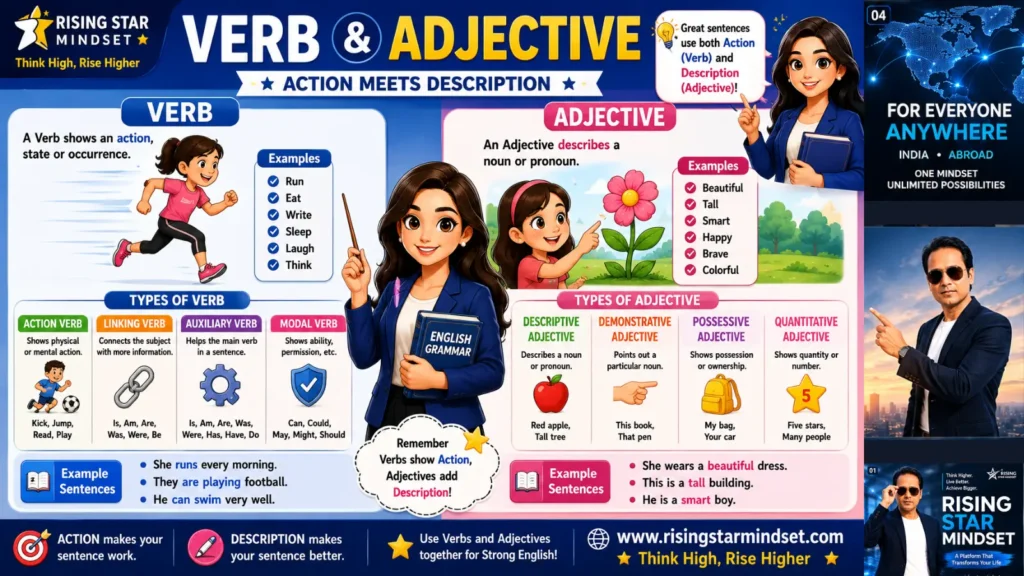
An Adjective is a word that describes or modifies a noun or pronoun. It gives us more information about a person, place, animal, thing, or idea, such as quality, quantity, size, shape, colour, age, number, or condition.
Definition
An Adjective is a word that describes or modifies a noun or pronoun.
Without adjectives, our sentences become plain and less informative.
Example
The boy is playing.
The smart boy is playing.
Here, smart tells us more about the boy.
हिन्दी
Adjective (विशेषण) वह शब्द है जो Noun (संज्ञा) या Pronoun (सर्वनाम) की विशेषता बताता है।
यह हमें किसी व्यक्ति, स्थान, वस्तु या जीव के बारे में अधिक जानकारी देता है, जैसे—
- कैसा?
- कितना?
- कितने?
- किस रंग का?
- किस प्रकार का?
Easy Trick to Identify an Adjective
Ask these questions:
- Which one?
- What kind?
- How many?
- How much?
The answer is usually an Adjective.
Examples
| Sentence | Adjective |
| She is a beautiful girl. | beautiful |
| Rahul is an honest student. | honest |
| I have three books. | three |
| This is a red car. | red |
| The river is long. | long |
Why are Adjectives Important?
Adjectives make our English more attractive, meaningful, and expressive.
Compare these:
❌ I bought a phone.
✅ I bought a new smartphone.
The second sentence gives much more information.
Types of Adjectives ( Parts of Speech in English )
There are several kinds of adjectives.
| Type | Example |
| Quality | beautiful, honest |
| Quantity | little, much |
| Number | one, five |
| Demonstrative | this, that |
| Possessive | my, your |
| Interrogative | which, what |
| Distributive | each, every |
| Proper | Indian, American |
1. Adjective of Quality
These describe the quality or nature of a noun.
Examples
beautiful
honest
brave
kind
intelligent
hardworking
strong
polite
careful
clever
Sentences
She is a beautiful dancer.
Rahul is an honest boy.
The lion is a strong animal.
2. Adjective of Quantity
These describe how much of something.
Examples
much
little
some
enough
all
no
half
Sentences
I have little money.
There is enough water.
She has much patience.
3. Adjective of Number
These tell how many.
Examples
one
two
three
many
few
several
first
second
last
Sentences
I bought three notebooks.
Many students attended the class.
She won the first prize.
4. Demonstrative Adjectives
These point out specific nouns.
Examples
this
that
these
those
Sentences
This book is interesting.
Those students are hardworking.
5. Possessive Adjectives
These show ownership.
Examples
my
your
his
her
our
their
its
Sentences
My bag is blue.
Their house is beautiful.
Our teacher is very helpful.
6. Interrogative Adjectives
Used before nouns while asking questions.
Examples
what
which
whose
Sentences
Which book is yours?
Whose pen is this?
What subject do you like?
7. Distributive Adjectives
These refer to members of a group individually.
Examples
each
every
either
neither
Sentences
Each student received a certificate.
Every child deserves education.
8. Proper Adjectives
These are formed from proper nouns.
Examples
Indian
American
Chinese
French
Japanese
Sentences
Indian culture is rich.
Japanese technology is advanced.
Degrees of Comparison
Adjectives have three degrees.
| Degree | Example |
| Positive | tall |
| Comparative | taller |
| Superlative | tallest |
Examples
Positive
Rahul is tall.
Comparative
Rahul is taller than Mohan.
Superlative
Rahul is the tallest boy in the class.
More Examples
| Positive | Comparative | Superlative |
| big | bigger | biggest |
| small | smaller | smallest |
| fast | faster | fastest |
| high | higher | highest |
| old | older | oldest |
| rich | richer | richest |
| happy | happier | happiest |
| easy | easier | easiest |
| beautiful | more beautiful | most beautiful |
| intelligent | more intelligent | most intelligent |
Memory Trick ( Parts of Speech in English )
Remember:
Q Q N D P I D P
- Quality
- Quantity
- Number
- Demonstrative
- Possessive
- Interrogative
- Distributive
- Proper
Common Mistakes ( Parts of Speech in English )
❌ She is more taller than me.
✅ She is taller than me.
❌ He is the most tallest boy.
✅ He is the tallest boy.
❌ This are my books.
✅ These are my books.
❌ I have many money.
✅ I have much money.
❌ Every students are present.
✅ Every student is present.
Spoken English Examples
Conversation 1
A: Which bag is yours?
B: The black bag is mine.
Conversation 2
A: How was the movie?
B: It was fantastic.
Conversation 3
A: How many books do you have?
B: I have five books.
Conversation 4
A: Which subject do you enjoy the most?
B: English is my favourite subject.
Daily Use Adjectives ( Parts of Speech in English )
good
bad
beautiful
ugly
new
old
young
strong
weak
smart
honest
kind
polite
friendly
helpful
rich
poor
large
small
clean
dirty
fast
slow
easy
difficult
interesting
boring
happy
sad
careful
Practice Exercise ( Parts of Speech in English )
Identify the Adjectives
- The beautiful garden attracts visitors.
- She bought three apples.
- This pen belongs to me.
- My brother is very intelligent.
- Every student submitted the assignment.
Answers
- beautiful
- three
- this
- intelligent
- every
Mini Quiz
Q1. Which is an Adjective?
A. Quickly
B. Honest ✅
C. Run
D. School
Q2. Which sentence has an Adjective of Number?
A. She is kind.
B. I have five books. ✅
C. This is my pen.
D. He runs fast.
Q3. What is the superlative form of “small”?
A. Smaller
B. Smallest ✅
C. More small
D. Most smaller
Exam Tips
- Adjectives describe nouns and pronouns.
- Learn the different types of adjectives with examples.
- Use comparative forms for comparing two things.
- Use superlative forms for comparing three or more.
- Avoid double comparison (e.g., more taller, most fastest).
What is an Adverb?
English
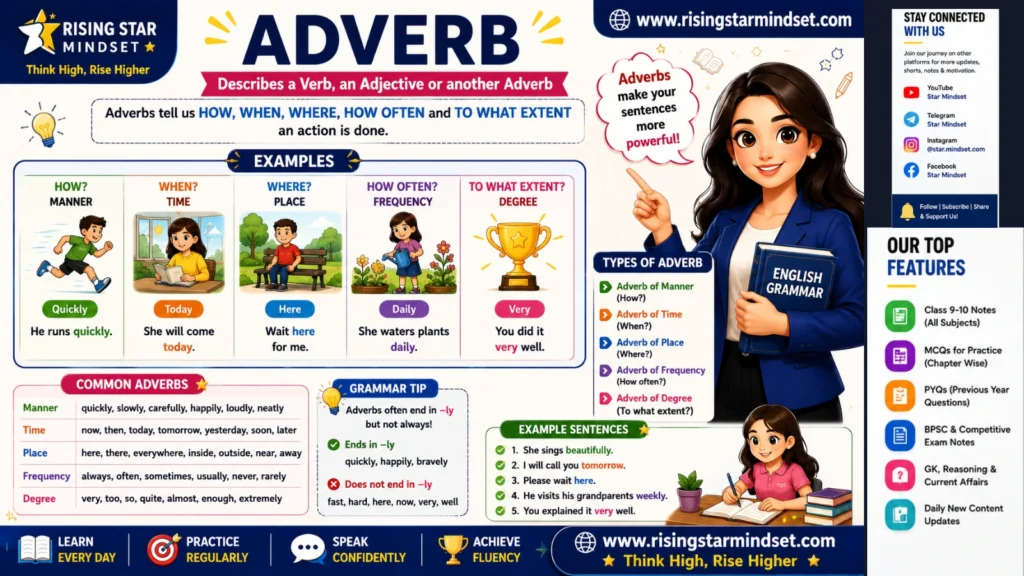
An Adverb is a word that modifies or describes a verb, an adjective, or another adverb. It tells us how, when, where, how often, or to what extent something happens.
Definition
An Adverb is a word that modifies a verb, an adjective, or another adverb.
Simply put, an adverb gives us more information about an action or description.
हिन्दी
Adverb (क्रिया विशेषण) वह शब्द है जो Verb, Adjective या दूसरे Adverb की विशेषता बताता है।
यह बताता है—
- कार्य कैसे हुआ?
- कब हुआ?
- कहाँ हुआ?
- कितनी बार हुआ?
- किस सीमा तक हुआ?
Easy Trick to Identify an Adverb
इन प्रश्नों का उत्तर खोजिए:
- How? (कैसे?)
- When? (कब?)
- Where? (कहाँ?)
- How often? (कितनी बार?)
- To what extent? (किस सीमा तक?)
जिस शब्द से उत्तर मिले, वह अक्सर Adverb होता है।
Examples ( Parts of Speech in English )
| Sentence | Adverb |
| Rahul speaks clearly. | clearly |
| She arrived early. | early |
| Birds fly high. | high |
| He works hard. | hard |
| They visit us often. | often |
Why are Adverbs Important?
Adverbs make our sentences more meaningful by adding details.
Compare
❌ She sings.
✅ She sings beautifully.
❌ He completed the work.
✅ He completed the work quickly.
Types of Adverbs ( Parts of Speech in English )
| Type | Purpose | Example |
| Adverb of Manner | How? | slowly |
| Adverb of Time | When? | today |
| Adverb of Place | Where? | here |
| Adverb of Frequency | How often? | always |
| Adverb of Degree | To what extent? | very |
1. Adverb of Manner
It tells us how an action is performed.
Examples
slowly
quickly
carefully
beautifully
politely
happily
bravely
well
badly
loudly
Sentences
She speaks politely.
He drives carefully.
The students listened attentively.
The baby slept peacefully.
2. Adverb of Time
It tells us when an action happens.
Examples
today
tomorrow
yesterday
now
soon
later
already
finally
recently
immediately
Sentences
I will call you tomorrow.
She arrived early.
We finished the project yesterday.
3. Adverb of Place
It tells us where something happens.
Examples
here
there
outside
inside
everywhere
nowhere
upstairs
downstairs
nearby
away
Sentences
Come here.
The children are playing outside.
Please wait downstairs.
4. Adverb of Frequency
It tells us how often an action occurs.
Examples
always
usually
often
sometimes
rarely
never
daily
weekly
regularly
frequently
Sentences
She always arrives on time.
We usually study in the evening.
He never tells lies.
5. Adverb of Degree
It tells us to what extent something happens.
Examples
very
too
quite
almost
enough
completely
extremely
hardly
nearly
fully
Sentences
The movie was very interesting.
She is extremely intelligent.
The bottle is almost empty.
Position of Adverbs
Adverbs can appear in different positions.
Beginning
Yesterday, we visited the museum.
Middle
She always helps others.
End
He completed the work quickly.
Formation of Adverbs
Many adverbs are formed by adding -ly to adjectives.
| Adjective | Adverb |
| quick | quickly |
| careful | carefully |
| happy | happily |
| polite | politely |
| slow | slowly |
| brave | bravely |
| loud | loudly |
| beautiful | beautifully |
Important Exceptions ( Parts of Speech in English )
Some words remain the same.
| Adjective | Adverb |
| fast | fast |
| hard | hard |
| early | early |
| late | late |
Examples
He runs fast.
She works hard.
We arrived early.
Memory Trick ( Parts of Speech in English )
Remember:
M T P F D
- M → Manner
- T → Time
- P → Place
- F → Frequency
- D → Degree
Common Mistakes ( Parts of Speech in English )
❌ He speaks very loud.
✅ He speaks very loudly.
❌ She sings beautiful.
✅ She sings beautifully.
❌ I am going tomorrow morning early.
✅ I am going early tomorrow morning.
❌ He works hardly.
✅ He works hard.
(Hardly means “मुश्किल से”, जबकि hard का अर्थ “मेहनत से” होता है।)
❌ She never is late.
✅ She is never late.
Spoken English Examples ( Parts of Speech in English )
Conversation 1
A: How do you speak English?
B: I speak English confidently.
Conversation 2
A: How often do you read newspapers?
B: I read newspapers every day.
Conversation 3
A: Where are your friends?
B: They are waiting outside.
Conversation 4
A: When will you finish your homework?
B: I will finish it tonight.
Daily Use Adverbs
always
usually
often
sometimes
never
quickly
slowly
carefully
easily
clearly
politely
well
badly
today
tomorrow
yesterday
here
there
inside
outside
very
too
almost
enough
already
finally
soon
late
early
hard
Practice Exercise
Identify the Adverbs
- She sings beautifully.
- They always arrive early.
- Please sit here.
- He completed the task quickly.
- The weather is extremely hot.
Answers
- beautifully
- always, early
- here
- quickly
- extremely
Mini Quiz ( Parts of Speech in English )
Q1. Which is an Adverb?
A. Honest
B. Quickly ✅
C. Student
D. School
Q2. Which sentence contains an Adverb of Frequency?
A. She is beautiful.
B. He always smiles. ✅
C. This is my bag.
D. They bought a car.
Q3. Which word is an Adverb of Place?
A. Tomorrow
B. Quickly
C. Here ✅
D. Very
Exam Tips ( Parts of Speech in English )
- Adverbs modify verbs, adjectives, or other adverbs.
- Learn the five main types: Manner, Time, Place, Frequency, and Degree.
- Be careful with words like hard and hardly, as they have different meanings.
- Place adverbs in the correct position to make sentences natural and grammatically correct.
- Read and speak English daily to become familiar with common adverbs.
What is a Preposition?
English
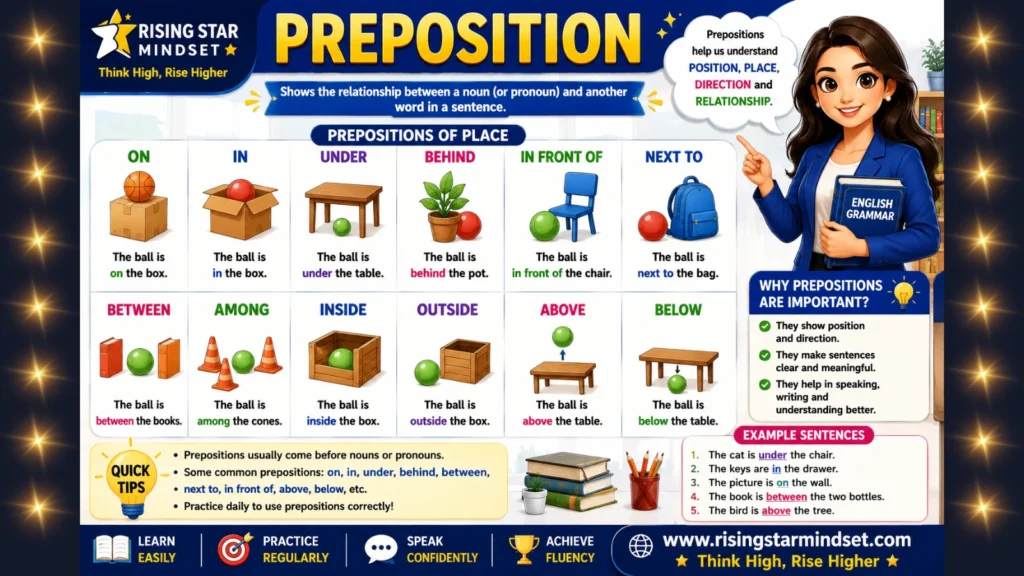
A Preposition is a word that shows the relationship between a noun (or pronoun) and another word in a sentence. It often tells us about place, time, direction, position, cause, or manner.
Definition
A Preposition is a word that shows the relationship between a noun or pronoun and another word in a sentence.
In simple words, a preposition tells us where, when, how, or in what relation something happens.
हिन्दी
Preposition (संबंधबोधक अव्यय) वह शब्द है जो Noun (संज्ञा) या Pronoun (सर्वनाम) का संबंध वाक्य के अन्य शब्दों से बताता है।
यह हमें बताता है—
- Preposition हमें यह बताती है:
- 📍 किसी वस्तु या व्यक्ति का स्थान कहाँ है।
- 🕒 कोई घटना कब हुई।
- 🧭 कोई व्यक्ति किस दिशा में गया।
- 🤝 कोई व्यक्ति किसके साथ है।
- ⬆️ कोई वस्तु किसके ऊपर है।
- ⬇️ कोई वस्तु किसके नीचे है।
- 💡 कोई कार्य किस कारण से हुआ।
Easy Trick to Identify a Preposition
अपने आप से पूछिए—
- Where? (कहाँ?)
- When? (कब?)
- In which direction? (किस दिशा में?)
- In relation to what? (किसके संबंध में?)
यदि कोई शब्द स्थान, समय या संबंध बता रहा है, तो वह Preposition हो सकता है।
Examples
| Sentence | Preposition |
| The book is on the table. | on |
| Rahul lives in Patna. | in |
| She arrived at 9 a.m. | at |
| We walked through the park. | through |
| The cat is under the chair. | under |
Why are Prepositions Important?
Prepositions make sentences clear and meaningful.
Compare
❌ The book is the table.
✅ The book is on the table.
❌ Rahul lives Patna.
✅ Rahul lives in Patna.
Without prepositions, many sentences become incomplete or confusing.
Types of Prepositions
| Type | Purpose | Example |
| Preposition of Time | Shows time | at, on, in |
| Preposition of Place | Shows location | in, on, under |
| Preposition of Direction | Shows movement | to, into, towards |
| Preposition of Position | Shows position | between, among |
| Preposition of Movement | Shows movement | across, through |
| Compound Preposition | Combined words | because of, instead of |
1. Prepositions of Time ( Parts of Speech in English )
These tell us when something happens.
Common Prepositions
- at
- on
- in
- before
- after
- during
- since
- for
- until
- by
Examples
She wakes up at 6 a.m.
My birthday is on Monday.
We travel in December.
He has lived here since 2020.
They studied for two hours.
Easy Rule
AT → Exact Time
- Meet me at 5:00 p.m.
- The class starts at noon.
- The train arrives at midnight.
ON → Days & Dates
- We play cricket on Sunday.
- Our event is on 15 August.
- My birthday falls on Monday.
IN → Months, Years, Seasons
- Schools reopen in July.
- He was born in 2026.
- Flowers bloom in spring.
2. Prepositions of Place
These show where someone or something is.
Common Prepositions
- in
- on
- under
- over
- behind
- in front of
- beside
- between
- among
- near
Examples
The pen is on the desk.
The keys are in the drawer.
The dog is under the table.
The school is near the hospital.
She stood between her friends.
3. Prepositions of Direction
These show movement from one place to another.
Examples
to
into
onto
towards
from
through
across
along
past
up
Sentences
She walked to the market.
The child jumped into the pool.
We drove through the tunnel.
He ran across the road.
4. Prepositions of Position
These describe the position of someone or something.
Examples
between
among
beside
behind
opposite
near
above
below
inside
outside
Sentences
The bank is opposite the school.
The teacher stood beside the board.
The picture hangs above the sofa.
5. Compound Prepositions
These are made up of two or more words.
Examples
because of
instead of
according to
in front of
next to
due to
out of
along with
Sentences
The match was cancelled because of rain.
She sat next to me.
According to the report, sales increased.
Most Common Prepositions
| Preposition | Meaning |
| in | inside |
| on | on the surface |
| at | exact place/time |
| under | below |
| above | higher than |
| behind | at the back |
| beside | next to |
| between | in the middle of two |
| among | in a group |
| through | from one side to another |
| across | from one side across |
| into | moving inside |
| from | starting point |
| to | destination |
Memory Trick
Remember:
T P D P C
- Time
- Place
- Direction
- Position
- Compound
Common Mistakes
❌ She lives at India.
✅ She lives in India.
❌ I will meet you in Monday.
✅ I will meet you on Monday.
❌ He arrived in 8 o’clock.
✅ He arrived at 8 o’clock.
❌ The cat is in the table.
✅ The cat is under the table.
❌ We walked in the road.
✅ We walked along the road.
Spoken English Examples
Conversation 1
A: Where is your bag?
B: It is on the chair.
Conversation 2
A: When is your exam?
B: It is on Monday.
Conversation 3
A: Where do you live?
B: I live in Patna.
Conversation 4
A: How do you go to school?
B: I go by bus.
Daily Use Prepositions
in
on
at
by
with
for
from
to
into
onto
over
under
above
below
between
among
behind
beside
near
inside
outside
through
across
along
towards
before
after
during
since
until
Practice Exercise
Identify the Prepositions
- The books are on the shelf.
- She reached school at 8 a.m.
- The children ran across the playground.
- We stayed in Jaipur for three days.
- The keys are under the pillow.
Answers
- on
- at
- across
- in, for
- under
Mini Quiz
Q1. Which is a Preposition?
A. Beautiful
B. Quickly
C. Under ✅
D. Happy
Q2. Which preposition is used with months?
A. At
B. On
C. In ✅
D. By
Q3. Choose the correct sentence.
A. I was born at July.
B. I was born on July.
C. I was born in July. ✅
D. I was born by July.
Exam Tips
- At is generally used for exact time and specific places.
- On is used for days, dates, and surfaces.
- In is used for months, years, countries, cities, and enclosed spaces.
- Learn common preposition combinations (e.g., interested in, good at, afraid of) through regular reading and practice.
- Read English passages daily to observe how native sentences use prepositions naturally.
What is a Conjunction?
English
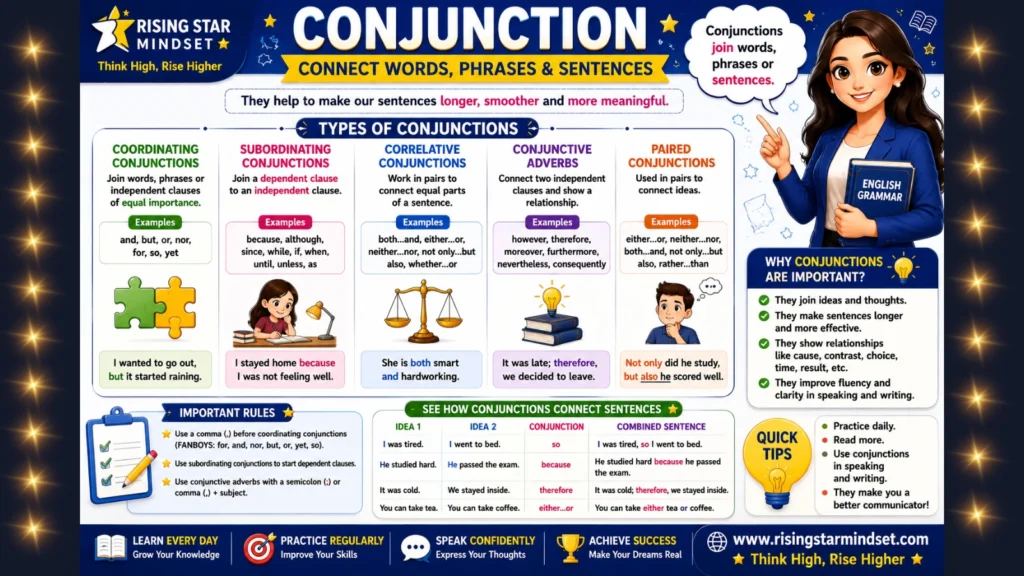
A Conjunction is a word that joins words, phrases, clauses, or sentences. It helps us connect ideas smoothly and makes our writing and speaking more natural.
Definition
A Conjunction is a word used to join words, phrases, clauses, or sentences.
Without conjunctions, our sentences become short, repetitive, and less fluent.
Example
❌ Rahul is intelligent. Rahul is hardworking.
✅ Rahul is intelligent and hardworking.
Here, and joins two ideas.
हिन्दी
Conjunction (समुच्चयबोधक अव्यय) वह शब्द है जो दो शब्दों, दो वाक्यांशों या दो वाक्यों को जोड़ता है।
यह वाक्य को अधिक सुन्दर, स्पष्ट और प्रवाहपूर्ण बनाता है।
उदाहरण
❌ राहुल पढ़ता है। राहुल खेलता है।
✅ राहुल पढ़ता है और खेलता है।
यहाँ और (and) दोनों विचारों को जोड़ रहा है।
Easy Trick to Identify a Conjunction
यदि कोई शब्द दो शब्दों, दो वाक्यों या दो विचारों को जोड़ रहा है, तो वह Conjunction है।
Common joining words:
- and
- but
- or
- because
- although
- if
- so
- while
Examples
| Sentence | Conjunction |
| Rahul and Mohan are friends. | and |
| She is poor but honest. | but |
| Hurry up or you will miss the bus. | or |
| I stayed home because it was raining. | because |
| Although he was tired, he continued working. | although |
Why are Conjunctions Important?
Conjunctions help us:
- Join ideas naturally.
- Avoid repeating short sentences.
- Improve spoken English fluency.
- Write longer and meaningful sentences.
- Express relationships like reason, choice, contrast, and condition.
Types of Conjunctions
There are three main types of conjunctions.
| Type | Function | Examples |
| Coordinating Conjunction | Joins equal words or clauses | and, but, or |
| Subordinating Conjunction | Joins dependent and independent clauses | because, if, although |
| Correlative Conjunction | Used in pairs | either…or, neither…nor |
1. Coordinating Conjunctions ( Parts of Speech in English )
These join words or clauses of equal importance.
The FANBOYS Rule
Remember the word FANBOYS:
- F – For
- A – And
- N – Nor
- B – But
- O – Or
- Y – Yet
- S – So
Examples
Rahul and Mohan study together.
She is tired but happy.
Do you want tea or coffee?
He was late, so he missed the train.
2. Subordinating Conjunctions
These connect a dependent clause with an independent clause.
Common Examples
because
if
although
while
when
before
after
since
unless
until
where
though
Sentences
I stayed home because it was raining.
If you study hard, you will succeed.
Although she was sick, she attended the class.
Call me when you arrive.
3. Correlative Conjunctions
These always work in pairs.
| Pair | Example |
| either…or | Either Rahul or Mohan will come. |
| neither…nor | Neither tea nor coffee is available. |
| both…and | Both Ram and Shyam are honest. |
| not only…but also | She is not only intelligent but also hardworking. |
| whether…or | I don’t know whether he will come or not. |
Most Common Conjunctions
| Conjunction | Meaning |
| and | adds information |
| but | shows contrast |
| or | gives a choice |
| because | gives a reason |
| so | shows result |
| although | shows contrast |
| if | shows condition |
| while | shows simultaneous action |
| before | earlier time |
| after | later time |
| since | from a point in time / because (depending on context) |
| unless | except if |
Memory Trick
Remember:
C S C
- C → Coordinating
- S → Subordinating
- C → Correlative
Common Mistakes
❌ Because he was tired. (Incomplete sentence)
✅ He slept early because he was tired.
❌ Although he is poor but honest.
✅ Although he is poor, he is honest.
✅ He is poor but honest.
❌ Either Rahul and Mohan will come.
✅ Either Rahul or Mohan will come.
❌ Neither Ram or Shyam came.
✅ Neither Ram nor Shyam came.
❌ She studied hard because so she passed.
✅ She studied hard, so she passed.
✅ She passed because she studied hard.
Spoken English Examples
Conversation 1
A: Would you like tea or coffee?
B: I would like coffee.
Conversation 2
A: Why were you absent?
B: Because I was not feeling well.
Conversation 3
A: Are you coming with us?
B: Yes, but I will arrive a little late.
Conversation 4
A: Will you go by train or by bus?
B: I will go by train.
Daily Use Conjunctions
and
but
or
so
because
if
although
while
when
before
after
since
unless
until
yet
for
nor
both…and
either…or
neither…nor
not only…but also
whether…or
Practice Exercise
Identify the Conjunctions
- Rahul and Riya are classmates.
- She was tired, but she finished her work.
- If you practice daily, you will improve.
- Neither the teacher nor the students were absent.
- I stayed home because it was raining.
Answers
- and
- but
- if
- neither…nor
- because
Mini Quiz
Q1. Which is a Coordinating Conjunction?
A. Because
B. And ✅
C. Although
D. Unless
Q2. Which pair is a Correlative Conjunction?
A. Because…So
B. Either…Or ✅
C. If…Then
D. Since…When
Q3. Choose the correct sentence.
A. Although he was ill but he worked.
B. Although he was ill, he worked. ✅
C. Because he was ill but worked.
D. He although worked.
Exam Tips
- Learn the FANBOYS rule for Coordinating Conjunctions.
- Do not use although and but together in the same clause.
- Use either…or and neither…nor as fixed pairs.
- Choose conjunctions according to the relationship you want to express: addition, contrast, reason, choice, condition, or result.
- Reading English articles and practicing sentence formation daily will improve your understanding of conjunctions.
What is an Interjection?
English
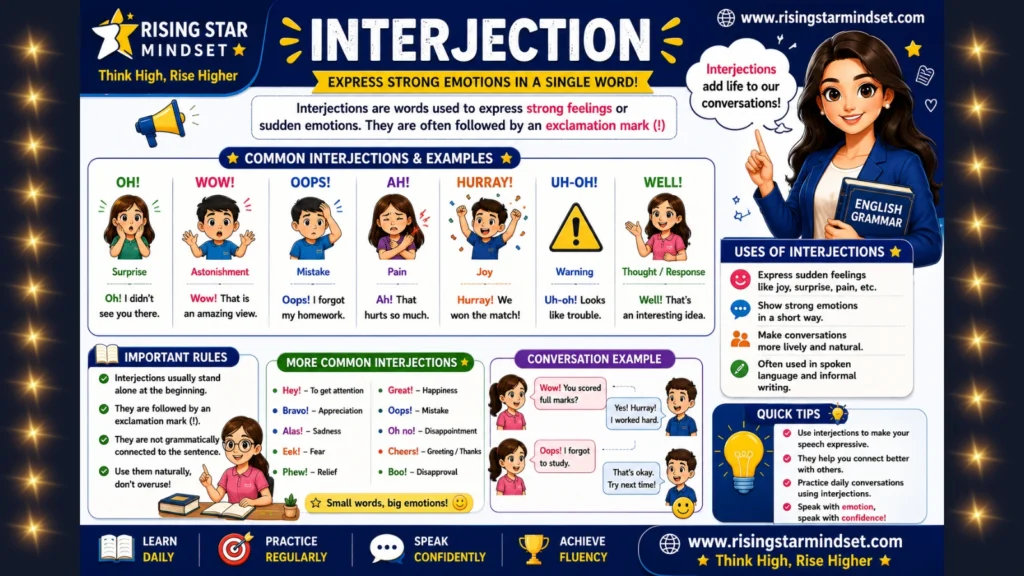
An Interjection is a word or short expression used to express a sudden emotion, feeling, reaction, surprise, joy, sorrow, pain, excitement, or greeting.
An interjection is usually followed by an exclamation mark (!) because it expresses strong emotions.
Definition
An Interjection is a word or phrase that expresses a sudden feeling or emotion.
Unlike other Parts of Speech, an interjection does not have a grammatical relationship with the rest of the sentence. It simply expresses the speaker’s emotion.
हिन्दी
Interjection (विस्मयादिबोधक अव्यय) वह शब्द या छोटा वाक्यांश है जो अचानक उत्पन्न होने वाली भावना, आश्चर्य, खुशी, दुख, दर्द, डर, उत्साह, अभिवादन या प्रशंसा को व्यक्त करता है।
अधिकांश Interjections के बाद Exclamation Mark (!)
लगाया जाता है।
Easy Trick to Identify an Interjection
यदि कोई शब्द अचानक किसी भावना को व्यक्त कर रहा हो, जैसे—
- खुशी 😊
- दुख 😢
- दर्द 😖
- आश्चर्य 😲
- डर 😨
- गुस्सा 😠
- प्रशंसा 👏
तो वह शब्द Interjection है।
Examples
| Sentence | Interjection |
| Wow! What a beautiful painting! | Wow! |
| Hurrah! We won the match. | Hurrah! |
| Alas! The old man died. | Alas! |
| Ouch! That hurts. | Ouch! |
| Bravo! You did an excellent job. | Bravo! |
Why are Interjections Important?
Interjections make conversations more natural and expressive.
Compare:
❌ I won the competition.
✅ Hurrah! I won the competition.
The second sentence sounds much more emotional.
Types of Interjections
| Emotion | Interjection |
| Joy | Hurrah!, Wow! |
| Surprise | Oh!, Wow! |
| Pain | Ouch!, Ow! |
| Sadness | Alas! |
| Greeting | Hello!, Hi! |
| Approval | Bravo!, Well done! |
| Disgust | Ugh!, Yuck! |
| Attention | Hey!, Listen! |
1. Interjections of Joy
Used to express happiness or success.
Examples
Hurrah!
Wow!
Yippee!
Fantastic!
Excellent!
Sentences
Hurrah! We won the championship.
Wow! This place is amazing.
Yippee! Our holidays have started.
2. Interjections of Surprise
Used when something unexpected happens.
Examples
Oh!
Wow!
Really?
What!
Goodness!
Sentences
Oh! I forgot my keys.
Wow! Your English has improved a lot.
Goodness! That was unexpected.
3. Interjections of Pain
Used when someone feels physical pain.
Examples
Ouch!
Ow!
Ah!
Sentences
Ouch! My finger is hurt.
Ow! That was painful.
Ah! My back hurts.
4. Interjections of Sadness
Used to express grief or disappointment.
Examples
Alas!
Oh no!
Sadly!
Sentences
Alas! The king is dead.
Oh no! I missed the bus.
Sadly, we lost the match.
5. Interjections of Greeting
Used while meeting people.
Examples
Hello!
Hi!
Good morning!
Good evening!
Welcome!
Sentences
Hello! How are you?
Hi! Nice to see you.
Welcome! Please come in.
6. Interjections of Appreciation
Used to praise someone.
Examples
Bravo!
Excellent!
Wonderful!
Amazing!
Great!
Sentences
Bravo! You answered correctly.
Excellent! Keep it up.
Great! You did a wonderful job.
Common Interjections
| Interjection | Emotion |
| Wow! | Surprise |
| Hurrah! | Joy |
| Alas! | Sadness |
| Ouch! | Pain |
| Bravo! | Appreciation |
| Hello! | Greeting |
| Hey! | Attention |
| Oh! | Surprise |
| Yuck! | Disgust |
| Well done! | Appreciation |
Memory Trick
Remember:
J S P S G A
- Joy
- Surprise
- Pain
- Sadness
- Greeting
- Appreciation
Common Mistakes
❌ Wow this is beautiful.
✅ Wow! This is beautiful.
❌ Hurrah we won.
✅ Hurrah! We won.
❌ Alas he passed the exam.
✅ Hurrah! He passed the exam.
(Alas is used for sadness, not success.)
❌ Ouch! I got first rank.
✅ Hurrah! I got first rank.
❌ Bravo! Someone died.
✅ Alas! Someone died.
Spoken English Examples
Conversation 1
A: I got the job!
B: Congratulations! Wow!
Conversation 2
A: I hurt my hand.
B: Oh! Ouch! Are you okay?
Conversation 3
A: We won the cricket match.
B: Hurrah! Let’s celebrate!
Conversation 4
A: Look at this beautiful view.
B: Wow! It’s wonderful.
Daily Use Interjections
Hello!
Hi!
Hey!
Wow!
Hurrah!
Ouch!
Oh!
Oops!
Bravo!
Excellent!
Amazing!
Fantastic!
Great!
Wonderful!
Congratulations!
Well done!
Good!
Oops!
Yuck!
Alas!
Practice Exercise
Identify the Interjections
- Wow! This cake is delicious.
- Alas! The old tree has fallen.
- Ouch! My foot hurts.
- Bravo! You performed very well.
- Hello! How have you been?
Answers
- Wow!
- Alas!
- Ouch!
- Bravo!
- Hello!
Mini Quiz
Q1. Which word is an Interjection?
A. Honest
B. Wow! ✅
C. Quickly
D. Teacher
Q2. Which Interjection expresses pain?
A. Hurrah!
B. Ouch! ✅
C. Bravo!
D. Hello!
Q3. Which Interjection is used for appreciation?
A. Alas!
B. Bravo! ✅
C. Oops!
D. Oh!
Exam Tips
- Interjections express emotions rather than grammatical relationships.
- Most interjections are followed by an exclamation mark (!).
- Choose the interjection according to the emotion being expressed.
- Learn commonly used interjections for daily conversations.
- Use interjections naturally; overusing them can make writing sound unnatural.
🎉 Congratulations!
अब आपने Parts of Speech के सभी 8 भाग सीख लिए हैं:
| No. | Part of Speech |
| 1 | Noun |
| 2 | Pronoun |
| 3 | Verb |
| 4 | Adjective |
| 5 | Adverb |
| 6 | Preposition |
| 7 | Conjunction |
| 8 | Interjection |

Summary Table
| Part of Speech | Function | Example |
| Noun | Names a person, place, thing, or idea | Rahul, School, Book |
| Pronoun | Replaces a noun | He, She, They |
| Verb | Shows action or state | Run, Eat, Is |
| Adjective | Describes a noun or pronoun | Beautiful, Tall |
| Adverb | Describes a verb, adjective, or another adverb | Quickly, Very |
| Preposition | Shows relationship | In, On, At |
| Conjunction | Joins words or sentences | And, But, Because |
| Interjection | Expresses emotion | Wow!, Hurrah! |
Common Mistakes Students Make
❌ Rahul go to school.
✅ Rahul goes to school.
❌ She is more taller.
✅ She is taller.
❌ I lives in Patna.
✅ I live in Patna.
❌ He don’t know.
✅ He doesn’t know.
❌ This books are mine.
✅ These books are mine.
❌ She is good in English.
✅ She is good at English.
❌ I am agree.
✅ I agree.
❌ Me am ready.
✅ I am ready.
❌ He can sings.
✅ He can sing.
❌ I reached to home.
✅ I reached home.
Quick Revision Chart
| Question | Answer |
| Who? | Noun |
| Instead of Noun? | Pronoun |
| Action? | Verb |
| Quality? | Adjective |
| How/When/Where? | Adverb |
| Relation? | Preposition |
| Join? | Conjunction |
| Emotion? | Interjection |
Daily Speaking Practice
Read these sentences aloud every day.
I am learning English every day.
She speaks English confidently.
They are good friends.
The book is on the table.
Wow! Your pronunciation is improving.
Rahul studies hard because he wants success.
Our teacher explains every lesson clearly.
We always help each other.
English becomes easier with daily practice.
I believe in myself.
Practice Paragraph
English
My name is Rahul. I live in Patna with my family. Every morning I wake up early and study English for one hour. My teacher is very kind and always encourages me to speak confidently. I enjoy reading books because they improve my vocabulary. Wow! Learning English is becoming easier every day.
हिन्दी
मेरा नाम राहुल है। मैं अपने परिवार के साथ पटना में रहता हूँ। हर सुबह मैं जल्दी उठता हूँ और एक घंटे तक अंग्रेज़ी पढ़ता हूँ। मेरे शिक्षक बहुत दयालु हैं और हमेशा मुझे आत्मविश्वास के साथ बोलने के लिए प्रेरित करते हैं। मुझे किताबें पढ़ना पसंद है क्योंकि इससे मेरी शब्दावली बेहतर होती है। वाह! हर दिन अंग्रेज़ी सीखना और आसान होता जा रहा है।
Learning Tips
- Learn 10 new words every day.
- Read English newspapers for 15–20 minutes.
- Watch English videos with subtitles.
- Speak English daily without fear.
- Revise grammar regularly.
- Write a short paragraph every day.
- Listen carefully to English conversations.
- Practice with your friends.
- Keep a vocabulary notebook.
- Never stop practicing.
Remember This Formula
Learn → Understand → Practice → Speak → Revise → Repeat
This simple formula helps build long-term English speaking confidence.
30 MCQs (Q1–Q30)
Q1. Which Part of Speech names a person, place, or thing?
A. Verb
B. Pronoun
C. Noun ✅
D. Adjective
Q2. Which Pronoun replaces “Rahul”?
A. It
B. He ✅
C. They
D. We
Q3. Which word is a Verb?
A. Beautiful
B. Quickly
C. Run ✅
D. School
Q4. Which word is an Adjective?
A. Happy ✅
B. Happily
C. Happiness
D. Happier
Q5. Which word is an Adverb?
A. Honest
B. Slowly ✅
C. Student
D. Apple
Q6. Which is a Preposition?
A. Under ✅
B. Happy
C. Write
D. Boy
Q7. Which word is a Conjunction?
A. Because ✅
B. Quickly
C. Tall
D. School
Q8. Which word is an Interjection?
A. Wow! ✅
B. Student
C. Run
D. Blue
Q9. Which sentence contains a Proper Noun?
A. The boy is playing.
B. Rahul lives in Delhi. ✅
C. A dog is barking.
D. The city is clean.
Q10. Which is a Collective Noun?
A. Gold
B. Team ✅
C. Boy
D. River
Q11. Which is an Abstract Noun?
A. Honesty ✅
B. Table
C. Cat
D. Garden
Q12. Which sentence contains a Pronoun?
A. She is reading. ✅
B. Rahul studies.
C. India is beautiful.
D. The teacher arrived.
Q13. Which is a Helping Verb?
A. Is ✅
B. Jump
C. Tall
D. Quickly
Q14. Which sentence contains an Adjective?
A. She is intelligent. ✅
B. She runs.
C. They arrived.
D. Birds fly.
Q15. Which sentence contains an Adverb?
A. He speaks politely. ✅
B. The boy is tall.
C. This is my book.
D. India is large.
Q16. Which preposition is used with months?
A. At
B. On
C. In ✅
D. By
Q17. Which conjunction shows contrast?
A. And
B. But ✅
C. Because
D. So
Q18. Which interjection expresses joy?
A. Alas!
B. Hurrah! ✅
C. Ouch!
D. Oh!
Q19. Which sentence is correct?
A. He go to school.
B. He goes to school. ✅
C. He going school.
D. He gone school.
Q20. Which sentence is correct?
A. These book are new.
B. These books are new. ✅
C. This books are new.
D. These books is new.
Q21. Which word is a Demonstrative Pronoun?
A. This ✅
B. Mine
C. Who
D. Anyone
Q22. Which sentence contains a Linking Verb?
A. He is a doctor. ✅
B. He runs fast.
C. They play football.
D. Birds fly.
Q23. Which sentence contains a Transitive Verb?
A. She wrote a letter. ✅
B. The baby cried.
C. The sun rises.
D. Birds fly.
Q24. Which adjective is in the Superlative Degree?
A. Tall
B. Taller
C. Tallest ✅
D. More Tall
Q25. Which adverb shows frequency?
A. Quickly
B. Always ✅
C. Here
D. Very
Q26. Which preposition shows movement?
A. Into ✅
B. Under
C. Near
D. Above
Q27. Which pair is a Correlative Conjunction?
A. Either…Or ✅
B. Because…So
C. If…Then
D. Since…When
Q28. Which Interjection expresses pain?
A. Bravo!
B. Ouch! ✅
C. Hurrah!
D. Hello!
Q29. How many Parts of Speech are there in English?
A. Six
B. Seven
C. Eight ✅
D. Nine
Q30. Which Part of Speech joins words and sentences?
A. Verb
B. Adverb
C. Conjunction ✅
D. Noun
10 HOTS Questions
- Explain why a sentence cannot be complete without a verb.
- Compare a Proper Noun and a Common Noun with your own examples.
- Write five sentences using different types of pronouns.
- Describe your classroom using at least five adjectives.
- Write a short paragraph using all eight Parts of Speech.
- Explain the difference between an Adjective and an Adverb.
- Why are prepositions important in spoken English?
- Create five compound sentences using different conjunctions.
- Write five daily conversations using suitable interjections.
- Identify all the Parts of Speech in the sentence: “The hardworking student completed the difficult assignment carefully because he wanted excellent marks.”
20 Fill in the Blanks
- Rahul _____ to school every day. (goes)
- She is _____ honest girl. (an)
- The book is _____ the table. (on)
- _____! We won the match. (Hurrah)
- My father is _____ doctor. (a)
- They _____ playing football. (are)
- I live _____ Bihar. (in)
- She speaks English _____. (fluently)
- This is _____ pen. (my)
- The lion is a _____ animal. (wild)
- He is taller _____ me. (than)
- We reached school _____ 8 a.m. (at)
- I stayed home _____ it was raining. (because)
- _____ student received a certificate. (Each)
- She completed the work _____. (carefully)
- The children are _____ the garden. (in)
- He bought _____ umbrella. (an)
- They have _____ homework today. (some)
- She is the _____ girl in the class. (smartest)
- Please come _____ and have a seat. (inside)
15 Match the Following
| Column A | Column B |
| Noun | Names a person, place, or thing |
| Pronoun | Replaces a noun |
| Verb | Shows action |
| Adjective | Describes a noun |
| Adverb | Describes a verb |
| Preposition | Shows relationship |
| Conjunction | Joins words or sentences |
| Interjection | Expresses emotion |
| Proper Noun | Rahul |
| Collective Noun | Team |
| Abstract Noun | Honesty |
| Material Noun | Gold |
| Demonstrative Pronoun | This |
| Helping Verb | Is |
| Correlative Conjunction | Either…Or |
Daily Speaking Challenge
🎯 Today’s Challenge
Speak these five sentences without reading after practicing them three times:
- I speak English with confidence every day.
- My vocabulary is improving day by day.
- I enjoy learning new English words.
- Practice makes me a better speaker.
- I will never stop learning English.
Viewer Assignment
Complete the following tasks:
- List 20 nouns from your surroundings.
- Replace those nouns with suitable pronouns in meaningful sentences.
- Identify 20 verbs used in your daily routine.
- Describe five people or places using at least 20 adjectives.
- Use 20 adverbs to improve different sentences.
- Create 10 sentences with different prepositions.
- Join pairs of sentences using suitable conjunctions.
- Express five emotions with appropriate interjections in short dialogues.
- Compose a short paragraph using all eight Parts of Speech.
- Read your paragraph aloud to improve pronunciation and speaking confidence.
20 Frequently Asked Questions (FAQs)
Q1. What are Parts of Speech?
Answer (English): Parts of Speech are categories of words based on their function in a sentence.
उत्तर (हिन्दी): Parts of Speech वे श्रेणियाँ हैं जिनमें शब्दों को उनके कार्य के आधार पर रखा जाता है।
Q2. How many Parts of Speech are there in English?
Answer: There are eight Parts of Speech in English Grammar.
Q3. What is a Noun?
Answer: A Noun is the name of a person, place, thing, animal, or idea.
Q4. What is a Pronoun?
Answer: A Pronoun is a word that replaces a noun.
Q5. What is a Verb?
Answer: A Verb shows an action, state, or occurrence.
Q6. What is an Adjective?
Answer: An Adjective describes a noun or pronoun.
Q7. What is an Adverb?
Answer: An Adverb describes a verb, adjective, or another adverb.
Q8. What is a Preposition?
Answer: A Preposition shows the relationship between a noun (or pronoun) and another word.
Q9. What is a Conjunction?
Answer: A Conjunction joins words, phrases, or sentences.
Q10. What is an Interjection?
Answer: An Interjection expresses sudden emotions or feelings.
Q11. Which Part of Speech is the most important?
Answer: Every Part of Speech is important because each has a different role in sentence formation.
Q12. Can a sentence exist without a Verb?
Answer: No. A complete English sentence generally requires a verb.
Q13. Why should beginners learn Parts of Speech first?
Answer: Because Parts of Speech form the foundation of English Grammar and help learners understand sentence structure.
Q14. Are Parts of Speech important for competitive exams?
Answer: Yes. They are frequently tested in BPSC, SSC, Banking, Railways, UPSC, CDS, NDA, and other competitive examinations.
Q15. How can I remember all eight Parts of Speech?
Answer: Practice daily, revise regularly, and create simple sentences using each Part of Speech.
Q16. Which Part of Speech describes a Noun?
Answer: An Adjective describes a noun.
Q17. Which Part of Speech replaces a Noun?
Answer: A Pronoun replaces a noun.
Q18. Which Part of Speech joins sentences?
Answer: A Conjunction joins words, phrases, and sentences.
Q19. How long does it take to master Parts of Speech?
Answer: With daily practice, most beginners can build a strong understanding in a few weeks.
Q20. What is the best way to improve English Grammar?
Answer: Read English daily, practice grammar exercises, learn vocabulary, speak regularly, and revise consistently.
Conclusion
English
Parts of Speech are the foundation of English Grammar. Every correct sentence is built using these eight categories of words. Once you understand how nouns, pronouns, verbs, adjectives, adverbs, prepositions, conjunctions, and interjections work, speaking and writing English becomes much easier.
Learning grammar is not only about remembering rules—it is about using them in real-life conversations. Practice every day, read English books and articles, listen to English conversations, and speak with confidence. Small, consistent efforts will gradually improve your fluency and accuracy.
Remember, mastering English is a journey. Every new word you learn, every sentence you speak, and every exercise you complete brings you one step closer to becoming a confident English speaker.
Keep Learning Keep Growing!
हिन्दी
Parts of Speech अंग्रेज़ी व्याकरण की मजबूत नींव हैं। सही अंग्रेज़ी बोलने और लिखने के लिए इन आठों Parts of Speech को समझना बहुत आवश्यक है। जब आप Noun, Pronoun, Verb, Adjective, Adverb, Preposition, Conjunction और Interjection का सही प्रयोग सीख लेते हैं, तब अंग्रेज़ी सीखना कहीं अधिक आसान हो जाता है।
व्याकरण केवल नियम याद करने का विषय नहीं है, बल्कि उन्हें रोज़मर्रा की बातचीत में सही ढंग से प्रयोग करने की कला भी है। इसलिए प्रतिदिन पढ़ें, लिखें, सुनें और बोलने का अभ्यास करें। छोटी-छोटी नियमित कोशिशें समय के साथ बड़े परिणाम देती हैं।

🎤 Record Yourself Challenge
Record your voice while speaking today’s five sentences. Listen to your recording, identify one pronunciation mistake, and repeat the sentences again with improved confidence.
Keep Learning, Keep Growing! 🚀
P Kumar | Rising Star Mindset
www.risingstarmindset.com
Together We Will Make The Difference