
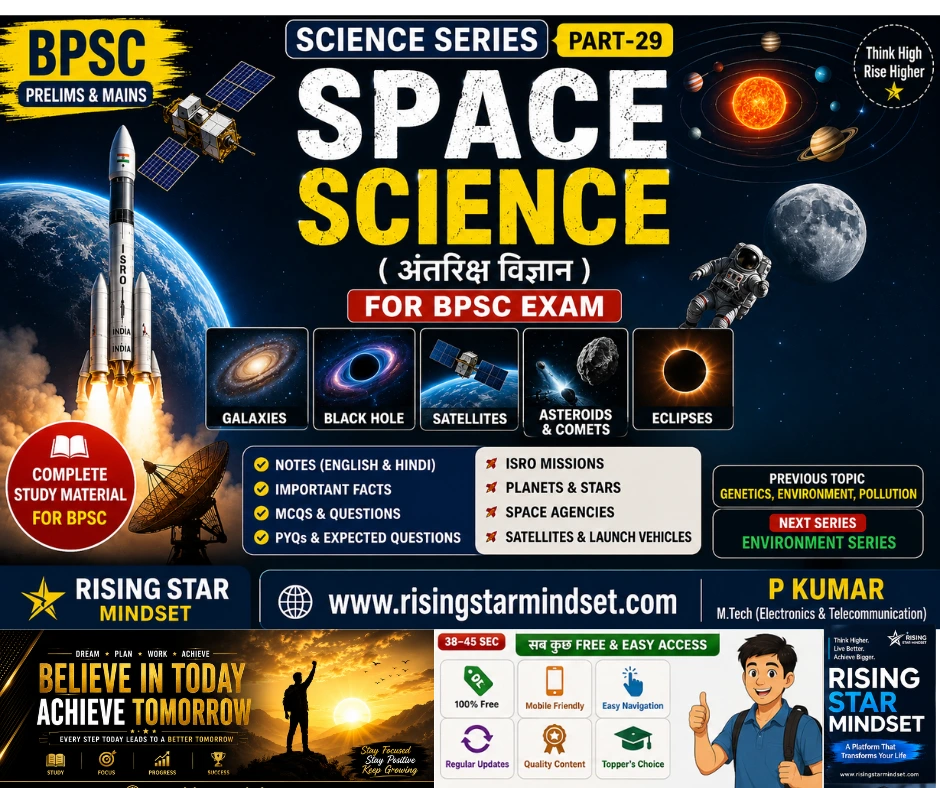
🚀 Science Series – Part 29
Space Science (अंतरिक्ष विज्ञान) ( Space Science for BPSC )
Previous Topic: Genetics, Environment & Pollution (Science Series Part-28)
Next Series: Environment Series
Table of Contents ( Space Science for BPSC )
- Introduction
- What is Space Science?
- Importance for BPSC
- Abbreviations
- Key Points
- Solar System
- Planets
- Satellites
- Stars and Galaxies
- Black Hole
- Asteroids, Meteoroids & Comets
- Eclipses
- Indian Space Programme
- Important Space Missions
- Space Agencies
- Important Facts
- Match the Following
- MCQs
- Question & Answers
- Previous Year Questions (PYQs)
- Expected Questions
- Revision Points
- Conclusion
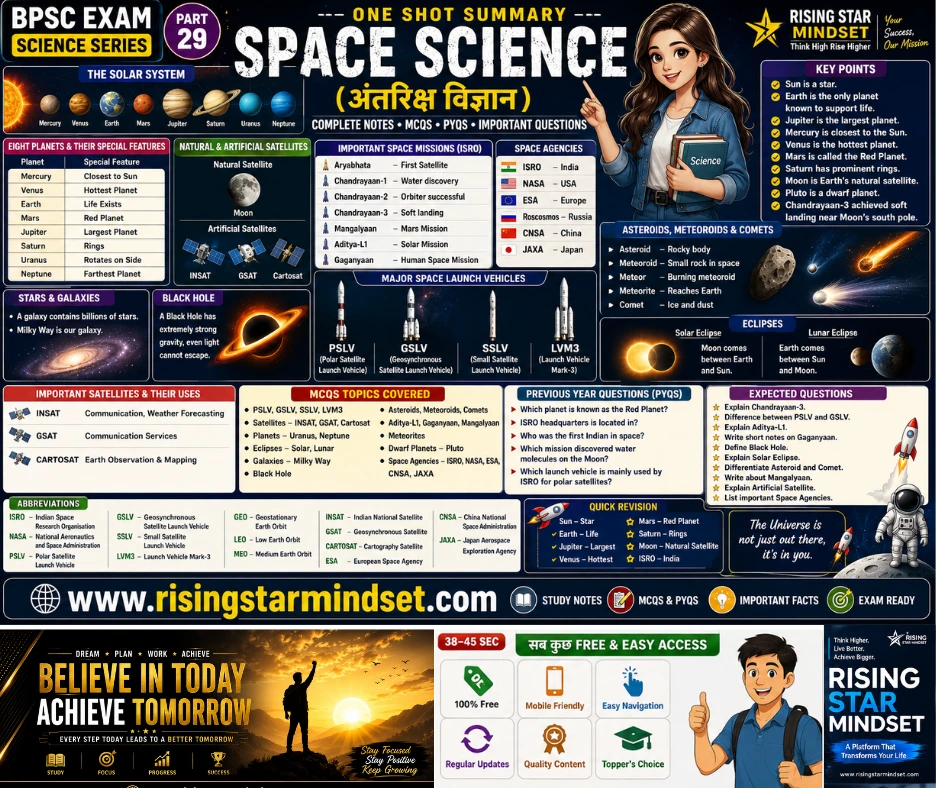
Introduction (परिचय)
English
Space Science studies celestial bodies, the Solar System, galaxies, stars, planets, satellites, and the universe. Moreover, it explains how space technology helps weather forecasting, communication, navigation, disaster management, and national security. Therefore, Space Science has become an important topic in the BPSC examination. ( Space Science for BPSC )
हिंदी
अंतरिक्ष विज्ञान वह विज्ञान है जिसमें ग्रह, तारे, उपग्रह, आकाशगंगा, सौरमंडल तथा ब्रह्मांड का अध्ययन किया जाता है। इसके अलावा अंतरिक्ष तकनीक मौसम पूर्वानुमान, संचार, नेविगेशन, आपदा प्रबंधन तथा राष्ट्रीय सुरक्षा में महत्वपूर्ण भूमिका निभाती है। इसलिए BPSC परीक्षा में यह अत्यंत महत्वपूर्ण विषय है।
What is Space Science? (अंतरिक्ष विज्ञान क्या है?)
English
Space Science is the branch of science that studies everything beyond Earth’s atmosphere.
हिंदी
पृथ्वी के वायुमंडल के बाहर स्थित सभी खगोलीय पिंडों एवं घटनाओं का अध्ययन अंतरिक्ष विज्ञान कहलाता है।
Why is Space Science Important for BPSC?
English
- Frequently asked in Prelims.
- Important for Current Affairs.
- Useful in Science and Technology.
- Helps in Geography.
- Relevant for Interview.
हिंदी
- प्रारंभिक परीक्षा में नियमित प्रश्न
- विज्ञान एवं तकनीक का महत्वपूर्ण भाग
- समसामयिक घटनाओं से जुड़ा
- भूगोल में उपयोगी
- साक्षात्कार हेतु भी महत्वपूर्ण
Important Abbreviations ( Space Science for BPSC )
| Abbreviation | Full Form |
| ISRO | Indian Space Research Organisation |
| NASA | National Aeronautics and Space Administration |
| PSLV | Polar Satellite Launch Vehicle |
| GSLV | Geosynchronous Satellite Launch Vehicle |
| SSLV | Small Satellite Launch Vehicle |
| LVM3 | Launch Vehicle Mark-3 |
| GEO | Geostationary Earth Orbit |
| LEO | Low Earth Orbit |
| MEO | Medium Earth Orbit |
| ESA | European Space Agency |
| CNSA | China National Space Administration |
| JAXA | Japan Aerospace Exploration Agency |
Key Points (महत्वपूर्ण तथ्य) ( Space Science for BPSC )
English
- The Sun is a star.
- Earth is the only known planet supporting life.
- Jupiter is the largest planet.
- Mercury is the closest planet to the Sun.
- Venus is the hottest planet.
- Saturn has the most prominent rings.
- Mars is called the Red Planet.
- Moon is Earth’s natural satellite.
- Pluto is a dwarf planet.
- Chandrayaan-3 achieved a soft landing near the Moon’s south pole.
हिंदी
- सूर्य एक तारा है।
- पृथ्वी जीवन वाला ज्ञात ग्रह है।
- बृहस्पति सबसे बड़ा ग्रह है।
- बुध सूर्य के सबसे निकट है।
- शुक्र सबसे गर्म ग्रह है।
- शनि के सुंदर वलय हैं।
- मंगल लाल ग्रह कहलाता है।
- चंद्रमा पृथ्वी का प्राकृतिक उपग्रह है।
- प्लूटो बौना ग्रह है।
- चंद्रयान-3 ने चंद्रमा के दक्षिणी ध्रुव के पास सफल सॉफ्ट लैंडिंग की।
Solar System (सौरमंडल) ( Space Science for BPSC )
English
The Solar System consists of the Sun, eight planets, dwarf planets, asteroids, comets, and satellites.
हिंदी
सौरमंडल में सूर्य, आठ ग्रह, बौने ग्रह, क्षुद्रग्रह, धूमकेतु तथा उपग्रह शामिल हैं।
Eight Planets ( Space Science for BPSC )
| Planet | Special Feature |
| Mercury | Closest to Sun |
| Venus | Hottest Planet |
| Earth | Life Exists |
| Mars | Red Planet |
| Jupiter | Largest Planet |
| Saturn | Rings |
| Uranus | Rotates on Side |
| Neptune | Farthest Planet |
Natural and Artificial Satellites
English
Natural satellites occur naturally, whereas artificial satellites are launched by humans.
Examples
Natural: Moon
Artificial: INSAT, GSAT, Cartosat
हिंदी
प्राकृतिक उपग्रह प्राकृतिक रूप से बने होते हैं जबकि कृत्रिम उपग्रह मनुष्य द्वारा भेजे जाते हैं।
Stars and Galaxies
English
A galaxy contains billions of stars.
Milky Way is our galaxy.
हिंदी
आकाशगंगा करोड़ों-अरबों तारों का समूह है।
मिल्की वे हमारी आकाशगंगा है।
Black Hole
English
A Black Hole has extremely strong gravity, and therefore even light cannot escape.
हिंदी
ब्लैक होल का गुरुत्वाकर्षण इतना अधिक होता है कि प्रकाश भी बाहर नहीं निकल सकता।
Asteroid, Meteoroid and Comet
| Object | Description |
| Asteroid | Rocky body |
| Meteoroid | Small rock in space |
| Meteor | Burning meteoroid |
| Meteorite | Reaches Earth |
| Comet | Ice and dust |
Eclipses
Solar Eclipse
Moon comes between Earth and Sun.
Lunar Eclipse
Earth comes between Sun and Moon.
Indian Space Programme
| Mission | Achievement |
| Aryabhata | First Satellite |
| Chandrayaan-1 | Water discovery |
| Chandrayaan-2 | Orbiter successful |
| Chandrayaan-3 | Soft landing |
| Mangalyaan | Mars Mission |
| Aditya-L1 | Solar Mission |
| Gaganyaan | Human Space Mission |
Major Space Agencies
| Agency | Country |
| ISRO | India |
| NASA | USA |
| ESA | Europe |
| Roscosmos | Russia |
| CNSA | China |
| JAXA | Japan |
Match the Following ( Space Science for BPSC )
| Column A | Column B |
| Mars | Red Planet |
| Jupiter | Largest Planet |
| Venus | Hottest Planet |
| Saturn | Rings |
| Mercury | Closest to Sun |
| Moon | Natural Satellite |
| ISRO | India |
| NASA | USA |
MCQs (1–30)
1. Which is the largest planet?
A. Earth
B. Jupiter
C. Saturn
D. Mars
Answer: B
2. Which planet is called the Red Planet?
A. Earth
B. Mars
C. Venus
D. Neptune
Answer: B
3. Which planet has beautiful rings?
A. Saturn
B. Mercury
C. Mars
D. Earth
Answer: A
4. Chandrayaan-3 landed on
A. Mars
B. Moon
C. Venus
D. Sun
Answer: B
5. ISRO belongs to
A. India
B. USA
C. Japan
D. China
Answer: A
6. PSLV stands for
A. Polar Satellite Launch Vehicle
B. Planetary Satellite Launch Vehicle
C. Public Satellite Launch Vehicle
D. Polar Space Launch Vehicle
✅ Answer: A. Polar Satellite Launch Vehicle
7. GSLV is mainly used to launch satellites into
A. Low Earth Orbit (LEO)
B. Polar Orbit
C. Geostationary Orbit (GEO)
D. Lunar Orbit
✅ Answer: C. Geostationary Orbit (GEO)
8. Which of the following is Earth’s natural satellite?
A. INSAT
B. GSAT
C. Moon
D. Cartosat
✅ Answer: C. Moon
9. Which of the following is an artificial satellite?
A. Moon
B. Europa
C. INSAT
D. Titan
✅ Answer: C. INSAT
10. A Solar Eclipse occurs when
A. Earth comes between the Sun and Moon
B. Moon comes between the Sun and Earth
C. Sun comes between Earth and Moon
D. Mars comes between Earth and Sun
✅ Answer: B. Moon comes between the Sun and Earth
11. A Lunar Eclipse occurs when
A. Moon comes between Earth and Sun
B. Earth comes between Sun and Moon
C. Sun comes between Earth and Moon
D. Venus comes between Earth and Moon
✅ Answer: B. Earth comes between Sun and Moon
12. The Milky Way is a
A. Planet
B. Galaxy
C. Star
D. Nebula
✅ Answer: B. Galaxy
13. A Black Hole is known for its
A. High temperature
B. Strong magnetic field only
C. Extremely strong gravitational force
D. Bright light emission
✅ Answer: C. Extremely strong gravitational force
14. Which celestial body mainly consists of rock and metal and revolves around the Sun?
A. Comet
B. Asteroid
C. Meteor
D. Satellite
✅ Answer: B. Asteroid
15. A comet is mainly made up of
A. Iron only
B. Ice, dust and gases
C. Liquid water
D. Carbon only
✅ Answer: B. Ice, dust and gases
16. Aditya-L1 mission is related to the study of
A. Mars
B. Moon
C. Sun
D. Jupiter
✅ Answer: C. Sun
17. Gaganyaan Mission aims to
A. Explore Mars
B. Send Indian astronauts into space
C. Study the Sun
D. Launch communication satellites
✅ Answer: B. Send Indian astronauts into space
18. Mangalyaan is India’s mission to
A. Moon
B. Venus
C. Mars
D. Jupiter
✅ Answer: C. Mars
19. Which planet rotates on its side?
A. Mars
B. Neptune
C. Uranus
D. Mercury
✅ Answer: C. Uranus
20. Which is the farthest planet from the Sun?
A. Uranus
B. Saturn
C. Neptune
D. Jupiter
✅ Answer: C. Neptune
21. A meteoroid that reaches the Earth’s surface is called
A. Asteroid
B. Meteorite
C. Comet
D. Satellite
✅ Answer: B. Meteorite
22. INSAT satellites are mainly used for
A. Mining
B. Communication and Weather Forecasting
C. Agriculture only
D. Space Tourism
✅ Answer: B. Communication and Weather Forecasting
23. GSAT satellites are primarily used for
A. Navigation
B. Communication Services
C. Weather Observation
D. Planetary Exploration
✅ Answer: B. Communication Services
24. Cartosat satellites are mainly used for
A. Ocean Research
B. Earth Observation and Mapping
C. Human Spaceflight
D. Lunar Exploration
✅ Answer: B. Earth Observation and Mapping
25. Which of the following is a dwarf planet?
A. Earth
B. Mars
C. Pluto
D. Venus
✅ Answer: C. Pluto
26. Which space agency belongs to India?
A. NASA
B. ESA
C. ISRO
D. CNSA
✅ Answer: C. ISRO
27. NASA is the space agency of
A. Russia
B. Japan
C. USA
D. China
✅ Answer: C. USA
28. ESA stands for
A. European Satellite Agency
B. European Space Agency
C. Earth Space Administration
D. European Science Association
✅ Answer: B. European Space Agency
29. Which country operates the space agency JAXA?
A. China
B. Japan
C. India
D. France
✅ Answer: B. Japan
30. Which launch vehicle has been widely used by ISRO to place satellites into Polar Sun-Synchronous Orbit?
A. PSLV
B. GSLV
C. SSLV
D. LVM3
✅ Answer: A. PSLV
Important Question & Answers
Q1. What is Space Science?
Answer
Study of celestial bodies and outer space.
अंतरिक्ष एवं खगोलीय पिंडों का अध्ययन।
Q2. What is the Solar System?
Sun and eight planets.
सूर्य तथा आठ ग्रहों का समूह।
Q3. What is ISRO?
India’s Space Research Organisation.
भारत का अंतरिक्ष अनुसंधान संगठन।
Q4. Difference between Natural and Artificial Satellite.
Natural forms naturally.
Artificial launched by humans.
Q5. Why is Chandrayaan-3 important?
It made India’s first successful soft landing near the Moon’s south pole.
Previous Year Questions (PYQs)
Q1
Which planet is known as the Red Planet?
Q2
ISRO headquarters is located in
Q3
Who was the first Indian in space?
Q4
Which mission discovered water molecules on the Moon?
Q5
Which launch vehicle is mainly used by ISRO for polar satellites?
Expected Questions for BPSC
- Explain Chandrayaan-3.
- Difference between PSLV and GSLV.
- Explain Aditya-L1.
- Write short notes on Gaganyaan.
- Define Black Hole.
- Explain Solar Eclipse.
- Differentiate Asteroid and Comet.
- Write about Mangalyaan.
- Explain Artificial Satellite.
- List important Space Agencies.
Quick Revision
- Sun → Star
- Earth → Life
- Jupiter → Largest
- Venus → Hottest
- Mars → Red
- Saturn → Rings
- Moon → Natural Satellite
- ISRO → India
- NASA → USA
- Chandrayaan-3 → South Pole Landing
- Aditya-L1 → Sun Mission
- Gaganyaan → Human Mission
Conclusion
English
Space Science is one of the most scoring topics in BPSC Science because it combines static knowledge with current affairs. Moreover, candidates should revise planetary facts, ISRO missions, satellites, and space technology regularly. Therefore, consistent practice of MCQs and PYQs will significantly improve accuracy in the examination.
हिंदी
अंतरिक्ष विज्ञान BPSC विज्ञान का अत्यंत महत्वपूर्ण एवं स्कोरिंग विषय है क्योंकि इसमें स्थिर तथ्यों के साथ समसामयिक घटनाएँ भी शामिल होती हैं। इसके अलावा ग्रहों, उपग्रहों, ISRO मिशनों तथा अंतरिक्ष तकनीक का नियमित अध्ययन आवश्यक है। इसलिए यदि अभ्यर्थी MCQs एवं PYQs का निरंतर अभ्यास करेंगे, तो परीक्षा में बेहतर अंक प्राप्त करने की संभावना काफी बढ़ जाएगी।
Keep Learning, Keep Growing! 🚀
P Kumar | Rising Star Mindset
www.risingstarmindset.com
Together We Will Make The Difference