
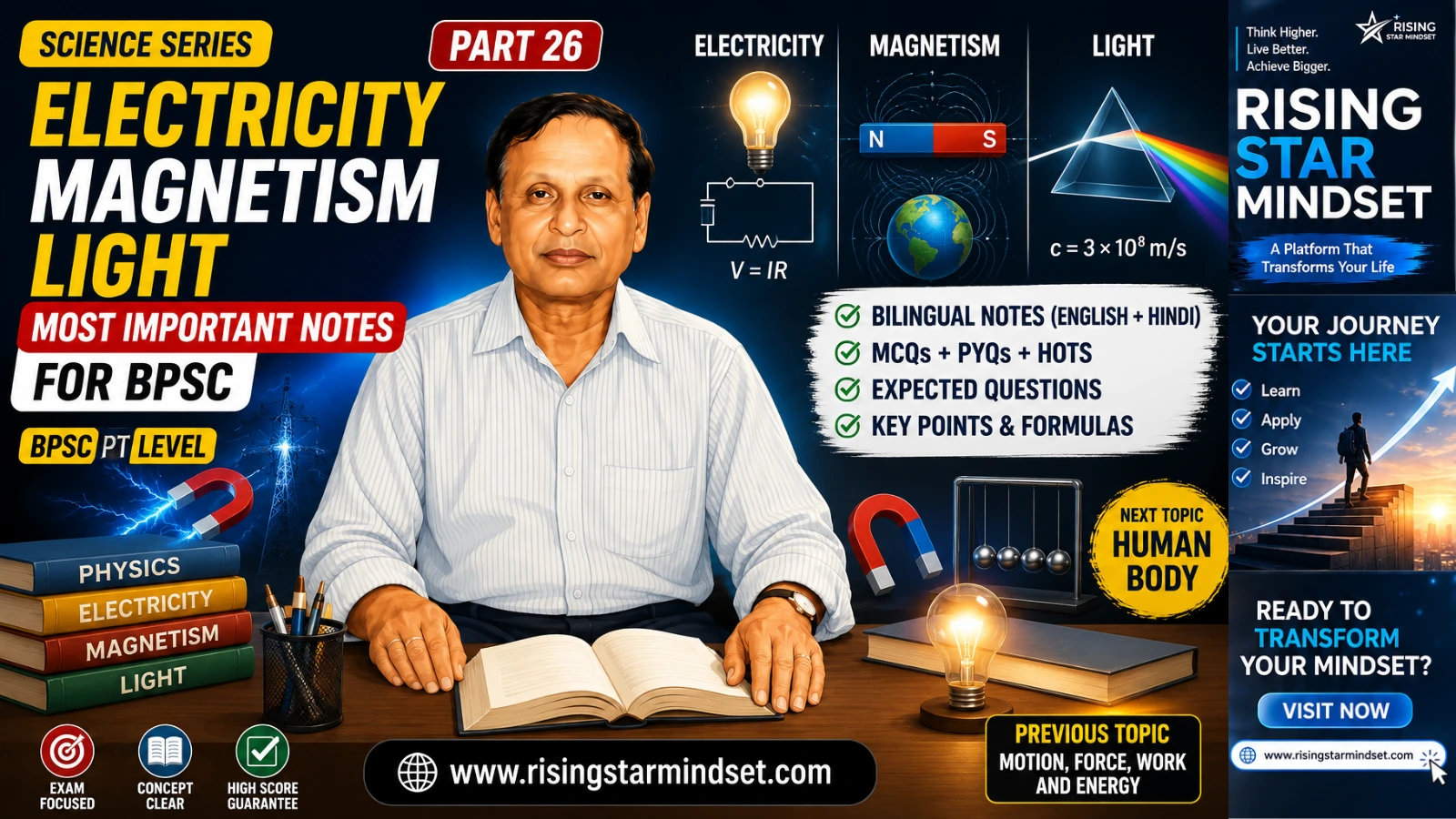
Electricity Magnetism Light (विद्युत, चुंबकत्व एवं प्रकाश)
Science Series – Part 26 ( Electricity Magnetism Light )
Previous Part: Motion, Force, Work & Energy
Current Part: Electricity, Magnetism & Light
Next Part: Human Body
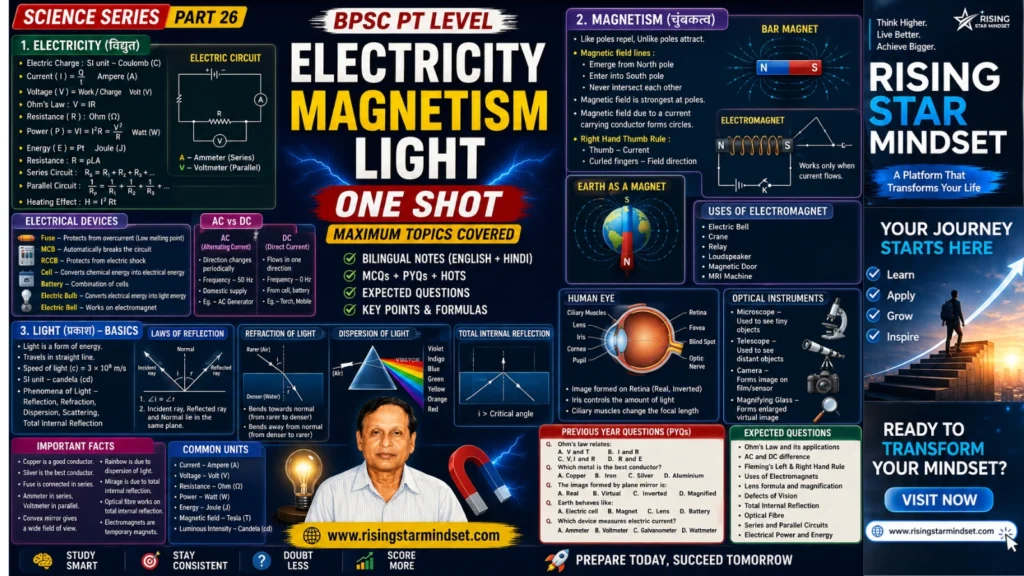
Table of Contents
- Introduction
- Electricity
- Magnetism
- Light
- Important Formulae
- Abbreviations
- Key Points
- PYQs
- MCQs
- Short Questions & Answers
- HOTS Questions
- Expected Questions for BPSC PT
- Conclusion
Introduction (परिचय) ( Electricity Magnetism Light )
English
Electricity, Magnetism, and Light are among the most frequently asked topics in BPSC, UPSC, SSC, Railway, Bihar Police, and other competitive examinations. Understanding their concepts helps solve both theoretical and numerical questions.
हिन्दी
विद्युत, चुंबकत्व तथा प्रकाश प्रतियोगी परीक्षाओं में सबसे अधिक पूछे जाने वाले विषयों में से हैं। इनके मूल सिद्धांत समझ लेने पर वस्तुनिष्ठ प्रश्न आसानी से हल किए जा सकते हैं।
1. Electricity (विद्युत)
English
Electricity is the flow of electric charges through a conductor.
Important Concepts
- Electric Charge
- Electric Current
- Voltage
- Resistance
- Electric Power
- Ohm’s Law
Formulae
Current
I = Q/t
Voltage
V = IR
Power
P = VI
Energy
E = Pt
हिन्दी
किसी चालक में विद्युत आवेश के प्रवाह को विद्युत धारा कहते हैं।
मुख्य अवधारणाएँ
- विद्युत धारा
- विभवांतर
- प्रतिरोध
- शक्ति
- ऊर्जा
- ओम का नियम
Ohm’s Law (ओम का नियम)
English
Current is directly proportional to voltage if temperature remains constant.
V = IR
हिन्दी
यदि तापमान स्थिर रहे तो धारा विभवांतर के समानुपाती होती है।
V = IR
2. Magnetism (चुंबकत्व)
English
Magnetism is the property by which a magnet attracts iron, nickel, and cobalt.
Important Facts
- Like poles repel.
- Unlike poles attract.
- Magnetic field lines never intersect.
- Earth behaves like a giant magnet.
हिन्दी
चुंबकत्व वह गुण है जिसके कारण चुंबक लोहा, निकेल तथा कोबाल्ट को आकर्षित करता है।
मुख्य तथ्य
- समान ध्रुव प्रतिकर्षित करते हैं।
- असमान ध्रुव आकर्षित करते हैं।
- चुंबकीय क्षेत्र रेखाएँ कभी नहीं कटतीं।
- पृथ्वी एक विशाल चुंबक की तरह कार्य करती है।
Electromagnet (विद्युत चुंबक)
English
An electromagnet works only when electric current flows.
Uses
- Electric bell
- Crane
- Relay
- Speaker
हिन्दी
विद्युत धारा प्रवाहित होने पर बना चुंबक विद्युत चुंबक कहलाता है।
उपयोग
- विद्युत घंटी
- क्रेन
- स्पीकर
- रिले
3. Light (प्रकाश)
English
Light is a form of energy that enables vision.
Properties
- Reflection
- Refraction
- Dispersion
- Total Internal Reflection
हिन्दी
प्रकाश ऊर्जा का एक रूप है जिससे हमें वस्तुएँ दिखाई देती हैं।
मुख्य गुण
- परावर्तन
- अपवर्तन
- वर्ण विक्षेपण
- पूर्ण आंतरिक परावर्तन
Reflection (परावर्तन)
Laws
- Angle of incidence = Angle of reflection
- Incident ray, reflected ray and normal lie in the same plane.
Refraction (अपवर्तन)
When light travels from one medium to another, its direction changes.
Example
- Pencil appears bent in water.
Human Eye (मानव नेत्र)
Important Facts
- Retina forms image.
- Iris controls light.
- Lens is convex.
- Blind spot has no photoreceptors.
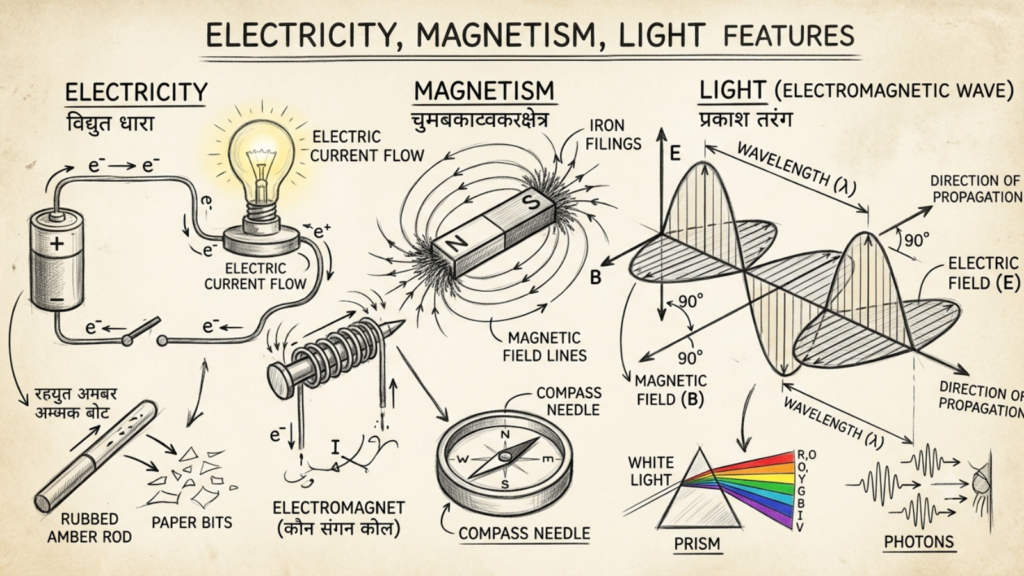
Important Formulae
Ohm’s Law
V = IR
Electric Power
P = VI
Electrical Energy
E = Pt
Resistance
R = ρL/A
Lens Formula
1/f = 1/v − 1/u
Magnification
M = h₂/h₁ = v/u
Abbreviations ( Electricity Magnetism Light )
| Abbreviation | Full Form |
| AC | Alternating Current |
| DC | Direct Current |
| EMF | Electromotive Force |
| LED | Light Emitting Diode |
| CFL | Compact Fluorescent Lamp |
| SI | International System |
| MCB | Miniature Circuit Breaker |
| RCCB | Residual Current Circuit Breaker |
| MRI | Magnetic Resonance Imaging |
| LASER | Light Amplification by Stimulated Emission of Radiation |
Key Points ( Electricity Magnetism Light )
- Current flows from higher potential to lower potential.
- Electron flow is opposite to conventional current.
- Copper is a good conductor.
- Silver is the best conductor.
- Fuse is connected in series.
- Ammeter is connected in series.
- Voltmeter is connected in parallel.
- Magnetic field is strongest at poles.
- Convex lens converges light.
- Concave lens diverges light.
- Rainbow is formed due to dispersion.
- Mirage is caused by total internal reflection.
- Optical fibre works on total internal reflection.
- Electromagnets lose magnetism when current stops.
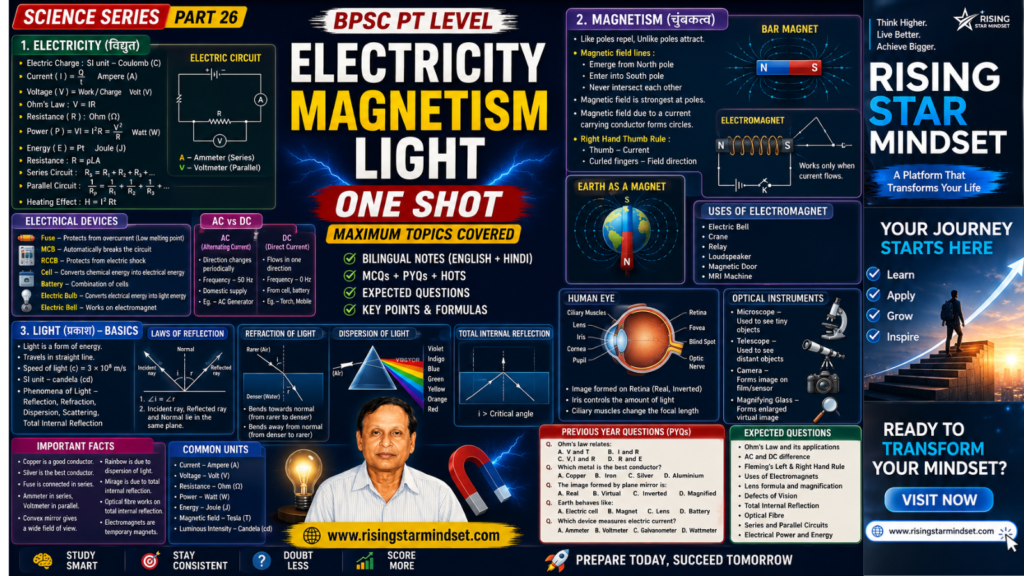
Previous Year Questions (PYQs)
Q1.
Ohm’s law relates
A. Voltage and Temperature
B. Current and Resistance
C. Voltage, Current and Resistance
D. Resistance and Energy
Answer: C
Q2.
Which metal is the best conductor?
A. Copper
B. Iron
C. Silver
D. Aluminium
Answer: C
Q3.
The image formed by a plane mirror is
A. Real
B. Virtual
C. Inverted
D. Magnified
Answer: B
Q4.
Earth behaves like
A. Electric cell
B. Magnet
C. Lens
D. Battery
Answer: B
Q5.
Which device measures electric current?
A. Ammeter
B. Voltmeter
C. Galvanometer
D. Wattmeter
Answer: A
MCQs (Practice Set)
1.
SI unit of resistance
A. Volt
B. Ohm
C. Ampere
D. Watt
Answer: B
2.
Power is measured in
A. Watt
B. Joule
C. Newton
D. Pascal
Answer: A
3.
Who gave Ohm’s Law?
A. Newton
B. Ohm
C. Faraday
D. Maxwell
Answer: B
4.
Magnetic field lines never
A. Bend
B. Cross
C. Curve
D. Expand
Answer: B
5.
Which lens is used to correct myopia?
A. Convex
B. Concave
C. Cylindrical
D. Plano
Answer: B
6.
Which mirror is used in vehicles?
A. Convex
B. Concave
C. Plane
D. None
Answer: A
7.
Optical fibre works on
A. Reflection
B. Refraction
C. Total Internal Reflection
D. Diffraction
Answer: C
8.
Fuse wire has
A. High melting point
B. Low melting point
C. High density
D. Zero resistance
Answer: B
9.
Electric bell works on
A. Permanent magnet
B. Electromagnet
C. Gravity
D. Spring
Answer: B
10.
Speed of light is
A. 3 × 10⁸ m/s
B. 3 × 10⁶ m/s
C. 3 × 10⁵ km/s
D. Both A and C
Answer: D
Short Questions & Answers
What is electric current?
Flow of electric charge through a conductor.
विद्युत आवेश के प्रवाह को विद्युत धारा कहते हैं।
What is resistance?
Opposition offered to current.
धारा के प्रवाह का विरोध प्रतिरोध कहलाता है।
What is an electromagnet?
A temporary magnet produced by electric current.
विद्युत धारा से उत्पन्न अस्थायी चुंबक।
Why is convex mirror used in vehicles?
It provides a wider field of view.
यह अधिक क्षेत्र दिखाई देता है।
Why is optical fibre important?
It enables high-speed communication using total internal reflection.
HOTS Questions
- Explain why a fuse is always connected in series with an electric circuit.
- How does an electromagnet lose its magnetism when the electric current is switched off?
- State the reason aluminium is preferred over silver for long-distance transmission wires.
- Describe the process responsible for the occurrence of lightning during thunderstorms.
- Under what conditions does a rainbow become visible after rainfall?
- Compare optical fibre and copper cable in terms of speed, signal loss, and communication efficiency.
- What prevents birds from getting electrocuted while sitting on high-voltage power lines?
- Discuss how mirrors produce left-right reversal without reversing the top and bottom of an image.
Expected Questions for BPSC PT 2026
- Ohm’s Law and its applications.
- Difference between AC and DC.
- Fuse vs MCB.
- Fleming’s Left-Hand Rule.
- Fleming’s Right-Hand Rule.
- Faraday’s Law.
- Uses of electromagnets.
- Permanent magnet vs electromagnet.
- Lens formula.
- Total internal reflection.
- Optical fibre.
- Defects of vision.
- Human eye.
- Rainbow formation.
- Electric power and energy.
- Series and parallel circuits.
- Domestic wiring.
- Conductors and insulators.
- Magnetic field lines.
- SI units related to electricity.
Conclusion
Electricity, Magnetism, and Light form a high-scoring section in the BPSC Preliminary Examination. Focus on fundamental concepts, SI units, formulas, devices, applications, and previous-year trends. Revise the bilingual explanations, solve MCQs regularly, and practice expected questions to strengthen conceptual clarity and improve accuracy in the exam.
Series Progress:
- ✅ Part 25: Motion, Force, Work & Energy
- ✅ Part 26: Electricity, Magnetism & Light
- 🔜 Part 27: Human Body
Keep Learning, Keep Growing! 🚀
P Kumar | Rising Star Mindset
www.risingstarmindset.com
Together We Will Make The Difference