
Geography Series – Part 13
Atmosphere, Winds and Climate Complete Notes for BPSC, UPSC & Competitive Exams
Series Name: Geography Series ( Atmosphere Winds and Climate )
Part Number: 13
Current Topic: Atmosphere, Winds & Climate
Previous Topic: Volcano and Earthquake
Next Topic: Indian Rivers
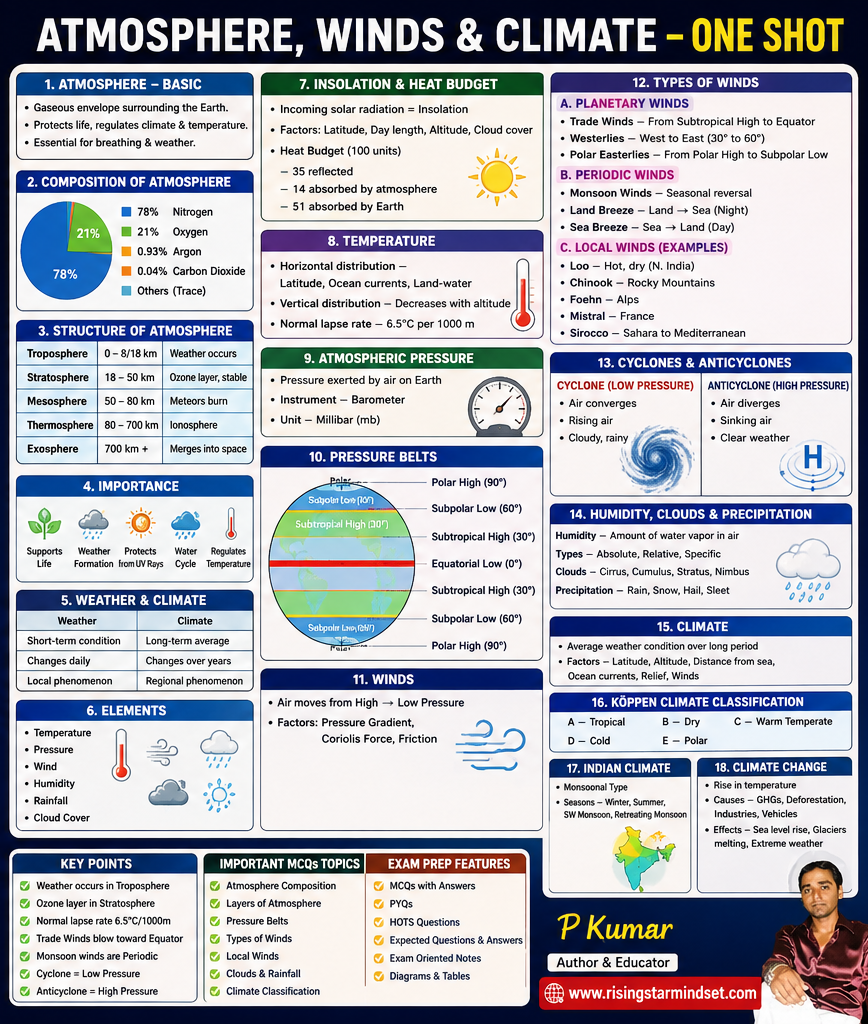
Table of Contents ( Atmosphere Winds and Climate )
- Introduction to Atmosphere
- Composition of Atmosphere
- Structure of Atmosphere
- Importance of Atmosphere
- Weather and Climate
- Elements of Weather and Climate
- Insolation and Heat Budget
- Temperature Distribution
- Atmospheric Pressure
- Winds
- Types of Winds
- Planetary Winds
- Periodic Winds
- Local Winds
- Cyclones and Anticyclones
- Humidity
- Clouds and Precipitation
- Climate and Climatic Factors
- Köppen Climate Classification
- Indian Climate
- Climate Change and Global Warming
- Key Points for BPSC
- Previous Year Questions (PYQ)
- HOTS Questions
- Important MCQs
- Expected Questions and Answers
- Conclusion
Introduction | परिचय ( Atmosphere Winds and Climate )
The atmosphere is a layer of gases around the Earth. It protects us from harmful solar rays. That helps to maintain temperature. It also provides the gases needed for life.
हिंदी में:
वायुमंडल पृथ्वी के चारों ओर गैसों का आवरण है। यह सूर्य की हानिकारक किरणों से रक्षा करता है तथा जीवन के लिए आवश्यक गैसें उपलब्ध कराता है।
Abbreviations ( Atmosphere Winds and Climate )
| Abbreviation | Full Form |
|---|---|
| O₃ | Ozone |
| CO₂ | Carbon Dioxide |
| UV | Ultraviolet |
| ITCZ | Inter Tropical Convergence Zone |
| ELR | Environmental Lapse Rate |
| GHG | Greenhouse Gas |
| ENSO | El Niño Southern Oscillation |
| IMD | India Meteorological Department |
What is Atmosphere?
Atmosphere is the gaseous envelope surrounding the Earth.
Composition of Atmosphere
| Gas | Percentage |
|---|---|
| Nitrogen | 78% |
| Oxygen | 21% |
| Argon | 0.93% |
| Carbon Dioxide | 0.04% |
| Others | Trace Amount |
Key Facts
- Nitrogen is the most abundant gas.
- Oxygen supports life and combustion.
- Plants use carbon dioxide to make food.
- Ozone absorbs UV rays.
Structure of Atmosphere
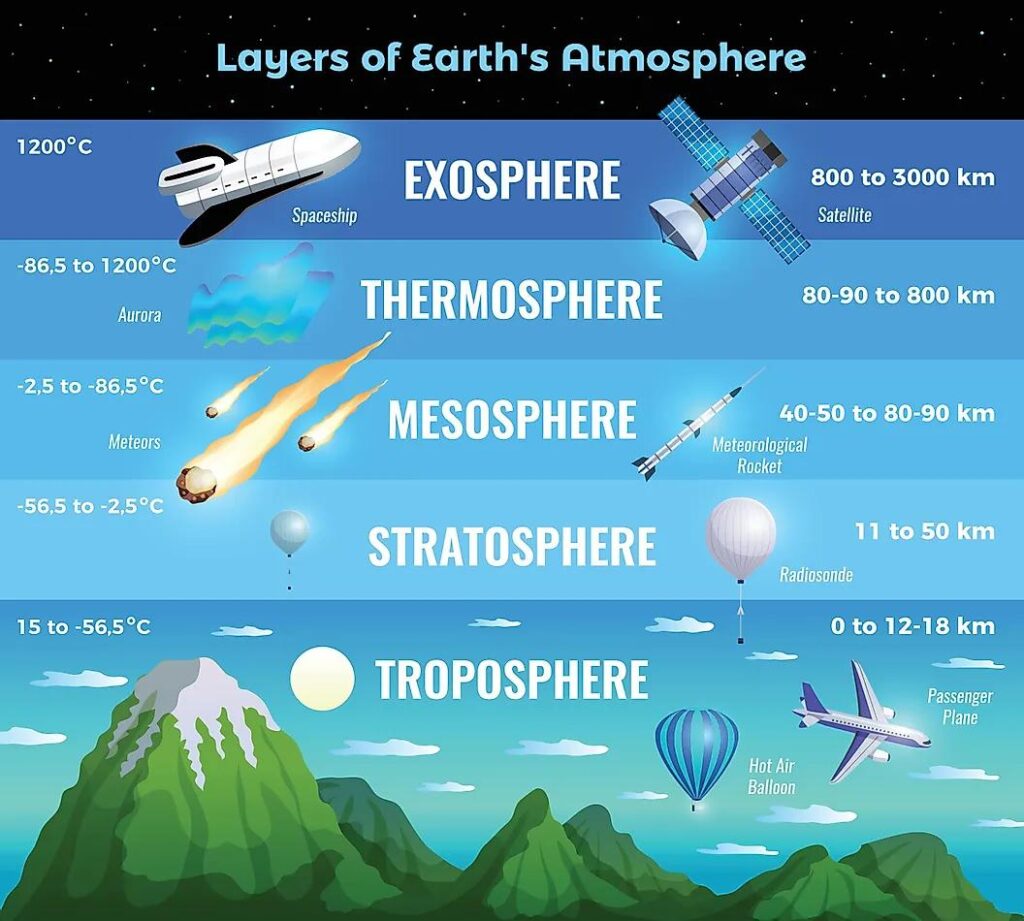
1. Troposphere
- Height: 8–18 km
- All weather activities like rain, clouds and storms occur here.
- Contains 75% of atmospheric gases.
Important Fact
Temperature decreases by 6.5°C per 1000 m.
2. Stratosphere
- 18–50 km
- Ozone layer present.
- Aircraft fly here.
3. Mesosphere
- 50–80 km
- Meteors burn here.
4. Thermosphere
- 80–700 km
- Contains ionosphere.
- Radio communication possible.
5. Exosphere
- Uppermost layer.
- Merges into outer space.
Importance of Atmosphere ( Atmosphere Winds and Climate )
Atmosphere Helps In
- Breathing
- Weather formation
- Protection from meteorites
- Water cycle
- Maintaining temperature
Weather and Climate ( Atmosphere Winds and Climate )
| Weather | Climate |
|---|---|
| Short-term condition | Long-term average condition |
| Changes daily | Changes over years |
| Local phenomenon | Regional phenomenon |
Example
Today’s rain = Weather
Average rainfall of Bihar = Climate
Elements of Weather and Climate
- Temperature
- Pressure
- Wind
- Humidity
- Rainfall
- Cloud Cover
Insolation
Definition
Insolation means the solar energy received by the Earth. It is the main source of heat and light on our planet.
Factors Affecting Insolation
- Latitude
- Duration of daylight
- Cloud cover
- Altitude
Heat Budget of Earth
100 units solar energy received:
- 35 reflected
- 14 absorbed by atmosphere
- 51 absorbed by Earth
This balance is called Heat Budget.
Temperature Distribution
Horizontal Distribution
Affected by:
- Latitude
- Ocean currents
- Land-water contrast
Vertical Distribution
Temperature decreases with altitude.
Lapse Rate
Normal lapse rate = 6.5°C per 1000 m
Atmospheric Pressure
Pressure exerted by air on Earth surface.
Instrument
Barometer
Unit
Millibar (mb)
Pressure Belts of Earth
- Equatorial Low Pressure Belt
- Subtropical High Pressure Belt
- Subpolar Low Pressure Belt
- Polar High Pressure Belt
Winds ( Atmosphere Winds and Climate )
Wind is moving air. It always moves from a high-pressure area to a low-pressure area.
Factors Affecting Winds
- Pressure Gradient
- Coriolis Force
- Friction
Types of Winds
1. Planetary Winds
Trade Winds
- Blow from subtropical highs to equatorial low.
- Northeast Trade Winds (Northern Hemisphere)
Westerlies
- Blow west to east.
- Important for Europe.
Polar Easterlies
- Blow from polar high pressure.
2. Periodic Winds
Monsoon Winds
Seasonal reversal of winds.
Land Breeze
Night time:
Land → Sea
Sea Breeze
Day time:
Sea → Land
3. Local Winds
Loo
- Hot dry wind
- Northern India
- Summer season
Chinook
- Rocky Mountains
Foehn
- Alps
Mistral
- France
Sirocco
- Sahara to Mediterranean
Cyclones and Anticyclones
Cyclone
- Low pressure center
- Air converges inward
- Associated with rain
Examples
- Amphan
- Fani
- Yaas
Anticyclone
- High pressure center
- Air diverges outward
- Clear weather
Humidity
Amount of water vapor in air.
Types
- Absolute Humidity
- Relative Humidity
- Specific Humidity
Clouds
Condensation of water vapor.
Major Cloud Types
Cirrus
High altitude
Cumulus
Cotton-like
Stratus
Layered clouds
Nimbus
Rain-bearing clouds
Precipitation
Water falling from atmosphere.
Types
- Rainfall
- Snowfall
- Hail
- Sleet
Types of Rainfall ( Atmosphere Winds and Climate )
Convectional Rainfall
Equatorial regions
Orographic Rainfall
Mountain barriers
Example:
Western Ghats
Cyclonic Rainfall
Associated with cyclones
Climate
Average weather condition over a long period.
Factors Affecting Climate
Latitude
Higher latitude = Lower temperature
Altitude
Higher altitude = Cooler climate
Distance from Sea
Moderates climate
Ocean Currents
Warm and cold currents affect temperature
Relief
Mountains influence rainfall
Köppen Climate Classification
| Type | Climate |
|---|---|
| A | Tropical |
| B | Dry |
| C | Warm Temperate |
| D | Cold |
| E | Polar |
Indian Climate
Characteristics
- Monsoonal climate
- Seasonal reversal of winds
- Uneven rainfall
Seasons of India
Winter
December–February
Summer
March–May
Southwest Monsoon
June–September
Retreating Monsoon
October–November
Climate Change
Climate change means long-term changes in temperature, rainfall and weather conditions across the world.
Global Warming
Global warming is the gradual increase in Earth’s temperature. It happens mainly because of greenhouse gases released by human activities.
Major Greenhouse Gases
- CO₂
- Methane
- Nitrous Oxide
- Water Vapor
Effects of Global Warming
- Glacier melting
- Sea level rise
- Extreme weather events
- Biodiversity loss
Key Points for BPSC Examination
| Troposphere contains weather phenomena. |
| Ozone layer lies in Stratosphere. |
| Loo blows in North India. |
| Trade Winds blow toward Equator. |
| Normal lapse rate = 6.5°C/1000m. |
| Cyclone = Low pressure center. |
| Anticyclone = High pressure center |
| Monsoon is a periodic wind. |
| Köppen classified climate into five major groups. |
| Indian climate is monsoonal. |
Previous Year Questions (PYQ)
Q1. Ozone layer is located in which layer?
A. Troposphere
B. Stratosphere
C. Mesosphere
D. Thermosphere
Answer: B
Q2. Loo is a:
A. Cold wind
B. Local hot wind
C. Trade wind
D. Polar wind
Answer: B
Q3. Weather phenomena occur in:
A. Stratosphere
B. Troposphere
C. Mesosphere
D. Exosphere
Answer: B
Q4. Instrument measuring pressure?
A. Hygrometer
B. Thermometer
C. Barometer
D. Rain Gauge
Answer: C
Q5. Which layer contains ozone?
A. Troposphere
B. Stratosphere
C. Thermosphere
D. Exosphere
Answer: B
HOTS Questions
1. Why are aircraft generally flown in the stratosphere?
Answer: Due to stable weather conditions and absence of clouds.
2. Why is Chennai wetter in winter than Delhi?
Answer: Due to retreating monsoon winds from Bay of Bengal.
3. Why does temperature decrease with altitude?
Answer: Atmosphere is heated from Earth’s surface, so temperature decreases upward.
4. Explain the role of ozone layer.
Answer: Absorbs harmful ultraviolet radiation.
5. Why does Rajasthan experience extreme temperatures?
Answer: Continental location and low humidity.
Important MCQs
1. Most abundant atmospheric gas?
A. Oxygen
B. Nitrogen
C. Argon
D. CO₂
Answer: B
2. Trade winds blow toward:
A. Poles
B. Equator
C. Tropics
D. Mountains
Answer: B
3. Which cloud gives rainfall?
A. Cirrus
B. Nimbus
C. Cumulus
D. Stratus
Answer: B
4. Normal lapse rate is:
A. 3°C
B. 4°C
C. 5°C
D. 6.5°C
Answer: D
5. Hot local wind of North India:
A. Chinook
B. Mistral
C. Loo
D. Foehn
Answer: C
6. Cyclone represents:
A. High pressure
B. Low pressure
C. Neutral pressure
D. None
Answer: B
7. Humidity is measured by:
A. Hygrometer
B. Barometer
C. Thermometer
D. Anemometer
Answer: A
8. Monsoon winds are:
A. Planetary winds
B. Local winds
C. Periodic winds
D. Polar winds
Answer: C
9. Ozone absorbs:
A. Infrared rays
B. UV rays
C. Radio waves
D. X-rays
Answer: B
10. Which rainfall occurs due to mountains?
A. Cyclonic
B. Convectional
C. Orographic
D. Frontal
Answer: C
Expected Questions and Answers (BPSC 2026)
Q1. Describe the structure of atmosphere.
Answer: Atmosphere consists of Troposphere, Stratosphere, Mesosphere, Thermosphere and Exosphere with distinct characteristics.
Q2. Explain planetary winds.
Answer: Permanent winds including Trade Winds, Westerlies and Polar Easterlies that blow throughout the year.
Q3. Differentiate weather and climate.
Answer: Weather is short-term atmospheric condition while climate is long-term average weather pattern.
Q4. What are pressure belts?
Answer: Zones of high and low atmospheric pressure distributed from equator to poles.
Q5. Discuss the causes of global warming.
Answer: Excess greenhouse gases from industries, vehicles, deforestation and fossil fuel burning.
Exam-Oriented Revision Sheet
Remember These 10 Facts
- Nitrogen = 78%
- Oxygen = 21%
- Ozone Layer → Stratosphere
- Weather → Troposphere
- Lapse Rate = 6.5°C/1000m
- Loo → North India
- Monsoon → Periodic Wind
- Cyclone → Low Pressure
- Anticyclone → High Pressure
- India → Tropical Monsoon Climate
Conclusion
Atmosphere, winds and climate are important topics in Geography. These concepts help us understand weather, rainfall, monsoons and climate change. Questions from this chapter are frequently asked in BPSC, UPSC, SSC and Railway exams. Therefore, students should revise atmospheric layers, pressure belts, winds and Indian climate regularly for better exam performance.
Previous Part: Volcano and Earthquake
Next Part: Indian Rivers (Complete Geography Notes for BPSC)
Website: www.risingstarmindset.com
Geography Series – Part 13 🌍📚
Hi