
BPSC Science Series Part 28 | Genetics, Environment & Pollution | Most Important Notes, PYQs & MCQs
BPSC Science Series – Part 28
Genetics, Environment & Pollution | आनुवंशिकी, पर्यावरण एवं प्रदूषण
Current Topic: Genetics, Environment & Pollution
Previous Topic: Human Body, Nutrition & Diseases
Next Topic: Space Science
Table of Contents ( Genetics, Environment & Pollution )
- Introduction
- Genetics (आनुवंशिकी)
- Important Genetic Terms
- Environment (पर्यावरण)
- Ecosystem (पारिस्थितिकी तंत्र)
- Food Chain & Food Web
- Pollution (प्रदूषण)
- Air Pollution
- Water Pollution
- Soil Pollution
- Noise Pollution
- Greenhouse Effect & Global Warming
- Ozone Layer
- Biodiversity
- Environmental Organizations
- Important Abbreviations
- Key Facts
- Previous Year Questions (PYQs)
- HOTS Questions
- Expected Questions
- MCQs (1–50)
- FAQs
- Conclusion
Introduction | परिचय ( Genetics, Environment & Pollution )
Genetics explains how characteristics pass from parents to offspring. Environment studies the interaction between living organisms and nature, while pollution deals with harmful changes affecting ecological balance. These three topics are highly important for BPSC Prelims, Bihar SI, BSSC, CDPO, and other Bihar competitive examinations.
हिंदी
आनुवंशिकी जीवों में गुणों के पीढ़ी-दर-पीढ़ी स्थानांतरण का अध्ययन है। पर्यावरण जीवों एवं उनके आसपास के वातावरण का अध्ययन करता है, जबकि प्रदूषण पर्यावरण में होने वाले हानिकारक परिवर्तनों से संबंधित है। यह विषय BPSC सहित बिहार की लगभग सभी प्रतियोगी परीक्षाओं में महत्वपूर्ण है।
Genetics (आनुवंशिकी)
English
Genetics is the branch of biology that studies heredity and variation.
Father of Genetics:
Gregor Johann Mendel
His pea plant experiments established the basic laws of inheritance.
हिंदी
आनुवंशिकी जीव विज्ञान की वह शाखा है जिसमें वंशागति एवं विभिन्नताओं का अध्ययन किया जाता है।
आनुवंशिकी के जनक: ग्रेगर जॉन मेंडल
Important Terms ( Genetics, Environment & Pollution )
| English | हिंदी |
|---|---|
| Gene | जीन |
| DNA | डीएनए |
| Chromosome | गुणसूत्र |
| Genome | जीनोम |
| Mutation | उत्परिवर्तन |
| Trait | लक्षण |
| Heredity | वंशागति |
Mendel’s Laws ( Genetics, Environment & Pollution
Law of Dominance
Dominant gene expresses itself.
प्रभावी लक्षण स्वयं प्रकट होता है।
Law of Segregation
Genes separate during gamete formation.
गैमेट बनने के समय जीन अलग हो जाते हैं।
Law of Independent Assortment
Different genes inherit independently.
भिन्न-भिन्न जीन स्वतंत्र रूप से विरासत में जाते हैं।
DNA ( Genetics, Environment & Pollution )
Full Form
Deoxyribonucleic Acid
DNA carries hereditary information.
DNA आनुवंशिक सूचना का वाहक है।
Environment (पर्यावरण)
Environment includes all living and non-living components surrounding an organism.
पर्यावरण जीवों के चारों ओर उपस्थित जैविक एवं अजैविक तत्वों का समूह है।
Components ( Genetics, Environment & Pollution )
Biotic
Plants
Animals
Microorganisms
Abiotic
Air
Water
Soil
Sunlight
Temperature
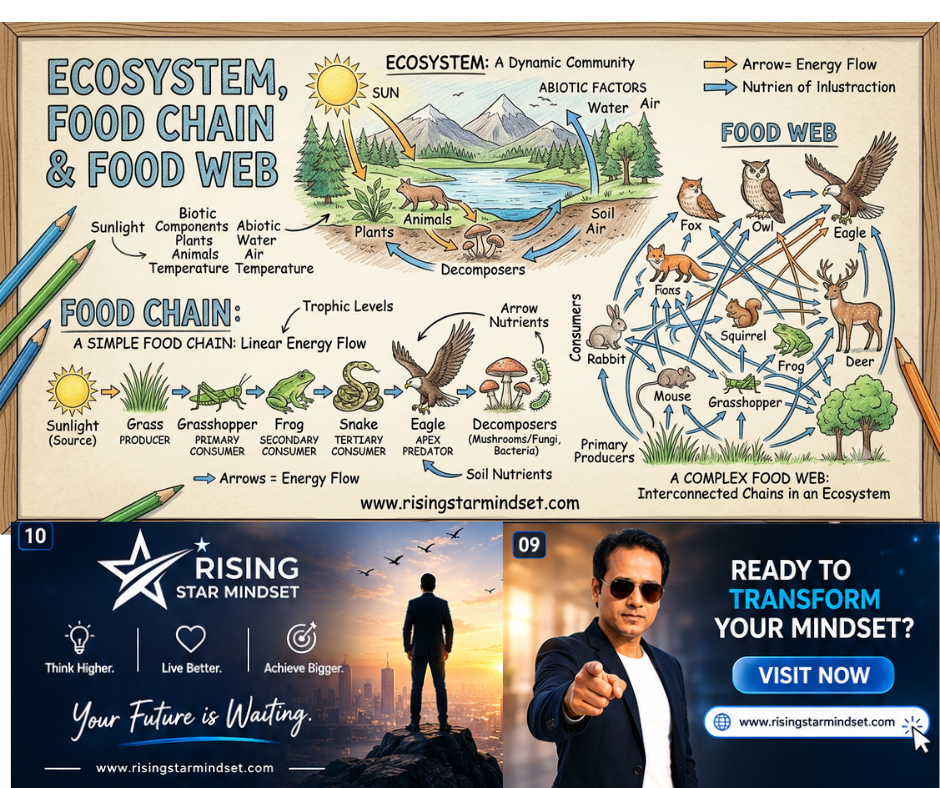
Ecosystem ( Genetics, Environment & Pollution )
An ecosystem is the interaction between living organisms and non-living surroundings.
जीव एवं अजैविक घटकों के बीच पारस्परिक संबंध को पारिस्थितिकी तंत्र कहते हैं।
Food Chain
Grass → Deer → Tiger
Food Web
Interconnected food chains.
Pollution (प्रदूषण)
Pollution is the undesirable change in the environment caused by harmful substances.
हानिकारक पदार्थों के कारण पर्यावरण में होने वाला अवांछित परिवर्तन प्रदूषण कहलाता है।
Types of Pollution
Air Pollution
Causes
Vehicle smoke
Industries
Burning fossil fuels
Effects
Asthma
Acid Rain
Global Warming
Water Pollution
Causes
Industrial waste
Sewage
Fertilizers
Effects
Waterborne diseases
Death of aquatic organisms
Soil Pollution
Causes
Plastic
Pesticides
Chemical fertilizers
Noise Pollution
Causes
Traffic
Loudspeakers
Industries
Effects
Hearing loss
Stress
High blood pressure
Greenhouse Effect
Main greenhouse gases
Carbon dioxide
Methane
Nitrous oxide
Water vapour
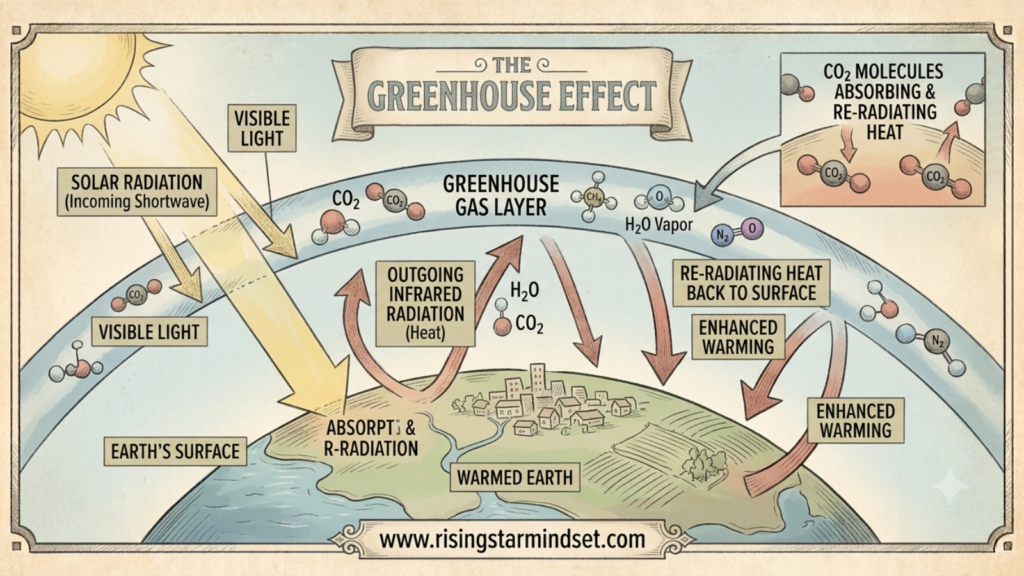
Global Warming
Increase in Earth’s average temperature due to greenhouse gases.
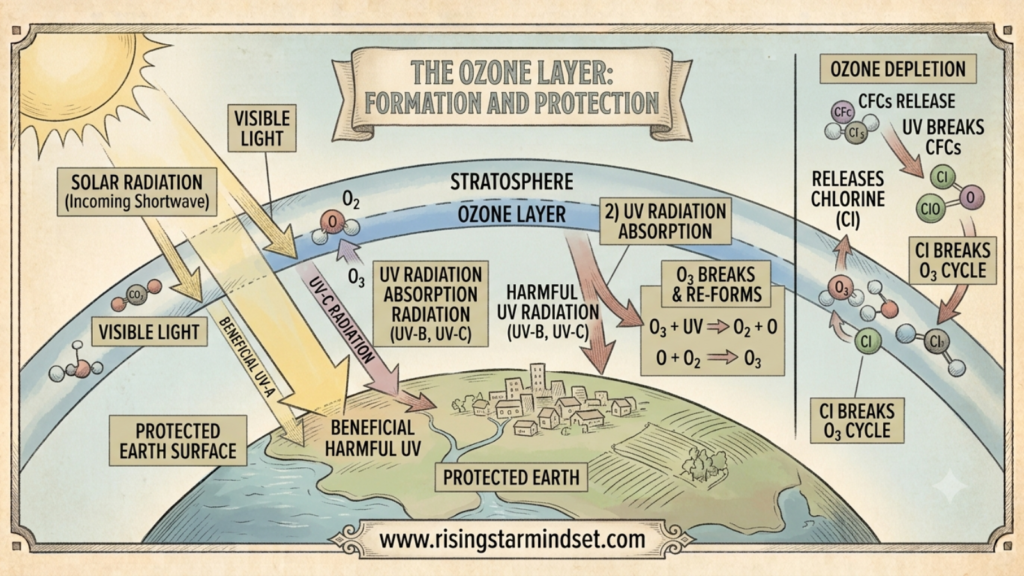
Ozone Layer
Located in the Stratosphere.
Protects Earth from UV rays.
Ozone hole mainly caused by CFCs.
Biodiversity
Variety of plants, animals and microorganisms.
India is one of the world’s mega biodiversity countries.
Environmental Organizations
UNEP
IPCC
WWF
IUCN
CPCB
BSPCB
Important Abbreviations
| Abbreviation | Full Form |
|---|---|
| DNA | Deoxyribonucleic Acid |
| RNA | Ribonucleic Acid |
| GMO | Genetically Modified Organism |
| UNEP | United Nations Environment Programme |
| IPCC | Intergovernmental Panel on Climate Change |
| WWF | World Wide Fund for Nature |
| IUCN | International Union for Conservation of Nature |
| CPCB | Central Pollution Control Board |
| BSPCB | Bihar State Pollution Control Board |
| CFC | Chlorofluorocarbon |
| UV | Ultraviolet |
Key Facts
- Gregor Mendel is Father of Genetics.
- DNA stores hereditary information.
- Humans have 46 chromosomes.
- Ozone layer lies in the Stratosphere.
- CFC damages ozone.
- CO₂ is a major greenhouse gas.
- Acid rain mainly contains sulphuric and nitric acid.
- Noise above 85 dB is harmful.
- Biodiversity maintains ecological balance.
- Bihar has Valmiki Tiger Reserve.
Previous Year Questions (PYQs)
Q1.
Who is known as the Father of Genetics?
Answer:
Gregor Mendel
Q2.
Which gas is mainly responsible for global warming?
Answer:
Carbon dioxide
Q3.
Where is ozone layer located?
Answer:
Stratosphere
Q4.
DNA is located in—
Answer:
Nucleus
Q5.
Acid rain is mainly caused by—
Answer:
SO₂ and NOx
HOTS Questions
Q1.
Why does biodiversity decrease due to pollution?
Q2.
Explain relationship between greenhouse effect and global warming.
Q3.
Differentiate food chain and food web.
Q4.
Why are mutations sometimes beneficial?
Q5.
Why is ozone depletion dangerous?
Expected Questions for Upcoming BPSC
- Mendel’s laws.
- DNA vs RNA.
- Human chromosome number.
- Causes of air pollution.
- Acid rain.
- Greenhouse gases.
- Global warming.
- Ozone depletion.
- Food chain.
- Food web.
- Ecosystem.
- Biodiversity hotspots.
- CPCB.
- BSPCB.
- UNEP.
50 Most Important MCQs
1.
Father of Genetics is
A. Darwin
B. Mendel ✅
C. Lamarck
D. Watson
2.
DNA stands for
A. Deoxyribonucleic Acid ✅
B. Dynamic Nuclear Acid
C. Double Nuclear Acid
D. None
3.
Human chromosome number is
A. 42
B. 44
C. 46 ✅
D. 48
4.
Ozone layer is found in
A. Troposphere
B. Stratosphere ✅
C. Mesosphere
D. Exosphere
5.
Greenhouse gas is
A. Oxygen
B. Nitrogen
C. Carbon dioxide ✅
D. Hydrogen
6. The functional unit of heredity is
A. Cell
B. Chromosome
C. Gene ✅
D. Tissue
Answer: C. Gene
7. The scientist who discovered DNA double helix is
A. Charles Darwin
B. Watson and Crick ✅
C. Mendel
D. Lamarck
Answer: B. Watson and Crick
8. The total genetic material of an organism is called
A. Chromosome
B. Genome ✅
C. Gene
D. Nucleus
Answer: B. Genome
9. Mutation means
A. Cell division
B. Sudden change in genetic material ✅
C. Photosynthesis
D. Digestion
Answer: B. Sudden change in genetic material
10. Human beings have how many pairs of chromosomes?
A. 22
B. 23 ✅
C. 24
D. 46
Answer: B. 23
11. Which one is a dominant trait in Mendel’s pea plant?
A. Wrinkled seed
B. Green seed
C. Tall plant ✅
D. White flower
Answer: C. Tall plant
12. Which acid carries hereditary information?
A. HCl
B. RNA
C. DNA ✅
D. H₂SO₄
Answer: C. DNA
13. The basic structural and functional unit of life is
A. Organ
B. Cell ✅
C. Tissue
D. Nucleus
Answer: B. Cell
14. The branch of biology dealing with heredity is
A. Ecology
B. Genetics ✅
C. Zoology
D. Botany
Answer: B. Genetics
15. The process of passing characters from parents to offspring is called
A. Mutation
B. Evolution
C. Heredity ✅
D. Adaptation
Answer: C. Heredity
16. Environment consists of
A. Only living organisms
B. Only non-living things
C. Both living and non-living components ✅
D. None
Answer: C. Both living and non-living components
17. Which of the following is an abiotic component?
A. Plants
B. Animals
C. Air ✅
D. Bacteria
Answer: C. Air
18. Which is a biotic component?
A. Water
B. Soil
C. Grass ✅
D. Sunlight
Answer: C. Grass
19. Producers in an ecosystem are
A. Herbivores
B. Carnivores
C. Green plants ✅
D. Omnivores
Answer: C. Green plants
20. Which organism decomposes dead matter?
A. Lion
B. Cow
C. Fungi ✅
D. Deer
Answer: C. Fungi
21. Grass → Deer → Tiger is an example of
A. Food web
B. Food chain ✅
C. Ecosystem
D. Habitat
Answer: B. Food chain
22. A network of interconnected food chains is called
A. Habitat
B. Food web ✅
C. Community
D. Population
Answer: B. Food web
23. Which level receives maximum solar energy?
A. Producers ✅
B. Primary consumers
C. Secondary consumers
D. Tertiary consumers
Answer: A. Producers
24. Air pollution mainly causes
A. Diabetes
B. Asthma ✅
C. Malaria
D. Typhoid
Answer: B. Asthma
25. The major source of air pollution in cities is
A. Trees
B. Vehicles ✅
C. Rivers
D. Mountains
Answer: B. Vehicles
26. Acid rain is mainly caused by
A. Oxygen
B. Nitrogen
C. Sulphur dioxide and nitrogen oxides ✅
D. Hydrogen
Answer: C. Sulphur dioxide and nitrogen oxides
27. Water pollution mainly affects
A. Aquatic organisms ✅
B. Birds only
C. Soil only
D. Air only
Answer: A. Aquatic organisms
28. Which disease spreads through polluted water?
A. Cholera ✅
B. Cancer
C. Asthma
D. Diabetes
Answer: A. Cholera
29. Excessive use of pesticides leads to
A. Soil pollution ✅
B. Air purification
C. Water conservation
D. Afforestation
Answer: A. Soil pollution
30. Noise level above ____ dB is considered harmful.
A. 40
B. 60
C. 85 ✅
D. 120
Answer: C. 85
31. Which gas contributes most to global warming?
A. Oxygen
B. Carbon dioxide ✅
C. Nitrogen
D. Helium
Answer: B. Carbon dioxide
32. Greenhouse effect mainly results in
A. Cooling of Earth
B. Global warming ✅
C. Earthquakes
D. Volcanoes
Answer: B. Global warming
33. Ozone layer protects us from
A. Infrared rays
B. UV rays ✅
C. X-rays
D. Gamma rays
Answer: B. UV rays
34. Ozone layer is present in
A. Troposphere
B. Stratosphere ✅
C. Mesosphere
D. Thermosphere
Answer: B. Stratosphere
35. Ozone depletion is mainly caused by
A. Carbon dioxide
B. CFCs ✅
C. Oxygen
D. Nitrogen
Answer: B. CFCs
36. Biodiversity means
A. Variety of living organisms ✅
B. Variety of rocks
C. Variety of planets
D. Variety of gases
Answer: A. Variety of living organisms
37. Which country is known as a mega biodiversity nation?
A. India ✅
B. Nepal
C. Bhutan
D. Sri Lanka
Answer: A. India
38. Which organization prepares the Red List of threatened species?
A. WWF
B. UNEP
C. IUCN ✅
D. CPCB
Answer: C. IUCN
39. UNEP stands for
A. United Nations Environment Programme ✅
B. United Nations Energy Programme
C. Universal Nature Programme
D. United Nature Protection
Answer: A. United Nations Environment Programme
40. IPCC is mainly associated with
A. Climate Change ✅
B. Space Research
C. Agriculture
D. Medicine
Answer: A. Climate Change
41. CPCB stands for
A. Central Pollution Control Board ✅
B. Central Public Control Board
C. Climate Pollution Control Board
D. Central Pollution Conservation Board
Answer: A. Central Pollution Control Board
42. The Bihar State Pollution Control Board is abbreviated as
A. BSPCB ✅
B. BPCB
C. BSEB
D. BSSC
Answer: A. BSPCB
43. Which tiger reserve is located in Bihar?
A. Kaziranga
B. Valmiki Tiger Reserve ✅
C. Jim Corbett
D. Ranthambore
Answer: B. Valmiki Tiger Reserve
44. Which of the following is biodegradable?
A. Plastic
B. Glass
C. Vegetable waste ✅
D. Aluminum
Answer: C. Vegetable waste
45. Which of the following is non-biodegradable?
A. Paper
B. Plastic ✅
C. Cotton
D. Leaves
Answer: B. Plastic
46. Which process converts organic waste into manure?
A. Recycling
B. Composting ✅
C. Filtration
D. Distillation
Answer: B. Composting
47. Which type of waste includes discarded electronic devices?
A. Wet waste
B. Dry waste
C. E-waste ✅
D. Biomedical waste
Answer: C. E-waste
48. Planting more trees helps in
A. Increasing pollution
B. Reducing carbon dioxide ✅
C. Increasing soil erosion
D. Ozone depletion
Answer: B. Reducing carbon dioxide
49. The increase in harmful substances at successive trophic levels is called
A. Biomagnification ✅
B. Mutation
C. Respiration
D. Composting
Answer: A. Biomagnification
50. Which of the following is the best method to control environmental pollution?
A. Deforestation
B. Excessive use of fossil fuels
C. Afforestation and sustainable development ✅
D. Dumping waste into rivers
Answer: C. Afforestation and sustainable development
Frequently Asked Questions (FAQs)
Q1. Who is called the Father of Genetics?
Gregor Mendel is known as the Father of Genetics.
Q2. What is DNA?
DNA is the hereditary material that carries genetic information.
Q3. What is the ecosystem?
An ecosystem is the interaction of living organisms with their physical environment.
Q4. Which gas damages the ozone layer?
Chlorofluorocarbons (CFCs) are the major cause of ozone depletion.
Q5. Which pollution is most harmful to human health?
Air pollution is considered one of the most harmful due to its widespread effects on respiratory and cardiovascular health.
Conclusion
Genetics, Environment, and Pollution form one of the most scoring science sections for BPSC Prelims. Questions are regularly asked on Mendel’s laws, DNA, chromosomes, biodiversity, ecosystems, greenhouse gases, pollution control, and environmental organizations. Mastering these concepts with regular MCQ practice and PYQ revision will significantly improve your science score.
निष्कर्ष
आनुवंशिकी, पर्यावरण एवं प्रदूषण BPSC विज्ञान खंड के सबसे महत्वपूर्ण विषयों में से एक हैं। मेंडल के नियम, DNA, गुणसूत्र, पारिस्थितिकी तंत्र, जैव विविधता, ग्रीनहाउस गैसें तथा प्रदूषण नियंत्रण से प्रत्येक वर्ष प्रश्न पूछे जाते हैं। यदि आप इन विषयों का नियमित अध्ययन, MCQs का अभ्यास तथा PYQs का पुनरावलोकन करते हैं, तो BPSC प्रारंभिक परीक्षा में विज्ञान खंड में उत्कृष्ट अंक प्राप्त कर सकते हैं।
Keep Learning, Keep Growing! 🚀
P Kumar | Rising Star Mindset
www.risingstarmindset.com
Together We Will Make The Difference
Hii