
Previous topic : Electricity, Magnetism, Light
Table of Contents ( Human Body Nutrition Diseases )
- Introduction
- Body Overview (मानव शरीर का परिचय)
- Levels of Organization
- Important Abbreviations
- Major Organ Systems
- Nutrition (पोषण)
- Balanced Diet
- Types of Nutrients
- Carbohydrates
- Proteins
- Fats
- Vitamins
- Minerals
- Digestive System (पाचन तंत्र)
- Digestive Enzymes
- Blood (रक्त)
- Blood Groups
- Heart (हृदय)
- Circulatory System (रक्त परिसंचरण तंत्र)
- Respiratory System (श्वसन तंत्र)
- Excretory System (उत्सर्जन तंत्र)
- Nervous System (तंत्रिका तंत्र)
- Brain and Neuron
- Reflex Action
- Endocrine System (अंतःस्रावी तंत्र)
- Important Hormones
- Immunity (प्रतिरक्षा)
- Vaccination (टीकाकरण)
- Human Diseases (मानव रोग)
- Deficiency Diseases
- Communicable Diseases
- Non-Communicable Diseases
- Vector-Borne Diseases
- Important Scientists & Discoveries
- BPSC PT Important Facts
- Key Points for Revision
- Quick Revision (One-Liners)
- BPSC PT Practice MCQs (1–100)
- Previous Year Questions (PYQs)
- HOTS Questions
- Assertion & Reason Questions
- Match the Following
- Expected Questions for BPSC PT
- Rapid Revision Table
- Memory Tricks
- Final Revision Sheet
- BPSC PT Preparation Tips
- Frequently Asked Questions (FAQs)
- Conclusion (English)
- निष्कर्ष (हिंदी)
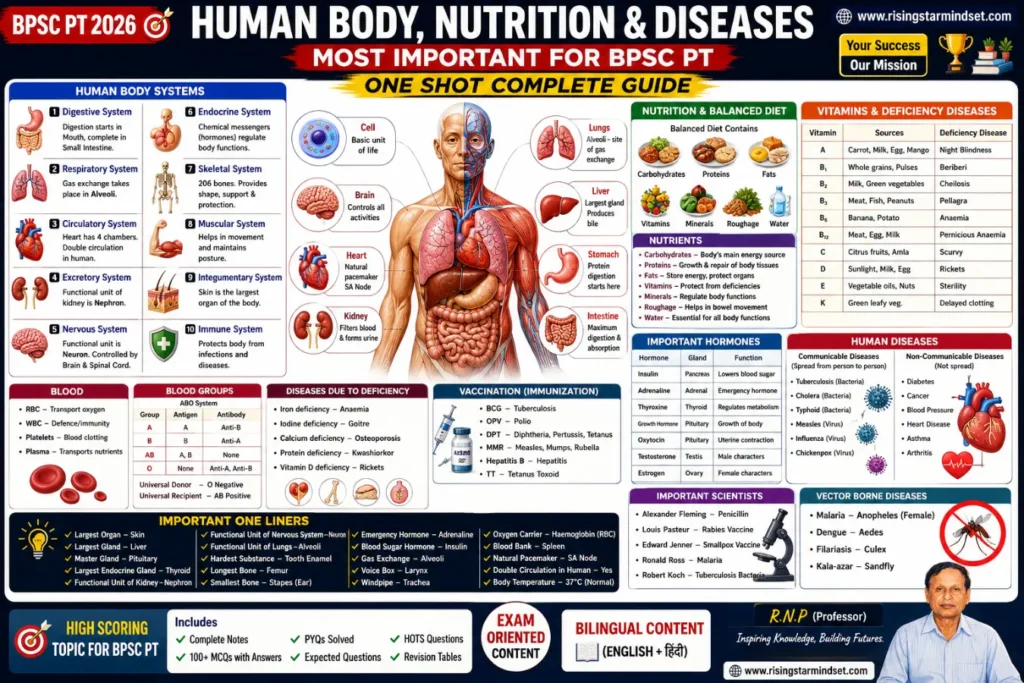
Important Abbreviations ( Human Body Nutrition Diseases )
| Abbreviation | Full Form |
| DNA | Deoxyribonucleic Acid |
| RNA | Ribonucleic Acid |
| RBC | Red Blood Cell |
| WBC | White Blood Cell |
| ATP | Adenosine Triphosphate |
| BMI | Body Mass Index |
| WHO | World Health Organization |
| UNICEF | United Nations Children’s Fund |
| BMR | Basal Metabolic Rate |
| Hb | Hemoglobin |
Introduction ( Human Body Nutrition Diseases )
The human body is one of the most complex biological systems. It consists of trillions of cells working together to perform various life processes such as digestion, respiration, circulation, excretion, reproduction, and coordination. ( Human Body Nutrition Diseases )
मानव शरीर प्रकृति की सबसे जटिल जैविक संरचनाओं में से एक है। यह खरबों कोशिकाओं से मिलकर बना है जो मिलकर पाचन, श्वसन, रक्त संचार, उत्सर्जन, प्रजनन तथा नियंत्रण जैसी जीवन प्रक्रियाएँ संपन्न करती हैं।
Human Body Overview ( Human Body Nutrition Diseases )
| Feature | Details |
| Basic Unit | Cell (कोशिका) |
| Tissue | समान कोशिकाओं का समूह |
| Organ | विभिन्न ऊतकों से बना अंग |
| Organ System | कई अंग मिलकर एक तंत्र बनाते हैं |
| Organism | सम्पूर्ण मानव शरीर |
Levels of Organization ( Human Body Nutrition Diseases )
Cell (कोशिका)
English: Cell is the structural and functional unit of life.
Hindi: कोशिका जीवन की संरचनात्मक एवं क्रियात्मक इकाई है।
Tissue (ऊतक)
A group of similar cells performing a common function.
समान कार्य करने वाली समान कोशिकाओं के समूह को ऊतक कहते हैं।
Organ (अंग)
Two or more tissues together form an organ.
दो या अधिक ऊतक मिलकर एक अंग बनाते हैं।
Examples:
- Heart (हृदय)
- Kidney (गुर्दा)
- Liver (यकृत)
- Brain (मस्तिष्क)
Organ System (अंग तंत्र)
Many organs work together to perform a particular function.
अनेक अंग मिलकर एक विशेष कार्य करने के लिए अंग तंत्र बनाते हैं।
Major Organ Systems ( Human Body Nutrition Diseases )
| Organ System | Main Function |
| Digestive System | Digestion of food |
| Respiratory System | Exchange of gases |
| Circulatory System | Transport of materials |
| Nervous System | Control & Coordination |
| Excretory System | Removal of wastes |
| Reproductive System | Reproduction |
| Endocrine System | Hormonal regulation |
| Skeletal System | Support & Protection |
| Muscular System | Movement |
Nutrition (पोषण) ( Human Body Nutrition Diseases )
Definition
English: Nutrition is the process by which organisms obtain and utilize food for growth, energy, repair, and maintenance.
Hindi: पोषण वह प्रक्रिया है जिसके द्वारा जीव भोजन प्राप्त कर उसे ऊर्जा, वृद्धि, मरम्मत एवं शरीर के रख-रखाव के लिए उपयोग करता है।
Types of Nutrients ( Human Body Nutrition Diseases )
The human body requires six essential nutrients.
मानव शरीर को छह प्रमुख पोषक तत्वों की आवश्यकता होती है।
| Nutrient | Main Function |
| Carbohydrates | Energy |
| Proteins | Growth & Repair |
| Fats | Energy Storage |
| Vitamins | Protection & Regulation |
| Minerals | Body Functions |
| Water | Transport & Temperature Regulation |
Balanced Diet (संतुलित आहार)
A balanced diet contains all nutrients in the correct proportion.
संतुलित आहार वह है जिसमें सभी पोषक तत्व उचित मात्रा में उपस्थित हों।
Components
- Carbohydrates
- Proteins
- Fats
- Vitamins
- Minerals
- Water
- Dietary Fibre
Carbohydrates ( Human Body Nutrition Diseases )
English
Carbohydrates are the primary source of energy.
Hindi
कार्बोहाइड्रेट शरीर को ऊर्जा प्रदान करने वाला मुख्य पोषक तत्व है।
Examples
- Rice
- Wheat
- Potato
- Maize
Proteins
Proteins are body-building nutrients.
प्रोटीन शरीर की वृद्धि एवं क्षतिग्रस्त ऊतकों की मरम्मत करते हैं।
Sources
- Milk
- Egg
- Fish
- Soybean
- Pulses
Fats ( Human Body Nutrition Diseases )
Fats store energy and protect internal organs.
वसा ऊर्जा का भंडारण करती है तथा आंतरिक अंगों की सुरक्षा करती है।
Sources
- Butter
- Ghee
- Oil
- Dry Fruits
Vitamins ( Human Body Nutrition Diseases )
Vitamins are protective nutrients required in small quantities.
विटामिन शरीर को रोगों से बचाते हैं तथा विभिन्न जैविक क्रियाओं का नियमन करते हैं।
| Vitamin | Source | Deficiency Disease |
| A | Carrot, Mango | Night Blindness |
| B1 | Whole grains | Beriberi |
| B2 | Milk | Cheilosis |
| B3 | Groundnut | Pellagra |
| B6 | Cereals | Anaemia (certain types) |
| B9 | Green leafy vegetables | Megaloblastic Anaemia |
| B12 | Meat, Milk | Pernicious Anaemia |
| C | Lemon, Orange | Scurvy |
| D | Sunlight, Fish | Rickets |
| E | Vegetable Oil | Muscle Weakness (rare) |
| K | Green Vegetables | Delayed Blood Clotting |
Minerals ( Human Body Nutrition Diseases )
| Mineral | Function | Deficiency |
| Calcium | Bones & Teeth | Weak Bones |
| Iron | Hemoglobin | Anaemia |
| Iodine | Thyroid Hormone | Goitre |
| Phosphorus | Bones | Weak Bones |
| Sodium | Fluid Balance | Muscle Problems |
| Potassium | Nerve Function | Muscle Weakness |
Important Facts for BPSC PT
- The largest organ of the human body is Skin.
- The largest internal organ is Liver.
- The hardest substance is Tooth Enamel.
- The longest bone is Femur.
- The smallest bone is Stapes.
- The largest gland is Liver.
- The master gland is Pituitary Gland.
- The largest endocrine gland is Thyroid Gland.
- The functional unit of kidney is Nephron.
- The functional unit of the nervous system is Neuron.
Key Points (Revision)
- Cell is the basic structural and functional unit of life.
- Human body has multiple organ systems working together.
- Six essential nutrients are required for good health.
- Balanced diet contains all nutrients in correct proportion.
- Vitamin D deficiency causes Rickets.
- Vitamin C deficiency causes Scurvy.
- Iron deficiency causes Anaemia.
- Iodine deficiency causes Goitre.
- Liver is the largest internal organ.
- Skin is the largest organ of the body.
Quick Revision (One-Liners)
- Basic unit of life → Cell
- Body-building nutrient → Protein
- Energy-giving nutrient → Carbohydrate
- Energy reserve → Fat
- Largest gland → Liver
- Largest bone → Femur
- Smallest bone → Stapes
- Functional unit of kidney → Nephron
- Functional unit of nervous system → Neuron
- Master gland → Pituitary
Digestive System (पाचन तंत्र)
Definition
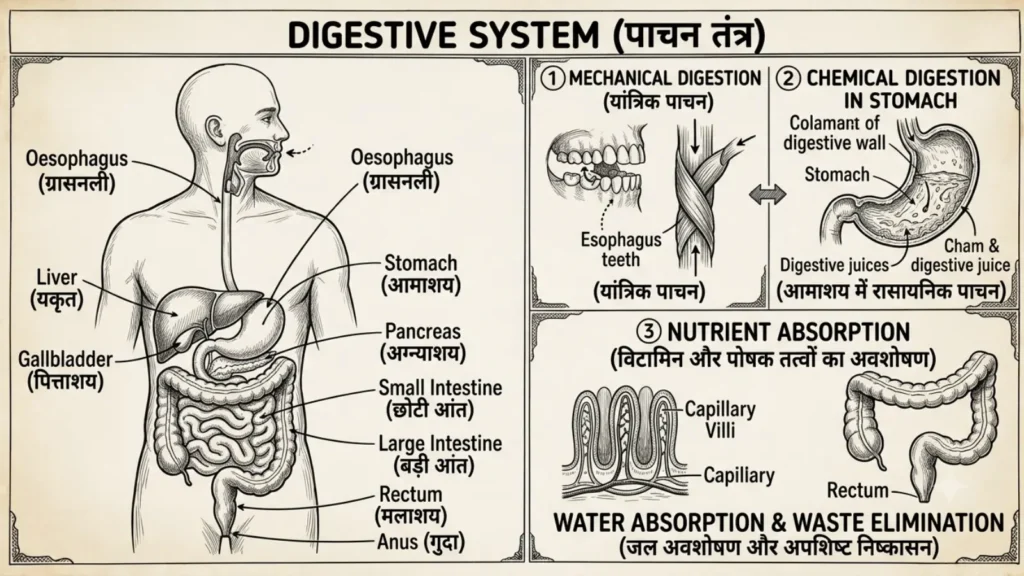
English: The digestive system breaks down food into simple absorbable nutrients.
Hindi: पाचन तंत्र भोजन को सरल पोषक तत्वों में बदलता है ताकि शरीर उन्हें अवशोषित कर सके।
Parts of Digestive System ( Human Body Nutrition Diseases )
| Organ | Main Function |
| Mouth | Chewing and mixing food with saliva |
| Pharynx | Passage of food |
| Oesophagus | Carries food to stomach |
| Stomach | Digestion of proteins |
| Small Intestine | Complete digestion and absorption |
| Large Intestine | Water absorption |
| Rectum | Storage of faeces |
| Anus | Elimination of waste |
Digestive Glands ( Human Body Nutrition Diseases )
| Gland | Function |
| Salivary Glands | Saliva secretion |
| Liver | Produces bile |
| Gall Bladder | Stores bile |
| Pancreas | Produces digestive enzymes |
Important Digestive Enzymes
| Enzyme | Secreted By | Acts On |
| Ptyalin (Salivary Amylase) | Saliva | Starch |
| Pepsin | Stomach | Protein |
| Trypsin | Pancreas | Protein |
| Lipase | Pancreas | Fat |
| Maltase | Small Intestine | Maltose |
Important Facts ( Human Body Nutrition Diseases )
- Digestion begins in the mouth.
- Protein digestion begins in the stomach.
- Most digestion occurs in the small intestine.
- Absorption of nutrients mainly takes place in the small intestine.
- The liver is the largest internal organ and largest gland.
- Bile juice contains no digestive enzyme; it emulsifies fats.
Blood (रक्त) ( Human Body Nutrition Diseases )
Definition
Blood is a fluid connective tissue.
रक्त एक तरल संयोजी ऊतक (Fluid Connective Tissue) है।
Components of Blood
| Component | Function |
| Plasma | Transports nutrients, hormones and wastes |
| RBC | Carries oxygen |
| WBC | Fights infections |
| Platelets | Blood clotting |
Red Blood Cells (RBC)
- Produced in Red Bone Marrow.
- Contain Hemoglobin.
- Average life span: 120 days.
- Mature human RBCs do not have a nucleus.
Hindi: लाल रक्त कणिकाएँ ऑक्सीजन का परिवहन करती हैं तथा इनमें हीमोग्लोबिन पाया जाता है।
White Blood Cells (WBC)
- Protect the body from diseases.
- Also called Soldiers of the Body.
श्वेत रक्त कणिकाएँ शरीर की रक्षा करती हैं।
Platelets ( Human Body Nutrition Diseases )
Responsible for blood clotting.
रक्त का थक्का जमाने का कार्य प्लेटलेट्स करते हैं।
Blood Groups ( Human Body Nutrition Diseases )
| Blood Group | Can Donate To | Can Receive From |
| A | A, AB | A, O |
| B | B, AB | B, O |
| AB | AB | All |
| O | All | O |
Rh Factor
- Positive Rh
- Negative Rh
Heart (हृदय) ( Human Body Nutrition Diseases )
The heart is a muscular pumping organ.
हृदय एक पेशीय पम्प है जो पूरे शरीर में रक्त प्रवाहित करता है।
Important Facts ( Human Body Nutrition Diseases )
- Located slightly towards the left side.
- Size is approximately equal to a closed fist.
- Four chambers:
- Right Atrium
- Right Ventricle
- Left Atrium
- Left Ventricle
Heart Valves
Prevent backward flow of blood.
वाल्व रक्त को पीछे लौटने से रोकते हैं।
Pacemaker
The natural pacemaker of the heart is the SA Node (Sinoatrial Node).
Circulatory System (रक्त परिसंचरण तंत्र)
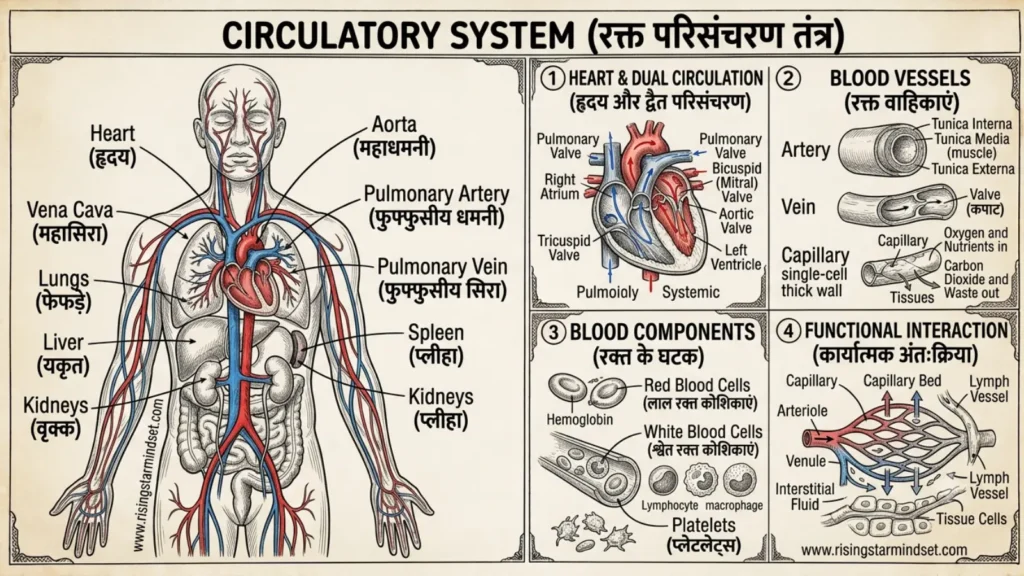
The circulatory system transports oxygen, nutrients and hormones throughout the body.
रक्त परिसंचरण तंत्र पूरे शरीर में ऑक्सीजन, पोषक तत्व तथा हार्मोन पहुँचाता है।
Blood Vessels
| Vessel | Function |
| Artery | Carries blood away from heart |
| Vein | Carries blood towards heart |
| Capillary | Exchange of materials |
Differences
| Artery | Vein |
| Thick walls | Thin walls |
| High pressure | Low pressure |
| Usually oxygenated blood | Usually deoxygenated blood |
| No valves | Valves present |
Double Circulation
Humans have double circulation, consisting of:
- Pulmonary Circulation
- Systemic Circulation
Respiratory System (श्वसन तंत्र)
Definition
Respiration is the process of taking oxygen and releasing carbon dioxide.
श्वसन वह प्रक्रिया है जिसमें ऑक्सीजन ली जाती है तथा कार्बन डाइऑक्साइड बाहर निकाली जाती है।
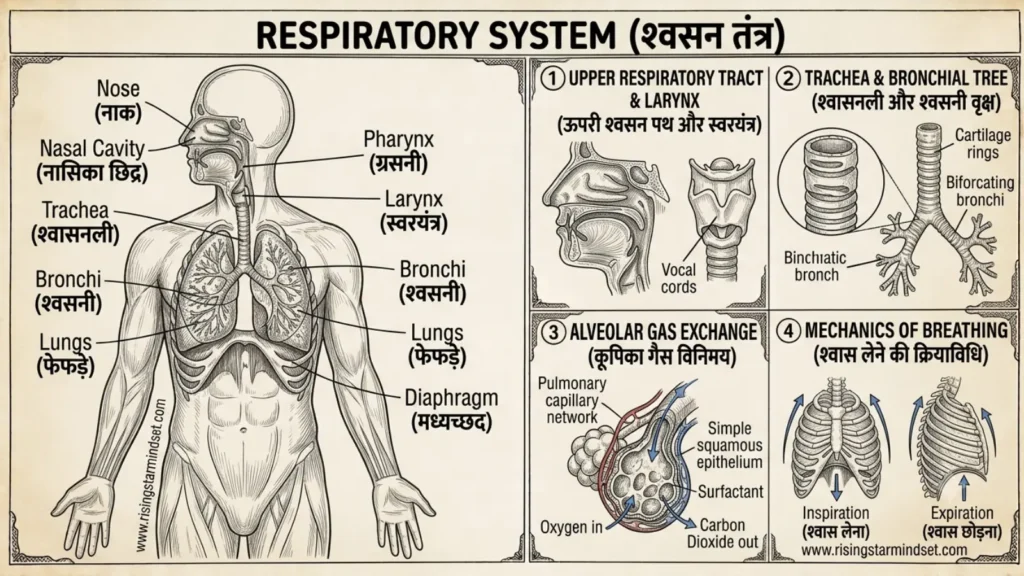
Respiratory Organs
| Organ | Function |
| Nose | Filters air |
| Pharynx | Passage |
| Larynx | Voice box |
| Trachea | Windpipe |
| Bronchi | Carry air |
| Lungs | Gas exchange |
| Alveoli | Exchange of gases |
Alveoli
- Tiny air sacs.
- Main site of gaseous exchange.
- Increase surface area.
Important Facts ( Human Body Nutrition Diseases )
- Right lung has 3 lobes.
- Left lung has 2 lobes.
- Diaphragm is the main breathing muscle.
Excretory System (उत्सर्जन तंत्र)
Definition
Excretion is the removal of metabolic wastes.
उत्सर्जन शरीर से अपशिष्ट पदार्थों को बाहर निकालने की प्रक्रिया है।
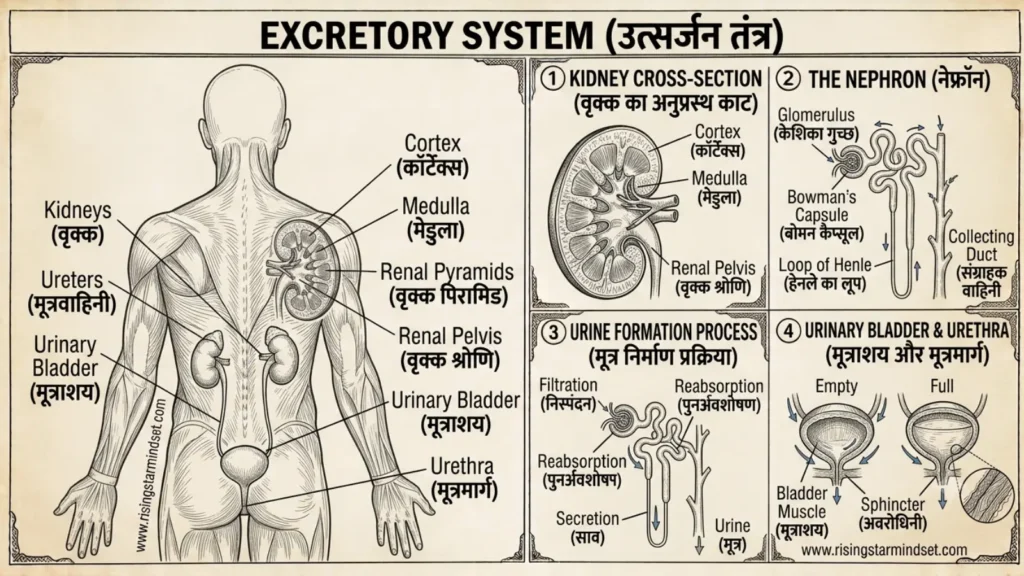
Organs
| Organ | Function |
| Kidney | Filters blood |
| Ureter | Carries urine |
| Urinary Bladder | Stores urine |
| Urethra | Removes urine |
Kidney
- Bean-shaped organ.
- One pair in humans.
- Filters blood continuously.
Nephron
The structural and functional unit of the kidney is Nephron.
Composition of Urine
- Water
- Urea
- Uric Acid
- Mineral Salts
Dialysis
Artificial purification of blood is called Dialysis.
जब गुर्दे सही ढंग से कार्य नहीं करते तब कृत्रिम रूप से रक्त शुद्ध करने की प्रक्रिया डायलिसिस कहलाती है।
Important Diseases Related to These Systems
| Disease | Cause |
| Anaemia | Iron deficiency |
| Hypertension | High blood pressure |
| Coronary Artery Disease | Blockage in arteries |
| Asthma | Narrowing of airways |
| Pneumonia | Lung infection |
| Tuberculosis | Bacterial infection |
| Kidney Stone | Mineral deposition |
| Kidney Failure | Loss of kidney function |
BPSC PT Important Facts
- Largest gland → Liver
- Longest part of digestive canal → Small Intestine
- Largest artery → Aorta
- Largest vein → Inferior Vena Cava
- Universal donor → O Negative
- Universal recipient → AB Positive
- Blood bank of body → Spleen
- Largest lymphatic organ → Spleen
- Voice box → Larynx
- Windpipe → Trachea
- Functional unit of lung → Alveolus
- Functional unit of kidney → Nephron
Key Points for Revision
- Digestion starts in the mouth.
- Protein digestion starts in the stomach.
- Maximum digestion and absorption occur in the small intestine.
- Liver produces bile but does not store it.
- Gall bladder stores bile.
- RBC carries oxygen.
- WBC provides immunity.
- Platelets help in blood clotting.
- Human heart has four chambers.
- Humans have double circulation.
- Alveoli are the sites of gaseous exchange.
- Kidneys remove nitrogenous wastes.
- Nephron is the functional unit of the kidney.
Quick Revision (One-Liners)
- Largest internal organ → Liver
- Largest gland → Liver
- Blood clotting → Platelets
- Oxygen carrier → RBC
- Defence cell → WBC
- Natural pacemaker → SA Node
- Functional unit of kidney → Nephron
- Functional unit of lung → Alveolus
- Universal donor → O Negative
- Universal recipient → AB Positive
Nervous System (तंत्रिका तंत्र)
The nervous system controls and coordinates all activities of the body by receiving, processing, and transmitting information through nerve impulses.
तंत्रिका तंत्र शरीर की सभी क्रियाओं का नियंत्रण एवं समन्वय करता है। यह तंत्रिका आवेगों (Nerve Impulses) के माध्यम से संदेशों का आदान-प्रदान करता है।
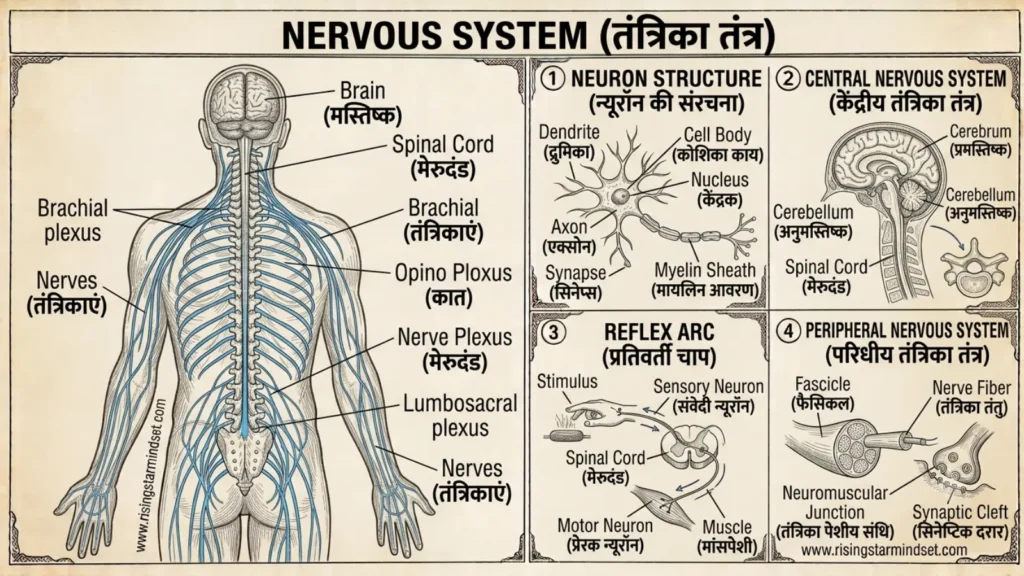
Main Parts of Nervous System
| Part | Function |
| Central Nervous System (CNS) | Control and coordination |
| Peripheral Nervous System (PNS) | Connects CNS with body organs |
| Autonomic Nervous System (ANS) | Controls involuntary actions |
Central Nervous System (CNS)
The CNS consists of:
- Brain
- Spinal Cord
केन्द्रीय तंत्रिका तंत्र (CNS) में मस्तिष्क एवं मेरुरज्जु शामिल होते हैं।
Brain (मस्तिष्क) ( Human Body Nutrition Diseases )
The brain is the control centre of the human body.
मस्तिष्क मानव शरीर का नियंत्रण केंद्र है।
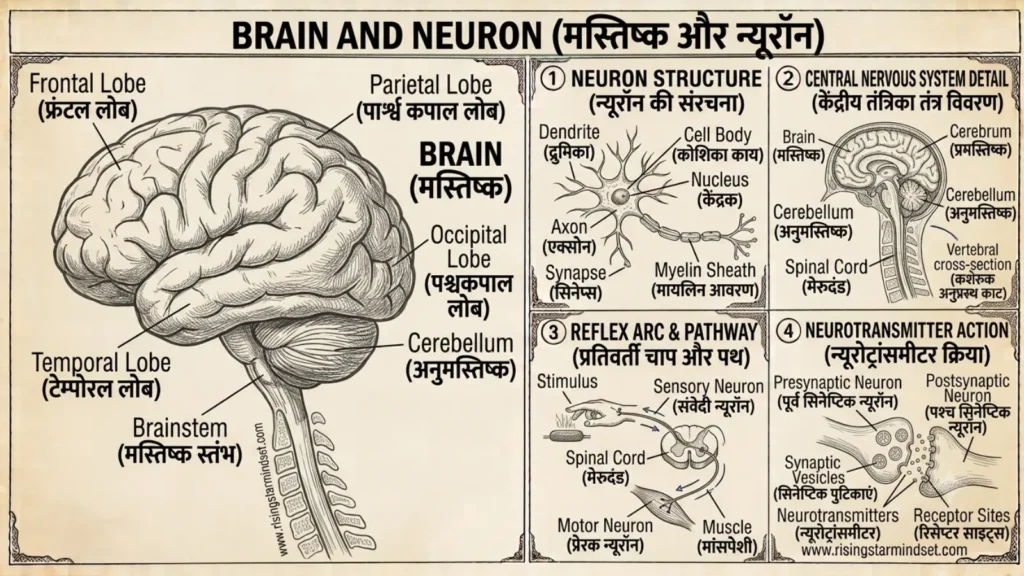
Parts of Brain ( Human Body Nutrition Diseases )
| Part | Function |
| Cerebrum | Intelligence, memory, thinking |
| Cerebellum | Balance and coordination |
| Medulla Oblongata | Controls heartbeat and breathing |
Important Facts
- Largest part of brain → Cerebrum
- Balance of body → Cerebellum
- Controls involuntary actions → Medulla Oblongata
Spinal Cord (मेरुरज्जु)
The spinal cord carries messages between the brain and body.
मेरुरज्जु मस्तिष्क एवं शरीर के बीच संदेशों का संचार करती है।
Neuron (तंत्रिका कोशिका)
Neuron is the structural and functional unit of the nervous system.
न्यूरॉन तंत्रिका तंत्र की संरचनात्मक एवं क्रियात्मक इकाई है।
Parts of Neuron
- Dendrite
- Cell Body
- Axon
Reflex Action (प्रतिवर्ती क्रिया)
A reflex action is a quick and automatic response to a stimulus.
प्रतिवर्ती क्रिया किसी उद्दीपन के प्रति तीव्र एवं स्वतः होने वाली प्रतिक्रिया है।
Example
- Hand withdrawal from hot object.
- Eye blinking.
Endocrine System (अंतःस्रावी तंत्र)
The endocrine system consists of ductless glands that secrete hormones directly into the blood.
अंतःस्रावी तंत्र में नलिकाविहीन ग्रंथियाँ होती हैं जो हार्मोन सीधे रक्त में छोड़ती हैं।
Hormone (हार्मोन)
Hormones are chemical messengers produced by endocrine glands.
हार्मोन रासायनिक संदेशवाहक होते हैं जो शरीर की विभिन्न क्रियाओं को नियंत्रित करते हैं।
Important Endocrine Glands
| Gland | Hormone | Function |
| Pituitary | Growth Hormone | Growth and control of other glands |
| Thyroid | Thyroxine | Metabolism |
| Parathyroid | Parathormone | Calcium regulation |
| Pancreas | Insulin | Controls blood sugar |
| Adrenal | Adrenaline | Emergency response |
| Testis | Testosterone | Male characters |
| Ovary | Estrogen & Progesterone | Female characters |
Pituitary Gland
Known as the Master Gland because it controls other endocrine glands.
पिट्यूटरी ग्रंथि को मास्टर ग्रंथि कहा जाता है।
Thyroid Gland
Located in the neck.
Produces Thyroxine.
Requires iodine for hormone production.
आयोडीन की कमी से Goitre (घेंघा) रोग होता है।
Pancreas
Produces Insulin.
Insulin regulates blood glucose level.
Insulin की कमी से Diabetes Mellitus होता है।
Adrenal Gland
Produces Adrenaline.
Also called the Emergency Hormone.
Reproductive Hormones
| Hormone | Function |
| Testosterone | Male secondary sexual characters |
| Estrogen | Female secondary sexual characters |
| Progesterone | Maintains pregnancy |
Immunity (प्रतिरक्षा)
Immunity is the ability of the body to resist diseases.
प्रतिरक्षा शरीर की रोगों से लड़ने की क्षमता है।
Types of Immunity
| Type | Description |
| Natural Immunity | Present by birth |
| Acquired Immunity | Develops after infection or vaccination |
Vaccination (टीकाकरण)
Vaccination stimulates the immune system to produce antibodies against diseases.
टीकाकरण शरीर में रोगों के विरुद्ध प्रतिरक्षा विकसित करता है।
Vaccine and Disease ( Human Body Nutrition Diseases )
| Vaccine | Disease Prevented |
| BCG | Tuberculosis |
| OPV | Polio |
| DPT | Diphtheria, Pertussis, Tetanus |
| MMR | Measles, Mumps, Rubella |
| Hepatitis-B | Hepatitis B |
| HPV | Cervical Cancer Prevention |
Human Diseases (मानव रोग)
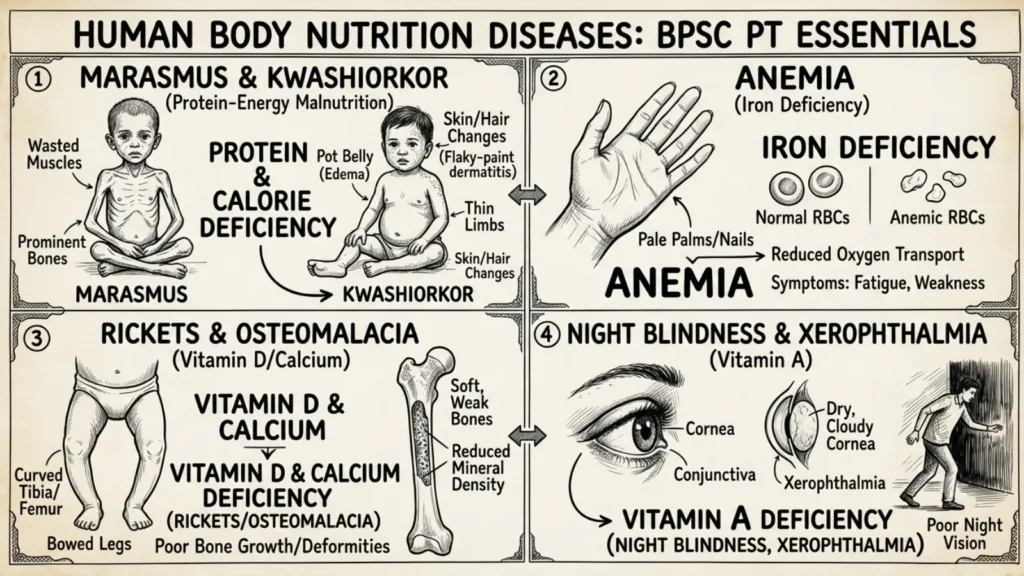
Deficiency Diseases
| Disease | Cause |
| Night Blindness | Vitamin A deficiency |
| Beriberi | Vitamin B1 deficiency |
| Pellagra | Vitamin B3 deficiency |
| Scurvy | Vitamin C deficiency |
| Rickets | Vitamin D deficiency |
| Goitre | Iodine deficiency |
| Anaemia | Iron deficiency |
Communicable Diseases ( Human Body Nutrition Diseases )
| Disease | Causative Organism |
| Tuberculosis | Bacteria |
| Typhoid | Bacteria |
| Cholera | Bacteria |
| Malaria | Protozoa |
| Dengue | Virus |
| Chikungunya | Virus |
| Rabies | Virus |
| COVID-19 | Virus |
Non-Communicable Diseases
- Diabetes Mellitus
- Hypertension
- Cancer
- Heart Disease
- Obesity
- Osteoporosis
Vector-Borne Diseases
| Disease | Vector |
| Malaria | Female Anopheles Mosquito |
| Dengue | Aedes Mosquito |
| Chikungunya | Aedes Mosquito |
| Filariasis | Culex Mosquito |
| Kala-azar | Sandfly |
Important Scientists
| Scientist | Contribution |
| Edward Jenner | Smallpox Vaccine |
| Louis Pasteur | Rabies Vaccine |
| Alexander Fleming | Discovery of Penicillin |
| Robert Koch | Tuberculosis Bacterium |
| Ronald Ross | Malaria Transmission |
BPSC PT Important Facts
- Functional unit of nervous system → Neuron
- Largest part of brain → Cerebrum
- Balance maintained by → Cerebellum
- Involuntary actions controlled by → Medulla Oblongata
- Master gland → Pituitary
- Emergency hormone → Adrenaline
- Blood sugar regulating hormone → Insulin
- Metabolism regulating hormone → Thyroxine
- Goitre occurs due to → Iodine deficiency
- Diabetes occurs due to → Insulin deficiency
- BCG vaccine prevents → Tuberculosis
- OPV prevents → Polio
- Female Anopheles mosquito spreads → Malaria
- Aedes mosquito spreads → Dengue and Chikungunya
Quick Revision ( Human Body Nutrition Diseases )
- Brain = Control Centre
- Neuron = Functional Unit of Nervous System
- Reflex Action = Spinal Cord
- Master Gland = Pituitary
- Largest Endocrine Gland = Thyroid
- Emergency Hormone = Adrenaline
- Blood Sugar Hormone = Insulin
- Iodine Deficiency = Goitre
- Vitamin D Deficiency = Rickets
- Vitamin C Deficiency = Scurvy
- Iron Deficiency = Anaemia
- BCG = Tuberculosis
- OPV = Polio
- MMR = Measles, Mumps & Rubella
BPSC PT Practice MCQs (1–50)
Multiple Choice Questions
1. The structural and functional unit of the human body is:
मानव शरीर की संरचनात्मक एवं क्रियात्मक इकाई है—
A. Tissue
B. Organ
C. Cell
D. Neuron
Answer: C. Cell
2. Which is the largest organ of the human body?
मानव शरीर का सबसे बड़ा अंग कौन-सा है?
A. Liver
B. Brain
C. Skin
D. Lung
Answer: C. Skin
3. The largest internal organ is:
मानव शरीर का सबसे बड़ा आंतरिक अंग है—
A. Kidney
B. Liver
C. Brain
D. Heart
Answer: B. Liver
4. The functional unit of the kidney is:
गुर्दे की क्रियात्मक इकाई है—
A. Neuron
B. Alveolus
C. Nephron
D. Villi
Answer: C. Nephron
5. Digestion begins in the:
पाचन की शुरुआत कहाँ से होती है?
A. Stomach
B. Mouth
C. Small Intestine
D. Oesophagus
Answer: B. Mouth
6. Protein digestion starts in the:
प्रोटीन का पाचन प्रारम्भ होता है—
A. Mouth
B. Stomach
C. Small Intestine
D. Large Intestine
Answer: B. Stomach
7. Maximum absorption of digested food occurs in:
भोजन का अधिकतम अवशोषण होता है—
A. Large Intestine
B. Stomach
C. Small Intestine
D. Rectum
Answer: C. Small Intestine
8. Which gland secretes bile?
पित्त रस का निर्माण किस ग्रंथि में होता है?
A. Pancreas
B. Liver
C. Thyroid
D. Pituitary
Answer: B. Liver
9. Bile is stored in the:
पित्त का संग्रह होता है—
A. Kidney
B. Gall Bladder
C. Pancreas
D. Stomach
Answer: B. Gall Bladder
10. The oxygen-carrying pigment is:
ऑक्सीजन वहन करने वाला वर्णक है—
A. Chlorophyll
B. Hemoglobin
C. Melanin
D. Keratin
Answer: B. Hemoglobin
11. RBC is produced in:
A. Liver
B. Bone Marrow
C. Spleen
D. Kidney
Answer: B. Bone Marrow
12. The average lifespan of RBC is:
A. 90 Days
B. 100 Days
C. 120 Days
D. 150 Days
Answer: C. 120 Days
13. Which blood cell fights infection?
A. RBC
B. Platelet
C. WBC
D. Plasma
Answer: C. WBC
14. Blood clotting is mainly due to:
A. Plasma
B. RBC
C. Platelets
D. Lymph
Answer: C. Platelets
15. Universal donor is:
A. A+
B. B+
C. O−
D. AB+
Answer: C. O−
16. Universal recipient is:
A. A−
B. O−
C. AB+
D. B+
Answer: C. AB+
17. Human heart has:
A. 2 Chambers
B. 3 Chambers
C. 4 Chambers
D. 5 Chambers
Answer: C. 4 Chambers
18. The natural pacemaker of the heart is:
A. AV Node
B. SA Node
C. Bundle of His
D. Purkinje Fibres
Answer: B. SA Node
19. The largest artery is:
A. Pulmonary Artery
B. Aorta
C. Renal Artery
D. Femoral Artery
Answer: B. Aorta
20. Human beings have:
A. Open Circulation
B. Double Circulation
C. Single Circulation
D. No Circulation
Answer: B. Double Circulation
21. Exchange of gases occurs in:
A. Bronchi
B. Trachea
C. Alveoli
D. Nose
Answer: C. Alveoli
22. The right lung has:
A. 2 Lobes
B. 3 Lobes
C. 4 Lobes
D. 5 Lobes
Answer: B. 3 Lobes
23. The voice box is called:
A. Trachea
B. Bronchus
C. Larynx
D. Pharynx
Answer: C. Larynx
24. The windpipe is:
A. Larynx
B. Trachea
C. Bronchus
D. Pharynx
Answer: B. Trachea
25. Urine is stored in the:
A. Kidney
B. Ureter
C. Urinary Bladder
D. Urethra
Answer: C. Urinary Bladder
26. The structural and functional unit of the nervous system is:
A. Nephron
B. Neuron
C. Alveolus
D. Osteon
Answer: B. Neuron
27. Which part of the brain controls intelligence?
A. Cerebellum
B. Medulla
C. Cerebrum
D. Pons
Answer: C. Cerebrum
28. Body balance is maintained by:
A. Cerebrum
B. Cerebellum
C. Medulla
D. Thalamus
Answer: B. Cerebellum
29. The Master Gland is:
A. Thyroid
B. Adrenal
C. Pituitary
D. Pancreas
Answer: C. Pituitary
30. Insulin is secreted by:
A. Liver
B. Thyroid
C. Pancreas
D. Kidney
Answer: C. Pancreas
31. Deficiency of insulin causes:
A. Goitre
B. Diabetes Mellitus
C. Anaemia
D. Asthma
Answer: B. Diabetes Mellitus
32. Thyroxine is secreted by:
A. Thyroid
B. Adrenal
C. Pancreas
D. Pituitary
Answer: A. Thyroid
33. Goitre is caused by deficiency of:
A. Iron
B. Calcium
C. Iodine
D. Vitamin D
Answer: C. Iodine
34. Which vitamin deficiency causes night blindness?
A. Vitamin A
B. Vitamin C
C. Vitamin D
D. Vitamin K
Answer: A. Vitamin A
35. Scurvy is caused due to deficiency of:
A. Vitamin A
B. Vitamin C
C. Vitamin D
D. Vitamin E
Answer: B. Vitamin C
36. Rickets is caused by deficiency of:
A. Vitamin A
B. Vitamin D
C. Vitamin E
D. Vitamin K
Answer: B. Vitamin D
37. Anaemia is mainly caused by deficiency of:
A. Calcium
B. Sodium
C. Iron
D. Potassium
Answer: C. Iron
38. Beriberi is caused due to deficiency of:
A. Vitamin B₁
B. Vitamin B₂
C. Vitamin C
D. Vitamin D
Answer: A. Vitamin B₁
39. Pellagra is caused by deficiency of:
A. Vitamin B₁₂
B. Vitamin B₃
C. Vitamin C
D. Vitamin K
Answer: B. Vitamin B₃
40. Which vaccine protects against Tuberculosis?
A. OPV
B. BCG
C. DPT
D. MMR
Answer: B. BCG
41. OPV is used to prevent:
A. Measles
B. Polio
C. Rabies
D. Cholera
Answer: B. Polio
42. Malaria is caused by:
A. Virus
B. Bacteria
C. Protozoa
D. Fungus
Answer: C. Protozoa
43. Malaria is transmitted by:
A. Aedes Mosquito
B. Culex Mosquito
C. Female Anopheles Mosquito
D. Sandfly
Answer: C. Female Anopheles Mosquito
44. Dengue is spread by:
A. Housefly
B. Aedes Mosquito
C. Anopheles Mosquito
D. Culex Mosquito
Answer: B. Aedes Mosquito
45. Rabies is caused by:
A. Bacteria
B. Virus
C. Protozoa
D. Fungus
Answer: B. Virus
46. Who discovered the Smallpox vaccine?
A. Louis Pasteur
B. Edward Jenner
C. Alexander Fleming
D. Robert Koch
Answer: B. Edward Jenner
47. Penicillin was discovered by:
A. Robert Koch
B. Louis Pasteur
C. Alexander Fleming
D. Ronald Ross
Answer: C. Alexander Fleming
48. The causative organism of Tuberculosis is:
A. Virus
B. Protozoa
C. Bacteria
D. Fungus
Answer: C. Bacteria
49. Which organ is mainly affected by Tuberculosis?
A. Heart
B. Lung
C. Liver
D. Kidney
Answer: B. Lung
50. Which nutrient is known as the body-building nutrient?
A. Fat
B. Carbohydrate
C. Protein
D. Vitamin
Answer: C. Protein
BPSC PT Practice MCQs (51–100)
Multiple Choice Questions
51. Which nutrient is the main source of energy?
शरीर को ऊर्जा मुख्य रूप से किस पोषक तत्व से प्राप्त होती है?
A. Protein
B. Fat
C. Carbohydrate
D. Vitamin
Answer: C. Carbohydrate
52. Which vitamin helps in blood clotting?
A. Vitamin A
B. Vitamin C
C. Vitamin K
D. Vitamin D
Answer: C. Vitamin K
53. Which mineral is essential for healthy bones and teeth?
A. Iron
B. Calcium
C. Sodium
D. Potassium
Answer: B. Calcium
54. Which gland stores bile juice?
A. Liver
B. Pancreas
C. Gall Bladder
D. Spleen
Answer: C. Gall Bladder
55. Which organ produces insulin?
A. Kidney
B. Pancreas
C. Liver
D. Thyroid
Answer: B. Pancreas
56. Which blood vessel carries oxygenated blood from the lungs to the heart?
A. Pulmonary Artery
B. Pulmonary Vein
C. Aorta
D. Vena Cava
Answer: B. Pulmonary Vein
57. Which chamber of the heart has the thickest wall?
A. Right Atrium
B. Left Atrium
C. Right Ventricle
D. Left Ventricle
Answer: D. Left Ventricle
58. Which organ filters blood in the human body?
A. Liver
B. Kidney
C. Heart
D. Lung
Answer: B. Kidney
59. Which gas is carried by haemoglobin?
A. Nitrogen
B. Carbon Dioxide
C. Oxygen
D. Hydrogen
Answer: C. Oxygen
60. Which blood cells are called the soldiers of the body?
A. RBC
B. Platelets
C. WBC
D. Plasma
Answer: C. WBC
61. The largest endocrine gland is:
A. Pituitary
B. Thyroid
C. Pancreas
D. Adrenal
Answer: B. Thyroid
62. Which hormone is called the emergency hormone?
A. Thyroxine
B. Insulin
C. Adrenaline
D. Estrogen
Answer: C. Adrenaline
63. Which vitamin is synthesized in the skin in the presence of sunlight?
A. Vitamin A
B. Vitamin B₁₂
C. Vitamin C
D. Vitamin D
Answer: D. Vitamin D
64. Which disease is caused by Vitamin C deficiency?
A. Beriberi
B. Pellagra
C. Scurvy
D. Rickets
Answer: C. Scurvy
65. Which disease is caused by Vitamin A deficiency?
A. Night Blindness
B. Goitre
C. Anaemia
D. Diabetes
Answer: A. Night Blindness
66. Dengue is spread by which mosquito ?
A. Anopheles
B. Aedes
C. Culex
D. Sandfly
Answer: B. Aedes
67. Cholera is caused by:
A. Virus
B. Fungus
C. Bacteria
D. Protozoa
Answer: C. Bacteria
68. Typhoid is caused by:
A. Virus
B. Bacteria
C. Protozoa
D. Fungus
Answer: B. Bacteria
69. Which disease is caused by Protozoa?
A. Dengue
B. Cholera
C. Malaria
D. Tuberculosis
Answer: C. Malaria
70. Which scientist discovered the Rabies vaccine?
A. Edward Jenner
B. Ronald Ross
C. Louis Pasteur
D. Robert Koch
Answer: C. Louis Pasteur
Statement Based Questions
71. RBC transports oxygen.
A. True
B. False
Answer: A. True
72. Nephron is the functional unit of the lung.
A. True
B. False
Answer: B. False
73. Insulin regulates blood sugar level.
A. True
B. False
Answer: A. True
74. Pituitary gland is known as the Master Gland.
A. True
B. False
Answer: A. True
75. Digestion begins in the stomach.
A. True
B. False
Answer: B. False
Assertion and Reason Questions
76. Assertion (A): Liver is the largest gland of the human body.
Reason (R): Liver produces bile juice.
A. Both A and R are true, and R is the correct explanation.
B. Both A and R are true, but R is not the correct explanation.
C. A is true, R is false.
D. A is false, R is true.
Answer: B
77. Assertion (A): Vitamin D deficiency causes Rickets.
Reason (R): Vitamin D helps in calcium absorption.
Answer: A
78. Assertion (A): Insulin deficiency causes Diabetes Mellitus.
Reason (R): Insulin regulates blood glucose level.
Answer: A
79. Assertion (A): Platelets help in blood clotting.
Reason (R): Platelets contain clotting factors.
Answer: A
80. Assertion (A): Cerebellum maintains body balance.
Reason (R): It coordinates muscular activities.
Answer: A
Match the Following
81. Match List I with List II
| List I | List II |
| (a) Nephron | 1. Kidney |
| (b) Alveoli | 2. Lungs |
| (c) Neuron | 3. Nervous System |
| (d) Hepatocyte | 4. Liver |
Answer: a–1, b–2, c–3, d–4
82. Match the Vitamins
| Vitamin | Disease |
| A | Night Blindness |
| B₁ | Beriberi |
| C | Scurvy |
| D | Rickets |
83. Match the Hormones
| Hormone | Gland |
| Insulin | Pancreas |
| Thyroxine | Thyroid |
| Adrenaline | Adrenal |
| Growth Hormone | Pituitary |
84. Match the Diseases
| Disease | Cause |
| Goitre | Iodine Deficiency |
| Anaemia | Iron Deficiency |
| Diabetes | Insulin Deficiency |
| Malaria | Protozoa |
85. Match the Scientists
| Scientist | Discovery |
| Edward Jenner | Smallpox Vaccine |
| Louis Pasteur | Rabies Vaccine |
| Alexander Fleming | Penicillin |
| Ronald Ross | Malaria Transmission |
Expected Questions for BPSC PT
86. Which gland is called the Master Gland?
A. Thyroid
B. Pituitary
C. Pancreas
D. Adrenal
Answer: B
87. Which blood group is known as the universal recipient?
A. O−
B. AB+
C. A+
D. B−
Answer: B
88. Organ stores bile?
A. Liver
B. Gall Bladder
C. Pancreas
D. Kidney
Answer: B
89. Which disease is prevented by the BCG vaccine?
A. Polio
B. Measles
C. Tuberculosis
D. Cholera
Answer: C
90. Name the organ which is called the blood bank of the body?
A. Liver
B. Spleen
C. Heart
D. Kidney
Answer: B
91. Which vitamin is known as the Sunshine Vitamin?
A. Vitamin A
B. Vitamin C
C. Vitamin D
D. Vitamin E
Answer: C
92. Which organ controls involuntary actions?
A. Cerebrum
B. Cerebellum
C. Medulla Oblongata
D. Hypothalamus
Answer: C
93. Which disease is spread by Aedes mosquito?
A. Malaria
B. Dengue
C. Filariasis
D. Kala-azar
Answer: B
94. Which organ is responsible for gas exchange?
A. Trachea
B. Bronchi
C. Alveoli
D. Larynx
Answer: C
95. Which hormone regulates metabolism?
A. Insulin
B. Thyroxine
C. Adrenaline
D. Testosterone
Answer: B
96. Name the organ which produces bile juice?
A. Liver
B. Pancreas
C. Kidney
D. Stomach
Answer: A
97. Which gland secretes insulin?
A. Thyroid
B. Adrenal
C. Pancreas
D. Pituitary
Answer: C
98. Which disease is caused by iodine deficiency?
A. Anaemia
B. Goitre
C. Diabetes
D. Asthma
Answer: B
99. Which blood component carries oxygen?
A. Plasma
B. Platelets
C. RBC
D. WBC
Answer: C
100. The functional unit of the nervous system is:
A. Nephron
B. Neuron
C. Alveolus
D. Osteon
Answer: B
Previous Year Questions (PYQs) – BPSC & Bihar Competitive Exams
नोट: नीचे दिए गए प्रश्न BPSC, BSSC, Bihar Police, Bihar SI, BTSC, SSC, Railway एवं अन्य राज्य स्तरीय परीक्षाओं के पैटर्न पर आधारित हैं। इनमें कई प्रश्न पूर्व वर्षों में समान या मिलते-जुलते रूप में पूछे जा चुके हैं।
PYQ 1
The functional unit of the kidney is:
गुर्दे की क्रियात्मक इकाई है—
A. Neuron
B. Nephron
C. Alveolus
D. Osteon
Answer: B. Nephron
PYQ 2
Insulin is secreted by:
इंसुलिन का स्राव किस ग्रंथि द्वारा होता है?
A. Thyroid
B. Liver
C. Pancreas
D. Adrenal
Answer: C. Pancreas
PYQ 3
Which vitamin deficiency causes Night Blindness?
A. Vitamin A
B. Vitamin B
C. Vitamin C
D. Vitamin D
Answer: A
PYQ 4
The largest gland of the human body is:
A. Thyroid
B. Liver
C. Pancreas
D. Pituitary
Answer: B
PYQ 5
Which blood group is called Universal Donor?
A. O−
B. AB+
C. A+
D. B−
Answer: A
PYQ 6
Which mosquito spreads Malaria?
A. Aedes
B. Culex
C. Female Anopheles
D. Sandfly
Answer: C
PYQ 7
Goitre is caused due to deficiency of:
A. Iron
B. Calcium
C. Iodine
D. Zinc
Answer: C
PYQ 8
The Master Gland is:
A. Thyroid
B. Pituitary
C. Pancreas
D. Adrenal
Answer: B
PYQ 9
Which vitamin helps in blood clotting?
A. Vitamin A
B. Vitamin C
C. Vitamin K
D. Vitamin D
Answer: C
PYQ 10
Who discovered Penicillin?
A. Edward Jenner
B. Robert Koch
C. Alexander Fleming
D. Louis Pasteur
Answer: C
HOTS (Higher Order Thinking Skills)
Question 1
A person is suffering from weakness, pale skin and low haemoglobin.
Which deficiency is most likely responsible?
A. Calcium
B. Iron
C. Vitamin C
D. Iodine
Answer: Iron
Question 2
A patient has high blood sugar despite consuming less sugar.
Which hormone is likely deficient?
A. Thyroxine
B. Insulin
C. Adrenaline
D. Growth Hormone
Answer: Insulin
Question 3
Why are villi present in the small intestine?
A. To store food
B. To increase surface area for absorption
C. To digest protein
D. To produce enzymes
Answer: B
Question 4
Why are alveoli present in large numbers?
A. Increase breathing rate
B. Increase gaseous exchange surface
C. Reduce oxygen intake
D. Increase blood pressure
Answer: B
Question 5
If platelets become very low, which problem is most likely?
A. High blood sugar
B. Blood clotting problem
C. Asthma
D. Kidney failure
Answer: B
Question 6
Why is the left ventricle thicker than the right ventricle?
A. It stores more blood.
B. It pumps blood to the entire body.
C. It receives oxygen.
D. It filters blood.
Answer: B
Question 7
Which body system will be directly affected if the nephron is damaged?
Answer: Excretory System
Question 8
Why is iodine added to common salt?
Answer: To prevent Goitre and maintain normal thyroid hormone production.
Question 9
Why does Vitamin D deficiency weaken bones?
Answer: Because Vitamin D helps absorb calcium from the intestine.
Question 10
A child has bowed legs and weak bones. Which vitamin deficiency is responsible?
Answer: Vitamin D (Rickets)
Expected Questions for Upcoming BPSC PT
- Identify the hormone known as the emergency hormone.
- Name the largest endocrine gland in the human body.
- Vitamin synthesized in sunlight is known as?
- Insulin deficiency leads to which disease?
- Which blood cells are responsible for body immunity?
- Name the enzyme that begins starch digestion in the mouth.
- Bile juice is produced by which organ?
- Identify the organ that stores bile juice.
- The functional unit of the lungs is called _____.
- Who developed the Smallpox vaccine?
- Dengue is transmitted by which mosquito?
- Which organ is popularly known as the blood bank of the body?
- Name the blood vessel that carries oxygen-rich blood from the lungs to the heart.
- Beriberi occurs due to the deficiency of which vitamin?
- Which gland regulates the body’s metabolic rate?
- Identify the part of the brain that controls involuntary activities.
- Scurvy develops because of the deficiency of which vitamin?
- Malaria is caused by which type of microorganism?
- Which blood group is known as the universal recipient?
- Name the largest internal organ of the human body.
Rapid Revision Table
| Topic | Important Fact |
| Largest Organ | Skin |
| Largest Internal Organ | Liver |
| Largest Gland | Liver |
| Master Gland | Pituitary |
| Largest Endocrine Gland | Thyroid |
| Functional Unit of Kidney | Nephron |
| Functional Unit of Nervous System | Neuron |
| Functional Unit of Lung | Alveolus |
| Universal Donor | O Negative |
| Universal Recipient | AB Positive |
| Oxygen Carrier | RBC |
| Defence Cell | WBC |
| Blood Clotting | Platelets |
| Emergency Hormone | Adrenaline |
| Blood Sugar Hormone | Insulin |
| Protein Digestion Starts | Stomach |
| Maximum Digestion | Small Intestine |
| Maximum Absorption | Small Intestine |
| Digestion Begins | Mouth |
| Balance of Body | Cerebellum |
Memory Tricks (Exam Booster)
Vitamins
A → Eyes → Night Blindness
B₁ → Beriberi
B₃ → Pellagra
C → Scurvy
D → Rickets
K → Clotting
Hormones
Pituitary → Master
Thyroid → Thyroxine
Pancreas → Insulin
Adrenal → Adrenaline
Mosquitoes
Female Anopheles → Malaria
Aedes → Dengue, Chikungunya
Culex → Filariasis
Sandfly → Kala-azar
Scientists
Edward Jenner → Smallpox Vaccine
Louis Pasteur → Rabies Vaccine
Alexander Fleming → Penicillin
Ronald Ross → Malaria
Robert Koch → Tuberculosis Bacterium
Last Minute BPSC Revision
- Cell = Basic Unit
- Neuron = Nervous System
- Nephron = Kidney
- Alveoli = Lungs
- Liver = Largest Gland
- Skin = Largest Organ
- Heart = Four Chambers
- Human = Double Circulation
- Insulin ↓ = Diabetes
- Iron ↓ = Anaemia
- Iodine ↓ = Goitre
- Vitamin A ↓ = Night Blindness
- Scurvy = Vitamin C ↓
- Vitamin D ↓ = Rickets
- BCG = Tuberculosis
- OPV = Polio
- MMR = Measles, Mumps, Rubella
Frequently Asked Questions (FAQs)
1. Why is Human Body, Nutrition & Diseases important for BPSC PT?
English: This topic is one of the most important sections of Biology for BPSC PT. Every year, questions are asked from the human body, vitamins, hormones, diseases, blood, and nutrition.
हिंदी: मानव शरीर, पोषण एवं रोग BPSC PT के जीवविज्ञान भाग का सबसे महत्वपूर्ण विषय है। लगभग हर वर्ष मानव शरीर, विटामिन, हार्मोन, रक्त, रोग तथा पोषण से प्रश्न पूछे जाते हैं।
2. Which organ is the largest in the human body?
Answer: Skin (त्वचा)
3. Which is the largest internal organ?
Answer: Liver (यकृत)
4. Which gland is known as the Master Gland?
Answer: Pituitary Gland (पीयूष ग्रंथि)
5. What is the functional unit of the kidney?
Answer: Nephron (नेफ्रॉन)
6. Which blood cells carry oxygen?
Answer: Red Blood Cells (RBC)
7. Which blood cells protect the body from diseases?
Answer: White Blood Cells (WBC)
8. Which vitamin deficiency causes Night Blindness?
Answer: Vitamin A
9. Which vitamin deficiency causes Rickets?
Answer: Vitamin D
10. Which vitamin deficiency causes Scurvy?
Answer: Vitamin C
11. Which mineral deficiency causes Goitre?
Answer: Iodine
12. Which hormone regulates blood sugar?
Answer: Insulin
13. Which mosquito spreads Malaria?
Answer: Female Anopheles Mosquito
14. Which mosquito spreads Dengue?
Answer: Aedes Mosquito
15. Which vaccine prevents Tuberculosis?
Answer: BCG Vaccine
16. Which organ produces bile?
Answer: Liver
17. Where is bile stored?
Answer: Gall Bladder
18. Which organ is responsible for gas exchange?
Answer: Alveoli of the lungs
19. Which organ controls involuntary activities?
Answer: Medulla Oblongata
20. What is the functional unit of the nervous system?
Answer: Neuron
Final Revision Sheet (One-Minute Revision)
Human Body
- Basic Unit → Cell
- Largest Organ → Skin
- Liver is the Largest Internal Organ
- Largest Gland → Liver
- Hardest Substance → Tooth Enamel
- Longest Bone → Femur
- Smallest Bone → Stapes
Digestive System
- Digestion Begins → Mouth
- Protein Digestion → Stomach
- Maximum Digestion → Small Intestine
- Maximum Absorption → Small Intestine
- Bile Produced By → Liver
- Bile Stored In → Gall Bladder
Blood
- RBC → Oxygen Transport
- WBC → Immunity
- Platelets → Blood Clotting
- Universal Donor → O Negative
- Universal Recipient → AB Positive
Heart
- Four Chambers
- Double Circulation
- Natural Pacemaker → SA Node
Respiratory System
- Gas Exchange → Alveoli
- Voice Box → Larynx
- Windpipe → Trachea
Excretory System
- Functional Unit → Nephron
- Artificial Blood Purification → Dialysis
Nervous System
- Functional Unit → Neuron
- Largest Brain Part → Cerebrum
- Balance → Cerebellum
- Involuntary Actions → Medulla Oblongata
Endocrine System
- Master Gland → Pituitary
- Largest Endocrine Gland → Thyroid
- Blood Sugar Hormone → Insulin
- Emergency Hormone → Adrenaline
Vitamins
| Vitamin | Deficiency Disease |
| A | Night Blindness |
| B₁ | Beriberi |
| B₃ | Pellagra |
| C | Scurvy |
| D | Rickets |
| K | Delayed Blood Clotting |
Important Diseases
- Anaemia → Iron Deficiency
- Goitre → Iodine Deficiency
- Diabetes Mellitus → Insulin Deficiency
- Tuberculosis → Bacteria
- Malaria → Protozoa
- Dengue → Virus
BPSC PT Preparation Tips
- Read NCERT Biology fundamentals thoroughly.
- Revise vitamins, hormones, glands, and diseases regularly.
- Practice MCQs daily to improve speed and accuracy.
- Focus on previous year question patterns.
- Revise one-liners before the examination.
- Prepare scientific names and important discoveries.
Related Topics You Should Study Next
- Genetics (Next Science Series – Part 28)
- Biotechnology
- Cell Biology
- Reproduction
- Evolution
- Human Health & Disease
- Ecology & Environment
English Conclusion
Human Body, Nutrition & Diseases is one of the highest-scoring topics in Biology for BPSC PT. A clear understanding of body systems, nutrients, vitamins, hormones, blood, immunity, and diseases helps candidates solve both direct and concept-based questions. Regular revision of key facts, scientific terms, and previous year questions will significantly improve exam performance.
हिंदी निष्कर्ष
मानव शरीर, पोषण एवं रोग BPSC PT के जीवविज्ञान का सबसे महत्वपूर्ण एवं अधिक अंक दिलाने वाला विषय है। यदि अभ्यर्थी शरीर के विभिन्न तंत्रों, विटामिन, हार्मोन, रक्त, प्रतिरक्षा तथा प्रमुख रोगों की मूल अवधारणाओं को अच्छी तरह समझ लेते हैं और नियमित रूप से MCQs तथा PYQs का अभ्यास करते हैं, तो इस विषय से आने वाले अधिकांश प्रश्न आसानी से हल किए जा सकते हैं।
लगातार पुनरावृत्ति (Revision), वैज्ञानिक तथ्यों का अभ्यास तथा NCERT आधारित अध्ययन सफलता की कुंजी है। इस अध्याय के बाद Genetics (Science Series – Part 28) का अध्ययन करना आपकी Biology की तैयारी को और अधिक मजबूत करेगा।
Keep Learning, Keep Growing! 🚀
P Kumar | Rising Star Mindset
www.risingstarmindset.com
Together We Will Make The Difference
Hii