
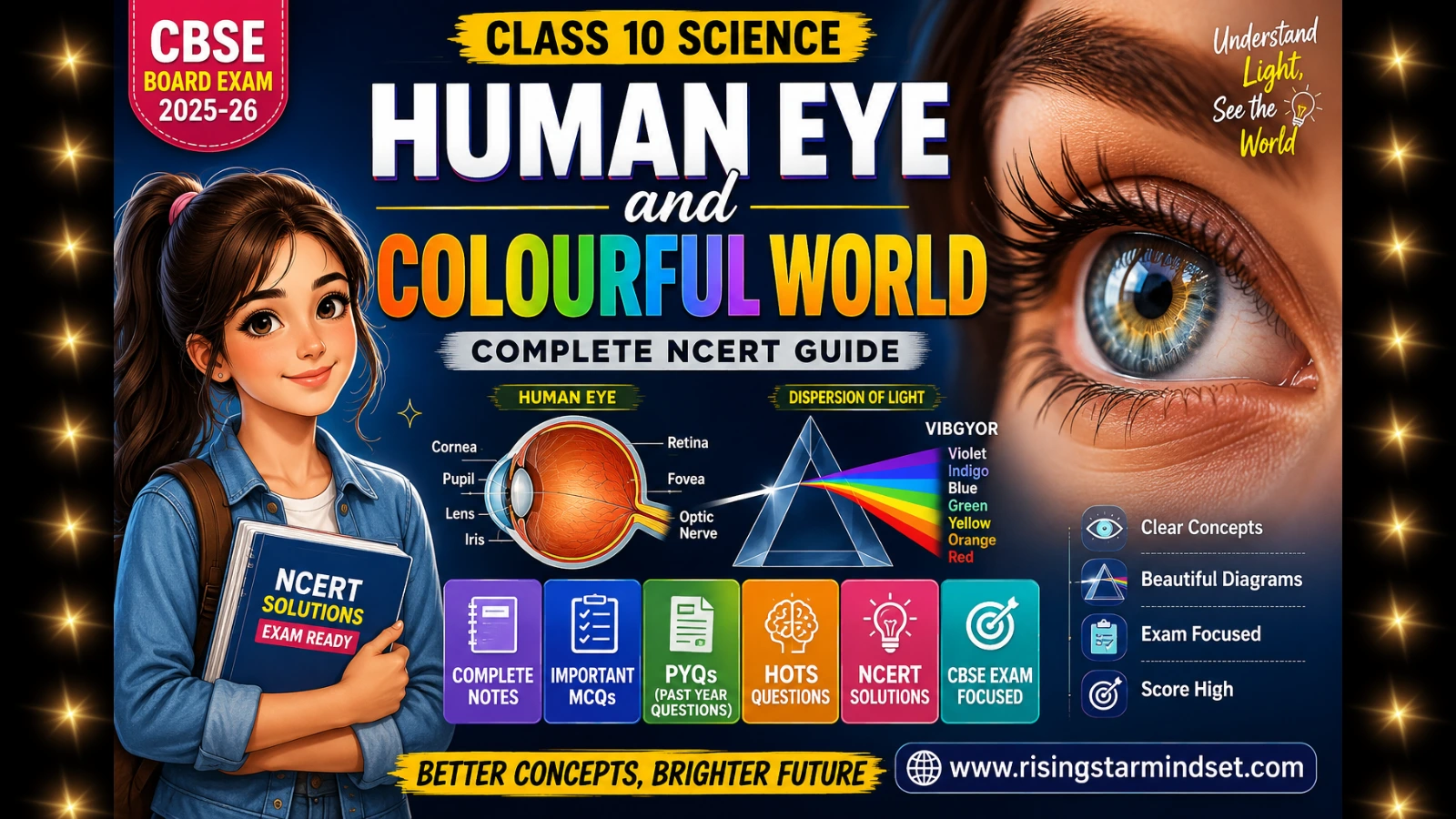
Human Eye and Colourful World Class 10 | Complete Notes (English + Hindi)
Introduction (English)
The chapter Human Eye and Colourful World class 10 explains how the human eye works and how we are able to see different colours around us. It also discusses defects of vision, their corrections, atmospheric refraction, scattering of light, rainbow formation, and many interesting natural phenomena. This chapter is very important for the CBSE Class 10 Board Exam because it contains conceptual, numerical, and diagram-based questions. PREVIOUS TOPIC : LIGHT REFLECTION AND REFRACTION
परिचय (Hindi)
मानव नेत्र तथा रंग–बिरंगी दुनिया अध्याय हमें बताता है कि हमारी आँख कैसे कार्य करती है तथा हम विभिन्न रंगों को कैसे देख पाते हैं। इस अध्याय में दृष्टि दोष (Vision Defects), उनके सुधार, वायुमंडलीय अपवर्तन (Atmospheric Refraction), प्रकाश का प्रकीर्णन (Scattering of Light), इंद्रधनुष (Rainbow) तथा कई प्राकृतिक घटनाओं का अध्ययन किया जाता है।
यह अध्याय CBSE बोर्ड परीक्षा के लिए अत्यंत महत्वपूर्ण है क्योंकि इसमें सैद्धांतिक प्रश्न, चित्र आधारित प्रश्न तथा संख्यात्मक प्रश्न पूछे जाते हैं।
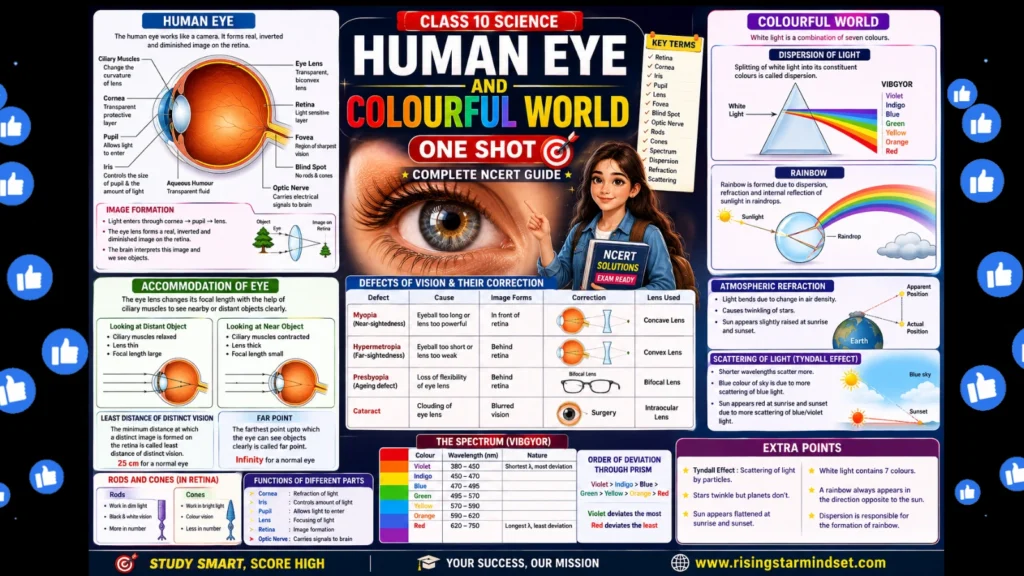
Table of Contents
- Introduction (English + Hindi)
- Abbreviations
- Key Points
- Complete Chapter Notes (English + Hindi)
- Diagrams (Text Format)
- Important Formulae
- Ray Diagrams
- Complete MCQs (50+)
- Fill in the Blanks
- True/False
- Match the Following
- Assertion & Reason
- NCERT Questions with Answers
- HOTS Questions
- Case Study Questions
- Competency Based Questions
- Word Problems
- Diagram Based Questions
- Previous Year Questions (CBSE PYQs)
- Expected Board Questions 2027
- Important Revision Notes
- Mind Map
- FAQs
- Conclusion (
Learning Objectives
After studying this chapter, students will be able to:
- Understand the structure of the human eye.
- Explain how vision occurs.
- Describe accommodation of the eye.
- Differentiate between near point and far point.
- Understand persistence of vision.
- Prepare confidently for CBSE Board questions.
अध्याय के उद्देश्य
इस अध्याय का अध्ययन करने के बाद विद्यार्थी—
- मानव नेत्र की संरचना समझ पाएंगे।
- दृष्टि बनने की प्रक्रिया समझेंगे।
- समंजन (Accommodation) को समझेंगे।
- निकट बिंदु एवं दूर बिंदु में अंतर बता पाएंगे।
- दृष्टि स्थायित्व (Persistence of Vision) को समझेंगे।
- CBSE बोर्ड परीक्षा की बेहतर तैयारी कर पाएंगे।
Abbreviations
| Abbreviation | Full Form | Meaning |
| Retina | Retina | प्रकाश-संवेदी परत |
| Iris | Iris | परितारिका |
| Pupil | Pupil | पुतली |
| Ciliary Muscles | CM | सिलियरी मांसपेशियाँ |
| Optic Nerve | ON | दृष्टि तंत्रिका |
| Focal Length | FL | फोकस दूरी |
| Lens | Convex Lens | उत्तल लेंस |
Chapter at a Glance (Key Points)
| Human eye is one of the most sensitive sense organs. |
| Retina forms the image. |
| Eye lens is a convex lens. |
| Iris controls the amount of light entering the eye. |
| Pupil acts like the aperture of a camera. |
| Ciliary muscles change the focal length of the eye lens. |
| Normal eye can clearly see objects from 25 cm to infinity. |
| Human eye produces a real and inverted image on the retina. |
| Brain interprets the inverted image as erect. |
मुख्य बिंदु (Hindi)
| मानव नेत्र सबसे महत्वपूर्ण ज्ञानेंद्रियों में से एक है। |
| मानव नेत्र सबसे महत्वपूर्ण ज्ञानेंद्रियों में से एक है। |
| रेटिना पर वास्तविक एवं उल्टा प्रतिबिंब बनता है। |
| नेत्र लेंस उत्तल (Convex) होता है। |
| परितारिका (Iris) प्रकाश की मात्रा नियंत्रित करती है। |
| पुतली (Pupil) कैमरे के अपर्चर की तरह कार्य करती है। |
| सिलियरी मांसपेशियाँ लेंस की फोकस दूरी बदलती हैं। |
| दूर बिंदु अनंत (Infinity) माना जाता है। |
| सामान्य नेत्र का निकट बिंदु 25 सेमी होता है। |
Human Eye
English Explanation
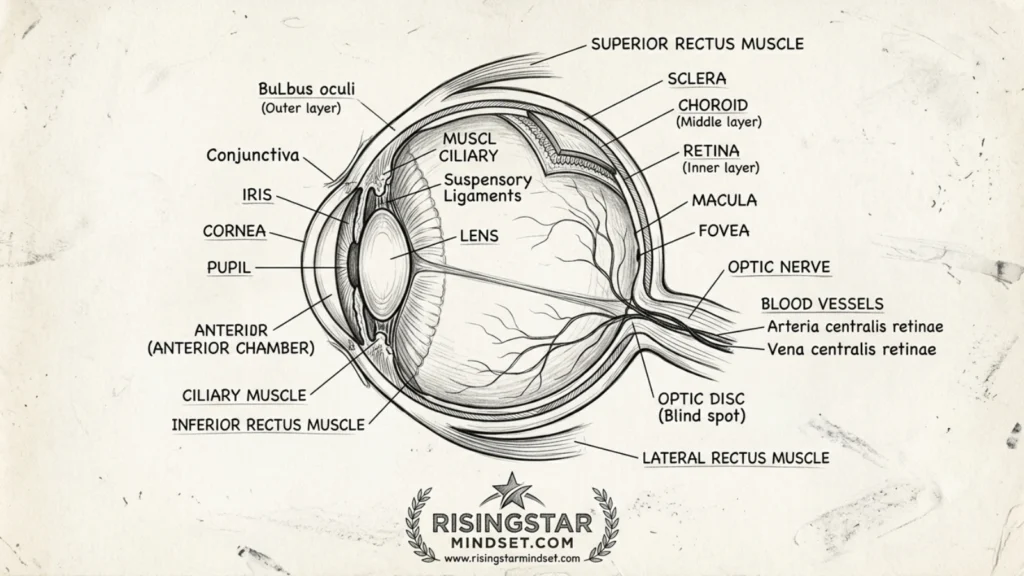
The human eye is a natural optical instrument that enables us to see objects around us. It works similarly to a camera by focusing light onto the retina. The retina converts light into electrical signals, which are transmitted to the brain through the optic nerve. The brain interprets these signals, allowing us to perceive images.
हिंदी व्याख्या
मानव नेत्र एक प्राकृतिक प्रकाशीय उपकरण (Natural Optical Instrument) है जो हमें अपने आसपास की वस्तुओं को देखने में सहायता करता है। यह कैमरे की तरह कार्य करता है। नेत्र में आने वाला प्रकाश रेटिना पर प्रतिबिंब बनाता है। रेटिना इस प्रकाश को विद्युत संकेतों में बदल देती है, जिन्हें दृष्टि तंत्रिका (Optic Nerve) मस्तिष्क तक पहुँचाती है। मस्तिष्क इन संकेतों की व्याख्या करके हमें वस्तु दिखाई देती है।
Parts of Human Eye
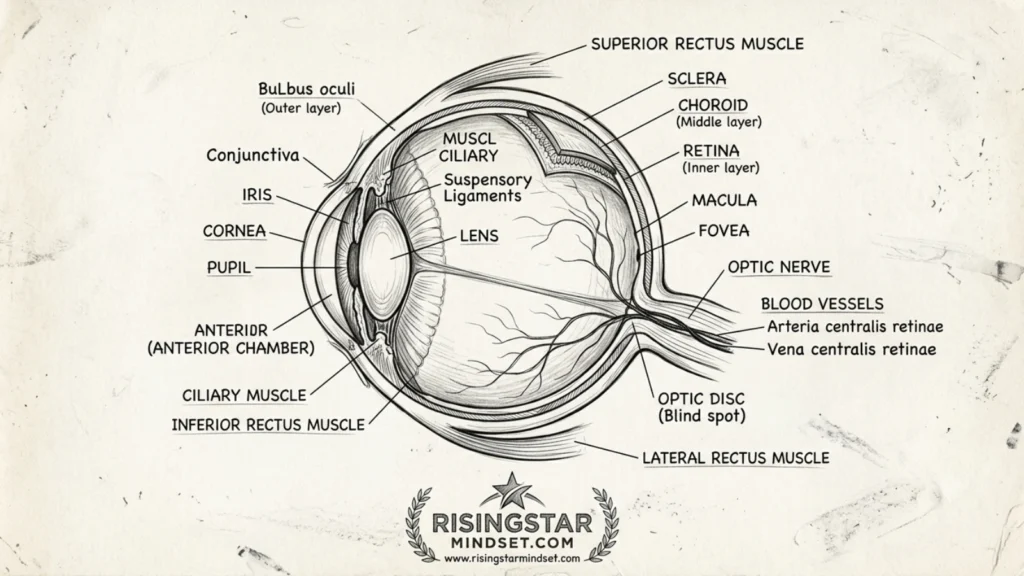
| Part | Function (English) | कार्य (Hindi) |
| Cornea | Allows light to enter | प्रकाश प्रवेश कराता है |
| Iris | Controls light | प्रकाश नियंत्रित करती है |
| Pupil | Opening for light | प्रकाश प्रवेश का छिद्र |
| Eye Lens | Focuses light | प्रकाश को फोकस करता है |
| Retina | Forms image | प्रतिबिंब बनाती है |
| Optic Nerve | Carries signals | संकेत मस्तिष्क तक पहुँचाती है |
| Ciliary Muscles | Change focal length | फोकस दूरी बदलती हैं |
| Aqueous Humour | Nourishes eye | पोषण प्रदान करता है |
| Vitreous Humour | Maintains eye shape | नेत्र का आकार बनाए रखता है |
Working of Human Eye
English
- Light enters through the cornea.
- Iris controls the amount of light.
- Light passes through the pupil.
- Eye lens focuses light on the retina.
- Retina forms a real and inverted image.
- Optic nerve sends signals to the brain.
- Brain interprets the image correctly.
हिंदी
- प्रकाश कॉर्निया से आँख में प्रवेश करता है।
- परितारिका प्रकाश की मात्रा नियंत्रित करती है।
- प्रकाश पुतली से होकर गुजरता है।
- नेत्र लेंस रेटिना पर प्रकाश को केंद्रित करता है।
- रेटिना पर वास्तविक एवं उल्टा प्रतिबिंब बनता है।
- दृष्टि तंत्रिका संकेत मस्तिष्क तक पहुँचाती है।
- मस्तिष्क वस्तु को सीधा पहचानता है।
Power of Accommodation
English
The ability of the eye lens to change its focal length to see nearby and distant objects clearly is called the power of accommodation.
Important Facts
- Controlled by ciliary muscles.
- More in young people.
- Decreases with age.
- Helps in focusing both near and distant objects.
हिंदी
आँख के लेंस की वह क्षमता जिसके द्वारा वह अपनी फोकस दूरी बदलकर पास एवं दूर की वस्तुओं को स्पष्ट देख सकता है, समंजन शक्ति (Accommodation) कहलाती है।
महत्वपूर्ण तथ्य
- सिलियरी मांसपेशियों द्वारा नियंत्रित होती है।
- बच्चों में अधिक होती है।
- उम्र बढ़ने पर कम हो जाती है।
- पास एवं दूर दोनों वस्तुएँ स्पष्ट दिखाई देती हैं।
Near Point and Far Point
| Term | English | Hindi |
| Near Point | 25 cm | निकट बिंदु |
| Far Point | Infinity | दूर बिंदु |
Near Point
The nearest distance at which an object can be seen clearly without strain is called the near point.
Hindi
वह न्यूनतम दूरी जिस पर वस्तु स्पष्ट दिखाई देती है, निकट बिंदु कहलाती है।
Normal Near Point = 25 cm
Far Point
The farthest point up to which a normal eye can see clearly is called the far point.
Hindi
वह अधिकतम दूरी जिस तक सामान्य नेत्र स्पष्ट देख सकता है, दूर बिंदु कहलाती है।
Far Point = Infinity
Persistence of Vision
English
The impression of an image remains on the retina for about 1/16th of a second even after the object is removed. This is called persistence of vision.
It is the reason why movies and animations appear continuous.
हिंदी
जब कोई वस्तु हट जाती है तब भी उसका प्रतिबिंब लगभग 1/16 सेकंड तक रेटिना पर बना रहता है। इसे दृष्टि स्थायित्व (Persistence of Vision) कहते हैं।
इसी सिद्धांत के कारण चलचित्र (Movies), वीडियो एवं एनीमेशन लगातार चलते हुए दिखाई देते हैं।
Quick Revision Table ( Human Eye and Colourful World Class 10 )
| Topic | Key Fact |
| Eye Lens | Convex Lens |
| Image | Real and Inverted |
| Retina | Image Formation |
| Iris | Controls Light |
| Pupil | Aperture |
| Accommodation | Change in Focal Length |
| Near Point | 25 cm |
| Far Point | Infinity |
| Persistence of Vision | 1/16 second |
Summary till now ( Human Eye and Colourful World Class 10 )
English
The human eye is a remarkable optical instrument that enables us to observe the colourful world. It works through coordinated action of the cornea, iris, pupil, eye lens, retina, and optic nerve. The eye lens changes its focal length through accommodation to focus on objects at different distances. The retina forms a real, inverted image, which the brain interprets correctly. Understanding these concepts provides the foundation for learning vision defects, atmospheric refraction, and scattering of light in the remaining parts of this chapter.
हिंदी
मानव नेत्र एक अद्भुत प्राकृतिक प्रकाशीय उपकरण है जो हमें रंग-बिरंगी दुनिया देखने में सक्षम बनाता है। कॉर्निया, परितारिका, पुतली, नेत्र लेंस, रेटिना और दृष्टि तंत्रिका मिलकर देखने की प्रक्रिया को पूरा करते हैं। समंजन (Accommodation) के कारण लेंस अपनी फोकस दूरी बदलता है और पास तथा दूर की वस्तुओं का स्पष्ट प्रतिबिंब रेटिना पर बनाता है। यही आधार आगे दृष्टि दोष, वायुमंडलीय अपवर्तन तथा प्रकाश के प्रकीर्णन जैसे महत्वपूर्ण विषयों को समझने में सहायता करता है.
Defects of Vision (दृष्टि दोष)
A person with a normal eye can clearly see objects from 25 cm to infinity. However, due to changes in the shape of the eyeball, eye lens, or ciliary muscles, some people cannot see objects clearly. These conditions are known as defects of vision.
परिचय (Hindi)
एक सामान्य मानव नेत्र 25 सेमी से अनंत (Infinity) तक की वस्तुओं को स्पष्ट रूप से देख सकता है। लेकिन नेत्रगोलक, नेत्र लेंस या सिलियरी मांसपेशियों में परिवर्तन होने के कारण कुछ लोगों को वस्तुएँ स्पष्ट दिखाई नहीं देतीं। इन्हें दृष्टि दोष (Defects of Vision) कहते हैं।
Types of Vision Defects ( Human Eye and Colourful World Class 10 )
| Vision Defect | Problem | Corrective Lens |
| Myopia | Cannot see distant objects clearly | Concave Lens |
| Hypermetropia | Cannot see nearby objects clearly | Convex Lens |
| Presbyopia | Difficulty seeing nearby objects due to ageing | Convex/Bifocal Lens |
| Cataract | Eye lens becomes cloudy | Surgery |
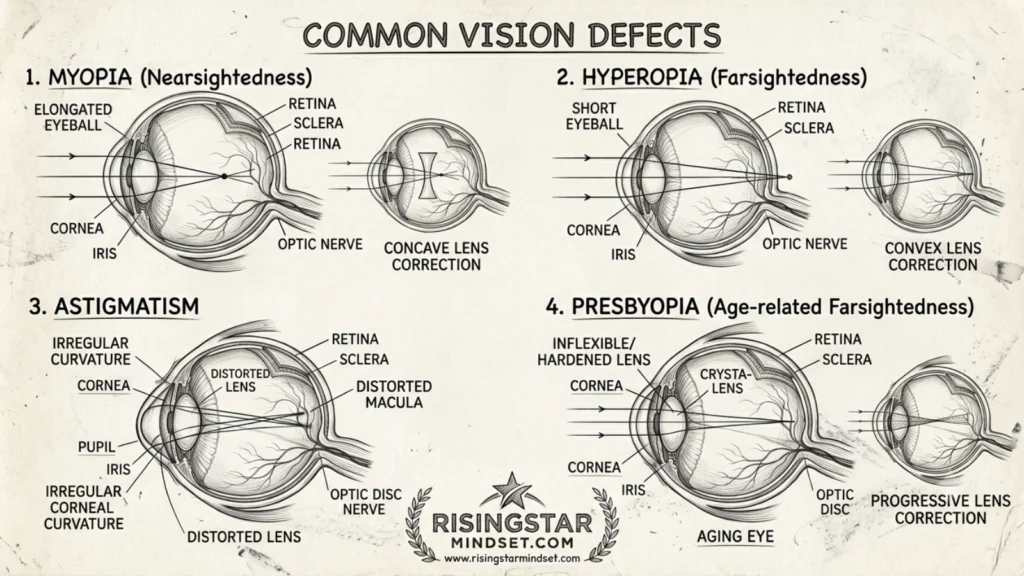
1. Myopia (Near-sightedness)
English Explanation
Myopia is a defect of vision in which a person can see nearby objects clearly but cannot see distant objects clearly.
Causes
- Eyeball becomes elongated.
- Eye lens becomes too powerful.
- Focal length decreases.
Image Formation
The image is formed in front of the retina.
Correction
Myopia is corrected using a concave (diverging) lens, which diverges incoming light rays so that the image forms on the retina.
हिंदी व्याख्या
मायोपिया या निकट दृष्टि दोष में व्यक्ति पास की वस्तुएँ स्पष्ट देख सकता है, लेकिन दूर की वस्तुएँ धुंधली दिखाई देती हैं।
कारण
- नेत्रगोलक लंबा हो जाता है।
- नेत्र लेंस की अभिसारी शक्ति बढ़ जाती है।
- फोकस दूरी कम हो जाती है।
प्रतिबिंब कहाँ बनता है?
रेटिना के सामने।
सुधार
इसे अवतल (Concave) लेंस द्वारा ठीक किया जाता है।
Quick Facts
- Far Point comes closer than infinity
- Image forms before retina.
- Corrected by Concave Lens.
2. Hypermetropia (Far-sightedness)
English Explanation
Hypermetropia is a defect in which a person can see distant objects clearly but cannot see nearby objects clearly.
Causes
- Eyeball becomes shorter.
- Eye lens loses power.
- Focal length increases.
Image Formation
Image forms behind the retina.
Correction
Corrected using a convex lens.
हिंदी व्याख्या
हाइपरमेट्रोपिया या दूर दृष्टि दोष में व्यक्ति दूर की वस्तुएँ स्पष्ट देख सकता है लेकिन पास की वस्तुएँ स्पष्ट नहीं देख पाता।
कारण
- नेत्रगोलक छोटा हो जाता है।
- नेत्र लेंस की शक्ति कम हो जाती है।
- फोकस दूरी बढ़ जाती है।
प्रतिबिंब
रेटिना के पीछे।
सुधार
उत्तल (Convex) लेंस द्वारा किया जाता है।
Quick Facts
- Near Point shifts away.
- Image forms behind retina.
- Corrected by Convex Lens.
3. Presbyopia
English Explanation
Presbyopia is an age-related defect of vision.
It occurs because ciliary muscles weaken with age, reducing the eye’s power of accommodation.
Symptoms
- Difficulty reading books.
- Difficulty seeing nearby objects.
- Common after 40 years.
Correction
- Convex Lens
- Bifocal Lens
हिंदी व्याख्या
उम्र बढ़ने के साथ सिलियरी मांसपेशियाँ कमजोर हो जाती हैं जिससे समंजन शक्ति कम हो जाती है। इसे प्रेसबायोपिया कहते हैं।
लक्षण
- पुस्तक पढ़ने में कठिनाई
- पास की वस्तुएँ धुंधली दिखाई देना
- सामान्यतः 40 वर्ष के बाद
सुधार
- उत्तल लेंस
- द्विफोकसी (Bifocal) लेंस
4. Cataract
English
Cataract is a condition in which the eye lens becomes cloudy or opaque.
Symptoms
- Blurred vision
- Difficulty seeing at night
- Reduced brightness
Treatment
Cataract is treated by replacing the damaged lens with an artificial lens through surgery.
हिंदी
मोतियाबिंद (Cataract) में नेत्र लेंस धुंधला हो जाता है।
लक्षण
- धुंधला दिखाई देना
- रात में देखने में कठिनाई
- रोशनी कम महसूस होना
उपचार
ऑपरेशन द्वारा कृत्रिम लेंस लगाया जाता है।
Comparison of Vision Defects
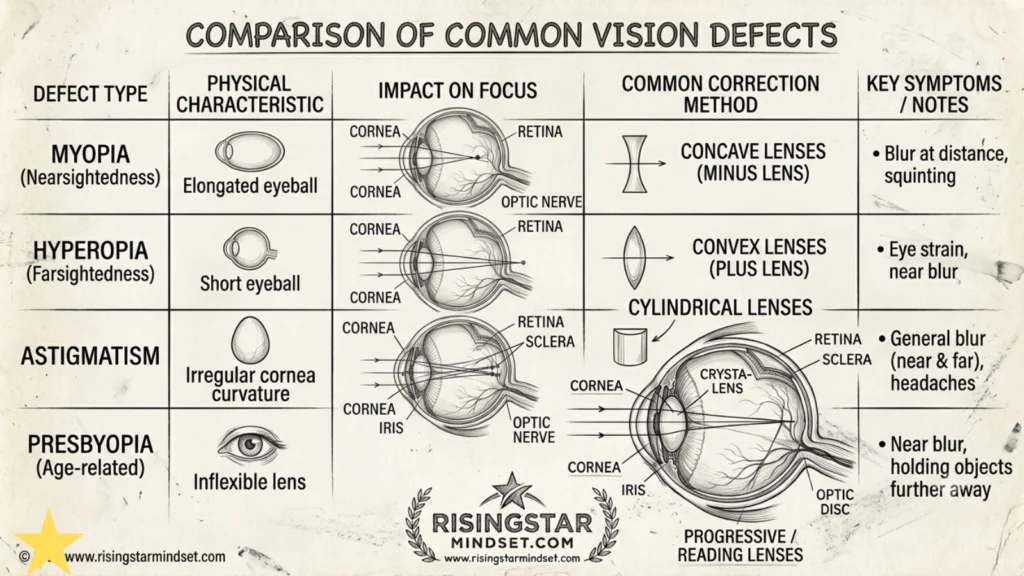
| Feature | Myopia | Hypermetropia | Presbyopia |
| Clear Vision | Near | Far | Far |
| Blurred Vision | Far | Near | Near |
| Image | Before Retina | Behind Retina | Behind Retina |
| Lens Used | Concave | Convex | Convex/Bifocal |
Atmospheric Refraction
English Explanation
Atmospheric refraction is the bending of light when it passes through different layers of the atmosphere having different densities.
हिंदी व्याख्या
जब प्रकाश वायुमंडल की विभिन्न घनत्व वाली परतों से होकर गुजरता है तो उसका मार्ग बदल जाता है। इसे वायुमंडलीय अपवर्तन कहते हैं।
Effects of Atmospheric Refraction
- Twinkling of Stars
- Advanced Sunrise
- Delayed Sunset
Twinkling of Stars ( Human Eye and Colourful World Class 10 )
English
Stars appear to twinkle because their light continuously undergoes atmospheric refraction.
Since stars are very far away, they behave like point sources.
हिंदी
तारे टिमटिमाते हुए दिखाई देते हैं क्योंकि उनका प्रकाश वायुमंडल की विभिन्न परतों से गुजरते समय बार-बार अपवर्तित होता है।
Important Board Point ( Human Eye and Colourful World Class 10 )
Stars twinkle but planets do not.
Reason:
Planets are nearer and behave like extended sources.
Advanced Sunrise
English
The Sun becomes visible about 2 minutes before the actual sunrise due to atmospheric refraction.
हिंदी
वास्तविक सूर्योदय से लगभग 2 मिनट पहले सूर्य दिखाई देने लगता है।
Delayed Sunset
English
The Sun remains visible for about 2 minutes after the actual sunset.
हिंदी
सूर्यास्त के लगभग 2 मिनट बाद तक सूर्य दिखाई देता है।
Scattering of Light
English Explanation
Scattering is the phenomenon in which light changes its direction after striking tiny particles.
हिंदी व्याख्या
जब प्रकाश सूक्ष्म कणों से टकराकर विभिन्न दिशाओं में फैल जाता है तो इसे प्रकाश का प्रकीर्णन कहते हैं।
Tyndall Effect
English
The scattering of light by colloidal particles is known as the Tyndall Effect.
हिंदी
कोलॉइडल कणों द्वारा प्रकाश के प्रकीर्णन को टिंडल प्रभाव कहते हैं।
Examples
- Sunlight entering a dusty room.
- Car headlights in fog.
- Light passing through smoke.
Why is the Sky Blue? ( Human Eye and Colourful World Class 10 )
English
Blue light has the shortest wavelength among visible colours (except violet, which is less perceived by our eyes), so it scatters the most. Therefore, the sky appears blue.
हिंदी
नीले रंग का तरंगदैर्ध्य कम होने के कारण उसका प्रकीर्णन अधिक होता है। इसलिए आकाश नीला दिखाई देता है।
Why is the Sun Red at Sunrise and Sunset?
English
During sunrise and sunset, sunlight travels a longer distance through the atmosphere. Most shorter wavelengths (blue and violet) are scattered away, while the longer wavelengths (red) reach our eyes.
हिंदी
सूर्योदय एवं सूर्यास्त के समय सूर्य का प्रकाश वायुमंडल में अधिक दूरी तय करता है। छोटे तरंगदैर्ध्य वाले रंग प्रकीर्णित हो जाते हैं और लाल रंग हमारी आँखों तक पहुँचता है, इसलिए सूर्य लाल दिखाई देता है।
Rainbow Formation
English
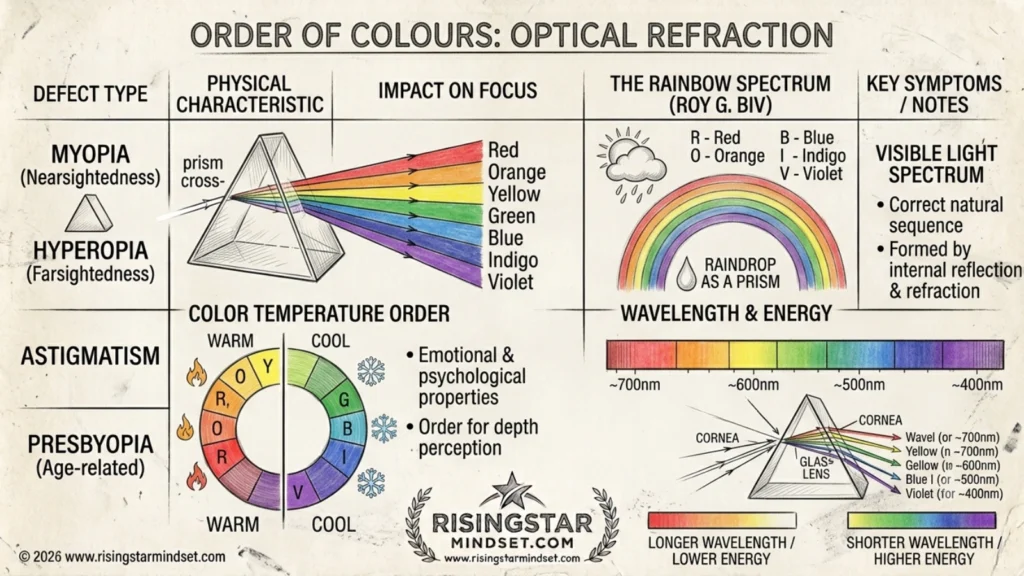
A rainbow is formed due to the dispersion, refraction, and total internal reflection of sunlight inside raindrops.
Order of Colours ( Human Eye and Colourful World Class 10 )
VIBGYOR
- Violet
- Indigo
- Blue
- Green
- Yellow
- Orange
- Red
हिंदी
इंद्रधनुष वर्षा की बूंदों में अपवर्तन, विक्षेपण (Dispersion) तथा पूर्ण आंतरिक परावर्तन के कारण बनता है।
रंगों का क्रम
VIBGYOR
बैंगनी → जामुनी → नीला → हरा → पीला → नारंगी → लाल
Important Board Facts ( Human Eye and Colourful World Class 10 )
| Topic | Important Fact |
| Myopia | Concave Lens |
| Hypermetropia | Convex Lens |
| Presbyopia | Age-related defect |
| Cataract | Surgery |
| Stars | Twinkle |
| Planets | Do not twinkle |
| Sky | Blue |
| Sunrise | 2 min early |
| Sunset | 2 min late |
| Rainbow | VIBGYOR |
| Scattering | More for shorter wavelengths |
Quick Revision ( Human Eye and Colourful World Class 10 )
- Myopia → Concave Lens
- Hypermetropia → Convex Lens
- Presbyopia → Bifocal Lens
- Cataract → Surgery
- Stars Twinkle → Atmospheric Refraction
- Sky Blue → Scattering of Light
- Sunrise Early → Atmospheric Refraction
- Sunset Late → Atmospheric Refraction
- Rainbow → Dispersion + Refraction + Total Internal Reflection
Important Formulae (Quick Revision)
| Formula | Description |
| Power of Lens | |
| Lens Power (when focal length is in cm) | |
| Unit of Power = Dioptre (D) | SI Unit |
| Convex Lens | Positive Power |
| Concave Lens | Negative Power |
One Shot Revision Table
| Topic | Remember |
| Image in Human Eye | Real and Inverted |
| Retina | Image Formation |
| Near Point | 25 cm |
| Far Point | Infinity |
| Myopia | Concave Lens |
| Hypermetropia | Convex Lens |
| Presbyopia | Bifocal Lens |
| Sky | Blue |
| Stars | Twinkle |
| Rainbow | VIBGYOR |
Multiple Choice Questions (MCQs)
Q1. The image formed on the retina is
A) Virtual and erect
B) Real and erect
C) Real and inverted
D) Virtual and inverted
Answer: C
Q2. Which part of the eye controls the amount of light entering the eye?
A) Retina
B) Cornea
C) Iris
D) Lens
Answer: C
Q3. The near point of a normal eye is
A) 20 cm
B) 25 cm
C) 50 cm
D) Infinity
Answer: B
Q4. Which lens is used to correct myopia?
A) Convex
B) Cylindrical
C) Concave
D) Bifocal
Answer: C
Q5. Hypermetropia is corrected by
A) Concave Lens
B) Convex Lens
C) Plane Mirror
D) Prism
Answer: B
Q6. Cataract is treated by
A) Medicine only
B) Eye exercise
C) Surgery
D) Spectacles
Answer: C
Q7. Twinkling of stars is due to
A) Reflection
B) Dispersion
C) Atmospheric Refraction
D) Diffraction
Answer: C
Q8. The sky appears blue because of
A) Reflection
B) Refraction
C) Scattering
D) Dispersion
Answer: C
Q9. Which colour is scattered the most?
A) Red
B) Orange
C) Green
D) Blue
Answer: D
Q10. Rainbow is formed due to
A) Reflection
B) Dispersion, Refraction and Total Internal Reflection
C) Refraction only
D) Diffraction
Answer: B
11. Which part of the eye controls the amount of light entering the eye?
A) Retina
B) Iris
C) Cornea
D) Optic Nerve
Answer: B) Iris
12. The transparent front part of the eye is called:
A) Lens
B) Retina
C) Cornea
D) Pupil
Answer: C) Cornea
13. The image is formed on the:
A) Cornea
B) Iris
C) Retina
D) Pupil
Answer: C) Retina
14. Which part of the eye acts like a camera lens?
A) Retina
B) Eye Lens
C) Iris
D) Cornea
Answer: B) Eye Lens
15. The blind spot is the point where:
A) Lens is absent
B) Retina has no rods and cones
C) Iris is absent
D) Cornea ends
Answer: B) Retina has no rods and cones
16. Which cells help us see in bright light?
A) Rod cells
B) Cone cells
C) Nerve cells
D) Muscle cells
Answer: B) Cone cells
17. Which cells are responsible for vision in dim light?
A) Cone cells
B) Rod cells
C) Iris cells
D) Retina cells
Answer: B) Rod cells
18. The least distance of distinct vision for a normal eye is:
A) 10 cm
B) 25 cm
C) 50 cm
D) 100 cm
Answer: B) 25 cm
19. The far point of a normal eye is:
A) 25 cm
B) 50 cm
C) Infinity
D) 100 cm
Answer: C) Infinity
20. The ability of the eye lens to change its focal length is called:
A) Reflection
B) Accommodation
C) Refraction
D) Dispersion
Answer: B) Accommodation
21. Myopia is also known as:
A) Long-sightedness
B) Near-sightedness
C) Colour blindness
D) Cataract
Answer: B) Near-sightedness
22. Myopia is corrected using:
A) Convex lens
B) Concave lens
C) Cylindrical lens
D) Bifocal lens
Answer: B) Concave lens
23. Hypermetropia is corrected by:
A) Convex lens
B) Concave lens
C) Plane mirror
D) Prism
Answer: A) Convex lens
24. Hypermetropia is also called:
A) Near-sightedness
B) Far-sightedness
C) Colour blindness
D) Astigmatism
Answer: B) Far-sightedness
25. Presbyopia generally occurs due to:
A) Old age
B) Injury
C) Infection
D) Lack of vitamins
Answer: A) Old age
26. Cataract affects the:
A) Retina
B) Cornea
C) Eye Lens
D) Iris
Answer: C) Eye Lens
27. The splitting of white light into its constituent colours is called:
A) Reflection
B) Refraction
C) Dispersion
D) Scattering
Answer: C) Dispersion
28. A rainbow is formed due to:
A) Reflection only
B) Refraction only
C) Dispersion, refraction and internal reflection
D) Diffraction
Answer: C)
29. Which colour deviates the least through a prism?
A) Violet
B) Indigo
C) Red
D) Blue
Answer: C) Red
30. Which colour deviates the most through a prism?
A) Red
B) Green
C) Yellow
D) Violet
Answer: D) Violet
31. The band of seven colours formed after dispersion is called:
A) Image
B) Spectrum
C) Reflection
D) Halo
Answer: B) Spectrum
32. VIBGYOR stands for:
A) Seven colours of the spectrum
B) Seven planets
C) Seven stars
D) Seven mirrors
Answer: A)
33. Atmospheric refraction is caused due to:
A) Earth’s gravity
B) Variation in air density
C) Reflection from clouds
D) Dispersion only
Answer: B)
34. Twinkling of stars is due to:
A) Reflection
B) Refraction
C) Atmospheric refraction
D) Dispersion
Answer: C)
35. Planets do not twinkle because:
A) They emit their own light
B) They are closer and appear as extended sources
C) They are smaller
D) They have no atmosphere
Answer: B)
36. The Sun appears flattened at sunrise due to:
A) Reflection
B) Atmospheric refraction
C) Scattering
D) Dispersion
Answer: B)
37. Advance sunrise occurs because of:
A) Reflection
B) Atmospheric refraction
C) Dispersion
D) Scattering
Answer: B)
38. The Tyndall effect is caused by:
A) Reflection of light
B) Scattering of light
C) Refraction of light
D) Dispersion of light
Answer: B)
39. The colour of the clear sky is:
A) Red
B) Yellow
C) Blue
D) White
Answer: C)
40. The blue colour of the sky is due to:
A) Reflection
B) Refraction
C) Scattering of shorter wavelengths
D) Dispersion
Answer: C)
41. During sunrise and sunset, the Sun appears:
A) Blue
B) Green
C) Red
D) White
Answer: C)
42. Which colour has the longest wavelength?
A) Violet
B) Blue
C) Red
D) Green
Answer: C)
43. Which colour has the shortest wavelength?
A) Red
B) Yellow
C) Violet
D) Orange
Answer: C)
44. Which colour is scattered the most in the atmosphere?
A) Red
B) Blue
C) Green
D) Orange
Answer: B)
45. Which colour is scattered the least?
A) Violet
B) Blue
C) Green
D) Red
Answer: D)
46. The human eye forms:
A) Erect image
B) Virtual image
C) Real and inverted image
D) Magnified image
Answer: C)
47. The eye lens is:
A) Concave
B) Convex
C) Plano-concave
D) Cylindrical
Answer: B)
48. The pupil appears:
A) White
B) Blue
C) Black
D) Red
Answer: C)
49. The retina contains:
A) Rods and Cones
B) Muscles only
C) Blood vessels only
D) Iris cells only
Answer: A)
50. Which part sends visual signals to the brain?
A) Iris
B) Retina
C) Optic Nerve
D) Cornea
Answer: C)
51. The transparent fluid between cornea and lens is:
A) Vitreous humour
B) Aqueous humour
C) Plasma
D) Lymph
Answer: B)
52. The jelly-like fluid behind the lens is:
A) Plasma
B) Aqueous humour
C) Vitreous humour
D) Tears
Answer: C)
53. Which phenomenon explains the formation of a rainbow?
A) Diffraction
B) Dispersion
C) Polarization
D) Reflection only
Answer: B)
54. Which device is commonly used to demonstrate dispersion?
A) Mirror
B) Glass Prism
C) Magnifying Glass
D) Telescope
Answer: B)
55. The colour sequence in a spectrum starts with:
A) Violet
B) Indigo
C) Red
D) Blue
Answer: C)
56. The colour sequence in a spectrum ends with:
A) Red
B) Yellow
C) Violet
D) Orange
Answer: C)
57. Which defect makes distant objects appear blurred?
A) Hypermetropia
B) Myopia
C) Presbyopia
D) Cataract
Answer: B)
58. Which defect makes nearby objects appear blurred?
A) Myopia
B) Hypermetropia
C) Colour Blindness
D) Cataract
Answer: B)
59. The scattering of light depends mainly on:
A) Wavelength of light
B) Temperature only
C) Pressure only
D) Shape of Earth
Answer: A)
60. Which chapter explains why the sky is blue and sunsets appear red?
A) Electricity
B) Light – Reflection and Refraction
C) Human Eye and Colourful World
D) Magnetic Effects of Electric Current
Answer: C) Human Eye and Colourful World
Fill in the Blanks ( Human Eye and Colourful World Class 10 )
- The image is formed on the __________.
Answer: Retina - The eye lens is a __________ lens.
Answer: Convex - Myopia is corrected using a __________ lens.
Answer: Concave - Hypermetropia is corrected using a __________ lens.
Answer: Convex - The near point of a normal eye is __________ cm.
Answer: 25 - The far point of a normal eye is __________.
Answer: Infinity - The blue colour of the sky is due to __________ of light.
Answer: Scattering - Stars twinkle due to __________ refraction.
Answer: Atmospheric - Rainbow consists of __________ colours.
Answer: Seven - VIBGYOR represents the __________ of rainbow colours.
Answer: Order
True or False ( Human Eye and Colourful World Class 10 )
| Statement | Answer |
| Retina forms the image. | True |
| Eye lens is concave. | False |
| Myopia is corrected using a convex lens. | False |
| Hypermetropia affects near vision. | True |
| Cataract is treated by surgery. | True |
| Stars twinkle due to reflection. | False |
| The sky appears blue due to scattering. | True |
| Rainbow has seven colours. | True |
| Near point of normal eye is 50 cm. | False |
| Presbyopia is age-related. | True |
Match the Following ( Human Eye and Colourful World Class 10 )
| Column A | Column B |
| Myopia | Concave Lens |
| Hypermetropia | Convex Lens |
| Presbyopia | Bifocal Lens |
| Retina | Image Formation |
| Iris | Controls Light |
| Pupil | Opening of Eye |
| Cataract | Cloudy Lens |
| Rainbow | Dispersion |
| Sky | Blue Colour |
| Stars | Twinkling |
Assertion and Reason ( Human Eye and Colourful World Class 10 )
Q1
Assertion: Myopia is corrected by a concave lens.
Reason: The image forms in front of the retina.
Answer: Both Assertion and Reason are true, and Reason correctly explains Assertion.
Q2
Assertion: Stars twinkle.
Reason: Atmospheric refraction changes the apparent position of stars.
Answer: Both are true.
Q3
Assertion: The sky appears blue.
Reason: Blue light scatters more than red light.
Answer: Both are true.
Q4
Assertion: Hypermetropia is corrected by a convex lens.
Reason: The image forms behind the retina.
Answer: Both are true.
Q5
Assertion: Cataract can be cured by surgery.
Reason: The cloudy eye lens is replaced with an artificial lens.
Answer: Both are true.
HOTS (Higher Order Thinking Skills)
Q1.
Why do planets not twinkle whereas stars twinkle?
Answer:
Stars behave like point sources, so atmospheric refraction causes noticeable fluctuations in their brightness. Planets are much closer and appear as extended sources; the light from different parts averages out, so they do not twinkle.
Q2.
Why does the sky appear blue but space appears black?
Answer:
Earth’s atmosphere scatters sunlight, especially shorter wavelengths like blue. Space has almost no atmosphere, so there is negligible scattering, making it appear black.
Q3.
Why is the Sun reddish during sunrise and sunset?
Answer:
At sunrise and sunset, sunlight travels through a thicker layer of the atmosphere. Shorter wavelengths are scattered away, while longer wavelengths (red) reach our eyes.
Q4.
Why is a concave lens used to correct myopia?
Answer:
A concave lens diverges incoming light rays so that the image shifts from in front of the retina onto the retina.
Q5.
Why does the eye need accommodation?
Answer:
Accommodation allows the eye lens to change its focal length so that both near and distant objects are focused clearly on the retina.
NCERT Questions and Answers ( Human Eye and Colourful World Class 10 )
Q1. What is the function of the iris?
Answer:
The iris controls the amount of light entering the eye by adjusting the size of the pupil.
Q2. Why is the retina important?
Answer:
The retina is the light-sensitive layer where a real and inverted image is formed. It converts light into electrical signals that are sent to the brain.
Q3. What is accommodation?
Answer:
Accommodation is the ability of the eye lens to change its focal length to focus on objects at different distances.
Q4. Why do stars twinkle?
Answer:
Stars twinkle due to atmospheric refraction caused by continuous changes in the density of Earth’s atmosphere.
Q5. Why is the sky blue?
Answer:
The sky appears blue because shorter wavelengths of sunlight are scattered more by the atmosphere.
Case Study Questions ( Human Eye and Colourful World Class 10 )
Case Study 1
A student cannot read the blackboard clearly from the last bench but can read a book comfortably.
Questions
- Which eye defect does the student have?
Answer: Myopia - Which lens is used to correct it?
Answer: Concave Lens - Where is the image formed?
Answer: In front of the retina - What is the main cause?
Answer: Elongated eyeball or excessive converging power of the eye lens
Word Problems ( Human Eye and Colourful World Class 10 )
Problem 1
A person cannot see distant objects clearly. Which eye defect does the person have? How can it be corrected?
Answer:
The person has myopia. It is corrected using a concave lens.
Problem 2
Why is a driver advised to wear anti-glare glasses while driving at night?
Answer:
Anti-glare glasses reduce the effect of scattered and intense light from oncoming vehicles, improving visibility and reducing eye strain.
Problem 3
Why is a rainbow usually seen after rain?
Answer:
Raindrops act like tiny prisms. Sunlight undergoes refraction, dispersion, and total internal reflection inside the droplets, producing a rainbow.
Exam Tips
- Learn all vision defects with their corrective lenses.
- Revise the reasons for blue sky, red sunrise/sunset, and twinkling of stars.
- Memorize VIBGYOR in order.
- Practice ray diagrams regularly.
- Solve NCERT textbook questions before attempting PYQs.
CBSE Previous Year Questions (PYQs)
Note: नीचे दिए गए प्रश्न CBSE बोर्ड परीक्षा में बार-बार पूछे जाने वाले तथा पिछले वर्षों के प्रश्नों के समान पैटर्न पर आधारित महत्वपूर्ण अभ्यास प्रश्न हैं।
Very Short Answer Questions (1 Mark)
Q1. Which lens is used to correct myopia?
Answer: Concave lens.
Q2. What is the least distance of distinct vision for a normal eye?
Answer: 25 cm.
Q3. Name the defect of vision corrected by a convex lens.
Answer: Hypermetropia.
Q4. Why do stars twinkle?
Answer: Due to atmospheric refraction.
Q5. Which colour is scattered the most in Earth’s atmosphere?
Answer: Blue light.
Short Answer Questions (2 Marks)
Q1.
Differentiate between Myopia and Hypermetropia.
| Myopia | Hypermetropia |
| Nearby objects are seen clearly. | Distant objects are seen clearly. |
| Image forms in front of the retina. | Image forms behind the retina. |
| Corrected using a concave lens. | Corrected using a convex lens. |
Q2.
Explain atmospheric refraction.
Answer:
Atmospheric refraction is the bending of light as it passes through layers of air having different optical densities. It is responsible for the twinkling of stars, advanced sunrise, and delayed sunset.
Q3.
Why does the sky appear blue?
Answer:
The sky appears blue because molecules in the atmosphere scatter shorter wavelengths (mainly blue) more than longer wavelengths.
Long Answer Questions (3 Marks)
Q1.
Explain Myopia with causes, image formation, and correction.
Answer:
- Myopia is a defect in which distant objects appear blurred.
- Causes:
- Elongated eyeball.
- Increased converging power of the eye lens.
- Image forms in front of the retina.
- Corrected using a concave lens.
Q2.
Explain Hypermetropia with a suitable diagram.
Answer:
- Hypermetropia is a defect in which nearby objects appear blurred.
- Causes:
- Shortened eyeball.
- Reduced converging power of the eye lens.
- Image forms behind the retina.
- Corrected using a convex lens.
Q3.
Explain the formation of a rainbow.
Answer:
A rainbow is formed when sunlight enters raindrops and undergoes:
- Refraction
- Dispersion
- Total Internal Reflection
- Refraction again while emerging
The colours appear in the order:
VIBGYOR
Expected CBSE Board Questions (2026–27)
1 Mark Questions ( Human Eye and Colourful World Class 10 )
- Define accommodation.
- What is the function of the iris?
- Define cataract.
- What is atmospheric refraction?
- State the far point of a normal eye.
2 Marks Questions ( Human Eye and Colourful World Class 10 )
- Explain why planets do not twinkle.
- Why is the Sun reddish during sunrise?
- What is Tyndall Effect?
- Why does the sky appear blue?
- Explain the persistence of vision.
3 Marks Questions ( Human Eye and Colourful World Class 10 )
- Explain Myopia with causes and correction.
- Define Hypermetropia with causes and correction.
- Explain Presbyopia.
- Discuss atmospheric refraction with examples.
- Explain the formation of a rainbow.
5 Marks Questions ( Human Eye and Colourful World Class 10 )
Q1.
Describe the structure and working of the human eye with the help of a neat labelled diagram.
Q2.
Explain all defects of vision with causes and corrective lenses.
Q3.
Discuss atmospheric refraction and explain:
- Twinkling of stars
- Advanced sunrise
- Delayed sunset
Q4.
Explain scattering of light and discuss:
- Blue colour of sky
- Red colour of sunrise and sunset
- Tyndall Effect
Q5.
Write detailed notes on rainbow formation.
Revision Checklist ( Human Eye and Colourful World Class 10 )
Before your CBSE Board Exam, ensure you can answer these confidently:
| Parts of the Human Eye |
| Functions of Retina, Iris, and Pupil |
| Accommodation |
| Near Point and Far Point |
| Myopia |
| Hypermetropia |
| Presbyopia |
| Cataract |
| Atmospheric Refraction |
| Twinkling of Stars |
| Advanced Sunrise |
| Delayed Sunset |
| Scattering of Light |
| Blue Colour of Sky |
| Red Colour of Sunrise & Sunset |
| Rainbow Formation |
| VIBGYOR |
Frequently Asked Questions (FAQs)
Q1. What is the Human Eye?
Answer (English):
The human eye is a natural optical instrument that helps us see objects by focusing light on the retina.
उत्तर (Hindi):
मानव नेत्र एक प्राकृतिक प्रकाशीय उपकरण है जो प्रकाश को रेटिना पर फोकस करके हमें वस्तुएँ देखने में सहायता करता है।
Q2. What is the near point of a normal eye?
Answer (English):
The near point of a normal eye is 25 cm.
उत्तर (Hindi):
सामान्य नेत्र का निकट बिंदु 25 सेमी होता है।
Q3. Which lens is used to correct Myopia?
Answer (English):
A concave lens is used.
उत्तर (Hindi):
मायोपिया को अवतल (Concave) लेंस द्वारा ठीक किया जाता है।
Q4. Why do stars twinkle?
Answer (English):
Stars twinkle due to atmospheric refraction.
उत्तर (Hindi):
तारे वायुमंडलीय अपवर्तन के कारण टिमटिमाते हैं।
Q5. Why is the sky blue?
Answer (English):
Blue light is scattered more than other colours.
उत्तर (Hindi):
नीले रंग का प्रकीर्णन अधिक होने के कारण आकाश नीला दिखाई देता है।
Q6. What is Presbyopia?
Answer (English):
It is an age-related defect caused by the reduced power of accommodation.
उत्तर (Hindi):
उम्र बढ़ने पर समंजन शक्ति कम होने से उत्पन्न दृष्टि दोष को प्रेसबायोपिया कहते हैं।
Q7. What is the order of colours in a rainbow?
Answer (English):
Violet, Indigo, Blue, Green, Yellow, Orange, Red (VIBGYOR).
उत्तर (Hindi):
बैंगनी, जामुनी, नीला, हरा, पीला, नारंगी और लाल (VIBGYOR)।
Q8. What is Atmospheric Refraction?
Answer (English):
It is the bending of light due to changes in the density of the atmosphere.
उत्तर (Hindi):
वायुमंडल की विभिन्न घनत्व वाली परतों से गुजरते समय प्रकाश का मुड़ना वायुमंडलीय अपवर्तन कहलाता है।
Summary ( Human Eye and Colourful World Class 10 )
English
The chapter Human Eye and Colourful World explains the structure and working of the human eye, common defects of vision and their correction, atmospheric refraction, scattering of light, and the formation of a rainbow. These concepts form an important part of the CBSE Class 10 Science syllabus and are frequently tested through conceptual, diagram-based, and application-oriented questions. Regular revision and practice of NCERT exercises, MCQs, HOTS, and PYQs will help students build a strong conceptual foundation and perform confidently in the board examination.
हिंदी
मानव नेत्र तथा रंग–बिरंगी दुनिया अध्याय में मानव नेत्र की संरचना एवं कार्य, दृष्टि दोष और उनके सुधार, वायुमंडलीय अपवर्तन, प्रकाश का प्रकीर्णन तथा इंद्रधनुष के निर्माण का विस्तृत अध्ययन किया जाता है। यह अध्याय CBSE कक्षा 10 विज्ञान का अत्यंत महत्वपूर्ण भाग है और बोर्ड परीक्षा में अवधारणात्मक, चित्र आधारित तथा अनुप्रयोग आधारित प्रश्नों के रूप में नियमित रूप से पूछा जाता है। यदि विद्यार्थी NCERT, MCQs, HOTS तथा PYQs का नियमित अभ्यास करते हैं, तो वे इस अध्याय में उत्कृष्ट प्रदर्शन कर सकते हैं।
Conclusion
English
The Human Eye and Colourful World chapter is one of the most scoring chapters in CBSE Class 10 Science. A clear understanding of the human eye, defects of vision, atmospheric refraction, and scattering of light enables students to solve theoretical, numerical, and diagram-based questions with confidence. Make it a habit to revise the concepts, practise labelled diagrams, and solve NCERT questions along with previous years’ papers. Consistent practice will not only improve conceptual understanding but also help you achieve excellent marks in the CBSE Board Examination.
निष्कर्ष (Hindi)
मानव नेत्र तथा रंग–बिरंगी दुनिया कक्षा 10 विज्ञान का सबसे महत्वपूर्ण और अंक प्राप्त करने वाला अध्यायों में से एक है। यदि आप मानव नेत्र की संरचना, दृष्टि दोष, वायुमंडलीय अपवर्तन तथा प्रकाश के प्रकीर्णन जैसी अवधारणाओं को अच्छी तरह समझ लेते हैं और नियमित रूप से NCERT प्रश्न, MCQs, HOTS तथा पिछले वर्षों के प्रश्नों का अभ्यास करते हैं, तो बोर्ड परीक्षा में उत्कृष्ट अंक प्राप्त करना आसान हो जाता है। नियमित पुनरावृत्ति, चित्रों का अभ्यास और अवधारणाओं की स्पष्ट समझ आपकी सफलता की कुंजी है।
Keep Learning, Keep Growing!
P Kumar | Rising Star Mindset
www.risingstarmindset.com
Together We Will Make The Difference