
Notes : Class 10 light – Introduction
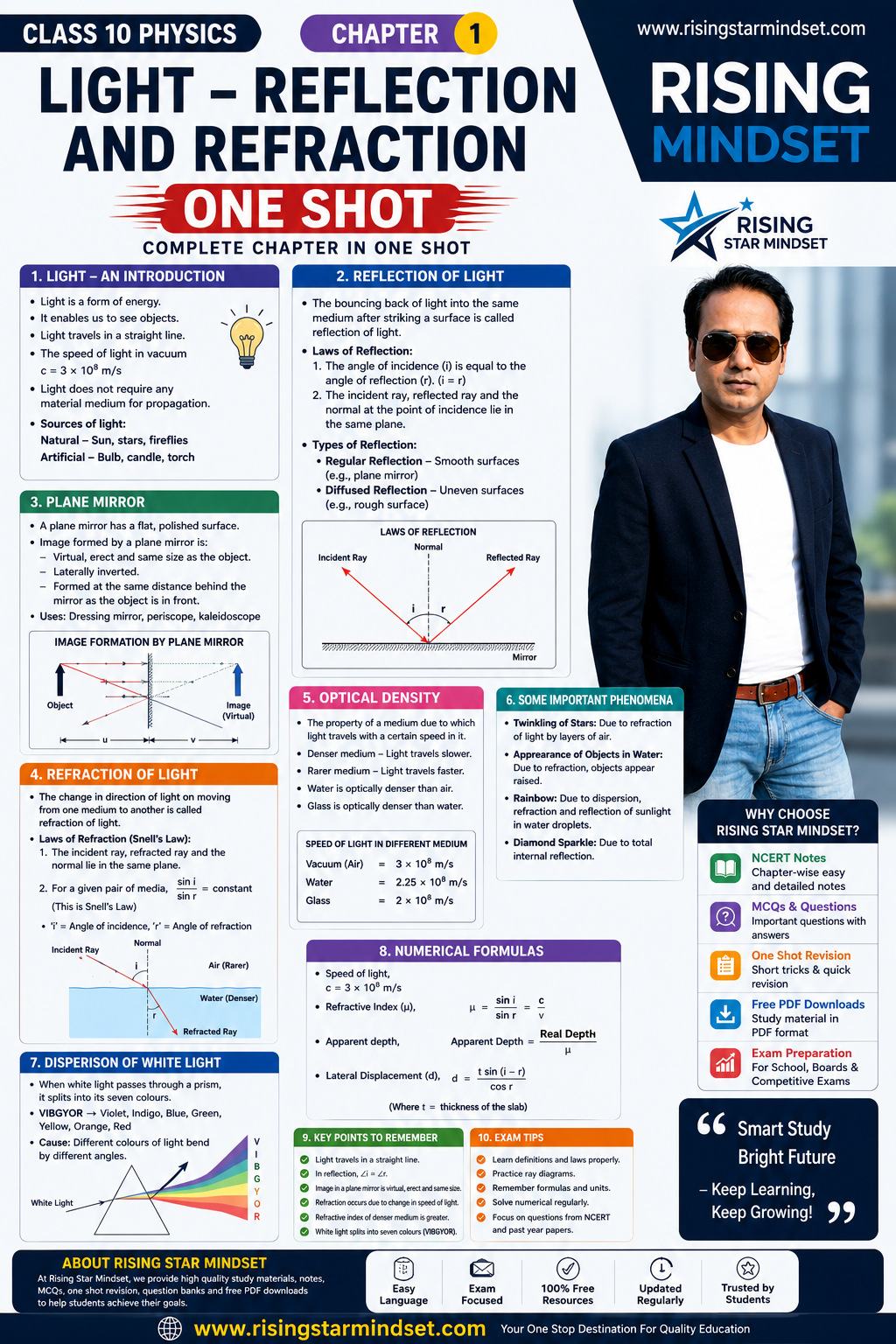
Light हमारे जीवन का एक महत्वपूर्ण भाग है। हम किसी वस्तु को तभी देख पाते हैं जब प्रकाश उस वस्तु से हमारी आंखों तक पहुंचता है। इसलिए, Class 10 Science Chapter “Light – Reflection and Refraction” में प्रकाश के परावर्तन (Reflection), अपवर्तन (Refraction), दर्पण, लेंस और मानव आंख के बारे में अध्ययन किया जाता है।
यह chapter बोर्ड परीक्षा के लिए बहुत महत्वपूर्ण है। इसलिए, इस पोस्ट में आसान भाषा में सभी महत्वपूर्ण definitions, formulas, diagrams explanation और questions answers दिए गए हैं। (Notes)
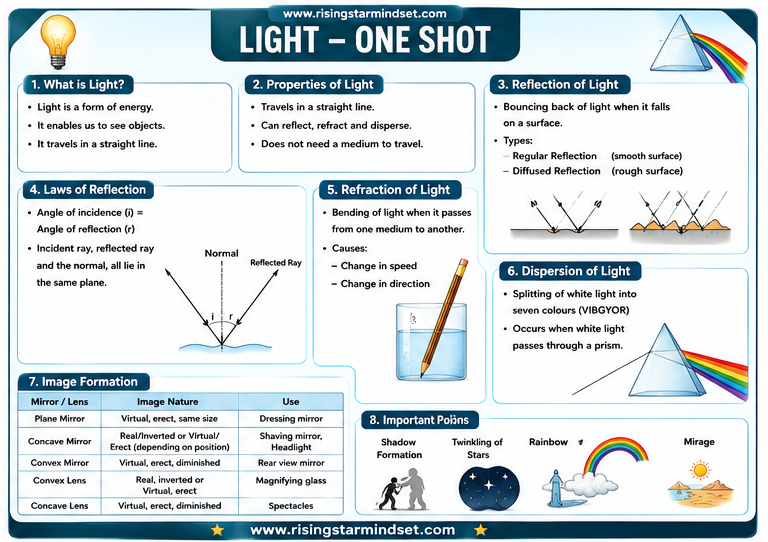
What is Light? | प्रकाश क्या है?
Light एक form of energy है जो हमें वस्तुओं को देखने में मदद करती है।
Properties of Light
- Light straight line में travel करती है।
- reflection और refraction दिखाती है।
- Light की speed बहुत अधिक होती है।
Reflection of Light | प्रकाश का परावर्तन (Notes)
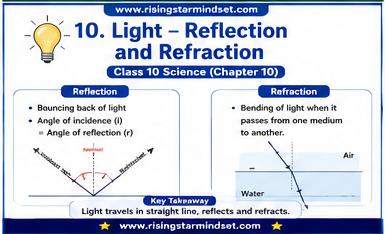
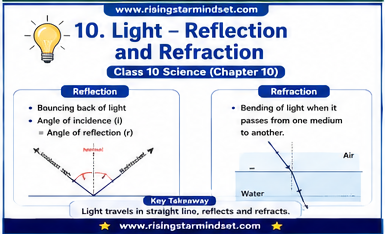
जब प्रकाश किसी सतह से टकराकर वापस लौटता है, तो उसे Reflection of Light कहते हैं।
Laws of Reflection
1. Angle of Incidence = Angle of Reflection

2. Incident ray, reflected ray और normal एक ही plane में होते हैं।
Types of Reflection ( Class 10 Notes )
| Type of Reflection | Definition | Surface Type | Image Formation | Example |
| Regular Reflection | When parallel rays of light fall on a smooth surface and reflect in one direction. | Smooth and polished surface | Clear and sharp image | Plane mirror, calm water |
| Irregular Reflection (Diffuse Reflection) | When parallel rays of light fall on a rough surface and scatter in different directions. | Rough or uneven surface | No clear image formed | Wall, paper, road |
| Basis | Regular Reflection | Irregular Reflection |
|---|---|---|
| Surface | Smooth | Rough |
| Reflection of Rays | In one direction | In many directions |
| Image Formation | Clear image formed | No clear image |
| Example | Mirror | Wall |
Important Points
- Reflection of light follows laws of reflection.
- In both types, the angle of incidence is equal to the angle of reflection.
- Smooth surfaces produce better reflection than rough surfaces.
Types of Mirrors – Class 10 Science (Notes)
| Type of Mirror | Definition | Shape | Image Formed | Uses | Example |
|---|---|---|---|---|---|
| Plane Mirror | A mirror with a flat reflecting surface. | Flat | Virtual, erect, and same size image | Dressing mirror, looking mirror | Bathroom mirror |
| Concave Mirror | A spherical mirror whose reflecting surface is curved inward. | Curved inward | Can form real or virtual image depending on object position | Torch, vehicle headlights, shaving mirror | Dentist mirror |
| Convex Mirror | A spherical mirror whose reflecting surface is curved outward. | Curved outward | Virtual, erect, and diminished image | Rear-view mirror in vehicles | Side mirror of car |
Difference Between Concave and Convex Mirror
| Basis | Concave Mirror | Convex Mirror |
|---|---|---|
| Shape | Curved inward | Curved outward |
| Nature | Converging mirror | Diverging mirror |
| Image Size | May be magnified or diminished | Always diminished |
| Field of View | Small | Large |
| Main Use | Headlights, shaving mirror | Rear-view mirrors |
Important Points of Class 10 Notes
- Plane mirror forms an image of the same size as the object.
- Concave mirrors can produce both real and virtual images.
- Convex mirrors always form virtual and smaller images.
- Convex mirrors are used in vehicles because they provide a wider field of view.
Important Terms of Mirrors
- Pole (P)
- Centre of Curvature (C)
- Radius of Curvature (R)
- Principal Focus (F)
Mirror Formula
The mirror formula connects focal length, image distance, and object distance.

Where:
- f = focal length
- v = image distance
- u = object distance
Magnification in Mirrors
Magnification tells us the size of the image compared to the object.

Refraction of Light प्रकाश का अपवर्तन
Refraction is the bending of light when it travels from one medium to another.
जब प्रकाश एक माध्यम से दूसरे माध्यम में जाता है और उसका मार्ग बदल जाता है, तो उसे Refraction कहते हैं।
For example, a pencil partially dipped in water appears bent because of refraction.
पानी में रखा पेंसिल टेढ़ा दिखाई देना।
Laws of Refraction (Notes : www.risingstarmindset.com)
- The incident ray, refracted ray, and normal lie in the same plane.
- The ratio of sine of angle of incidence to sine of angle of refraction is constant.
This law is also called Snell’s Law.

Refraction Through a Glass Slab
When light enters a glass slab:
Finally, the emergent ray becomes parallel to the incident ray.
It bends toward the normal.
After leaving the slab, it bends away from the normal.
Lenses
Lenses are transparent materials that refract light.
Types of Lenses (Notes)
| Lens Type | Shape | Nature |
|---|---|---|
| Convex Lens | Thicker at center | Converging |
| Concave Lens | Thinner at center | Diverging |
Lens Formula

Magnification for Lenses

Power of Lens
Power of a lens tells how strongly it converges or diverges light.

Unit of power = Dioptre (D)
Lenses | लेंस
Lenses दो प्रकार के होते हैं:
1. Convex Lens
बीच में मोटा और किनारों पर पतला।
Uses:
- Microscope
- Camera
- Human Eye
2. Concave Lens
बीच में पतला और किनारों पर मोटा।
Uses:
Spectacles for Myopia
Human Eye | मानव आंख
Human eye एक प्राकृतिक optical instrument है।
Functions:
- Light receive करना
- Image बनाना
Brain को signal भेजना
The human eye helps us see objects clearly. It consists of:
- Cornea
- Iris
- Retina
- Eye lens
- Optic nerve
Defects of Vision
| Defect | Cause | Correction |
|---|---|---|
| Myopia | Distant objects not visible clearly | Concave lens |
| Hypermetropia | Nearby objects not visible clearly | Convex lens |
| Presbyopia | Aging effect | Bifocal lens |
Conclusion
In conclusion, the chapter Light – Reflection and Refraction is very important for Class 10 CBSE students. Moreover, this chapter includes theory, diagrams, and numericals that are frequently asked in exams. Therefore, students should practice formulas and ray diagrams regularly for better understanding and higher marks.
FAQ
Q1. What is regular reflection?
Answer: Reflection from a smooth surface in which reflected rays remain parallel is called regular reflection.
Q2. What is irregular reflection?
Answer: Reflection from a rough surface in which reflected rays scatter in different directions is called irregular reflection.
Q3. Give one example of regular reflection.
Answer: Plane mirror.
Q4. Give one example of irregular reflection.
Answer: Reflection from a wall.
3 thoughts on “Light Reflection and Refraction Most Important One Shot”