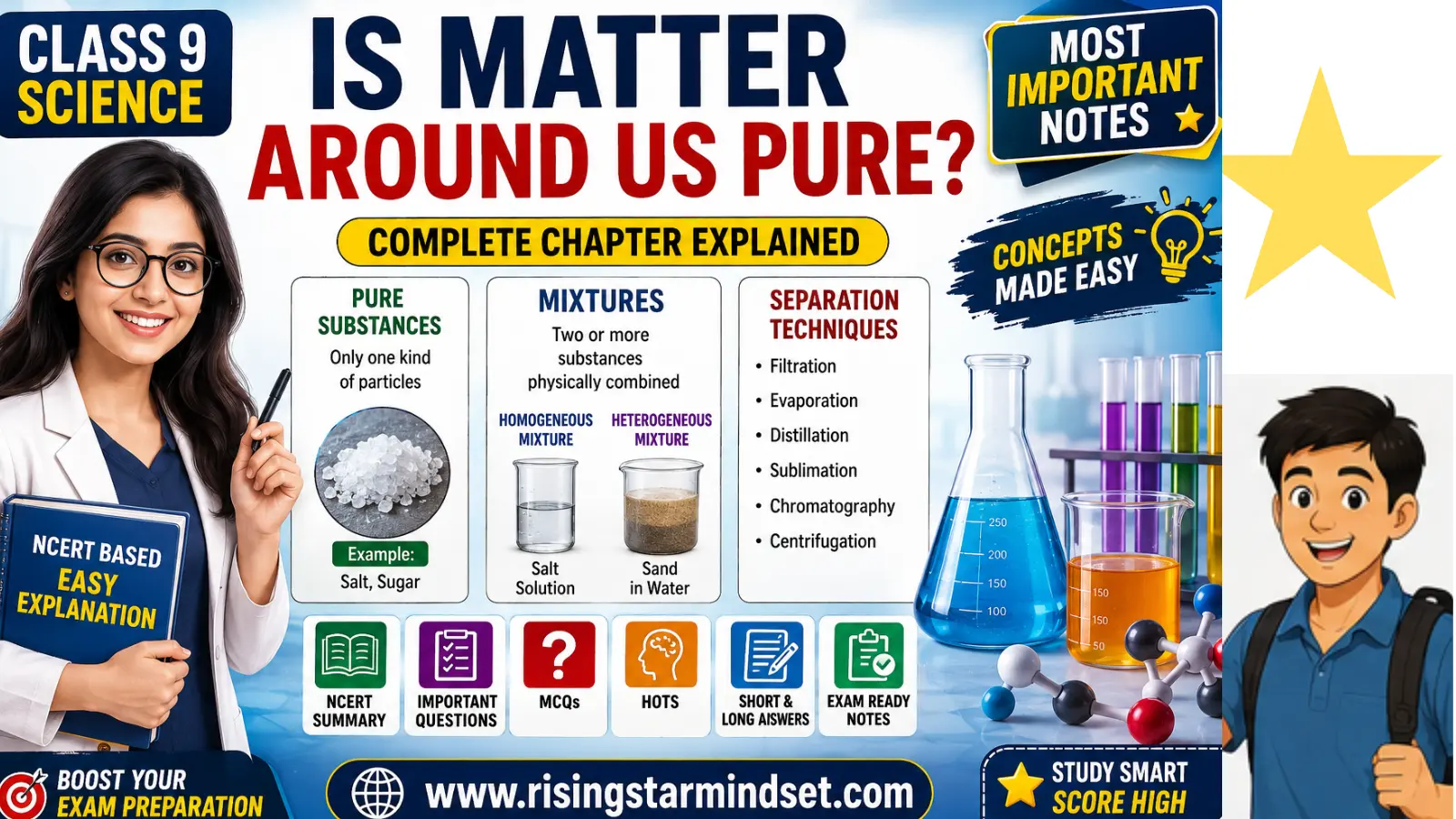
Introduction ( Is Matter Around Us Pure )
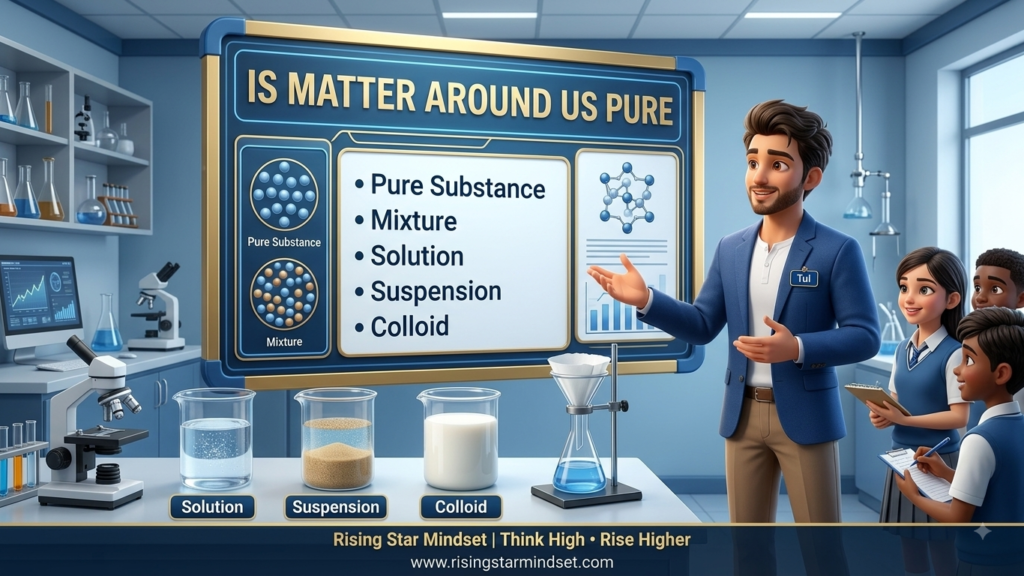
हम अपने आसपास कई प्रकार के पदार्थ देखते हैं। कुछ पदार्थ शुद्ध होते हैं जबकि कुछ मिश्रण (Mixtures) होते हैं। इसलिए, Class 9 Science Chapter 2 “Is Matter Around Us Pure” में हम शुद्ध पदार्थ, मिश्रण, विलयन, कोलॉइड और निलंबन के बारे में सीखते हैं। साथ ही, पदार्थों को अलग करने की विभिन्न विधियाँ भी समझते हैं। ( Is Matter Around Us Pure )
यह chapter परीक्षा की दृष्टि से बहुत महत्वपूर्ण है। इसलिए, इस पोस्ट में आसान भाषा में सभी महत्वपूर्ण topics, definitions और questions answers दिए गए हैं।
PREVIOUS TOPIC : Matter in Our Surroundings – Class 9 Science Chapter 1 Notes, (Hindi + English)
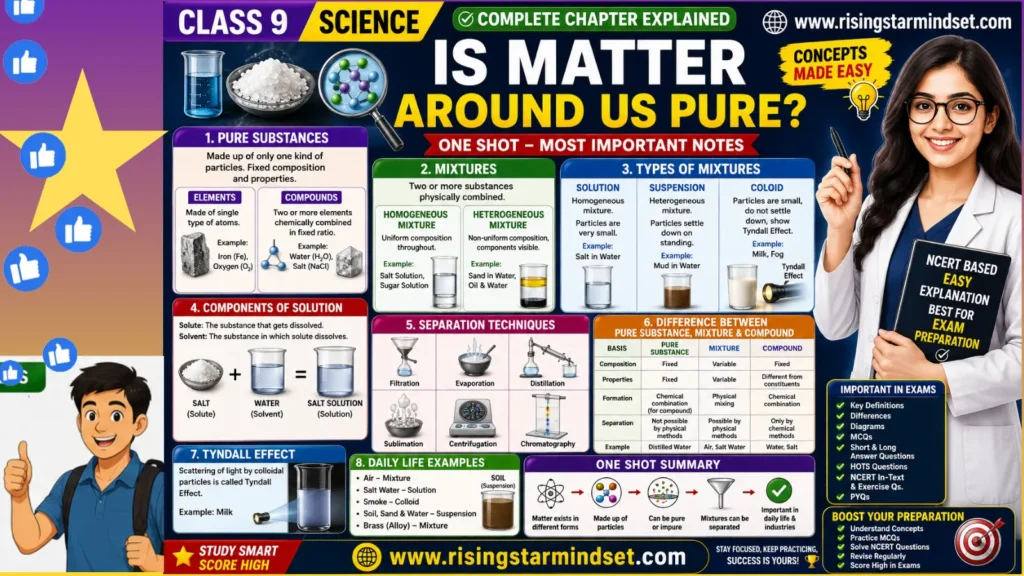
What is a Pure Substance? | शुद्ध पदार्थ क्या है?
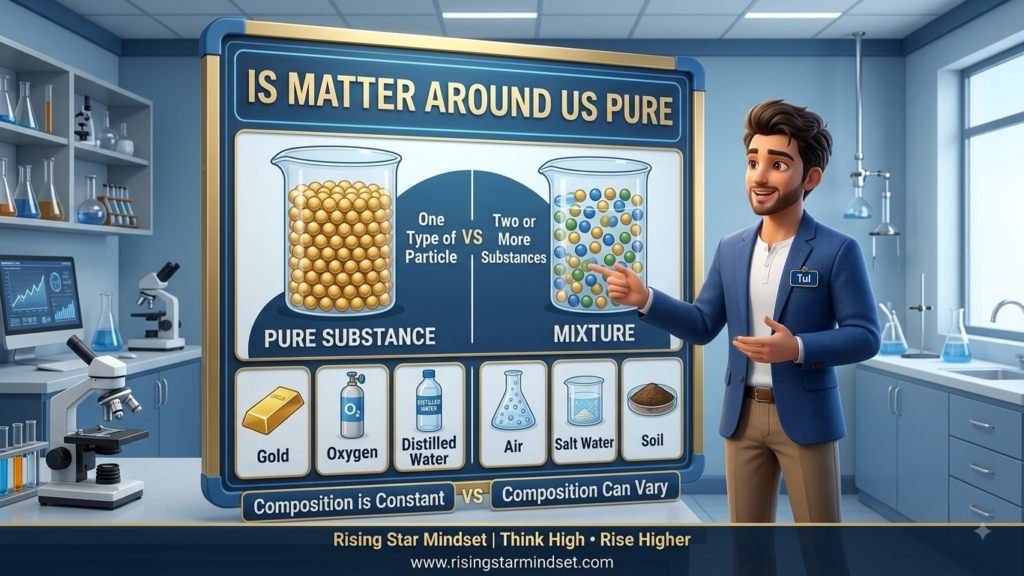
ऐसा पदार्थ जिसमें केवल एक ही प्रकार के कण मौजूद हों, उसे Pure Substance कहते हैं।
Examples:
- Gold
- Oxygen
- Distilled Water
शुद्ध पदार्थ के गुण हर जगह समान होते हैं। इसलिए, इन्हें आसानी से पहचाना जा सकता है।
What is a Mixture? | मिश्रण क्या है?
जब दो या दो से अधिक पदार्थ बिना किसी रासायनिक परिवर्तन के मिलते हैं, तब मिश्रण बनता है।
Examples:
- Air
- Salt Water
- Soil
मिश्रण के घटकों को भौतिक विधियों द्वारा अलग किया जा सकता है।
Types of Mixtures | मिश्रण के प्रकार (Class 9)
1. Homogeneous Mixture
जिस मिश्रण का संघटन हर जगह समान हो, उसे Homogeneous Mixture कहते हैं।
Examples:
- Sugar Solution
- Salt Solution
इनमें अलग-अलग घटक दिखाई नहीं देते।
2. Heterogeneous Mixture
जिस मिश्रण का संघटन हर जगह समान न हो, उसे Heterogeneous Mixture कहते हैं।
Examples:
- Sand and Water
- Oil and Water
इनमें घटक आसानी से दिखाई देते हैं।
Solution | विलयन
Solution एक homogeneous mixture होता है।
Components of Solution
Solute
जो पदार्थ कम मात्रा में घुलता है।
Solvent
जो पदार्थ अधिक मात्रा में होता है और solute को घोलता है।
Example:
Salt + Water
- Salt = Solute
- Water = Solvent
Properties of Solution
- यह homogeneous mixture होता है।
- इसके कण बहुत छोटे होते हैं।
- प्रकाश की किरण को scatter नहीं करता।
- स्थिर रहता है।
Suspension | निलंबन
Suspension एक heterogeneous mixture है जिसमें कण बड़े होते हैं।
Properties of Suspension
- कण दिखाई देते हैं।
- कुछ समय बाद नीचे बैठ जाते हैं।
- Filter paper से अलग किए जा सकते हैं।
- प्रकाश को scatter करते हैं।
Example:
Chalk Powder in Water
Colloid | कोलॉइड
Colloid ऐसा मिश्रण है जिसमें कण suspension से छोटे लेकिन solution से बड़े होते हैं।
Properties of Colloid
- कण दिखाई नहीं देते।
- नीचे नहीं बैठते।
- प्रकाश को scatter करते हैं।
Example:
Milk
Fog
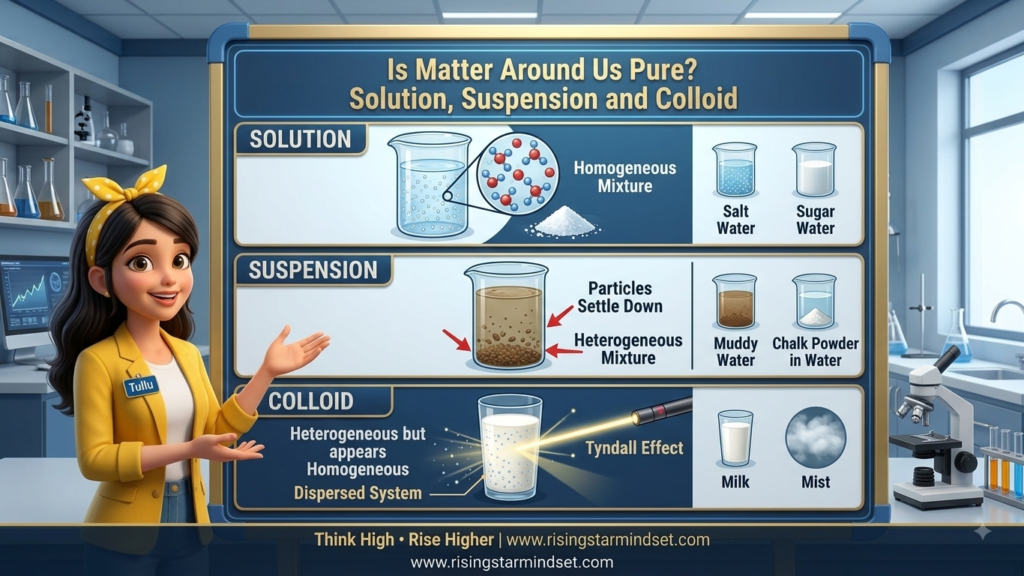
Tyndall Effect
जब प्रकाश की किरण colloid से गुजरती है और उसका path दिखाई देता है, तो उसे Tyndall Effect कहते हैं।
Examples:
- Fog
- Smoke
- Milk
Separation of Components | मिश्रण को अलग करने की विधियाँ
1. Evaporation
इस विधि में solvent को गर्म करके उड़ा दिया जाता है।
Example:
Salt from Sea Water
2. Centrifugation
इसमें मशीन को तेजी से घुमाकर भारी कणों को अलग किया जाता है।
Example:
Cream from Milk
3. Sublimation
कुछ पदार्थ सीधे solid से gas बन जाते हैं।
Example:
Camphor
4. Chromatography
इसका उपयोग रंगों को अलग करने में किया जाता है।
Example:
Ink Separation
5. Distillation
इस विधि से liquids को उनके boiling point के आधार पर अलग किया जाता है।
Difference Between Compound and Mixture
| Compound | Mixture |
|---|---|
| Chemical combination | Physical combination |
| Fixed composition | Variable composition |
| Properties change | Properties remain same |
| Cannot be separated physically | Can be separated physically |
Important Question Answers for Class 9
Q1. What is a pure substance?
A pure substance contains only one type of particles.
Q2. Define solution.
A solution is a homogeneous mixture of two or more substances.
Q3. What is Tyndall Effect?
The scattering of light by colloidal particles is called Tyndall Effect.
Q4. Give one example of colloid.
Milk is an example of colloid.
Q5. Name one method used to separate cream from milk.
Centrifugation is used to separate cream from milk.
MCQs for Practice
1. Which mixture shows Tyndall Effect?
- (A) Salt Solution
- (B) Sugar Solution
- (C) Milk
- (D) Copper Sulphate Solution
✅ Answer: Milk
2. Which method is used to separate salt from water?
- (A) Filtration
- (B) Evaporation
- (C) Sedimentation
- (D) Decantation
✅ Answer: Evaporation
3. Which is a homogeneous mixture?
- (A) Soil
- (B) Sand and Water
- (C) Salt Solution
- (D) Smoke
✅ Answer: Salt Solution
FAQs – Is Matter Around Us Pure? Class 9 Most Important Notes
1. What is a pure substance?
English: A pure substance is made up of only one kind of particle and has a fixed composition and properties.
हिंदी: शुद्ध पदार्थ (Pure Substance) केवल एक ही प्रकार के कणों से बना होता है तथा इसकी संरचना और गुण निश्चित होते हैं।
2. What is a mixture?
English: A mixture is formed when two or more substances are physically combined without any chemical reaction.
हिंदी: मिश्रण (Mixture) दो या दो से अधिक पदार्थों के भौतिक रूप से मिलने से बनता है, जिसमें कोई रासायनिक परिवर्तन नहीं होता।
3. What are the types of mixtures?
English: Mixtures are of two types:
- Homogeneous Mixture
- Heterogeneous Mixture
हिंदी: मिश्रण दो प्रकार के होते हैं:
- समांगी मिश्रण (Homogeneous Mixture)
- विषमांगी मिश्रण (Heterogeneous Mixture)
4. What is a homogeneous mixture?
English: A homogeneous mixture has a uniform composition throughout the mixture. Example: Salt solution.
हिंदी: समांगी मिश्रण में सभी घटक समान रूप से मिश्रित होते हैं। उदाहरण: नमक का घोल।
5. What is a heterogeneous mixture?
English: A heterogeneous mixture has a non-uniform composition, and its components can be seen separately. Example: Sand and water.
हिंदी: विषमांगी मिश्रण में घटक समान रूप से नहीं मिलते और उन्हें अलग-अलग देखा जा सकता है। उदाहरण: रेत और पानी।
6. What is a solution?
English: A solution is a homogeneous mixture of two or more substances.
हिंदी: विलयन (Solution) दो या दो से अधिक पदार्थों का समांगी मिश्रण होता है।
7. What are solute and solvent?
English:
- Solute: The substance that dissolves.
- Solvent: The substance in which the solute dissolves.
हिंदी:
- विलेय (Solute): जो पदार्थ घुलता है।
- विलायक (Solvent): जिसमें विलेय घुलता है।
8. What is a suspension?
English: A suspension is a heterogeneous mixture in which solid particles do not dissolve and settle down on standing.
हिंदी: निलंबन (Suspension) एक विषमांगी मिश्रण है जिसमें ठोस कण नहीं घुलते और कुछ समय बाद नीचे बैठ जाते हैं।
9. What is a colloid?
English: A colloid is a mixture in which particles are small enough to remain suspended and scatter light (Tyndall Effect).
हिंदी: कोलॉइड (Colloid) ऐसा मिश्रण है जिसमें कण बहुत छोटे होते हैं और वे प्रकाश का प्रकीर्णन (टिंडल प्रभाव) करते हैं।
10. What is the Tyndall Effect?
English: The scattering of light by colloidal particles is called the Tyndall Effect.
हिंदी: कोलॉइड के कणों द्वारा प्रकाश का प्रकीर्णन टिंडल प्रभाव कहलाता है।
11. What are the methods of separating mixtures?
English: Common methods include:
- Filtration
- Evaporation
- Distillation
- Centrifugation
- Sublimation
- Chromatography
हिंदी: मिश्रण को अलग करने की प्रमुख विधियाँ हैं:
- निस्पंदन (Filtration)
- वाष्पीकरण (Evaporation)
- आसवन (Distillation)
- अपकेंद्रण (Centrifugation)
- उर्ध्वपातन (Sublimation)
- वर्णलेखन (Chromatography)
12. What is distillation?
English: Distillation is used to separate liquids based on differences in their boiling points.
हिंदी: आसवन (Distillation) का उपयोग विभिन्न क्वथनांक वाले द्रवों को अलग करने के लिए किया जाता है।
13. What is chromatography?
English: Chromatography is used to separate colored substances or pigments in a mixture.
हिंदी: वर्णलेखन (Chromatography) का उपयोग रंगों या मिश्रण के विभिन्न घटकों को अलग करने के लिए किया जाता है।
14. What is the difference between compounds and mixtures?
English: Compounds are formed by chemical combination, while mixtures are formed by physical mixing.
हिंदी: यौगिक (Compound) रासायनिक अभिक्रिया से बनते हैं, जबकि मिश्रण (Mixture) भौतिक रूप से बनते हैं।
15. Which topics are most important for Class 9 exams from “Is Matter Around Us Pure?”
English: Pure substances, mixtures, solution, suspension, colloids, Tyndall Effect, separation techniques, compounds vs mixtures, and NCERT in-text & exercise questions are the most important exam topics.
हिंदी: शुद्ध पदार्थ, मिश्रण, विलयन, निलंबन, कोलॉइड, टिंडल प्रभाव, मिश्रण पृथक्करण की विधियाँ, यौगिक एवं मिश्रण का अंतर तथा NCERT के सभी प्रश्न परीक्षा की दृष्टि से सबसे महत्वपूर्ण विषय हैं।
Conclusion
Class 9 Science Chapter 2 “Is Matter Around Us Pure?” हमें पदार्थों की शुद्धता और मिश्रणों के बारे में महत्वपूर्ण जानकारी देता है। इसके अलावा, इस chapter में separation techniques भी समझाई गई हैं, जो दैनिक जीवन में उपयोगी हैं। इसलिए, परीक्षा की तैयारी के लिए इस chapter के concepts को अच्छी तरह समझना जरूरी है।
🌟 Keep Learning with Rising Star Mindset
📘 Spoken English Course
🏛️ BPSC Preparation
🎓 School Notes
💡 Daily Motivation
Keep Learning, Keep Growing! 🚀
P Kumar | Rising Star Mindset
www.risingstarmindset.com
Together We Will Make The Difference
2 thoughts on “Is Matter Around Us Pure? Class 9 Most Important Notes”