
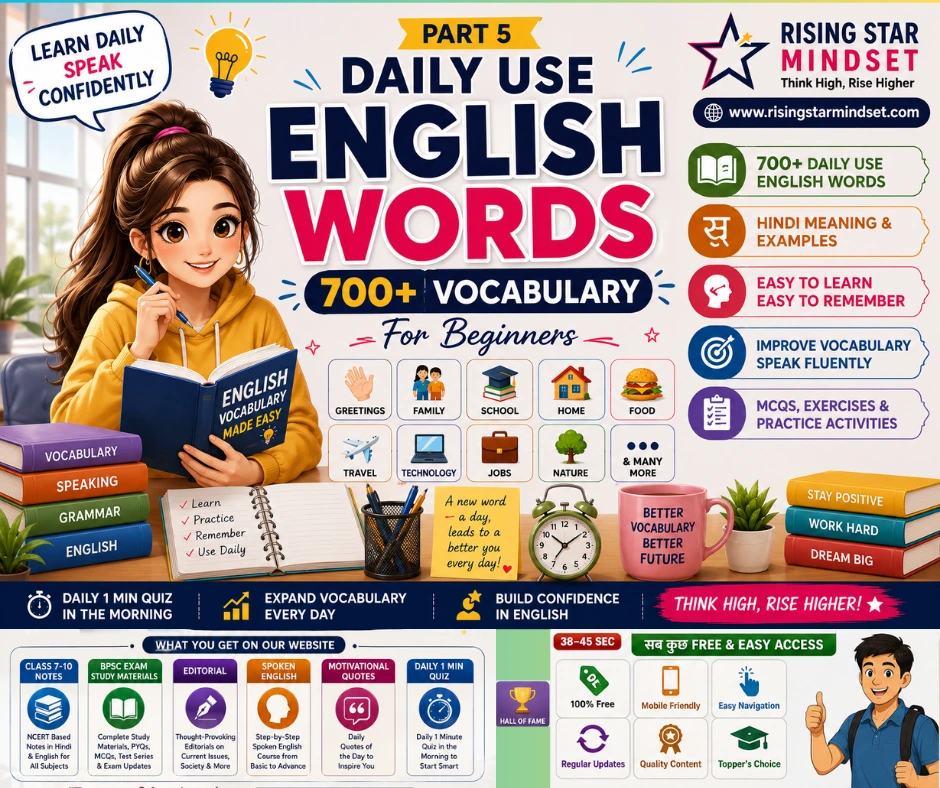
Daily Use English Words | 700+ Vocabulary for Beginners
Table of Contents
- Introduction
- What is Vocabulary?
- Why Daily Vocabulary Matters
- Types of Daily Use Words
- 700+ Daily Use English Words
- Greetings
- Family
- School
- Home
- Kitchen
- Food
- Clothes
- Colors
- Numbers
- Time
- Nature
- Body Parts
- Feelings
- Jobs
- Transport
- Technology
- Business
- Education
- Travel
- Common Verbs
- Daily Practice Tips
- Abbreviations
- Key Points
- MCQs
- HOTS Questions
- Fill in the Blanks
- Match the Following
- Daily Vocabulary Challenge
- Viewer Assignment
- FAQs
- Conclusion
- Previous post : English Vowels and Consonants Made Easy for Beginners
Introduction ( Daily Use English Words )
English
A strong vocabulary is the foundation of effective communication. If you know common English words, you can understand conversations, read books, write confidently, and speak English naturally. ( Daily Use English Words )
This lesson introduces more than 700 daily use English words with Hindi meanings and simple examples. Whether you are a beginner, school student, or preparing for interviews and competitive exams, this vocabulary list will help you improve step by step.
हिन्दी
अच्छी Vocabulary (शब्दावली) अंग्रेज़ी सीखने की सबसे मजबूत नींव होती है। यदि आपको रोज़मर्रा में उपयोग होने वाले शब्द याद हैं, तो आप आसानी से बोल सकते हैं, पढ़ सकते हैं, लिख सकते हैं और दूसरों की बात समझ सकते हैं।
इस पोस्ट में 700+ Daily Use English Words हिन्दी अर्थ और आसान उदाहरणों सहित दिए गए हैं।
Abbreviations ( Daily Use English Words )
| Short Form | Full Form |
| Eng. | English |
| Voc. | Vocabulary |
| Syn. | Synonym |
| Ant. | Antonym |
| Ex. | Example |
| Adj. | Adjective |
| Adv. | Adverb |
| N. | Noun |
| V. | Verb |
Why Daily Vocabulary is Important
- Builds confidence while speaking English.
- Improves listening and reading skills.
- Makes conversations smoother.
- Helps in interviews and public speaking.
- Supports school studies and competitive exams.
- Strengthens writing ability.
- Expands understanding of English books and articles.
- Reduces hesitation during communication.
- Enhances pronunciation through regular practice.
- Makes language learning faster and more enjoyable.
700+ Daily Use English Words (Part 1: Words 1–100)
| English | Hindi |
| Hello | नमस्ते |
| Hi | नमस्ते |
| Good | अच्छा |
| Bad | बुरा |
| Big | बड़ा |
| Small | छोटा |
| Long | लंबा |
| Short | छोटा |
| Happy | खुश |
| Sad | उदास |
| Smile | मुस्कान |
| Laugh | हँसना |
| Cry | रोना |
| Run | दौड़ना |
| Walk | चलना |
| Sit | बैठना |
| Stand | खड़ा होना |
| Eat | खाना |
| Drink | पीना |
| Sleep | सोना |
| Wake | जागना |
| Read | पढ़ना |
| Write | लिखना |
| Listen | सुनना |
| Speak | बोलना |
| Learn | सीखना |
| Teach | सिखाना |
| Think | सोचना |
| Know | जानना |
| Understand | समझना |
| Open | खोलना |
| Close | बंद करना |
| Start | शुरू करना |
| Finish | समाप्त करना |
| Win | जीतना |
| Lose | हारना |
| Buy | खरीदना |
| Sell | बेचना |
| Give | देना |
| Take | लेना |
| Come | आना |
| Go | जाना |
| Stay | रुकना |
| Wait | प्रतीक्षा करना |
| Help | मदद करना |
| Ask | पूछना |
| Answer | उत्तर देना |
| Love | प्रेम करना |
| Like | पसंद करना |
| Dislike | नापसंद करना |
| Friend | मित्र |
| Family | परिवार |
| Mother | माँ |
| Father | पिता |
| Brother | भाई |
| Sister | बहन |
| Teacher | शिक्षक |
| Student | विद्यार्थी |
| School | विद्यालय |
| College | महाविद्यालय |
| Book | किताब |
| Pen | पेन |
| Pencil | पेंसिल |
| Bag | बैग |
| Table | मेज |
| Chair | कुर्सी |
| Door | दरवाज़ा |
| Window | खिड़की |
| House | घर |
| Room | कमरा |
| Kitchen | रसोई |
| Water | पानी |
| Milk | दूध |
| Tea | चाय |
| Coffee | कॉफी |
| Rice | चावल |
| Bread | ब्रेड |
| Fruit | फल |
| Vegetable | सब्ज़ी |
| Apple | सेब |
| Banana | केला |
| Mango | आम |
| Orange | संतरा |
| Sun | सूर्य |
| Moon | चंद्रमा |
| Star | तारा |
| Sky | आकाश |
| Earth | पृथ्वी |
| River | नदी |
| Mountain | पर्वत |
| Tree | पेड़ |
| Flower | फूल |
| Bird | पक्षी |
| Animal | जानवर |
| Dog | कुत्ता |
| Cat | बिल्ली |
| Fish | मछली |
| Horse | घोड़ा |
| Cow | गाय |
| Market | बाज़ार |
| Office | कार्यालय |
700+ Daily Use English Words
Part B (Words 101–200) – Home & Family Vocabulary
| English | Hindi |
| Home | घर |
| House | मकान |
| Family | परिवार |
| Parent | माता-पिता |
| Son | बेटा |
| Daughter | बेटी |
| Uncle | चाचा/मामा |
| Aunt | चाची/मौसी |
| Grandfather | दादा/नाना |
| Grandmother | दादी/नानी |
| Baby | बच्चा |
| Child | बालक |
| Neighbor | पड़ोसी |
| Guest | मेहमान |
| Room | कमरा |
| Bedroom | शयनकक्ष |
| Bathroom | स्नानघर |
| Kitchen | रसोई |
| Balcony | बालकनी |
| Garden | बगीचा |
| Floor | फर्श |
| Roof | छत |
| Wall | दीवार |
| Window | खिड़की |
| Door | दरवाज़ा |
| Lock | ताला |
| Key | चाबी |
| Fan | पंखा |
| Light | रोशनी |
| Bulb | बल्ब |
| Bed | बिस्तर |
| Pillow | तकिया |
| Blanket | कंबल |
| Sheet | चादर |
| Chair | कुर्सी |
| Table | मेज |
| Sofa | सोफा |
| Television | टेलीविजन |
| Remote | रिमोट |
| Clock | घड़ी |
| Mirror | दर्पण |
| Bucket | बाल्टी |
| Mug | मग |
| Soap | साबुन |
| Towel | तौलिया |
| Toothbrush | टूथब्रश |
| Toothpaste | टूथपेस्ट |
| Comb | कंघी |
| Dress | पोशाक |
| Shirt | कमीज़ |
| T-shirt | टी-शर्ट |
| Pant | पैंट |
| Jeans | जीन्स |
| Shoe | जूता |
| Slipper | चप्पल |
| Sock | मोज़ा |
| Cap | टोपी |
| Belt | बेल्ट |
| Watch | घड़ी |
| Bag | बैग |
| Purse | पर्स |
| Mobile | मोबाइल |
| Charger | चार्जर |
| Bottle | बोतल |
| Glass | गिलास |
| Plate | प्लेट |
| Spoon | चम्मच |
| Fork | कांटा |
| Knife | चाकू |
| Bowl | कटोरी |
| Cup | कप |
| Tea | चाय |
| Coffee | कॉफी |
| Milk | दूध |
| Water | पानी |
| Sugar | चीनी |
| Salt | नमक |
| Rice | चावल |
| Wheat | गेहूँ |
| Bread | ब्रेड |
| Butter | मक्खन |
| Egg | अंडा |
| Chicken | मुर्गा/चिकन |
| Fish | मछली |
| Fruit | फल |
| Vegetable | सब्ज़ी |
| Potato | आलू |
| Tomato | टमाटर |
| Onion | प्याज |
| Garlic | लहसुन |
| Ginger | अदरक |
| Lemon | नींबू |
| Apple | सेब |
| Mango | आम |
| Banana | केला |
| Orange | संतरा |
| Grapes | अंगूर |
| Watermelon | तरबूज |
| Biscuit | बिस्कुट |
| Chocolate | चॉकलेट |
Vocabulary Learning Tips
1. Learn 10 New Words Daily
रोज़ केवल 10 नए शब्द सीखें और उनका उपयोग करें।
2. Make Your Own Sentences
हर शब्द से कम से कम एक वाक्य बनाइए।
3. Speak Aloud
शब्दों को ज़ोर से बोलने की आदत डालें।
4. Revise Every Week
सप्ताह में एक बार सभी शब्द दोहराएँ।
5. Use Flash Cards
Flash Cards से Vocabulary जल्दी याद होती है।
6. Watch English Videos
सुनने से नए शब्द स्वतः याद होने लगते हैं।
7. Read Daily
रोज़ 10–15 मिनट English Newspaper या Story पढ़ें।
8. Maintain a Vocabulary Notebook
नए शब्द और उनके अर्थ लिखते रहें।
Common Vocabulary Mistakes
| ❌ Do one mistake → | ✅ Make one mistake |
| Give an exam → | Take an exam |
| Open the TV → | Turn on the TV |
| Close the light → | Turn off the light |
| Return back → | Return |
| Discuss about → | Discuss |
| More better → | Better |
| Very unique → | Unique |
500+ Daily Use English Words
Part D (Words 301–400) – Travel, Technology & Office Vocabulary
| English | Hindi |
| Airport | हवाई अड्डा |
| Airplane | हवाई जहाज |
| Bus | बस |
| Train | ट्रेन |
| Taxi | टैक्सी |
| Car | कार |
| Motorcycle | मोटरसाइकिल |
| Bicycle | साइकिल |
| Ticket | टिकट |
| Platform | प्लेटफॉर्म |
| Passenger | यात्री |
| Driver | चालक |
| Road | सड़क |
| Bridge | पुल |
| Station | स्टेशन |
| Journey | यात्रा |
| Travel | यात्रा करना |
| Luggage | सामान |
| Hotel | होटल |
| Room | कमरा |
| Reception | स्वागत कक्ष |
| Passport | पासपोर्ट |
| Visa | वीज़ा |
| Map | नक्शा |
| Direction | दिशा |
| Camera | कैमरा |
| Mobile | मोबाइल |
| Laptop | लैपटॉप |
| Computer | कंप्यूटर |
| Keyboard | कीबोर्ड |
| Mouse | माउस |
| Screen | स्क्रीन |
| Internet | इंटरनेट |
| Website | वेबसाइट |
| Browser | ब्राउज़र |
| Search | खोज |
| Download | डाउनलोड |
| Upload | अपलोड |
| ईमेल | |
| Password | पासवर्ड |
| Login | लॉगिन |
| Logout | लॉगआउट |
| Printer | प्रिंटर |
| Scanner | स्कैनर |
| Office | कार्यालय |
| Employee | कर्मचारी |
| Manager | प्रबंधक |
| Meeting | बैठक |
| Project | परियोजना |
| Presentation | प्रस्तुति |
| Salary | वेतन |
| Company | कंपनी |
| Business | व्यवसाय |
| Customer | ग्राहक |
| Service | सेवा |
| Support | सहायता |
| Report | रिपोर्ट |
| Document | दस्तावेज़ |
| File | फ़ाइल |
| Folder | फ़ोल्डर |
| Network | नेटवर्क |
| Software | सॉफ्टवेयर |
| Hardware | हार्डवेयर |
| Update | अपडेट |
| Security | सुरक्षा |
| Cloud | क्लाउड |
| Data | डेटा |
| Information | जानकारी |
| Technology | प्रौद्योगिकी |
| Online | ऑनलाइन |
| Offline | ऑफलाइन |
| Digital | डिजिटल |
| Smart | स्मार्ट |
| Device | उपकरण |
| Charging | चार्ज करना |
| Battery | बैटरी |
| Headphone | हेडफोन |
| Microphone | माइक्रोफोन |
| Speaker | स्पीकर |
| Video | वीडियो |
| Audio | ऑडियो |
| Message | संदेश |
| Call | कॉल |
| Contact | संपर्क |
| Calendar | कैलेंडर |
| Reminder | अनुस्मारक |
| Schedule | समय-सारिणी |
| Appointment | नियुक्ति |
| Deadline | अंतिम तिथि |
| Success | सफलता |
| Goal | लक्ष्य |
| Achievement | उपलब्धि |
| Growth | विकास |
| Career | करियर |
| Promotion | पदोन्नति |
| Experience | अनुभव |
| Interview | साक्षात्कार |
| Resume | बायोडाटा |
| Skill | कौशल |
Part E (Words 401–500+) – Business, Banking & Daily Conversation Vocabulary
| English | Hindi |
| Bank | बैंक |
| Account | खाता |
| Balance | शेष राशि |
| Money | पैसा |
| Cash | नकद |
| Coin | सिक्का |
| Note | नोट |
| Payment | भुगतान |
| Bill | बिल |
| Receipt | रसीद |
| Loan | ऋण |
| Interest | ब्याज |
| Deposit | जमा |
| Withdraw | निकालना |
| Credit | जमा राशि |
| Debit | निकासी |
| Investment | निवेश |
| Profit | लाभ |
| Loss | हानि |
| Market | बाज़ार |
| Shop | दुकान |
| Seller | विक्रेता |
| Buyer | खरीदार |
| Price | मूल्य |
| Cheap | सस्ता |
| Expensive | महँगा |
| Offer | प्रस्ताव |
| Discount | छूट |
| Quality | गुणवत्ता |
| Product | उत्पाद |
| Brand | ब्रांड |
| Order | आदेश |
| Delivery | वितरण |
| Package | पैकेज |
| Courier | कुरियर |
| Return | वापस करना |
| Exchange | बदलना |
| Complaint | शिकायत |
| Solution | समाधान |
| Problem | समस्या |
| Idea | विचार |
| Opinion | राय |
| Advice | सलाह |
| Decision | निर्णय |
| Choice | चुनाव |
| Chance | अवसर |
| Future | भविष्य |
| Present | वर्तमान |
| Past | अतीत |
| Today | आज |
| Tomorrow | कल |
| Yesterday | बीता हुआ कल |
| Morning | सुबह |
| Afternoon | दोपहर |
| Evening | शाम |
| Night | रात |
| Always | हमेशा |
| Usually | सामान्यतः |
| Sometimes | कभी-कभी |
| Never | कभी नहीं |
| Often | अक्सर |
| Quickly | जल्दी |
| Slowly | धीरे-धीरे |
| Carefully | सावधानी से |
| Easily | आसानी से |
| Difficult | कठिन |
| Simple | सरल |
| Strong | मजबूत |
| Weak | कमजोर |
| Clean | साफ |
| Dirty | गंदा |
| Beautiful | सुंदर |
| Handsome | आकर्षक |
| Friendly | मिलनसार |
| Honest | ईमानदार |
| Polite | विनम्र |
| Brave | बहादुर |
| Happy | खुश |
| Angry | गुस्सा |
| Excited | उत्साहित |
| Tired | थका हुआ |
| Busy | व्यस्त |
| Free | खाली |
| Welcome | स्वागत है |
| Congratulations | बधाई |
| Thank You | धन्यवाद |
| Sorry | माफ़ कीजिए |
| Excuse Me | क्षमा कीजिए |
| Please | कृपया |
| You’re Welcome | आपका स्वागत है |
| See You Soon | फिर मिलेंगे |
| Have a Nice Day | आपका दिन शुभ हो |
Part E (Words 500+) – Business, Banking & Daily Conversation Vocabulary
| English Word | Hindi Meaning |
| Accept | स्वीकार करना |
| Reject | अस्वीकार करना |
| Allow | अनुमति देना |
| Refuse | मना करना |
| Invite | निमंत्रण देना |
| Attend | उपस्थित होना |
| Avoid | बचना |
| Escape | भाग निकलना |
| Protect | सुरक्षा करना |
| Attack | आक्रमण करना |
| Fight | लड़ना |
| Win | जीतना |
| Lose | हारना |
| Achieve | प्राप्त करना |
Part E(A) (Words 500+) – Business, Banking & Daily Conversation Vocabulary
| Improve | सुधारना | |
| Develop | विकसित करना | |
| Create | बनाना | |
| Destroy | नष्ट करना | |
| Repair | मरम्मत करना | |
| Build | निर्माण करना | |
| Break | तोड़ना | |
| Collect | इकट्ठा करना | |
| Divide | विभाजित करना | |
| Share | साझा करना | |
| Choose | चुनना | |
| Compare | तुलना करना | |
| Check | जांच करना | |
| Measure | मापना | |
| Count | गिनना | |
| Guess | अनुमान लगाना | |
| Promise | वादा करना | |
| Trust | विश्वास करना | |
| Doubt | संदेह करना | |
| Respect | सम्मान करना | |
| Support | समर्थन करना | |
| Lead | नेतृत्व करना | |
| Follow | अनुसरण करना | |
| Manage | प्रबंधन करना | |
| Control | नियंत्रण करना |
Part E(C) (Words 500 +) – Business, Banking & Daily Conversation Vocabulary
| Organize | व्यवस्थित करना |
| Celebrate | जश्न मनाना |
| Enjoy | आनंद लेना |
| Relax | आराम करना |
| Smile | मुस्कुराना |
| Laugh | हँसना |
| Cry | रोना |
| Hope | आशा करना |
| Wish | इच्छा करना |
| Pray | प्रार्थना करना |
| Believe | विश्वास करना |
| Travel | यात्रा करना |
| Journey | सफर |
| Tour | भ्रमण |
| Visit | मुलाकात करना |
| Return | वापस आना |
| Arrive | पहुँचना |
| Leave | छोड़ना |
| Enter | प्रवेश करना |
| Exit | बाहर निकलना |
| Cross | पार करना |
| Road | सड़क |
| Street | गली |
| Bridge | पुल |
| Station | स्टेशन |
| Airport | हवाई अड्डा |
| Ticket | टिकट |
| Passport | पासपोर्ट |
| Luggage | सामान |
| Hotel | होटल |
| Restaurant | रेस्तरां |
| Breakfast | नाश्ता |
| Lunch | दोपहर का भोजन |
| Dinner | रात्रि भोजन |
| Fruit | फल |
| Vegetable | सब्ज़ी |
| Rice | चावल |
| Bread | रोटी |
| Sugar | चीनी |
| Salt | नमक |
| Butter | मक्खन |
| कार्यालय | |
| Company | कंपनी |
| Employee | कर्मचारी |
| Employer | नियोक्ता |
| Salary | वेतन |
| Income | आय |
| Expense | खर्च |
| Profit | लाभ |
| Loss | हानि |
| Budget | बजट |
| Bank | बैंक |
| Account | खाता |
| Money | पैसा |
| Cash | नकद |
| Cheque | चेक |
| Online | ऑनलाइन |
| Offline | ऑफलाइन |
| Digital | डिजिटल |
| Password | पासवर्ड |
| Username | यूज़रनेम |
| Website | वेबसाइट |
| Browser | ब्राउज़र |
| Download | डाउनलोड करना |
| Upload | अपलोड करना |
| Search | खोजना |
Part E(D) (Words 500 +) – Business, Banking & Daily Conversation Vocabulary
| Click | क्लिक करना |
| Keyboard | कीबोर्ड |
| Mouse | माउस |
| Printer | प्रिंटर |
| Screen | स्क्रीन |
| Battery | बैटरी |
| Charger | चार्जर |
| Electricity | बिजली |
| Internet | इंटरनेट |
| Network | नेटवर्क |
| Signal | सिग्नल |
| Message | संदेश |
| Notification | सूचना |
| Update | अपडेट |
| Settings | सेटिंग्स |
| Doctor | डॉक्टर |
| Nurse | नर्स |
| Patient | मरीज |
| Medicine | दवा |
| Hospital | अस्पताल |
| Health | स्वास्थ्य |
| Exercise | व्यायाम |
| Fitness | फिटनेस |
| Energy | ऊर्जा |
| Strength | ताकत |
| Weakness | कमज़ोरी |
| Success | सफलता |
| Failure | असफलता |
| Experience | अनुभव |
| Knowledge | ज्ञान |
| Wisdom | बुद्धिमत्ता |
| Education | शिक्षा |
| Training | प्रशिक्षण |
| Skill | कौशल |
| Talent | प्रतिभा |
| Confidence | आत्मविश्वास |
| Communication | संचार |
| Conversation | बातचीत |
| Discussion | चर्चा |
| Presentation | प्रस्तुति |
| Interview | साक्षात्कार |
| Meeting | बैठक |
| Project | परियोजना |
| Report | रिपोर्ट |
| Assignment | असाइनमेंट |
| Future | भविष्य |
| Present | वर्तमान |
| Past | भूतकाल |
| Today | आज |
| Tomorrow | कल |
| Yesterday | बीता हुआ कल |
| Always | हमेशा |
| Never | कभी नहीं |
| Sometimes | कभी–कभी |
| Usually | आमतौर पर |
| Early | जल्दी |
| Late | देर से |
| Soon | शीघ्र |
| Immediately | तुरंत |
| Finally | अंततः |
| Already | पहले से |
| Again | फिर से |
| Together | साथ में |
| Alone | अकेले |
| Everyone | सभी |
| Someone | कोई |
Part E(E) (Till 700 Words ) – Business, Banking & Daily Conversation Vocabulary
| Anyone | कोई भी | |
| Nobody | कोई नहीं | |
| Everything | सब कुछ | |
| Nothing | कुछ भी नहीं | |
| Anywhere | कहीं भी | |
| Somewhere | कहीं | |
| Everywhere | हर जगह | |
| Inside | अंदर | |
| Outside | बाहर | |
| Above | ऊपर | |
| Below | नीचे | |
| Between | बीच में | |
| Around | चारों ओर | |
| Forward | आगे | |
| Backward | पीछे | |
| Right | दायाँ / सही | |
| Left | बायाँ | |
| Near | पास | |
| Far | दूर | |
| Beginning | शुरुआत | |
| Middle | मध्य | |
| End | अंत | |
| Reason | कारण | |
| Result | परिणाम | |
| Example | उदाहरण | |
| Practice | अभ्यास | |
| Revision | पुनरावृत्ति | |
| Progress | प्रगति | |
| Achievement | उपलब्धि |
Multiple Choice Questions (MCQs)
Q1. What is the meaning of “Journey”?
A) भोजन
B) यात्रा ✅
C) पढ़ाई
D) व्यापार
Q2. Which word means “विद्यालय”?
A) Office
B) School ✅
C) Garden
D) Station
Q3. What is the English word for “पानी”?
A) Milk
B) Tea
C) Water ✅
D) Juice
Q4. Which word means “किताब”?
A) Pen
B) Book ✅
C) Bag
D) Chair
Q5. What is the meaning of “Teacher”?
A) छात्र
B) शिक्षक ✅
C) मित्र
D) अधिकारी
Q6. Which word means “सफलता”?
A) Failure
B) Success ✅
C) Result
D) Target
Q7. Which word means “लक्ष्य”?
A) Goal ✅
B) Hope
C) Dream
D) Chance
Q8. Which is a greeting?
A) Sorry
B) Hello ✅
C) Pen
D) Office
Q9. “Laptop” is a ______.
A) Animal
B) Device ✅
C) Fruit
D) Place
Q10. “Beautiful” means ______.
A) बड़ा
B) सुंदर ✅
C) तेज
D) शांत
Q11. Which word means “मदद करना”?
A) Help ✅
B) Work
C) Study
D) Learn
Q12. Which word means “पढ़ना”?
A) Write
B) Read ✅
C) Listen
D) Speak
Q13. What is the English word for “दोस्त”?
A) Family
B) Friend ✅
C) Parent
D) Teacher
Q14. Which word means “समस्या”?
A) Answer
B) Problem ✅
C) Result
D) Decision
Q15. Which word means “निर्णय”?
A) Advice
B) Choice
C) Decision ✅
D) Plan
Q16. Which word means “ईमानदार”?
A) Honest ✅
B) Brave
C) Clever
D) Friendly
Q17. Which word means “मोबाइल”?
A) Laptop
B) Phone
C) Mobile ✅
D) Tablet
Q18. Which word means “ज्ञान”?
A) Skill
B) Knowledge ✅
C) Wisdom
D) Talent
Q19. Which word means “भविष्य”?
A) Present
B) Future ✅
C) Past
D) Today
Q20. Which word means “धन्यवाद”?
A) Sorry
B) Please
C) Thank You ✅
D) Welcome
Q21. Which word means “सुबह”?
A) Morning ✅
B) Evening
C) Night
D) Noon
Q22. Which word means “रात”?
A) Afternoon
B) Night ✅
C) Evening
D) Morning
Q23. Which word means “कंप्यूटर”?
A) Laptop
B) Computer ✅
C) Printer
D) Keyboard
Q24. Which word means “व्यवसाय”?
A) Market
B) Business ✅
C) Office
D) Service
Q25. Which word means “कर्मचारी”?
A) Manager
B) Employee ✅
C) Teacher
D) Driver
Q26. Which word means “साक्षात्कार”?
A) Meeting
B) Interview ✅
C) Report
D) Project
Q27. Which word means “कौशल”?
A) Talent
B) Skill ✅
C) Ability
D) Power
Q28. Which word means “मौका”?
A) Future
B) Chance ✅
C) Goal
D) Success
Q29. Which word means “स्वागत है”?
A) Welcome ✅
B) Goodbye
C) Sorry
D) Thanks
Q30. Which is the correct way to improve vocabulary?
A) Learn one word a month
B) Learn 10 words daily ✅
C) Never revise
D) Avoid speaking
HOTS Questions
- Why is vocabulary important in spoken English?
- How does daily practice improve vocabulary?
- Explain why learning words in context is better than memorizing lists.
- How can vocabulary improve interview performance?
- Why should students maintain a vocabulary notebook?
- How does reading improve vocabulary naturally?
- How can technology help in vocabulary learning?
- Why should new words be used in daily conversations?
- What happens if we know grammar but have limited vocabulary?
- Suggest five effective methods to remember new English words.
Fill in the Blanks
- Hello means ______. (नमस्ते)
- Teacher means ______. (शिक्षक)
- Book means ______. (किताब)
- Water means ______. (पानी)
- School means ______. (विद्यालय)
- Success means ______. (सफलता)
- Goal means ______. (लक्ष्य)
- Knowledge means ______. (ज्ञान)
- Business means ______. (व्यवसाय)
- Future means ______. (भविष्य)
- Morning means ______. (सुबह)
- Evening means ______. (शाम)
- Interview means ______. (साक्षात्कार)
- Skill means ______. (कौशल)
- Welcome means ______. (स्वागत है)
Match the Following
| English | Hindi |
| Teacher | शिक्षक |
| Student | विद्यार्थी |
| School | विद्यालय |
| Knowledge | ज्ञान |
| Success | सफलता |
| Goal | लक्ष्य |
| Friend | मित्र |
| Interview | साक्षात्कार |
| Business | व्यवसाय |
| Market | बाज़ार |
| Morning | सुबह |
| Evening | शाम |
| Beautiful | सुंदर |
| Honest | ईमानदार |
| Thank You | धन्यवाद |
Daily Vocabulary Challenge
Today’s Challenge
📖 Learn these 10 words:
- Opportunity
- Confidence
- Improve
- Knowledge
- Success
- Practice
- Achievement
- Decision
- Communication
- Education
Speaking Task
Make one English sentence using each word.
Example:
- I have a great opportunity to learn English.
- Practice makes me more confident.
🎯 Try to use all 10 words in your conversations today.
Viewer Assignment
Task 1
Learn 20 new words today.
Task 2
Write their Hindi meanings.
Task 3
Create one sentence for each word.
Task 4
Speak those sentences aloud.
Task 5
Revise the same words after 24 hours.
Task 6
Share your favourite five words in the comments.
Frequently Asked Questions (FAQs)
Q1. What is vocabulary?
Vocabulary is the collection of words we know and use.
Q2. How many words should I learn daily?
Start with 10–15 words every day.
Q3. Should I learn meanings only?
No. Learn pronunciation and sentence usage too.
Q4. How can I remember new words?
Revise regularly and use them in conversations.
Q5. Is vocabulary important for spoken English?
Yes, it helps you speak confidently.
Q6. Can children use this guide?
Yes, it is suitable for learners of all ages.
Q7. How long does it take to improve vocabulary?
With daily practice, noticeable improvement can be seen in a few months.
Q8. Should I keep a vocabulary notebook?
Yes, it helps with revision.
Q9. Are these words useful for interviews?
Yes, many are commonly used in interviews and workplaces.
Q10. Can vocabulary improve writing?
Yes, it makes writing clearer and more expressive.
Q11. What is the best time to learn new words?
Morning or during your regular study session.
Q12. Should I revise old words?
Yes, revision is essential for long-term memory.
Q13. How can I improve pronunciation?
Listen to native speakers and read aloud daily.
Q14. Is reading helpful?
Yes, books and articles naturally expand vocabulary.
Q15. Can I learn English without vocabulary?
No. Vocabulary is one of the foundations of communication.
Q16. Which apps help in vocabulary learning?
Dictionary and flashcard apps are useful.
Q17. How many words should beginners know?
A few hundred common words provide a strong start.
Q18. Is speaking necessary while learning vocabulary?
Yes, speaking reinforces memory.
Q19. What comes after vocabulary?
Learn sentence structure and grammar.
Q20. Where can I continue this course?
Follow the next parts of the Spoken English Series on www.risingstarmindset.com.
Conclusion
🇬🇧 English
Vocabulary is the key to confident English communication. The more useful words you learn and actively use, the easier it becomes to understand, speak, read, and write English. Instead of memorizing hundreds of words at once, focus on learning a small number every day, revise them regularly, and use them in real conversations. Consistent practice will gradually improve your fluency and confidence.
🇮🇳 हिन्दी
Vocabulary अंग्रेज़ी सीखने की सबसे महत्वपूर्ण नींव में से एक है। जितने अधिक उपयोगी शब्द आप सीखेंगे और उनका नियमित अभ्यास करेंगे, उतनी ही आसानी से आप अंग्रेज़ी बोल, पढ़, लिख और समझ पाएँगे। एक साथ बहुत सारे शब्द याद करने के बजाय, रोज़ थोड़े-थोड़े नए शब्द सीखें, उनका पुनरावृत्ति करें और दैनिक बातचीत में उनका प्रयोग करें। यही निरंतर अभ्यास आपको एक आत्मविश्वासी English Speaker बनने में मदद करेगा।
🎤 Record Yourself Challenge
Record your voice while speaking today’s five sentences. Listen to your recording, identify one pronunciation mistake, and repeat the sentences again with improved confidence.
Keep Learning, Keep Growing! 🚀
P Kumar | Rising Star Mindset
www.risingstarmindset.com
Together We Will Make The Difference