

Introduction (Class 9 Motion Notes)
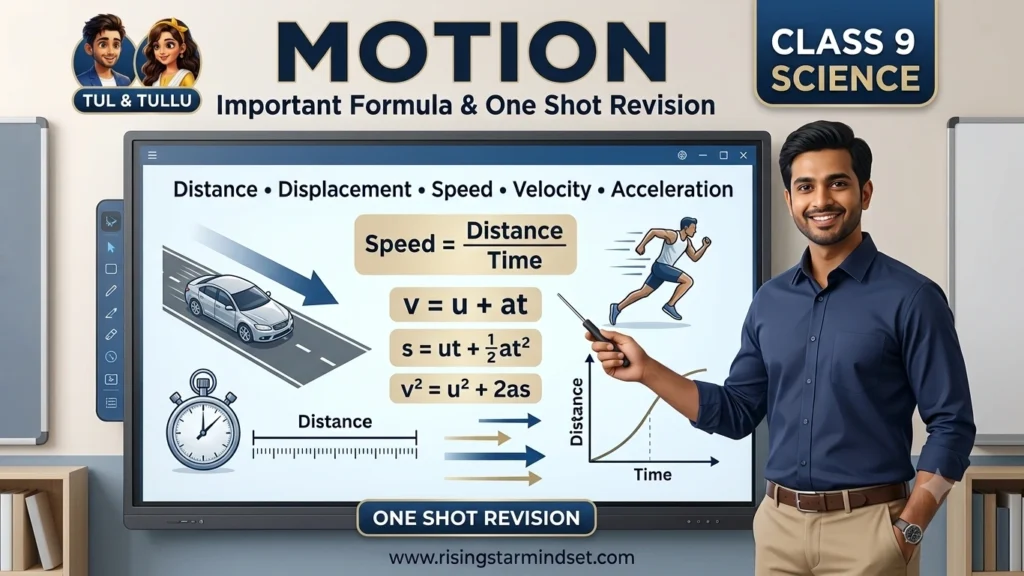
Before studying Motion, students should understand the basic concept of Physical Quantities and Measurement because motion is measured using distance, displacement, speed, velocity, and time. ( Class 9 Motion Notes )
इस अध्याय को पढ़ने से पहले छात्रों को मापन (Measurement) और भौतिक राशियों (Physical Quantities) की जानकारी होनी चाहिए क्योंकि गति को दूरी, समय, वेग आदि के माध्यम से मापा जाता है। ( click here : class 9 NOTES )
Motion is one of the most important chapters in Physics because it forms the foundation for advanced topics like Force and Laws of Motion, Gravitation, Work-Energy, and Mechanics.
Table of Contents
- What is Motion?
- Rest and Motion
- Distance and Displacement
- Scalar and Vector Quantity
- Speed
- Velocity
- Acceleration
- Equations of Motion
- Graphical Representation of Motion
- Uniform Circular Motion
- Important Formula
- Key Facts
- Abbreviations
- One Shot Revision
- Important Numerical Concepts
- Conclusion
- Related Post : Healthy Body, Calm Mind, Better Life
1. What is Motion?
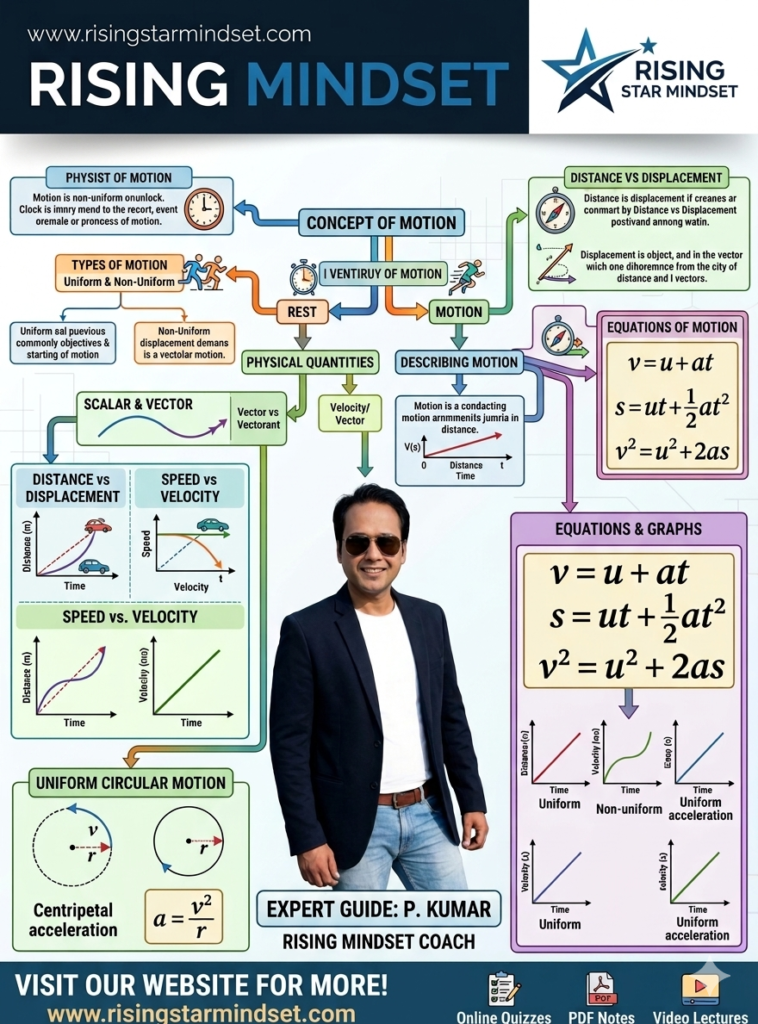
A body is said to be in motion if its position changes with time relative to its surroundings.
यदि किसी वस्तु की स्थिति समय के साथ बदलती है, तो वह वस्तु गति में कहलाती है।
Examples
- Moving car
- Running student
- Flying bird
- Rotating fan
2. Rest and Motion ( Class 9 Motion Notes )
Rest
If an object does not change its position with time, it is said to be at rest.
यदि वस्तु अपनी स्थिति नहीं बदलती है, तो वह विराम अवस्था में होती है।
Motion
If an object changes its position with time, it is in motion.
यदि वस्तु समय के साथ अपनी स्थिति बदलती है, तो वह गति में होती है।
3. Distance and Displacement ( Class 9 Motion Notes )
Distance
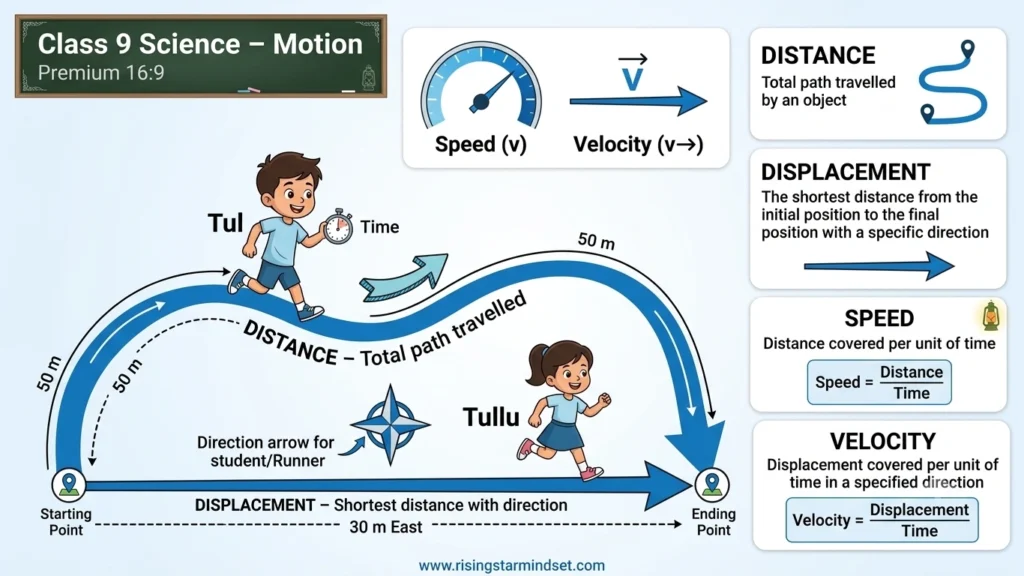
Total path covered by an object.
वस्तु द्वारा तय किया गया कुल मार्ग दूरी कहलाता है।
Features
- Scalar quantity
- Never negative
- SI Unit = meter (m)
Displacement
Shortest distance between initial and final position.
प्रारंभिक और अंतिम स्थिति के बीच की न्यूनतम दूरी विस्थापन कहलाती है।
Features
- Vector quantity
- Can be zero
- Has direction
Difference Between Distance and Displacement
| Distance | Displacement |
|---|---|
| Total path | Shortest path |
| Scalar | Vector |
| Always positive | Can be zero |
| No direction | Has direction |
4. Scalar and Vector Quantity ( Class 9 Motion Notes )
Scalar Quantity
Only magnitude.
Example:
- Distance
- Speed
- Time
Vector Quantity
Magnitude + Direction.
Example:
- Velocity
- Displacement
- Acceleration
5. Speed ( Class 9 Motion Notes )
Distance travelled per unit time is called speed.
इकाई समय में तय की गई दूरी को चाल कहते हैं।
Formula
Speed = Distance / Time
SI Unit
m/s
Types of Speed
- Uniform Speed
- Non-uniform Speed
- mean speed
Average Speed Formula ( Class 9 Motion Notes )
Average Speed = Total Distance / Total Time
6. Velocity
Displacement per unit time is called velocity.
इकाई समय में विस्थापन को वेग कहते हैं।
Formula
Velocity = Displacement / Time
Important Point
Velocity has direction.
7. Acceleration
Rate of change of velocity is called acceleration.
वेग परिवर्तन की दर को त्वरण कहते हैं।
Formula
a = (v – u) / t
Where:
- u = initial velocity
- v = final velocity
- t = time
Types of Acceleration ( Class 9 Motion Notes )
Positive Acceleration
Velocity increases.
Negative Acceleration (Retardation)
Velocity decreases.
8. Equations of Motion
These equations are very important for numericals and board exams.
ये समीकरण बोर्ड परीक्षा और न्यूमेरिकल के लिए अत्यंत महत्वपूर्ण हैं।
First Equation of Motion
v = u + at
Second Equation of Motion
s = ut + (1/2)at²
Third Equation of Motion
v² – u² = 2as
9. Graphical Representation of Motion
Distance-Time Graph
- Straight line → Uniform motion
- Curved line → Non-uniform motion
Velocity-Time Graph
- Slope gives acceleration
- Area gives displacement
10. Uniform Circular Motion
When an object moves in a circular path with constant speed, it is called uniform circular motion.
जब कोई वस्तु वृत्ताकार पथ में समान चाल से चलती है, तो उसे समान वृत्तीय गति कहते हैं।
Examples
- Clock hands
- Satellite motion
- Earth revolving around Sun
Important Formula Section ( Class 9 Motion Notes )
Basic Motion Formula
1. Speed Formula
Speed = Distance / Time
2. Average Speed Formula
Average Speed = Total Distance / Total Time
3. Velocity Formula
Velocity = Displacement / Time
4. Acceleration Formula
Acceleration = (Final Velocity – Initial Velocity) / Time
a = (v – u) / t
5. First Equation of Motion
v = u + at
6. Second Equation of Motion
s = ut + (1/2)at²
7. Third Equation of Motion
v² – u² = 2as
Symbol Meanings ( Class 9 Motion Notes )
u = Initial Velocity
v = Final Velocity
a = Acceleration
t = Time
s = Displacement
SI Units ( Class 9 Motion Notes )
Speed = m/s
Velocity = m/s
Acceleration = m/s²
Distance = meter (m)
Time = second (s)
Hindi Explanation
चाल = दूरी / समय
वेग = विस्थापन / समय
त्वरण = (अंतिम वेग – प्रारंभिक वेग) / समय
Abbreviations ( Class 9 Motion Notes )
| Symbol | Meaning |
| u | Initial Velocity |
| v | Final Velocity |
| a | Acceleration |
| s | Displacement |
| t | Time |
| m/s | Meter per second |
| km/h | Kilometer per hour |
Key Facts
- Distance can never be negative.
- Displacement may be zero.
- Velocity is a vector quantity.
- Speed is scalar.
- Acceleration can be positive or negative.
- Slope of velocity-time graph gives acceleration.
- Area under velocity-time graph gives displacement.
Important Numerical Concepts ( Class 9 Motion Notes )
Example 1
A car travels 100 m in 20 s. Find speed.
Solution:
Speed = \frac{100}{20} = 5\ m/s
Answer = 5 m/s
Example 2
Initial velocity = 10 m/s
Final velocity = 30 m/s
Time = 5 s
Find acceleration.
Solution:
a = \frac{30-10}{5} = 4\ m/s^2
Answer = 4 m/s²
One Shot Revision (Basic to Advanced)
Quick Revision Notes ( Class 9 Motion Notes )
- Motion means change in position with time.
- Distance is total path covered.
- Displacement is shortest distance.
- Speed = Distance ÷ Time.
- Velocity = Displacement ÷ Time.
- Acceleration = Change in velocity ÷ Time.
- Three equations of motion are most important.
- Graphs are frequently asked in exams.
- Uniform circular motion has changing direction.
- SI unit of speed and velocity = m/s.
Exam Preparation Tips ( Class 9 Motion Notes )
- Learn all formulas daily.
- Practice numerical questions.
- Understand graphs carefully.
- Remember SI units.
- Focus on derivations of equations of motion.
Conclusion ( Class 9 Motion Notes )
Motion is the foundation of Physics and helps students understand how objects move in the real world. Mastering formulas, graphs, and numerical concepts from this chapter makes advanced Physics much easier.
गति अध्याय भौतिकी की नींव है। इस अध्याय को अच्छे से समझने पर आगे के कठिन अध्याय जैसे Force, Gravitation और Work-Energy को समझना आसान हो जाता है।
Next Chapter Preview
➡️ In the next post, we will cover the important chapter:
Force and Laws of Motion (बल तथा गति के नियम)
where you will learn about Newton’s Laws, inertia, momentum, balanced and unbalanced forces with complete Hindi + English explanation.
🌟 Rising Star Mindset
Think High • Rise Higher
📘 Spoken English Course
🏛️ BPSC Preparation
🎓 School Notes
💡 Daily Motivation
🌐 Website: www.risingstarmindset.com
2 thoughts on “Class 9 Motion Notes | Important Formula & One Shot Revision”