
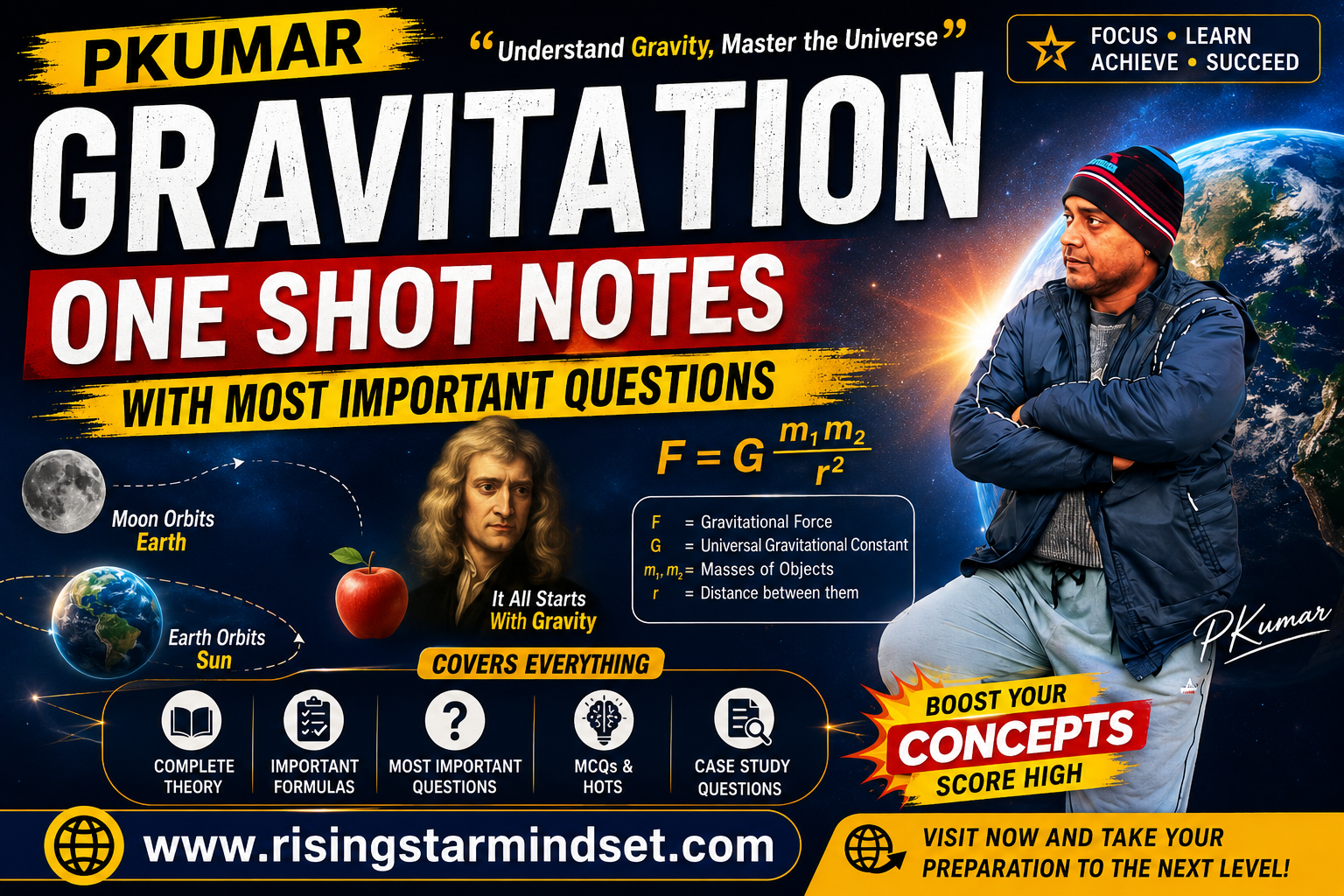
Gravitation Beginner to Advance Notes | Complete Theory, MCQs, HOTS, Case Study & Questions Answers
Table of Contents ( Gravitation One Shot Notes )
- Introduction to Gravitation
- What is Gravitation?
- History of Gravitation
- Newton’s Universal Law of Gravitation
- Importance of Gravitation
- Free Fall
- Acceleration Due to Gravity (g)
- Mass and Weight
- Difference Between Mass and Weight
- Thrust and Pressure
- Buoyancy
- Archimedes’ Principle
- Relative Density
- Important Formulae
- Important Abbreviations
- Key Points for Revision
- MCQs
- HOTS Questions
- Case Study Questions
- Short Answer Questions
- Long Answer Questions
- Exam Tips
- Conclusion

Introduction to Gravitation ( Gravitation One Shot Notes )
Gravitation is one of the most important concepts in Physics. It explains why objects fall towards the Earth and why planets revolve around the Sun. Moreover, gravitation plays a major role in our daily lives. ( Gravitation One Shot Notes )
गुरुत्वाकर्षण (Gravitation) भौतिक विज्ञान का एक महत्वपूर्ण विषय है। यह बताता है कि वस्तुएँ पृथ्वी की ओर क्यों गिरती हैं तथा ग्रह सूर्य के चारों ओर क्यों घूमते हैं। इसके अलावा, यह हमारे दैनिक जीवन में भी महत्वपूर्ण भूमिका निभाता है।
What is Gravitation?
English
Gravitation is the force of attraction between any two objects having mass.
Hindi
द्रव्यमान वाली किन्हीं दो वस्तुओं के बीच लगने वाले आकर्षण बल को गुरुत्वाकर्षण कहते हैं।
Examples


- Apple falling from a tree
- Moon revolving around Earth
- Earth revolving around the Sun
- Rain falling towards Earth
History of Gravitation ( Gravitation One Shot Notes )
Sir Isaac Newton and the Falling Apple
According to a famous story, Newton observed an apple falling from a tree. As a result, he started thinking about the force that pulled the apple towards Earth.
Subsequently, he proposed the Universal Law of Gravitation.
Hindi
आइज़ैक न्यूटन ने पेड़ से गिरते हुए सेब को देखकर गुरुत्वाकर्षण के सिद्धांत पर विचार किया। इसके बाद उन्होंने सार्वत्रिक गुरुत्वाकर्षण का नियम प्रस्तुत किया।
Newton’s Universal Law of Gravitation
Statement
Every object in the universe attracts every other object with a force.
This force:
- Is directly proportional to the product of their masses.
- Is inversely proportional to the square of the distance between them.
Formula
Where:
- F = Gravitational Force
- G = Universal Gravitational Constant
- m₁ = First Mass
- m₂ = Second Mass
- r = Distance between centers
Hindi
ब्रह्मांड की प्रत्येक वस्तु दूसरी वस्तु को आकर्षित करती है। यह बल उनके द्रव्यमानों के गुणनफल के समानुपाती तथा उनके बीच की दूरी के वर्ग के व्युत्क्रमानुपाती होता है।
Importance of Gravitation ( Gravitation One Shot Notes )
Gravitation is responsible for:
1. Falling of Objects
Objects fall towards Earth because of gravity.
2. Planetary Motion
Planets revolve around the Sun due to gravitational force.
3. Tides
Ocean tides occur due to the gravitational pull of the Moon.
4. Atmosphere
Earth’s gravity holds the atmosphere around it.
Hindi
गुरुत्वाकर्षण के कारण:
- वस्तुएँ पृथ्वी पर गिरती हैं।
- ग्रह सूर्य की परिक्रमा करते हैं।
- समुद्र में ज्वार-भाटा आता है।
- पृथ्वी का वायुमंडल बना रहता है।
Free Fall ( Gravitation One Shot Notes )
When an object falls towards Earth only under the influence of gravity, the motion is called free fall.
Examples
- Falling stone
- Falling fruit
- Raindrops
Hindi
जब कोई वस्तु केवल गुरुत्वाकर्षण बल के प्रभाव में पृथ्वी की ओर गिरती है, तो उसे मुक्त पतन (Free Fall) कहते हैं।
Acceleration Due to Gravity (g)
The acceleration produced in a freely falling object is called acceleration due to gravity.
Symbol
g
Value
Formula
Hindi
मुक्त रूप से गिरती वस्तु में उत्पन्न त्वरण को गुरुत्वजनित त्वरण कहते हैं।
Equations of Motion for Free Fall
First Equation
Second Equation
Third Equation
Mass
Mass is the amount of matter present in an object.
Characteristics
- Constant everywhere
- Scalar quantity
- SI Unit = Kilogram (kg)
Hindi
किसी वस्तु में उपस्थित पदार्थ की मात्रा को द्रव्यमान कहते हैं।
Weight
Weight is the gravitational force acting on a body.
Formula
SI Unit
Newton (N)
Hindi
किसी वस्तु पर लगने वाला गुरुत्वाकर्षण बल उसका भार कहलाता है।
Difference Between Mass and Weight
| Mass | Weight |
|---|---|
| Amount of matter | Force of gravity |
| Constant | Changes with location |
| Scalar | Vector |
| kg | Newton |
Thrust and Pressure
Thrust
Force acting perpendicular to a surface.
Formula
Hindi
किसी सतह पर लंबवत लगाया गया बल थ्रस्ट कहलाता है।
Pressure
Pressure is force acting per unit area.
Formula
SI Unit
Pascal (Pa)
Hindi
प्रति इकाई क्षेत्रफल पर लगने वाले बल को दाब कहते हैं।
Buoyancy ( Gravitation One Shot Notes )
When an object is immersed in a fluid, the fluid exerts an upward force.
This force is called buoyant force.
Examples
- Ship floating in water
- Balloon rising in air
Hindi
द्रव में डूबी वस्तु पर ऊपर की ओर लगने वाले बल को उत्प्लावन बल कहते हैं।
Archimedes’ Principle
Statement
A body immersed in a fluid experiences an upward force equal to the weight of the fluid displaced by it.
Hindi
द्रव में डूबी वस्तु पर लगने वाला उत्प्लावन बल उस द्रव के भार के बराबर होता है जिसे वह विस्थापित करती है।
Relative Density
Relative Density = Density of Substance ÷ Density of Water
Formula
Hindi
किसी पदार्थ के घनत्व और जल के घनत्व के अनुपात को आपेक्षिक घनत्व कहते हैं।
Important Formulae
| Concept | Formula |
|---|---|
| Gravitation | F = Gm₁m₂/r² |
| Weight | W = mg |
| Pressure | P = F/A |
| Relative Density | RD = ρs/ρw |
| Free Fall | v = u + gt |
| Free Fall | s = ut + ½gt² |
| Free Fall | v² – u² = 2gs |
Important Abbreviations
| Abbreviation | Full Form |
|---|---|
| SI | International System of Units |
| G | Universal Gravitational Constant |
| g | Acceleration Due to Gravity |
| kg | Kilogram |
| N | Newton |
| Pa | Pascal |
| RD | Relative Density |
| F | Force |
| W | Weight |
| M | Mass of Earth |
| R | Radius of Earth |
Key Points for Quick Revision
| Every object attracts every other object. |
| Gravitational force depends on mass and distance. |
| Value of g on Earth is 9.8 m/s². |
| Weight depends on gravity. |
| Mass remains constant. |
| Pressure increases when area decreases. |
| Buoyant force acts upward. |
| Archimedes’ Principle explains floating. |
| Relative density has no unit. |
| Weight on the Moon is less than on Earth. |
Multiple Choice Questions (MCQs)
1. Who proposed the law of gravitation?
A. Einstein
B. Newton
C. Galileo
D. Archimedes
Answer: B
2. SI unit of weight is:
A. kg
B. m
C. N
D. Pa
Answer: C
3. Value of g on Earth is:
A. 8.9
B. 9.8
C. 10.8
D. 11.8
Answer: B
4. Weight is:
A. Scalar
B. Vector
C. Both
D. None
Answer: B
5. SI unit of pressure is:
A. Newton
B. Joule
C. Pascal
D. Meter
Answer: C
6. Mass remains:
A. Variable
B. Constant
C. Negative
D. Zero
Answer: B
7. Archimedes’ Principle is related to:
A. Electricity
B. Light
C. Buoyancy
D. Sound
Answer: C
8. Weight on Moon is approximately:
A. Same as Earth
B. Double
C. One-sixth
D. Three times
Answer: C
9. Relative density has:
A. Meter
B. Newton
C. Pascal
D. No unit
Answer: D
10. Force per unit area is:
A. Work
B. Energy
C. Pressure
D. Velocity
Answer: C
HOTS Questions
HOTS 1
Why do astronauts appear weightless in a spacecraft?
Answer: Because both the spacecraft and astronauts are in free fall around Earth.
HOTS 2
Why is weight less on the Moon?
Answer: The Moon has lower gravity than Earth.
HOTS 3
Why do sharp knives cut easily?
Answer: Smaller area produces greater pressure.
HOTS 4
Why do ships float despite being heavy?
Answer: Buoyant force balances their weight.
HOTS 5
Can mass become zero in space?
Answer: No. Mass remains constant everywhere.
Case Study Based Questions
Case Study
Rahul weighs 600 N on Earth. He travels to the Moon where gravity is one-sixth of Earth’s gravity.
Q1. Will Rahul’s mass change?
Answer: No.
Q2. What happens to his weight?
Answer: It decreases.
Q3. Approximate weight on Moon?
Answer: 100 N
Q4. Why does weight decrease?
Answer: Due to lower gravity.
Q5. Is mass dependent on gravity?
Answer: No.
Short Answer Questions
1. Define gravitation.
Gravitation is the force of attraction between two masses.
2. What is free fall?
Motion under gravity alone is called free fall.
3. Define weight.
Weight is the gravitational force acting on an object.
4. What is buoyancy?
The upward force exerted by a fluid is called buoyancy.
5. What is pressure?
Pressure is force acting per unit area.
Long Answer Questions
1. State Newton’s Universal Law of Gravitation.
Every object attracts every other object with a force that is directly proportional to the product of their masses and inversely proportional to the square of the distance between them.
2. Differentiate between mass and weight.
Mass is the quantity of matter in a body, whereas weight is the gravitational force acting on it. Mass remains constant, but weight changes with gravity.
3. Explain Archimedes’ Principle.
When a body is immersed in a fluid, it experiences an upward force equal to the weight of the fluid displaced. Therefore, floating and sinking can be explained using this principle.
Exam Tips
- Learn all formulas carefully.
- Revise definitions daily.
- Practice numerical questions.
- Understand the difference between mass and weight.
- Remember SI units.
- Solve MCQs and HOTS regularly.
- Focus on Archimedes’ Principle and buoyancy.
Conclusion
Gravitation is a fundamental force of nature. It keeps planets in orbit, causes objects to fall, and helps maintain life on Earth. Furthermore, concepts such as free fall, mass, weight, pressure, buoyancy, and Archimedes’ Principle are frequently asked in school and competitive examinations. Therefore, a clear understanding of gravitation is essential for scoring high marks and building a strong foundation in Physics.
Keep Learning, Keep Growing! 🚀
P Kumar | Rising Star Mindset
www.risingstarmindset.com
Together We Will Make The Difference
2 thoughts on “Gravitation One Shot Notes with Most Important Questions”