

Air Pollution in India 2026: Causes, Health Effects, AQI and How to Protect Yourself

भारत में वायु प्रदूषण 2026: कारण, स्वास्थ्य पर प्रभाव, AQI और खुद को सुरक्षित रखने के उपाय
Introduction (English)
Air Pollution in India 2026: The Truth About Toxic Air highlights one of the most serious environmental challenges affecting our daily lives. Although the air around us may sometimes look clean, it can contain invisible pollutants such as PM2.5 and PM10. Moreover, emissions from vehicles, industrial activities, construction work, waste burning and other sources continue to affect air quality. As a result, understanding the Air Quality Index (AQI) has become increasingly important. However, awareness alone is not enough; we must also understand the causes, recognise the possible effects on human health and the environment, and adopt responsible practices. Therefore, this article explains the truth about toxic air, presents important air-quality information and explores practical steps that individuals and communities can take to support cleaner air. Ultimately, clean air is not just an environmental necessity; it is essential for a healthier and more sustainable future.
हिंदी में परिचय (Air Pollution in India 2026
भारत में वायु प्रदूषण 2026: जहरीली हवा का सच आज एक गंभीर पर्यावरणीय चिंता है। हालांकि, हवा साफ दिखाई दे सकती है, लेकिन उसमें PM2.5 और PM10 जैसे हानिकारक कण मौजूद हो सकते हैं। इसके अलावा, वाहनों का धुआँ, उद्योग, निर्माण कार्य और कचरा जलाना प्रदूषण बढ़ाते हैं। इसलिए, AQI को समझना और इसके प्रभावों से बचाव के उपाय जानना बेहद जरूरी है। इस लेख में हम वायु प्रदूषण के कारणों, संभावित प्रभावों और स्वच्छ हवा के लिए जरूरी कदमों पर चर्चा करेंगे।
Table of Contents (विषय सूची)
- What Is Air Pollution? – वायु प्रदूषण क्या है?
- Why Is Air Pollution a Growing Concern in India?
- Major Causes of Air Pollution
- Understanding AQI – Air Quality Index
- PM2.5 vs PM10: What Is the Difference?
- Latest Air Quality Snapshot: November 2026
- How Does Air Pollution Affect Human Health?
- Who Is More Vulnerable to Air Pollution?
- Indoor Air Pollution: The Hidden Problem
- Practical Ways to Protect Yourself and Your Family
- What Can Students and Citizens Do?
- Government Initiatives to Improve Air Quality
- Myths vs Facts About Air Pollution
- Frequently Asked Questions (FAQs)
- Knowledge Check: Multiple-Choice Questions
- Conclusion: Clean Air Is Everyone’s Responsibility
- PREVIOUS POST : How to Prevent Road Accidents: 10 Essential Safety Rules
1. What Is Air Pollution? ( Air Pollution in India 2026 )
Air pollution occurs when harmful substances such as gases, smoke, dust and tiny particles enter the atmosphere in quantities that can affect human health and the environment.
These pollutants may come from natural sources as well as human activities.
For example, vehicle exhaust, industrial emissions, construction dust, burning of waste and household cooking smoke can contribute to polluted air.
Unlike contaminated food or water, polluted air is not always visible. Some harmful particles are extremely small and cannot be detected by our eyes.
Therefore, the absence of visible smoke does not necessarily mean that the air is clean.
Common Air Pollutants ( Air Pollution in India 2026 )
| Pollutant | Full Name / Meaning | Common Sources |
| PM2.5 | Fine Particulate Matter | Vehicle emissions, combustion, biomass burning |
| PM10 | Coarse Particulate Matter | Road dust, construction activities |
| NO2 | Nitrogen Dioxide | Vehicles and industrial combustion |
| SO2 | Sulphur Dioxide | Industries and fuel combustion |
| CO | Carbon Monoxide | Incomplete combustion of fuels |
| O3 | Ground-level Ozone | Chemical reactions involving other pollutants in sunlight |
हिंदी में समझें: ( Air Pollution in India 2026 )
वायु प्रदूषण तब होता है जब हवा में धुआं, धूल, हानिकारक गैसें और सूक्ष्म कण निर्धारित स्तर से अधिक मात्रा में मौजूद हो जाते हैं और स्वास्थ्य या पर्यावरण को प्रभावित कर सकते हैं।
इसके प्रमुख स्रोतों में वाहन, कारखाने, निर्माण कार्य, कचरा जलाना और घरों में इस्तेमाल होने वाले कुछ पारंपरिक ईंधन शामिल हैं।
हवा में मौजूद सभी प्रदूषक दिखाई नहीं देते। कुछ कण इतने छोटे होते हैं कि हम उन्हें अपनी आंखों से नहीं देख सकते।
इसलिए केवल साफ आसमान देखकर यह मान लेना सही नहीं है कि हवा पूरी तरह स्वच्छ है।
2. Why Is Air Pollution a Growing Concern in India?
India has a diverse climate, population distribution and pattern of urban development. Consequently, air pollution levels vary considerably between cities, towns and rural areas.
In several northern Indian cities, air quality can deteriorate during winter.
One reason is that lower wind speeds and certain atmospheric conditions can reduce the dispersion of pollutants. As a result, emissions from different sources may remain concentrated near the ground.
However, air pollution is not exclusively a winter problem. Dust storms, industrial emissions, traffic and other sources can affect air quality throughout the year.
The Ministry of Environment, Forest and Climate Change has recognised that India’s air pollution results from multiple sources, including transport, industries, construction and demolition dust, biomass burning and municipal waste burning.
हिंदी में समझें: ( Air Pollution in India 2026 )
भारत में मौसम, जनसंख्या, यातायात और औद्योगिक गतिविधियों के अनुसार वायु प्रदूषण का स्तर अलग-अलग हो सकता है।
उत्तर भारत के कई शहरों में सर्दियों के दौरान वायु गुणवत्ता खराब हो जाती है।
इसका एक कारण यह है कि कुछ मौसम संबंधी परिस्थितियों में हवा की गति कम हो जाती है। ऐसे में प्रदूषक आसानी से फैल नहीं पाते और जमीन के आसपास जमा हो सकते हैं।
लेकिन वायु प्रदूषण केवल सर्दियों की समस्या नहीं है। धूल भरी आंधी, वाहन, उद्योग और अन्य स्रोत पूरे साल हवा की गुणवत्ता को प्रभावित कर सकते हैं।
इसलिए इस समस्या को समझने के लिए हमें इसके अलग-अलग स्रोतों पर ध्यान देना चाहिए।
3. Major Causes of Air Pollution in India 2026
Air pollution does not have a single cause. It is generally the combined result of several activities and environmental conditions.
Let us understand some important sources.
A. Vehicle Emissions
Cars, buses, trucks and two-wheelers release pollutants during fuel combustion.
Heavy traffic and poorly maintained vehicles can contribute to air pollution, particularly in busy urban areas.
B. Industrial Emissions
Factories, power plants, boilers and other industrial activities can release particulate matter and harmful gases.
Proper emission control and monitoring are important to reduce their environmental impact.
C. Construction and Road Dust
Construction, demolition, excavation and uncovered materials can release dust into the atmosphere.
Similarly, dust from roads and open areas can become airborne due to traffic and wind.
D. Burning of Waste and Biomass
Burning plastic, household waste, dry leaves, wood and agricultural residue releases smoke and harmful pollutants.
Avoiding open burning is an important step towards cleaner air.
E. Household Air Pollution
Traditional cooking fuels such as firewood, coal and certain other solid fuels can produce smoke inside homes.
Poor ventilation may increase indoor exposure.
F. Weather and Natural Conditions
Dust storms, forest fires and certain atmospheric conditions can also influence air quality.
Weather does not necessarily create all pollution, but it can affect how pollutants spread or accumulate.
Major Sources at a Glance
| Source | How It Contributes |
| Road traffic | Exhaust gases and fine particles |
| Industries | Particulate matter and gaseous emissions |
| Construction | Dust and suspended particles |
| Waste burning | Smoke and harmful gases |
| Biomass burning | Fine particles and combustion gases |
| Household solid fuels | Indoor smoke and particulate matter |
| Natural dust storms | Increased airborne dust |
हिंदी में समझें: ( Air Pollution in India 2026 )
भारत में वायु प्रदूषण के कई कारण हैं। इनमें से कुछ प्रमुख कारण हैं:
- वाहनों का धुआं: पेट्रोल और डीजल से चलने वाले वाहन प्रदूषण में योगदान कर सकते हैं।
- औद्योगिक गतिविधियां: कारखानों और बिजली उत्पादन से निकलने वाले उत्सर्जन हवा को प्रभावित कर सकते हैं।
- निर्माण कार्य: सड़क निर्माण, भवन निर्माण और तोड़फोड़ के कारण धूल फैलती है।
- कचरा जलाना: प्लास्टिक, पत्तियां और घरेलू कचरा जलाने से हानिकारक धुआं निकलता है।
- घरेलू ईंधन: लकड़ी और कोयले जैसे ईंधन से घर के अंदर भी प्रदूषण हो सकता है।
- प्राकृतिक कारण: धूल भरी आंधी और जंगलों में लगने वाली आग भी वायु गुणवत्ता को प्रभावित कर सकती है।
इससे स्पष्ट होता है कि स्वच्छ हवा के लिए केवल एक स्रोत को नियंत्रित करना पर्याप्त नहीं है। कई स्तरों पर प्रयास आवश्यक हैं।
4. Understanding AQI: What Is the Air Quality Index?

Have you ever checked the weather on your smartphone and noticed another number called AQI?
AQI stands for Air Quality Index.
It is a simplified measurement system that communicates the overall air quality and its possible health implications.
In India, the Central Pollution Control Board (CPCB) uses the National Air Quality Index to help people understand air pollution levels.
The index converts measurements of different pollutants into a common numerical scale.
A higher AQI generally indicates poorer air quality and greater potential health concerns.
India’s National AQI Categories
| AQI Range | Category | General Health Meaning |
| 0–50 | Good | Minimal health impact |
| 51–100 | Satisfactory | Minor discomfort to sensitive individuals |
| 101–200 | Moderate | Breathing discomfort for sensitive groups |
| 201–300 | Poor | Breathing discomfort on prolonged exposure |
| 301–400 | Very Poor | Increased risk of respiratory illness on prolonged exposure |
| 401–500 | Severe | Significant health effects, including for healthy individuals |
Source: Central Pollution Control Board (CPCB), National Air Quality Index.
How Should You Understand AQI?
For example:
- AQI 35 indicates Good air quality.
- AQI 85 indicates Satisfactory air quality.
- AQI 175 indicates Moderate air quality.
- AQI 250 indicates Poor air quality.
- AQI 350 indicates Very Poor air quality.
- AQI 450 indicates Severe air quality.
Remember that AQI is a public communication tool. It does not provide an individual medical diagnosis or guarantee that everyone will experience the same effects.
हिंदी में समझें: ( Air Pollution in India 2026 )
AQI का पूरा नाम Air Quality Index है। हिंदी में इसे वायु गुणवत्ता सूचकांक कहा जाता है।
यह एक ऐसा पैमाना है जो हमें बताता है कि हमारे आसपास की हवा की स्थिति कैसी है।
भारत में केंद्रीय प्रदूषण नियंत्रण बोर्ड (CPCB) द्वारा राष्ट्रीय AQI प्रणाली का उपयोग किया जाता है।
इसमें 0 से 500 तक के स्तर के आधार पर हवा की गुणवत्ता को अलग-अलग श्रेणियों में बांटा गया है।
उदाहरण के लिए:
- 0–50: अच्छी हवा।
- 51–100: संतोषजनक हवा।
- 101–200: मध्यम स्तर की प्रदूषित हवा।
- 201–300: खराब हवा।
- 301–400: बहुत खराब हवा।
- 401–500: गंभीर स्थिति।
जैसे–जैसे AQI बढ़ता है, स्वास्थ्य संबंधी सावधानी की आवश्यकता भी बढ़ती है।
इसलिए घर से बाहर निकलने, बच्चों की गतिविधियों और सुबह की सैर की योजना बनाने से पहले अपने शहर का AQI देखना एक अच्छी आदत है।
5. PM2.5 vs PM10: What Is the Difference?
PM stands for Particulate Matter. These are tiny solid particles and liquid droplets suspended in the air.
Two important types are PM2.5 and PM10.
What Is PM2.5? ( Air Pollution in India 2026 )
PM2.5 refers to particles with a diameter of 2.5 micrometres or smaller.
These particles are so tiny that they can travel deep into the respiratory system and reach the lungs.
What Is PM10? ( Air Pollution in India 2026 )
PM10 refers to particles with a diameter of 10 micrometres or smaller.
These particles include dust, pollen and other inhalable particles.
Comparison Table ( Air Pollution in India 2026 )
| Feature | PM2.5 | PM10 |
| Particle size | 2.5 micrometres or smaller | 10 micrometres or smaller |
| Relative size | Smaller | Generally larger |
| Common sources | Combustion and smoke | Road dust and construction |
| Where it can travel | Deep into the lungs | Mainly respiratory passages, with some reaching the lungs |
| Health concern | Can affect respiratory and cardiovascular health | Can irritate the respiratory system |
An important fact: PM2.5 is a subset of PM10 because particles smaller than 2.5 micrometres are also smaller than 10 micrometres.
हिंदी में समझें:
PM का अर्थ है Particulate Matter यानी हवा में मौजूद सूक्ष्म कण।
PM2.5 और PM10 प्रदूषण को समझने के लिए महत्वपूर्ण हैं।
PM2.5: ये 2.5 माइक्रोमीटर या उससे छोटे कण होते हैं। इनका आकार बहुत छोटा होता है और ये सांस के साथ फेफड़ों के अंदर तक पहुंच सकते हैं।
PM10: ये 10 माइक्रोमीटर या उससे छोटे कण होते हैं। इनमें सड़क की धूल, निर्माण कार्यों की धूल और परागकण जैसे कण शामिल हो सकते हैं।
सरल शब्दों में कहें तो PM2.5 बहुत छोटे कण होते हैं, जबकि PM10 में उनसे बड़े कण भी शामिल होते हैं।
इसीलिए वायु प्रदूषण की चर्चा में केवल धूल ही नहीं, बल्कि हवा में मौजूद सूक्ष्म कणों पर भी ध्यान देना जरूरी है।
6. Latest Air Quality Snapshot: November 2026
Recent reports show why air quality deserves attention during the winter season.
The following examples are based on specific dated reports. They should not be treated as live readings or as the air quality of every location in India.
Recent Observations ( Air Pollution in India 2026 )
| Location | Date | Reported AQI / Observation | Category | |
| Delhi | 6 November 2026 | Daily average AQI 382 | Very Poor | |
| Delhi | 13 November 2026 | City-level AQI 403 in a reported CPCB reading | Severe | |
| Delhi | 14 November 2026 | Daily average AQI 367 | Very Poor | |
| Patna | 10 November 2026 | AQI 199, as reported from CPCB bulletin | Moderate | |
| Delhi monitoring stations | 15 November 2026 | 47 stations in Very Poor and 7 in Severe category | Station-level observations |
Sources: Government of India PIB, The New Indian Express and Times of India reports referring to CPCB data.
What Do These Numbers Tell Us? ( Air Pollution in India 2026 )
First, air quality can differ significantly from one city to another.
Second, even within the same city, monitoring stations may record different readings.
Third, pollution levels can change from one day to another because of weather conditions, emissions and other environmental factors.
Therefore, it is better to check the latest reading for your own location instead of depending on an old national headline.
हिंदी में समझें: ( Air Pollution in India 2026 )
नवंबर 2026 की कुछ हालिया रिपोर्टों से पता चलता है कि अलग-अलग शहरों में वायु गुणवत्ता का स्तर अलग हो सकता है।
उदाहरण के लिए, 6 नवंबर को दिल्ली का दैनिक औसत AQI 382 दर्ज किया गया था। वहीं 14 नवंबर को यह 367 था।
पटना में 10 नवंबर की रिपोर्ट के अनुसार AQI 199 दर्ज किया गया था।
इन आंकड़ों से यह समझना जरूरी है कि एक शहर का AQI दूसरे शहर की स्थिति नहीं बताता।
यहां तक कि एक ही शहर के अलग-अलग इलाकों में भी प्रदूषण का स्तर अलग हो सकता है।
इसलिए अपने क्षेत्र की ताजा जानकारी देखना सबसे बेहतर तरीका है।
Where can you check your city’s AQI?
- CPCB: https://app.cpcbccr.com/AQI_India/
- CPCB: https://cpcb.nic.in/
- Delhi Air Quality Information: https://aqi.delhi.gov.in/
7. How Does Air Pollution Affect Human Health?
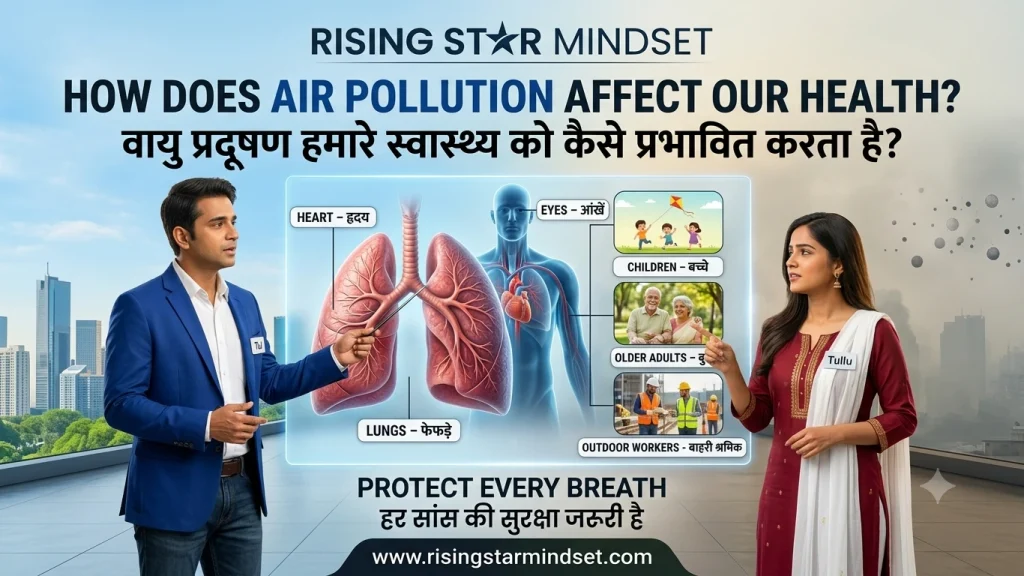
Air pollution can affect different parts of the human body. The impact depends on the pollutant, exposure level, duration and individual vulnerability.
According to the Ministry of Health and Family Welfare’s National Programme on Climate Change and Human Health, short-term exposure to high pollution levels may cause irritation of the eyes, nose and throat, coughing, wheezing and chest discomfort.
Long-term exposure can contribute to chronic respiratory and cardiovascular health problems.
Let us understand some possible effects.
A. Respiratory System ( Air Pollution in India 2026 )
The respiratory system is directly exposed to polluted air.
Possible effects include:
- Coughing.
- Throat irritation.
- Breathing discomfort.
- Wheezing.
- Worsening of existing asthma.
B. Heart and Cardiovascular Health ( Air Pollution in India 2026 )
Long-term exposure to air pollution is associated with an increased risk of cardiovascular problems.
Fine particles can enter the body through the respiratory system and contribute to processes that affect cardiovascular health.
C. Eye and Throat Irritation
Dust, smoke and certain gases can irritate the eyes, nose and throat.
Some people may experience watery eyes, sneezing or throat discomfort.
D. Effects on Children
Children are an important group to protect because their bodies and lungs are still developing.
High pollution exposure may affect respiratory health and can worsen existing breathing problems.
E. Effects on Older Adults
Older people, especially those with existing heart or lung conditions, may be more vulnerable to polluted air.
Health Impact Summary ( Air Pollution in India 2026 )
| Body System | Possible Effects |
| Respiratory system | Coughing, wheezing and breathing difficulty |
| Cardiovascular system | Increased risk of heart-related problems |
| Eyes | Irritation and watering |
| Nose and throat | Irritation and discomfort |
| Children | Increased vulnerability to respiratory effects |
| Older adults | Greater risk of complications with existing illnesses |
हिंदी में समझें: ( Air Pollution in India 2026 )
वायु प्रदूषण का प्रभाव शरीर के अलग-अलग अंगों पर पड़ सकता है। इसका असर इस बात पर निर्भर करता है कि प्रदूषण कितना है, कितने समय तक संपर्क हुआ और व्यक्ति की स्वास्थ्य स्थिति कैसी है।
1. फेफड़ों पर प्रभाव: खांसी, सांस लेने में परेशानी, घरघराहट और अस्थमा की समस्या बढ़ सकती है।
2. हृदय पर प्रभाव: लंबे समय तक प्रदूषित हवा के संपर्क में रहने से हृदय और रक्त संचार संबंधी बीमारियों का जोखिम बढ़ सकता है।
3. आंखों और गले पर प्रभाव: आंखों में जलन, पानी आना और गले में परेशानी हो सकती है।
4. बच्चों पर प्रभाव: बच्चों के फेफड़े विकास की अवस्था में होते हैं। इसलिए उन्हें प्रदूषित हवा से बचाना विशेष रूप से जरूरी है।
5. बुजुर्गों पर प्रभाव: पहले से हृदय या फेफड़ों की समस्या से जूझ रहे बुजुर्गों को अधिक सावधानी रखनी चाहिए।
ध्यान रहे, ये सामान्य स्वास्थ्य संबंधी प्रभाव हैं। हर व्यक्ति में एक जैसे लक्षण दिखाई देना जरूरी नहीं है।
8. Who Is More Vulnerable to Air Pollution?
Although air pollution can affect everyone, certain groups may face greater health risks.
According to the public health advisory issued under the National Programme on Climate Change and Human Health, vulnerable groups include:
| Vulnerable Group | Why Extra Care Is Important |
| Children below 5 years | Developing lungs and respiratory system |
| Older adults | Greater possibility of existing health conditions |
| Pregnant women | Exposure may affect maternal and child health |
| People with asthma | Pollution can worsen breathing symptoms |
| People with heart disease | Greater vulnerability to cardiovascular effects |
| Outdoor workers | Longer exposure to polluted environments |
Outdoor workers such as traffic personnel, road sweepers, construction workers, roadside vendors and drivers may experience prolonged exposure.
हिंदी में समझें:
वायु प्रदूषण सभी के लिए चिंता का विषय है, लेकिन कुछ लोगों को विशेष सावधानी बरतने की आवश्यकता होती है।
इनमें छोटे बच्चे, गर्भवती महिलाएं, बुजुर्ग और पहले से अस्थमा या हृदय संबंधी समस्या वाले लोग शामिल हैं।
इसके अलावा सड़क पर लंबे समय तक काम करने वाले कर्मचारी, निर्माण श्रमिक, ट्रैफिक पुलिसकर्मी और रेहड़ी-पटरी लगाने वाले लोग भी अधिक समय तक प्रदूषित हवा के संपर्क में रह सकते हैं।
इन लोगों के लिए AQI की जानकारी रखना और स्थानीय स्वास्थ्य सलाह का पालन करना विशेष रूप से उपयोगी है।
9. Indoor Air Pollution: The Hidden Problem
Many people believe that air pollution exists only outside their homes.
However, indoor air quality also matters.
Smoke from cooking fuels, tobacco, mosquito coils, incense sticks, poor ventilation and certain household activities can affect indoor air.
The National Centre for Disease Control (NCDC) identifies several indoor pollution sources, including solid cooking fuels, burning materials and smoke from tobacco and mosquito coils.
Common Sources of Indoor Pollution
| Indoor Source | Possible Concern |
| Firewood and coal | Smoke and fine particles |
| Tobacco smoke | Harmful gases and particles |
| Mosquito coils | Smoke and particulate matter |
| Poor ventilation | Accumulation of indoor pollutants |
| Burning waste indoors | Harmful smoke and gases |
| Dust accumulation | Airborne particles during cleaning |
How to Improve Indoor Air Quality
- Prefer cleaner cooking fuels where available.
- Ensure adequate ventilation.
- Avoid smoking inside homes.
- Do not burn waste or plastic indoors.
- Avoid using mosquito coils in closed rooms.
- Use wet mopping instead of dry sweeping.
- Maintain cooking equipment properly.
हिंदी में समझें: ( Air Pollution in India 2026 )
कई लोग सोचते हैं कि प्रदूषण केवल सड़क और बाहर के वातावरण में होता है। लेकिन घर के अंदर की हवा भी प्रदूषित हो सकती है।
लकड़ी या कोयले से खाना बनाना, सिगरेट का धुआं, मच्छर भगाने वाली कॉइल और बंद कमरों में धुआं जमा होना इसके कुछ कारण हैं।
घर के अंदर हवा को बेहतर बनाने के लिए:
- जहां संभव हो, स्वच्छ ईंधन का उपयोग करें।
- घर में उचित वेंटिलेशन रखें।
- घर के अंदर धूम्रपान न करें।
- प्लास्टिक और कचरा न जलाएं।
- बंद कमरे में मच्छर कॉइल जलाने से बचें।
- सूखी झाड़ू की जगह गीले पोछे का इस्तेमाल करें।
स्वच्छ वातावरण की शुरुआत हमारे अपने घर से भी होती है।
10. Practical Ways to Protect Yourself and Your Family
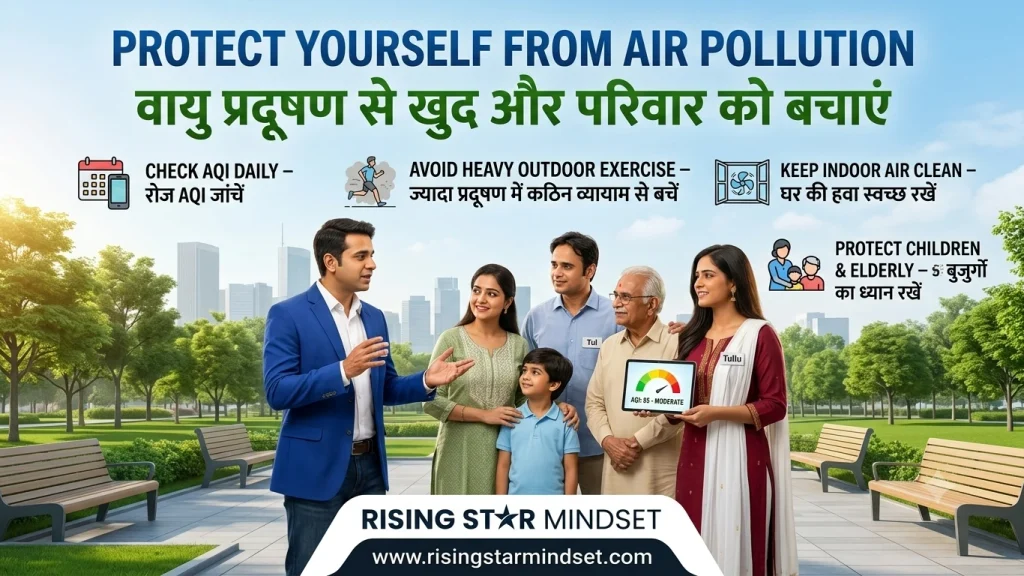
We may not be able to control every source of air pollution individually. However, we can take practical steps to reduce our exposure.
1. Check AQI Before Outdoor Activities
Check your local AQI before planning morning walks, jogging, cycling or outdoor sports.
2. Reduce Outdoor Exercise During Poor Air Quality
When AQI is Poor, Very Poor or Severe, avoid strenuous outdoor activities according to official health advisories.
3. Protect Children
Avoid unnecessary outdoor exposure for children during high pollution periods. Follow school and local health advisories.
4. Use a Well-Fitting N95 or Equivalent Respirator When Appropriate
When outdoor exposure cannot be avoided during heavy particle pollution, a properly fitted particulate respirator such as an N95 may help reduce inhalation of particles.
A loose-fitting cloth or surgical mask should not be assumed to offer equivalent protection against fine particles.
5. Keep Indoor Air Cleaner
Avoid smoking, open burning and unnecessary sources of indoor smoke.
6. Follow Official Health Advisories
Check CPCB and local authorities for updated air quality information.
7. Seek Medical Advice When Necessary
If you experience persistent coughing, breathing difficulty, chest discomfort or worsening respiratory symptoms, seek advice from a qualified healthcare professional.
Important: People with prescribed medicines or inhalers should follow their healthcare provider’s instructions. Do not stop or change treatment because of an online article.
Daily Air Pollution Safety Checklist
| Daily Habit | Why It Matters |
| Check AQI | Helps plan outdoor activities |
| Avoid heavy outdoor exercise during high pollution | Reduces exposure |
| Keep rooms free from smoke | Improves indoor air quality |
| Avoid open waste burning | Reduces pollution |
| Protect vulnerable family members | Helps reduce exposure |
| Follow official advisories | Provides location-specific guidance |
| Seek medical help for warning symptoms | Supports timely care |
हिंदी में समझें: ( Air Pollution in India 2026 )
हम सभी मिलकर हर प्रकार के प्रदूषण को तुरंत समाप्त नहीं कर सकते, लेकिन अपनी दिनचर्या में कुछ बदलाव करके प्रदूषित हवा के संपर्क को कम कर सकते हैं।
- सुबह की सैर से पहले AQI जांचें।
- बहुत खराब हवा में दौड़ने और कठिन व्यायाम से बचें।
- बच्चों और बुजुर्गों को विशेष सुरक्षा दें।
- जरूरत पड़ने पर सही फिटिंग वाला N95 या समकक्ष पार्टिकुलेट रेस्पिरेटर इस्तेमाल करें।
- घर में धुआं जमा न होने दें।
- कचरा और प्लास्टिक न जलाएं।
- लगातार खांसी या सांस की परेशानी होने पर डॉक्टर से सलाह लें।
याद रखें, प्रदूषण से बचाव के लिए केवल मास्क पहनना पर्याप्त नहीं है। प्रदूषण के संपर्क को कम करना और आधिकारिक स्वास्थ्य सलाह का पालन करना भी जरूरी है।
11. What Can Students and Citizens Do?
Clean air is not only the responsibility of government departments or environmental organisations. Citizens, schools, families and local communities can also contribute.
Seven Simple Actions ( Air Pollution in India 2026 )
| Action | Positive Contribution |
| Use public transport when practical | Can reduce individual vehicle use |
| Share rides | Helps reduce the number of vehicles on roads |
| Avoid open burning | Prevents unnecessary smoke |
| Maintain vehicles | Helps control avoidable emissions |
| Save electricity | Can reduce demand-related emissions |
| Keep construction materials covered | Helps control dust |
| Plant and protect trees | Supports a healthier local environment |
Trees are valuable for the environment, but planting trees alone cannot solve air pollution. Emission reduction, better waste management, cleaner energy and effective monitoring are also essential.
A Small School Activity: Become an Air Awareness Ambassador
Students can organise a simple awareness activity in their schools.
Activity: Know Your Air ( Air Pollution in India 2026 )
- Find the AQI of your city using an official source.
- Write down the date and time of the reading.
- Identify the AQI category.
- Discuss what precautions are recommended.
- Prepare a small poster on clean air.
- Share five ways to reduce pollution at home and school.
हिंदी में समझें: ( Air Pollution in India 2026 )
स्वच्छ हवा के लिए केवल सरकार पर निर्भर रहना पर्याप्त नहीं है। आम नागरिक, विद्यार्थी, शिक्षक और परिवार भी महत्वपूर्ण भूमिका निभा सकते हैं।
हम सार्वजनिक परिवहन का इस्तेमाल कर सकते हैं, अनावश्यक वाहन यात्राओं को कम कर सकते हैं, कचरा जलाने से बच सकते हैं और निर्माण कार्यों में धूल नियंत्रण के उपाय अपना सकते हैं।
विद्यार्थी अपने स्कूल में AQI जागरूकता अभियान चला सकते हैं।
इससे उनमें पर्यावरण के प्रति जिम्मेदारी और वैज्ञानिक सोच विकसित होगी।

12. Government Initiatives to Improve Air Quality in India
India has introduced several programmes and measures to improve air quality.
One important initiative is the National Clean Air Programme (NCAP), launched in 2019.
The programme focuses on reducing air pollution in identified cities through measures such as monitoring, dust control, waste management and better coordination among authorities.
Important Initiatives ( Air Pollution in India 2026 )
| Initiative | Main Objective |
| National Clean Air Programme (NCAP) | Improving air quality in identified cities |
| National Air Quality Index | Providing understandable air quality information |
| National Ambient Air Quality Standards (NAAQS) | Setting standards for major air pollutants |
| Graded Response Action Plan (GRAP) | Implementing graded emergency measures in Delhi-NCR |
| Air Quality Monitoring Network | Measuring and reporting air pollution levels |
Why Are These Initiatives Important?
Air pollution requires long-term planning and coordinated action.
Monitoring helps identify pollution levels. Standards provide measurable limits. City-level action plans help address local sources, while public awareness encourages responsible behaviour.
हिंदी में समझें: ( Air Pollution in India 2026 )
भारत में वायु प्रदूषण को नियंत्रित करने के लिए कई कार्यक्रम और व्यवस्थाएं बनाई गई हैं।
इनमें National Clean Air Programme (NCAP), National Air Quality Index (AQI), National Ambient Air Quality Standards और दिल्ली-NCR के लिए Graded Response Action Plan (GRAP) शामिल हैं।
इन पहलों का उद्देश्य हवा की गुणवत्ता की निगरानी करना, प्रदूषण के स्रोतों को नियंत्रित करना और लोगों को समय पर जानकारी उपलब्ध कराना है।
स्वच्छ हवा के लिए सरकारी योजनाओं के साथ-साथ नागरिकों की भागीदारी भी जरूरी है।
13. Myths vs Facts About Air Pollution
There are several misconceptions about air pollution. Understanding the facts can help us make better decisions.
| Myth | Fact |
| Air pollution is visible only as smoke. | Many harmful particles are invisible. |
| Pollution affects only big cities. | Rural and smaller urban areas can also experience air pollution. |
| Winter fog and smog are always the same. | Fog is made of tiny water droplets; smog involves pollutants and may contain fog mixed with pollution. |
| Indoor air is always clean. | Cooking smoke, tobacco and other indoor sources can affect air quality. |
| Only people with asthma need to worry. | Air pollution can affect healthy people too, especially with prolonged exposure. |
| Planting trees alone can solve the problem. | Pollution control also requires reducing emissions and controlling dust and waste burning. |
| A high AQI means everyone will experience identical symptoms. | Individual effects vary according to exposure and health conditions. |
हिंदी में समझें: ( Air Pollution in India 2026 )
वायु प्रदूषण को लेकर कई गलत धारणाएं प्रचलित हैं।
उदाहरण के लिए, यह मानना गलत है कि प्रदूषण केवल बड़े शहरों में होता है या केवल धुआं दिखाई देने पर ही हवा खराब होती है।
इसी तरह, केवल पेड़ लगाने से पूरी समस्या समाप्त नहीं हो सकती। इसके लिए वाहनों के उत्सर्जन, निर्माण की धूल, कचरा जलाने और अन्य स्रोतों को भी नियंत्रित करना आवश्यक है।
सही जानकारी हमें बेहतर निर्णय लेने में मदद करती है।
14. Frequently Asked Questions About Air Pollution
Q1. What is air pollution?
Air pollution is the presence of harmful gases, smoke, dust and particles in the atmosphere that can affect health and the environment.
हिंदी: हवा में हानिकारक गैसों, धुएं और धूल के कणों की अधिकता को वायु प्रदूषण कहा जाता है।
Q2. What does AQI stand for?
AQI stands for Air Quality Index.
हिंदी: AQI का पूरा नाम Air Quality Index यानी वायु गुणवत्ता सूचकांक है।
Q3. What is considered a good AQI in India?
An AQI between 0 and 50 falls under the Good category in India’s National AQI system.
हिंदी: भारत के राष्ट्रीय AQI पैमाने में 0 से 50 के बीच का स्तर अच्छी वायु गुणवत्ता दर्शाता है।
Q4. What is the difference between PM2.5 and PM10?
PM2.5 consists of particles measuring 2.5 micrometres or smaller, whereas PM10 includes particles measuring 10 micrometres or smaller.
हिंदी: PM2.5 के कण 2.5 माइक्रोमीटर या उससे छोटे होते हैं, जबकि PM10 में 10 माइक्रोमीटर या उससे छोटे कण शामिल होते हैं।
Q5. Why does air pollution sometimes increase during winter?
Lower wind speeds and certain atmospheric conditions can reduce the dispersion of pollutants, causing them to accumulate near the ground.
हिंदी: सर्दियों में हवा की गति कम होने और कुछ मौसम संबंधी परिस्थितियों के कारण प्रदूषक हवा में जमा हो सकते हैं।
Q6. Can air pollution affect children?
Yes. Children may be more vulnerable because their lungs and respiratory systems are still developing.
हिंदी: हां। बच्चों के फेफड़े विकास की अवस्था में होते हैं, इसलिए उन्हें विशेष सावधानी की जरूरत होती है।
Q7. Does wearing a mask help during air pollution?
A properly fitted N95 or equivalent particulate respirator can reduce exposure to airborne particles. However, it does not eliminate every type of air pollution risk.
हिंदी: सही तरीके से पहना गया N95 या समकक्ष रेस्पिरेटर सूक्ष्म कणों के संपर्क को कम कर सकता है, लेकिन यह हर प्रकार के प्रदूषण से पूरी सुरक्षा नहीं देता।
Q8. How can I check my city’s AQI?
You can check the CPCB air quality portal and other official monitoring services.
हिंदी: आप CPCB की आधिकारिक वेबसाइट पर अपने शहर की वायु गुणवत्ता जांच सकते हैं।
Q9. Is indoor air pollution also harmful?
Yes. Smoke from cooking fuels, tobacco, mosquito coils and other sources can affect indoor air quality.
हिंदी: हां। खाना बनाने के ईंधन, तंबाकू और मच्छर कॉइल से निकलने वाला धुआं घर की हवा को भी प्रदूषित कर सकता है।
Q10. What is the simplest way to reduce personal exposure?
Check local AQI, reduce outdoor exposure during high pollution periods and follow official health advisories.
हिंदी: अपने क्षेत्र का AQI जांचें, प्रदूषण अधिक होने पर बाहर जाने और कठिन व्यायाम को सीमित करें तथा आधिकारिक सलाह का पालन करें।
15. Knowledge Check: Test Your Understanding
Let’s check how much you have learned about air pollution.
Q1. What is the full form of AQI?
A. Air Quality Index
B. Air Quantity Information
C. Atmospheric Quality Indicator
D. Air Quick Information
Correct Answer: A. Air Quality Index
Q2. Which of the following is the smallest particle category?
A. PM10
B. PM2.5
C. Both are the same size
D. Neither
Correct Answer: B. PM2.5
Q3. Which organisation provides India’s National AQI information?
A. RBI
B. CPCB
C. UGC
D. UPSC
Correct Answer: B. CPCB
Q4. What does an AQI of 350 indicate in India?
A. Good
B. Moderate
C. Very Poor
D. Satisfactory
Correct Answer: C. Very Poor
Q5. Which activity can increase indoor air pollution?
A. Proper ventilation
B. Burning waste indoors
C. Wet mopping
D. Keeping rooms clean
Correct Answer: B. Burning waste indoors
Q6. Which group may be more vulnerable to air pollution?
A. Young children
B. Older adults
C. People with heart or lung conditions
D. All of the above
Correct Answer: D. All of the above
Q7. What should you check before planning outdoor exercise?
A. AQI
B. Television volume
C. Mobile battery percentage
D. Internet speed
Correct Answer: A. AQI
Q8. Which of these is an important measure to reduce pollution?
A. Open waste burning
B. Unnecessary vehicle use
C. Better dust management
D. Burning plastic
Correct Answer: C. Better dust management
16. Conclusion: Clean Air Is Everyone’s Responsibility

Air pollution is not just an environmental issue. It is also connected with public health, education, lifestyle and the quality of life of future generations.
We may not always see the pollutants around us, but that does not mean they are harmless.
Understanding AQI, recognising the difference between PM2.5 and PM10, checking reliable information and following practical precautions can help us make informed decisions.
However, personal precautions alone cannot solve the entire problem. Cleaner transport, responsible industrial practices, dust management, proper waste disposal, cleaner household energy and effective environmental monitoring are equally important.
Every small responsible action can contribute to a healthier environment.
Our message is simple: ( Air Pollution in India 2026 )
“Clean air is not just a gift for the next generation. It is a responsibility we must fulfil today.”
हिंदी में निष्कर्ष: ( Air Pollution in India 2026 )
वायु प्रदूषण केवल पर्यावरण की समस्या नहीं है, बल्कि यह हमारे स्वास्थ्य, जीवनशैली और आने वाली पीढ़ियों के भविष्य से भी जुड़ा हुआ है।
हवा में मौजूद प्रदूषक हमेशा दिखाई नहीं देते, लेकिन उनका प्रभाव हमारे स्वास्थ्य पर पड़ सकता है।
AQI की जानकारी रखना, PM2.5 और PM10 के बीच अंतर समझना और सही सावधानियां अपनाना हमारे लिए जरूरी है।
हालांकि, केवल व्यक्तिगत सावधानियों से पूरी समस्या समाप्त नहीं होगी। इसके लिए स्वच्छ परिवहन, कचरे का उचित प्रबंधन, निर्माण कार्यों में धूल नियंत्रण और स्वच्छ ऊर्जा का उपयोग भी जरूरी है।
आइए, हम सभी स्वच्छ हवा के लिए अपनी जिम्मेदारी निभाएं।
“स्वच्छ हवा हमारा अधिकार भी है और हमारी जिम्मेदारी भी। आज का छोटा प्रयास आने वाली पीढ़ियों के लिए बेहतर भविष्य बना सकता है।“
References and Verified Information Sources
For further reading and fact-checking:
- Central Pollution Control Board (CPCB) – National AQI: https://app.cpcbccr.com/AQI_India/
- CPCB – National Ambient Air Quality Standards: https://cpcb.nic.in/
- World Health Organization – Air Quality and Health: https://www.who.int/health-topics/air-pollution
- WHO – Global Air Quality Guidelines (2021): https://www.who.int/publications/i/item/9789240034228
- Ministry of Health and Family Welfare – National Centre for Disease Control: https://ncdc.mohfw.gov.in/
- Press Information Bureau – Government of India: https://www.pib.gov.in/
- National Clean Air Programme: https://moef.gov.in/