

Child Sexual Abuse Prevention 2026: How to Protect Children from Sexual Abuse

Child Sexual Abuse Prevention 2026 reminds us that protecting children is a shared responsibility. Parents, teachers, governments, communities and digital platforms must work together to create safer environments for every child.
The World Day for the Prevention of and Healing from Child Sexual Exploitation, Abuse and Violence is observed every year on 18 November. This international observance encourages people to prevent abuse, protect children’s rights, support survivors and strengthen child protection systems.
Moreover, child safety in today’s digital world requires more than physical protection. Children also need guidance about online privacy, personal boundaries, suspicious messages, manipulation and unsafe digital interactions.
Therefore, this article explains the importance of child protection, warning signs that adults should take seriously, practical prevention strategies, online safety measures and the responsibilities of families, schools and communities.
Most importantly, every child must know that they have the right to feel safe, speak up and ask for help.
Contents at a Glance
- Understanding Child Sexual Abuse Prevention 2026
- Why Child Protection Needs Global Attention in 2026
- Important Global Facts and Figures
- Different Forms of Violence and Exploitation Against Children
- How Parents Can Support Child Sexual Abuse Prevention 2026
- Digital Safety: Protecting Children in the Online World
- What Should Adults Do If a Child Reports Abuse?
- The Role of Schools, Teachers and Communities
- Why Responsible Media Reporting Matters in 2026
- Child Protection Action Plan: What Can We Do Today?
- Frequently Asked Questions
- Key Takeaways and Final Message
- World Cervical Cancer Day 2026: How to Stay Protected
1. Understanding Child Sexual Abuse Prevention 2026
The United Nations General Assembly officially proclaimed 18 November as the World Day for the Prevention of and Healing from Child Sexual Exploitation, Abuse and Violence through Resolution A/RES/77/8, adopted on 7 November 2022.
The observance focuses on several important objectives:
- Preventing child sexual exploitation and abuse.
- Protecting children’s rights and dignity.
- Improving access to justice and protection services.
- Supporting the physical and emotional recovery of survivors.
- Encouraging cooperation between governments, institutions and communities.
Furthermore, this global day reminds society that preventing abuse is just as important as responding to it. Children need safe homes, supportive schools, responsible adults and accessible protection services.
हिंदी में समझें Child Sexual Abuse Prevention 2026 को
संयुक्त राष्ट्र ने 18 नवंबर को बच्चों के यौन शोषण, उत्पीड़न और हिंसा की रोकथाम तथा पीड़ित बच्चों के उपचार और पुनर्वास के लिए एक वैश्विक दिवस घोषित किया है।
इसका उद्देश्य केवल समस्या के बारे में जागरूकता फैलाना नहीं है। बल्कि बच्चों को सुरक्षित वातावरण देना, उनके अधिकारों की रक्षा करना, अपराधों को रोकना और प्रभावित बच्चों को उचित सहायता दिलाना भी है।
इसलिए Child Sexual Abuse Prevention 2026 हमें याद दिलाता है कि बच्चों की सुरक्षा पूरे समाज की सामूहिक जिम्मेदारी है।
2. Why Child Sexual Abuse Prevention 2026 Needs Global Attention
Child safety has become an increasingly important international concern. Unfortunately, violence against children can happen in homes, schools, communities, institutions and digital spaces.
Some children experience physical or emotional violence, while others face exploitation, neglect, harassment or sexual abuse. In addition, the misuse of digital platforms can expose children to manipulation, threats and harmful interactions.
According to the World Health Organization, violence affects more than one billion children worldwide every year.
Furthermore, a WHO announcement on 17 November 2026 highlighted new international commitments to prevent violence against children.
More than 230 additional pledges are being announced at the Second Global Ministerial Conference on Ending Violence Against Children, held in Manila, Philippines, on 18–19 November 2026. These commitments bring the global total to more than 630 pledges from 140 countries.
The commitments include important areas such as:
- Creating safer schools.
- Strengthening child protection services.
- Supporting parents and caregivers.
- Preventing technology-facilitated violence.
- Improving systems for reporting and responding to abuse.
Consequently, these developments show that child protection requires continuous action rather than a single awareness campaign.
हिंदी में समझें
दुनिया भर में बच्चों की सुरक्षा एक गंभीर सामाजिक और अंतरराष्ट्रीय मुद्दा बन चुकी है। बच्चों के साथ हिंसा केवल घर या स्कूल में ही नहीं, बल्कि इंटरनेट और डिजिटल प्लेटफॉर्म पर भी हो सकती है।
WHO की जानकारी के अनुसार, हर साल एक अरब से अधिक बच्चे किसी न किसी रूप में हिंसा से प्रभावित होते हैं।
इसके अलावा, नवंबर 2026 में विभिन्न देशों द्वारा बच्चों की सुरक्षा के लिए नई प्रतिबद्धताएं भी घोषित की जा रही हैं।
इससे स्पष्ट होता है कि बच्चों की सुरक्षा केवल माता-पिता या किसी एक देश की जिम्मेदारी नहीं है। इसके लिए पूरी दुनिया को मिलकर प्रयास करना होगा।
3. Important Global Facts and Figures About Child Protection
Understanding the scale of a problem helps people make better decisions. The following information highlights why child protection deserves continuous attention.
| Global Information | Reported Figures / Details |
| Children affected by violence | More than 1 billion children each year |
| Technology-facilitated abuse | Around 20 million children aged 12–17 across 21 countries experienced at least one measured form in a single year |
| Additional international pledges | More than 230 announced in November 2026 |
| Countries involved in global pledges | 140 countries |
| Total global pledges | More than 630 |
| UN-recognised observance | 18 November |
| UN Resolution | A/RES/77/8 (2022) |
Important Note: These figures come from different reports, surveys and reporting periods. They do not measure exactly the same forms of violence and should not be added together.
The technology-facilitated abuse figure comes from a UNICEF report released on 3 September 2026, covering 21 countries. Therefore, it should not be interpreted as a complete estimate for every country in the world.
हिंदी में समझें
ये आंकड़े बताते हैं कि बच्चों की सुरक्षा के लिए लगातार प्रयास करना कितना जरूरी है। विशेष रूप से इंटरनेट और डिजिटल तकनीक के बढ़ते इस्तेमाल के साथ ऑनलाइन सुरक्षा पर भी ध्यान देना आवश्यक है।
हालांकि, अलग-अलग रिपोर्टों में सर्वेक्षण की अवधि, देशों और हिंसा के प्रकार अलग हो सकते हैं। इसलिए इन आंकड़ों को समझते समय उनके संदर्भ को ध्यान में रखना चाहिए।
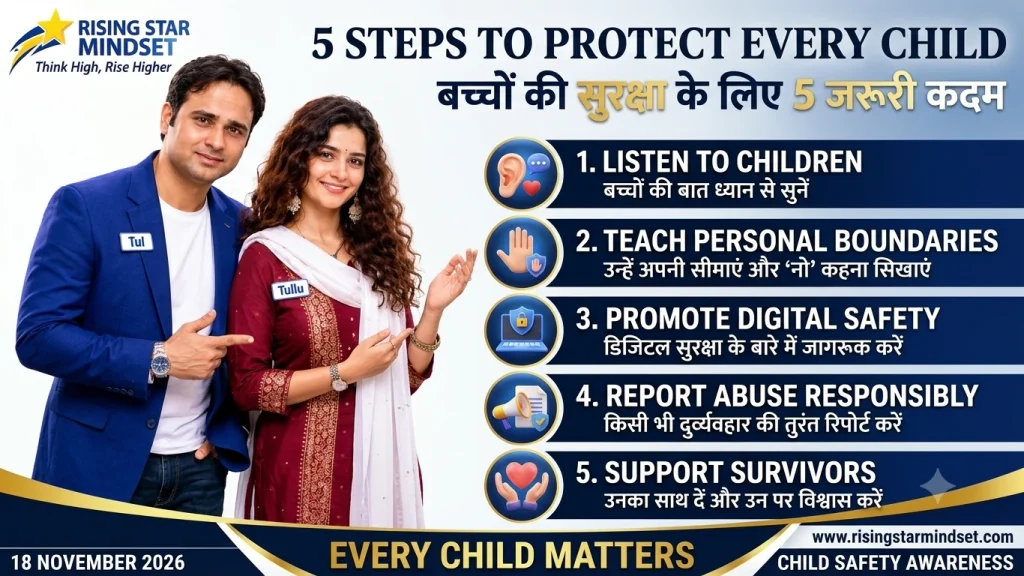
4. Different Forms of Violence and Exploitation Against Children ( Child Sexual Abuse Prevention 2026 )
Child abuse and exploitation do not always appear in the same form. Sometimes the signs are visible, while in other situations children may experience emotional distress or fear without being able to explain what is happening.
Understanding different forms of harm can help adults recognise concerns and respond appropriately.
4.1 Physical Violence
Physical violence involves deliberately causing physical harm to a child. It may occur at home, in schools, institutions or other places where children should feel protected.
For example, hitting, kicking, burning or deliberately injuring a child can have serious physical and emotional consequences.
4.2 Emotional and Psychological Abuse
Repeated humiliation, threats, intimidation, rejection and constant fear can affect a child’s emotional development.
Moreover, children need encouragement, respect and emotional security to build confidence and healthy relationships.
4.3 Sexual Exploitation and Abuse
Sexual exploitation and abuse involve inappropriate sexual conduct or the exploitation of a child for sexual purposes.
Children cannot be held responsible for abuse committed against them. The responsibility always lies with the person who causes harm.
Therefore, adults and institutions must take concerns seriously and ensure that children receive appropriate protection and support.
4.4 Online Exploitation
Digital platforms can be misused to manipulate children, threaten them, request inappropriate images or expose them to harmful interactions.
For this reason, children need age-appropriate digital safety education and access to trusted adults who can help them.
4.5 Neglect and Lack of Protection
Neglect can involve failing to provide essential care, supervision, safety or support required for a child’s well-being.
Children need proper care, attention and protection to grow in a healthy environment.
हिंदी में समझें
बच्चों के साथ होने वाली हिंसा केवल शारीरिक चोट तक सीमित नहीं होती। मानसिक प्रताड़ना, यौन शोषण, ऑनलाइन उत्पीड़न और आवश्यक देखभाल की कमी भी उनके जीवन को प्रभावित कर सकती है।
इसलिए बच्चों की सुरक्षा के लिए शारीरिक, मानसिक, भावनात्मक और डिजिटल सुरक्षा पर एक साथ ध्यान देना जरूरी है।
5. How Parents Can Support Child Sexual Abuse Prevention 2026
Parents and caregivers play an important role in building a child’s first protective environment. However, protection should not depend only on strict rules or constant monitoring.
Children also need trust, communication and the confidence to seek help whenever something makes them uncomfortable.
Here are six practical steps families can follow.
5.1 Build an Environment of Trust
Encourage children to share their experiences, worries and uncomfortable situations.
Listen patiently instead of immediately blaming, scolding or questioning them. Furthermore, make time for regular conversations so that children feel comfortable discussing their problems.
5.2 Teach Body Safety and Personal Boundaries
Explain personal boundaries in simple, age-appropriate language.
Children should understand that:
- They have the right to say no to uncomfortable contact.
- Their bodies deserve respect.
- They can move away from situations that make them feel unsafe.
- They can ask a trusted adult for help.
- They do not have to obey every adult without question.
5.3 Explain Safe and Unsafe Secrets
Children should understand that nobody has the right to pressure them into keeping secrets involving threats, inappropriate behaviour or uncomfortable interactions.
For example, a surprise birthday party may be a happy secret for a short time. However, a secret that makes a child frightened or uncomfortable should always be shared with a trusted adult.
5.4 Understand Their Digital Activities
Know which apps, games and online platforms children use.
Discuss privacy settings, unknown contacts, suspicious messages and the importance of not sharing personal information with strangers.
In addition, encourage children to ask for help whenever an online interaction makes them uncomfortable.
5.5 Identify Trusted Adults
Help children identify more than one trusted adult they can approach if they feel unsafe.
These may include:
- Parents or caregivers.
- Trusted relatives.
- Teachers.
- School counsellors.
- Authorised child protection professionals.
Having more than one trusted person can make it easier for a child to seek help.
5.6 Respect Their Feelings
Never dismiss a child’s fear, discomfort or concerns as imagination or overreaction.
Instead, listen carefully and take their words seriously. A child who feels heard is more likely to ask for help when needed.
हिंदी में समझें
माता-पिता बच्चों को सुरक्षित रखने में महत्वपूर्ण भूमिका निभाते हैं। इसके लिए बच्चों के साथ विश्वास का रिश्ता बनाना जरूरी है।
उन्हें व्यक्तिगत सीमाओं, सुरक्षित और असुरक्षित व्यवहार तथा इंटरनेट सुरक्षा के बारे में उनकी उम्र के अनुसार समझाएं।
सबसे जरूरी बात यह है कि यदि कोई बच्चा अपनी परेशानी बताता है, तो उसे डांटने या दोष देने के बजाय उसकी बात ध्यान से सुनें।
इस प्रकार परिवार में विश्वास और खुली बातचीत का वातावरण बनाकर Child Sexual Abuse Prevention 2026 के उद्देश्य को व्यवहार में लाया जा सकता है।
6. Digital Safety: Protecting Children in the Online World on Child Sexual Abuse Prevention 2026
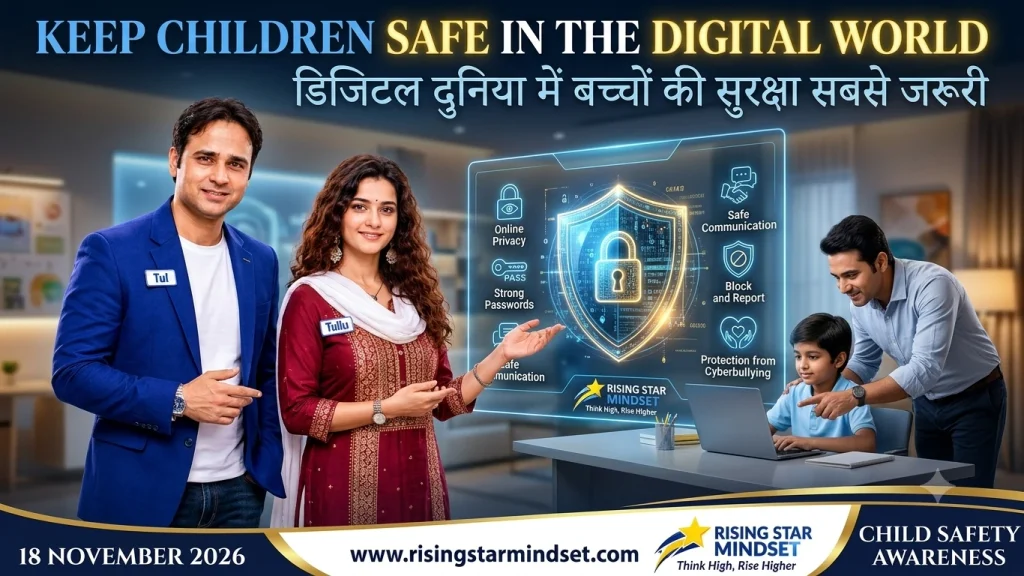
Technology has transformed education, communication and entertainment. Children now use smartphones, online games, social media and educational platforms from an early age.
These technologies offer valuable opportunities. However, their misuse can expose children to serious risks.
Therefore, parents and caregivers should teach children how to use digital platforms responsibly.
Common Digital Risks and Recommended Safety Actions
| Digital Risk | Recommended Safety Action |
| Unknown online contacts | Do not share personal details with strangers |
| Suspicious messages | Avoid responding and report inappropriate communication |
| Requests for private images | Never feel pressured to send personal images |
| Cyberbullying | Save relevant evidence and seek adult support |
| Public social media profiles | Review privacy and audience settings |
| Unsafe websites | Use age-appropriate content restrictions |
| Online gaming risks | Discuss safe communication and reporting tools |
| Account security | Use strong passwords and suitable security settings |
Five Digital Safety Rules Every Child Should Know from Child Sexual Abuse Prevention 2026
- Never share your home address, school details, phone number or passwords with unknown people online.
- Do not accept suspicious friend requests or private messages.
- Never agree to send private photographs because someone threatens, pressures or manipulates you.
- Tell a trusted adult if an online interaction makes you uncomfortable or frightened.
- Block and report suspicious accounts rather than engaging with people who threaten or exploit you.
Moreover, parents should remember that digital monitoring alone cannot replace communication. Children need to understand why online safety matters.
हिंदी में समझें
आज के समय में बच्चों की सुरक्षा के लिए इंटरनेट की सही जानकारी होना बहुत जरूरी है।
बच्चों को बताएं कि वे अनजान लोगों से निजी जानकारी साझा न करें, किसी के दबाव में अपनी तस्वीरें न भेजें और ऑनलाइन किसी भी प्रकार की धमकी या परेशानी मिलने पर तुरंत भरोसेमंद बड़े व्यक्ति को बताएं।
हालांकि, इंटरनेट का इस्तेमाल पूरी तरह रोकना हमेशा समाधान नहीं होता। सही डिजिटल शिक्षा, जिम्मेदार निगरानी और बच्चों के साथ बातचीत अधिक उपयोगी हो सकती है।
7. What Should Adults Do If a Child Reports Abuse?
One of the most important parts of child protection is knowing how to respond when a child shares an uncomfortable or harmful experience.
An adult’s response can influence whether a child feels safe enough to seek further help.
Therefore, follow these essential steps:
7.1 Listen Calmly
Give the child your full attention. Allow them to speak at their own pace without interruption or pressure.
7.2 Believe and Reassure
Tell the child that you take their concern seriously and that the abuse is not their fault.
7.3 Avoid Blame
Never shame, threaten or punish a child for sharing an experience. They need support, not criticism.
7.4 Do Not Interrogate
Avoid repeated or leading questions. Allow trained professionals to conduct appropriate interviews.
7.5 Ensure Immediate Safety
Take reasonable steps to prevent further contact with the person suspected of causing harm. If the child is in immediate danger, contact emergency services.
7.6 Seek Professional Assistance
Contact appropriate child protection authorities, healthcare professionals or trained support organisations.
7.7 Report Appropriately
Follow local child protection and reporting laws. If there is immediate danger, seek urgent assistance from the relevant authorities.
7.8 Protect the Child’s Privacy
Do not share the child’s identity, photographs or personal information publicly.
A child who has experienced abuse may need medical care, psychological support, legal assistance and long-term emotional care.
Furthermore, healing takes time. Every child deserves patience, dignity and professional support.
हिंदी में समझें
यदि कोई बच्चा अपने साथ हुई गलत घटना के बारे में बताता है, तो सबसे पहले शांत रहें और उसकी बात ध्यान से सुनें।
उसे भरोसा दिलाएं कि उसकी कोई गलती नहीं है। उसे डांटें नहीं, शर्मिंदा न करें और बार-बार सवाल पूछकर परेशान न करें।
इसके बाद बच्चे की तत्काल सुरक्षा सुनिश्चित करें और संबंधित बाल संरक्षण अधिकारियों तथा योग्य विशेषज्ञों से सहायता लें।
ध्यान रखें, बच्चे की पहचान और निजी जानकारी सार्वजनिक करना उसकी परेशानी को और बढ़ा सकता है। इसलिए उसकी गोपनीयता का सम्मान करना भी बेहद जरूरी है।
8. The Role of Schools, Teachers and Communities in Child Sexual Abuse Prevention 2026

Child protection cannot be achieved through parents alone. Schools, sports organisations, healthcare institutions, community groups and local authorities also have important responsibilities.
Educational institutions should create clear safeguarding policies and ensure that children know where to seek help.
Important Child Protection Responsibilities from Child Sexual Abuse Prevention 2026
| Institution / Group | Important Responsibility |
| Schools | Establish child safeguarding policies and safe reporting systems |
| Teachers | Recognise concerns and respond without blaming children |
| Parents | Encourage open communication and digital awareness |
| Healthcare professionals | Provide sensitive medical care and appropriate referrals |
| Community organisations | Conduct awareness and child safety programmes |
| Governments | Strengthen child protection laws and services |
| Technology companies | Improve reporting, privacy and child safety measures |
| Media organisations | Protect children’s identities and report responsibly |
Why Child-Friendly Reporting Systems Matter on Child Sexual Abuse Prevention 2026
Children may hesitate to report abuse because of fear, shame, threats or uncertainty about what will happen next.
Therefore, schools and organisations should provide accessible, confidential and child-sensitive ways to raise concerns.
Every report should be handled responsibly, with the child’s safety and dignity as the priority.
हिंदी में समझें
बच्चों की सुरक्षा केवल माता-पिता का काम नहीं है। स्कूल, शिक्षक, डॉक्टर, प्रशासन, सामाजिक संस्थाएं और तकनीकी कंपनियां भी इस जिम्मेदारी का हिस्सा हैं।
हर स्कूल में शिकायत करने की सुरक्षित व्यवस्था होनी चाहिए। बच्चों को यह पता होना चाहिए कि किसी समस्या के समय वे किससे संपर्क कर सकते हैं।
इसलिए परिवार और संस्थानों के बीच सहयोग बच्चों के लिए अधिक सुरक्षित वातावरण बनाने में मदद कर सकता है।
9. Child Sexual Abuse Prevention 2026: Why Responsible Media Reporting Matters
In 2026, the Council of Europe’s edition of the 18 November child protection observance focuses on “Ethical media reporting on sexual violence against children.”
This is an important reminder that media organisations, websites, journalists and social media creators must report sensitive cases responsibly.
News reporting should increase public awareness without exposing children to further harm.
Essential Principles of Responsible Reporting from Child Sexual Abuse Prevention 2026
- Never publish a child’s identity without lawful justification and appropriate protection.
- Avoid photographs that reveal the identity of victims or survivors.
- Do not share private details, addresses or identifying information.
- Avoid sensational headlines and disturbing descriptions.
- Respect the dignity and privacy of survivors.
- Share verified information instead of rumours.
- Focus on prevention, accountability and available support.
Why Responsible Reporting Matters for Digital Publishers
Websites and content creators also have a responsibility to protect vulnerable people.
Awareness articles should educate readers without exposing private identities or exploiting painful experiences to attract clicks.
Moreover, a responsible article can be informative, engaging and search-friendly while maintaining ethical standards.
हिंदी में समझें Child Sexual Abuse Prevention 2026 को
2026 में Council of Europe ने 18 नवंबर के अपने जागरूकता अभियान में बच्चों के विरुद्ध यौन हिंसा से संबंधित समाचारों की नैतिक रिपोर्टिंग पर विशेष ध्यान दिया है।
मीडिया और वेबसाइटों को ऐसी खबरें प्रकाशित करते समय बच्चों की पहचान, तस्वीरों और निजी जानकारी की सुरक्षा करनी चाहिए।
समाचार का उद्देश्य जागरूकता बढ़ाना होना चाहिए, न कि पीड़ित बच्चों की परेशानी को सनसनीखेज तरीके से प्रस्तुत करना।
10. Child Sexual Abuse Prevention 2026: What Can We Do Today?
Awareness becomes meaningful when it leads to action. Families, schools and community organisations can take small but important steps to improve child safety.
Here is a practical action plan for different groups.
Parents: Building a Safe Environment
- Spend quality time listening to children.
- Discuss personal boundaries and online safety.
- Review the privacy settings of devices and applications.
- Identify trusted adults who can help children.
- Take children’s concerns seriously.
Creating Safer Schools and Classrooms

- Review existing child safeguarding policies.
- Establish safe and accessible reporting channels.
- Train staff to respond appropriately to disclosures.
- Include age-appropriate personal safety education.
- Protect children’s identities and confidential information.
Community Action for Child Protection
- Organise child safety awareness programmes.
- Share verified information about available support services.
- Encourage reporting of suspected abuse through appropriate channels.
- Support survivors without stigma or discrimination.
- Promote safer environments in public spaces and institutions.
Responsible Digital Content and Online Safety
- Avoid publishing identifying details of child survivors.
- Use reliable sources for awareness articles.
- Do not use disturbing images to attract attention.
- Share practical prevention information.
- Encourage responsible online behaviour.
हिंदी में समझें
बच्चों की सुरक्षा के लिए केवल भाषण और सोशल मीडिया पोस्ट पर्याप्त नहीं हैं। हमें अपने घर, स्कूल और समाज में वास्तविक बदलाव लाने होंगे।
माता-पिता बच्चों से बातचीत करें, शिक्षक सुरक्षित स्कूल वातावरण बनाएं, समुदाय जागरूकता फैलाए और डिजिटल प्लेटफॉर्म बच्चों की गोपनीयता तथा सुरक्षा को प्राथमिकता दें।
इस प्रकार छोटे-छोटे प्रयास मिलकर एक बड़ा सकारात्मक बदलाव ला सकते हैं।

11. Frequently Asked Questions About Child Sexual Abuse Prevention 2026
1. What is Child Sexual Abuse Prevention 2026?
Child Sexual Abuse Prevention 2026 refers to awareness, education and practical efforts to prevent child sexual abuse, protect children’s rights and support children who have experienced exploitation or violence.
हिंदी: इसका अर्थ है बच्चों को यौन शोषण से बचाने, उनके अधिकारों की रक्षा करने और प्रभावित बच्चों को सहायता देने के लिए जागरूकता तथा व्यावहारिक प्रयास करना।
2. When is the World Day for the Prevention of and Healing from Child Sexual Exploitation, Abuse and Violence observed?
It is observed every year on 18 November.
हिंदी: यह वैश्विक दिवस हर साल 18 नवंबर को मनाया जाता है।
3. When was this global day established?
The United Nations General Assembly adopted Resolution A/RES/77/8 on 7 November 2022.
हिंदी: संयुक्त राष्ट्र महासभा ने 7 नवंबर 2022 को प्रस्ताव A/RES/77/8 अपनाया था।
4. What is the main objective of this day?
Its main objective is to raise awareness, prevent child exploitation and abuse, strengthen protection systems, promote justice and support survivors.
हिंदी: इसका मुख्य उद्देश्य बच्चों के शोषण और हिंसा को रोकना, सुरक्षा व्यवस्था मजबूत करना, न्याय को बढ़ावा देना और प्रभावित बच्चों की सहायता करना है।
5. Can child exploitation happen online?
Yes. Digital platforms can be misused for manipulation, harassment, exploitation and other forms of abuse. Children need age-appropriate digital safety education and access to trusted adults.
हिंदी: हां, इंटरनेट और डिजिटल प्लेटफॉर्म का गलत इस्तेमाल बच्चों को शोषण, धमकी और उत्पीड़न के खतरे में डाल सकता है।
6. How can parents help prevent child abuse?
Parents can build trust, teach personal boundaries, discuss online safety, listen to children’s concerns and seek professional assistance when necessary.
हिंदी: माता-पिता बच्चों के साथ विश्वास का रिश्ता बनाकर, व्यक्तिगत सीमाओं और इंटरनेट सुरक्षा की जानकारी देकर तथा उनकी बात ध्यान से सुनकर मदद कर सकते हैं।
7. What should a child do if someone makes them uncomfortable?
The child should move towards safety if possible, tell a trusted adult and seek help. They should never feel responsible for another person’s abusive behaviour.
हिंदी: यदि कोई व्यक्ति बच्चे को असहज महसूस कराता है, तो बच्चे को सुरक्षित स्थान पर जाना चाहिए और किसी भरोसेमंद बड़े व्यक्ति को बताना चाहिए। इसमें बच्चे की कोई गलती नहीं होती।
8. What is the 2026 focus of the Council of Europe’s 18 November campaign?
The 2026 edition focuses on ethical media reporting on sexual violence against children.
हिंदी: 2026 में Council of Europe का विशेष ध्यान बच्चों के विरुद्ध यौन हिंसा से जुड़ी खबरों की नैतिक और जिम्मेदार रिपोर्टिंग पर है।
9. What is the role of schools in preventing abuse?
Schools should maintain safeguarding policies, train staff, provide child-friendly reporting channels and create a respectful learning environment.
हिंदी: स्कूलों को बच्चों की सुरक्षा के नियम बनाने, शिक्षकों को प्रशिक्षित करने और शिकायत करने की सुरक्षित व्यवस्था उपलब्ध कराने की जरूरत है।
10. Why is survivor support important?
Children who experience abuse may need medical, psychological and social support. Compassionate care, justice and privacy can help them recover and rebuild their lives.
हिंदी: शोषण का सामना करने वाले बच्चों को चिकित्सा, मानसिक और सामाजिक सहायता की जरूरत हो सकती है। संवेदनशील व्यवहार और उचित सहायता उनके पुनर्वास में मदद कर सकती है।
12. Key Takeaways: Every Child Deserves Protection on Child Sexual Abuse Prevention 2026
Child Sexual Abuse Prevention 2026 is a reminder that children’s safety must never be treated as an optional responsibility.
Here are the most important lessons:
- Every child has the right to live with dignity and without fear.
- Parents should build trust and encourage open communication.
- Children should learn about personal boundaries and body safety.
- Digital safety education is essential in today’s connected world.
- Schools and institutions must maintain child safeguarding policies.
- Adults should listen calmly and take children’s concerns seriously.
- Survivors deserve privacy, justice, professional care and compassion.
- Media organisations must report sensitive cases responsibly.
Moreover, technology should empower children, not expose them to exploitation. Media should spread awareness, not compromise their dignity. Communities should support survivors, not blame them.
A Message for Every Parent, Teacher and Citizen on Child Sexual Abuse Prevention 2026

Protecting a child is not only about preventing harm. It is also about creating a world where every child can grow, learn, dream and live without fear.
Let us work together to build a future where childhood is protected and every child’s voice is heard.
Every Child Matters. Every Childhood Deserves Protection.
Let us protect children today for a safer tomorrow.
References and Further Reading on Child Sexual Abuse Prevention 2026
For more reliable information, readers can explore these official resources:
- United Nations – World Day for the Prevention of and Healing from Child Sexual Exploitation, Abuse and Violence.
- World Health Organization – Global efforts to end violence against children.
- UNICEF – Technology-facilitated sexual exploitation and abuse of children.
- Council of Europe – Ethical media reporting on sexual violence against children.
Educational and Awareness Note: This article is intended to promote child safety, prevention and access to support. It is not a substitute for professional medical, legal or child protection advice.