
Discover how science transforms our world through AI, space exploration, healthcare, clean energy and global cooperation.

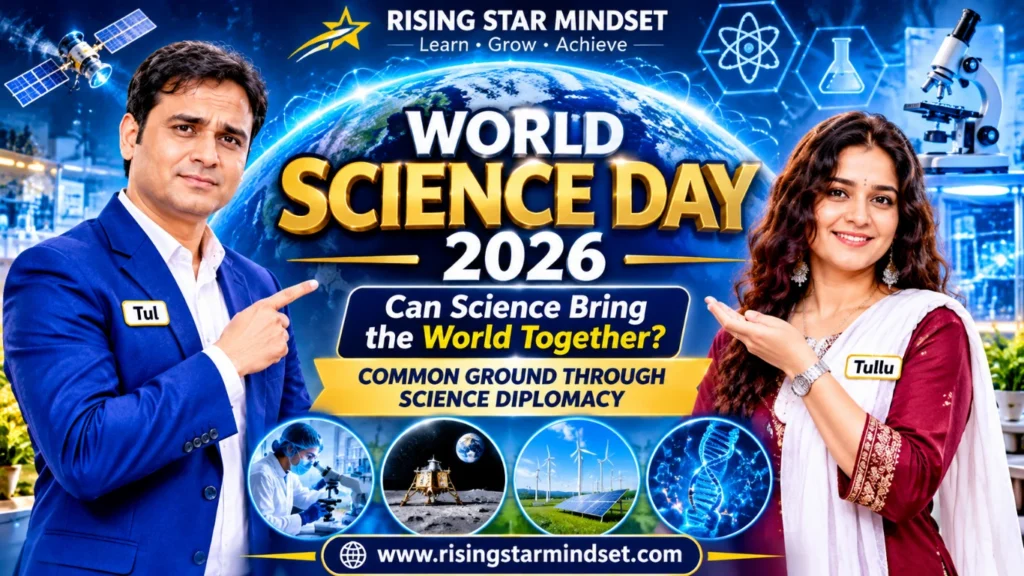
World Science Day for Peace and Development 2026 will be observed on 10 November 2026. This important international observance highlights how science can bring people and nations together, encourage peaceful cooperation and help create a sustainable future. The 2026 theme, announced by UNESCO, is “Common Ground Through Science Diplomacy.”
But have you ever wondered how scientific discoveries can help countries overcome differences? How can scientists from different nations work together to fight diseases, protect the environment and develop new technologies?
Science is not just about laboratories, complicated equations or expensive machines. It is connected to almost every part of our daily lives, from the clean water we drink to the smartphones we use.
On this World Science Day, let’s explore how science connects the world, why international scientific cooperation matters, and what students and young people can do to contribute to a better future.
PREVIOUS POST : X-Ray to MRI: The Amazing Technology That Helps Save Lives
A Quick Look: World Science Day 2026
| Important Information | Details |
| Observance | World Science Day for Peace and Development |
| Date | 10 November 2026 |
| Day | Tuesday |
| 2026 Theme | Common Ground Through Science Diplomacy |
| Promoted by | UNESCO |
| First proclaimed | 2001 |
| First celebration | 10 November 2002 |
| Main Purpose | Science for peace and sustainable development |
| Global Focus | Scientific cooperation and shared knowledge |
Contents: Explore the Important Topics
- What Is World Science Day for Peace and Development?
- What Is the Theme of World Science Day 2026?
- Understanding Science Diplomacy in Simple Words
- Why Does the World Need Science for Peace?
- Seven Ways Science Is Changing Our World
- How Science Helps India and the World
- Science and the United Nations Sustainable Development Goals
- Challenges Facing Modern Science
- How Students Can Become Future Scientists
- Interesting Facts About Science
- English and Hindi Explanation
- Important Questions and Answers
- Multiple Choice Questions (MCQs)
- Higher Order Thinking Skills (HOTS)
- Frequently Asked Questions
1. What Is World Science Day for Peace and Development?
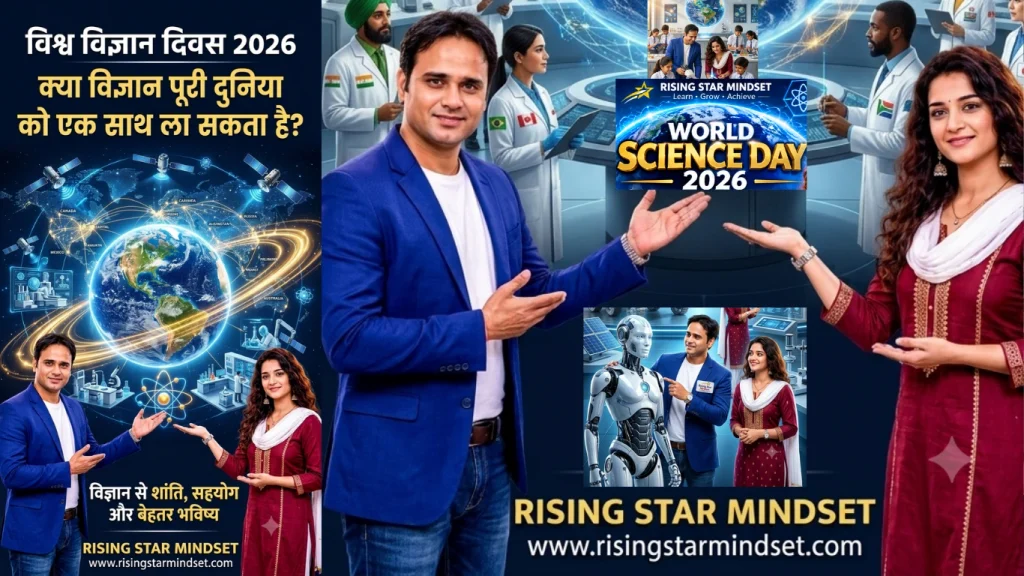
World Science Day for Peace and Development is an international observance that highlights the importance of science in society.
It encourages people to understand how scientific knowledge can improve human life, support peaceful societies and contribute to sustainable development.
The day also reminds governments, educational institutions, researchers and ordinary citizens that science should benefit everyone, not just a small group of people.
Science helps us understand the world around us. It explains how diseases spread, how weather changes, how plants grow, how technology works and how we can protect our planet.
However, scientific discoveries become truly valuable when they are used responsibly for the benefit of humanity.
A Simple Example : ( World Science Day 2026 )
Imagine that scientists in one country discover a new method of detecting a disease. If this knowledge is shared with researchers and hospitals in other countries, more people may benefit from that discovery.
This is one way scientific cooperation can contribute to global development.
2. What Is the Theme of World Science Day 2026?
The official theme for 2026 is:
Common Ground Through Science Diplomacy
This theme highlights the importance of using scientific knowledge and international cooperation to build understanding between countries.
The world faces many challenges that cannot be solved by one country alone. Climate change, infectious diseases, food security, water shortages and environmental pollution affect people across national borders.
Scientific collaboration allows countries to exchange knowledge, share research and work towards common solutions.
What Does This Theme Mean?
In simple words, science can become a bridge between countries that may have different cultures, languages, political systems or economic interests.
When researchers work together to solve a common problem, their shared scientific goals can encourage dialogue and cooperation.
For example, scientists from different countries can collaborate on climate research, medical discoveries, ocean protection and space exploration.
The message is simple: humanity may have different national identities, but many of its challenges are shared.
3. Understanding Science Diplomacy in Simple Words
Science diplomacy is the use of scientific cooperation, knowledge and expertise to support international relationships and address common global challenges.
It connects two important areas:
- Science: Research, experiments, discoveries and innovation.
- Diplomacy: Communication, cooperation and relationships between countries.
Three Important Dimensions of Science Diplomacy
| Dimension | Meaning | Example |
| Science in Diplomacy | Scientific knowledge helps governments make decisions | Climate research supporting environmental agreements |
| Diplomacy for Science | International relationships support scientific research | Countries cooperating on large research projects |
| Science for Diplomacy | Scientific collaboration builds trust between countries | Researchers sharing knowledge across borders |
Hindi Explanation (हिंदी में समझिए) ( World Science Day 2026 )
Science Diplomacy का अर्थ है विज्ञान के माध्यम से देशों के बीच सहयोग और बेहतर संबंध स्थापित करना।
जब अलग-अलग देशों के वैज्ञानिक किसी बीमारी, जलवायु परिवर्तन या अंतरिक्ष अनुसंधान जैसी समस्या पर मिलकर काम करते हैं, तो इससे ज्ञान का आदान-प्रदान होता है और आपसी समझ बढ़ती है।
उदाहरण के लिए, यदि दो देश मिलकर किसी नई बीमारी के उपचार पर शोध करते हैं, तो उसका लाभ केवल उन दो देशों को ही नहीं, बल्कि पूरी दुनिया को मिल सकता है।
4. Why Does the World Need Science for Peace?

Peace does not simply mean the absence of war. It also includes safety, health, education, equality, opportunities and cooperation.
Science can contribute to these goals in several ways.
A. Fighting Global Diseases
Medical research helps scientists understand diseases, develop diagnostic methods and improve treatments.
International cooperation allows researchers to exchange important findings and improve responses to health emergencies.
B. Protecting the Environment
Scientists study air pollution, deforestation, ocean health and rising temperatures.
Their research helps communities and governments make informed environmental decisions.
C. Improving Food Security
Agricultural science helps farmers understand soil health, crop diseases, water management and sustainable farming methods.
D. Supporting Disaster Management
Weather forecasting, satellite technology and early-warning systems can help communities prepare for floods, cyclones and other natural disasters.
E. Building Educational Opportunities
Digital learning platforms, scientific resources and international academic collaboration allow students to access knowledge beyond geographical boundaries.
5. Seven Ways Science Is Changing Our World ( World Science Day 2026 )
Science is not limited to research institutions. Its impact can be seen in ordinary activities.
1. Artificial Intelligence (AI)
Artificial Intelligence enables computers to perform tasks that usually require human intelligence, such as recognizing patterns, understanding language and analysing information.
AI can assist in medical research, education, agriculture and transportation. However, it must be developed and used responsibly.
2. Space Exploration
Space research helps us understand our universe and develop technologies that can also benefit life on Earth.
Satellites support weather forecasting, communication, navigation and environmental monitoring.
3. Medical Technology
Modern medical technology has improved disease detection and treatment.
Examples include MRI scanners, CT scans, ultrasound systems, robotic-assisted procedures and advanced laboratory testing.
4. Renewable Energy
Solar, wind and other renewable energy technologies offer alternatives to fossil fuels.
They can contribute to cleaner energy systems when supported by suitable infrastructure.
5. Agricultural Innovation
Scientific farming methods, improved seeds, precision agriculture and soil testing can help farmers use resources more efficiently.
6. Clean Water Technology
Water purification, wastewater treatment and desalination technologies can help improve access to safe water.
7. Climate Research
Scientific observations help researchers understand changing weather patterns, temperature trends and environmental risks.
This knowledge is important for planning a more resilient future.
6. How Science Helps India and the World ( World Science Day 2026 )
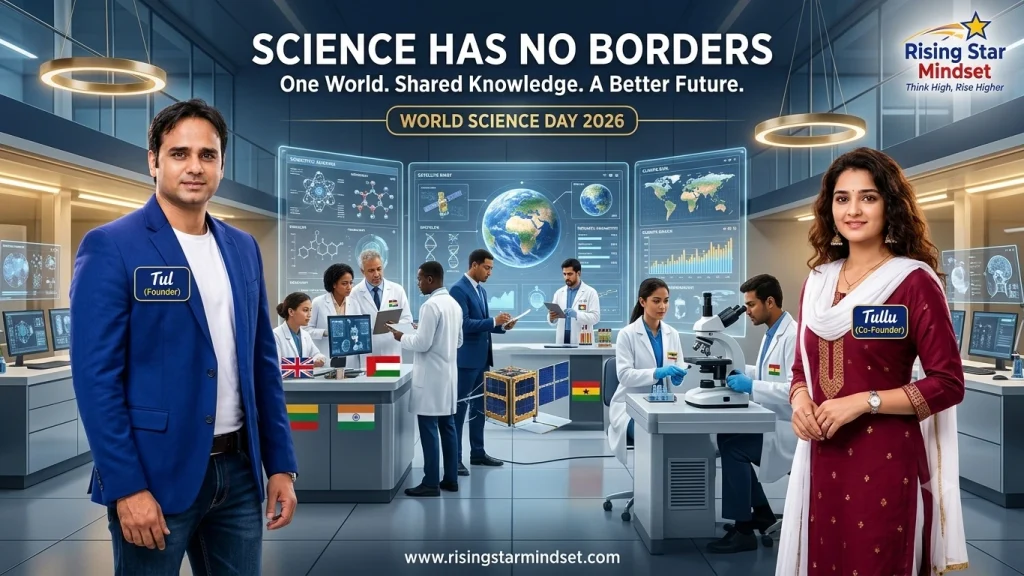
India has made important contributions to science, technology, space research, healthcare and agriculture.
Here are some examples of Indian scientific achievements and institutions.
| Indian Contribution | Organisation / Mission | Importance |
| Mars Orbiter Mission | ISRO | Demonstrated India’s Mars exploration capability |
| Chandrayaan-3 | ISRO | Achieved a successful soft landing near the lunar south polar region |
| Aditya-L1 | ISRO | Studies the Sun and solar activity |
| Digital healthcare initiatives | Government and research institutions | Support technology-enabled healthcare services |
| Agricultural research | ICAR | Supports agricultural development and research |
| Vaccine research and manufacturing | Indian research and pharmaceutical sector | Contributes to global healthcare |
India’s Role in Space Science ( World Science Day 2026 )

India’s space programme demonstrates how scientific research can create opportunities for innovation and development.
Chandrayaan-3 achieved a historic lunar landing in August 2023. Its success demonstrated the importance of engineering, teamwork and scientific research.
Aditya-L1, India’s first space-based solar observatory, is designed to study the Sun and help scientists understand solar phenomena.
These achievements also inspire students to explore careers in science, mathematics, engineering and technology.
Hindi Explanation (भारत का विज्ञान में योगदान)
भारत ने अंतरिक्ष विज्ञान, चिकित्सा, कृषि और तकनीक के क्षेत्र में महत्वपूर्ण उपलब्धियाँ हासिल की हैं।
चंद्रयान-3 की सफल चंद्र लैंडिंग और आदित्य-L1 मिशन इस बात के उदाहरण हैं कि वैज्ञानिक अनुसंधान किस प्रकार देश की तकनीकी क्षमता को आगे बढ़ा सकता है।
इन उपलब्धियों से युवाओं को विज्ञान और अनुसंधान के क्षेत्र में आगे बढ़ने की प्रेरणा मिलती है।
7. Science and the United Nations Sustainable Development Goals ( World Science Day 2026 )
Science plays an important role in achieving the United Nations Sustainable Development Goals (SDGs).
These goals aim to create a better world by addressing poverty, health, education, inequality and environmental challenges.
| SDG Number | Sustainable Development Goal | How Science Contributes |
| Goal 2 | Zero Hunger | Better agricultural research and food production |
| Goal 3 | Good Health and Well-being | Medical research and disease prevention |
| Goal 4 | Quality Education | Digital education and scientific learning |
| Goal 6 | Clean Water and Sanitation | Water purification and treatment |
| Goal 7 | Affordable and Clean Energy | Renewable energy technologies |
| Goal 9 | Industry, Innovation and Infrastructure | Research and technological development |
| Goal 13 | Climate Action | Climate monitoring and environmental research |
| Goal 14 | Life Below Water | Marine research and ocean conservation |
| Goal 15 | Life on Land | Biodiversity and ecosystem protection |
Science alone cannot achieve these goals. Governments, businesses, communities and individuals must also work together.
8. Challenges Facing Modern Science ( World Science Day 2026 )
Although science has created remarkable opportunities, the world still faces several challenges.
1. Unequal Access to Scientific Knowledge
Not every country has the same research facilities, funding or educational resources.
2. Misinformation
False scientific claims can spread quickly through social media and digital platforms.
People need scientific literacy and reliable sources to distinguish evidence from misinformation.
3. Ethical Concerns About Artificial Intelligence
AI raises important questions about privacy, fairness, transparency and employment.
4. Environmental Costs
Some technologies require significant energy and natural resources. Scientific innovation must also consider environmental sustainability.
5. Lack of Research Opportunities
Many talented students and researchers lack access to laboratories, scholarships, mentors and advanced research facilities.
Addressing these challenges requires investment, education, transparency and international cooperation.
9. How Students Can Become Future Scientists
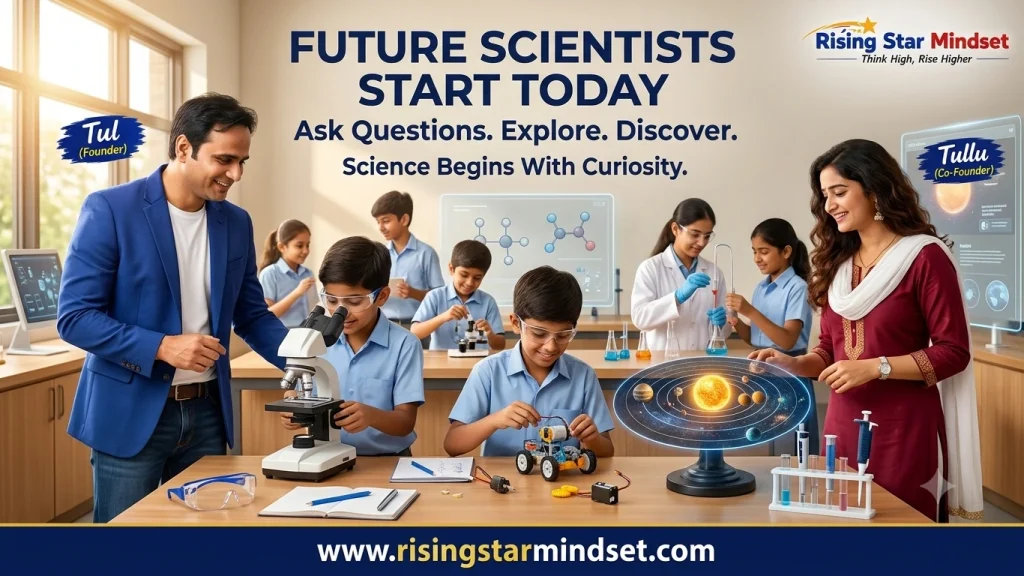
You do not need an expensive laboratory to begin developing a scientific mindset.
Every great scientific journey starts with curiosity.
Here are some practical ways students can develop scientific thinking.
| Activity | What Students Can Learn |
| Observe plants growing | Biology and environmental science |
| Study the night sky | Astronomy |
| Build simple models | Engineering and creativity |
| Perform safe school experiments | Observation and experimentation |
| Read science magazines | Scientific awareness |
| Learn basic coding | Computer science |
| Participate in science exhibitions | Communication and teamwork |
| Ask questions about everyday events | Critical thinking |
Five Habits of a Scientific Mind ( World Science Day 2026 )
- Ask questions instead of accepting everything without thinking.
- Observe carefully and collect information.
- Test ideas through safe experiments.
- Learn from mistakes and unexpected results.
- Respect evidence and remain open to new discoveries.
A Message for Young Minds ( World Science Day 2026 )
You do not have to become a famous scientist to make a difference.
A student who develops a low-cost water-saving idea, a farmer who adopts better agricultural practices or a young programmer who creates a useful educational application can contribute to society.
Curiosity, knowledge and responsible action are powerful tools for changing the world.
10. Interesting Facts About Science ( World Science Day 2026 )
Here are some interesting facts that show how science connects our everyday lives with the wider universe.
| No. | Interesting Fact | Why It Matters |
| 1 | The speed of light in a vacuum is approximately 299,792 kilometres per second. | It is a fundamental constant in physics. |
| 2 | Earth completes one revolution around the Sun in approximately 365.25 days. | This forms the basis of our calendar year. |
| 3 | The human heart beats around 100,000 times a day on average. | It demonstrates the importance of the circulatory system. |
| 4 | Satellites help scientists monitor weather and environmental changes. | They support forecasting and disaster preparedness. |
| 5 | DNA carries genetic information. | It helps explain heredity and biological characteristics. |
| 6 | Solar panels convert sunlight into electrical energy. | They support renewable energy production. |
| 7 | Scientific knowledge changes as new evidence becomes available. | Research is a continuous process of learning. |
Note: The heart-beat figure is an approximate educational estimate; actual rates vary between individuals.
11. English and Hindi Explanation: The Importance of Science
English
Science is one of the most powerful tools for improving human life. It helps us understand nature, solve problems and develop technologies that make everyday activities easier.
However, the real value of science lies not only in discoveries but also in how responsibly we use them.
When countries share scientific knowledge, they can work together to address common challenges such as climate change, disease, hunger and environmental pollution.
Science teaches us to question, observe, experiment and learn from evidence. These habits are important not only for scientists but also for every responsible citizen.
हिंदी में व्याख्या ( World Science Day 2026 )
विज्ञान मानव जीवन को बेहतर बनाने का एक महत्वपूर्ण साधन है। इसकी सहायता से हम प्रकृति को समझते हैं, समस्याओं का समाधान खोजते हैं और नई तकनीकों का विकास करते हैं।
लेकिन विज्ञान का वास्तविक महत्व केवल नई खोज करने में नहीं, बल्कि उन खोजों का उपयोग मानवता के कल्याण के लिए करने में है।
जब अलग-अलग देश वैज्ञानिक जानकारी और अनुसंधान को साझा करते हैं, तो वे जलवायु परिवर्तन, बीमारियों, भूख और प्रदूषण जैसी वैश्विक समस्याओं का समाधान खोजने में एक-दूसरे की सहायता कर सकते हैं।
विज्ञान हमें प्रश्न पूछना, निरीक्षण करना, प्रयोग करना और प्रमाण के आधार पर निष्कर्ष निकालना सिखाता है।
12. Important Questions and Answers ( World Science Day 2026 )
Q1. When is World Science Day for Peace and Development observed?
Answer: It is observed every year on 10 November.
Q2. What is the theme of World Science Day 2026?
Answer: Common Ground Through Science Diplomacy.
Q3. Which organisation promotes World Science Day?
Answer: UNESCO (United Nations Educational, Scientific and Cultural Organization).
Q4. When was World Science Day first proclaimed?
Answer: It was proclaimed by UNESCO in 2001.
Q5. When was the first World Science Day celebrated?
Answer: 10 November 2002.
Q6. What is science diplomacy?
Answer: It refers to the use of scientific cooperation and knowledge to support international relationships and address shared challenges.
Q7. How does science help protect the environment?
Answer: It helps researchers understand climate change, pollution, biodiversity loss and environmental risks.
Q8. What is the role of ISRO in Indian science?
Answer: ISRO develops and operates space missions and satellite technologies for scientific research and national development.
Q9. How can students develop scientific thinking?
Answer: By asking questions, observing nature, conducting safe experiments and learning from evidence.
Q10. Why is international scientific cooperation important?
Answer: Because many global challenges require knowledge, research and solutions that go beyond national boundaries.
13. Multiple Choice Questions (MCQs) ( World Science Day 2026 )
Test your knowledge with these questions.
1. World Science Day for Peace and Development is observed on:
A. 5 June
B. 10 November
C. 22 April
D. 15 August
2. What is the official theme of World Science Day 2026?
A. Science for Every Child
B. Innovation for a Better Earth
C. Common Ground Through Science Diplomacy
D. Science and Digital Education
3. Which organisation promotes World Science Day?
A. WHO
B. UNESCO
C. IMF
D. WTO
4. What does DNA carry?
A. Genetic information
B. Electrical energy
C. Sound waves
D. Solar energy
5. Which Indian organisation is responsible for India’s space programme?
A. ICAR
B. DRDO
C. ISRO
D. ICMR
6. Which technology helps convert sunlight into electricity?
A. Wind turbine
B. Solar panel
C. MRI scanner
D. Microscope
7. Which SDG focuses on climate action?
A. Goal 3
B. Goal 4
C. Goal 7
D. Goal 13
8. Science diplomacy mainly encourages:
A. International scientific cooperation
B. Scientific competition only
C. Stopping research
D. Limiting knowledge sharing
Answer Key: 1-B, 2-C, 3-B, 4-A, 5-C, 6-B, 7-D, 8-A.
14. Higher Order Thinking Skills (HOTS)
These questions encourage students to think beyond memorised facts.
Q1. If scientists from two countries with political differences work together to develop a life-saving medicine, how could this support peace?
Suggested Answer: Scientific cooperation can create shared goals, improve communication and build trust. It demonstrates that human welfare can be more important than political differences.
Q2. Should every scientific invention be used simply because it is technologically possible? Explain your answer.
Suggested Answer: No. Scientific inventions should be evaluated for their safety, ethical implications, environmental impact and effects on society.
Q3. How could students use science to solve a problem in their local community?
Suggested Answer: Students could study water wastage, waste management, local pollution or energy consumption and develop practical, evidence-based solutions.
Q4. Why is sharing scientific knowledge important for developing countries?
Suggested Answer: Knowledge sharing can improve research opportunities, education, healthcare and access to useful technologies.
15. Frequently Asked Questions (FAQs) ( World Science Day 2026 )
1. Is World Science Day celebrated every year?
Yes. World Science Day for Peace and Development is observed annually on 10 November.
2. Is World Science Day a United Nations observance?
Yes. It is an international observance promoted by UNESCO and recognised within the United Nations system.
3. What is the main objective of World Science Day?
Its main objective is to increase public awareness of the importance of science and encourage the responsible use of scientific knowledge for peaceful and sustainable societies.
4. What does Common Ground Through Science Diplomacy mean?
It means using scientific cooperation to encourage dialogue, shared understanding and solutions to common global challenges.
5. How can schools celebrate World Science Day?
Schools can organise science exhibitions, quizzes, debates, experiments, poster competitions and educational discussions.
6. Why is science important for sustainable development?
Science helps improve healthcare, agriculture, clean energy, education, water management and environmental protection.
7. Can science help create a peaceful world?
Science can support peace by encouraging international collaboration, sharing knowledge and helping countries address common problems.
Conclusion: Science Is a Bridge to a Better Future
World Science Day for Peace and Development 2026 reminds us that scientific knowledge has the power to connect people beyond geographical, cultural and political boundaries.
The theme, Common Ground Through Science Diplomacy, highlights an important message: when people work together to solve shared problems, science can become a powerful instrument of cooperation.
From medical discoveries and artificial intelligence to space exploration and climate research, science continues to create opportunities for a better future.
But progress does not depend only on scientists, laboratories or governments. It also depends on students, teachers, innovators and ordinary citizens who are willing to learn, think critically and act responsibly.
Remember: Science does not simply help us understand the world. It gives us the knowledge to improve it.
A Thought to Remember ( World Science Day 2026 )
“Science gives us knowledge, cooperation gives it direction, and humanity gives it purpose.”
Share Your Thoughts ( World Science Day 2026 )
What do you think is the most important role of science in today’s world?
- Finding cures for diseases?
- Protecting our planet?
- Developing new technologies?
- Bringing countries together?
Share your thoughts in the comments and encourage others to think about how science can create a better future.
Explore more educational articles, inspiring ideas and useful knowledge at Rising Star Mindset.
Visit: www.risingstarmindset.com