
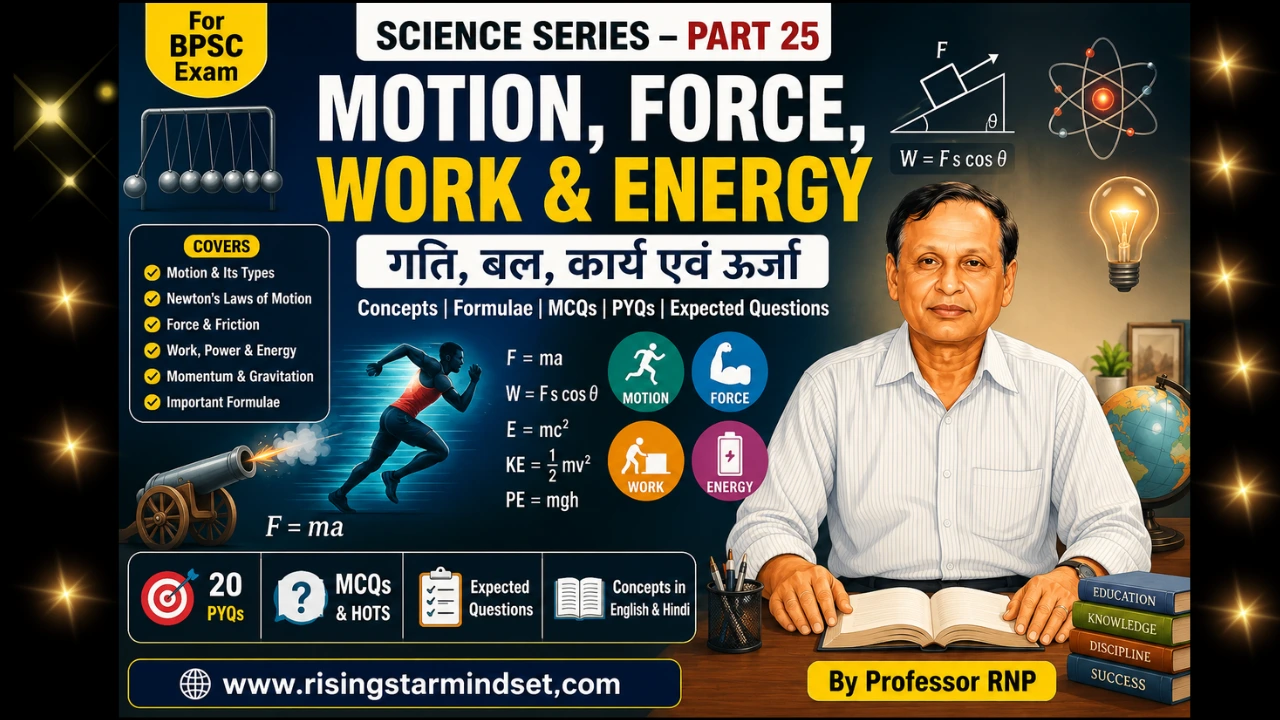
Science Series – Part 25 ( Motion Force Work Energy )
Previous Part: Bihar Economy
Next Part: Electricity, Magnetism and Light
Table of Contents ( Motion Force Work Energy )
- Introduction
- Motion (गति)
- Types of Motion
- Distance and Displacement
- Speed and Velocity
- Acceleration
- Newton’s Laws of Motion
- Force
- Friction
- Momentum
- Gravitation
- Work
- Power
- Energy
- Law of Conservation of Energy
- Abbreviations
- Key Points
- Important Formulae
- BPSC Previous Year Questions (20)
- Expected Questions
- HOTS Questions
- MCQs
- Question & Answers
- FAQs
- Conclusion
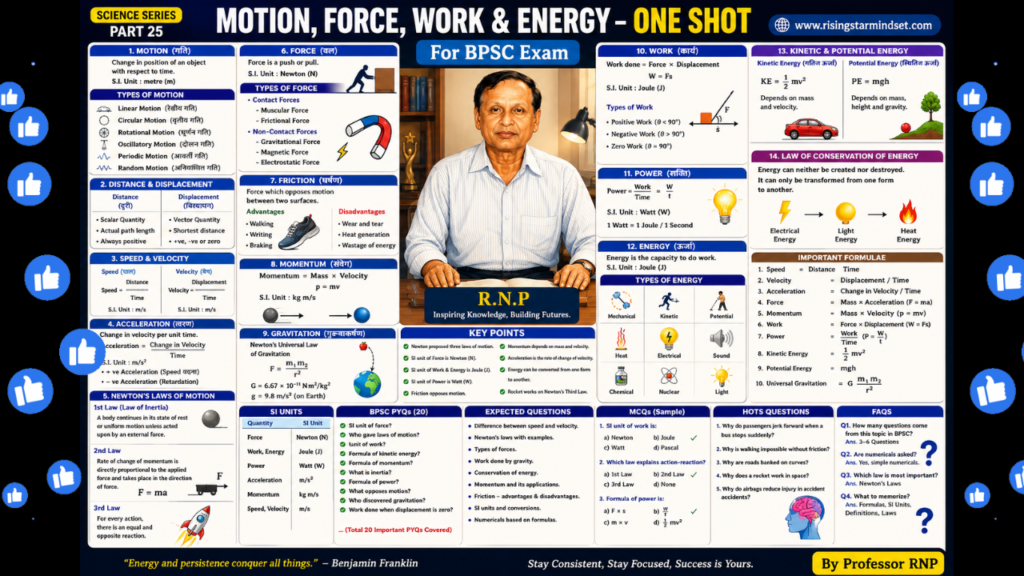
Introduction (English) ( Motion Force Work Energy )
Motion, Force, Work and Energy are among the most frequently asked topics in BPSC General Science. Every year, 3–6 questions are directly or indirectly asked from these concepts.
परिचय (Hindi)
गति, बल, कार्य एवं ऊर्जा BPSC विज्ञान का सबसे महत्वपूर्ण भाग है। लगभग प्रत्येक परीक्षा में इन अध्यायों से प्रश्न पूछे जाते हैं।
1. Motion (गति)
English
Motion is the change in position of an object with respect to time.
Hindi
समय के साथ किसी वस्तु की स्थिति में परिवर्तन को गति कहते हैं।
SI Unit
metre (m)
Types of Motion (गतियों के प्रकार)
| English | Hindi |
| Linear Motion | रेखीय गति |
| Circular Motion | वृत्तीय गति |
| Rotational Motion | घूर्णन गति |
| Oscillatory Motion | दोलन गति |
| Periodic Motion | आवर्ती गति |
| Random Motion | अनियमित गति |
Distance vs Displacement
| Distance | Displacement |
| Scalar | Vector |
| Path length | Shortest distance |
| Always positive | Can be positive, negative or zero |
Speed (चाल) ( Motion Force Work Energy )
Formula
Speed = Distance / Time
SI Unit
m/s
Velocity (वेग)
Velocity = Displacement / Time
It has both magnitude and direction.
Acceleration (त्वरण)
Acceleration = Change in Velocity / Time
SI Unit
m/s²
Positive Acceleration
Negative Acceleration (Retardation)
Newton’s First Law
Law of Inertia
“A body continues in its state unless acted upon by an external force.”
Newton’s Second Law
Force = Mass × Acceleration
F = ma
Newton’s Third Law
Every action has an equal and opposite reaction.
Examples
Walking
Rocket
Swimming
Gun recoil
Force (बल)
Force is a push or pull.
SI Unit
Newton (N)
Types of Force
Contact Force
Non-contact Force
Muscular Force
Magnetic Force
Gravitational Force
Electrostatic Force
Frictional Force
Friction (घर्षण)
Opposes motion.
Advantages
Walking
Writing
Braking
Disadvantages
Wear and tear
Heat generation
Momentum (संवेग)
Momentum = Mass × Velocity
p = mv
Unit
kg m/s
Gravitation (गुरुत्वाकर्षण)
Newton discovered Universal Law of Gravitation.
Formula
F = Gm₁m₂/r²
g = 9.8 m/s²
Work (कार्य)
Work = Force × Displacement
W = Fs
Unit
Joule
Positive Work
Negative Work
Zero Work
Power (शक्ति)
Power = Work / Time
SI Unit
Watt
James Watt
Energy (ऊर्जा)
Capacity to do work.
Types of Energy ( Motion Force Work Energy )
Mechanical
Potential
Kinetic
Heat
Sound
Electrical
Chemical
Nuclear
Solar
Wind
Kinetic Energy
KE = ½mv²
Potential Energy
PE = mgh
Law of Conservation of Energy
Energy can neither be created nor destroyed.
It only changes from one form to another.
Abbreviations
| Short Form | Full Form |
| SI | International System |
| KE | Kinetic Energy |
| PE | Potential Energy |
| CGS | Centimetre Gram Second |
| MKS | Metre Kilogram Second |
| N | Newton |
| J | Joule |
| W | Watt |
Important Formulae
Speed = Distance/Time
Velocity = Displacement/Time
Acceleration = Velocity/Time
Force = ma
Momentum = mv
Work = Fs
Power = W/t
KE = ½mv²
PE = mgh
Key Points
| Newton has three laws. |
| SI unit of force is Newton. |
| Energy is conserved. |
| SI unit of work is Joule. |
| Friction always opposes motion. |
| SI unit of power is Watt |
| SI unit of energy is Joule. |
| Momentum depends on mass and velocity. |
| Acceleration is rate of change of velocity. |
20 BPSC Previous Year Based Questions
1.
SI unit of force?
Answer: Newton
2.
Who gave laws of motion?
Answer: Newton
3.
Unit of power?
Answer: Watt
4.
Formula of kinetic energy?
Answer: ½mv²
5.
Formula of momentum?
Answer: mv
6.
Unit of work?
Answer: Joule
7.
Acceleration unit?
Answer: m/s²
8.
Energy unit?
Answer: Joule
9.
What opposes motion?
Answer: Friction
10.
Who discovered gravitation?
Answer: Newton
11.
Work done when displacement is zero?
Answer: Zero
12.
Force equals?
Answer: ma
13.
Velocity depends on?
Answer: Displacement
14.
Power equals?
Answer: Work/Time
15.
Potential energy formula?
Answer: mgh
16.
Rocket works on?
Answer: Newton’s Third Law
17.
Walking depends upon?
Answer: Friction
18.
Inertia depends upon?
Answer: Mass
19.
SI unit of momentum?
Answer: kg m/s
20.
Law of conservation of energy states?
Answer: Energy cannot be created or destroyed.
Expected Questions (BPSC 2026)
- Difference between speed and velocity.
- Types of motion.
- Newton’s Laws.
- Work done by gravity.
- SI units.
- Power and Energy.
- Momentum.
- Friction.
- Universal Gravitation.
- Potential vs Kinetic Energy.
HOTS Questions
- Explain why passengers move forward when a bus stops suddenly.
- How does friction make walking possible?
- State the reason roads are banked on sharp curves.
- Describe how a rocket works in outer space.
- What is the purpose of airbags in reducing injuries during road accidents?
30 Practice MCQs
1. SI unit of force is
A. Joule
B. Newton ✅
C. Watt
D. Pascal
2. Unit of work is
A. Newton
B. Joule ✅
C. Watt
D. Ampere
3. Newton’s Third Law explains
A. Inertia
B. Action-Reaction ✅
C. Gravitation
D. Acceleration
4. Formula of power
A. W/t ✅
B. Fs
C. mv
D. ma
5. Friction is
A. Useful only
B. Harmful only
C. Both useful and harmful ✅
D. None
Important Question & Answers
Q1. What is force?
Force is a push or pull.
बल किसी वस्तु पर लगाया गया धक्का या खिंचाव है।
Q2. What is work?
Force × displacement.
Q3. Difference between speed and velocity?
Speed is scalar.
Velocity is vector.
Q4. Define energy.
Capacity to do work.
Q5. What is momentum?
Mass × velocity.
FAQs
Q1. How many questions come from this chapter in BPSC?
Usually 3–6 questions.
Q2. Which formula is most important?
F = ma
KE = ½mv²
PE = mgh
W = Fs
Q3. Is numericals asked?
Yes, simple formula-based numericals are frequently asked.
Q4. Which law is most important?
Newton’s Laws of Motion.
Q5. What should I memorize?
All SI units, formulas, and definitions.
Conclusion
Motion, Force, Work, and Energy form the foundation of Physics for BPSC and other Bihar competitive exams. Mastering the concepts, formulas, SI units, Newton’s Laws, and solving PYQs and MCQs regularly will significantly improve your score in the General Science section.
Keep Learning, Keep Growing! 🚀
P Kumar | Rising Star Mindset
www.risingstarmindset.com
Together We Will Make The Difference