
Bihar Economy Notes for BPSC
Part-24 | Economy Series
Current Topic
Bihar Economy Notes for BPSC
Previous Topic
Tax System, Poverty and Unemployment
Next Series
Science Series
Next Topic
Motion, Force, Work and Energy
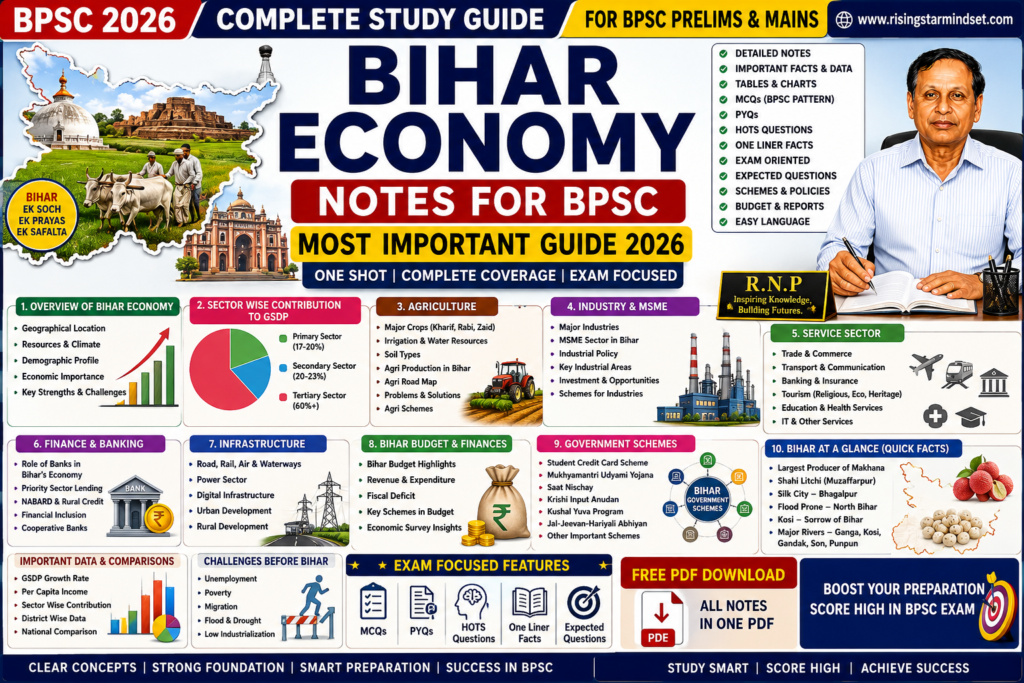
Table of Contents ( Bihar Economy Notes for BPSC )
- Introduction to Bihar Economy
- Meaning of Bihar Economy
- Importance of Bihar Economy in BPSC
- Important Abbreviations
- Economic Profile of Bihar
- Historical Development of Bihar Economy
- Structure of Bihar Economy
- Gross State Domestic Product (GSDP)
- Per Capita Income
- Sector-wise Contribution
- Agriculture in Bihar
- Irrigation System
- Animal Husbandry
- Fisheries
- Horticulture
- Major Crops
- Industrial Development
- MSME Sector
- Food Processing Industry
- Tourism Economy
- Infrastructure Development
- Banking in Bihar
- Bihar Budget
- Government Schemes
- Challenges
- Future Opportunities
- Bihar Economy One-Liners
- Important Tables
- MCQs
- Assertion-Reason Questions
- HOTS
- Previous Year Questions
- Practice Set
- Expected Questions
- Conclusion
Introduction ( Bihar Economy Notes for BPSC )
परिचय
Bihar is one of the fastest-growing economies in India. Despite facing challenges such as low industrialization, floods, migration, and high population density, the state has recorded impressive economic growth over the last decade. Agriculture continues to be the backbone of Bihar’s economy, while the service sector contributes the largest share to the Gross State Domestic Product (GSDP). In recent years, the state government has focused on infrastructure development, road connectivity, education, healthcare, entrepreneurship, and industrial investment to accelerate inclusive growth.
हिन्दी
बिहार भारत के सबसे तेजी से विकसित होने वाले राज्यों में से एक है। औद्योगीकरण की कमी, बाढ़, पलायन और अधिक जनसंख्या जैसी चुनौतियों के बावजूद राज्य ने पिछले कुछ वर्षों में उल्लेखनीय आर्थिक वृद्धि दर्ज की है। बिहार की अर्थव्यवस्था मुख्यतः कृषि पर आधारित है, जबकि सकल राज्य घरेलू उत्पाद (GSDP) में सेवा क्षेत्र का सबसे बड़ा योगदान है। राज्य सरकार ने हाल के वर्षों में सड़क, शिक्षा, स्वास्थ्य, उद्योग, कौशल विकास और निवेश को बढ़ावा देकर आर्थिक विकास को गति देने का प्रयास किया है।
What is Bihar Economy?
The Bihar Economy refers to all economic activities related to the production, distribution, exchange, and consumption of goods and services within the state of Bihar.
हिन्दी
बिहार में वस्तुओं एवं सेवाओं के उत्पादन, वितरण, विनिमय तथा उपभोग से संबंधित सभी आर्थिक गतिविधियों को बिहार की अर्थव्यवस्था कहा जाता है।
Why Bihar Economy is Important for BPSC?
Every year BPSC asks questions from:
- Agriculture
- Budget
- Economic Survey
- GSDP
- Government Schemes
- Industries
- Current Affairs
- Infrastructure
- Poverty
- Employment
- Bihar Special Facts
Exam Weightage
| Exam | Expected Questions |
|---|---|
| BPSC Pre | 3-5 |
| BPSC Mains | 1-2 Descriptive |
| Bihar SI | 2-3 |
| BSSC | 3-4 |
Important Abbreviations ( Bihar Economy Notes for BPSC )
| Short Form | Full Form | Hindi |
|---|---|---|
| GSDP | Gross State Domestic Product | सकल राज्य घरेलू उत्पाद |
| NSDP | Net State Domestic Product | शुद्ध राज्य घरेलू उत्पाद |
| PCI | Per Capita Income | प्रति व्यक्ति आय |
| FDI | Foreign Direct Investment | प्रत्यक्ष विदेशी निवेश |
| MSME | Micro Small Medium Enterprises | सूक्ष्म, लघु एवं मध्यम उद्योग |
| SHG | Self Help Group | स्वयं सहायता समूह |
| NABARD | National Bank for Agriculture and Rural Development | राष्ट्रीय कृषि एवं ग्रामीण विकास बैंक |
| SIDBI | Small Industries Development Bank of India | भारतीय लघु उद्योग विकास बैंक |
Economic Profile of Bihar ( Bihar Economy Notes for BPSC )
| Particular | Details |
|---|---|
| Capital | Patna |
| Area | 94,163 sq km |
| Population | 13+ Crore |
| Literacy Rate | Around 63% |
| Official Language | Hindi |
| Second Official Language | Urdu |
| Major River | Ganga |
| Districts | 38 |
| Divisions | 9 |
Historical Development of Bihar Economy
Ancient Period
- Centre of Trade
- Magadh Empire
- Nalanda University
- Rich Agricultural Economy
Medieval Period
- Agriculture dominated.
- Trade declined gradually.
British Period
- Indigo cultivation
- Zamindari System
- Drain of Wealth
- Poor Industrial Growth
After Independence
- Green Revolution impact limited.
- Slow industrialization.
- Migration increased.
Present Scenario
- High GDP Growth
- Better Roads
- More Investments
- Startup Promotion
- Agriculture Road Map
Structure of Bihar Economy ( Bihar Economy Notes for BPSC )
The economy is divided into three sectors:
Primary Sector
Includes:
- Agriculture
- Dairy
- Fisheries
- Forestry
- Animal Husbandry
Importance
Employs the largest number of people.
Secondary Sector
Includes:
- Sugar Industry
- Textile
- Food Processing
- Leather
- Handloom
- Cement
Problems
- Lack of Industries
- Electricity Issues
- Limited Investment
Tertiary Sector
Includes
- Banking
- Education
- Tourism
- Transport
- IT
- Healthcare
- Communication
This sector contributes the highest share to Bihar’s GSDP.
Gross State Domestic Product (GSDP)
GSDP is the total monetary value of all final goods and services produced within Bihar during one financial year.
Formula
GSDP = Agriculture + Industry + Services
Importance
- Measures Economic Growth
- Budget Planning
- Development Indicator
- Policy Making
Per Capita Income ( Bihar Economy Notes for BPSC )
Per Capita Income means average income earned by one person in a year.
Formula
Per Capita Income = State Income ÷ Population
BPSC Fact
Although Bihar’s per capita income has increased over the years, it remains among the lowest in India due to its large population.
Agriculture of Bihar ( Bihar Economy Notes for BPSC )
Agriculture is called the backbone of Bihar Economy.
Major Crops
| Kharif | Rabi | Zaid |
|---|---|---|
| Paddy | Wheat | Vegetables |
| Maize | Gram | Watermelon |
| Bajra | Mustard | Muskmelon |
Major Fruits
- Shahi Litchi
- Mango
- Banana
- Guava
Major Cash Crops
- Sugarcane
- Tobacco
- Jute
Horticulture
Bihar is famous for:
- Litchi
- Makhana
- Banana
- Honey
- Vegetables
Animal Husbandry
Major Components
- Dairy
- Poultry
- Goat Farming
- Pig Farming
Importance
- Rural Employment
- Additional Income
- Women Empowerment
Fisheries
Large ponds and rivers support fish production.
Government promotes:
- Fish Farming
- Hatcheries
- Modern Aquaculture
Major Industries ( Bihar Economy Notes for BPSC )
- Sugar Industry
- Food Processing
- Dairy Industry
- Leather Industry
- Textile Industry
- Silk Industry
- Rice Mills
- Maize Processing
Food Processing Industry
This sector has huge future potential because Bihar produces:
- Fruits
- Vegetables
- Makhana
- Maize
- Milk
Benefits include higher farmer income, employment generation, reduced post-harvest losses, and export opportunities.
Tourism Economy ( Bihar Economy Notes for BPSC )
Important Tourist Places
- Bodh Gaya
- Nalanda
- Rajgir
- Vaishali
- Vikramshila
- Patna Sahib
Tourism creates:
- Employment
- Hotel Industry
- Transport
- Handicrafts
- Foreign Exchange
Infrastructure Development ( Bihar Economy Notes for BPSC )
Roads
Railways
Airports
Bridges
Electricity
Digital Bihar
Industrial Parks
Logistics Parks
Government Schemes ( Bihar Economy Notes for BPSC )
- Saat Nischay
- Jal Jeevan Hariyali
- Mukhyamantri Udyami Yojana
- Student Credit Card
- Kushal Yuva Program
- Agriculture Road Map
- Industrial Investment Promotion Policy
- Startup Bihar
Challenges ( Bihar Economy Notes for BPSC )
- Poverty
- Flood
- Drought
- Migration
- Unemployment
- Low Industrialization
- High Population Density
- Low Per Capita Income
- Climate Change
- Skill Gap
Future Opportunities
- Food Processing
- Renewable Energy
- Tourism
- Organic Farming
- Startup Ecosystem
- Digital Economy
- MSME Development
- Warehousing
- River Transport
- Export Promotion
MCQs (BPSC Level)
Q1. Bihar is the largest producer of—
A. Cotton
B. Tea
C. Makhana
D. Coffee
Answer: C
Q2. Bhagalpur is famous for—
A. Tea
B. Silk
C. Coal
D. Iron
Answer: B
Q3. Main occupation of Bihar is—
A. Mining
B. Agriculture
C. IT
D. Banking
Answer: B
Q4. Which river divides Bihar?
A. Yamuna
B. Narmada
C. Ganga
D. Krishna
Answer: C
Q5. Bihar Student Credit Card Scheme belongs to—
A. Education
B. Agriculture
C. Industry
D. Banking
Answer: A
Q6. Which sector contributes the highest share to Bihar GSDP?
A. Primary
B. Secondary
C. Service
D. Mining
Answer: C
Q7. Bihar is famous for—
A. Rubber
B. Makhana
C. Coffee
D. Tea
Answer: B
Q8. Bhagalpur Silk belongs to—
A. Textile Industry
B. Dairy
C. Fishery
D. Mining
Answer: A
Q9. Which crop is widely grown in Bihar?
A. Rubber
B. Paddy
C. Coffee
D. Tea
Answer: B
Q10. Bihar economy mainly depends upon—
A. Agriculture
B. Petroleum
C. Mining
D. Shipping
Answer: A
HOTS Questions ( Bihar Economy Notes for BPSC )
Q1.
Why has Bihar remained agriculture-dependent despite rapid GDP growth?
Answer
Low industrialization, limited manufacturing, high rural population, and migration have kept agriculture as the dominant occupation.
Q2.
Explain how food processing can transform Bihar’s economy.
Answer
It increases farmers’ income, reduces wastage, creates employment, attracts investment, and promotes exports.
Q3.
How can river-based transport benefit Bihar?
Answer
It reduces transport costs, promotes trade, strengthens logistics, and supports tourism.
Previous Year Questions (PYQs)
Q1.
Which city of Bihar is known as Silk City?
Answer: Bhagalpur
Q2.
Which crop makes Bihar famous internationally?
Answer: Makhana
Q3.
Which river divides Bihar?
Answer: Ganga
Q4.
Main occupation of Bihar is—
Answer: Agriculture
Q5
बिहार की अर्थव्यवस्था मुख्यतः किस पर आधारित है?
A. उद्योग
B. कृषि
C. सेवा
D. पर्यटन
✅ Answer: B
Q6
बिहार में सर्वाधिक उत्पादित मखाना किस जिले के आसपास के क्षेत्रों में पाया जाता है?
A. गया
B. दरभंगा-मिथिलांचल क्षेत्र
C. भोजपुर
D. कैमूर
✅ Answer: B
Q7
बिहार को दो भागों में विभाजित करने वाली नदी कौन-सी है?
A. सोन
B. कोसी
C. गंगा
D. पुनपुन
✅ Answer: C
Q8
भागलपुर किस उद्योग के लिए प्रसिद्ध है?
A. चीनी
B. रेशम
C. चमड़ा
D. सीमेंट
✅ Answer: B
Q9
बिहार की प्रमुख नकदी फसल कौन-सी है?
A. गेहूँ
B. धान
C. गन्ना
D. बाजरा
✅ Answer: C
Q10
बिहार का प्रमुख व्यवसाय क्या है?
✅ Answer: कृषि
Q11
बिहार में “शाही लीची” किस क्षेत्र से प्रसिद्ध है?
✅ Answer: मुजफ्फरपुर
Q12
भारत में मखाना उत्पादन में बिहार का स्थान क्या है?
✅ Answer: प्रथम
Q13
बिहार में सबसे अधिक रोजगार किस क्षेत्र में मिलता है?
✅ Answer: कृषि क्षेत्र
Q14
बिहार का सबसे बड़ा आर्थिक क्षेत्र कौन-सा है?
✅ Answer: सेवा क्षेत्र (GSDP में)
Q15
बिहार में चीनी उद्योग का मुख्य कच्चा माल क्या है?
✅ Answer: गन्ना
Q16
बिहार की कृषि मुख्यतः किस पर निर्भर है?
✅ Answer: मानसून
Q17
किस सरकारी योजना का उद्देश्य युवाओं को स्वरोजगार उपलब्ध कराना है?
✅ Answer: मुख्यमंत्री उद्यमी योजना
Q18
बिहार में प्रसिद्ध रेशम उद्योग कहाँ स्थित है?
✅ Answer: भागलपुर
Q19
बिहार का GI टैग प्राप्त कृषि उत्पाद कौन-सा है?
✅ Answer: शाही लीची
Q20
बिहार में कृषि रोड मैप किस क्षेत्र से संबंधित है?
✅ Answer: कृषि विकास
30 Expected Questions (BPSC 71st / 72nd)
Prelims Level
Q1.
बिहार की अर्थव्यवस्था किस प्रकार की है?
Q2.
बिहार का सबसे बड़ा आर्थिक क्षेत्र कौन-सा है?
Q3.
बिहार में सबसे अधिक रोजगार किस क्षेत्र में मिलता है?
Q4.
बिहार का सबसे बड़ा कृषि उत्पाद कौन-सा है?
Q5.
बिहार किस उत्पादन में भारत में प्रथम है?
Q6.
भागलपुर किस उद्योग के लिए प्रसिद्ध है?
Q7.
शाही लीची किस जिले से संबंधित है?
Q8.
बिहार की प्रमुख नकदी फसल कौन-सी है?
Q9.
बिहार कृषि रोड मैप का उद्देश्य क्या है?
Q10.
मुख्यमंत्री उद्यमी योजना किससे संबंधित है?
Q11.
GSDP का पूर्ण रूप क्या है?
Q12.
Per Capita Income का अर्थ क्या है?
Q13.
बिहार में सबसे अधिक बाढ़ किस क्षेत्र में आती है?
Q14.
कोसी नदी को किस नाम से जाना जाता है?
Q15.
बिहार की सबसे बड़ी समस्या कौन-सी है?
Q16.
बिहार में खाद्य प्रसंस्करण उद्योग क्यों महत्वपूर्ण है?
Q17.
बिहार में डेयरी विकास किस संस्था द्वारा किया जाता है?
Q18.
बिहार की प्रमुख नदी कौन-सी है?
Q19.
बिहार में सबसे अधिक उगाई जाने वाली खाद्यान्न फसल कौन-सी है?
Q20.
बिहार में सबसे अधिक सेवा क्षेत्र किस क्षेत्र से जुड़ा है?
Mains Level
Q21.
Explain the structure of Bihar Economy.
Q22.
Discuss the role of Agriculture in Bihar Economy.
Q23.
Explain the importance of Food Processing Industries.
Q24.
Write a note on Industrial Development in Bihar.
Q25.
Discuss the role of MSMEs in Bihar.
Q26.
Explain Bihar’s major employment challenges.
Q27.
Discuss migration and its economic impact.
Q28.
Evaluate Bihar Budget priorities.
Q29.
Explain measures for doubling farmers’ income.
Q30.
Suggest measures to make Bihar a developed economy.
Model Answers (BPSC Mains)
Question
Explain the structure of Bihar Economy.
Model Answer
Bihar Economy consists of three sectors:
Primary Sector
Agriculture, Animal Husbandry, Fisheries, Forestry
Secondary Sector
Food Processing, Sugar Industry, Textile, Leather, MSME
Tertiary Sector
Education, Banking, Tourism, Transport, Healthcare, IT
Although Agriculture provides employment to the majority of the population, the Service Sector contributes the highest share to GSDP. Bihar is focusing on industrialization, infrastructure, and skill development to achieve balanced economic growth.
Question
Discuss the challenges before Bihar Economy.
Model Answer
Major Challenges
- Poverty
- Migration
- Flood
- Drought
- Low Industrialization
- High Population Density
- Low Per Capita Income
- Skill Gap
- Unemployment
- Climate Change
Solutions
- Promote Industries
- Skill Development
- Better Irrigation
- Food Processing
- MSME Promotion
- Digital Economy
- Infrastructure Development
Bihar Economy Revision Chart
| Topic | Remember |
|---|---|
| Backbone | Agriculture |
| Largest GSDP Share | Service Sector |
| Largest Employment | Agriculture |
| Silk City | Bhagalpur |
| GI Product | Shahi Litchi |
| Largest Producer | Makhana |
| Dairy Brand | Sudha |
| Major River | Ganga |
| Cash Crop | Sugarcane |
| Main Challenge | Migration |
Last Minute Notes (5-Minute Revision)
Remember These 25 Facts
| Agriculture = Backbone |
| Service Sector = Highest GSDP |
| Agriculture = Highest Employment |
| Makhana = No.1 |
| Shahi Litchi = GI Tag |
| Bhagalpur = Silk City |
| Sugar = Important Industry |
| COMFED = Dairy |
| Sudha = Dairy Brand |
| PMGSY = Roads |
| Saat Nischay = Bihar Scheme |
| Student Credit Card = Education |
| Kushal Yuva = Skill |
| Flood = North Bihar |
| Drought = South Bihar |
| Ganga = Divides Bihar |
| Tourism = Bodh Gaya |
| Rajgir = Tourism |
| Nalanda = Education Heritage |
| Food Processing = Future |
| MSME = Employment |
| Migration = Challenge |
| Infrastructure = Growth Engine |
| Startup = Opportunity |
| Bihar Economy = Agriculture + Services |
200+ Rapid Revision Points (Sample Set)
- Bihar is an agriculture-based state.
- Agriculture employs the largest workforce.
- Service sector contributes the highest share to GSDP.
- Ganga divides Bihar into North and South.
- North Bihar is flood-prone.
- South Bihar is relatively drought-prone.
- Makhana production ranks first in India.
- Muzaffarpur is famous for Shahi Litchi.
- Bhagalpur is known as the Silk City.
- Sugarcane is an important cash crop.
- Paddy is the major Kharif crop.
- Wheat is the major Rabi crop.
- Maize is a significant cereal crop.
- COMFED markets dairy products under the Sudha brand.
- Fisheries provide supplementary income in rural areas.
- Horticulture has high growth potential.
- Food processing adds value to agricultural produce.
- MSMEs are key employment generators.
- Tourism supports the service economy.
- Bodh Gaya attracts international tourists.
- Nalanda is a global heritage site.
- Road connectivity has improved significantly.
- Inland waterways have future potential.
- Skill development reduces unemployment.
- Entrepreneurship is being promoted through state schemes.
- Bihar Student Credit Card supports higher education.
- Kushal Yuva Program focuses on employability.
- Saat Nischay emphasizes infrastructure and public services.
- Agriculture Road Map guides farm sector development.
- Organic farming has emerging potential.
- Irrigation improves crop productivity.
- Climate change affects agriculture.
- Flood management is an economic priority.
- Migration impacts labor availability.
- Industrialization remains a key challenge.
- Per capita income is improving gradually.
- Urbanization is increasing slowly.
- Digital services are expanding.
- Rural roads improve market access.
- Warehousing reduces post-harvest losses.
- Cold storage benefits horticulture.
- Dairy cooperatives strengthen rural incomes.
- Women SHGs contribute to local development.
- Financial inclusion supports economic growth.
- Banking access is expanding.
- Renewable energy offers future opportunities.
- Startups are encouraged through policy support.
- Investment promotion is a government priority.
- Balanced regional development remains essential.
- Bihar’s long-term growth depends on agriculture, industry, and services working together.
Practice Test – Bihar Economy (50 Most Important Questions)
BPSC Prelims Level | Bihar Economy | Part-24
Instructions:
- Total Questions: 50
- Time: 40 Minutes
- Marks: 50
- Correct Answer: +1
- No Negative Marking
Q1. Bihar’s economy is primarily based on—
A. Mining
B. Agriculture
C. Manufacturing
D. Tourism
Q2. Which sector contributes the highest share to Bihar’s GSDP?
A. Primary Sector
B. Secondary Sector
C. Service Sector
D. Mining
Q3. The backbone of Bihar Economy is—
A. Tourism
B. Agriculture
C. IT Sector
D. Textile
Q4. Bihar is India’s largest producer of—
A. Tea
B. Cotton
C. Makhana
D. Coffee
Q5. Bhagalpur is famous for—
A. Sugar
B. Silk
C. Cement
D. Leather
Q6. Which river divides Bihar into North and South?
A. Kosi
B. Gandak
C. Son
D. Ganga
Q7. Bihar’s famous GI-tagged Shahi Litchi belongs to—
A. Patna
B. Muzaffarpur
C. Gaya
D. Nalanda
Q8. The major occupation of Bihar is—
A. Industry
B. Banking
C. Agriculture
D. IT
Q9. Sugar industry is mainly based on—
A. Cotton
B. Jute
C. Sugarcane
D. Wheat
Q10. Bihar Student Credit Card Scheme is related to—
A. Agriculture
B. Education
C. Tourism
D. Health
Q11. GSDP stands for—
A. Gross State Domestic Product
B. General State Development Plan
C. Gross Social Development Plan
D. Gross State Demand Price
Q12. Per Capita Income means—
A. Total Income
B. State Revenue
C. Average Income per Person
D. Government Income
Q13. Bihar’s Agriculture Road Map is related to—
A. Road Construction
B. Agriculture Development
C. Railways
D. Banking
Q14. Which crop is mainly grown during Kharif season?
A. Wheat
B. Gram
C. Paddy
D. Mustard
Q15. Which crop is mainly grown during Rabi season?
A. Paddy
B. Wheat
C. Maize
D. Jute
Q16. Which organization markets ‘Sudha’ dairy products?
A. NABARD
B. COMFED
C. FCI
D. NDDB
Q17. Bihar is especially famous for—
A. Coffee
B. Rubber
C. Makhana
D. Tea
Q18. Which sector provides maximum employment in Bihar?
A. Industry
B. Services
C. Agriculture
D. Mining
Q19. Bihar’s major cash crop is—
A. Wheat
B. Sugarcane
C. Rice
D. Gram
Q20. Flood is mainly a problem in—
A. South Bihar
B. North Bihar
C. Western Bihar
D. Southern Plateau
Q21. Which city is known as Silk City?
A. Patna
B. Gaya
C. Bhagalpur
D. Darbhanga
Q22. Bihar’s economy faces a major challenge due to—
A. Excess Industries
B. Migration
C. High Oil Production
D. Coal Mining
Q23. Which sector has the greatest future potential in Bihar?
A. Shipbuilding
B. Food Processing
C. Petroleum Refining
D. Automobile
Q24. Which scheme promotes entrepreneurship in Bihar?
A. PMGSY
B. Mukhyamantri Udyami Yojana
C. Ayushman Bharat
D. PMAY
Q25. Bihar’s largest river is—
A. Son
B. Gandak
C. Ganga
D. Punpun
Q26. Which crop is famous in Muzaffarpur?
A. Mango
B. Banana
C. Shahi Litchi
D. Apple
Q27. Bihar has a comparative advantage in—
A. Marine Fisheries
B. Food Processing
C. Coal Mining
D. Petroleum
Q28. Which industry is associated with Bhagalpur?
A. Cotton
B. Silk
C. Steel
D. Tea
Q29. Which is NOT a primary sector activity?
A. Agriculture
B. Fisheries
C. Dairy
D. Banking
Q30. Which factor most affects Bihar’s agriculture?
A. Snowfall
B. Monsoon
C. Desert Climate
D. Ocean Currents
Q31. Bihar’s service sector includes—
A. Banking
B. Tourism
C. Education
D. All of the above
Q32. Which of the following is a horticultural product of Bihar?
A. Apple
B. Shahi Litchi
C. Saffron
D. Walnut
Q33. Which river is known as the ‘Sorrow of Bihar’?
A. Son
B. Kosi
C. Ganga
D. Falgu
Q34. Bihar’s industrial development is mainly constrained by—
A. High Literacy
B. Low Population
C. Limited Industrialization
D. Excess Rainfall
Q35. Which is a major objective of the Bihar Student Credit Card Scheme?
A. Irrigation
B. Higher Education
C. Road Development
D. Industrial Investment
Q36. Bihar’s economy is gradually shifting toward—
A. Mining
B. Service-led Growth
C. Oil Economy
D. Heavy Industry
Q37. Which crop is widely cultivated in Bihar after paddy?
A. Coffee
B. Wheat
C. Tea
D. Cotton
Q38. Bihar’s high population density mainly affects—
A. Sports
B. Resource Availability
C. Climate
D. Forest Cover
Q39. Which organization supports agricultural credit in India?
A. RBI
B. NABARD
C. SEBI
D. IRDAI
Q40. Which economic indicator measures the average income of people?
A. GDP
B. GSDP
C. Per Capita Income
D. Inflation
Q41. Bihar has high potential for—
A. Marine Exports
B. Organic Farming
C. Petroleum Export
D. Diamond Mining
Q42. Which of the following is a major challenge for Bihar?
A. Labour Shortage
B. Unemployment
C. Low Rainfall Throughout the Year
D. High Petroleum Imports
Q43. Which mode of transport has emerging potential in Bihar due to the Ganga?
A. Air Transport
B. Inland Waterways
C. Metro Rail
D. Ropeway
Q44. Which district is associated with Buddhist tourism?
A. Bodh Gaya (Gaya)
B. Siwan
C. Araria
D. Buxar
Q45. MSMEs are important because they—
A. Increase Imports
B. Generate Employment
C. Reduce Agriculture
D. Increase Inflation
Q46. Bihar’s economy is best described as—
A. Mining-based
B. Agriculture-oriented with a growing service sector
C. Oil-based
D. Export-driven
Q47. Which is an important dairy brand of Bihar?
A. Amul
B. Sudha
C. Verka
D. Nandini
Q48. Which government initiative focuses on skill development?
A. PMAY
B. Kushal Yuva Program
C. PM-KISAN
D. Jal Jeevan Mission
Q49. Bihar’s economic growth can be accelerated through—
A. Food Processing
B. Infrastructure Development
C. Skill Development
D. All of the above
Q50. Which statement is correct regarding Bihar Economy?
A. Agriculture is the largest employer.
B. Service sector contributes the highest share to GSDP.
C. Bihar is the largest producer of Makhana in India.
D. All of the above.
Answer Key – Practice Test: Bihar Economy (50 Most Important Questions)
1-B, 2-C, 3-B, 4-C, 5-B, 6-D, 7-B, 8-C, 9-C, 10-B, 11-A, 12-C, 13-B, 14-C, 15-B, 16-B, 17-C, 18-C, 19-B, 20-B, 21-C, 22-B, 23-B, 24-B, 25-C, 26-C, 27-B, 28-B, 29-D, 30-B, 31-D, 32-B, 33-B, 34-C, 35-B, 36-B, 37-B, 38-B, 39-B, 40-C, 41-B, 42-B, 43-B, 44-A, 45-B, 46-B, 47-B, 48-B, 49-D, 50-D.
📊 Score Analysis
| Score | Performance |
|---|---|
| 45–50 | 🏆 Excellent – BPSC Ready |
| 40–44 | ⭐ Very Good – Minor Revision Needed |
| 30–39 | 👍 Good – Revise Bihar Economy Once Again |
| 20–29 | 📖 Average – Practice More MCQs |
| Below 20 | 🔄 Re-read the Complete Bihar Economy Notes |
🎯 Challenge for Aspirants
बिना Answer Key देखे पहले सभी 50 प्रश्न हल करें। यदि आपका Score 45+ आता है, तो आपकी Bihar Economy की तैयारी BPSC Prelims स्तर के लिए मजबूत मानी जा सकती है।
Keep Learning, Keep Growing! 🚀
P Kumar | Rising Star Mindset
www.risingstarmindset.com
Together We Will Make The Difference