
Periodic Classification of Elements Class 10
Periodic Classification of Elements Class 10 is an important chapter in Science. It explains how elements are classified. Scientists arrange elements according to their properties. This arrangement makes learning easier. It also helps us compare different elements. Moreover, we can predict the properties of new elements. Therefore, students should understand this chapter carefully. In addition, these notes include English and Hindi explanations, MCQs, HOTS, PYQs, and important questions. PREVIOUS TOPIC: CBSE Class 10 Chemistry PYQs | 10 Years Important Questions
हिंदी में:
आवर्त वर्गीकरण (Periodic Classification of Elements) कक्षा 10 विज्ञान का एक महत्वपूर्ण अध्याय है। इसमें तत्वों को उनके गुणों के आधार पर व्यवस्थित किया गया है। इसलिए उन्हें समझना आसान हो जाता है। साथ ही, नए तत्वों के गुणों का अनुमान भी लगाया जा सकता है। इस नोट्स में English और Hindi दोनों में सरल व्याख्या दी गई है। इसके अलावा MCQs, HOTS, PYQs और महत्वपूर्ण प्रश्न भी शामिल हैं।
📚 Table of Contents ( Periodic Classification of Elements Class 10 )
- Introduction
- Learning Objectives
- Abbreviations
- Key Terms
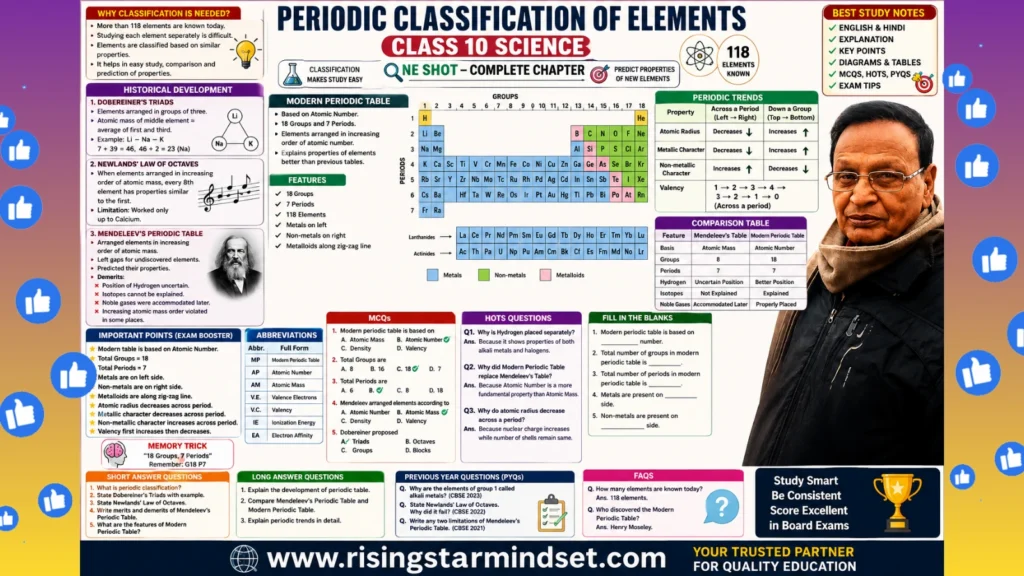
- Why Classification is Needed?
- Dobereiner’s Triads
- Newlands’ Law of Octaves
- Mendeleev’s Periodic Table
- Modern Periodic Table
- Periodic Trends
- Comparison Table
- Important Points
- Mnemonics
- MCQs
- HOTS Questions
- Fill in the Blanks
- Short Answer Questions
- Long Answer Questions
- Previous Year Questions (PYQs)
- FAQs
- Conclusion
🎯 Learning Objectives
After studying this chapter, students will be able to:
- Understand the need for classification.
- Explain Dobereiner’s Triads.
- Describe Newlands’ Law of Octaves.
- Explain Mendeleev’s Periodic Table.
- Understand Modern Periodic Table.
- Predict periodic trends.
📖 Abbreviations ( Periodic Classification of Elements Class 10 )
| Abbreviation | Full Form |
| MP | Modern Periodic Table |
| AP | Atomic Number |
| AM | Atomic Mass |
| V.E. | Valence Electrons |
| V.C. | Valency |
| IE | Ionization Energy |
| EA | Electron Affinity |
Important Terms ( Periodic Classification of Elements Class 10 )
| English | Hindi |
| Element | तत्व |
| Group | समूह |
| Period | आवर्त |
| Atomic Number | परमाणु संख्या |
| Atomic Mass | परमाणु द्रव्यमान |
| Valency | संयोजकता |
Why is Classification Necessary?
English
Today, scientists know more than 118 elements. Studying every element separately is difficult. Therefore, they classify elements into groups. As a result, students can learn their properties easily. Moreover, classification helps predict the behaviour of new elements.
हिंदी
118 से अधिक तत्व ज्ञात हैं। प्रत्येक तत्व का अलग-अलग अध्ययन कठिन है। इसलिए समान गुणों वाले तत्वों को एक साथ रखा गया।
Dobereiner’s Triads
English
Dobereiner arranged elements in groups of three.
The atomic mass of the middle element is approximately equal to the average of the first and third.
Example:
Lithium – Sodium – Potassium
7 + 39 = 46
46 ÷ 2 = 23
Middle element = Sodium (23)
हिंदी
डोबेरेनर ने तत्वों को तीन-तीन के समूह में रखा।
बीच वाले तत्व का परमाणु द्रव्यमान पहले और तीसरे तत्व के औसत के बराबर होता है।
Newlands’ Law of Octaves
English
When elements are arranged in increasing order of atomic mass, every eighth element has properties similar to the first.
हिंदी
परमाणु द्रव्यमान के बढ़ते क्रम में रखने पर प्रत्येक आठवाँ तत्व पहले तत्व के समान गुण प्रदर्शित करता है।
Limitation
Worked only up to Calcium.
Mendeleev’s Periodic Table
English
Mendeleev arranged elements according to atomic mass.
| Merits | Demerits |
| Left gaps for undiscovered elements | Position of Hydrogen uncertain |
| Predicted their properties | Isotopes cannot be explained |
| Noble gases were accommodated later | Increasing atomic mass order violated in some places |
Modern Periodic Table
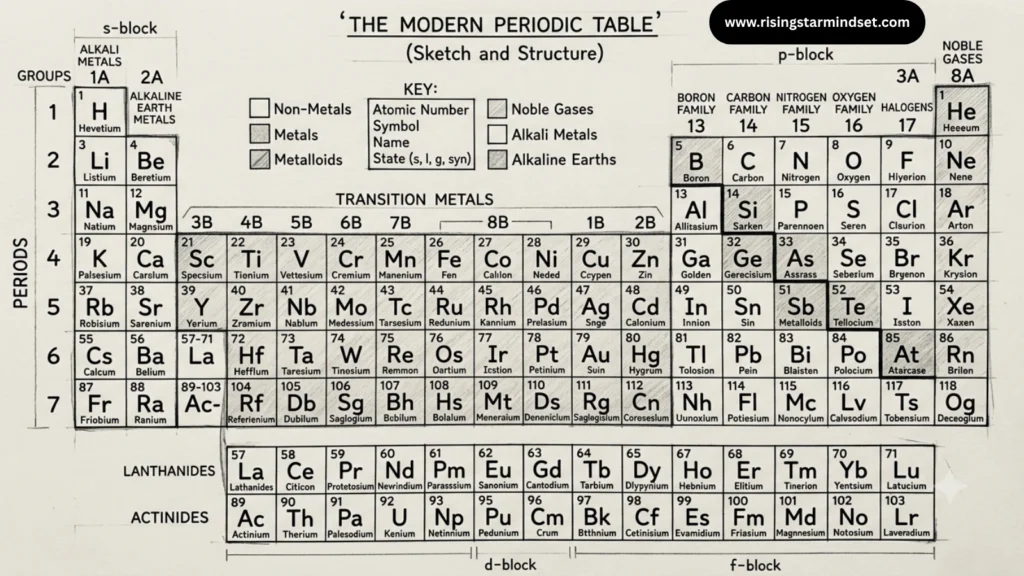
The Modern Periodic Table is based on Atomic Number.The Modern Periodic Table has 18 groups. Moreover, it has 7 periods. Therefore, students can classify elements easily.
Features
- 18 Groups
- 7 Periods
- 118 Elements
- Metals on left
- Non-metals on right
- Metalloids in middle
Structure of Modern Periodic Table
| Feature | Details |
| Groups | 18 |
| Periods | 7 |
| Metals | Left Side |
| Non-metals | Right Side |
| Metalloids | Zig-zag line |
Periodic Trends
1 Atomic Radius
Across Period
⬇ Decreases
Down Group
⬆ Increases
2 Metallic Character
Across Period
⬇ Decreases
Down Group
⬆ Increases
3 Non-metallic Character
Across Period
⬆ Increases
Down Group
⬇ Decreases
4 Valency
Across a period
1 → 2 → 3 → 4 → 3 → 2 → 1 → 0
Comparison Table
| Feature | Mendeleev | Modern Table |
| Based On | Atomic Mass | Atomic Number |
| Groups | 8 | 18 |
| Periods | 7 | 7 |
| Hydrogen | Uncertain | Better Position |
| Isotopes | Not Explained | Explained |
Key Points (Exam Booster)
| Modern table is based on Atomic Number. |
| Total Groups = 18 |
| Total Periods = 7 |
| Metals are present on left side. |
| Non-metals are on right side. |
| Atomic radius decreases across period. |
| Metallic character decreases across period. |
| Non-metallic character increases across period. |
| Valency first increases then decreases. |
Memory Trick ( Periodic Classification of Elements Class 10 )
Groups
“18 Groups, 7 Periods”
Remember:
G18 P7
MCQs
1. Modern periodic table is based on
A. Atomic Mass
B. Atomic Number
C. Density
D. Valency
✅ Answer: B
2. Total Groups are
A. 8
B. 16
C. 18
D. 7
✅ C
3. Total Periods are
A. 6
B. 7
C. 8
D. 18
✅ B
4. Mendeleev arranged elements according to
A. Atomic Number
B. Atomic Mass
C. Density
D. Valency
✅ B
5. Dobereiner proposed
A. Triads
B. Octaves
C. Groups
D. Blocks
✅ A
6. Newlands proposed
A. Triads
B. Octaves
C. Modern Table
D. None
✅ B
7. Which property decreases across a period?
A. Metallic character
B. Atomic number
C. Nuclear charge
D. Electrons
✅ A
8. Number of periods
A. 18
B. 7
C. 8
D. 9
✅ B
9. Noble gases belong to
A. Group 1
B. Group 17
C. Group 18
D. Group 8
✅ C
10. Hydrogen position is uncertain in
A. Modern Table
B. Mendeleev Table
C. Both
D. None
✅ B
HOTS Questions
Q1
Why is Hydrogen placed separately?
Answer
Because it shows properties of both alkali metals and halogens.
Q2
Why did Modern Periodic Table replace Mendeleev’s Table?
Answer
Because Atomic Number is a more fundamental property than Atomic Mass.
Q3
Why do elements in one group have similar properties?
Answer
Because they have the same number of valence electrons.
Q4
Why does atomic radius decrease across a period?
Answer
Due to increased nuclear charge.
Q5
Why do metals lose electrons easily?
Answer
Because they have low ionization energy.
Fill in the Blanks
- Modern periodic table is based on ________.
Answer: Atomic Number - Total groups are ________.
Answer: 18 - Total periods are ________.
Answer: 7 - Dobereiner proposed ________.
Answer: Triads - Newlands proposed ________.
Answer: Law of Octaves - Mendeleev used ________.
Answer: Atomic Mass - Modern table uses ________.
Answer: Atomic Number - Metals are found on the ________.
Answer: Left - Noble gases are placed in Group ________.
Answer: 18 - Atomic radius decreases across a ________.
Answer: Period
Short Answer Questions
Q1. What is periodic classification?
Answer:
The arrangement of elements based on their similarities in physical and chemical properties is called periodic classification.
हिंदी:
तत्वों को उनके समान गुणों के आधार पर व्यवस्थित करना आवर्त वर्गीकरण कहलाता है।
Q2. State Dobereiner’s Triads.
Answer:
Groups of three elements in which the atomic mass of the middle element is approximately the average of the other two.
Q3. What is Newlands’ Law of Octaves?
Answer:
Every eighth element has properties similar to the first when arranged by increasing atomic mass.
Q4. Why is the modern periodic table based on atomic number?
Answer:
The Modern Periodic Table is based on atomic number. It helps students understand similar elements. Therefore, predicting their properties becomes easier.
Q5. What are groups and periods?
Answer:
Vertical columns are called groups, and horizontal rows are called periods.
Long Answer Questions
Q1. Compare Mendeleev’s and Modern Periodic Tables.
Answer Points:
- Basis of classification
- Number of groups
- Number of periods
- Position of hydrogen
- Isotopes
- Predictive power
Q2. Explain periodic trends with examples.
Answer:
Discuss atomic radius, metallic character, non-metallic character, valency, and their variation across periods and down groups with suitable examples.
Previous Year Questions (PYQs)
1. Why did Mendeleev leave gaps in his periodic table?
Answer: To accommodate undiscovered elements and predict their properties.
2. Why is the position of hydrogen unique?
Answer: Because it resembles both Group 1 and Group 17 elements.
3. State two limitations of Newlands’ Law of Octaves.
Answer:
- Applicable only up to calcium.
- No gaps for undiscovered elements.
4. Name the basis of the Modern Periodic Table.
Answer: Atomic number.
5. What is meant by a period and a group?
Answer: Horizontal rows are periods; vertical columns are groups.
Frequently Asked Questions (FAQs)
Q1. What is the basis of the Modern Periodic Table?
Answer: Atomic number.
Q2. How many groups are there in the Modern Periodic Table?
Answer: 18.
Q3. How many periods are there?
Answer: 7.
Q4. Which scientist proposed the Triads?
Answer: Dobereiner.
Q5. Which scientist proposed the Law of Octaves?
Answer: Newlands.
Q6. Why is Mendeleev’s table important?
Answer: It successfully organized known elements and predicted the existence and properties of undiscovered elements.
📌 Conclusion
Periodic Classification of Elements Class 10 is one of the most important chemistry chapters. It explains how elements are arranged in the periodic table. Therefore, students can understand their properties easily.
Moreover, this chapter is important for board exams. Practice the MCQs, HOTS, PYQs, and important questions regularly. Finally, revise the periodic trends to score better in examinations.
Keep Learning, Keep Growing! 🚀
P Kumar | Rising Star Mindset
www.risingstarmindset.com
Together We Will Make The Difference