

Carbon and Its Compounds Class 10 Notes
Carbon and Its Compounds Class 10 is one of the most important chapters in CBSE Class 10 Science. This chapter explains the unique properties of carbon, how it forms millions of compounds, different types of hydrocarbons, functional groups, ethanol, ethanoic acid, soaps, detergents, and their applications in everyday life. A clear understanding of this chapter is essential for scoring well in board examinations and building a strong foundation in Organic Chemistry. CBSE Class 10 Chemistry PYQs | 10 Years Important Questions
हिंदी में:
कार्बन एवं उसके यौगिक कक्षा 10 विज्ञान का एक महत्वपूर्ण अध्याय है। इस अध्याय में कार्बन के विशेष गुण, सहसंयोजक बंध, हाइड्रोकार्बन, कार्यात्मक समूह (Functional Groups), एथेनॉल, एथेनोइक अम्ल, साबुन तथा अपमार्जक (Detergents) का विस्तृत अध्ययन किया जाता है। यह अध्याय बोर्ड परीक्षा की दृष्टि से अत्यंत महत्वपूर्ण है तथा आगे की ऑर्गेनिक केमिस्ट्री की नींव भी तैयार करता है।
Table of Contents
1. Introduction
2. Learning Objectives
3. What is Carbon?
4. Position of Carbon in the Periodic Table
5. Electronic Configuration of Carbon
6. Why is Carbon Unique?
7. Tetravalency of Carbon
8. Catenation
9. Covalent Bonding
10. Formation of Covalent Bonds
11. Why Carbon Does Not Form Ionic Compounds
12. Properties of Covalent Compounds
13. Versatile Nature of Carbon
14. Strong Carbon–Carbon Bond
15. Allotropes of Carbon
16. Hydrocarbons
17. Types of Hydrocarbons
18. Saturated Hydrocarbons
19. Unsaturated Hydrocarbons
20. Homologous Series
21. Functional Groups
22. IUPAC Nomenclature
23. Chemical Properties of Carbon Compounds
24. Ethanol
25. Ethanoic Acid
26. Esterification Reaction
27. Saponification Reaction
28. Soap and Detergents
29. Cleansing Action of Soap
30. Micelle Formation
31. Important Difference Tables
32. Important Chemical Reactions
33. Important Formulae
34. Exam-Oriented Quick Revision Points
35. Abbreviations
36. Key Points
37. FAQs
38. Conclusion
39. Continue Your Learning
Learning Objectives ( Carbon and Its Compounds Class 10 )
After studying this chapter, you will be able to:
- Explain the unique properties of carbon.
- Understand tetravalency and catenation.
- Describe covalent bond formation.
- Identify different allotropes of carbon.
- Compare ionic and covalent compounds.
- Understand why carbon forms a large number of compounds.
Abbreviations ( Carbon and Its Compounds Class 10 )
| Abbreviation | Full Form |
| C | Carbon |
| CH₄ | Methane |
| CO₂ | Carbon Dioxide |
| CO | Carbon Monoxide |
| C₂H₆ | Ethane |
| C₂H₄ | Ethene |
| C₂H₂ | Ethyne |
| C₆₀ | Fullerene |
| C-C | Carbon–Carbon Bond |
| e⁻ | Electron |
Key Points ( Carbon and Its Compounds Class 10 )
| Carbon is a non-metal element. |
| Its atomic number is 6. |
| It belongs to Group 14 and Period 2 of the Modern Periodic Table. |
| The valency of carbon is 4. |
| This element mainly forms covalent bonds |
| One of its unique properties is catenation, which allows it to form long chains. |
| Most carbon compounds are known as organic compounds. |
| Diamond and graphite are the two most important allotropes of this element. |
| Because of its versatile nature, carbon forms millions of compounds. |
| Organic chemistry is primarily based on carbon compounds and their reactions.. |
What is Carbon?
Carbon is one of the most important elements found in nature. It is called the backbone of Organic Chemistry because almost all organic compounds contain carbon atoms. Carbon is present in living organisms, fossil fuels, food, medicines, plastics, paper, fabrics, and countless everyday materials.
Basic Information about Carbon
| Property | Value |
| Name | Carbon |
| Symbol | C |
| Atomic Number | 6 |
| Atomic Mass | 12 u |
| Valency | 4 |
| Group | 14 |
| Period | 2 |
| Nature | Non-metal |
हिंदी में
कार्बन प्रकृति में पाया जाने वाला एक अत्यंत महत्वपूर्ण तत्व है। इसे कार्बनिक रसायन (Organic Chemistry) की रीढ़ (Backbone) कहा जाता है क्योंकि लगभग सभी कार्बनिक यौगिकों में कार्बन उपस्थित होता है। यह जीवित प्राणियों, भोजन, ईंधन, प्लास्टिक, दवाइयों, कपड़ों तथा अनेक दैनिक उपयोग की वस्तुओं में पाया जाता है।
Position of Carbon in the Periodic Table
Carbon belongs to Group 14 (Carbon Family) and Period 2 of the Modern Periodic Table.
It is placed between Boron (B) and Nitrogen (N).
हिंदी में
आधुनिक आवर्त सारणी में कार्बन समूह 14 तथा द्वितीय आवर्त (Period 2) में स्थित है।
Electronic Configuration of Carbon
Carbon has six electrons.
Electronic configuration:
2,4
or
1s² 2s² 2p²
Since carbon has four electrons in its outermost shell, it neither loses nor gains four electrons easily. Therefore, it shares electrons with other atoms.
हिंदी में
कार्बन के बाहरी कोश में चार इलेक्ट्रॉन होते हैं। इसलिए यह चार इलेक्ट्रॉनों का त्याग या ग्रहण नहीं करता, बल्कि अन्य परमाणुओं के साथ इलेक्ट्रॉनों की साझेदारी करता है।
Why is Carbon Unique?
Carbon is different from most other elements because it possesses two remarkable properties:
- Tetravalency
- Catenation
These two properties enable carbon to form millions of stable compounds.
हिंदी में
कार्बन दो विशेष गुणों के कारण अन्य तत्वों से अलग है—
- चतुसंयोजकता (Tetravalency)
- कैटेनेशन (Catenation)
इन्हीं गुणों के कारण कार्बन लाखों प्रकार के यौगिक बनाता है।
Tetravalency of Carbon
The valency of carbon is four, which means one carbon atom can form four covalent bonds with other atoms.
Example
Methane (CH₄)
One carbon atom shares electrons with four hydrogen atoms to complete its octet.
Importance of Tetravalency
- Forms stable compounds.
- Produces long chains.
- Creates branched and ring structures.
- Supports the formation of complex organic molecules.
हिंदी में
कार्बन की संयोजकता चार होती है। इसलिए एक कार्बन परमाणु चार सहसंयोजक बंध बना सकता है। इसी गुण के कारण अनेक प्रकार के कार्बनिक यौगिक बनते हैं।
Catenation
Catenation is the property of carbon by which carbon atoms join together to form long chains, branched chains, and ring structures.
Types of Carbon Chains
- Straight Chain
- Branched Chain
- Cyclic Chain
Examples
- Ethane
- Propane
- Butane
- Cyclohexane
- Benzene
Why Carbon Shows Catenation?
- Small atomic size
- Strong Carbon–Carbon bond
- Stable covalent bonding
हिंदी में
कार्बन की वह क्षमता जिसके द्वारा वह स्वयं के परमाणुओं से जुड़कर लंबी श्रृंखला या वलय (Ring) बनाता है, कैटेनेशन कहलाती है।
Covalent Bonding
A covalent bond is formed when two atoms share electrons to complete their outermost shell.
Carbon generally forms covalent bonds instead of ionic bonds.
Examples
- Methane (CH₄)
- Water (H₂O)
- Carbon Dioxide (CO₂)
- Oxygen (O₂)
Characteristics
- Electron sharing
- Strong chemical bond
- Stable compounds
- No transfer of electrons
हिंदी में
जब दो परमाणु अपने इलेक्ट्रॉनों की साझेदारी करते हैं, तब सहसंयोजक बंध (Covalent Bond) बनता है। कार्बन मुख्य रूप से सहसंयोजक यौगिक बनाता है।
Formation of Covalent Bond in Methane (CH₄)
Carbon has four valence electrons, while each hydrogen atom has one valence electron. Carbon shares one electron with each hydrogen atom, forming four covalent bonds and completing the octet.
हिंदी में
मीथेन (CH₄) में कार्बन चार हाइड्रोजन परमाणुओं के साथ एक-एक इलेक्ट्रॉन साझा करता है, जिससे चार सहसंयोजक बंध बनते हैं।
Why Carbon Does Not Form Ionic Compounds?
Carbon usually does not form ionic compounds because:
- Losing four electrons requires a very large amount of energy.
- Gaining four electrons is unstable due to electron-electron repulsion.
- Sharing electrons is energetically more favorable.
हिंदी में
कार्बन सामान्यतः आयनिक यौगिक नहीं बनाता क्योंकि चार इलेक्ट्रॉनों का त्याग या ग्रहण करना अत्यधिक ऊर्जा की मांग करता है। इसलिए कार्बन इलेक्ट्रॉनों की साझेदारी करके सहसंयोजक यौगिक बनाता है।
Properties of Covalent Compounds
| Property | Explanation |
| Low Melting Point | Weak intermolecular forces |
| Low Boiling Point | Molecules separate easily |
| Poor Electrical Conductivity | No free ions or electrons |
| Mostly Gases or Liquids | Weak attraction between molecules |
| Insoluble in Water | Mostly non-polar compounds |
| Soluble in Organic Solvents | Similar nature of solvent and solute |
हिंदी में
सहसंयोजक यौगिकों के प्रमुख गुण—
- निम्न गलनांक
- निम्न क्वथनांक
- विद्युत के कुचालक
- जल में कम घुलनशील
- कार्बनिक विलायकों में घुलनशील
Versatile Nature of Carbon
Carbon forms more than 10 million compounds, making it one of the most versatile elements known.
Reasons
- Tetravalency
- Catenation
- Strong Carbon–Carbon Bonds
- Ability to bond with many elements like Hydrogen, Oxygen, Nitrogen, Sulphur, and Halogens
हिंदी में
कार्बन की चतुसंयोजकता, कैटेनेशन, तथा मजबूत C-C बंध के कारण यह लाखों प्रकार के यौगिक बनाता है।
Strong Carbon–Carbon Bond
Carbon atoms form very strong covalent bonds with each other.
The bond energy of a Carbon–Carbon single bond is approximately 348 kJ/mol, making carbon compounds highly stable.
हिंदी में
कार्बन-कार्बन बंध अत्यंत मजबूत होता है, जिसके कारण कार्बनिक यौगिक स्थायी (Stable) होते हैं।
Hydrocarbons
Hydrocarbons are organic compounds made up of only carbon (C) and hydrogen (H) atoms. They are the simplest organic compounds and serve as the basic building blocks of many other carbon compounds.
Hydrocarbons are widely used as fuels and are found in petrol, diesel, LPG, CNG, kerosene, natural gas, and coal.
हिंदी में
हाइड्रोकार्बन वे कार्बनिक यौगिक हैं जो केवल कार्बन और हाइड्रोजन से मिलकर बने होते हैं। ये कार्बनिक रसायन के सबसे सरल यौगिक हैं तथा अनेक अन्य कार्बनिक यौगिकों के निर्माण का आधार हैं।
Types of Hydrocarbons
Hydrocarbons are mainly divided into two categories.
1. Saturated Hydrocarbons (Alkanes)
Saturated hydrocarbons contain only single covalent bonds (C-C) between carbon atoms.
General Formula
CnH₂n+₂
Examples
| Compound | Molecular Formula |
| Methane | CH₄ |
| Ethane | C₂H₆ |
| Propane | C₃H₈ |
| Butane | C₄H₁₀ |
Properties
- Less reactive
- Burn with a clean blue flame
- Undergo substitution reactions
हिंदी में
संतृप्त हाइड्रोकार्बन में कार्बन परमाणुओं के बीच केवल एकल सहसंयोजक बंध (Single Bond) होता है।
2. Unsaturated Hydrocarbons
Unsaturated hydrocarbons contain double or triple bonds between carbon atoms.
These are of two types.
(A) Alkenes
Contain one or more double bonds (C=C).
General Formula
CnH₂n
Example
- Ethene (C₂H₄)
- Propene (C₃H₆)
(B) Alkynes
Contain one or more triple bonds (C≡C).
General Formula
CnH₂n−₂
Examples
- Ethyne (C₂H₂)
- Propyne (C₃H₄)
हिंदी में
असंतृप्त हाइड्रोकार्बन में कार्बन परमाणुओं के बीच द्विबंध (Double Bond) या त्रिबंध (Triple Bond) होता है।
Difference Between Saturated and Unsaturated Hydrocarbons
| Saturated Hydrocarbons | Unsaturated Hydrocarbons |
| Only single bonds | Double or triple bonds present |
| Less reactive | More reactive |
| Undergo substitution reaction | Undergo addition reaction |
| Burn with clean flame | Burn with yellow smoky flame |
| Example: Methane | Example: Ethene |
Homologous Series
A homologous series is a group of organic compounds having:
- Same functional group
- Similar chemical properties
- Same general formula
- Successive members differ by –CH₂–
Example
| Compound | Formula |
| Methane | CH₄ |
| Ethane | C₂H₆ |
| Propane | C₃H₈ |
| Butane | C₄H₁₀ |
Difference between two consecutive members
CH₂ (14 u)
Characteristics
- Similar chemical properties
- Gradual change in physical properties
- Same functional group
- Same method of preparation
हिंदी में
सजातीय श्रेणी (Homologous Series) ऐसे यौगिकों का समूह है जिनका कार्यात्मक समूह समान होता है तथा क्रमागत दो सदस्यों में CH₂ का अंतर होता है।
Functional Groups
A functional group is an atom or group of atoms responsible for the characteristic chemical properties of an organic compound.
हिंदी में
कार्यात्मक समूह (Functional Group) वह परमाणु या परमाणुओं का समूह है जो किसी कार्बनिक यौगिक के रासायनिक गुणों को निर्धारित करता है।
Important Functional Groups
| Functional Group | Formula | Suffix | Example |
| Alcohol | –OH | -ol | Ethanol |
| Aldehyde | –CHO | -al | Ethanal |
| Ketone | >C=O | -one | Propanone |
| Carboxylic Acid | –COOH | -oic acid | Ethanoic Acid |
| Halo Compound | –Cl, –Br | Chloro/Bromo | Chloroethane |
Nomenclature of Carbon Compounds (IUPAC)
The IUPAC system provides a standard method for naming organic compounds.
Rules
Step 1
Count the number of carbon atoms.
| Carbon Atoms | Prefix |
| 1 | Meth |
| 2 | Eth |
| 3 | Prop |
| 4 | But |
| 5 | Pent |
| 6 | Hex |
| 7 | Hept |
| 8 | Oct |
| 9 | Non |
| 10 | Dec |
Step 2
Identify the type of bond.
| Bond Type | Suffix |
| Single | ane |
| Double | ene |
| Triple | yne |
Step 3
Identify the functional group.
Examples
CH₄ → Methane
C₂H₄ → Ethene
C₂H₂ → Ethyne
C₂H₅OH → Ethanol
CH₃COOH → Ethanoic Acid
हिंदी में
IUPAC नामकरण प्रणाली के अनुसार यौगिकों का नाम उनके कार्बन परमाणुओं की संख्या, बंध के प्रकार तथा कार्यात्मक समूह के आधार पर रखा जाता है।
Chemical Properties of Carbon Compounds
Carbon compounds undergo various chemical reactions.
1. Combustion Reaction
Carbon compounds burn in oxygen to produce carbon dioxide, water, and heat.
Example
CH₄ + 2O₂ → CO₂ + 2H₂O + Heat
हिंदी में
ऑक्सीजन की उपस्थिति में कार्बनिक यौगिक जलकर ऊष्मा तथा प्रकाश उत्पन्न करते हैं।
2. Oxidation Reaction
Addition of oxygen or removal of hydrogen is called oxidation.
Example
Ethanol + Alkaline KMnO₄ → Ethanoic Acid
Oxidising Agents
- Acidified KMnO₄
- Alkaline KMnO₄
- Acidified K₂Cr₂O₇
हिंदी में
ऑक्सीकरण वह अभिक्रिया है जिसमें ऑक्सीजन जुड़ती है या हाइड्रोजन निकलता है।
3. Addition Reaction
Unsaturated hydrocarbons add hydrogen in the presence of a catalyst.
Example
C₂H₄ + H₂ → C₂H₆
Catalyst
- Nickel
- Palladium
- Platinum
Application
Hydrogenation of vegetable oils to prepare vanaspati ghee.
हिंदी में
असंतृप्त हाइड्रोकार्बन हाइड्रोजन जोड़कर संतृप्त हाइड्रोकार्बन बनाते हैं।
4. Substitution Reaction
In saturated hydrocarbons, one hydrogen atom is replaced by another atom.
Example
CH₄ + Cl₂ → CH₃Cl + HCl
(Sunlight)
हिंदी में
संतृप्त हाइड्रोकार्बन में हाइड्रोजन परमाणु के स्थान पर अन्य परमाणु आ जाते हैं।
Ethanol (C₂H₅OH)
Ethanol is an important alcohol containing the –OH functional group.
Physical Properties
- Colourless liquid
- Pleasant smell
- Soluble in water
- Neutral in nature
Uses
- Solvent
- Medicine
- Sanitizer
- Fuel
- Perfumes
- Chemical industries
Harmful Effects
Excessive consumption of alcohol affects the liver, brain, heart, and nervous system.
हिंदी में
एथेनॉल एक महत्वपूर्ण अल्कोहल है जिसमें –OH कार्यात्मक समूह पाया जाता है।
Ethanoic Acid (CH₃COOH)
Ethanoic acid is commonly known as Acetic Acid.
Physical Properties
- Colourless liquid
- Sour smell
- Miscible with water
Pure ethanoic acid freezes at 16.6°C, forming ice-like crystals called Glacial Acetic Acid.
Uses
- Vinegar
- Food preservation
- Medicines
- Textile industry
- Rubber industry
हिंदी में
एथेनोइक अम्ल को एसिटिक अम्ल भी कहते हैं। इसका उपयोग सिरका, खाद्य संरक्षण तथा उद्योगों में किया जाता है।
Reaction of Ethanoic Acid with Sodium
2CH₃COOH + 2Na → 2CH₃COONa + H₂↑
Hydrogen gas is evolved.
Esterification Reaction
When ethanol reacts with ethanoic acid in the presence of concentrated sulphuric acid, an ester is formed.
CH₃COOH + C₂H₅OH → CH₃COOC₂H₅ + H₂O
Catalyst
Concentrated H₂SO₄
Importance
Esters have pleasant fruity smells and are used in perfumes and flavouring agents.
हिंदी में
एथेनॉल तथा एथेनोइक अम्ल की अभिक्रिया से एस्टर बनता है, जिसकी सुगंध फल जैसी होती है।
Saponification Reaction
Hydrolysis of an ester in the presence of sodium hydroxide produces soap and alcohol.
हिंदी में
एस्टर की सोडियम हाइड्रॉक्साइड के साथ अभिक्रिया से साबुन बनता है। इसे सैपोनिफिकेशन कहते हैं।
Soap and Detergents
Soap and detergents are cleaning agents used to remove dirt, oil, and grease from clothes, utensils, and our body. Although both perform the same function, their composition and effectiveness are different.
हिंदी में
साबुन (Soap) और अपमार्जक (Detergents) ऐसे सफाई करने वाले पदार्थ हैं जिनका उपयोग कपड़ों, बर्तनों तथा शरीर की सफाई के लिए किया जाता है। दोनों का कार्य समान है, लेकिन उनकी संरचना और कार्य करने की क्षमता अलग-अलग होती है।
Soap
Soap is the sodium or potassium salt of long-chain fatty acids. It is generally prepared by the saponification of oils and fats.
General Formula
RCOONa or RCOOK
Properties of Soap
- Biodegradable
- Eco-friendly
- Works well in soft water
- Less effective in hard water
- Forms scum with calcium and magnesium ions
Advantages of Soap
- Environment friendly
- Easily decomposed by microorganisms
- Safe for skin
Disadvantages of Soap
- Does not lather well in hard water
- Forms insoluble scum
- Cleaning efficiency decreases in hard water
हिंदी में
साबुन वसा अम्लों के सोडियम या पोटैशियम लवण होते हैं। कठोर जल में यह झाग कम बनाते हैं क्योंकि कैल्शियम और मैग्नीशियम आयनों के साथ अविलेय परत (Scum) बना लेते हैं।
Detergents
Detergents are synthetic cleaning agents that work effectively in both soft and hard water.
Properties
- Synthetic compounds
- Work in hard water
- Produce more lather
- Better cleaning efficiency
Advantages
- Effective in hard water
- No scum formation
- Better stain removal
Disadvantages
- Some detergents are non-biodegradable
- May cause water pollution
हिंदी में
डिटर्जेंट कृत्रिम (Synthetic) सफाई करने वाले पदार्थ हैं जो कठोर जल में भी अच्छी तरह कार्य करते हैं।
Difference Between Soap and Detergent
| Soap | Detergent |
| Natural product | Synthetic product |
| Biodegradable | Some are non-biodegradable |
| Works best in soft water | Works in both soft and hard water |
| Forms scum in hard water | Does not form scum |
| Less effective in hard water | More effective in hard water |
Cleansing Action of Soap
Soap molecules have two ends.
Hydrophilic End
- Water-loving
- Ionic end
- Dissolves in water
Hydrophobic End
- Water-repelling
- Oil-loving
- Attaches to grease and dirt
When soap is mixed with water, the hydrophobic ends surround the grease while the hydrophilic ends remain in water. During washing, grease gets trapped inside small spherical structures called micelles and is removed with water.
हिंदी में
साबुन के अणु का एक सिरा जल को आकर्षित करता है तथा दूसरा सिरा तेल और गंदगी को। धोने पर गंदगी माइसेल (Micelle) के अंदर फँस जाती है और पानी के साथ बाहर निकल जाती है।
Micelle Formation
A micelle is a spherical structure formed by soap molecules in water.
Characteristics
- Hydrophobic tails face inward.
- Hydrophilic heads face outward.
- Traps grease and oil inside.
- Helps in effective cleaning.
Importance of Micelles
- Remove oily stains
- Improve washing efficiency
- Essential for soap action
हिंदी में
माइसेल साबुन के अणुओं द्वारा बनाया गया गोलाकार समूह है, जिसके अंदर तेल और गंदगी फँस जाती है।
Flow Chart: Cleansing Action of Soap
Soap + Water → Micelle Formation → Dirt Trapped → Rinsing with Water → Clean Surface
Important Difference Tables
Ionic Compounds vs Covalent Compounds
| Ionic Compounds | Covalent Compounds |
| Formed by transfer of electrons | Formed by sharing of electrons |
| High melting point | Low melting point |
| Conduct electricity in molten state | Poor conductor of electricity |
| Soluble in water | Mostly insoluble in water |
| Strong electrostatic forces | Weak intermolecular forces |
Saturated vs Unsaturated Hydrocarbons
| Saturated | Unsaturated |
| Single bond | Double or Triple bond |
| Less reactive | More reactive |
| Alkane | Alkene/Alkyne |
| Substitution reaction | Addition reaction |
| Blue flame | Yellow smoky flame |
Ethanol vs Ethanoic Acid
| Ethanol | Ethanoic Acid |
| Alcohol | Carboxylic acid |
| Functional group –OH | Functional group –COOH |
| Neutral | Acidic |
| Pleasant smell | Sour smell |
| Used in sanitizer and medicines | Used in vinegar and food preservation |
Diamond vs Graphite
| Diamond | Graphite |
| Hardest natural substance | Soft and slippery |
| Transparent | Black in colour |
| Does not conduct electricity | Conducts electricity |
| Tetrahedral structure | Layered structure |
| Used in jewellery | Used in pencils and electrodes |
Important Chemical Reactions
Combustion
CH₄ + 2O₂ → CO₂ + 2H₂O + Heat
Oxidation
C₂H₅OH + [O] → CH₃COOH + H₂O
Addition Reaction
C₂H₄ + H₂ → C₂H₆
Catalyst: Nickel (Ni)
Substitution Reaction
CH₄ + Cl₂ → CH₃Cl + HCl
(Sunlight)
Esterification
CH₃COOH + C₂H₅OH → CH₃COOC₂H₅ + H₂O
Catalyst: Concentrated H₂SO₄
Saponification
Ester + NaOH → Soap + Alcohol
Important Formulae
| Compound | Formula |
| Methane | CH₄ |
| Ethane | C₂H₆ |
| Ethene | C₂H₄ |
| Ethyne | C₂H₂ |
| Ethanol | C₂H₅OH |
| Ethanoic Acid | CH₃COOH |
| Carbon Dioxide | CO₂ |
| Carbon Monoxide | CO |
Exam-Oriented Quick Revision Points
- Carbon has atomic number 6.
- It belongs to Group 14.
- Carbon has valency 4.
- It mainly forms covalent bonds.
- Catenation is the self-linking property of carbon.
- Saturated hydrocarbons contain only single bonds.
- Unsaturated hydrocarbons contain double or triple bonds.
- Ethanol is an alcohol.
- Ethanoic acid is also called acetic acid.
- Esterification produces esters.
- Saponification produces soap.
- Soap forms micelles.
- Detergents work well in hard water.
- Diamond is the hardest natural substance.
- Graphite is a good conductor of electricity.
Conclusion
Carbon and Its Compounds is one of the most important chapters in Class 10 Science. Understanding concepts such as tetravalency, catenation, covalent bonding, hydrocarbons, functional groups, ethanol, ethanoic acid, soaps, and detergents helps students build a strong foundation in Organic Chemistry. These concepts are not only important for the CBSE Board Examination but also for competitive exams and higher studies in science.
Regular revision of chemical reactions, functional groups, and difference tables will improve conceptual understanding and exam performance. Students should practice diagrams, reaction-based questions, and numerical examples to strengthen their preparation.
हिंदी में
कार्बन एवं उसके यौगिक कक्षा 10 विज्ञान का एक अत्यंत महत्वपूर्ण अध्याय है। इस अध्याय में चतुसंयोजकता, कैटेनेशन, सहसंयोजक बंध, हाइड्रोकार्बन, कार्यात्मक समूह, एथेनॉल, एथेनोइक अम्ल, साबुन एवं अपमार्जक जैसे महत्वपूर्ण विषयों का अध्ययन किया जाता है। इन सभी अवधारणाओं को अच्छी तरह समझने से बोर्ड परीक्षा में बेहतर अंक प्राप्त किए जा सकते हैं तथा आगे की ऑर्गेनिक केमिस्ट्री के लिए मजबूत आधार तैयार होता है।
Continue Your Learning
यदि आप इस अध्याय की और अधिक अभ्यास सामग्री चाहते हैं, तो नीचे दिए गए अध्ययन संसाधनों को भी अवश्य देखें।
📘 Carbon and Its Compounds Class 10 Important Questions with Answers
इस पोस्ट में आपको मिलेगा:
- NCERT Important Questions
- Very Short Answer Questions
- Short Answer Questions
- Long Answer Questions
- Case Study Questions
- Competency-Based Questions
- Board Exam Important Questions
👉 ( “Carbon and Its Compounds Class 10 Important Questions with Answers”)
📝 Carbon and Its Compounds Class 10 MCQs with Answers
इस पोस्ट में शामिल हैं:
- 50+ MCQs with Answers
- Assertion and Reason Questions
- Fill in the Blanks
- True or False
- Match the Following
- Exam-Oriented Practice Questions
👉 ( Carbon and Its Compounds Class 10 MCQs with Answers )
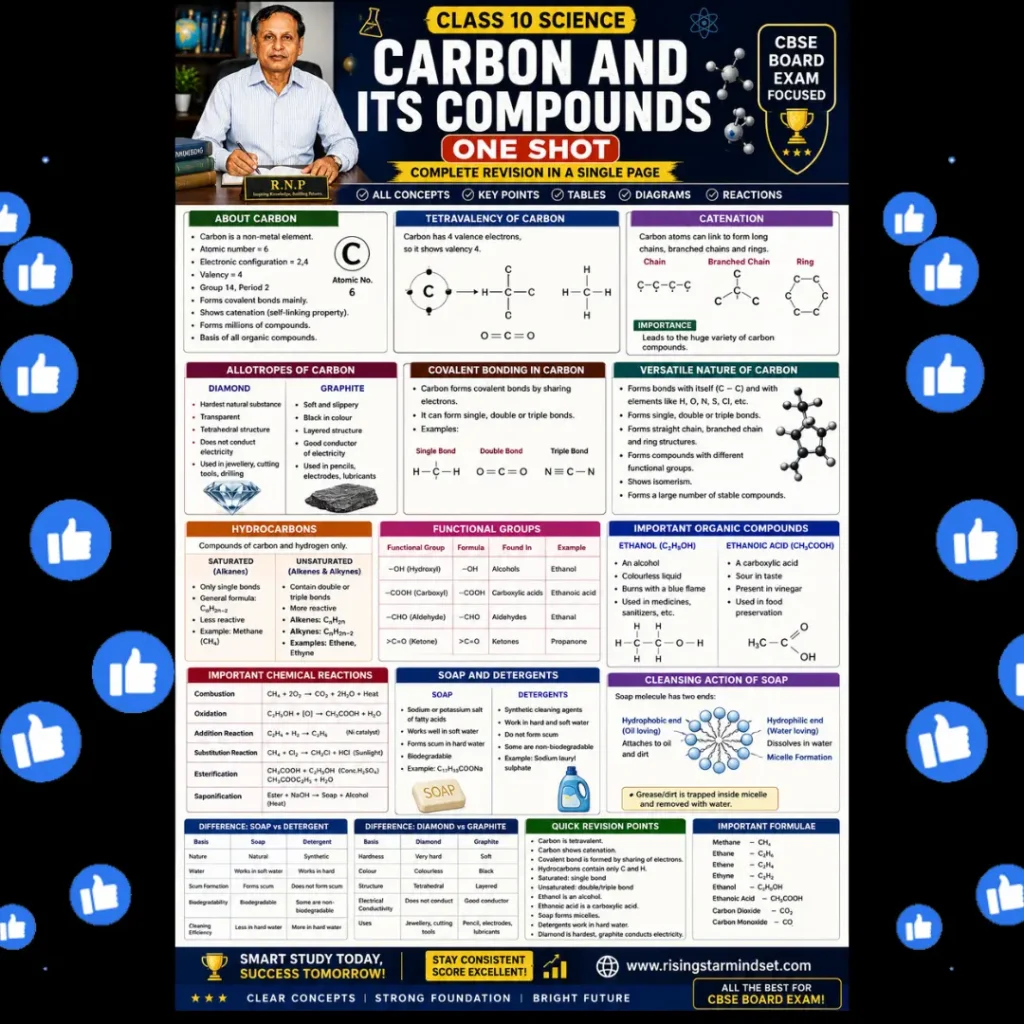
⚡ Carbon and Its Compounds Class 10 One Shot Revision Notes
इस पोस्ट में मिलेगा:
- Chapter Revision in 10–15 Minutes
- Quick Notes
- Important Formulae
- Key Reactions
- Board Exam Revision Points
👉 (Carbon and Its Compounds Class 10 One Shot Revision Notes )
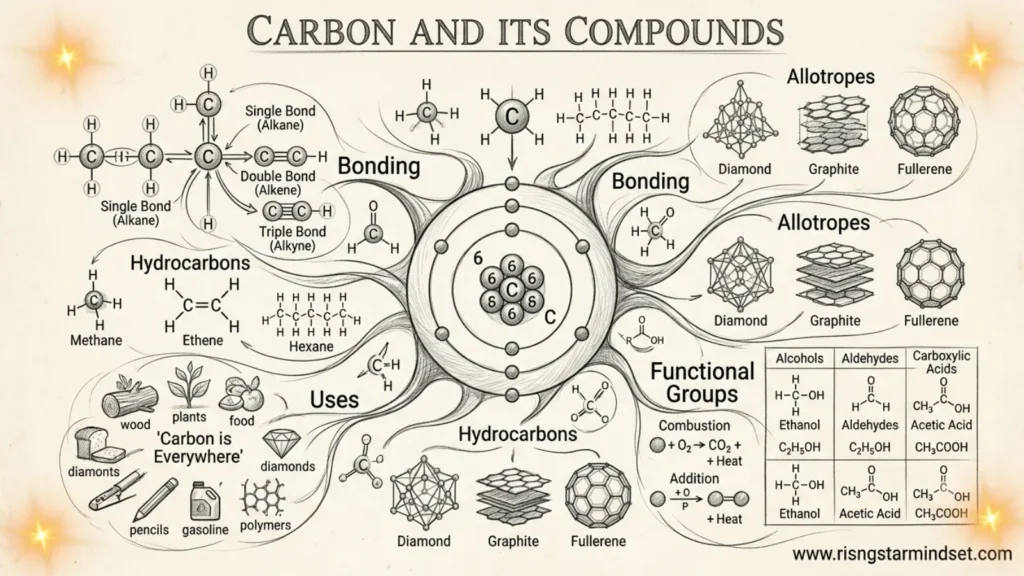
🧠 Carbon and Its Compounds Class 10 Mind Map
इस पोस्ट में मिलेगा:
- Complete Chapter Mind Map
- Flow Charts
- Visual Revision Notes
- Last Minute Revision Sheet
👉 (Carbon and Its Compounds Class 10 Mind Map )
Final Exam Tip
💡 पहले Complete Notes पढ़ें, फिर Important Questions हल करें, उसके बाद MCQs की Practice करें और अंत में One Shot Revision से पूरे Chapter का Revision करें। इस क्रम में तैयारी करने से आपकी Conceptual Understanding मजबूत होगी और बोर्ड परीक्षा में अच्छे अंक प्राप्त करने की संभावना बढ़ेगी।
Keep Learning, Keep Growing! 🚀
P Kumar | Rising Star Mindset
www.risingstarmindset.com
Together We Will Make The Difference