
United Nations Day 2026: Why Does the World Still Need the United Nations?

Can the world solve its biggest problems if every country works alone? Imagine a world where nations refuse to cooperate during wars, natural disasters, disease outbreaks or climate emergencies. Would it be possible to protect peace, human rights and the future of millions of people? ( United Nations Day 2026 )
These questions explain why United Nations Day remains important in 2026.
Observed every year on October 24, United Nations Day commemorates the creation of the United Nations (UN), an international organization established after the Second World War to promote peace, security, cooperation and respect for human rights.
In today’s interconnected world, decisions made in one country can affect people thousands of kilometres away. Climate change, infectious diseases, food insecurity, humanitarian emergencies and technological developments often require countries to work together.
But what does the United Nations actually do? How was it created? What has it achieved, and why does it sometimes struggle to solve international problems?
This article explores the history, responsibilities, achievements and limitations of the United Nations, with simple explanations in both English and Hindi.
PREVIOUS POST : India’s 3 New UNESCO Tentative List Sites: History & Facts
1. What Is United Nations Day 2026?
United Nations Day is observed on October 24 every year. It marks the anniversary of the United Nations Charter coming into force on October 24, 1945, which officially brought the organization into existence.
The day provides an opportunity to understand the importance of international cooperation and the role of the UN in addressing global challenges.
In 2026, the United Nations marks 81 years since its establishment.
Rather than being only a ceremonial occasion, United Nations Day encourages people to reflect on questions of peace, equality, human dignity and shared responsibility.
हिंदी में समझें: ( United Nations Day 2026 )
संयुक्त राष्ट्र दिवस हर साल 24 अक्टूबर को मनाया जाता है। इसी दिन वर्ष 1945 में संयुक्त राष्ट्र का चार्टर लागू हुआ था और संगठन ने आधिकारिक रूप से काम करना शुरू किया था।
इस दिन का उद्देश्य लोगों को यह समझाना है कि विश्व शांति, मानवाधिकार, विकास और अंतरराष्ट्रीय सहयोग के लिए देशों के बीच बातचीत कितनी महत्वपूर्ण है।
2. Why Was the United Nations Established? ( United Nations Day 2026 )
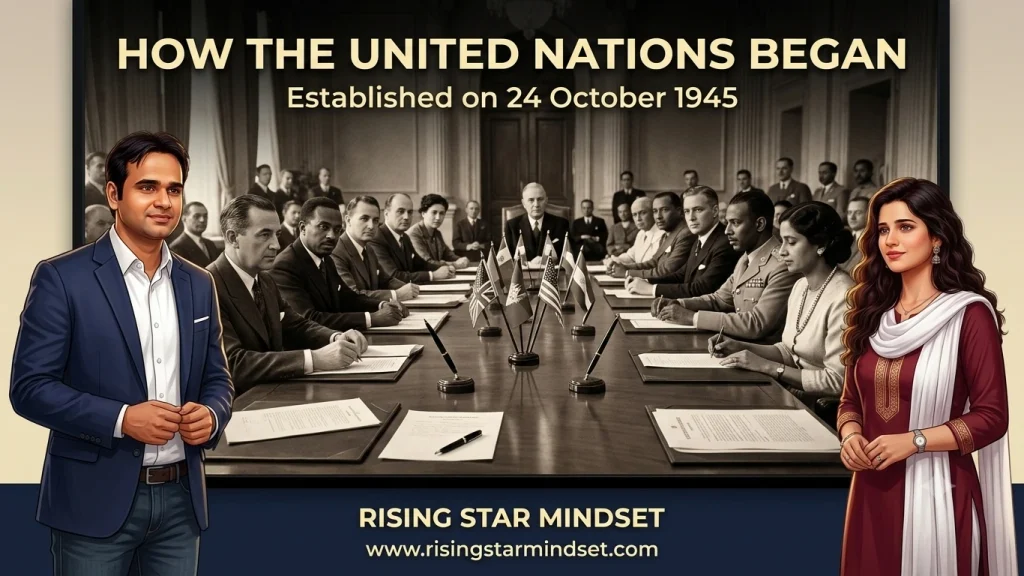
To understand the purpose of the United Nations, we must look back at the history of the twentieth century.
The Second World War, which lasted from 1939 to 1945, caused enormous destruction. Millions of people lost their lives, cities were devastated and communities experienced widespread displacement and suffering.
The international community recognized that preventing future conflicts required more than temporary agreements between governments. Countries needed a framework through which they could discuss disagreements, establish common principles and cooperate on international problems.
The United Nations Charter was signed in San Francisco on June 26, 1945, and came into force on October 24, 1945.
The organization was created with several major purposes:
- Maintaining international peace and security.
- Developing friendly relations among nations.
- Encouraging international cooperation to solve economic, social and humanitarian problems.
- Promoting respect for human rights and fundamental freedoms.
- Providing a platform for countries to discuss shared challenges.
The United Nations was not designed to replace every national government. Instead, it provides a framework for cooperation among sovereign countries.
हिंदी में समझें: ( United Nations Day 2026 )
द्वितीय विश्व युद्ध ने दुनिया को यह एहसास कराया कि देशों के बीच स्थायी शांति बनाए रखने के लिए मजबूत अंतरराष्ट्रीय सहयोग जरूरी है।
इसी उद्देश्य से संयुक्त राष्ट्र की स्थापना की गई। यह देशों को बातचीत करने, विवादों का शांतिपूर्ण समाधान खोजने और वैश्विक समस्याओं पर मिलकर काम करने का मंच प्रदान करता है।
3. United Nations Day 2026 at a Glance: Important Facts
The following facts provide a quick introduction to the organization.
| Key detail | Information |
| Official name | United Nations |
| Established | October 24, 1945 |
| Founding document | United Nations Charter |
| Headquarters | New York City, United States |
| Original members | 51 founding member states |
| Current membership | 193 member states |
| Official languages | Arabic, Chinese, English, French, Russian and Spanish |
| Main objectives | Peace, security, human rights and international cooperation |
| Annual observance | October 24 — United Nations Day |
The United Nations has grown considerably since its founding. Its membership now includes 193 countries, giving it a broad international role in diplomacy and cooperation.
However, membership does not mean that every country always agrees with every UN decision. Different national interests, political systems and security concerns can create disagreements.
हिंदी में समझें: ( United Nations Day 2026 )
संयुक्त राष्ट्र में आज 193 सदस्य देश शामिल हैं। इतने बड़े संगठन में अलग-अलग भाषाओं, संस्कृतियों, राजनीतिक व्यवस्थाओं और राष्ट्रीय हितों वाले देश एक साथ आते हैं।
इसी विविधता के कारण संयुक्त राष्ट्र बातचीत और सहयोग का महत्वपूर्ण मंच है, लेकिन कई बार निर्णय लेना कठिन भी हो जाता है।
4. How Does the United Nations Work?

Many people know the name United Nations but do not understand how its major bodies function.
The UN has six principal organs, each with a distinct role.
A. General Assembly ( United Nations Day 2026 )
The General Assembly is the main deliberative body of the United Nations. All 193 member states have a seat, and each has one vote.
Countries discuss international issues, debate proposals and adopt resolutions on matters within the Assembly’s responsibilities.
Its resolutions are generally recommendations rather than legally binding decisions for member states, although certain decisions, such as those concerning the organization’s internal functioning, have different effects.
B. Security Council
The Security Council has primary responsibility under the Charter for maintaining international peace and security.
It has 15 members: five permanent members and ten elected members serving two-year terms.
The five permanent members are China, France, Russia, the United Kingdom and the United States. They have special voting powers, including the ability to veto substantive resolutions.
This veto system is one reason the Security Council can sometimes struggle to respond effectively when major powers disagree.
C. Economic and Social Council
The Economic and Social Council, commonly called ECOSOC, coordinates work on economic, social and sustainable-development issues.
It brings together governments and other participants to discuss development priorities and international cooperation.
D. International Court of Justice
The International Court of Justice (ICJ) is the principal judicial organ of the United Nations. It settles legal disputes between states when it has jurisdiction and provides advisory opinions on legal questions referred to it by authorized bodies.
It should not be confused with the International Criminal Court, which is a separate institution.
E. Secretariat ( United Nations Day 2026 )
The Secretariat carries out the day-to-day work of the United Nations. It supports meetings, prepares reports, implements assigned tasks and assists the Secretary-General.
F. Trusteeship Council
The Trusteeship Council was established to supervise trust territories as they moved toward self-government or independence. It suspended regular operations in 1994 after the last trust territory achieved independence.
हिंदी में समझें:
संयुक्त राष्ट्र के अलग-अलग अंग अलग-अलग जिम्मेदारियाँ निभाते हैं। महासभा में सदस्य देश चर्चा करते हैं, सुरक्षा परिषद अंतरराष्ट्रीय शांति और सुरक्षा पर काम करती है, जबकि अंतरराष्ट्रीय न्यायालय देशों के बीच कानूनी विवादों से संबंधित मामलों को देखता है।
इन सभी संस्थाओं का उद्देश्य संयुक्त राष्ट्र के चार्टर में निर्धारित जिम्मेदारियों को पूरा करने में योगदान देना है।
5. Five Major Areas Where the United Nations Makes a Difference ( United Nations Day 2026 )
The work of the United Nations extends beyond meetings between world leaders. Its agencies, programmes and partners support initiatives that affect communities around the world.
1. Maintaining International Peace and Security
One of the UN’s best-known responsibilities is helping countries address threats to international peace and security.
It provides a diplomatic platform for negotiations and may support mediation, sanctions or peacekeeping operations under appropriate mandates.
UN peacekeeping missions can help protect civilians, support political processes and assist countries emerging from conflict.
However, peacekeeping is not a guarantee that violence will end. Its effectiveness depends on the mandate, resources, cooperation of the parties and conditions on the ground.
Example: When a conflict threatens civilians, diplomatic negotiations and international coordination may help create opportunities for humanitarian assistance or a political settlement.
हिंदी में: संयुक्त राष्ट्र देशों के बीच बातचीत को बढ़ावा देता है और कुछ परिस्थितियों में शांति स्थापना अभियानों के माध्यम से सहायता करता है। हालांकि, हर संघर्ष को समाप्त करना उसके नियंत्रण में नहीं होता।
2. Improving Global Health ( United Nations Day 2026 )
Health emergencies do not always remain within national borders. Infectious diseases can spread internationally, making information-sharing and coordinated responses important.
The World Health Organization (WHO), a specialized agency of the UN system, coordinates international public-health work, provides technical guidance and supports countries in strengthening health systems.
International cooperation also contributes to disease surveillance, vaccination programmes and responses to health emergencies.
Why it matters: When countries share reliable information and coordinate public-health responses, they can improve their ability to detect and manage health threats.
हिंदी में: स्वास्थ्य संबंधी समस्याएँ किसी एक देश तक सीमित नहीं रहतीं। विश्व स्वास्थ्य संगठन देशों को तकनीकी मार्गदर्शन और सार्वजनिक स्वास्थ्य संबंधी सहयोग प्रदान करता है।
3. Supporting Education and Protecting Children
Education provides children with knowledge, confidence and opportunities to build a better future.
UNICEF works to protect children’s rights and support their health, education, nutrition and well-being. UNESCO promotes international cooperation in education, science, culture and communication.
These efforts are especially important in communities affected by poverty, emergencies, discrimination or limited access to schools.
Why it matters: Children who receive quality education and essential support have better opportunities to develop their abilities and participate in society.
हिंदी में: शिक्षा बच्चों को अपने जीवन में आगे बढ़ने के अवसर देती है। संयुक्त राष्ट्र से जुड़ी संस्थाएँ शिक्षा, स्वास्थ्य, पोषण और बाल अधिकारों के क्षेत्र में देशों तथा स्थानीय भागीदारों के साथ काम करती हैं।
4. Addressing Climate Change and Environmental Problems ( United Nations Day 2026 )
Climate change is a global challenge because its effects can cross borders and affect agriculture, water supplies, ecosystems, health and livelihoods.
The United Nations supports international climate negotiations and cooperation through processes such as the UN Framework Convention on Climate Change.
The Sustainable Development Goals also include objectives relating to clean water, affordable energy, sustainable cities, responsible consumption and climate action.
International agreements alone cannot solve environmental problems. Governments, businesses and individuals must also take practical steps to reduce pollution and protect natural resources.
हिंदी में: जलवायु परिवर्तन का प्रभाव केवल एक देश तक सीमित नहीं रहता। तापमान में वृद्धि, चरम मौसम और पर्यावरणीय क्षति से दुनिया के कई हिस्से प्रभावित हो सकते हैं। इसीलिए पर्यावरण संरक्षण के लिए अंतरराष्ट्रीय सहयोग जरूरी है।
5. Providing Humanitarian Assistance
Armed conflicts, natural disasters and other emergencies can leave families without homes, food, clean water or medical care.
UN agencies and humanitarian partners provide different forms of assistance depending on the emergency and available resources.
For example, the World Food Programme supports food assistance, while the UN Refugee Agency works to protect refugees and other people covered by its mandate.
Humanitarian work can be difficult when aid workers face insecurity, blocked access or shortages of funding.

हिंदी में: युद्ध, बाढ़, भूकंप और अन्य आपदाओं के दौरान कई परिवारों को भोजन, आश्रय और चिकित्सा सहायता की जरूरत होती है। संयुक्त राष्ट्र की विभिन्न संस्थाएँ अपने कार्यक्षेत्र के अनुसार प्रभावित लोगों की सहायता करती हैं।
6. What Are the United Nations Sustainable Development Goals? ( United Nations Day 2026 )

In 2015, UN member states adopted the 2030 Agenda for Sustainable Development, which includes 17 Sustainable Development Goals (SDGs).
These goals provide a shared framework for addressing poverty, inequality, health, education, environmental protection and other development challenges.
Some of the best-known goals include:
| Goal | Main focus |
| Goal 1 | No Poverty |
| Goal 2 | Zero Hunger |
| Goal 3 | Good Health and Well-Being |
| Goal 4 | Quality Education |
| Goal 5 | Gender Equality |
| Goal 6 | Clean Water and Sanitation |
| Goal 7 | Affordable and Clean Energy |
| Goal 13 | Climate Action |
| Goal 16 | Peace, Justice and Strong Institutions |
| Goal 17 | Partnerships for the Goals |
The goals are interconnected. For example, access to education can help reduce inequality, while clean water and sanitation can improve public health.
The 2030 deadline also highlights the importance of measuring progress rather than simply announcing commitments.
हिंदी में समझें: ( United Nations Day 2026 )
सतत विकास लक्ष्य दुनिया को अधिक समान, स्वस्थ और पर्यावरण के अनुकूल बनाने के लिए तय किए गए 17 साझा लक्ष्य हैं।
इनमें गरीबी कम करना, बेहतर शिक्षा, स्वास्थ्य सेवाएँ, स्वच्छ पानी, लैंगिक समानता और जलवायु परिवर्तन से निपटना शामिल है। इन लक्ष्यों को प्राप्त करने के लिए सरकारों, संस्थाओं और नागरिकों के सहयोग की आवश्यकता है।
7. Why Does the United Nations Sometimes Fail to Stop Wars? ( United Nations Day 2026 )
This is one of the most frequently asked questions about the organization.
If the United Nations was created to maintain international peace, why do wars and serious conflicts continue?
The answer lies in the way the organization is structured and the limits of international cooperation.
The Security Council veto
The five permanent members of the Security Council have veto power over substantive resolutions. When one of these members votes against such a resolution, it can prevent its adoption even when many other countries support it.
National interests
Countries may disagree about responsibility, security, territory, sanctions or the best way to resolve a conflict.
Limited independent enforcement power
The United Nations is not a world government with unlimited authority over national governments. Its ability to act depends on the Charter, member-state cooperation and the specific circumstances.
Humanitarian and political obstacles
Even when the international community agrees on the need for assistance, access to affected populations and the safety of aid workers can remain major challenges.
These limitations do not mean that the UN has no value. They explain why its effectiveness varies across situations and why diplomacy, political commitment and cooperation remain essential.
हिंदी में समझें: ( United Nations Day 2026 )
संयुक्त राष्ट्र कोई विश्व सरकार नहीं है जिसके पास हर देश पर असीमित अधिकार हों। सुरक्षा परिषद में वीटो, देशों के अलग-अलग हित और जमीन पर मौजूद परिस्थितियाँ उसके निर्णयों को प्रभावित कर सकती हैं।
इसलिए संयुक्त राष्ट्र की भूमिका को समझते समय उसकी उपलब्धियों के साथ-साथ उसकी सीमाओं को भी समझना चाहिए।
8. How Has India Contributed to the United Nations?

India has been a member of the United Nations since its founding and has participated in international discussions on peace, development, decolonization and global cooperation.
India has also made significant contributions to UN peacekeeping operations over the decades, including the deployment of military, police and other personnel in different missions.
India’s engagement with the United Nations includes discussions on development, climate action, international security, public health and the interests of developing countries.
As one of the world’s largest countries by population, India’s participation is important in debates about global development and international cooperation.
At the same time, countries can have different views on how international institutions should be reformed and how global responsibilities should be shared.
हिंदी में समझें: ( United Nations Day 2026 )
भारत संयुक्त राष्ट्र का संस्थापक सदस्य रहा है और उसने विभिन्न शांति स्थापना अभियानों में योगदान दिया है। भारत वैश्विक विकास, जलवायु परिवर्तन, अंतरराष्ट्रीय सुरक्षा और विकासशील देशों से जुड़े विषयों पर भी अपनी भूमिका निभाता है।
भारत की भागीदारी यह दिखाती है कि अंतरराष्ट्रीय संस्थाओं में सहयोग और चर्चा के माध्यम से देशों को अपनी चिंताएँ तथा प्राथमिकताएँ रखने का अवसर मिलता है।
9. How Can Ordinary People Contribute to a Better World?
International cooperation may seem like the responsibility of presidents, diplomats and governments. However, ordinary people also influence the quality of their communities.
Here are six practical ways to support the broader principles behind United Nations Day.
1. Respect human dignity
Treat people fairly and avoid discrimination. Respectful behaviour can help create safer and more inclusive communities.
2. Verify information before sharing it
False information can create fear, hostility and confusion. Check reliable sources before forwarding news or making claims about international events.
3. Support education
Encourage children to learn, help students find educational resources and promote equal opportunities for learning.
4. Protect the environment
Reduce unnecessary waste, conserve water and energy, and adopt responsible everyday habits.
5. Help vulnerable people
Support legitimate community initiatives that assist children, older people, displaced families or people affected by emergencies.
6. Choose dialogue over hostility
Disagreements are unavoidable, but respectful discussion can help people understand different perspectives and identify common ground.
These actions cannot replace international policies or government responsibilities. Nevertheless, they can contribute to a culture of responsibility, understanding and cooperation.
हिंदी में समझें: ( United Nations Day 2026 )
दुनिया में सकारात्मक बदलाव लाने के लिए हर व्यक्ति का राष्ट्रपति या राजनयिक होना जरूरी नहीं है। हम अपने आसपास समानता, शिक्षा, पर्यावरण संरक्षण और जिम्मेदार व्यवहार को बढ़ावा देकर योगदान दे सकते हैं।
छोटे कदम अकेले सभी वैश्विक समस्याओं का समाधान नहीं कर सकते, लेकिन सामूहिक रूप से वे बेहतर समाज बनाने में मदद कर सकते हैं।
10. United Nations Day 2026: A Lesson for the Next Generation
Young people will inherit many of the challenges that countries face today. Their understanding of international affairs, human rights, environmental responsibility and peaceful communication can shape the future.
Schools and families can use United Nations Day to discuss questions such as:
- Why do countries need international agreements?
- How can conflicts be resolved without violence?
- Why should children everywhere have access to education?
- How can communities respond responsibly to climate change?
- What responsibilities do people have toward those affected by disasters?
These conversations can help students develop critical thinking and understand that global issues often have multiple causes and possible solutions.
Learning about the United Nations should not mean accepting every decision without question. Students should be encouraged to examine evidence, understand different viewpoints and evaluate international institutions fairly.
हिंदी में समझें: ( United Nations Day 2026 )
नई पीढ़ी को केवल संयुक्त राष्ट्र का इतिहास जानना ही पर्याप्त नहीं है। उसे यह भी समझना चाहिए कि शांति, समानता, शिक्षा और पर्यावरण संरक्षण के लिए नागरिकों की क्या भूमिका हो सकती है।
सही जानकारी, सवाल पूछने की आदत और अलग-अलग विचारों को समझने की क्षमता बेहतर भविष्य के निर्माण में मदद कर सकती है।
11. Frequently Asked Questions About United Nations Day 2026
Q1. When is United Nations Day celebrated?
United Nations Day is celebrated every year on October 24 to commemorate the anniversary of the UN Charter coming into force in 1945.
Q2. How old is the United Nations in 2026?
The United Nations marks 81 years since its establishment in 1945.
Q3. How many countries are members of the United Nations?
The United Nations has 193 member states.
Q4. What is the main purpose of the United Nations?
Its purposes include maintaining international peace and security, developing friendly relations among nations, promoting human rights and encouraging international cooperation.
Q5. Can the United Nations stop every war?
No. The organization’s ability to respond depends on its legal authority, the cooperation of member states, available resources and political circumstances.
Q6. What are the Sustainable Development Goals?
The 17 Sustainable Development Goals are a shared framework adopted in 2015 to address poverty, inequality, health, education, environmental protection and other development challenges by 2030.
Q7. What is India’s role in the United Nations?
India participates in UN deliberations and has contributed to peacekeeping missions and discussions on international development, security and cooperation.
Q8. How can students observe United Nations Day?
Students can learn about the UN Charter, research the Sustainable Development Goals, organize educational discussions and explore ways to promote peace, equality and environmental responsibility.
Q9. Is the United Nations the same as the International Court of Justice?
The International Court of Justice is one of the six principal organs of the United Nations. It is not the same as the separate International Criminal Court.
Q10. Why is United Nations Day important today?
It provides an opportunity to reflect on the need for international dialogue, cooperation, human rights and collective responses to global challenges.
Conclusion: A Better World Begins With Cooperation

United Nations Day 2026 reminds us that peace and progress require continuous effort.
Since its establishment in 1945, the United Nations has provided a platform for countries to discuss shared problems, develop international standards and cooperate on humanitarian, development and security issues.
Its limitations are real. Conflicts continue, international disagreements can block action, and many development goals remain unfinished. These realities make it important to assess the organization honestly rather than assume that it can solve every problem.
Nevertheless, global challenges such as climate change, pandemics, displacement and international conflict demonstrate why cooperation remains necessary.
Governments must fulfil their responsibilities, international institutions must work effectively, and citizens must support informed discussion, human dignity and peaceful solutions.
The future of our world depends not only on how countries compete, but also on how they cooperate.
Let us use United Nations Day as an opportunity to learn, question, understand and contribute to a more peaceful and sustainable future.
Think High • Rise Higher.
Rising Star Mindset — Knowledge, Motivation, Education and Awareness.
Official Sources and Further Reading
For readers who want to verify the historical facts and explore the subject further, consult these official resources:
- United Nations Day: https://www.un.org/en/observances/un-day/
- United Nations Charter: https://www.un.org/en/about-us/un-charter
- UN Member States: https://www.un.org/en/about-us/member-states
- The Six Main Organs of the UN: https://www.un.org/en/about-us/main-bodies
- Sustainable Development Goals: https://sdgs.un.org/goals
- UN Peacekeeping: https://peacekeeping.un.org/en
🌐 Website: www.risingstarmindset.com