
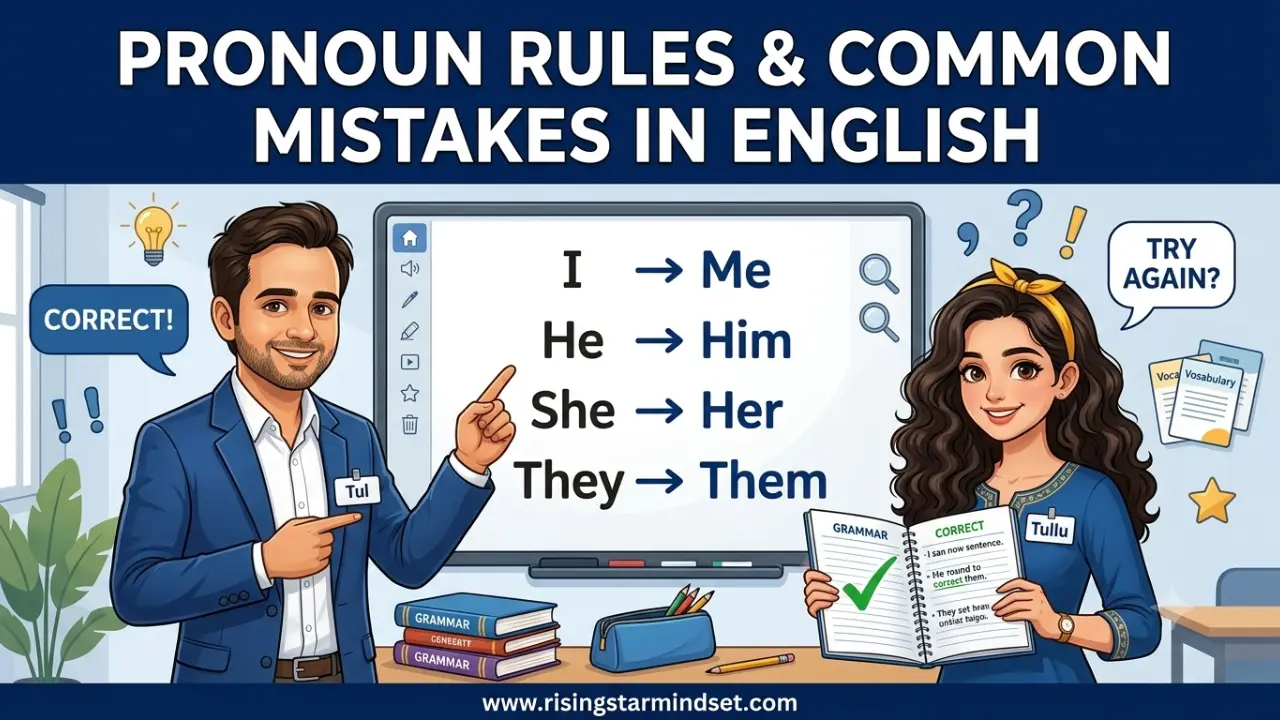
Lesson 11.10 – Pronoun Rules & Common Mistakes in English
Learning Pronoun Rules and Common Mistakes is essential for speaking and writing correct English. Pronouns are used in almost every English sentence. Therefore, even a small mistake in pronoun usage can make a sentence grammatically incorrect or unclear.
In this Lesson 11.9, we will learn important pronoun rules, common mistakes, English and Hindi explanations, examples, key points, questions and answers, fill-in-the-blanks, MCQs, HOTS questions, FAQs, and quick revision.
Pronouns Complete Roadmap
This Pronouns Course is divided into 11 easy lessons.
| Lesson | Topic | Status |
| Lesson 11.1 | Introduction to Pronouns | CLICK HERE |
| Lesson 11.2 | Subject Pronouns | CLICK HERE |
| Lesson 11.3 | Object Pronouns | CLICK HERE |
| Lesson 11.4 | Possessive Pronouns | CLICK HERE |
| Lesson 11.5 | Possessive Adjectives | CLICK HERE |
| Lesson 11.6 | Relative Pronouns | CLICK HERE |
| Lesson 11.7 | Demonstrative Pronouns | CLICK HERE |
| Lesson 11.8 | Interrogative & Relative Pronouns | 👈 CLICK |
| Lesson 11.9 | Indefinite, Distributive & Reciprocal Pronouns | CLICK HERE |
| Lesson 11.10 | Pronoun Rules & Common Mistakes | ✅ Current Lesson |
| Lesson 11.11 | Practice, MCQs & Final Revision | Coming Soon |
Table of Contents
- What Is a Pronoun?
- Definition of Pronoun
- Pronoun Meaning in Hindi
- Why Are Pronouns Important?
- Types of Pronouns – Quick Revision
- Rule 1 – Subject and Object Pronouns
- Rule 2 – I and Me
- Rule 3 – He and Him
- Rule 4 – She and Her
- Rule 5 – We and Us
- Rule 6 – They and Them
- Rule 7 – My and Mine
- Rule 8 – Your and Yours
- Rule 9 – Their and Theirs
- Rule 10 – Its and It’s
- Rule 11 – Who and Whom
- Rule 12 – Whose
- Rule 13 – Reflexive Pronouns
- Rule 14 – Demonstrative Pronouns
- Rule 15 – Indefinite Pronouns
- Rule 16 – Pronoun-Antecedent Agreement
- Rule 17 – Singular and Plural Agreement
- Rule 18 – Avoid Double Pronouns
- Rule 19 – Avoid Unclear Pronoun References
- Rule 20 – Pronoun Position
- Common Pronoun Mistakes
- English and Hindi Examples
- Daily Conversation Practice
- Key Points
- Fill in the Blanks
- Match the Following
- MCQs
- Question and Answers
- HOTS Questions
- Quick Revision
- FAQs
- Conclusion
- Next Lesson Notification
1. What Is a Pronoun?
A pronoun is a word that is used instead of a noun.
For example:
Rahul is a student. Rahul studies English every day.
We can avoid repeating Rahul:
Rahul is a student. He studies English every day.
Here, he replaces the noun Rahul. Therefore, he is a pronoun.
More Examples
- Riya is absent because she is sick.
- The boys are playing because they are happy.
- This book belongs to me. It is mine.
- The teacher asked Rahul and me to stay.
2. Definition of Pronoun
English Definition
A pronoun is a word used in place of a noun or noun phrase to avoid unnecessary repetition.
हिन्दी में परिभाषा
Pronoun वह शब्द है जिसका प्रयोग Noun या Noun Phrase के स्थान पर किया जाता है ताकि एक ही Noun को बार-बार दोहराने से बचा जा सके।
Example
Ravi is my friend. Ravi is helpful.
Better:
Ravi is my friend. He is helpful.
3. Pronoun Meaning in Hindi ( Pronoun Rules )
Pronoun = सर्वनाम
Examples:
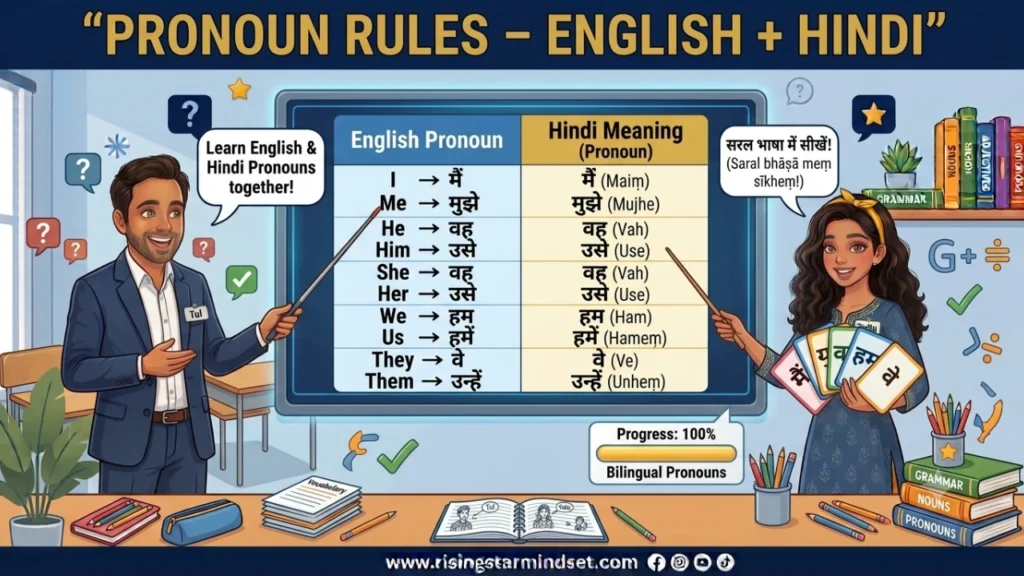
| Pronoun | Hindi Meaning |
| I | मैं |
| You | तुम / आप |
| He | वह |
| She | वह |
| It | यह / वह वस्तु |
| We | हम |
| They | वे |
| Me | मुझे / मुझको |
| Him | उसे / उसको |
| Her | उसे / उसको |
| Us | हमें |
| Them | उन्हें |
4. Why Are Pronouns Important?
Pronouns make English sentences shorter, clearer, smoother, and more natural.
For example:
❌ Riya went to the market because Riya wanted to buy a book.
✅ Riya went to the market because she wanted to buy a book.
The second sentence sounds more natural. Therefore, correct pronoun usage is important in both spoken and written English.
Moreover, pronouns are frequently tested in:
- School examinations
- Competitive examinations
- Spoken English
- Grammar tests
- Writing tasks
- Interviews
- Everyday conversations
Consequently, mastering pronoun rules can significantly improve your English communication.
5. Types of Pronouns – Quick Revision
Before learning common mistakes, let us quickly revise the major types.
| Type | Examples |
| Personal Pronouns | I, you, he, she, we, they |
| Possessive Pronouns | mine, yours, his, hers, ours, theirs |
| Reflexive Pronouns | myself, yourself, himself |
| Demonstrative Pronouns | this, that, these, those |
| Interrogative Pronouns | who, whom, whose, which, what |
| Relative Pronouns | who, whom, whose, which, that |
| Indefinite Pronouns | someone, anyone, everyone, nobody |
| Reciprocal Pronouns | each other, one another |
Therefore, understanding the function of each type is the first step toward avoiding mistakes.
6. Rule 1 – Subject and Object Pronouns
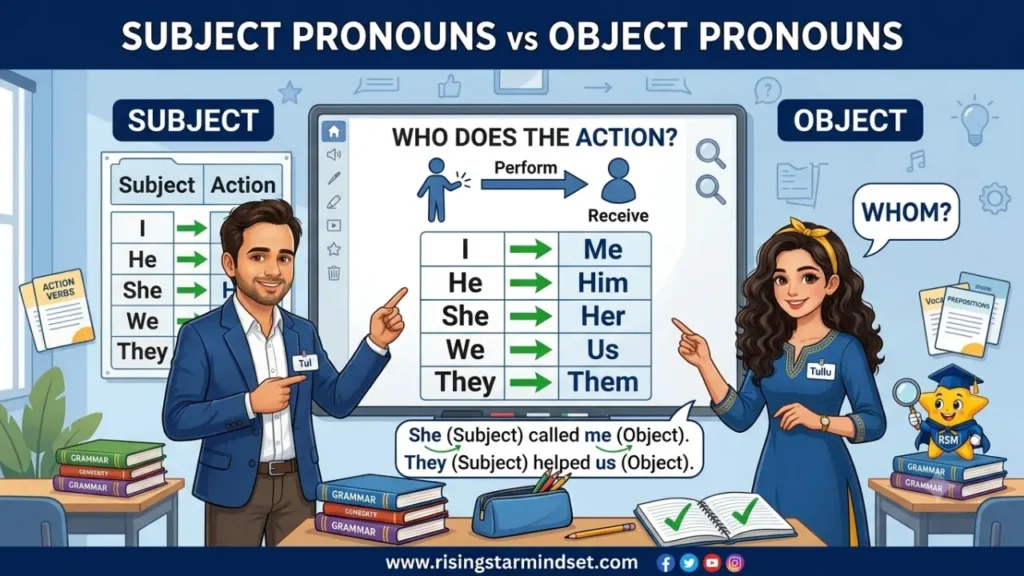
One of the most important pronoun rules is knowing whether the pronoun is functioning as a subject or an object.
Subject Pronouns
- I
- You
- He
- She
- It
- We
- They
Object Pronouns
- Me
- You
- Him
- Her
- It
- Us
- Them
Example
✅ She called me.
Here, she is the subject.
✅ I called her.
Here, her is the object.
हिन्दी
She = वह → काम करने वाली
Her = उसे/उसको → जिस पर काम हो रहा है
7. Rule 2 – I and Me ( Pronoun Rules )
Use I when the pronoun is the subject.
Use me when the pronoun is the object.
Correct
I went to school.
Rahul and I went to school.
The teacher called Rahul and me.
Incorrect
❌ Me went to school.
❌ Rahul and me went to school.
Easy Trick
Remove the other person’s name.
Rahul and I went to school.
Remove Rahul:
I went to school. ✅
Therefore, the correct sentence is:
Rahul and I went to school.
8. Rule 3 – He and Him ( Pronoun Rules )
Use he as a subject.
Use him as an object.
Examples
✅ He is my brother.
✅ I met him yesterday.
❌ Him is my brother.
❌ I met he yesterday.
हिन्दी
He = वह → subject
Him = उसे/उसको → object
9. Rule 4 – She and Her ( Pronoun Rules )
Use she as the subject.
Use her as the object or before a noun to show possession.
Examples
✅ She is my friend.
✅ I called her.
✅ This is her book.
❌ Her is my friend.
❌ I called she.
10. Rule 5 – We and Us ( Pronoun Rules )
Use we as the subject.
Use us as the object.
Examples
✅ We are students.
✅ The teacher helped us.
❌ Us are students.
❌ The teacher helped we.
हिन्दी
We = हम
Us = हमें / हमको
11. Rule 6 – They and Them ( Pronoun Rules )
Use they as the subject.
Use them as the object.
Examples
✅ They are playing football.
✅ I invited them to the party.
❌ Them are playing football.
❌ I invited they.
Therefore, always check the role of the pronoun before choosing they or them.
12. Rule 7 – My and Mine
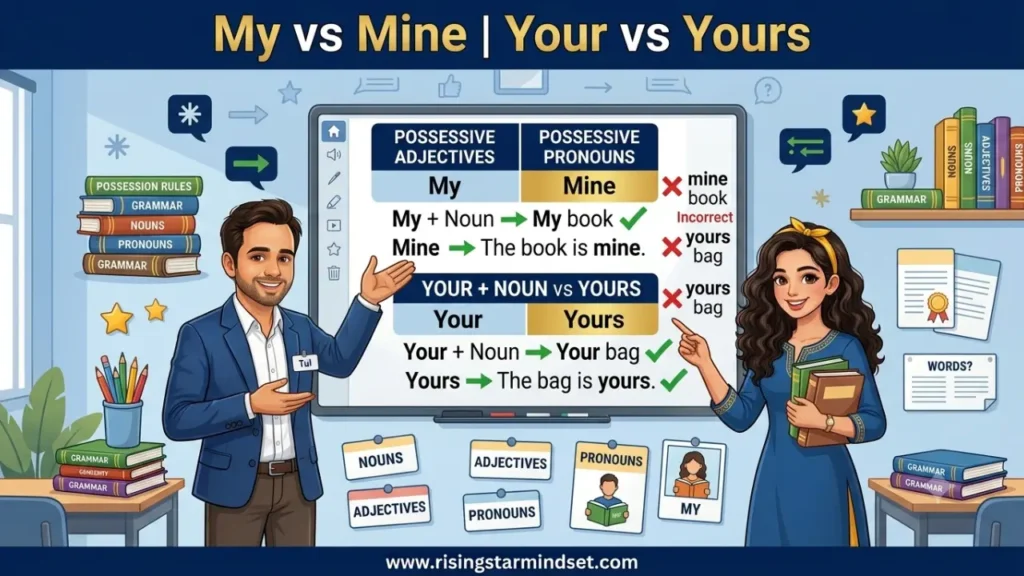
My is a possessive determiner. It comes before a noun.
Mine is a possessive pronoun. It can stand alone.
Examples
✅ This is my book.
✅ This book is mine.
❌ This is mine book.
❌ This book is my.
Easy Rule
My + Noun
Mine = no noun immediately after it
13. Rule 8 – Your and Yours
Similarly:
Your + noun
Yours = used independently
Examples
✅ This is your pen.
✅ This pen is yours.
❌ This is yours pen.
❌ This pen is your.
14. Rule 9 – Their and Theirs
Use their before a noun.
Use theirs independently.
Examples
✅ This is their house.
✅ This house is theirs.
❌ This is theirs house.
❌ This house is their.
15. Rule 10 – Its and It’s
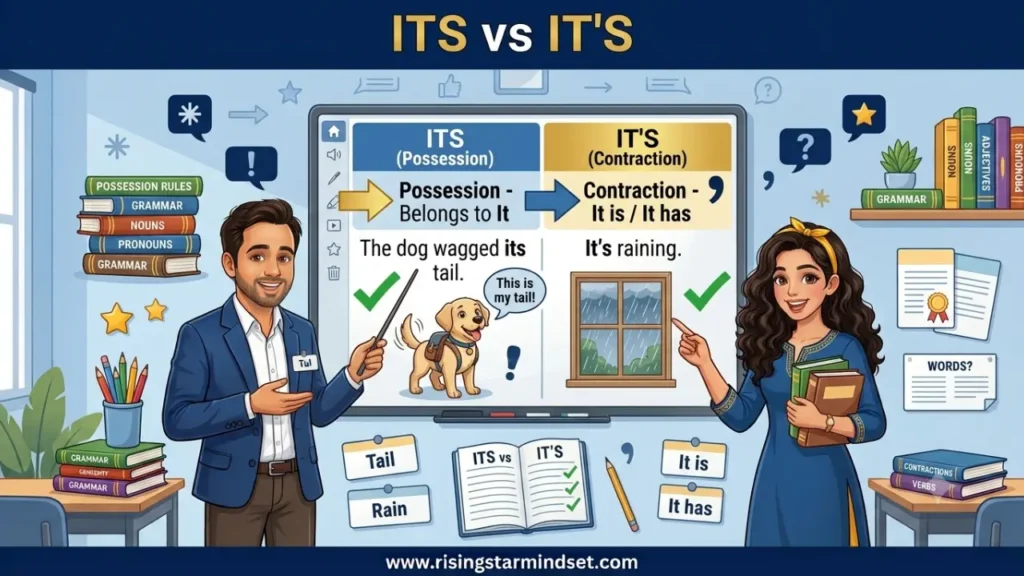
This is one of the most common English grammar mistakes.
Its
Its shows possession.
The dog wagged its tail.
It’s
It’s is a short form of:
It is
or
It has
Examples
✅ It’s raining.
= It is raining.
✅ The cat is cleaning its paws.
Therefore:
Its = possession
It’s = it is / it has
हिन्दी Trick
अगर it is या it has लगाया जा सकता है, तो it’s सही हो सकता है।
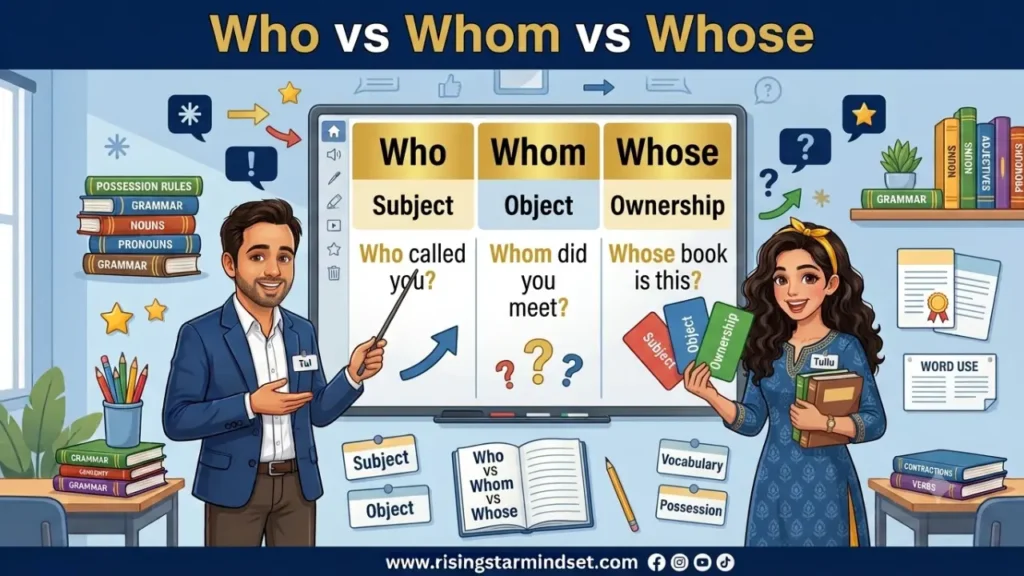
16. Rule 11 – Who and Whom
Who is generally used as the subject.
Whom is generally used as the object.
Examples
✅ Who called you?
✅ Whom did you meet?
Easy Trick
If you can answer with:
he/she/they → Who
If you can answer with:
him/her/them → Whom
For example:
Who called you?
Answer:
She called me.
Therefore, who is correct.
17. Rule 12 – Whose
Whose shows possession or ownership.
Examples
✅ Whose book is this?
✅ I met a student whose father is a doctor.
हिन्दी
Whose = किसका / किसकी / किसके
For example:
Whose bag is this?
यह बैग किसका है?
18. Rule 13 – Reflexive Pronouns
Reflexive Pronouns include:
- Myself
- Yourself
- Himself
- Herself
- Itself
- Ourselves
- Yourselves
- Themselves
They are generally used when the subject and object refer to the same person or thing.
Examples
✅ I hurt myself.
✅ She introduced herself.
✅ They enjoyed themselves.
Common Mistake
❌ Myself will contact you.
✅ I will contact you myself.
Myself should not normally replace I.
19. Rule 14 – Demonstrative Pronouns
The main Demonstrative Pronouns are:
- This
- That
- These
- Those
Rule
This → near + singular
That → far + singular
These → near + plural
Those → far + plural
Examples
✅ This is my book.
✅ That is your school.
✅ These are my shoes.
✅ Those are beautiful flowers.
20. Rule 15 – Indefinite Pronouns
Words such as:
- Someone
- Somebody
- Everyone
- Everybody
- Nobody
- Something
- Everything
- Nothing
are Indefinite Pronouns.
Many -one and -body pronouns take singular verbs.
Examples
✅ Everyone is ready.
❌ Everyone are ready.
✅ Somebody has called.
❌ Somebody have called.
Therefore, always check subject-verb agreement.
21. Rule 16 – Pronoun-Antecedent Agreement
An antecedent is the noun that a pronoun refers to.
The pronoun should normally agree with its antecedent in number and, where relevant, gender.
Example
Riya forgot her book.
Here:
Riya → antecedent
her → pronoun
Another example:
The boys finished their work.
Boys → plural
Therefore:
their → plural
22. Rule 17 – Singular and Plural Agreement
A singular noun generally requires a singular pronoun.
Example
The girl brought her notebook.
A plural noun generally requires a plural pronoun.
The girls brought their notebooks.
Incorrect
❌ The girls brought her notebooks.
Correct
✅ The girls brought their notebooks.
23. Rule 18 – Avoid Double Pronouns
Do not unnecessarily use two pronouns for the same grammatical role.
Incorrect
❌ My brother he is a teacher.
Correct
✅ My brother is a teacher.
or
✅ He is a teacher.
Similarly:
❌ Riya she is my friend.
✅ Riya is my friend.
✅ She is my friend.
24. Rule 19 – Avoid Unclear Pronoun References
A pronoun should clearly refer to a particular noun.
Consider:
Rahul told Amit that he was late.
Who was late—Rahul or Amit?
The sentence is unclear.
A better version is:
Rahul told Amit, “You are late.”
Or:
Rahul told Amit that Rahul was late.
Therefore, make the pronoun reference clear.
25. Rule 20 – Pronoun Position
Pronouns should be placed where their meaning is clear.
Example
❌ After talking to Rahul, he went home.
Who went home?
The sentence is unclear.
Better
✅ After talking to Rahul, Riya went home.
Consequently, the reader clearly understands who went home.
26. Common Pronoun Mistakes
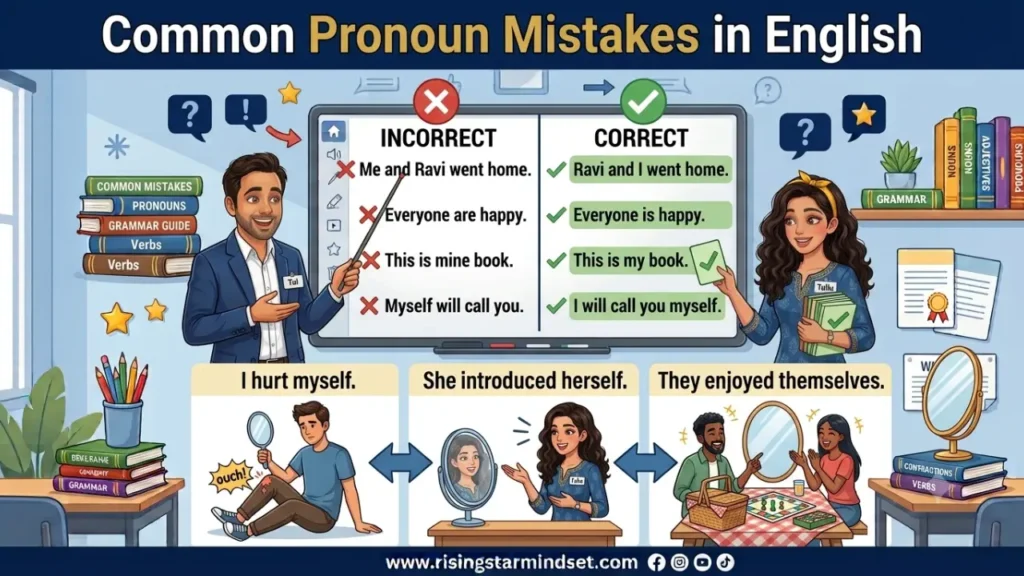
Here are some important mistakes that students should avoid.
| Incorrect ❌ | Correct ✅ |
| Me and Ravi went home. | Ravi and I went home. |
| Him is my friend. | He is my friend. |
| Her is a teacher. | She is a teacher. |
| Us are ready. | We are ready. |
| Them are students. | They are students. |
| This is mine book. | This is my book. |
| This book is my. | This book is mine. |
| Its raining. | It’s raining. |
| The dog hurt it’s leg. | The dog hurt its leg. |
| Everyone are happy. | Everyone is happy. |
| Myself will call you. | I will call you myself. |
| Nobody didn’t come. | Nobody came. |
27. English and Hindi Examples
Example 1
✅ She is my sister.
वह मेरी बहन है।
Example 2
✅ I met him yesterday.
मैं कल उससे मिला।
Example 3
✅ They helped us.
उन्होंने हमारी मदद की।
Example 4
✅ This book is mine.
यह किताब मेरी है।
Example 5
✅ Everyone is ready.
हर कोई तैयार है।
Example 6
✅ I hurt myself.
मुझे खुद चोट लगी।
Example 7
✅ Whose bag is this?
यह बैग किसका है?
Example 8
✅ Those are my books.
वे मेरी किताबें हैं।
28. Daily Conversation Practice
Conversation 1
Tul: Who is that boy?
Tullu: He is my brother.
Tul: Did you invite him?
Tullu: Yes, I invited him yesterday.
हिन्दी
तुल: वह लड़का कौन है?
टुल्लू: वह मेरा भाई है।
तुल: क्या तुमने उसे बुलाया?
टुल्लू: हाँ, मैंने उसे कल बुलाया था।
Conversation 2
Tul: Whose notebook is this?
Tullu: It is mine.
Tul: Are these your books?
Tullu: No, they are theirs.
हिन्दी
तुल: यह नोटबुक किसकी है?
टुल्लू: यह मेरी है।
तुल: क्या ये तुम्हारी किताबें हैं?
टुल्लू: नहीं, ये उनकी हैं।
29. Key Points ( Pronoun Rules )
| I → subject |
| Me → object |
| He → subject |
| Him → object |
| She → subject |
| Her → object/possessive determiner |
| We → subject |
| Us → object |
| They → subject |
| Them → object |
| My → before noun |
| Mine → independently |
| Your → before noun |
| Yours → independently |
| Their → before noun |
| Theirs → independently |
| Its → possession |
| It’s → it is / it has |
| Who → subject |
| Whom → object |
| Myself → reflexive/emphatic use, not a replacement for I |
| Whose → possession |
| Everyone → singular verb |
30. Abbreviations Used in This Lesson
| Abbreviation | Full Form | Meaning |
| N. | Noun | नाम बताने वाला शब्द |
| Pro. | Pronoun | सर्वनाम |
| S. | Subject | कर्ता |
| Obj. | Object | कर्म |
| V. | Verb | क्रिया |
| Adj. | Adjective | विशेषण |
| Adv. | Adverb | क्रिया-विशेषण |
| A. | Antecedent | वह noun जिसे pronoun refer करता है |
| Sing. | Singular | एकवचन |
| Pl. | Plural | बहुवचन |
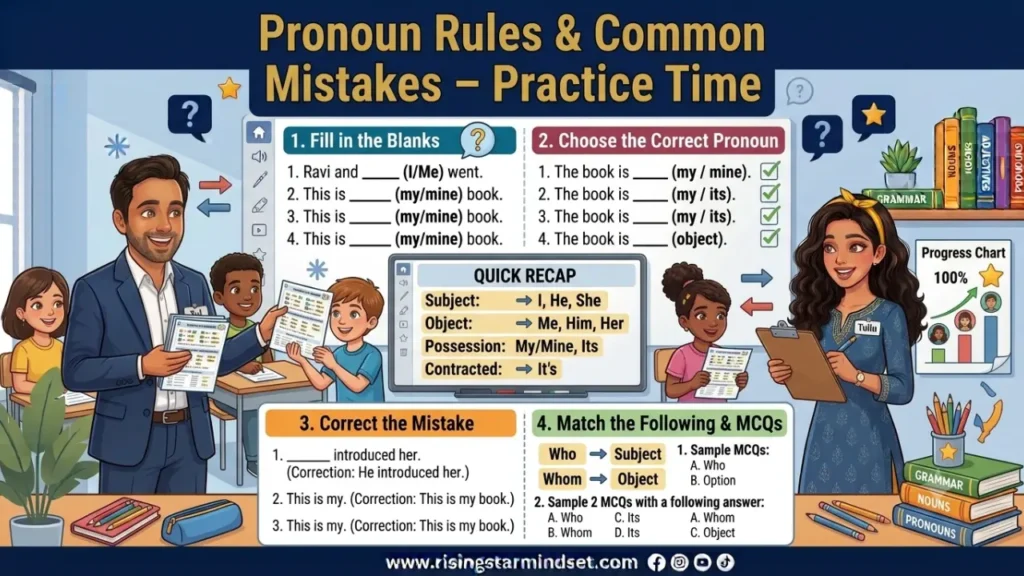
31. Fill in the Blanks ( Pronoun Rules )
Choose the correct pronoun.
- Rahul and ___ went to school.
(I / me) - The teacher called Riya and ___.
(I / me) - ___ is my brother.
(He / Him) - I met ___ yesterday.
(he / him) - ___ are my friends.
(They / Them) - The teacher helped ___.
(we / us) - This is ___ book.
(my / mine) - This book is ___.
(my / mine) - ___ raining outside.
(Its / It’s) - The dog wagged ___ tail.
(its / it’s)
Answers
- I
- me
- He
- him
- They
- us
- my
- mine
- It’s
- its
32. Match the Following ( Pronoun Rules )
| Column A | Column B |
| I | Object |
| Me | Subject |
| My | Possessive before noun |
| Mine | Possessive pronoun |
| Who | Subject |
| Whom | Object |
| Whose | Ownership |
| Myself | Reflexive |
Answers
I → Subject
Me → Object
My → Possessive before noun
Mine → Possessive pronoun
Who → Subject
Whom → Object
Whose → Ownership
Myself → Reflexive
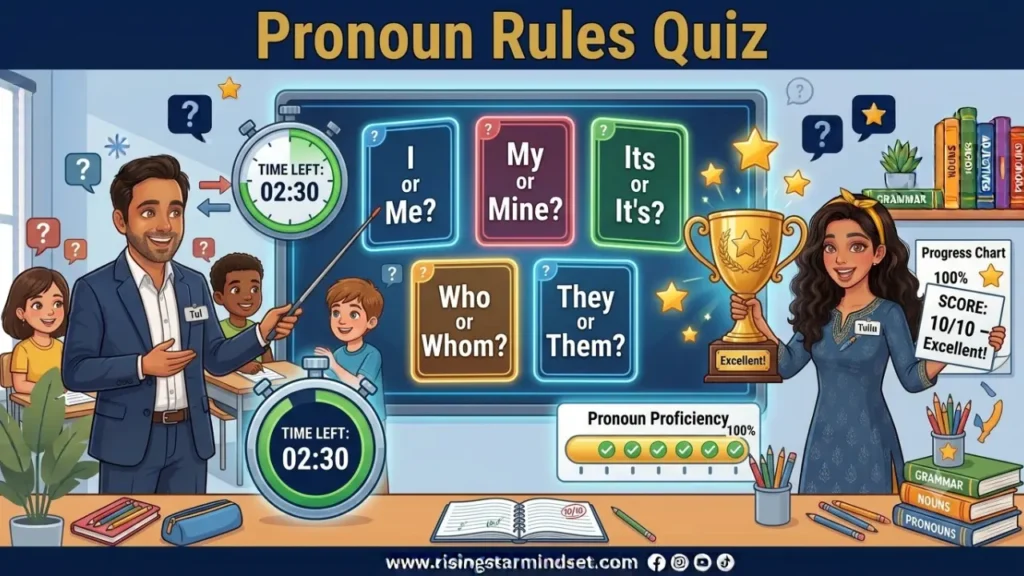
33. MCQs ( Pronoun Rules )
1. Choose the correct sentence.
A. Me went to school.
B. I went to school.
C. Him went to school.
D. Us went to school.
✅ Answer: B. I went to school.
2. Choose the correct option:
The teacher called Rahul and ___.
A. I
B. he
C. me
D. they
✅ Answer: C. me
3. Which word shows possession?
A. Who
B. Whose
C. Whom
D. What
✅ Answer: B. Whose
4. Choose the correct sentence.
A. Everyone are ready.
B. Everyone is ready.
C. Everyone am ready.
D. Everyone be ready.
✅ Answer: B
5. Which sentence uses “it’s” correctly?
A. The dog hurt it’s leg.
B. It’s a beautiful day.
C. The cat cleaned it’s paws.
D. The school changed it’s rules.
✅ Answer: B
6. Which sentence is correct?
A. This is mine book.
B. This book is my.
C. This is my book.
D. This is me book.
✅ Answer: C
7. Which is the object pronoun?
A. He
B. She
C. They
D. Him
✅ Answer: D. Him
8. Choose the correct sentence.
A. Myself will help you.
B. I will help you myself.
C. Me myself will help you.
D. Myself I help you.
✅ Answer: B
9. Which pronoun refers to ownership?
A. Whose
B. Who
C. Which
D. Whom
✅ Answer: A
10. Choose the correct sentence.
A. Them are my friends.
B. They are my friends.
C. They is my friends.
D. Them is my friends.
✅ Answer: B
34. Question and Answers ( Pronoun Rules )
Q1. What is a pronoun?
A pronoun is a word used instead of a noun or noun phrase.
Q2. What is the difference between I and me?
I is generally used as a subject, whereas me is used as an object.
Q3. What is the difference between my and mine?
My comes before a noun, whereas mine is used independently.
Q4. What is the difference between its and it’s?
Its shows possession, while it’s means it is or it has.
Q5. What is the difference between who and whom?
Who generally functions as a subject, whereas whom generally functions as an object.
Q6. What is an antecedent?
An antecedent is the noun or noun phrase to which a pronoun refers.
Q7. Why is “Everyone are happy” incorrect?
Because everyone is grammatically singular and therefore takes is.
Q8. Can “myself” replace “I”?
Normally, no. Use I as the subject and myself for reflexive or emphatic purposes.
35. HOTS Questions ( Pronoun Rules )
HOTS 1
Correct the sentence:
Me and my friend went to the library.
Answer
✅ My friend and I went to the library.
HOTS 2
Correct the sentence:
The teacher gave the books to Ravi and I.
Answer
✅ The teacher gave the books to Ravi and me.
Here, the pronoun is the object of to, so me is required.
HOTS 3
Correct the sentence:
Everyone are doing their homework.
Answer
For standard subject-verb agreement:
✅ Everyone is doing their homework.
Here, everyone takes the singular verb is. The singular they/their is also widely used in modern English when the person’s gender is unknown or irrelevant.
HOTS 4
Correct the sentence:
Its a beautiful morning.
Answer
✅ It’s a beautiful morning.
Because it’s = it is.
HOTS 5
Correct the sentence:
The cat hurt it’s leg.
Answer
✅ The cat hurt its leg.
Here, its shows possession.
HOTS 6
Identify the problem:
Rahul told Amit that he had won the competition.
Answer
The pronoun he is ambiguous because it is unclear whether Rahul or Amit won.
A clearer sentence would be:
Rahul told Amit that Rahul had won the competition.
36. Quick Revision Chart ( Pronoun Rules )
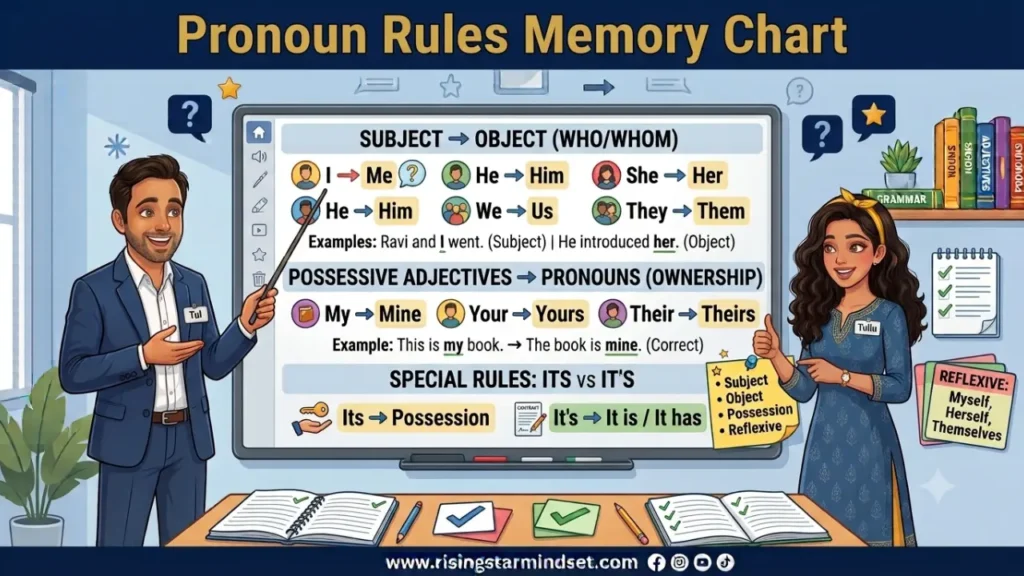
| Pronoun | Use | Example |
| I | Subject | I am ready. |
| Me | Object | She called me. |
| He | Subject | He is here. |
| Him | Object | I saw him. |
| She | Subject | She is kind. |
| Her | Object/Possessive | I met her. |
| We | Subject | We are ready. |
| Us | Object | Help us. |
| They | Subject | They are happy. |
| Them | Object | I invited them. |
| My | Before noun | My book |
| Mine | Independent | The book is mine. |
| Your | Before noun | Your bag |
| Yours | Independent | The bag is yours. |
| Its | Possession | Its tail |
| It’s | It is/has | It’s ready. |
| Who | Subject | Who came? |
| Whom | Object | Whom did you meet? |
| Whose | Possession | Whose book? |
| Myself | Reflexive | I hurt myself. |
37. FAQs
Q1. What are the most common pronoun mistakes in English?
The most common mistakes involve I/me, he/him, she/her, we/us, they/them, my/mine, your/yours, its/it’s, who/whom, and reflexive pronouns.
Q2. Is “Me and Rahul” correct?
When they are the subject, the standard form is:
Rahul and I
However, when they are the object:
The teacher called Rahul and me.
Q3. Is everyone singular or plural?
Everyone is grammatically singular for verb agreement.
Everyone is ready.
Q4. What is the easiest way to remember its and it’s?
Remember:
It’s = it is / it has
Its = possession
Q5. When should I use whom?
Use whom when it functions as an object, especially in formal English.
Whom did you meet?
Q6. Can “they” be singular?
Yes. In modern English, singular they/them/their is widely used when the gender of one person is unknown, irrelevant, or when that person uses they/them pronouns.
Q7. What is the difference between my and mine?
My is followed by a noun:
This is my book.
Mine stands alone:
This book is mine.
Q8. Why is “Myself will call you” incorrect?
Because myself is a reflexive/emphatic pronoun. It does not normally replace the subject pronoun I.
Correct:
I will call you myself.
Q9. How can students avoid pronoun mistakes?
First, identify the noun. Next, determine whether the pronoun is a subject, object, possessive, or reflexive form. Finally, check number and meaning before using it.
38. Conclusion
In conclusion, Pronoun Rules and Common Mistakes are important parts of English grammar because pronouns appear in almost every conversation and written sentence. Therefore, understanding their correct usage can make English communication more accurate and natural.
First, remember the basic subject and object forms: I/me, he/him, she/her, we/us, and they/them. Next, remember possessive forms such as my/mine, your/yours, and their/theirs. Furthermore, always distinguish between its and it’s, because they have completely different functions.
Similarly, remember that who generally works as a subject, while whom generally works as an object. Moreover, whose expresses possession. In addition, reflexive pronouns such as myself, yourself, himself, herself, and themselves should be used carefully.
Most importantly, check pronoun agreement with the noun. For example:
Everyone is ready. ✅
not:
Everyone are ready. ❌
Finally, avoid unclear pronoun references and double pronouns. By practising the rules, examples, conversations, and exercises in this lesson, learners can gradually reduce common grammar mistakes.
Therefore, keep practising every day. Moreover, read English sentences aloud. In addition, try to create your own examples. As a result, your confidence and accuracy will improve.
🌟 Think High • Rise Higher
Learn → Practice → Speak → Succeed
39. Next Lesson Notification 🚀
Coming Next: Lesson 11.11 – Prepositions in English
In the next lesson, we will learn Prepositions in English with:
- English + Hindi explanation
- Types of prepositions
- In, On, At
- By, With, From, To
- Common preposition rules
- Daily-use examples
- Common mistakes
- Conversation practice
- Fill in the blanks
- Match the Following
- MCQs
- HOTS Questions
- Question & Answers
- FAQs
- Quick Revision
👉 Don’t miss Lesson 11.11!
Rising Star Mindset – Think High • Rise Higher
🌟 Keep Learning with Rising Star Mindset
📘 Spoken English Course
🏛️ BPSC Preparation
🎓 School Notes
💡 Daily Motivation
🌐 Website: www.risingstarmindset.com