
Introduction to Pronouns in English (Lesson 11.1)
Learn English Grammar Step by Step with Tul & Tullu
Introduction ( Introduction to Pronouns in English )
English ( Introduction to Pronouns in English )
Have you ever wondered why English speakers rarely repeat the same person’s name again and again? Instead of repeating a noun, they naturally use another word that makes communication shorter, smoother, and more interesting. That special word is called a Pronoun.
Therefore, Pronouns are one of the most important building blocks of English Grammar. They are used in conversations, classrooms, interviews, emails, essays, stories, speeches, and almost every English sentence.
Moreover, learning Pronouns at the beginning of your Spoken English journey will help you speak confidently and correctly. Without understanding Pronouns, it becomes difficult to make natural English sentences.
In this complete Pronouns course, we will learn everything step by step. First, we will understand the basic idea of Pronouns. After that, we will move towards different types of Pronouns, their rules, examples, daily conversations, practice exercises, quizzes, and finally a complete revision.
Furthermore, this course is specially designed for:
- School Students
- CBSE Learners
- Beginners in Spoken English
- Competitive Exam Aspirants
- Interview Preparation
- Daily English Learners
Finally, by completing all eleven lessons, you will be able to understand and use Pronouns confidently in your daily English communication.
हिन्दी
क्या आपने कभी ध्यान दिया है कि अंग्रेज़ी बोलते समय लोग किसी व्यक्ति या वस्तु का नाम बार-बार नहीं दोहराते? इसके बजाय वे एक ऐसा शब्द प्रयोग करते हैं जो वाक्य को छोटा, सरल और प्रभावशाली बना देता है। इसी शब्द को Pronoun (सर्वनाम) कहा जाता है।
उदाहरण के लिए यदि हम बार-बार लिखें—
Tullu is a student. Tullu studies every day.
तो यह पढ़ने और सुनने में थोड़ा अजीब लगता है।
लेकिन यदि हम लिखें—
Tullu is a student. She studies every day.
तो वाक्य अधिक स्वाभाविक और आसान हो जाता है।
यही कारण है कि Pronouns अंग्रेज़ी व्याकरण का एक अत्यंत महत्वपूर्ण भाग हैं।
इसके अलावा, यदि आप Spoken English सीखना चाहते हैं, तो Pronouns को समझना बहुत आवश्यक है। क्योंकि लगभग हर अंग्रेज़ी वाक्य में किसी न किसी प्रकार का Pronoun प्रयोग होता है।
इसीलिए इस पूरे Course में हम Pronouns को बिल्कुल आसान भाषा में सीखेंगे। सबसे पहले हम यह समझेंगे कि Pronoun क्या होता है। उसके बाद हम धीरे-धीरे इसके सभी प्रकार, उनके नियम, उदाहरण, दैनिक वार्तालाप, अभ्यास प्रश्न, MCQs और Revision सीखेंगे।
इस Course को विशेष रूप से इस प्रकार तैयार किया गया है कि स्कूल के विद्यार्थी, प्रतियोगी परीक्षा की तैयारी करने वाले अभ्यर्थी तथा Spoken English सीखने वाले सभी विद्यार्थी आसानी से इसे समझ सकें।
अंततः यदि आप इस पूरे Pronouns Course के सभी Lessons को पूरा करते हैं, तो आप अंग्रेज़ी बोलते और लिखते समय Pronouns का सही और आत्मविश्वासपूर्ण प्रयोग कर पाएँगे।
Learning Objectives
After completing this lesson, you will be able to:
- Understand the meaning of Pronouns.
- Know why Pronouns are important.
- Understand the purpose of Pronouns.
- Learn where Pronouns are used.
- Build a strong foundation for the next lessons.
- Improve your Spoken English confidence.
Table of Contents
- Introduction
- Learning Objectives
- Pronouns Complete Course Roadmap
- Abbreviations
- What You Will Learn in This Course
- Why Pronouns are Important
- Who Should Learn This Course?
- Learning Tips
- Next Lesson Preview
- Previous topic : Articles in English Made Easy | A, An & The Rules
Pronouns Complete Roadmap
This Pronouns Course is divided into 11 easy lessons.
| Lesson | Topic | Status |
| Lesson 11.1 | Introduction to Pronouns | ✅ Current Lesson |
| Lesson 11.2 | Subject Pronouns | CLICK HERE |
| Lesson 11.3 | Object Pronouns | CLICK HERE |
| Lesson 11.4 | Possessive Pronouns | CLICK HERE |
| Lesson 11.5 | Possessive Adjectives | CLICK HERE |
| Lesson 11.6 | Relative Pronouns | CLICK HERE |
| Lesson 11.7 | Demonstrative Pronouns | CLICK HERE |
| Lesson 11.8 | Interrogative & Relative Pronouns | CLICK HERE |
| Lesson 11.9 | Indefinite, Distributive & Reciprocal Pronouns | CLICK HERE |
| Lesson 11.10 | Pronoun Rules & Common Mistakes | Coming Soon |
| Lesson 11.11 | Practice, MCQs & Final Revision | Coming Soon |
Abbreviations ( Introduction to Pronouns in English )
| Abbreviation | Meaning |
| Eng. | English |
| Hin. | Hindi |
| Pron. | Pronoun |
| Ex. | Example |
| FAQ | Frequently Asked Questions |
| MCQ | Multiple Choice Question |
| HOTS | Higher Order Thinking Skills |
| CBSE | Central Board of Secondary Education |
What You Will Learn in This Course?
Throughout this complete course, you will learn:
- Basic Pronoun Concepts
- Easy Grammar Rules
- Daily Use English
- Spoken English Practice
- Classroom Conversations
- Tul & Tullu Activities
- Practice Exercises
- Interview English
- Error Correction
- MCQs
- HOTS Questions
- Final Revision
Learning Tip 🌟 ( Introduction to Pronouns in English )
Tul says: “Don’t memorize grammar. Understand it first.”
Tullu says: “Practice every day, and English will become easy.”
What is a Pronoun?
Definition (English)
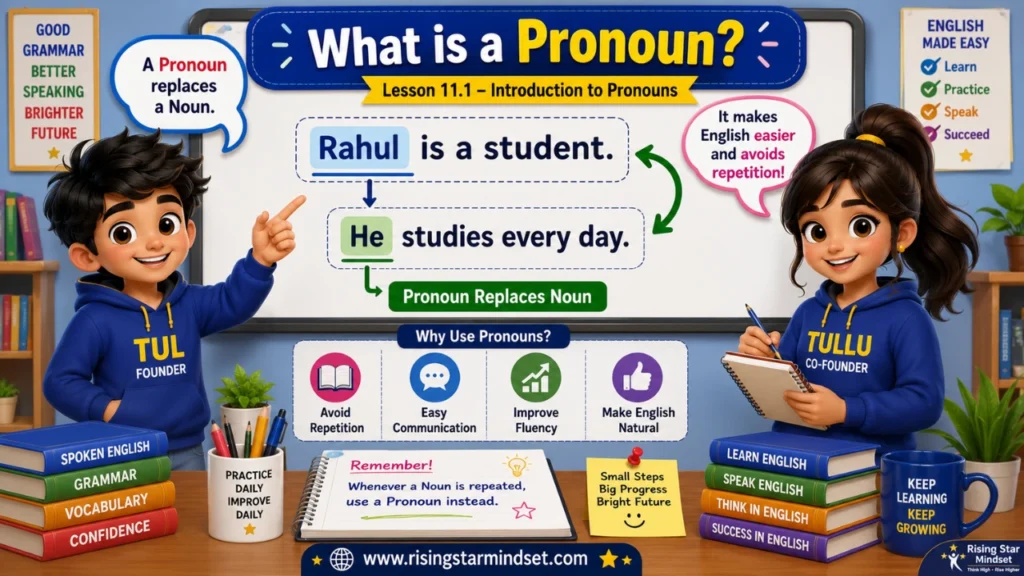
A Pronoun is a word that is used instead of a noun to avoid repeating the same person, place, animal, or thing again and again.
In simple words, a Pronoun replaces a noun and makes our sentences shorter, clearer, and more natural.
Examples
- Rahul is my friend. He is very kind.
- Riya is a teacher. She teaches English.
- The book is on the table. It is new.
In all these examples, He, She, and It replace the nouns Rahul, Riya, and Book.
Therefore, Pronouns help us communicate effectively without unnecessary repetition.
Pronoun Definition (Hindi)
Pronoun (सर्वनाम) वह शब्द है जो किसी Noun (संज्ञा) की जगह प्रयोग किया जाता है।
दूसरे शब्दों में, किसी व्यक्ति, वस्तु, स्थान या जानवर का नाम बार-बार दोहराने के बजाय हम Pronoun का प्रयोग करते हैं।
उदाहरण
❌ Butul is a student. Rahul studies every day.
✅ Butul is a student. He studies every day.
यहाँ He ने Butul की जगह ली है।
इसी प्रकार Pronoun वाक्य को सरल, छोटा और प्रभावशाली बनाता है।
Why Do We Use Pronouns?
Many beginners ask,
“Why can’t we simply repeat the noun every time?”
Although we can repeat the noun, it does not sound natural.
Example
❌ Without Pronouns
Anita is my sister.
Anita lives in Patna.
This paragraph sounds repetitive.
Example
✅ With Pronouns
Anita is my sister.
She lives in Patna.
She studies in Class 10.
Now the paragraph becomes easier to read and understand.
Therefore, Pronouns improve both speaking and writing.
Why Are Pronouns Important?
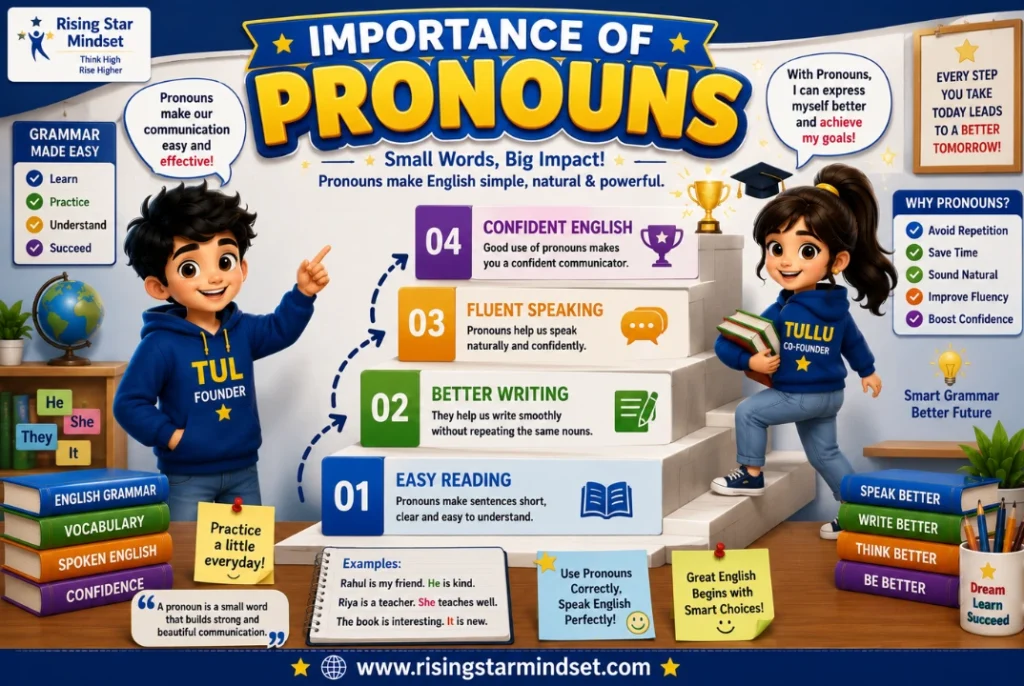
Pronouns are important because they make English communication smooth and natural.
Moreover, they help us avoid repeating the same noun several times.
Furthermore, they improve sentence structure and make conversations sound fluent.
In addition, Pronouns save time while speaking and writing.
Consequently, almost every English sentence contains one or more Pronouns.
हिन्दी में महत्व ( Introduction to Pronouns in English )
Pronouns अंग्रेज़ी भाषा का अत्यंत महत्वपूर्ण भाग हैं क्योंकि—
- वे बार-बार नाम दोहराने से बचाते हैं।
- वाक्य को छोटा और स्पष्ट बनाते हैं।
- अंग्रेज़ी को स्वाभाविक बनाते हैं।
- बोलने का आत्मविश्वास बढ़ाते हैं।
- लिखने की गुणवत्ता सुधारते हैं।
- प्रतियोगी परीक्षाओं में अच्छे अंक दिलाने में सहायता करते हैं।
इसलिए Pronouns सीखना प्रत्येक विद्यार्थी के लिए आवश्यक है।
Where Are Pronouns Used?
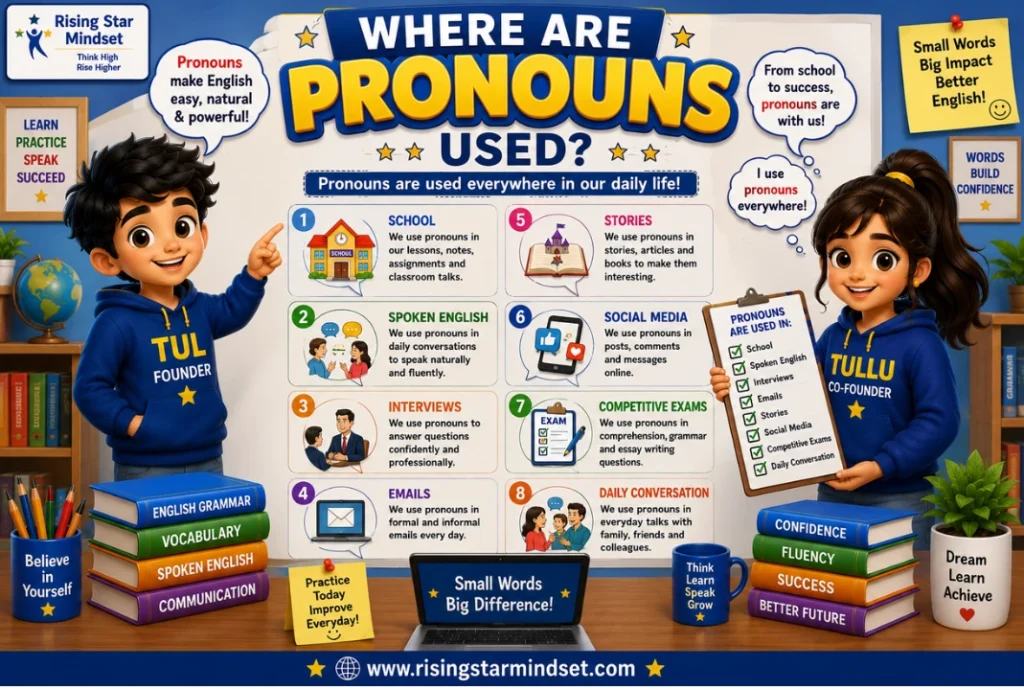
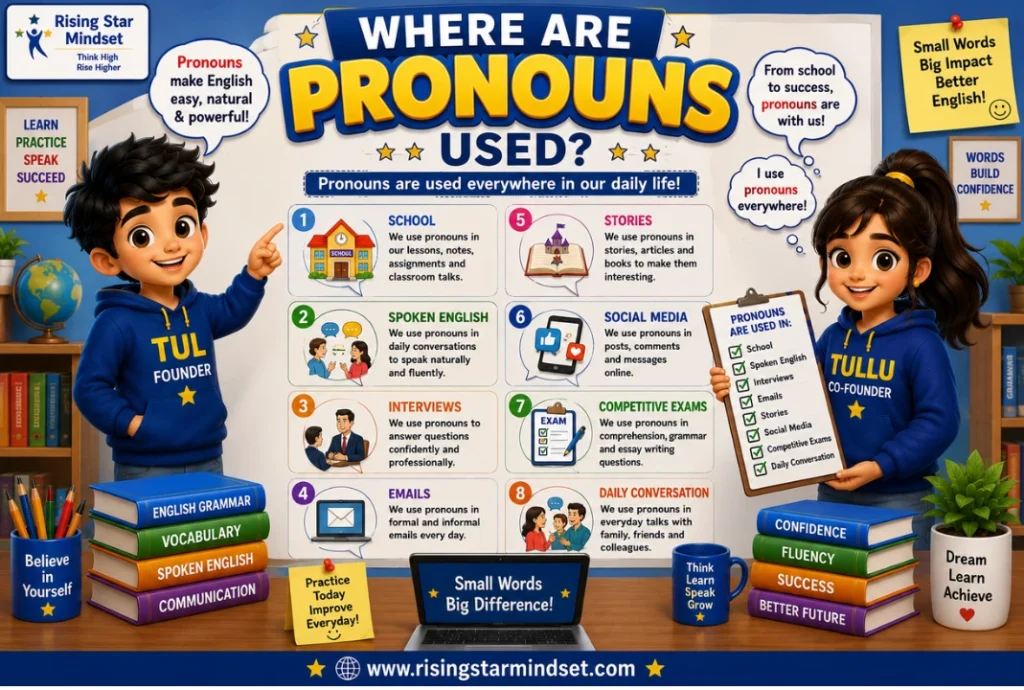
Pronouns are used almost everywhere in English.
For example:
- Daily Conversations
- School Textbooks
- Spoken English
- Competitive Exams
- Interviews
- Emails
- Letters
- Stories
- Essays
- Newspapers
- Social Media
In fact, if you observe any English conversation carefully, you will notice that Pronouns appear almost every minute.
Real-Life Examples ( Introduction to Pronouns in English )
Example 1
My father is a doctor.
He works in a hospital.
Example 2
My mother is cooking.
She is preparing dinner.
Example 3
The students are playing football.
They are enjoying the game.
Example 4
This is my laptop.
It is very fast.
Example 5
Tul and Tullu are learning English.
They practice every day.
Tul & Tullu Classroom Conversation
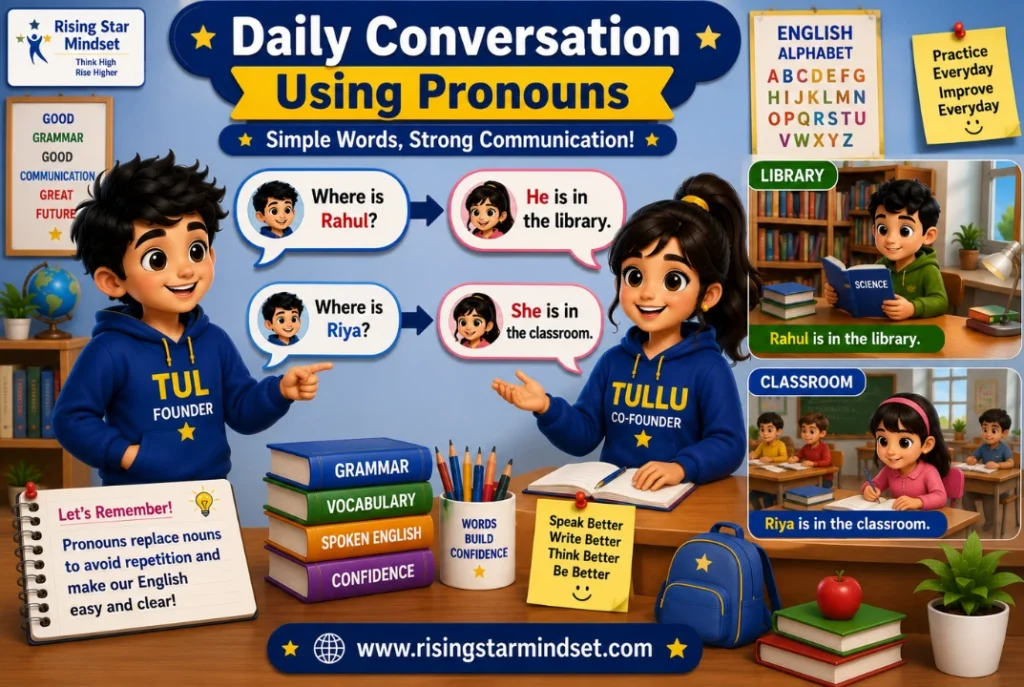
👩 Tul
Good morning, Tullu!
👦 Tullu
Good morning, Tul!
👩 Tul
Where is Rahul?
👦 Tullu
He is in the library.
👩 Tul
Where is Riya?
👦 Tullu
She is attending her English class.
👩 Tul
Where is the English book?
👦 Tullu
It is on the teacher’s table.
👩 Tul
Excellent! You are using Pronouns correctly.
👦 Tullu
Yes! Pronouns make English easier and faster.
Did You Know? 💡 ( Introduction to Pronouns in English )
Almost every paragraph in English uses Pronouns.
Without Pronouns, English would become repetitive and difficult to read.
That is why native speakers naturally use Pronouns in almost every conversation.
Quick Learning Tip ( Introduction to Pronouns in English )
✅ Always identify the noun first.
✅ Then think:
“Can I replace this noun with a Pronoun?”
If the answer is Yes, use the correct Pronoun.
This simple habit will improve your Spoken English significantly.
Mini Revision ( Introduction to Pronouns in English )
- Pronouns replace nouns.
- It reduce repetition.
- It also improve communication.
- Pronouns are used in speaking and writing
- Every English learner should master Pronouns before learning advanced grammar.
Key Points to Remember (Introduction to Pronouns in English)
Before moving to different types of Pronouns, every learner should understand these basic points. Moreover, these concepts will help you understand the next lessons more easily.
English ( Introduction to Pronouns in English )
- A Pronoun replaces a noun.
- Pronouns make sentences shorter and more meaningful.
- They improve spoken and written English.
- Pronouns help us avoid repetition.
- Every English learner uses Pronouns every day, even without realizing it.
- Furthermore, Pronouns make conversations natural and fluent.
हिन्दी
- Pronoun किसी Noun की जगह प्रयोग किया जाता है।
- Pronoun वाक्य को छोटा और प्रभावशाली बनाता है।
- यह बोलने और लिखने दोनों में सहायता करता है।
- बार-बार नाम दोहराने से बचाता है।
- लगभग हर अंग्रेज़ी वाक्य में किसी न किसी प्रकार का Pronoun होता है।
- इसलिए Pronouns को अच्छी तरह समझना अत्यंत आवश्यक है।
Common Beginner Mistakes ( Introduction to Pronouns in English )
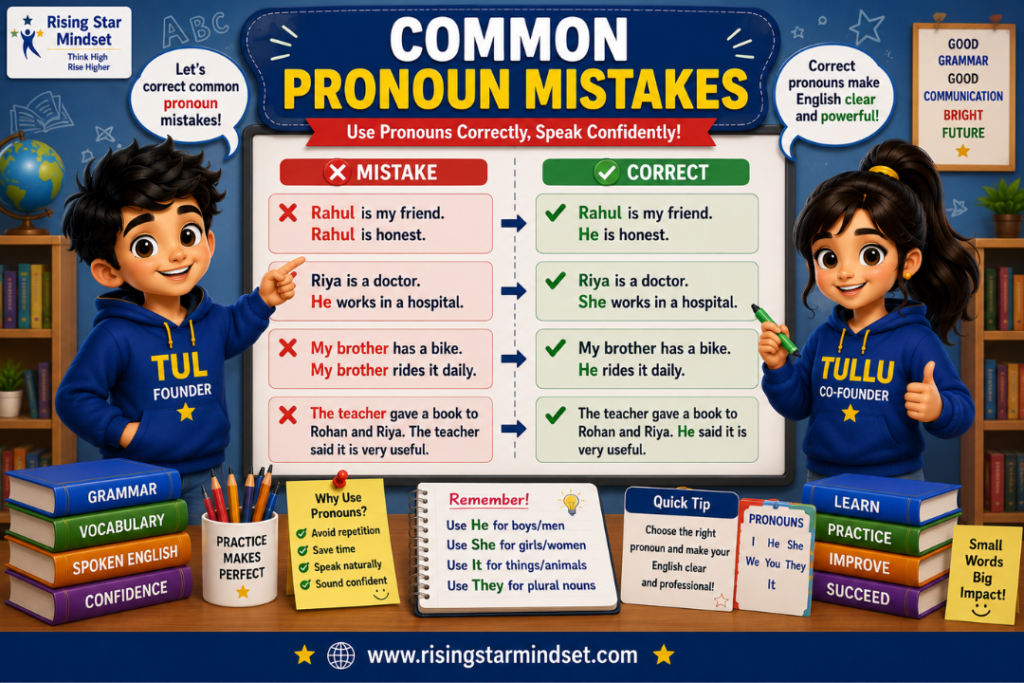
जब विद्यार्थी पहली बार Pronouns सीखते हैं, तब वे कुछ सामान्य गलतियाँ करते हैं। यदि आप इन्हें अभी समझ लेते हैं, तो आगे Grammar सीखना बहुत आसान हो जाएगा।
Mistake 1
❌ Rahul is my friend. Rahul is honest.
✅ Rahul is my friend. He is honest.
Mistake 2
❌ Riya is a doctor. He works in Patna.
✅ Riya is a doctor. She works in Patna.
Mistake 3
❌ The dog is sleeping. He is brown.
✅ The dog is sleeping. It is brown.
Note: सामान्यतः जानवरों के लिए It का प्रयोग किया जाता है। (यदि पालतू जानवर से भावनात्मक जुड़ाव हो, तो He/She भी प्रयोग किया जा सकता है।)
Mistake 4
❌ The students are studying. He are studying.
✅ The students are studying. They are studying.
Mistake 5
❌ My parents are teachers. She teaches English.
✅ My parents are teachers. They teach English.
Memory Trick
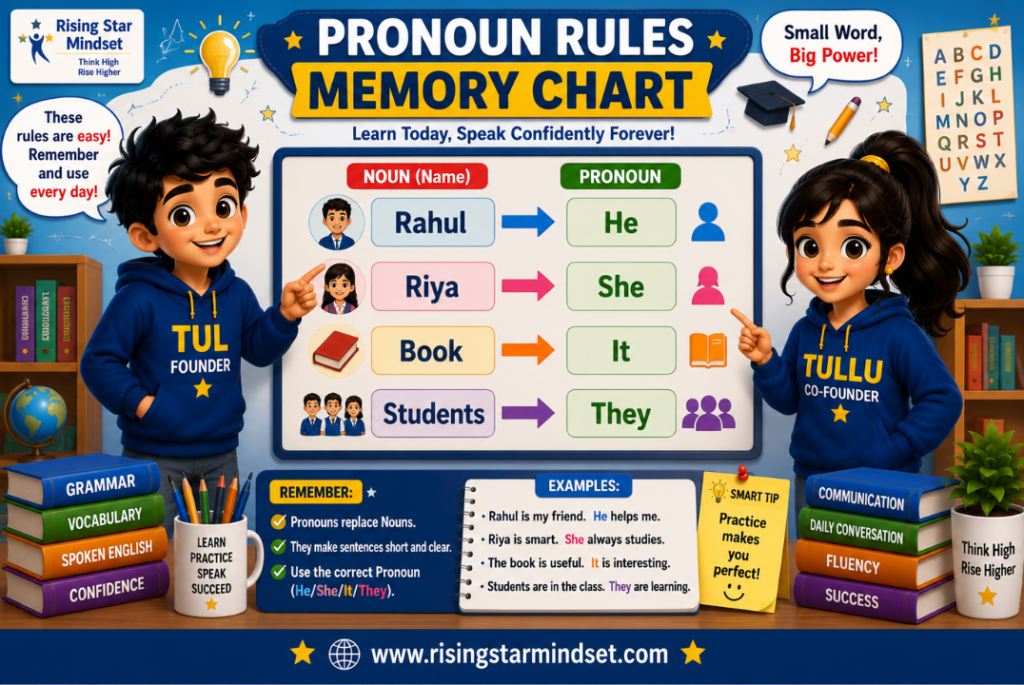
🌟 Easy Formula
Pronoun = Noun Replacement
या
Name → Pronoun
Examples:
Rahul → He
Riya → She
Book → It
Students → They
Mother & Father → They
Teacher & Student → They
Memory Tip:
👉 “Repeat less, speak better.”
Vocabulary Box
| Word | Meaning (English) | हिन्दी अर्थ |
| Pronoun | Replaces a noun | सर्वनाम |
| Noun | Name of a person, place, thing or animal | संज्ञा |
| Replace | To take the place of | स्थान लेना |
| Conversation | Talking with others | वार्तालाप |
| Sentence | Group of words | वाक्य |
| Grammar | Rules of language | व्याकरण |
| Fluent | Smooth and natural | धाराप्रवाह |
| Repetition | Saying the same thing again | बार-बार दोहराना |
| Communication | Exchange of ideas | संचार |
| Practice | Regular learning | अभ्यास |
Daily Speaking Practice
Read these sentences aloud every day.
Practice Set – 1
- He is my brother.
- She is my sister.
- It is my school bag.
- They are my classmates.
- We are learning English.
Practice Set – 2
- He is honest.
- She is intelligent.
- They are playing football.
- It is raining today.
- We are ready for the class.
हिन्दी अभ्यास
इन वाक्यों को पहले हिन्दी में समझिए, फिर अंग्रेज़ी में बोलिए।
- वह मेरा भाई है।
- वह मेरी बहन है।
- यह मेरा बैग है।
- वे मेरे मित्र हैं।
- हम अंग्रेज़ी सीख रहे हैं।
Tul & Tullu Activity
👩 Tul: Look at the picture. Who is standing there?
👦 Tullu: Rahul.
👩 Tul: Can you replace Rahul with a Pronoun?
👦 Tullu: Yes! He.
👩 Tul: Excellent!
👩 Tul: Now look at Riya.
👦 Tullu: I will use She.
👩 Tul: Very good!
👩 Tul: What about the students?
👦 Tullu: I will use They.
👩 Tul: Perfect! You are learning quickly.
Did You Know?
Did you know that children learn Pronouns naturally while speaking their first language?
Similarly, English learners also become fluent faster when they use Pronouns in daily conversations instead of memorizing only grammar rules.
Therefore, try to use Pronouns whenever you speak English.
⭐ Golden Rule:
Use Pronouns naturally, not mechanically.
Learning Challenge
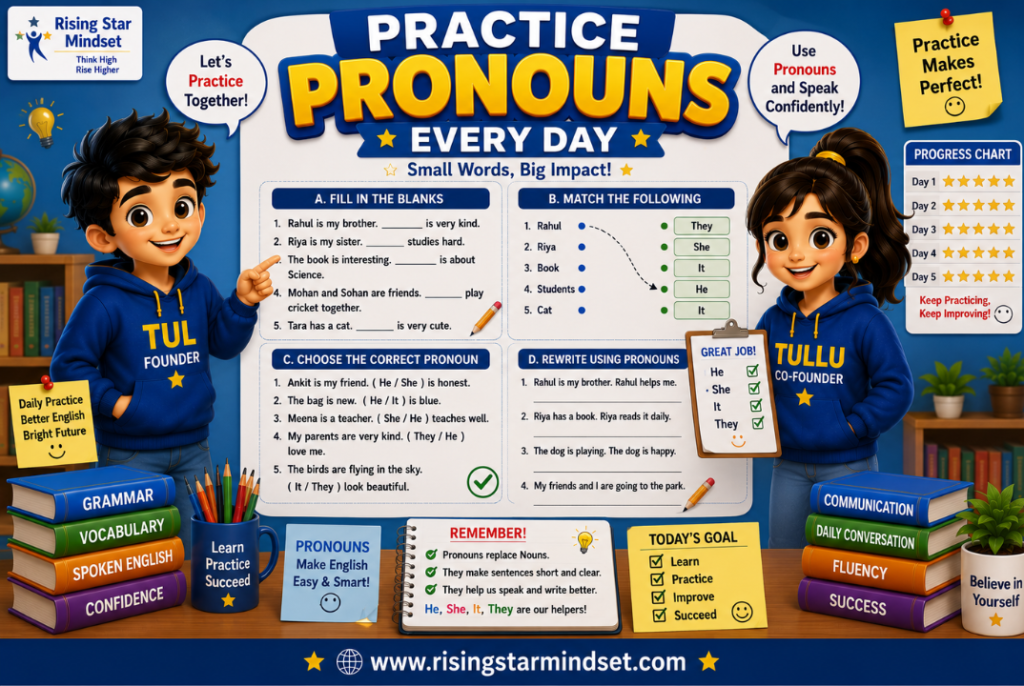
Today, look around your home and write 10 sentences by replacing names with Pronouns.
Example:
- My father is reading. → He is reading.
- My mother is cooking. → She is cooking.
This small activity will improve your Spoken English every day.
Question & Answers
Q1. What is a Pronoun?
Answer (English)
A Pronoun is a word that replaces a noun in a sentence.
उत्तर (हिन्दी)
Pronoun वह शब्द है जो किसी Noun (संज्ञा) की जगह प्रयोग किया जाता है।
Q2. Why do we use Pronouns?
Answer (English)
We use Pronouns to avoid repeating the same noun again and again.
उत्तर (हिन्दी)
Pronouns का प्रयोग किसी नाम को बार-बार दोहराने से बचने के लिए किया जाता है।
Q3. Can a Pronoun replace a person’s name?
Answer
Yes.
Example:
Rahul → He
Q4. What is the Hindi meaning of Pronoun?
Answer
Pronoun = सर्वनाम
Q5. Is Pronoun important in Spoken English?
Answer
Yes.
Without Pronouns, English sounds repetitive and unnatural.
Q6. Which is easier?
A)
Rahul is a student.
Rahul studies every day.
OR
B)
Rahul is a student.
He studies every day.
He likes English.
Answer
Option B
Q7. Why are Pronouns called “Replacing Words”?
Answer
Because they replace nouns.
Q8. Name one benefit of Pronouns.
Answer
They make sentences shorter and easier.
Q9. Are Pronouns used in writing?
Answer
Yes.
Pronouns are used in both speaking and writing.
Q10. Is learning Pronouns necessary before Tenses?
Answer
Yes.
Pronouns are one of the basic foundations of English Grammar.
Fill in the Blanks
Fill in the correct word.
- A Pronoun replaces a __________.
- Pronoun means __________ in Hindi.
- Pronouns help avoid __________.
- Pronouns make English more __________.
- Rahul is my friend. __________ is very honest.
- Riya is my sister. __________ studies in Class 10.
- The students are playing. __________ are happy.
- The book is new. __________ is on the table.
- Pronouns improve __________ English.
- English becomes more __________ by using Pronouns.
Answers
- Noun
- सर्वनाम
- Repetition
- Natural
- He
- She
- They
- It
- Spoken
- Fluent
Match the Following
| Column A | Column B |
| Pronoun | Replaces a noun |
| Noun | Name of a person, place, animal or thing |
| He | Rahul |
| She | Riya |
| They | Students |
| It | Book |
| Spoken English | Daily Communication |
| Grammar | Rules of Language |
| Repetition | Same word again and again |
| Communication | Exchange of ideas |
Classroom Practice
Activity 1
Replace the underlined noun with a Pronoun.
Rahul is playing.
Rahul is happy.
Riya is reading.
Riya likes English.
The boys are studying.
The boys are preparing for exams.
The cat is sleeping.
The cat is under the table.
My parents are teachers.
My parents are very kind.
Suggested Answers
He is playing.
He is happy.
She is reading.
She likes English.
They are studying.
They are preparing for exams.
It is sleeping.
It is under the table.
They are teachers.
They are very kind.
Think and Write
Write five sentences about your family.
Then replace the names with Pronouns.
Example
My father is a teacher.
He is very kind.
Speaking Practice
Read these sentences aloud.
He is my friend.
She is my sister.
It is my pen.
They are my classmates.
We are learning English.
Practice these sentences every morning.
Tul & Tullu Challenge
👩 Tul says:
Can you replace these nouns with Pronouns?
| Noun | Your Answer |
| Rahul | ______ |
| Riya | ______ |
| Students | ______ |
| Book | ______ |
| Teacher and Student | ______ |
Correct Answers
Rahul → He
Riya → She
Students → They
Book → It
Teacher and Student → They
Quick Practice Box
Choose the correct Pronoun.
Riya is a singer.
(a) He
(b) She
(c) They
The students are playing.
(a) It
(b) He
(c) They
The dog is sleeping.
(a) It
(b) We
(c) They
Rahul is reading.
(a) He
(b) She
(c) It
My parents are doctors.
(a) It
(b) They
(c) He
MCQs (Multiple Choice Questions)
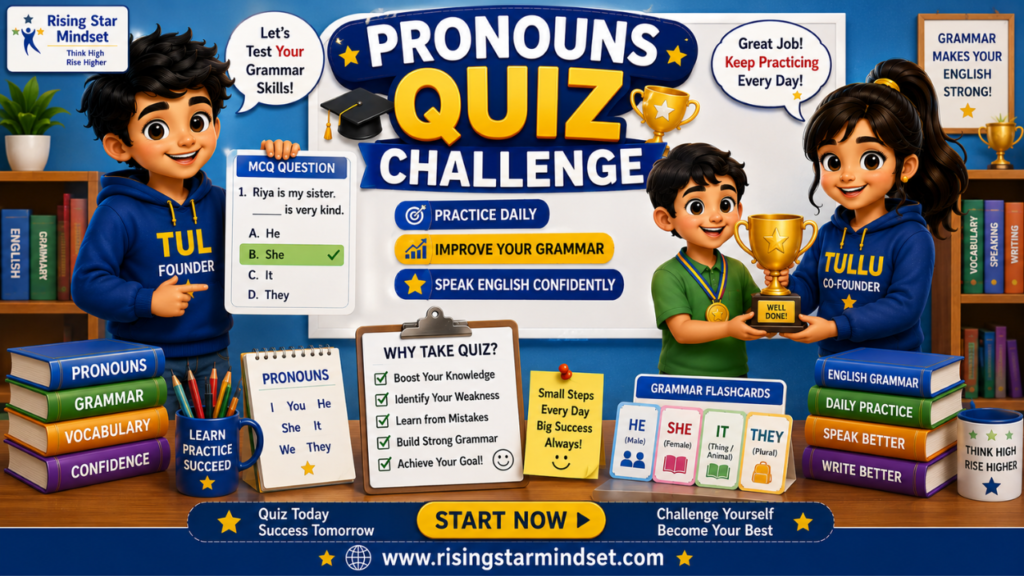
1. What is a Pronoun?
A) A naming word
B) A replacing word ✅
C) An action word
D) A describing word
2. Pronoun replaces—
A) Verb
B) Adjective
C) Noun ✅
D) Adverb
3. Pronoun means—
A) विशेषण
B) क्रिया
C) सर्वनाम ✅
D) संज्ञा
4. Which sentence is correct?
A) Rahul is my friend. Rahul is honest.
B) Rahul is my friend. He is honest. ✅
5. Which Pronoun is used for a girl?
A) He
B) It
C) She ✅
D) They
6. Which Pronoun is generally used for a thing?
A) He
B) She
C) It ✅
D) They
7. Which Pronoun is used for more than one person?
A) It
B) They ✅
C) He
D) She
8. Pronouns make English—
A) Difficult
B) Repetitive
C) Natural ✅
D) Longer
9. Which sentence sounds better?
A) Riya studies. Riya sings.
B) Riya studies. She sings. ✅
10. Pronouns are used in—
A) Speaking
B) Writing
C) Both Speaking and Writing ✅
D) None
11. Which is a Pronoun?
A) School
B) Student
C) He ✅
D) Teacher
12. Pronouns help avoid—
A) Reading
B) Grammar
C) Repetition ✅
D) Writing
13. Which word is a Pronoun?
A) Book
B) Rahul
C) She ✅
D) Apple
14. Pronouns are learned before—
A) Speaking
B) Grammar
C) Advanced English Topics ✅
D) Vocabulary
15. The main purpose of Pronouns is—
A) Increase sentence length
B) Replace nouns ✅
C) Replace verbs
D) Replace adjectives
HOTS (Higher Order Thinking Skills)
Q1
Why do you think English would become difficult if Pronouns did not exist?
Q2
Can you write a short paragraph without using Pronouns?
Now rewrite it using Pronouns.
Which one sounds better?
Explain.
Q3
Why are Pronouns important during interviews?
Q4
How do Pronouns improve Spoken English?
Q5
Imagine you are teaching a child.
How would you explain Pronouns in one simple sentence?
Daily Speaking Challenge
Stand in front of a mirror and speak these sentences.
I am a student.
You are my friend.
He is my brother.
She is my sister.
It is my book.
We are learning English.
They are playing football.
Practice these sentences for 5 minutes every day.
Quick Revision Box
- Pronouns replace nouns.
- reduce repetition.
- Pronouns improve Spoken English.
- It make communication natural.
- Every English learner should master Pronouns first.
Frequently Asked Questions (FAQs)
1. What is the easiest definition of a Pronoun?
A Pronoun is a word used instead of a noun.
हिन्दी: Pronoun वह शब्द है जो किसी संज्ञा की जगह प्रयोग किया जाता है।
2. Is Pronoun important for beginners?
Yes. Pronouns are one of the first grammar topics every English learner should study.
3. Can I speak English without learning Pronouns?
You can speak a little English, but your sentences will sound repetitive and unnatural.
4. Are Pronouns useful for competitive exams?
Yes. Questions on Pronouns are frequently asked in school exams, SSC, Banking, Railway, and other competitive exams.
5. Are Pronouns used every day?
Absolutely. We use Pronouns almost every day while speaking and writing English.
6. Should I memorize Pronouns?
No. First understand their purpose, then practice using them in real-life conversations.
7. How can I improve my Pronoun usage?
Read English books, observe conversations, and practice speaking daily.
8. Is this lesson enough to master Pronouns?
This lesson builds your foundation. The next lessons will teach each type of Pronoun in detail.
Conclusion
Learning the Introduction to Pronouns in English is the first step toward mastering English Grammar and Spoken English. Throughout this lesson, you discovered that Pronouns replace nouns, reduce repetition, and make communication smooth, natural, and professional. Moreover, you learned that Pronouns are not just grammar rules but practical tools that we use every day while speaking, writing, reading, and listening.
Furthermore, building a strong understanding of Pronouns now will make the upcoming lessons much easier. Therefore, instead of memorizing definitions only, try to notice Pronouns whenever you read a newspaper, a storybook, or even social media posts. Similarly, while talking with your friends or family, consciously replace repeated nouns with suitable Pronouns. Consequently, your confidence in Spoken English will improve day by day.
Finally, remember that fluency comes through daily practice, not through reading once. So revise today’s lesson, complete all the exercises again, and keep practicing with Tul & Tullu. One small step every day will lead to big improvements in your English communication skills.
📌 Conclusion (Hindi)
निष्कर्ष
इस Lesson में आपने Introduction to Pronouns in English के बारे में विस्तार से सीखा। सबसे पहले आपने समझा कि Pronouns क्या होते हैं और इन्हें अंग्रेज़ी भाषा में क्यों प्रयोग किया जाता है। इसके बाद आपने जाना कि Pronouns किसी Noun की जगह प्रयोग किए जाते हैं, जिससे वाक्य छोटे, स्पष्ट और स्वाभाविक बनते हैं।
इसके अलावा, आपने यह भी देखा कि Pronouns केवल Grammar की पुस्तक तक सीमित नहीं हैं, बल्कि इन्हें हम अपने दैनिक जीवन की बातचीत, स्कूल, इंटरव्यू, ईमेल, कहानियों और लगभग हर अंग्रेज़ी वाक्य में प्रयोग करते हैं। इसलिए Pronouns की सही समझ आपको बेहतर Communicator बनने में मदद करती है।
इसके साथ ही, इस Lesson के माध्यम से आपने Pronouns की आवश्यकता, महत्व, वास्तविक जीवन के उदाहरण, सामान्य गलतियाँ तथा प्रारम्भिक अभ्यास भी किया। अब आपके पास Pronouns की एक मजबूत बुनियाद (Strong Foundation) तैयार हो चुकी है।
हालाँकि, यह केवल शुरुआत है। आगे आने वाले Lessons में हम Pronouns के प्रत्येक प्रकार को विस्तार से समझेंगे। इसलिए इस Lesson का अच्छी तरह पुनरावृत्ति (Revision) करें और दिए गए अभ्यासों को अवश्य हल करें।
अंत में, हमेशा याद रखें कि अंग्रेज़ी सीखने का सबसे अच्छा तरीका नियमित अभ्यास (Daily Practice) है। प्रतिदिन थोड़ा-थोड़ा सीखने और बोलने का प्रयास करें। धीरे-धीरे आपका आत्मविश्वास बढ़ेगा और अंग्रेज़ी बोलना आपके लिए बिल्कुल स्वाभाविक हो जाएगा।
याद रखें:
“अंग्रेज़ी एक दिन में नहीं सीखी जाती, बल्कि रोज़ाना किए गए छोटे-छोटे अभ्यास आपको धाराप्रवाह अंग्रेज़ी बोलने की मंज़िल तक पहुँचाते हैं।”
Lesson Summary
| Meaning of Pronouns |
| Importance of Pronouns |
| Easy Explanation |
| Real-Life Examples |
| Common Mistakes |
| Practice Exercises |
| MCQs |
| HOTS Questions |
| FAQs |
📖 Next Lesson Notification
Lesson 11.2 – Subject Pronouns in English
In the next lesson, you will learn:
- What are Subject Pronouns?
- I, You, He, She, It, We, They
- Complete Rules
- English + Hindi Explanation
- Daily Use Examples
- Tul & Tullu Classroom Activities
- Memory Tricks
- Practice Exercises
- MCQs
- HOTS Questions
- FAQs
- Spoken English Practice
➡️ Continue Learning: Subject Pronouns in English – Lesson 11.2
🌟 Daily Motivation
“Every English expert was once a beginner. Practice every day, stay consistent, and your confidence will grow one sentence at a time.”
Think High • Rise Higher
www.risingstarmindset.com
🌟 Final Call to Action
Did this guide help you?
- Share it with your friends and classmates.
- Bookmark this page for quick revision.
- Practice the exercises regularly.
- Explore more English Grammar lessons on www.risingstarmindset.com.
Keep Learning, Keep Growing! 🚀
P Kumar | Rising Star Mindset
www.risingstarmindset.com
Together We Will Make The Difference