
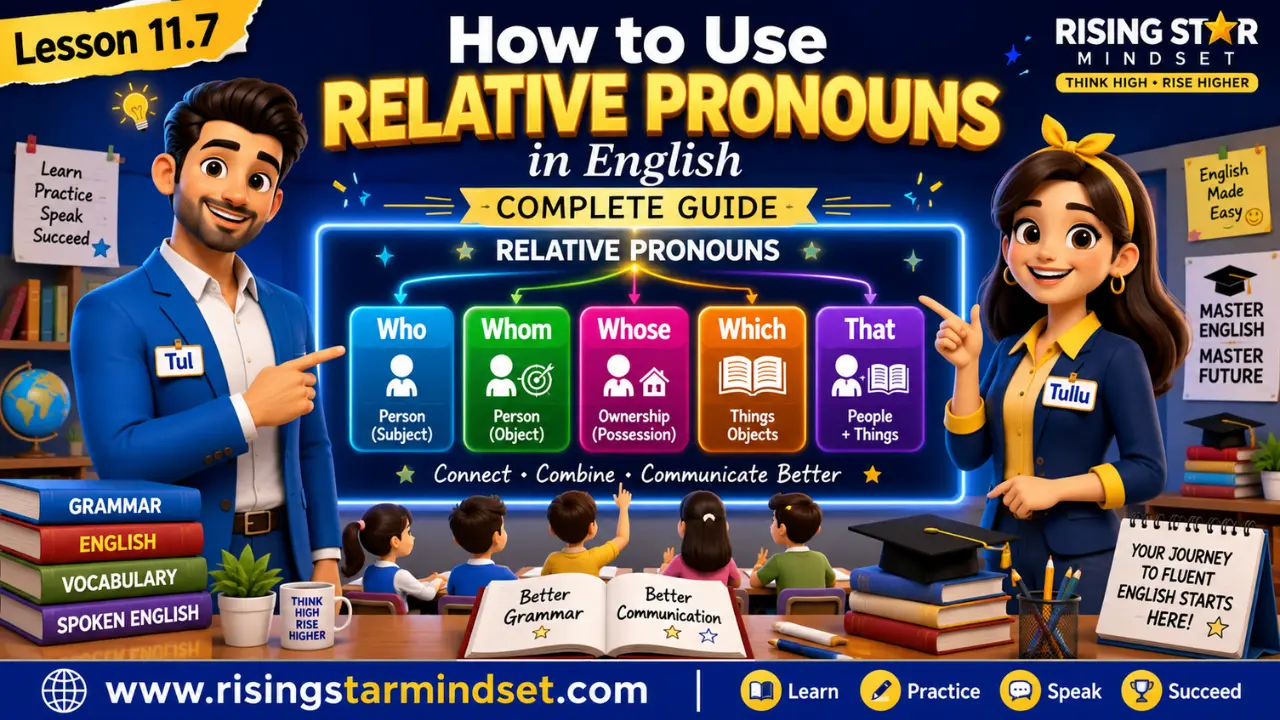
Lesson 11.7 – How to Use Relative Pronouns in English | Complete Beginner Guide
Website: www.risingstarmindset.com ( Use Relative Pronouns )
Introduction ( Use Relative Pronouns )
Have you ever wondered how native English speakers connect two simple sentences into one smooth and meaningful sentence?
For example:
❌ I know the girl. She won the competition.
✅ I know the girl who won the competition.
The word who joins both sentences naturally.
These special words are called Relative Pronouns.
Learning Relative Pronouns is one of the most important steps in improving your English grammar, spoken English, writing skills, and communication.
In this complete beginner-friendly guide, you will learn:
- What Relative Pronouns are
- Why they are important
- Types of Relative Pronouns
- Grammar rules
- Sentence structures
- Daily conversation examples
- English and Hindi explanations
- Practice exercises
- MCQs
- HOTS Questions
- Common mistakes
- FAQs
By the end of this lesson, you will be able to use Relative Pronouns confidently in your daily English conversations.
Table of Contents ( Use Relative Pronouns )
- What are Relative Pronouns?
- Definition of Relative Pronouns
- Hindi Meaning
- Why Relative Pronouns are Important
- Types of Relative Pronouns
- Who (Subject Relative Pronoun)
- Using Whom Correctly
- Whose (Showing Possession)
- Which (Things and Animals)
- That (People and Things)
- Grammar Rules
- Sentence Structure
- Relative Clauses
- Daily Conversation Examples
- Common Grammar Mistakes
- Practice Worksheet
- Fill in the Blanks
- Match the Following
- MCQs
- HOTS Questions
- FAQs
- Conclusion
- Next Lesson Notification : 📚 Lesson 11.8 – Indefinite Pronouns in English | Complete Beginner Guide
- Previous lesson : Lesson 11.6 – Interrogative Pronouns in English | Complete Beginner Guide
What are Relative Pronouns?
English Explanation
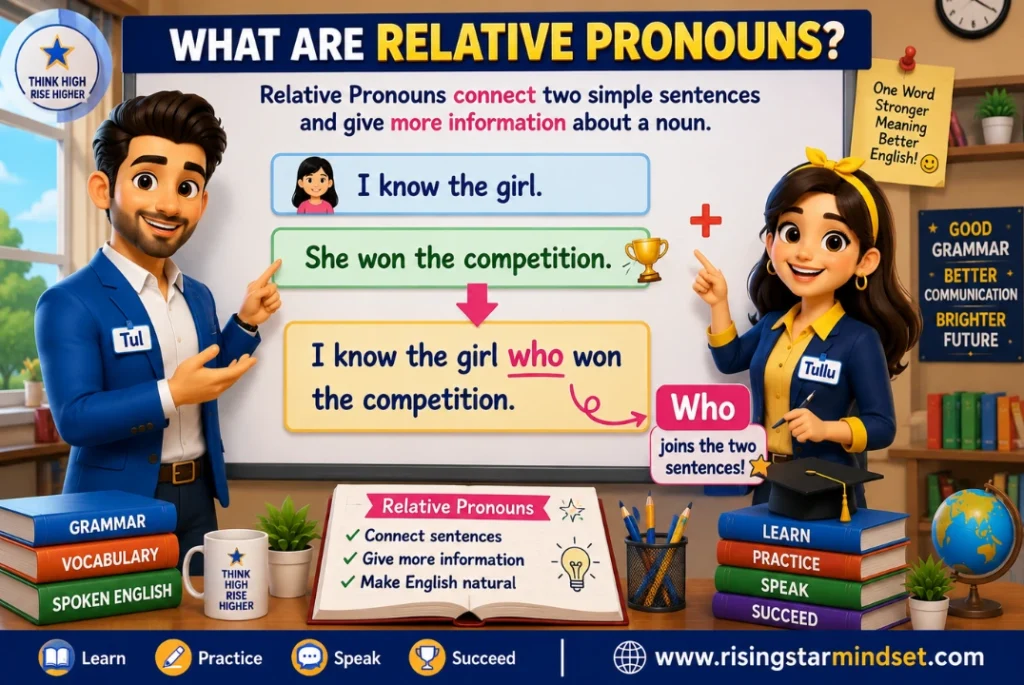
A Relative Pronoun is a pronoun that connects a noun with additional information about that noun.
Instead of writing two separate sentences, Relative Pronouns combine them into one meaningful sentence.
They make English sound smoother, shorter, and more natural.
Example
I have a friend.
He lives in Patna.
↓
I have a friend who lives in Patna.
The word who connects the two sentences.
हिन्दी व्याख्या
Relative Pronoun वह Pronoun होता है जो किसी व्यक्ति, वस्तु, स्थान या जानवर के बारे में अतिरिक्त जानकारी देने के लिए दो वाक्यों को जोड़ता है।
यह अंग्रेज़ी को अधिक प्रभावशाली, स्वाभाविक और सरल बनाता है।
उदाहरण
मेरे पास एक मित्र है।
वह पटना में रहता है।
↓
मेरे पास एक मित्र है जो पटना में रहता है।
यहाँ who दोनों वाक्यों को जोड़ रहा है।
Definition of Relative Pronouns
English Definition
A Relative Pronoun introduces a relative clause and connects it with the main clause while referring back to a noun already mentioned.
हिन्दी परिभाषा
Relative Pronoun वह Pronoun है जो मुख्य वाक्य (Main Clause) और अतिरिक्त जानकारी वाले वाक्य (Relative Clause) को जोड़ता है तथा पहले बताए गए Noun की ओर संकेत करता है।
Hindi Meaning
Relative Pronouns का सामान्य हिन्दी अर्थ
- जो
- जिसे
- जिसका
- जिनका
- जिनकी
- जिनके
ध्यान रखें कि हिन्दी में कई बार एक ही शब्द “जो” अलग-अलग Relative Pronouns का अर्थ दे सकता है। सही Pronoun का चयन Sentence की Structure पर निर्भर करता है।
Why are Relative Pronouns Important?
Relative Pronouns अंग्रेज़ी सीखने वालों के लिए अत्यंत महत्वपूर्ण हैं क्योंकि ये:
- Connect two related sentences naturally.
- Improve spoken English fluency.
- Make writing shorter and more professional.
- Help avoid unnecessary repetition.
- Improve grammar accuracy.
- Make communication clearer.
- Are commonly used in school exams.
- Frequently appear in competitive examinations.
- Improve IELTS, TOEFL, and interview English.
- Enhance day-to-day conversations.
हिन्दी में महत्व
Relative Pronouns सीखने से:
- दो वाक्यों को आसानी से जोड़ा जा सकता है।
- बार-बार Noun दोहराने की आवश्यकता नहीं पड़ती।
- अंग्रेज़ी अधिक Professional लगती है।
- बोलने और लिखने दोनों में सुधार होता है।
- Competitive Exams में अच्छे अंक मिलते हैं।
- Spoken English अधिक Natural बनती है।
Types of Relative Pronouns
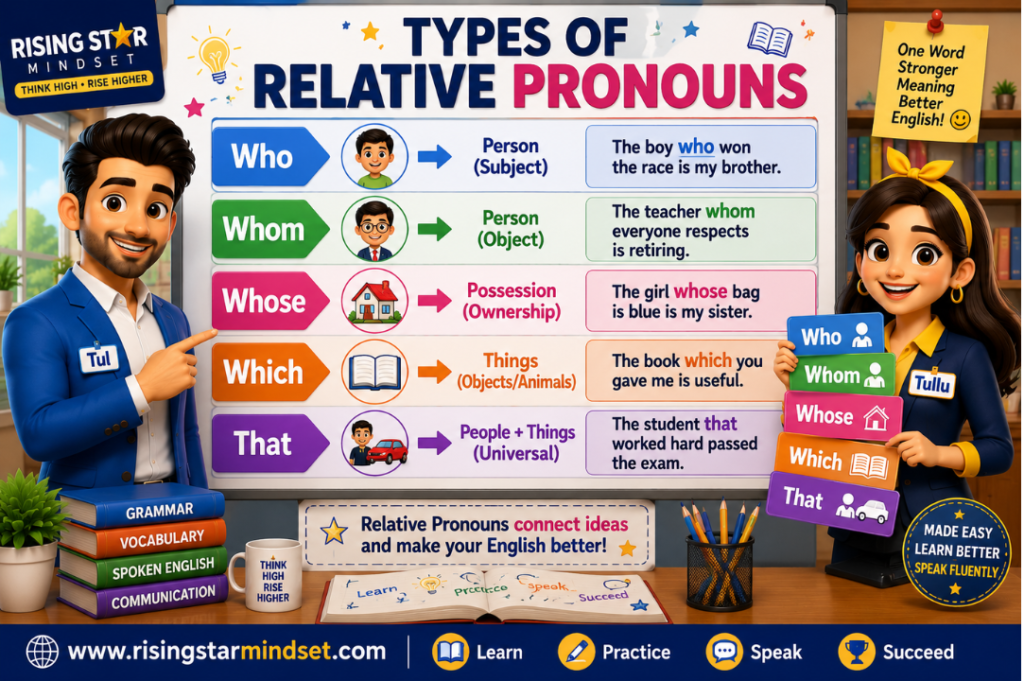
| Relative Pronoun | Used For | Hindi Meaning | Example |
| Who | People (Subject) | जो | The boy who won the race is my brother. |
| Whom | People (Object) | जिसे | The teacher whom everyone respects is retiring. |
| Whose | Possession | जिसका | The girl whose bag is blue is my cousin. |
| Which | Things & Animals | जो | The book which you gave me is useful. |
| That | People & Things | जो | The student that worked hard passed the exam. |
Quick Learning Tip ( Use Relative Pronouns )
Remember this easy formula:
- Who → Person
- Whom → Object
- Whose → Ownership
- Which → Things
- That → People + Things
Golden Rule ( Use Relative Pronouns )
Relative Pronouns never ask questions.
They connect information about a noun.
Compare
Interrogative Pronoun
Who is your teacher?
(Question)
Relative Pronoun
The teacher who teaches us English is very kind.
(Connection)
Quick Revision Box ( Use Relative Pronouns )
| Relative Pronouns connect two related ideas. |
| They provide extra information about a noun. |
| They improve spoken English and writing. |
| The five main Relative Pronouns are: |
- Who
- Whom
- Whose
- Which
- That
1. Using Who as a Relative Pronoun
English Explanation
Who is used for people when the pronoun acts as the subject of the relative clause.
It introduces extra information about a person.
Structure
Person + who + verb + remaining sentence
Examples
- The boy who won the race is my brother.
- The teacher who teaches English is very kind.
- The doctor who treated me is famous.
- The girl who is singing is my cousin.
- I know a man who speaks five languages.
हिन्दी व्याख्या
Who का प्रयोग व्यक्ति (Person) के लिए किया जाता है जब वह Relative Clause में Subject का कार्य करता है।
उदाहरण
- जो लड़का दौड़ जीता, वह मेरा भाई है।
- जो शिक्षक अंग्रेज़ी पढ़ाते हैं, वे बहुत दयालु हैं।
- जिस डॉक्टर ने मेरा इलाज किया, वे प्रसिद्ध हैं।
- जो लड़की गा रही है, वह मेरी बहन है।
- मैं ऐसे व्यक्ति को जानता हूँ जो पाँच भाषाएँ बोलता है।
Spoken English Examples
- I met a teacher who inspired me.
- She is the woman who helped us.
- He is the player who scored the winning goal.
Grammar Tip ( Use Relative Pronouns )
👉 Who = Person + Subject
2. Using Whom as a Relative Pronoun
English Explanation
Whom is used for people when the person is the object of the relative clause.
It is mainly used in formal English.
In spoken English, who is often used instead of whom.
Structure
Person + whom + subject + verb
Examples
- I met the teacher whom everyone respects.
- She is the doctor whom we consulted yesterday..
- The player whom the audience applauded received a trophy
- This is the student whom the principal honoured.
- We invited the guest whom everyone admired.
हिन्दी व्याख्या
Whom का प्रयोग व्यक्ति के लिए किया जाता है जब वह Relative Clause में Object होता है।
उदाहरण
- मैं उस शिक्षक से मिला जिसका सभी सम्मान करते हैं।
- वह वही डॉक्टर हैं जिनसे हमने कल सलाह ली थी।
- वह खिलाड़ी जिसकी दर्शकों ने प्रशंसा की, पुरस्कार जीत गया।
- यह वही छात्र है जिसे प्रधानाचार्य ने सम्मानित किया।
- हमने उस अतिथि को बुलाया जिसकी सभी प्रशंसा करते हैं।
Spoken English Tip ( Use Relative Pronouns )
Formal English
✅ The teacher whom everyone admires.
Daily Spoken English
✅ The teacher who everyone admires.
Both are understood, but whom is more formal.
Grammar Tip
👉 Whom = Person + Object
Who vs Whom ( Use Relative Pronouns )
| Who | Whom |
| Subject | Object |
| Performs Action | Receives Action |
| Very Common | Mostly Formal |
| Spoken & Written English | Mostly Written English |
Examples
The girl who won the competition.
The girl whom everyone praised received a prize.
3. Using Whose as a Relative Pronoun
English Explanation
Whose shows ownership or possession.
It tells us that something belongs to someone.
Structure
Person/Thing + whose + noun + verb
Examples
- I met a girl whose father is a doctor.
- The student whose project won the competition received a prize.
- This is the teacher whose classes are always interesting.
- We visited a family whose house overlooks the river.
- She adopted a puppy whose tail never stops wagging.
हिन्दी व्याख्या
Whose स्वामित्व (Ownership) या अधिकार (Possession) बताने के लिए प्रयोग किया जाता है।
उदाहरण
- मैं एक लड़की से मिला जिसके पिता डॉक्टर हैं।
- वह छात्र जिसकी परियोजना प्रतियोगिता जीती, पुरस्कार प्राप्त किया।
- यह वही शिक्षक हैं जिनकी कक्षाएँ हमेशा रोचक होती हैं।
- हमने एक परिवार से मुलाकात की जिसका घर नदी के किनारे है।
- उसने एक पिल्ला अपनाया जिसकी पूँछ हमेशा हिलती रहती है।
Spoken English Examples
- I met a girl whose father is a doctor.
- The student whose project won first prize is absent today.
- The man whose house is nearby is our neighbour.
Grammar Tip
👉 Whose = Possession
4. Using Which as a Relative Pronoun
English Explanation
Which is used for things, objects, places, and animals.
It provides additional information about non-human nouns.
Structure
Thing + which + verb + remaining sentence
Examples
- The book which you gave me is interesting.
- The house which was painted yesterday looks beautiful.
हिन्दी व्याख्या
Which का प्रयोग वस्तुओं, जानवरों और स्थानों के लिए किया जाता है।
उदाहरण
- जो किताब तुमने मुझे दी, वह रोचक है।
- जिस घर को कल रंगा गया, वह सुंदर दिख रहा है।
- जो कार मैंने खरीदी, वह बहुत आरामदायक है।
- जो कुत्ता पूरी रात भौंकता रहा, वह अब सो गया।
Grammar Tip
👉 Which = Things / Animals
5. Using That as a Relative Pronoun
English Explanation
That is the most flexible Relative Pronoun.
It can refer to people, animals, and things.
It is very common in everyday English.
Structure
Noun + that + verb + remaining sentence
Examples
- The student that studied hard passed the exam.
- The book that changed my life is amazing.
- The dog that chased the cat is friendly.
- The teacher that encouraged me is unforgettable.
- The movie that we watched yesterday was exciting.
हिन्दी व्याख्या
That का प्रयोग व्यक्ति, वस्तु और जानवर—तीनों के लिए किया जा सकता है।
यह दैनिक अंग्रेज़ी में सबसे अधिक प्रयोग होने वाला Relative Pronoun है।
उदाहरण
- जो विद्यार्थी मेहनत से पढ़ा, वह परीक्षा में सफल हुआ।
- जिस किताब ने मेरी ज़िंदगी बदल दी, वह अद्भुत है।
- जो कुत्ता बिल्ली के पीछे भागा, वह बहुत मिलनसार है।
- जिस शिक्षक ने मुझे प्रेरित किया, उन्हें मैं कभी नहीं भूलूँगा।
- जो फिल्म हमने कल देखी, वह रोमांचक थी।
Quick Comparison Table ( Use Relative Pronouns )
| Relative Pronoun | Used For | Example |
| Who | Person (Subject) | The boy who won the race… |
| Whom | Person (Object) | The teacher whom everyone respects… |
| Whose | Possession | The girl whose bag is blue… |
| Which | Things & Animals | The book which you gave me… |
| That | People & Things | The student that worked hard… |
Quick Revision ( Use Relative Pronouns )
| Who → Person (Subject) |
| Whom → Person (Object) |
| Whose → Ownership |
| Which → Things & Animals |
| That → People + Things |
Grammar Rules for Relative Pronouns
Relative Pronouns follow specific grammar rules. Learning these rules will help you write grammatically correct and natural English sentences.
Rule 1: A Relative Pronoun Connects Two Related Sentences
English
A Relative Pronoun joins two sentences that talk about the same person, thing, place, or animal.
Example
I know the girl.
She won the competition.
↓
I know the girl who won the competition.
हिन्दी
Relative Pronoun दो ऐसे वाक्यों को जोड़ता है जिनमें एक ही व्यक्ति या वस्तु के बारे में बात हो रही हो।
Rule 2: Use “Who” for the Subject
English
Use Who when the person performs the action.
Examples
The teacher who teaches us is kind.
The boy who helped me is my cousin.
हिन्दी
जब व्यक्ति कार्य कर रहा हो तब Who का प्रयोग करें।
Rule 3: Use “Whom” for the Object
English
Use Whom when the person receives the action.
Examples
The student whom the teacher praised smiled.
The officer whom everyone respects retired.
हिन्दी
जब व्यक्ति पर कार्य हो रहा हो तब Whom का प्रयोग किया जाता है।
Rule 4: Use “Whose” to Show Ownership
English
Whose shows possession.
Examples
The girl whose bicycle is red is my neighbour.
The student whose notebook is missing is worried.
The man whose car was stolen reported it to the police.
हिन्दी
Whose स्वामित्व (Ownership) दर्शाता है।
Rule 5: Use “Which” for Things and Animals
English
Use Which for objects, places, and animals.
Examples
The house which was built last year is beautiful.
The laptop which I bought yesterday is fast.
हिन्दी
वस्तुओं, स्थानों और जानवरों के लिए Which का प्रयोग करें।
Rule 6: Use “That” for Both People and Things
English
That can replace Who and Which in many situations.
Examples
The boy that won the race is my brother.
The book that changed my life is inspiring.
हिन्दी
That व्यक्ति और वस्तु दोनों के लिए प्रयोग किया जा सकता है।
Relative Clause ( Use Relative Pronouns )
English
A Relative Clause gives additional information about a noun.
It usually starts with a Relative Pronoun.
Structure
Noun + Relative Pronoun + Clause
Example
The boy who is standing there is my brother.
Relative Clause:
who is standing there
हिन्दी
Relative Clause वह भाग होता है जो Noun के बारे में अतिरिक्त जानकारी देता है।
Sentence Structure ( Use Relative Pronouns )
Structure 1
Person + Who + Verb
Example
The teacher who teaches English is kind.
Structure 2
Person + Whom + Subject + Verb
Example
The student whom I helped passed.
Structure 3
Person + Whose + Noun
Example
The girl whose father is a doctor is my friend.
Structure 4
Thing + Which + Verb
Example
The phone which I bought is expensive.
Structure 5
Noun + That + Verb
Example
The movie that everyone likes is interesting.
Relative Pronouns vs Interrogative Pronouns
| Relative Pronouns | Interrogative Pronouns |
| Connect sentences | Ask questions |
| Give extra information | Seek information |
| Used inside statements | Used at the beginning of questions |
| Example: The boy who won. | Example: Who won? |
Examples
Relative Pronoun
The teacher who teaches us is friendly.
Interrogative Pronoun
Who teaches you English?
Relative Pronouns vs Personal Pronouns
| Personal Pronouns | Relative Pronouns |
| I | Who |
| We | Which |
| You | That |
| He | Whose |
| She | Whom |
Personal Pronoun Example
She is my sister.
Relative Pronoun Example
She is the girl who won the prize.
Relative Pronouns vs Demonstrative Pronouns
| Demonstrative Pronouns | Relative Pronouns |
| This | Who |
| That | Which |
| These | Whose |
| Those | Whom |
Demonstrative
This is my book.
Relative
The book which you gave me is useful.
Memory Trick ( Use Relative Pronouns )
Remember this easy formula:
👤 Who → Person
🎯 Whom → Object
🏷 Whose → Owner
📚 Which → Things
⭐ That → Person + Things
Common Grammar Mistakes ( Use Relative Pronouns )
Mistake 1
❌ The boy which won the race.
✅ The boy who won the race.
Mistake 2
❌ The girl who bag is blue.
✅ The girl whose bag is blue.
Mistake 3
❌ The book who is on the table.
✅ The book which is on the table.
Mistake 4
❌ The teacher which teaches English.
✅ The teacher who teaches English.
Mistake 5
❌ The man whose I met yesterday.
✅ The man whom I met yesterday.
Mistake 6
❌ The phone who stopped working.
✅ The phone which stopped working.
Mistake 7
❌ The student whom won the prize.
✅ The student who won the prize.
Mistake 8
❌ The girl which is singing.
✅ The girl who is singing.
Daily Conversation Using Relative Pronouns
Learning Relative Pronouns becomes much easier when you use them in everyday conversations. Moreover, regular practice improves fluency and confidence. Therefore, below are some real-life spoken English conversations.
Conversation 1 – Classroom ( Use Relative Pronouns )
English
Teacher: Who is the student who won the science quiz?
Student: Rahul is the student who won the science quiz.
Teacher: Very good!
हिन्दी
शिक्षक: वह छात्र कौन है जिसने विज्ञान प्रतियोगिता जीती?
छात्र: राहुल वह छात्र है जिसने विज्ञान प्रतियोगिता जीती।
Conversation 2 – School Library ( Use Relative Pronouns )
English
Tul: Which is the book that you borrowed yesterday?
Tullu: The English grammar book that you recommended.
Tul: That’s a very useful book.
हिन्दी
तुल: वह कौन-सी पुस्तक है जो तुमने कल ली थी?
टुल्लू: वही अंग्रेज़ी Grammar की पुस्तक जो आपने सुझाई थी।
Conversation 3 – Friends
English
Aman: Who is the girl who is speaking on the stage?
Riya: She is my sister.
हिन्दी
अमन: वह लड़की कौन है जो मंच पर बोल रही है?
रिया: वह मेरी बहन है।
Conversation 4 – Office
English
Manager: Where is the employee who prepared this report?
Staff: He is attending a meeting.
हिन्दी
प्रबंधक: वह कर्मचारी कहाँ है जिसने यह रिपोर्ट तैयार की?
कर्मचारी: वे मीटिंग में हैं।
Conversation 5 – Market
English
Customer: Show me the phone that has the best camera.
Shopkeeper: This is the phone that most customers buy.
हिन्दी
ग्राहक: मुझे वह फोन दिखाइए जिसका कैमरा सबसे अच्छा है।
दुकानदार: यही वह फोन है जिसे अधिकांश ग्राहक खरीदते हैं।
Conversation 6 – Home
English
Mother: Where is the boy who broke the flower vase?
Father: He is studying in his room.
हिन्दी
माँ: वह लड़का कहाँ है जिसने फूलदान तोड़ा?
पिता: वह अपने कमरे में पढ़ रहा है।
Conversation 7 – Interview
English
Interviewer: Tell me about a teacher who inspired you.
Candidate: My mathematics teacher inspired me to work hard.
हिन्दी
इंटरव्यूअर: उस शिक्षक के बारे में बताइए जिसने आपको प्रेरित किया।
उम्मीदवार: मेरे गणित के शिक्षक ने मुझे मेहनत करना सिखाया।
Practice Worksheet
Exercise 1 – Fill in the Blanks
Choose the correct Relative Pronoun.
- The girl ______ won the race is my cousin.
- The teacher ______ everyone respects is retiring.
- The student ______ notebook is missing is worried.
- The car ______ I bought is electric.
- The book ______ changed my life is inspiring.
- The doctor ______ treated me is very experienced.
- The player ______ everyone admired received the award.
- The dog ______ chased the cat is playful.
- The woman ______ house is near ours is a lawyer.
- The movie ______ we watched yesterday was exciting.
Answers
- who
- whom
- whose
- which
- that
- who
- whom
- that
- whose
- which
Exercise 2 – Match the Following
| Column A | Column B |
| Who | Person (Subject) |
| Whom | Object Person |
| Whose | Ownership |
| Which | Things |
| That | Person & Things |
Answers
Who → Person (Subject)
Whom → Object Person
Whose → Ownership
Which → Things
That → Person & Things
Exercise 3 – Choose the Correct Answer
1.
The boy ______ won the prize is my brother.
A. Which
B. Who
C. Whose
D. What
✅ Answer: B
2.
The girl ______ father is a doctor is my friend.
A. Who
B. Which
C. Whose
D. Whom
✅ Answer: C
3.
The teacher ______ we invited accepted the invitation.
A. Which
B. Whom
C. What
D. Whose
✅ Answer: B
4.
The phone ______ stopped working is under warranty.
A. Which
B. Who
C. Whom
D. Whose
✅ Answer: A
5.
The student ______ studied hard topped the class.
A. Who
B. Which
C. What
D. Whom
✅ Answer: A
Exercise 4 – Rewrite the Sentences
Join the following sentences using Relative Pronouns.
1.
I met a man.
He speaks French.
✅ I met a man who speaks French.
2.
The book is interesting.
You gave it to me.
✅ The book which you gave me is interesting.
3.
The girl is smiling.
Her brother is my friend.
✅ The girl whose brother is my friend is smiling.
4.
The player scored the goal.
Everyone praised him.
✅ The player whom everyone praised scored the goal.
5.
The laptop is expensive.
It belongs to my father.
✅ The laptop that belongs to my father is expensive.
Exercise 5 – Correct the Mistakes
Correct the following sentences.
❌ The teacher which teaches English is kind.
✅ The teacher who teaches English is kind.
❌ The girl who bag is blue is my cousin.
✅ The girl whose bag is blue is my cousin.
❌ The phone who stopped working is mine.
✅ The phone which stopped working is mine.
❌ The student whom won the prize is absent.
✅ The student who won the prize is absent.
❌ The officer whose we invited came early.
✅ The officer whom we invited came early.
Practice Challenge
Complete these sentences yourself.
- I know a teacher __________
- The boy who __________
- The girl whose __________
- The phone which __________
- The movie that __________
Quick Practice Tip
📘 Every day, make five new sentences using:
- Who
- Whom
- Whose
- Which
- That
This simple habit will improve both your grammar and spoken English quickly.
Multiple Choice Questions (MCQs)
Choose the correct answer.
1. Which Relative Pronoun is used for a person as the subject?
A. Which
B. Whom
C. Who
D. Whose
✅ Answer: C
2. Which Relative Pronoun shows ownership?
A. Who
B. Whose
C. Which
D. That
✅ Answer: B
3. Which Relative Pronoun is mainly used for things?
A. Which
B. Who
C. Whom
D. Whose
✅ Answer: A
4. Which Relative Pronoun is mostly used in formal English as an object?
A. Who
B. Whom
C. Which
D. That
✅ Answer: B
5. Which Relative Pronoun can refer to both people and things?
A. That
B. Who
C. Which
D. What
✅ Answer: A
6. The teacher _____ teaches us English is very kind.
A. Which
B. Who
C. Whose
D. What
✅ Answer: B
7. The girl _____ bag is blue is my cousin.
A. Who
B. Which
C. Whose
D. That
✅ Answer: C
8. The book _____ I borrowed is excellent.
A. Who
B. Which
C. Whom
D. Whose
✅ Answer: B
9. The officer _____ we invited accepted the invitation.
A. Whom
B. Who
C. Which
D. What
✅ Answer: A
10. The movie _____ we watched yesterday was interesting.
A. Who
B. Which
C. Whose
D. What
✅ Answer: B
11. Which sentence is correct?
A. The boy which won.
B. The boy who won.
C. The boy whose won.
D. The boy whom won.
✅ Answer: B
12. Which sentence is correct?
A. The phone who stopped working.
B. The phone which stopped working.
C. The phone whom stopped working.
D. The phone whose stopped working.
✅ Answer: B
13. Relative Pronouns connect:
A. Two unrelated ideas
B. Two related clauses
C. Two verbs
D. Two adjectives
✅ Answer: B
14. Which Relative Pronoun is used for possession?
A. Which
B. Who
C. Whose
D. That
✅ Answer: C
15. Relative Pronouns make sentences:
A. Longer and confusing
B. Shorter and natural
C. Incorrect
D. None
✅ Answer: B
HOTS (Higher Order Thinking Skills) Questions
Q1.
Join these sentences.
The boy is my brother.
He won the scholarship.
Answer:
The boy who won the scholarship is my brother.
Q2.
Rewrite using a Relative Pronoun.
The woman is a scientist.
Her daughter studies with me.
Answer:
The woman whose daughter studies with me is a scientist.
Q3.
Correct the sentence.
The teacher which teaches Maths is excellent.
Answer:
The teacher who teaches Maths is excellent.
Q4.
Choose the best Relative Pronoun.
The laptop _____ I purchased yesterday is very fast.
Answer:
Which
Q5.
Explain the difference between Who and Whom with your own example.
Sample Answer
Who = Subject
Whom = Object
Important Questions & Answers
Q1. What is a Relative Pronoun?
A Relative Pronoun connects a noun with additional information.
Q2. Name five Relative Pronouns.
Who
Whom
Whose
Which
That
Q3. Which Relative Pronoun is used for ownership?
Whose
Q4. Which Relative Pronoun is commonly used for things?
Which
Q5. Can “That” be used for both people and things?
Yes.
Frequently Asked Questions (FAQs)
Q1. What is the easiest way to remember Relative Pronouns?
Remember this formula:
- Who → Person
- Whom → Object
- Whose → Owner
- Which → Thing
- That → Person + Thing
Q2. Is “Whom” necessary in Spoken English?
Not always.
Modern spoken English often uses Who instead of Whom, but Whom is still correct in formal writing.
Q3. Can “That” replace “Who” and “Which”?
Yes.
In many everyday sentences, That can replace Who and Which.
Q4. Why should we learn Relative Pronouns?
They improve grammar, writing, speaking, and sentence formation.
Q5. Are Relative Pronouns important for competitive exams?
Yes.
Questions based on Relative Pronouns frequently appear in:
- CBSE Exams
- SSC
- Banking
- BPSC
- UPSC
- NDA
- CDS
- CUET
Quick Revision Notes
Relative Pronouns
| Pronoun | Used For |
| Who | Person (Subject) |
| Whom | Person (Object) |
| Whose | Ownership |
| Which | Things |
| That | People & Things |
Golden Rules
| Use Who for the subject. |
| Use Whom for the object. |
| Make use of Whose for ownership. |
| Use Which for things. |
| Use That for both people and things. |
| Relative Pronouns connect two related clauses. |
| They improve both spoken and written English. |
Lesson Summary
English
In this lesson, you learned how Relative Pronouns connect two related ideas into one meaningful sentence. You understood the correct use of Who, Whom, Whose, Which, and That through grammar rules, sentence structures, conversations, worksheets, MCQs, and HOTS questions. Regular practice will help you speak and write English more naturally and confidently.
हिन्दी
इस Lesson में आपने सीखा कि Relative Pronouns दो संबंधित वाक्यों को जोड़कर एक अर्थपूर्ण वाक्य बनाते हैं। आपने Who, Whom, Whose, Which और That का सही प्रयोग नियमों, उदाहरणों, बातचीत, अभ्यास प्रश्नों, MCQs तथा HOTS Questions के माध्यम से समझा। नियमित अभ्यास से आपकी Grammar, Writing और Spoken English तीनों में सुधार होगा।
Conclusion
Congratulations! 🎉
You have successfully completed Lesson 11.7 – Relative Pronouns in English.
Now you can confidently:
- Connect sentences correctly.
- Use Relative Clauses naturally.
- Avoid common grammar mistakes.
- Improve your spoken English.
- Write better English sentences.
Keep practising every day because practice is the key to fluency.
Previous Lesson
📘 Lesson 11.6 – Interrogative Pronouns in English
You learned:
- Who
- Whom
- Whose
- Which
- What
- Asking Questions
- Grammar Rules
- Daily Conversation
Next Lesson Notification
🚀 Lesson 11.8 – Indefinite Pronouns in English
In the next lesson, you will learn:
- What are Indefinite Pronouns?
- Someone, Anyone, Everyone, Nobody, Anybody, Everything, Nothing, Something and more
- Grammar Rules
- English & Hindi Explanation
- Daily Conversations
- Common Mistakes
- Worksheets
- MCQs
- HOTS Questions
- FAQs
Don’t miss the next lesson because Indefinite Pronouns are widely used in daily conversations, exams, interviews, and spoken English.
🌟 Keep Learning with Rising Star Mindset
📘 Spoken English Course
🏛️ BPSC Preparation
🎓 School Notes
💡 Daily Motivation
🌐 Website: www.risingstarmindset.com