
Lesson 11.4 – Possessive Pronouns in English
Introduction ( Use Possessive Pronouns )
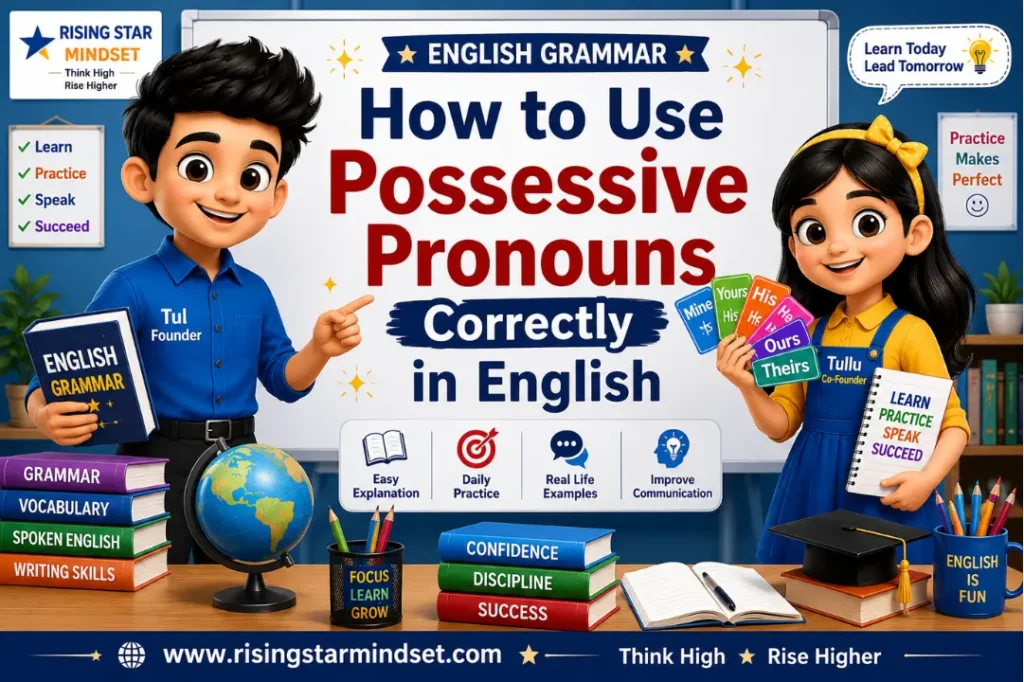
Whenever we want to show ownership or possession in English, we use special words called Possessive Pronouns. Instead of repeating the owner’s name again and again, these pronouns make our sentences shorter, clearer, and more natural. Therefore, they play an important role in both spoken and written English. ( Use Possessive Pronouns )
For example, rather than saying “This book belongs to Rahul,” we can simply say “This book is his.” Likewise, instead of repeating “This bag belongs to me,” we naturally say “This bag is mine.” As a result, our communication becomes smoother and easier to understand.
Moreover, Possessive Pronouns are used in school grammar, daily conversations, emails, interviews, competitive examinations, and professional communication. Consequently, learning them is essential for anyone who wants to improve English grammar as well as speaking skills.
In this lesson, you will understand the meaning, rules, sentence patterns, and practical uses of Possessive Pronouns. Furthermore, you will practise them through examples, conversations, worksheets, MCQs, HOTS questions, and revision exercises in the upcoming parts.
परिचय
जब भी हमें अंग्रेज़ी में किसी वस्तु, व्यक्ति या स्थान पर अधिकार (Ownership) या स्वामित्व (Possession) बताना होता है, तब हम Possessive Pronouns का प्रयोग करते हैं। बार-बार किसी व्यक्ति का नाम दोहराने के बजाय ये Pronouns वाक्य को अधिक सरल, स्पष्ट और प्रभावशाली बनाते हैं। इसलिए इनका सही ज्ञान अच्छी अंग्रेज़ी सीखने के लिए बहुत आवश्यक है।
उदाहरण के लिए, “This book belongs to Rahul” कहने के स्थान पर हम आसानी से “This book is his” कह सकते हैं। इसी प्रकार “This bag belongs to me” की जगह “This bag is mine” कहना अधिक स्वाभाविक लगता है। परिणामस्वरूप, हमारी बातचीत अधिक सहज और प्रभावशाली बन जाती है।
इसके अलावा, Possessive Pronouns का प्रयोग विद्यालयी व्याकरण, दैनिक बातचीत, ईमेल लेखन, इंटरव्यू, प्रतियोगी परीक्षाओं तथा पेशेवर संवाद में नियमित रूप से होता है। इसलिए यदि आप इन्हें अच्छी तरह समझ लेते हैं, तो आपकी Grammar, Writing तथा Spoken English तीनों में उल्लेखनीय सुधार होगा।
इस Lesson में आप Possessive Pronouns का अर्थ, नियम, वाक्य संरचना तथा उनका सही प्रयोग सीखेंगे। साथ ही, अगले Parts में उदाहरण, अभ्यास प्रश्न, MCQs, HOTS Questions और दैनिक बातचीत के माध्यम से इनका व्यावहारिक अभ्यास भी करेंगे।
Table of Contents
- Introduction
- What are Possessive Pronouns?
- Definition (English & Hindi)
- Why are Possessive Pronouns Important?
- Difference Between Possessive Pronouns and Possessive Adjectives
- Complete List of Possessive Pronouns
- Rules for Using Possessive Pronouns
- Sentence Structure
- Daily Conversations
- Common Mistakes
- Memory Trick
- Question & Answer
- Fill in the Blanks
- Match the Following
- MCQs
- HOTS Questions
- FAQs
- Lesson Summary
- Conclusion
- Previous Lesson : How to Use Object Pronouns Correctly in English
- Next Lesson : How to Use Demonstrative Pronouns Correctly in English
Abbreviations
| Abbreviation | Full Form |
| PP | Possessive Pronoun |
| SP | Subject Pronoun |
| OP | Object Pronoun |
| Eng. | English |
| Hin. | Hindi |
| Ex. | Example |
| MCQ | Multiple Choice Question |
| HOTS | Higher Order Thinking Skills |
| FAQ | Frequently Asked Questions |
What are Possessive Pronouns?
English Explanation
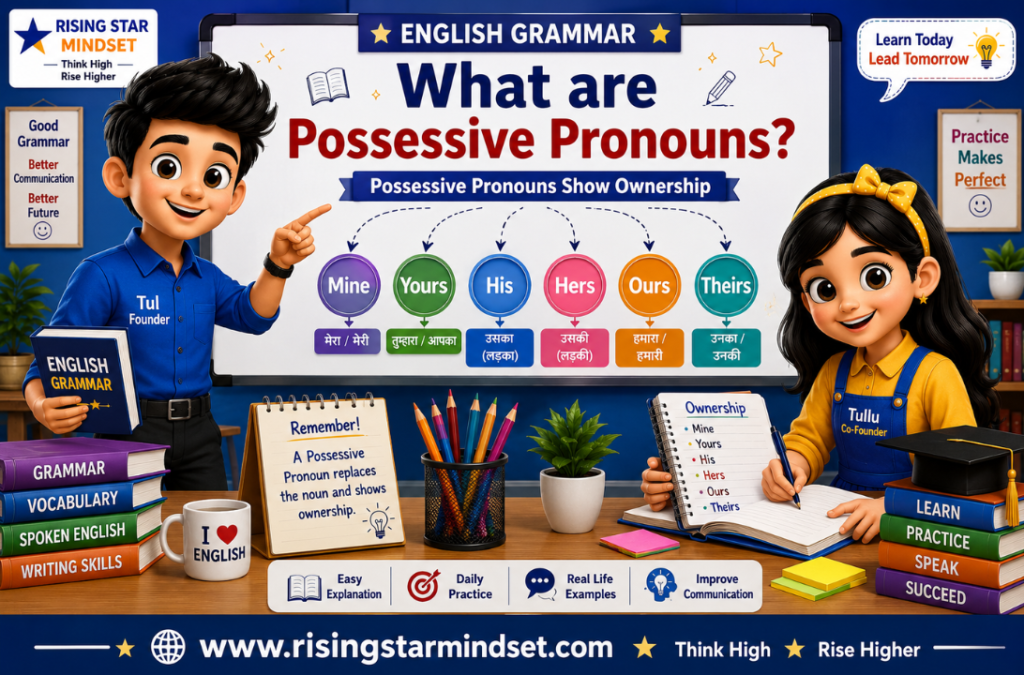
A Possessive Pronoun is a pronoun that shows ownership or possession. It replaces a noun together with its possessive adjective so that the sentence becomes shorter and avoids unnecessary repetition.
Instead of saying “This is my book,” we can say “This book is mine.” Here, the word mine replaces my book.
Examples
This pen is mine.
That bag is yours.
The blue car is his.
The red bicycle is hers.
This classroom is ours.
Those trophies are theirs.
हिन्दी व्याख्या
Possessive Pronoun वह Pronoun होता है जो अधिकार (Ownership) या स्वामित्व (Possession) को दर्शाता है। यह Noun और उसके Possessive Adjective दोनों की जगह लेकर वाक्य को छोटा और अधिक प्रभावशाली बनाता है।
उदाहरण के लिए,
This is my book.
को हम
This book is mine.
भी कह सकते हैं।
यहाँ mine ने my book की जगह ली है।
उदाहरण
This pen is mine.
यह पेन मेरा है।
That bag is yours.
वह बैग तुम्हारा/आपका है।
The blue car is his.
नीली कार उसकी है।
Why are Possessive Pronouns Important?
English Explanation
Possessive Pronouns are important because they make English more natural and professional. Furthermore, they reduce repetition and improve sentence flow. As a result, conversations become easier to understand.
They are commonly used in:
- Daily Conversations
- Spoken English
- School Grammar
- Competitive Exams
- Interviews
- Story Writing
- Email Writing
- Social Media Communication
Therefore, mastering Possessive Pronouns will help you communicate more confidently and accurately.
हिन्दी व्याख्या
Possessive Pronouns का महत्व इसलिए है क्योंकि ये वाक्य को अधिक स्वाभाविक, संक्षिप्त और प्रभावशाली बनाते हैं। इसके अलावा, ये बार-बार एक ही शब्द को दोहराने से बचाते हैं। परिणामस्वरूप, बातचीत और लेखन दोनों अधिक स्पष्ट हो जाते हैं।
इनका प्रयोग मुख्य रूप से निम्न स्थानों पर किया जाता है—
- दैनिक बातचीत
- Spoken English
- विद्यालयी व्याकरण
- प्रतियोगी परीक्षाएँ
- इंटरव्यू
- कहानी लेखन
- ईमेल लेखन
- सोशल मीडिया संवाद
इसलिए Possessive Pronouns का सही ज्ञान आपकी अंग्रेज़ी को अधिक आत्मविश्वासपूर्ण और प्रभावशाली बनाता है।
Difference Between Possessive Pronouns and Possessive Adjectives
English Explanation
Although both show ownership, they are used differently.
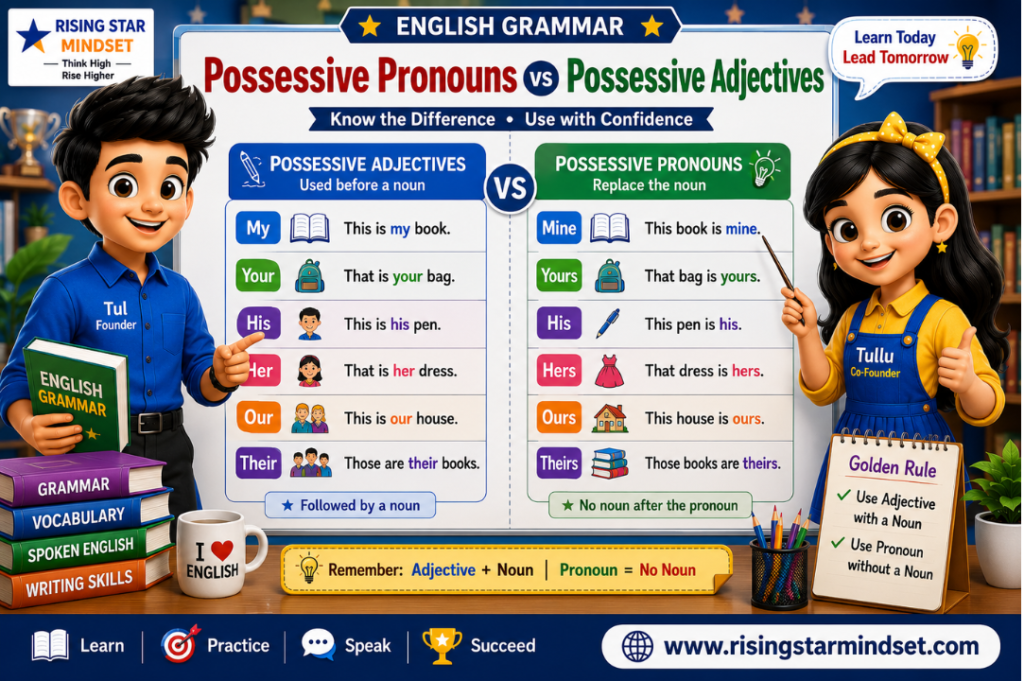
A Possessive Adjective comes before a noun, whereas a Possessive Pronoun replaces the noun completely.
| Possessive Adjective | Possessive Pronoun |
| My book | The book is mine. |
| Your bag | The bag is yours. |
| His car | The car is his. |
| Her dress | The dress is hers. |
| Our house | The house is ours. |
| Their school | The school is theirs. |
Example
This is my laptop.
This laptop is mine.
हिन्दी व्याख्या
Possessive Adjective और Possessive Pronoun दोनों स्वामित्व बताते हैं, लेकिन दोनों का प्रयोग अलग-अलग होता है।
Possessive Adjective हमेशा Noun के पहले आता है।
जबकि
Possessive Pronoun पूरे Noun की जगह ले लेता है।
उदाहरण
This is my laptop.
यह मेरा लैपटॉप है।
This laptop is mine.
यह लैपटॉप मेरा है।
Complete List of Possessive Pronouns
English Explanation
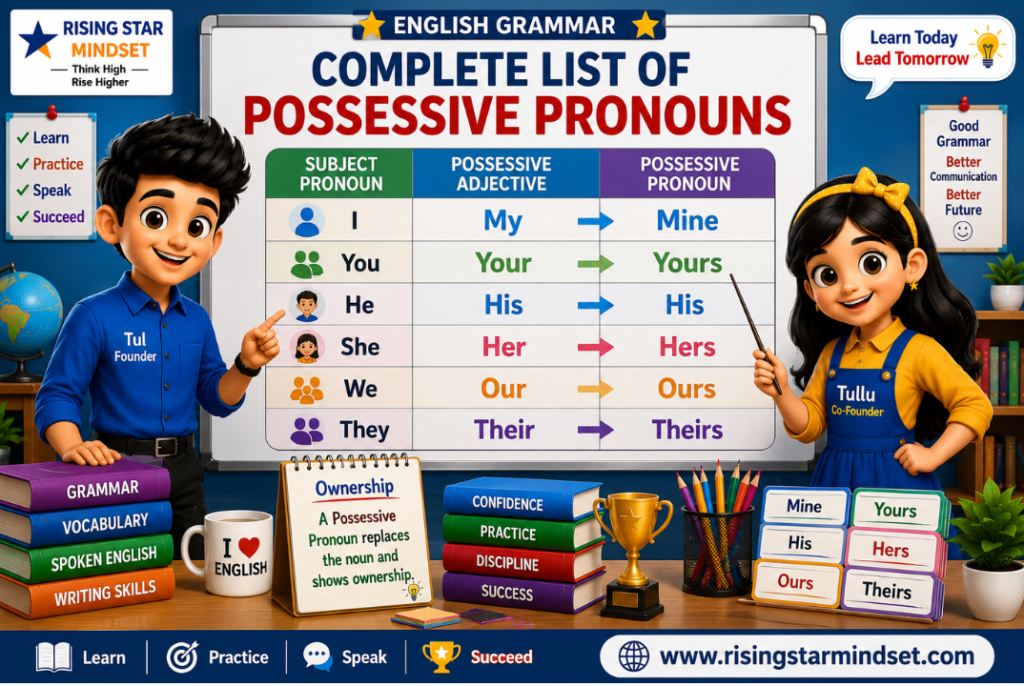
Possessive Pronouns replace a noun and show ownership. Instead of repeating the noun, they make sentences shorter, clearer, and more natural.
There are seven main Possessive Pronouns in English.
| Subject Pronoun | Possessive Adjective | Possessive Pronoun | Hindi Meaning |
| I | My | Mine | मेरा / मेरी / मेरे |
| You | Your | Yours | तुम्हारा / आपका |
| He | His | His | उसका (लड़का) |
| She | Her | Hers | उसकी (लड़की) |
| It | Its | — | (No Possessive Pronoun for “It”) |
| We | Our | Ours | हमारा / हमारी / हमारे |
| They | Their | Theirs | उनका / उनकी / उनके |
Important Note:
English does not have a separate Possessive Pronoun for “It”. The word its is a Possessive Adjective.
हिन्दी व्याख्या
Possessive Pronouns किसी वस्तु, व्यक्ति या स्थान पर अधिकार (Ownership) दर्शाते हैं। ये पूरे Noun की जगह प्रयोग किए जाते हैं जिससे वाक्य छोटा और अधिक प्रभावशाली बन जाता है।
अंग्रेज़ी में मुख्य रूप से निम्न Possessive Pronouns प्रयोग किए जाते हैं—
- Mine
- Yours
- His
- Hers
- Ours
- Theirs
महत्वपूर्ण बात:
It का कोई अलग Possessive Pronoun नहीं होता। Its केवल Possessive Adjective है।
Rule 1: Possessive Pronouns Replace the Noun
English Explanation
A Possessive Pronoun replaces the noun completely. Therefore, you should not use another noun immediately after it.
Correct
This pen is mine.
That house is ours.
The blue bicycle is hers.
Incorrect
❌ Mine pen
❌ Hers book
हिन्दी व्याख्या
Possessive Pronoun पूरे Noun की जगह ले लेता है। इसलिए इसके बाद फिर से Noun नहीं लिखा जाता।
सही
This pen is mine.
यह पेन मेरा है।
गलत
❌ Mine pen
❌ Hers book
Rule 2: Possessive Pronouns Usually Come at the End of the Sentence
English Explanation
In most English sentences, Possessive Pronouns appear after the linking verb.
Structure
Subject + Linking Verb + Possessive Pronoun
Examples
This laptop is mine.
That car is his.
The red bag is hers.
The classroom is ours.
Those trophies are theirs.
हिन्दी व्याख्या
अधिकांश वाक्यों में Possessive Pronoun Linking Verb के बाद आता है।
उदाहरण
This laptop is mine.
यह लैपटॉप मेरा है।
Those trophies are theirs.
वे ट्रॉफियाँ उनकी हैं।
Rule 3: Never Use a Noun After a Possessive Pronoun
English Explanation
Possessive Pronouns already replace the noun. Therefore, adding another noun after them is grammatically incorrect.
Incorrect
❌ Mine book
Correct
✅ My book
OR
✅ The book is mine.
Incorrect
❌ Hers dress
Correct
✅ Her dress
OR
✅ The dress is hers.
हिन्दी व्याख्या
Possessive Pronoun के बाद कभी भी Noun नहीं लगाया जाता क्योंकि वही पूरे Noun की जगह ले चुका होता है।
Rule 4: Choose the Correct Possessive Pronoun
| Owner | Possessive Pronoun |
| Me | Mine |
| You | Yours |
| Rahul | His |
| Riya | Hers |
| My family | Ours |
| Students | Theirs |
हिन्दी
हमेशा मालिक (Owner) के अनुसार सही Possessive Pronoun चुनें।
Sentence Structure ( Use Possessive Pronouns )
Pattern 1
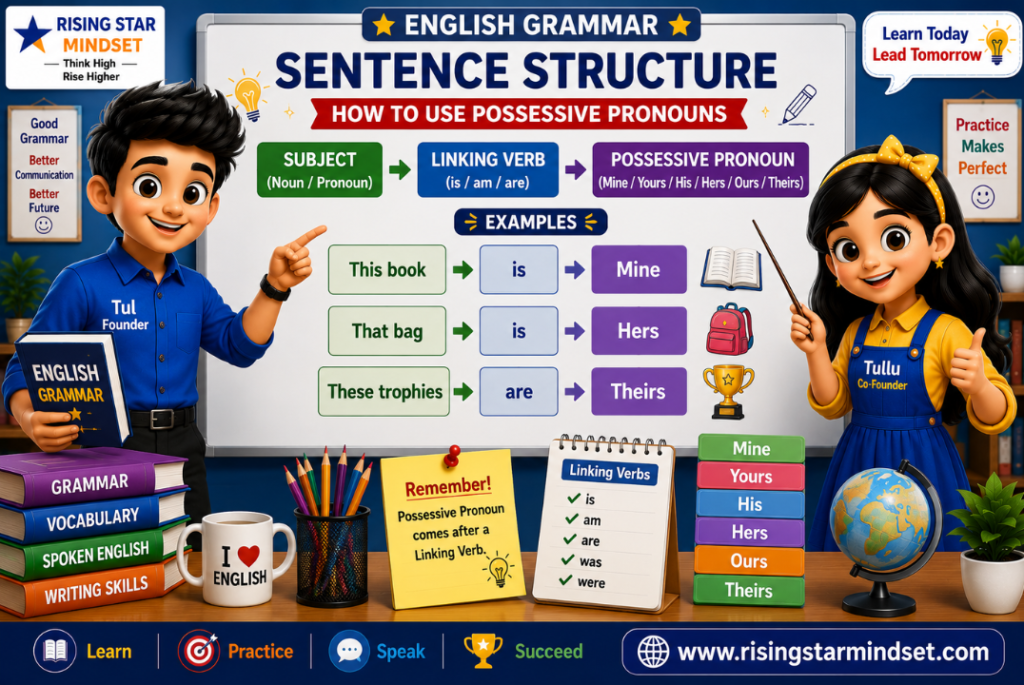
Subject + Linking Verb + Possessive Pronoun
Examples
This notebook is mine.
The black car is his.
The blue umbrella is hers.
Pattern 2
Whose + Noun + Linking Verb + Possessive Pronoun?
Examples
Whose bag is this?
It is mine.
Whose books are these?
They are ours.
हिन्दी
Possessive Pronouns मुख्य रूप से इन दोनों प्रकार की संरचनाओं में प्रयोग होते हैं—
- Subject + Linking Verb + Possessive Pronoun
- Whose + Noun + Linking Verb + Possessive Pronoun
Real-Life Examples ( Use Possessive Pronouns )
Example 1
This mobile phone is mine.
यह मोबाइल फोन मेरा है।
Example 2
That bicycle is yours.
वह साइकिल तुम्हारी है।
Example 3
The blue jacket is his.
नीली जैकेट उसकी है।
Example 4
The pink handbag is hers.
गुलाबी हैंडबैग उसकी है।
Example 5
The large house is ours.
वह बड़ा घर हमारा है।
Example 6
Those medals are theirs.
वे पदक उनके हैं।
Speaking Practice ( Use Possessive Pronouns )
Read these sentences aloud every day.
- This book is mine.
- That car is yours.
- The blue shirt is his.
- The red dress is hers.
- This classroom is ours.
- Those bags are theirs.
Furthermore, speaking these sentences aloud every day improves pronunciation and builds confidence. As a result, you will start using Possessive Pronouns naturally in daily English conversations.
Daily Conversations Using Possessive Pronouns
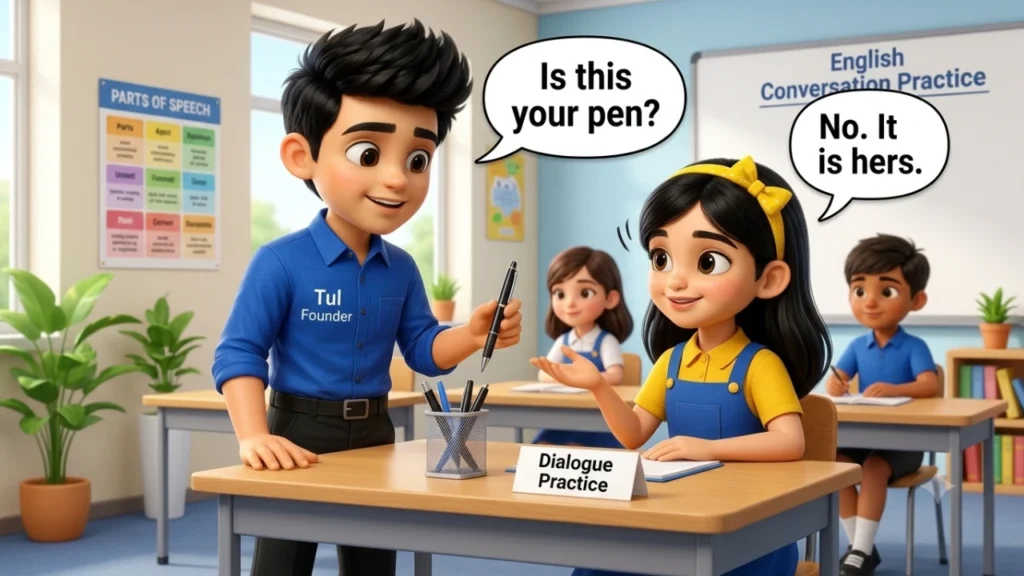
Conversation 1
Tul: Whose notebook is this?
Tullu: It is mine.
Tul: Thank you.
Tullu: You’re welcome.
हिन्दी अर्थ
तुल: यह नोटबुक किसकी है?
तुल्लू: यह मेरी है।
तुल: धन्यवाद।
तुल्लू: आपका स्वागत है।
Conversation 2
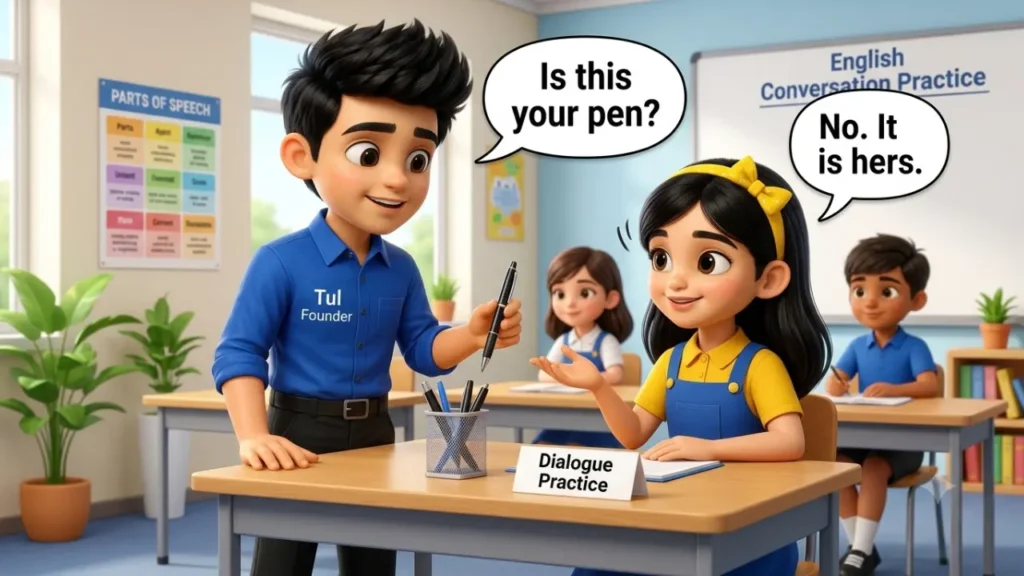
Teacher: Is this your pencil?
Student: No, it isn’t mine.
Teacher: Then whose is it?
Student: It is his.
हिन्दी अर्थ
शिक्षक: क्या यह तुम्हारी पेंसिल है?
विद्यार्थी: नहीं, यह मेरी नहीं है।
शिक्षक: फिर यह किसकी है?
विद्यार्थी: यह उसकी है।
Conversation 3
Mother: Are these books yours?
Son: No, they are theirs.
हिन्दी अर्थ
माँ: क्या ये किताबें तुम्हारी हैं?
बेटा: नहीं, ये उनकी हैं।
Conversation 4
Friend 1: Is this our classroom?
Friend 2: Yes, it is ours.
हिन्दी अर्थ
मित्र 1: क्या यह हमारी कक्षा है?
मित्र 2: हाँ, यह हमारी है।
Common Beginner Mistakes ( Use Possessive Pronouns )
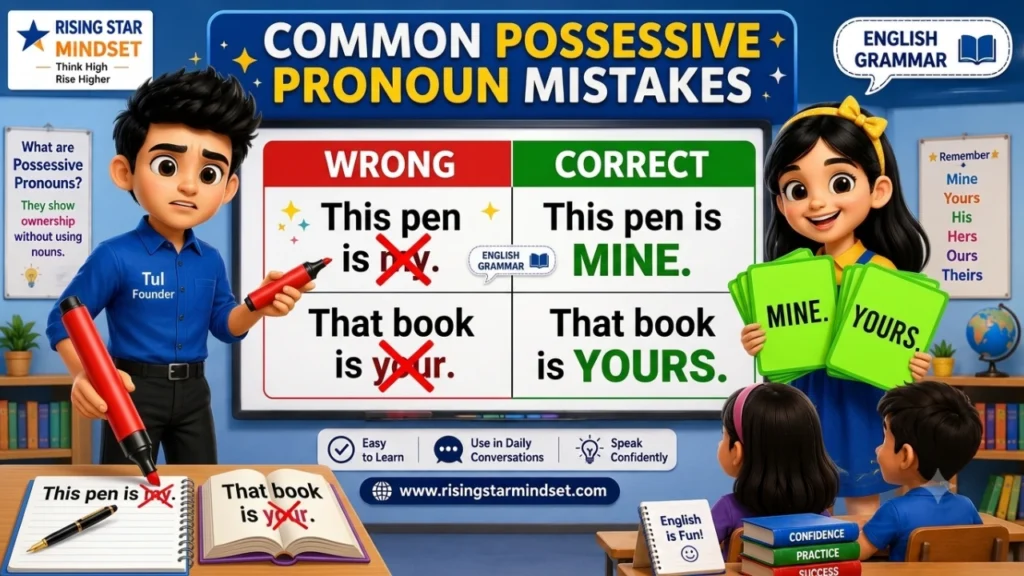
Many learners confuse Possessive Pronouns with Possessive Adjectives. Therefore, they often write incorrect sentences.
Mistake 1
❌ This is mine book.
✅ This is my book.
✅ This book is mine.
हिन्दी
Mine के बाद कभी Noun नहीं आता।
Mistake 2
❌ That is hers bag.
✅ That is her bag.
✅ That bag is hers.
Mistake 3
❌ This house is our.
✅ This house is ours.
Mistake 4
❌ These books are their.
✅ These books are theirs.
Mistake 5
❌ This bicycle is my.
✅ This bicycle is mine.
Memory Trick ( Use Possessive Pronouns )
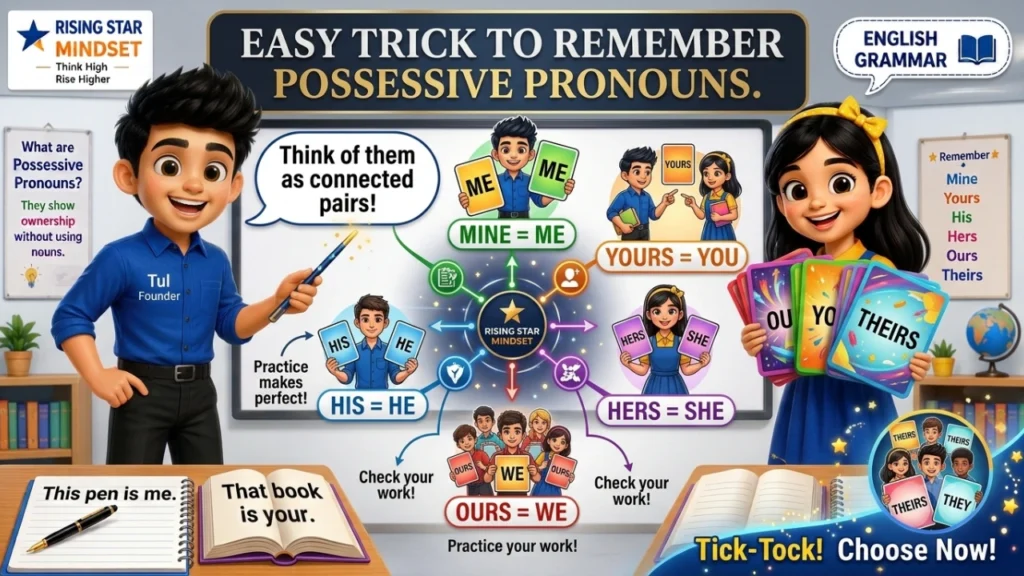
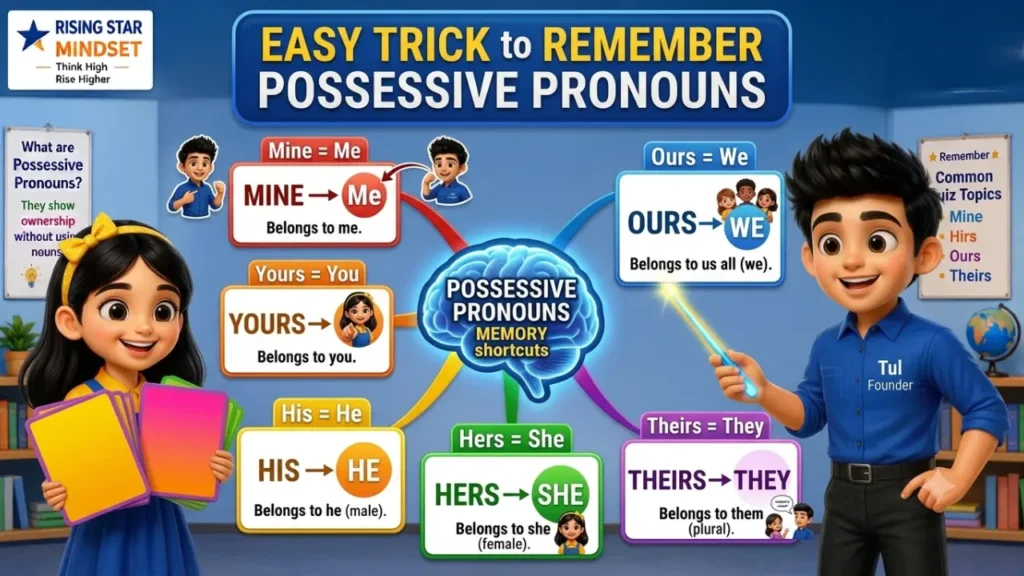
Easy Memory Formula
| Possessive Adjective | Possessive Pronoun |
| My | Mine |
| Your | Yours |
| His | His |
| Her | Hers |
| Our | Ours |
| Their | Theirs |
Golden Rule
👉 Adjective + Noun
My book
👉 Pronoun = No Noun
The book is mine.
हिन्दी ट्रिक
अगर Noun साथ हो → Possessive Adjective
अगर Noun न हो → Possessive Pronoun
याद रखने का आसान तरीका
My → Mine
Your → Yours
Her → Hers
Our → Ours
Their → Theirs
Question and Answer ( Use Possessive Pronouns )
Q1. What is a Possessive Pronoun?
Answer (English)
A Possessive Pronoun shows ownership and replaces a noun completely.
उत्तर (हिन्दी)
Possessive Pronoun स्वामित्व (Ownership) बताता है और पूरे Noun की जगह लेता है।
Q2. Name the main Possessive Pronouns.
Answer (English)
Mine, Yours, His, Hers, Ours, Theirs.
उत्तर (हिन्दी)
Mine, Yours, His, Hers, Ours और Theirs.
Q3. Can we use a noun after a Possessive Pronoun?
Answer (English)
No. A Possessive Pronoun already replaces the noun.
उत्तर (हिन्दी)
नहीं। Possessive Pronoun पहले ही Noun की जगह ले चुका होता है।
Q4. Which sentence is correct?
A. This is mine book.
B. This book is mine.
Answer
This book is mine.
Q5. Which Possessive Pronoun is used for “We”?
Answer (English)
Ours
उत्तर (हिन्दी)
Ours
Fill in the Blanks ( Use Possessive Pronouns )
Choose the correct Possessive Pronoun.
- This pen is ______.
(mine / my) - That car is ______.
(his / he) - These books are ______.
(theirs / their) - This classroom is ______.
(ours / our) - Is this bag ______?
(yours / your) - The blue dress is ______.
(hers / her) - This laptop is ______.
(mine / me) - Those trophies are ______.
(theirs / they)
Match the Following ( Use Possessive Pronouns )
| Column A | Column B |
| My | Mine |
| Your | Yours |
| His | His |
| Her | Hers |
| Our | Ours |
| Their | Theirs |
| Rahul’s car | His |
| Riya’s bag | Hers |
Speaking Practice ( Use Possessive Pronouns )
Read these sentences aloud every day.
- This notebook is mine.
- That bicycle is yours.
- The black jacket is his.
- The pink bag is hers.
- This classroom is ours.
- Those medals are theirs.
Moreover, regular speaking practice improves fluency and confidence. Consequently, you will begin using Possessive Pronouns naturally in everyday conversations, classroom discussions, and professional communication.
Practice Worksheet ( Use Possessive Pronouns )
Choose the correct Possessive Pronoun to complete each sentence.
Exercise 1
- This dictionary is ______.
(mine / my) - That bicycle is ______.
(his / he) - These books are ______.
(theirs / their) - This classroom is ______.
(ours / our) - Is this notebook ______?
(yours / your) - The blue handbag is ______.
(hers / her) - This laptop is ______.
(mine / me) - Those medals are ______.
(theirs / they) - The football is ______.
(his / him) - This project is ______.
(ours / us)
Error Correction
Correct the following sentences.
Question 1
❌ This is mine book.
✅ ___________________________
Question 2
❌ That bag is her.
✅ ___________________________
Question 3
❌ These notebooks are their.
✅ ___________________________
Question 4
❌ This classroom is our.
✅ ___________________________
Question 5
❌ The red bicycle is she.
✅ ___________________________
Question 6
❌ This pen is my.
✅ ___________________________
Question 7
❌ Those trophies are they.
✅ ___________________________
Question 8
❌ This mobile phone is me.
✅ ___________________________
Multiple Choice Questions (MCQs)
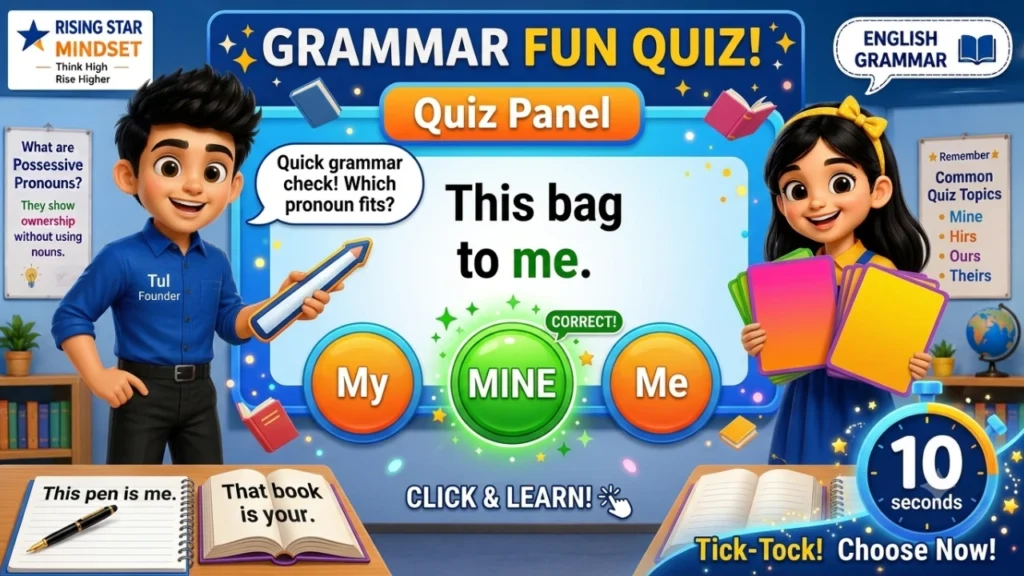
1. Which sentence is correct?
A. This is mine book.
B. This book is mine.
C. This book is my.
D. This book mine.
✅ Answer: B
2. Which Possessive Pronoun is used with I?
A. My
B. Me
C. Mine
D. Myself
✅ Answer: C
3. Which sentence is correct?
A. The bag is her.
B. The bag is hers.
C. The bag hers.
D. Her bag hers.
✅ Answer: B
4. Which Possessive Pronoun replaces our house?
A. Our
B. Ours
C. Us
D. We
✅ Answer: B
5. Complete the sentence.
This laptop is ______.
A. my
B. mine
C. me
D. I
✅ Answer: B
6. Which Possessive Pronoun is used for They?
A. Their
B. Them
C. Theirs
D. They
✅ Answer: C
7. Which sentence is grammatically correct?
A. This car is his.
B. This his car.
C. This is his car is.
D. This car his.
✅ Answer: A
8. Which Possessive Pronoun replaces your bag?
A. Your
B. Yours
C. You
D. Yourself
✅ Answer: B
9. Which sentence is incorrect?
A. The bicycle is hers.
B. This pen is mine.
C. That house is our.
D. These books are theirs.
✅ Answer: C
10. Which sentence is correct?
A. This is my.
B. This is mine.
C. Mine is book.
D. Mine book is.
✅ Answer: B
11. Which Possessive Pronoun replaces her dress?
A. Her
B. Hers
C. She
D. Herself
✅ Answer: B
12. Choose the correct sentence.
A. Those bags are their.
B. Those bags are theirs.
C. Their bags are theirs bags.
D. They bags are theirs.
✅ Answer: B
13. Which word shows ownership?
A. Subject Pronoun
B. Object Pronoun
C. Possessive Pronoun
D. Reflexive Pronoun
✅ Answer: C
14. Which sentence is correct?
A. The classroom is ours.
B. The classroom ours.
C. Ours classroom.
D. Our is classroom.
✅ Answer: A
15. Which Possessive Pronoun replaces my mobile phone?
A. My
B. Mine
C. Me
D. Myself
✅ Answer: B
16. Which sentence uses a Possessive Pronoun correctly?
A. This book is my.
B. This book is mine.
C. This mine book.
D. Mine this book.
✅ Answer: B
17. Which Possessive Pronoun replaces their school?
A. Their
B. Them
C. Theirs
D. They
✅ Answer: C
18. Which sentence is correct?
A. The red dress is hers.
B. The red dress hers.
C. The red hers dress.
D. Hers dress is.
✅ Answer: A
19. Which sentence is grammatically correct?
A. This house is ours.
B. This house our.
C. This ours house.
D. House ours.
✅ Answer: A
20. Which Possessive Pronoun replaces your notebook?
A. You
B. Your
C. Yours
D. Yourself
✅ Answer: C
HOTS (Higher Order Thinking Skills)
Question 1
Why is “This book is mine.” correct but “This is mine book.” incorrect?
Question 2
Explain the difference between my and mine using two examples.
Question 3
Identify the Possessive Pronoun in the sentence:
The blue bicycle is hers.
Question 4
Rewrite the sentence using a Possessive Pronoun.
This is my pen.
Question 5
Can his be both a Possessive Adjective and a Possessive Pronoun? Explain with examples.
Question 6
Why do Possessive Pronouns make English sentences shorter and more natural?
Question 7
Write three original sentences using mine, ours, and theirs.
Question 8
Correct the sentence.
Those bags are their.
Question 9
Differentiate between Possessive Pronouns and Possessive Adjectives with suitable examples.
Question 10
Write a short conversation using at least five different Possessive Pronouns.
Frequently Asked Questions (FAQs)
Q1. What is a Possessive Pronoun?
Answer (English)
A Possessive Pronoun is a pronoun that shows ownership or possession without using a noun after it. It replaces the noun completely.
उत्तर (हिन्दी)
Possessive Pronoun वह Pronoun है जो किसी व्यक्ति, वस्तु या स्थान पर अधिकार (Ownership) दर्शाता है और उसके बाद Noun का प्रयोग नहीं किया जाता। यह पूरे Noun की जगह ले लेता है।
Q2. Which words are Possessive Pronouns?
Answer (English)
The main Possessive Pronouns are:
Mine, Yours, His, Hers, Ours, Theirs
उत्तर (हिन्दी)
मुख्य Possessive Pronouns हैं—
Mine, Yours, His, Hers, Ours, Theirs
Q3. What is the difference between “My” and “Mine”?
Answer (English)
My is a Possessive Adjective and is followed by a noun.
Example:
My book
Mine is a Possessive Pronoun and replaces the noun.
Example:
The book is mine.
उत्तर (हिन्दी)
My एक Possessive Adjective है और इसके बाद Noun आता है।
उदाहरण—
My book
जबकि
Mine एक Possessive Pronoun है और यह पूरे Noun की जगह लेता है।
उदाहरण—
The book is mine.
Q4. Can we use a noun after a Possessive Pronoun?
Answer (English)
No. A Possessive Pronoun already replaces the noun.
उत्तर (हिन्दी)
नहीं। Possessive Pronoun स्वयं पूरे Noun की जगह लेता है, इसलिए इसके बाद Noun नहीं लिखा जाता।
Q5. Why should we learn Possessive Pronouns?
Answer (English)
Learning Possessive Pronouns improves grammar, avoids unnecessary repetition, and makes spoken as well as written English more natural and professional.
उत्तर (हिन्दी)
Possessive Pronouns सीखने से Grammar मजबूत होती है, बार-बार Noun दोहराने की आवश्यकता नहीं रहती तथा आपकी Spoken और Written English दोनों अधिक प्रभावशाली बनती हैं।
Quick Revision Chart
| Person | Possessive Adjective | Possessive Pronoun |
| I | My | Mine |
| You | Your | Yours |
| He | His | His |
| She | Her | Hers |
| We | Our | Ours |
| They | Their | Theirs |
Key Points to Remember
English
- Possessive Pronouns show ownership.
- They replace the noun completely.
- Never use a noun after a Possessive Pronoun.
- They usually come after a linking verb.
- They make English sentences shorter and more natural.
- Daily practice improves grammar and spoken English.
हिन्दी
- Possessive Pronouns स्वामित्व (Ownership) बताते हैं।
- ये पूरे Noun की जगह प्रयोग किए जाते हैं।
- Possessive Pronoun के बाद Noun नहीं आता।
- ये सामान्यतः Linking Verb के बाद प्रयोग होते हैं।
- इनसे वाक्य अधिक छोटे, स्पष्ट और स्वाभाविक बनते हैं।
- नियमित अभ्यास से Grammar और Spoken English दोनों बेहतर होती हैं।
Lesson Summary
English
Throughout this lesson, you learned the meaning, rules, sentence structure, and practical usage of Possessive Pronouns. Furthermore, you explored the differences between Possessive Pronouns and Possessive Adjectives, practised real-life conversations, solved worksheets, answered MCQs, and strengthened your understanding through HOTS questions. Consequently, you are now able to use Possessive Pronouns correctly while speaking and writing English.
हिन्दी
इस Lesson में आपने Possessive Pronouns का अर्थ, नियम, वाक्य संरचना तथा उनका सही प्रयोग विस्तार से सीखा। इसके अलावा, आपने Possessive Pronouns और Possessive Adjectives के बीच का अंतर समझा, दैनिक बातचीत का अभ्यास किया, Worksheets हल किए, MCQs का अभ्यास किया तथा HOTS Questions के माध्यम से अपनी समझ को और मजबूत बनाया। परिणामस्वरूप, अब आप Possessive Pronouns का सही प्रयोग आत्मविश्वास के साथ कर सकते हैं।
Previous Lesson
📘 Lesson 11.3 – Object Pronouns in English
In the previous lesson, you learned:
- Meaning of Object Pronouns
- Me, You, Him, Her, It, Us, Them
- Grammar Rules
- Sentence Structure
- Daily Conversations
- Common Mistakes
- Practice Exercises
- MCQs & HOTS Questions
हिन्दी
पिछले Lesson में आपने सीखा था—
- Object Pronouns का अर्थ
- Me, You, Him, Her, It, Us, Them
- इनके प्रयोग के नियम
- Sentence Structure
- Daily Conversation
- सामान्य गलतियाँ
- अभ्यास प्रश्न
- MCQs एवं HOTS Questions
Next Lesson Notification
🚀 Lesson 11.5 – Demonstrative Pronouns in English
In the next lesson, you will learn:
- What are Demonstrative Pronouns?
- This, That, These, Those
- Grammar Rules
- Sentence Structure
- Daily Conversations
- Practice Exercises
- MCQs
- HOTS Questions
- FAQs
हिन्दी
अगले Lesson में आप सीखेंगे—
- Demonstrative Pronouns क्या होते हैं?
- This, That, These, Those
- इनके प्रयोग के नियम
- Sentence Structure
- दैनिक बातचीत
- अभ्यास प्रश्न
- MCQs
- HOTS Questions
- FAQs
Therefore, don’t miss the next lesson because Demonstrative Pronouns are widely used in everyday English conversations, school grammar, spoken English, and competitive examinations.
Conclusion
English
Congratulations! You have successfully completed Lesson 11.4 – Possessive Pronouns in English. Throughout this lesson, you learned how Possessive Pronouns express ownership, how they differ from Possessive Adjectives, and how they are used in everyday communication. Moreover, you practised grammar rules, conversations, worksheets, MCQs, and HOTS questions. As a result, you now have a stronger foundation for speaking and writing accurate English. Keep revising regularly because consistent practice is the key to fluency and confidence.
निष्कर्ष (हिन्दी)
बधाई हो! आपने Lesson 11.4 – Possessive Pronouns in English सफलतापूर्वक पूरा कर लिया है। इस Lesson के माध्यम से आपने सीखा कि Possessive Pronouns स्वामित्व कैसे व्यक्त करते हैं, वे Possessive Adjectives से कैसे अलग हैं तथा उनका सही प्रयोग दैनिक अंग्रेज़ी में कैसे किया जाता है। इसके साथ ही, आपने उदाहरणों, अभ्यास प्रश्नों, MCQs और HOTS Questions के माध्यम से अपने ज्ञान को और मजबूत किया। इसलिए अब नियमित अभ्यास करते रहें, क्योंकि निरंतर अभ्यास ही आपको शुद्ध, प्रभावशाली और आत्मविश्वासपूर्ण अंग्रेज़ी बोलने तथा लिखने में सक्षम बनाएगा।
🌐 Continue Learning

➡️ Next Lesson: Lesson 11.5 – Demonstrative Pronouns in English
📚 Complete English Grammar Series:
www.risingstarmindset.com
🌟 Keep Learning with Rising Star Mindset
📘 Spoken English Course
🏛️ BPSC Preparation
🎓 School Notes
💡 Daily Motivation
🌐 Website: www.risingstarmindset.com
Think High • Rise Higher