
Numbers, Dates and Time in English | Complete Beginner Guide
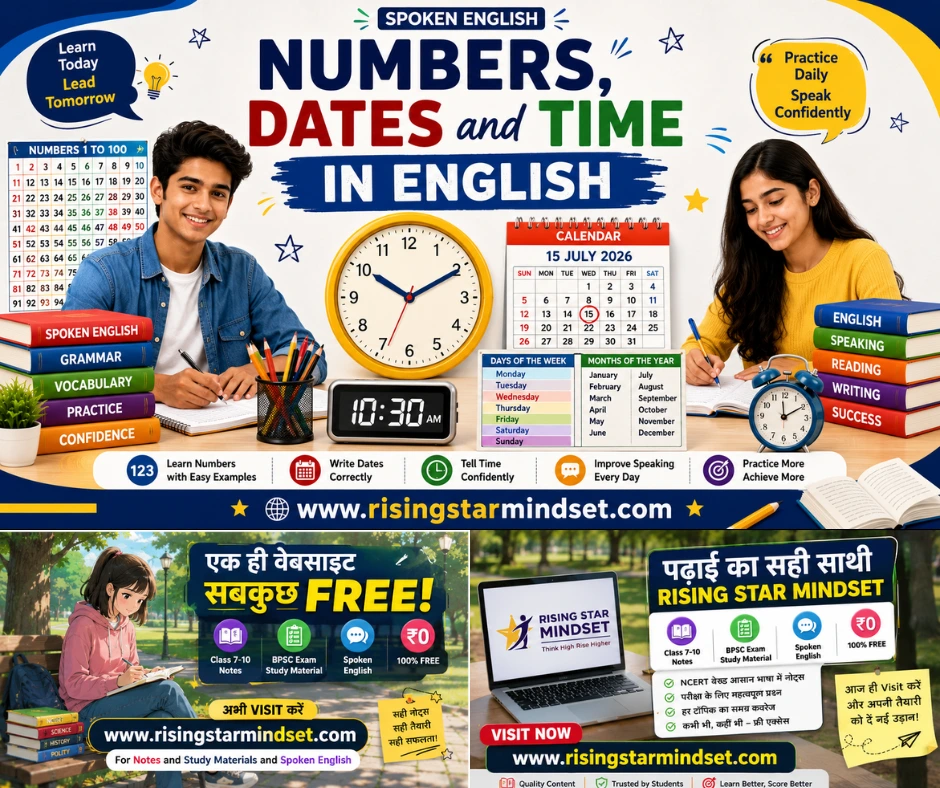
Table of Contents ( Numbers, Dates and Time )
- Introduction
- What are Numbers?
- Types of Numbers
- Cardinal Numbers
- Ordinal Numbers
- Reading Numbers in English
- Dates in English
- Days of the Week
- Months of the Year
- Writing Dates Correctly
- Time in English
- AM and PM
- Telling Time
- Common Time Expressions
- Daily Conversation Examples
- Practice Sentences
- Vocabulary
- Key Points
- MCQs
- HOTS Questions
- Fill in the Blanks
- Match the Following
- Question & Answers
- FAQs
- Conclusion
- Previous post : How to Greet and Introduce Yourself in English
Abbreviations ( Numbers, Dates and Time )
| Abbreviation | Full Form |
| AM | Ante Meridiem |
| PM | Post Meridiem |
| hr | Hour |
| min | Minute |
| sec | Second |
| Jan | January |
| Feb | February |
| Mar | March |
| Apr | April |
| Aug | August |
| Sept | September |
| Oct | October |
| Nov | November |
| Dec | December |
Introduction ( Numbers, Dates and Time )
What are Numbers, Dates and Time?
English
Numbers, Dates and Time are used every day in school, offices, travel, shopping, banking, interviews, and daily conversations. Therefore, learning them correctly is one of the most important steps in Spoken English.
Moreover, understanding how to read numbers, write dates, and tell the time helps you communicate clearly and confidently. Whether you are introducing yourself, filling out a form, booking a ticket, or attending an interview, these basic English skills are essential.
In this complete guide, you will learn numbers, dates, months, days, and time with easy explanations, practical examples, exercises, and quizzes in both English and Hindi.
हिन्दी
Numbers (संख्याएँ), Dates (तिथियाँ) और Time (समय) का उपयोग हम अपने दैनिक जीवन में हर जगह करते हैं। स्कूल, कॉलेज, ऑफिस, बैंक, यात्रा, खरीदारी और बातचीत—हर जगह इनका सही प्रयोग आवश्यक होता है।
यदि आप English Speaking सीखना चाहते हैं, तो Numbers, Dates और Time को सही ढंग से समझना बहुत ज़रूरी है। इस अध्याय में आप आसान उदाहरणों के साथ इन सभी विषयों को अंग्रेज़ी और हिन्दी में सीखेंगे।
Why Learn Numbers, Dates and Time?
English
Learning numbers, dates, and time improves your communication skills. Furthermore, it helps you understand schedules, appointments, calendars, clocks, and official documents. As a result, you become more confident while speaking English.
हिन्दी
Numbers, Dates और Time सीखने से आपकी Communication Skills बेहतर होती हैं। साथ ही, आप Calendar, Clock, Appointment, Timetable और Official Documents को आसानी से समझ पाते हैं।
Types of Numbers
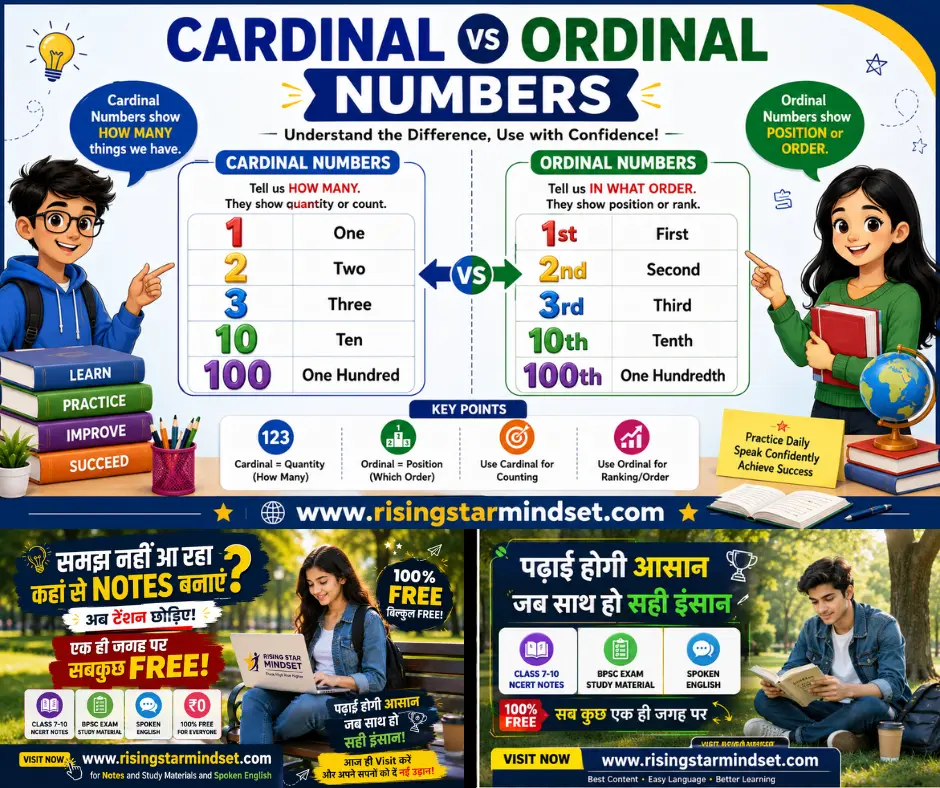
Numbers are mainly divided into two types.
1. Cardinal Numbers
These numbers tell how many.
Examples
One
Two
Three
Ten
Twenty
One Hundred
One Thousand
हिन्दी
Cardinal Numbers किसी वस्तु की संख्या बताते हैं।
उदाहरण
One = एक
Five = पाँच
Twenty = बीस
Hundred = सौ
2. Ordinal Numbers
These numbers tell the position or order.
Examples
First
Second
Third
Fourth
Fifth
Tenth
Twenty-first
हिन्दी
Ordinal Numbers क्रम बताते हैं।
First = पहला
Second = दूसरा
Third = तीसरा
Fourth = चौथा
Numbers 1–20 ( Numbers, Dates and Time )
| Number | Word | हिन्दी |
| 1 | One | एक |
| 2 | Two | दो |
| 3 | Three | तीन |
| 4 | Four | चार |
| 5 | Five | पाँच |
| 6 | Six | छह |
| 7 | Seven | सात |
| 8 | Eight | आठ |
| 9 | Nine | नौ |
| 10 | Ten | दस |
| 11 | Eleven | ग्यारह |
| 12 | Twelve | बारह |
| 13 | Thirteen | तेरह |
| 14 | Fourteen | चौदह |
| 15 | Fifteen | पंद्रह |
| 16 | Sixteen | सोलह |
| 17 | Seventeen | सत्रह |
| 18 | Eighteen | अठारह |
| 19 | Nineteen | उन्नीस |
| 20 | Twenty | बीस |
Key Points
- Numbers are used in daily life.
- Learn both cardinal and ordinal numbers.
- Dates have different writing formats.
- Time should be spoken naturally.
- Practice reading numbers every day.
- Learn days and months carefully.
- Use AM and PM correctly.
- Speak confidently while telling the time.
- Read calendars regularly.
- Daily practice improves fluency.
Numbers 21–100 ( Numbers, Dates and Time )
Learning numbers from 21 to 100 is essential because they are frequently used in daily conversations, phone numbers, prices, ages, marks, and addresses. Therefore, practice reading them aloud every day.
Numbers (21–30)
| Number | Word | हिन्दी |
| 21 | Twenty-one | इक्कीस |
| 22 | Twenty-two | बाईस |
| 23 | Twenty-three | तेईस |
| 24 | Twenty-four | चौबीस |
| 25 | Twenty-five | पच्चीस |
| 26 | Twenty-six | छब्बीस |
| 27 | Twenty-seven | सत्ताईस |
| 28 | Twenty-eight | अट्ठाईस |
| 29 | Twenty-nine | उनतीस |
| 30 | Thirty | तीस |
Numbers (31–40)
| Number | Word | हिन्दी |
| 31 | Thirty-one | इकतीस |
| 32 | Thirty-two | बत्तीस |
| 33 | Thirty-three | तैंतीस |
| 34 | Thirty-four | चौंतीस |
| 35 | Thirty-five | पैंतीस |
| 36 | Thirty-six | छत्तीस |
| 37 | Thirty-seven | सैंतीस |
| 38 | Thirty-eight | अड़तीस |
| 39 | Thirty-nine | उनतालीस |
| 40 | Forty | चालीस |
Numbers (41–50)
| Number | Word | हिन्दी |
| 41 | Forty-one | इकतालीस |
| 42 | Forty-two | बयालीस |
| 43 | Forty-three | तैंतालीस |
| 44 | Forty-four | चवालीस |
| 45 | Forty-five | पैंतालीस |
| 46 | Forty-six | छियालीस |
| 47 | Forty-seven | सैंतालीस |
| 48 | Forty-eight | अड़तालीस |
| 49 | Forty-nine | उनचास |
| 50 | Fifty | पचास |
Numbers (51–100)
Instead of memorizing every number separately, remember the pattern.
| Tens | Example |
| Fifty | Fifty-one, Fifty-two |
| Sixty | Sixty-one, Sixty-two |
| Seventy | Seventy-one |
| Eighty | Eighty-five |
| Ninety | Ninety-nine |
| One Hundred | 100 |
Hundreds and Thousands
| Number | English | हिन्दी |
| 100 | One Hundred | एक सौ |
| 200 | Two Hundred | दो सौ |
| 300 | Three Hundred | तीन सौ |
| 500 | Five Hundred | पाँच सौ |
| 1,000 | One Thousand | एक हजार |
| 10,000 | Ten Thousand | दस हजार |
| 1,00,000 | One Lakh | एक लाख |
| 10,00,000 | Ten Lakh | दस लाख |
| 1,000,000 | One Million | दस लाख (International System) |
Ordinal Numbers ( Numbers, Dates and Time )
It tell us the position or order of something.
Ordinal Numbers (1–20)
| Number | Ordinal | हिन्दी |
| 1 | First | पहला |
| 2 | Second | दूसरा |
| 3 | Third | तीसरा |
| 4 | Fourth | चौथा |
| 5 | Fifth | पाँचवाँ |
| 6 | Sixth | छठा |
| 7 | Seventh | सातवाँ |
| 8 | Eighth | आठवाँ |
| 9 | Ninth | नौवाँ |
| 10 | Tenth | दसवाँ |
| 11 | Eleventh | ग्यारहवाँ |
| 12 | Twelfth | बारहवाँ |
| 13 | Thirteenth | तेरहवाँ |
| 14 | Fourteenth | चौदहवाँ |
| 15 | Fifteenth | पंद्रहवाँ |
| 16 | Sixteenth | सोलहवाँ |
| 17 | Seventeenth | सत्रहवाँ |
| 18 | Eighteenth | अठारहवाँ |
| 19 | Nineteenth | उन्नीसवाँ |
| 20 | Twentieth | बीसवाँ |
Days of the Week ( Numbers, Dates and Time )
| Day | हिन्दी |
| Monday | सोमवार |
| Tuesday | मंगलवार |
| Wednesday | बुधवार |
| Thursday | गुरुवार |
| Friday | शुक्रवार |
| Saturday | शनिवार |
| Sunday | रविवार |
Months of the Year ( Numbers, Dates and Time )
| Month | हिन्दी |
| January | जनवरी |
| February | फ़रवरी |
| March | मार्च |
| April | अप्रैल |
| May | मई |
| June | जून |
| July | जुलाई |
| August | अगस्त |
| September | सितंबर |
| October | अक्टूबर |
| November | नवंबर |
| December | दिसंबर |
How to Write Dates in English
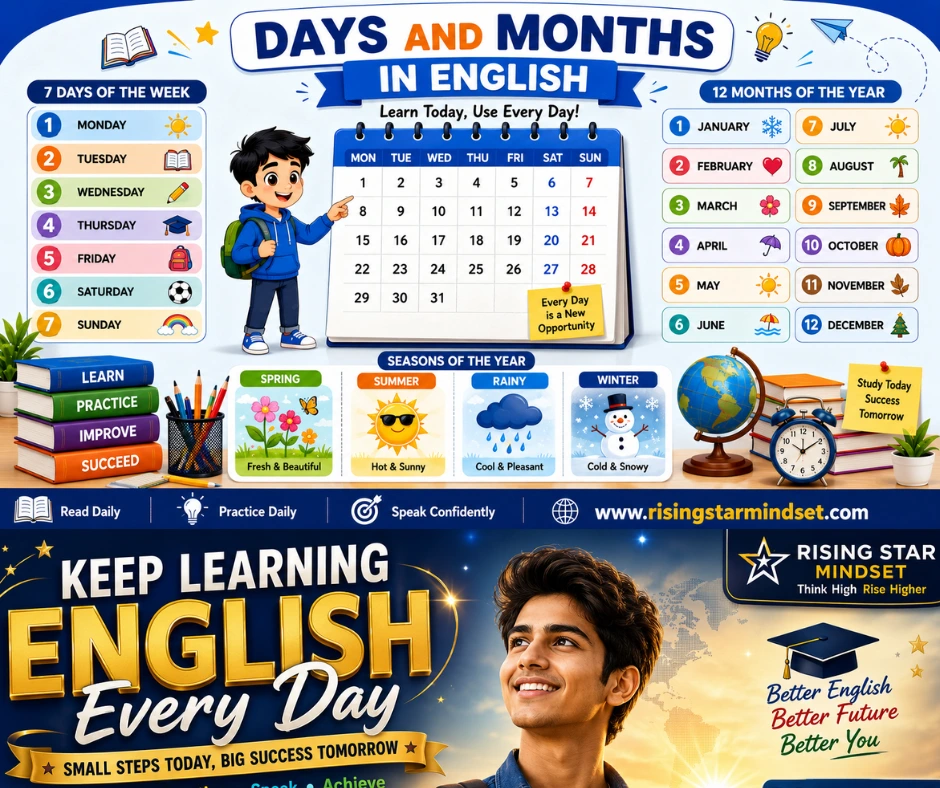
Different countries follow different date formats.
British Format
Day – Month – Year
Example:
15 July 2026
26 January 2027
American Format
Month – Day – Year
Example:
July 15, 2026
January 26, 2027
Useful Date Expressions
| English | हिन्दी |
| Today | आज |
| Tomorrow | कल (आने वाला) |
| Yesterday | कल (बीता हुआ) |
| This Week | इस सप्ताह |
| Next Week | अगला सप्ताह |
| Last Week | पिछला सप्ताह |
| This Month | इस महीना |
| Next Month | अगला महीना |
| Last Month | पिछला महीना |
| This Year | इस वर्ष |
Practice Sentences
English
- Today is Monday.
- Tomorrow is Tuesday.
- My birthday is on 12 August.
- Our school opens in June.
- India celebrates Independence Day on 15 August.
- Christmas is celebrated on 25 December.
- My examination starts next week.
- We will meet next month.
- January is the first month of the year.
- Sunday is my favourite day.
हिन्दी
- आज सोमवार है।
- कल मंगलवार होगा।
- मेरा जन्मदिन 12 अगस्त को है।
- हमारा विद्यालय जून में खुलता है।
- भारत 15 अगस्त को स्वतंत्रता दिवस मनाता है।
- क्रिसमस 25 दिसंबर को मनाया जाता है।
- मेरी परीक्षा अगले सप्ताह शुरू होगी।
- हम अगले महीने मिलेंगे।
- जनवरी वर्ष का पहला महीना है।
- रविवार मेरा पसंदीदा दिन है।
Vocabulary Builder
| Word | हिन्दी |
| Number | संख्या |
| Date | तिथि |
| Time | समय |
| Calendar | कैलेंडर |
| Clock | घड़ी |
| Week | सप्ताह |
| Month | महीना |
| Year | वर्ष |
| Birthday | जन्मदिन |
| Holiday | अवकाश |
Key Points
- Learn number patterns instead of memorizing every number.
- Ordinal numbers show position or rank.
- Remember all seven days of the week.
- Learn all twelve months in order.
- British and American date formats are different.
- Practice reading dates aloud.
- Use numbers correctly in daily conversations.
- Revise regularly to improve fluency.
Time in English
What is Time?
English
Time helps us organize our daily activities. It tells us when something happens. Therefore, learning how to tell the time correctly is an important part of spoken English.
Moreover, we use time while talking about school, office, meetings, travel, exams, and appointments. As a result, knowing time expressions makes your communication more natural and confident.
हिन्दी
समय (Time) हमारे दैनिक जीवन का एक महत्वपूर्ण भाग है। इसकी सहायता से हम जानते हैं कि कोई कार्य कब होता है। इसलिए, अंग्रेज़ी में समय बताना सीखना बहुत आवश्यक है।

Parts of a Clock
| Part | हिन्दी |
| Clock | घड़ी |
| Hour Hand | घंटे की सुई |
| Minute Hand | मिनट की सुई |
| Second Hand | सेकंड की सुई |
| Hour | घंटा |
| Minute | मिनट |
| Second | सेकंड |
AM and PM
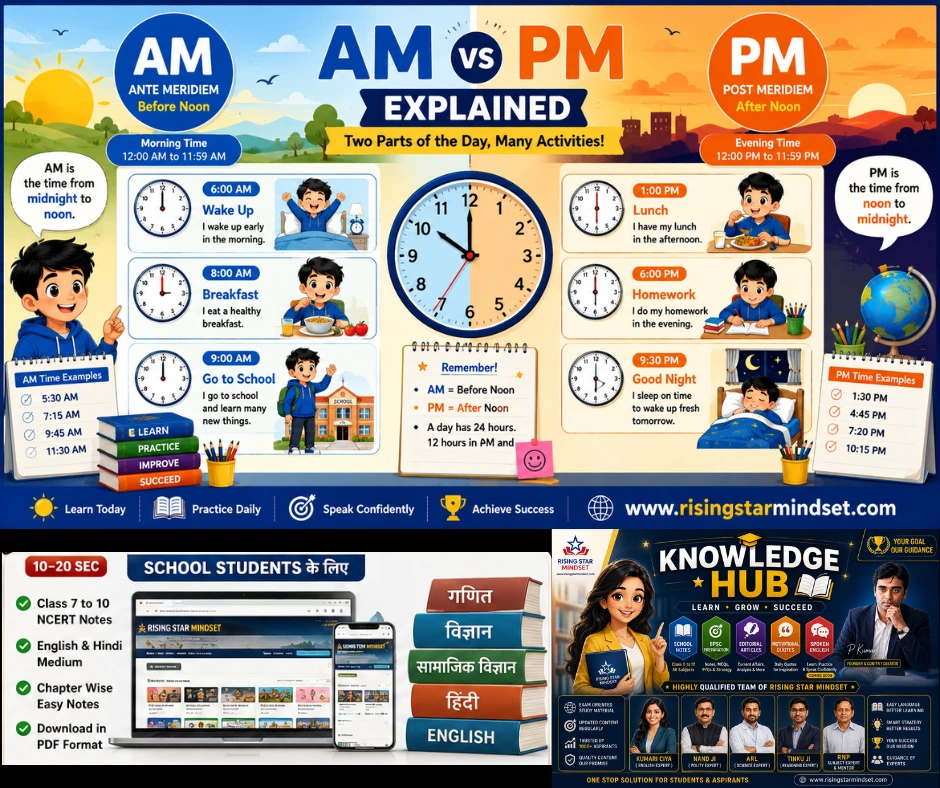
What is AM?
AM (Ante Meridiem) means before noon.
Time from 12:00 midnight to 11:59 morning is called AM.
Examples
- 6:00 AM
- 8:30 AM
- 11:45 AM
हिन्दी
AM का अर्थ है दोपहर से पहले का समय।
What is PM?
PM (Post Meridiem) means after noon.
Time from 12:00 noon to 11:59 night is called PM.
Examples
- 1:00 PM
- 5:30 PM
- 9:45 PM
हिन्दी
PM का अर्थ है दोपहर के बाद का समय।
O’Clock
When the minute hand is at 12, we use O’Clock.
Examples
| Time | English |
| 1:00 | One o’clock |
| 2:00 | Two o’clock |
| 5:00 | Five o’clock |
| 8:00 | Eight o’clock |
| 10:00 | Ten o’clock |
Quarter Past
When the minute hand shows 15 minutes, we say Quarter Past.
Examples
| Time | English |
| 2:15 | Quarter past two |
| 5:15 | Quarter past five |
| 9:15 | Quarter past nine |
Half Past
When the minute hand shows 30 minutes, we say Half Past.
Examples
| Time | English |
| 3:30 | Half past three |
| 6:30 | Half past six |
| 11:30 | Half past eleven |
Quarter To
When 15 minutes are left before the next hour, we say Quarter To.
Examples
| Time | English |
| 3:45 | Quarter to four |
| 6:45 | Quarter to seven |
| 10:45 | Quarter to eleven |
Common Time Expressions
| English | हिन्दी |
| What time is it? | क्या समय हुआ है? |
| It’s one o’clock. | एक बजा है। |
| It’s half past five. | साढ़े पाँच बजे हैं। |
| It’s quarter past eight. | सवा आठ बजे हैं। |
| It’s quarter to ten. | पौने दस बजे हैं। |
| It’s almost time. | लगभग समय हो गया है। |
| Right on time. | बिल्कुल समय पर। |
| I’m late. | मैं देर से आया हूँ। |
| Hurry up. | जल्दी करो। |
| Take your time. | आराम से करो। |
Daily Conversation Using Time
Conversation 1
A: What time is it?
B: It’s eight o’clock.
A: Thank you.
B: You’re welcome.
हिन्दी
A: कितना समय हुआ है?
B: आठ बजे हैं।
A: धन्यवाद।
B: आपका स्वागत है।
Conversation 2
A: When does your class start?
B: My class starts at 9:00 AM.
A: And when does it finish?
B: It finishes at 3:30 PM.
हिन्दी
A: आपकी कक्षा कब शुरू होती है?
B: मेरी कक्षा सुबह 9 बजे शुरू होती है।
A: और कब समाप्त होती है?
B: दोपहर 3:30 बजे।
Speaking Practice
Read these sentences aloud every day.
- My school starts at eight o’clock.
- Usually, I wake up at six in the morning.
- After breakfast, I leave for school.
- Our English class begins at nine o’clock.
- During the afternoon, I complete my homework.
- In the evening, I play with my friends.
- Before bedtime, I revise my lessons.
- Every day, I try to be on time.
- Good time management helps me succeed.
- Finally, I sleep at ten o’clock.

Fill in the Blanks
Choose the correct answer.
- 2:15 is ______ past two. (Half / Quarter)
- 5:30 is ______ past five. (Half / Quarter)
- AM means before ______. (Noon / Night)
- PM means after ______. (Noon / Morning)
- 8:00 is eight ______. (Clock / O’clock)
- 9:45 is quarter ______ ten. (Past / To)
- A day has ______ hours. (24 / 12)
- There are ______ minutes in one hour. (60 / 30)
- There are ______ seconds in one minute. (60 / 100)
- A week has ______ days. (7 / 8)
Answers
- Quarter
- Half
- Noon
- Noon
- O’clock
- To
- 24
- 60
- 60
- 7
Match the Following
| Column A | Column B |
| One o’clock | 1:00 |
| Quarter past four | 4:15 |
| Half past six | 6:30 |
| Quarter to nine | 8:45 |
| Midnight | 12:00 AM |
| Noon | 12:00 PM |
| Monday | First working day |
| Sunday | Holiday |
| January | First month |
| December | Last month |
Correct Answers
| Column A | Correct Match |
| One o’clock | 1:00 |
| Quarter past four | 4:15 |
| Half past six | 6:30 |
| Quarter to nine | 8:45 |
| Midnight | 12:00 AM |
| Noon | 12:00 PM |
| Monday | First working day |
| Sunday | Holiday |
| January | First month |
| December | Last month |
Question and Answers
Q1. What is AM?
Answer: AM stands for Ante Meridiem, which means before noon.
हिन्दी: AM का अर्थ दोपहर से पहले का समय होता है।
Q2. What is PM?
Answer: PM stands for Post Meridiem, which means after noon.
हिन्दी: PM का अर्थ दोपहर के बाद का समय होता है।
Q3. How many hours are there in a day?
Answer: There are 24 hours in a day.
हिन्दी: एक दिन में 24 घंटे होते हैं।
Q4. What does “Quarter Past” mean?
Answer: It means 15 minutes after the hour.
हिन्दी: इसका अर्थ है घंटे के 15 मिनट बाद।
Q5. What does “Half Past” mean?
Answer: It means 30 minutes after the hour.
हिन्दी: इसका अर्थ है घंटे के 30 मिनट बाद।
HOTS (Higher Order Thinking Skills)
1. Why is punctuality important in daily life?
Answer: Punctuality helps us complete tasks on time, builds trust, improves discipline, and creates a positive impression.
2. Imagine you have an interview at 10:00 AM. What should you do?
Sample Answer: I should arrive at least 15–20 minutes early, carry all necessary documents, and greet the interviewer politely.
3. Why should students learn to tell time in English?
Answer: It helps them understand schedules, exams, classes, and communicate confidently in English.
4. Explain the difference between AM and PM with one example each.
Sample Answer: 7:00 AM is in the morning, while 7:00 PM is in the evening.
5. How does time management help you achieve success?
Answer: Good time management improves productivity, reduces stress, and helps achieve goals efficiently.

Multiple Choice Questions (MCQs)
1. Which number comes after 29?
A. Twenty-eight
B. Thirty
C. Thirty-one
D. Twenty-nine
✅ Answer: B
2. Which is the correct spelling?
A. Fourty
B. Forty
C. Fortie
D. Fourtee
✅ Answer: B
3. Which is an ordinal number?
A. Three
B. Thirty
C. Third
D. Thirteen
✅ Answer: C
4. Which day comes after Monday?
A. Sunday
B. Wednesday
C. Tuesday
D. Friday
✅ Answer: C
5. Which is the first month of the year?
A. March
B. January
C. February
D. April
✅ Answer: B
6. Which month has Christmas?
A. November
B. December
C. October
D. January
✅ Answer: B
7. AM means—
A. After Midnight
B. Before Noon
C. After Noon
D. Morning Time
✅ Answer: B
8. PM means—
A. Before Noon
B. After Noon
C. Morning
D. Midnight
✅ Answer: B
9. 6:00 is—
A. Six O’clock
B. Half Past Six
C. Quarter Past Six
D. Quarter To Six
✅ Answer: A
10. 7:15 is—
A. Half Past Seven
B. Quarter To Seven
C. Quarter Past Seven
D. Seven O’clock
✅ Answer: C
11. 8:30 means—
A. Quarter Past Eight
B. Half Past Eight
C. Quarter To Eight
D. Eight O’clock
✅ Answer: B
12. 9:45 means—
A. Quarter Past Nine
B. Half Past Nine
C. Quarter To Ten
D. Ten O’clock
✅ Answer: C
13. A week has—
A. 5 days
B. 6 days
C. 7 days
D. 8 days
✅ Answer: C
14. A year has—
A. 10 months
B. 11 months
C. 12 months
D. 13 months
✅ Answer: C
15. There are ______ hours in a day.
A. 12
B. 18
C. 24
D. 48
✅ Answer: C
16. Which comes before Friday?
A. Wednesday
B. Thursday
C. Saturday
D. Monday
✅ Answer: B
17. Which is the last month?
A. November
B. October
C. December
D. January
✅ Answer: C
18. Independence Day in India is celebrated on—
A. 26 January
B. 15 August
C. 2 October
D. 14 November
✅ Answer: B
19. One Hundred means—
A. 10
B. 100
C. 1000
D. 10000
✅ Answer: B
20. First is—
A. Cardinal Number
B. Ordinal Number
C. Decimal Number
D. Fraction
✅ Answer: B
21. Which expression means “लगभग समय हो गया”?
A. Hurry up
B. Right on time
C. It’s almost time
D. Take care
✅ Answer: C
22. Which month comes after June?
A. August
B. July
C. May
D. September
✅ Answer: B
23. Which day comes before Sunday?
A. Friday
B. Saturday
C. Monday
D. Thursday
✅ Answer: B
24. Which sentence is correct?
A. Today is Monday.
B. Monday today is.
C. Is today Monday.
D. Today Monday.
✅ Answer: A
25. What time is 12:00 PM?
A. Midnight
B. Noon
C. Morning
D. Evening
✅ Answer: B
26. What time is 12:00 AM?
A. Noon
B. Midnight
C. Evening
D. Afternoon
✅ Answer: B
27. Which number comes before Fifty?
A. Forty-eight
B. Forty-nine
C. Fifty-one
D. Forty
✅ Answer: B
28. Which is correct?
A. Twenty one
B. Twenty-one
C. Twentyone
D. Twenty_one
✅ Answer: B
29. Which expression asks for the time?
A. Where are you?
B. What time is it?
C. What’s your name?
D. How old are you?
✅ Answer: B
30. The best way to learn numbers and time is—
A. Daily Practice
B. Memorizing Only
C. Avoid Speaking
D. Never Revising
✅ Answer: A
Test Your Score
| Score | Performance |
| 27–30 | 🌟 Excellent |
| 22–26 | 🏆 Very Good |
| 17–21 | 👍 Good |
| 12–16 | 📘 Average |
| 0–11 | 📖 Keep Practicing |
Key Points Revision ( Numbers, Dates and Time )
- Numbers are essential for everyday communication.
- Cardinal numbers show quantity.
- Ordinal numbers show order or position.
- Learn the correct spelling of English numbers.
- Remember all seven days of the week.
- Memorize the twelve months in sequence.
- Understand the difference between AM and PM.
- Practice telling the time using O’clock, Quarter Past, Half Past, and Quarter To.
- Read calendars and clocks in English every day.
- Consistent practice improves fluency and confidence.
Frequently Asked Questions (FAQs)
Q1. What are Cardinal Numbers?
Answer: Cardinal Numbers tell us the quantity or count of something, such as One, Two, Three.
हिन्दी: Cardinal Numbers किसी वस्तु की संख्या बताते हैं।
Q2. What are Ordinal Numbers?
Answer: Ordinal Numbers tell us the position or order, such as First, Second, Third.
हिन्दी: Ordinal Numbers क्रम या स्थान बताते हैं।
Q3. What is the difference between AM and PM?
Answer: AM refers to the time before noon, while PM refers to the time after noon.
हिन्दी: AM दोपहर से पहले और PM दोपहर के बाद का समय दर्शाता है।
Q4. Why should we learn dates and time in English?
Answer: Learning dates and time helps us communicate effectively, understand schedules, attend meetings, and manage daily activities confidently.
हिन्दी: Dates और Time सीखने से हम समय-सारणी समझने, मीटिंग में समय पर पहुँचने और दैनिक कार्यों का बेहतर प्रबंधन कर पाते हैं।
Q5. How can I improve my ability to read numbers and tell the time?
Answer: Practice reading clocks, calendars, timetables, and number charts every day. Regular speaking practice will also improve your confidence.
हिन्दी: रोज़ घड़ी, कैलेंडर और संख्या तालिकाओं का अभ्यास करें तथा अंग्रेज़ी में समय बोलने की आदत डालें।
English Conclusion
Learning Numbers, Dates and Time in English is a fundamental step toward improving your spoken English. Moreover, these topics are used in almost every real-life situation, including classrooms, workplaces, interviews, shopping, travel, and daily conversations.
Furthermore, regular practice with numbers, dates, days, months, and time expressions will improve both your fluency and confidence. Instead of memorizing everything at once, practice a little every day and apply what you learn in real conversations.
Finally, remember that success in spoken English comes through consistency, patience, and daily practice. Therefore, keep reading, keep speaking, and keep challenging yourself with new exercises. With continuous effort, you will communicate naturally and confidently in English.
Learn Every Day • Practice Every Day • Speak with Confidence
हिन्दी निष्कर्ष
Numbers, Dates और Time अंग्रेज़ी सीखने की बुनियादी और सबसे महत्वपूर्ण विषयों में से हैं। इनका सही ज्ञान आपको स्कूल, प्रतियोगी परीक्षाओं, इंटरव्यू, यात्रा और दैनिक जीवन की बातचीत में अधिक आत्मविश्वास के साथ अंग्रेज़ी बोलने में मदद करता है।
रोज़ कुछ मिनट संख्या पढ़ने, तारीख़ लिखने और समय बताने का अभ्यास करें। धीरे-धीरे आपकी शब्दावली, उच्चारण और बोलने का आत्मविश्वास बढ़ेगा। याद रखें, नियमित अभ्यास ही सफलता की कुंजी है।
🌟 Final Call to Action
Did this guide help you?
- Share it with your friends and classmates.
- Bookmark this page for quick revision.
- Practice the exercises regularly.
- Explore more English Grammar lessons on www.risingstarmindset.com.
Keep Learning, Keep Growing! 🚀
P Kumar | Rising Star Mindset
www.risingstarmindset.com
Together We Will Make The Difference