
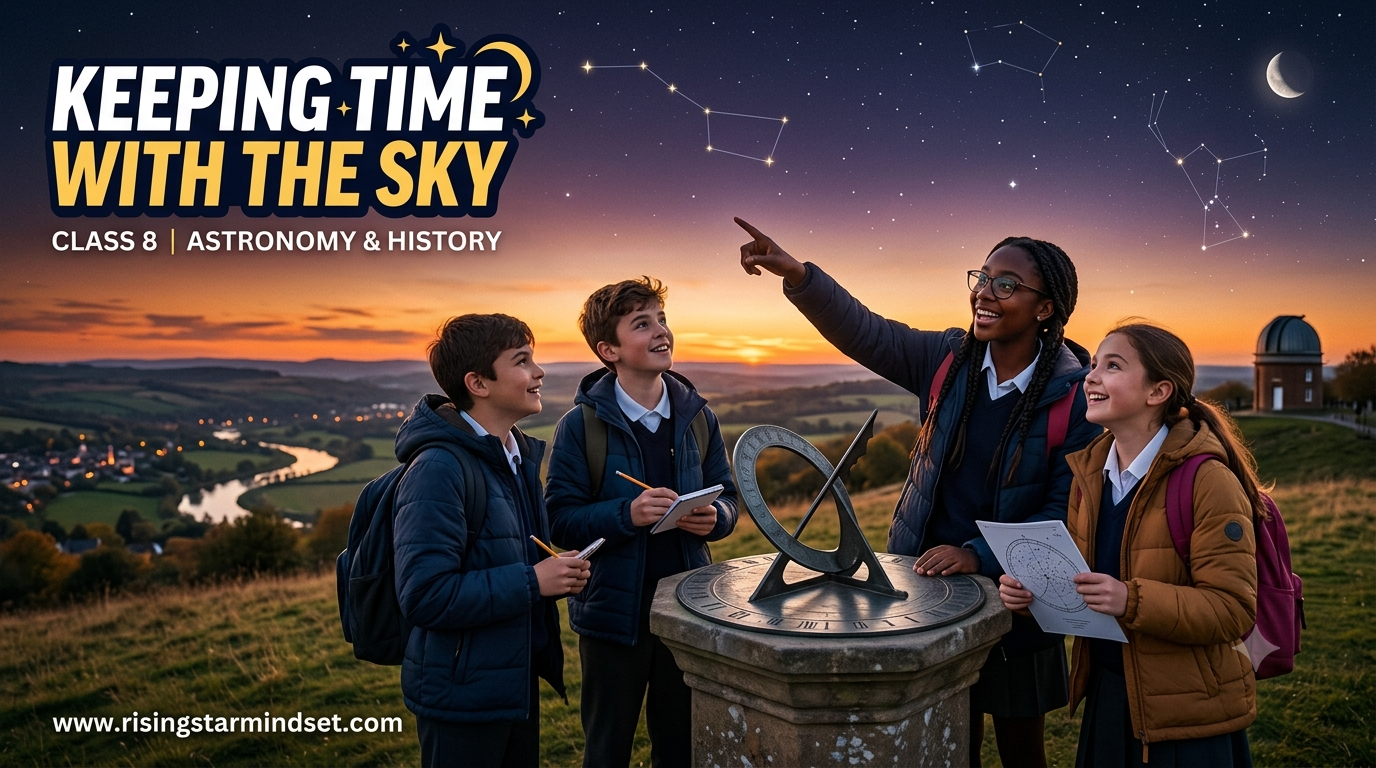
Keeping Time with the Sky Class 8
Introduction | परिचय
English:
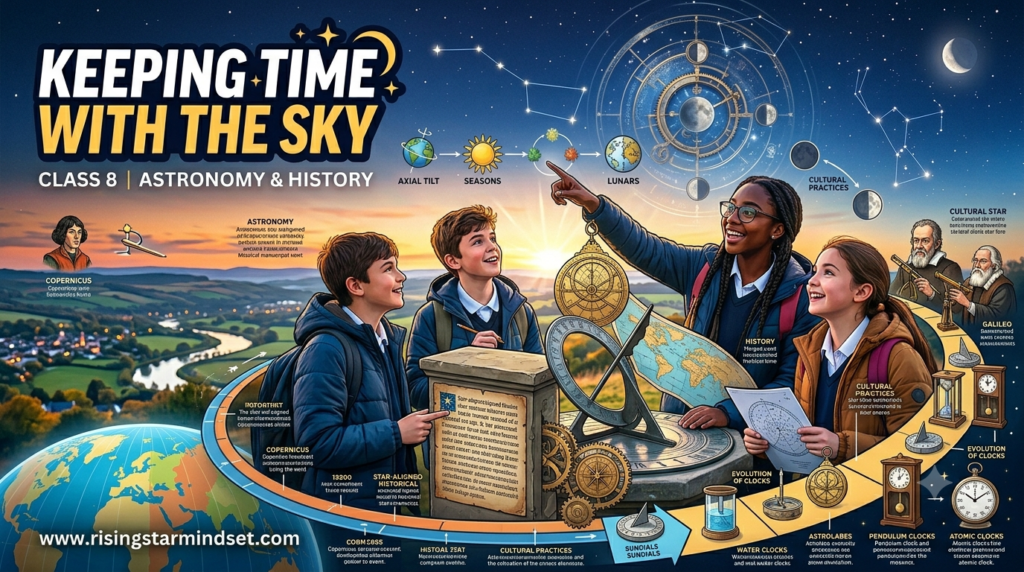
The chapter Keeping Time with the Sky Class 8 explains how ancient people measured time by observing the Sun, Moon, and stars. Before clocks and watches were invented, people used celestial bodies to know the time, seasons, and directions.
Hindi:
Keeping Time with the Sky Class 8 अध्याय में बताया गया है कि प्राचीन लोग सूर्य, चंद्रमा और तारों को देखकर समय का निर्धारण करते थे। घड़ी के आविष्कार से पहले लोग आकाशीय पिंडों के आधार पर समय, ऋतु और दिशा का पता लगाते थे।
Table of Contents
- Introduction
- What is Time Measurement?
- Role of the Sun
- Sundials
- Role of the Moon
- Constellations
- Pole Star
- Calendar System
- Key Points
- Important Abbreviations
- MCQs
- HOTS Questions
- Short Answer Questions
- Long Answer Questions
- FAQs
- Conclusion
What is Time Measurement?
English
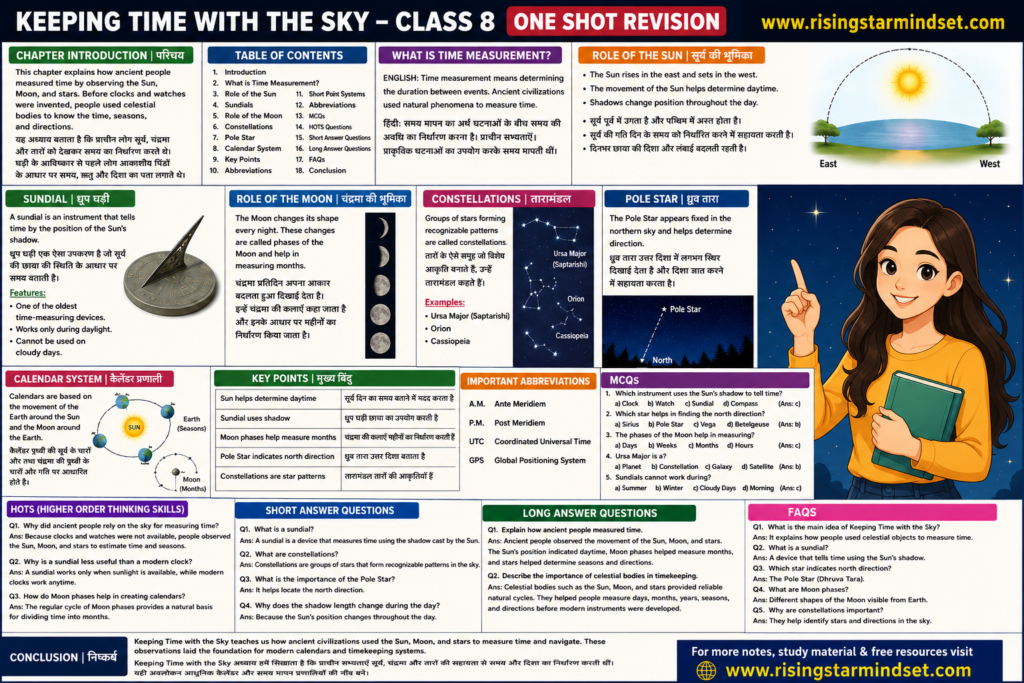
Time measurement means determining the duration between events. Ancient civilizations used natural phenomena to measure time.
Hindi
समय मापन का अर्थ घटनाओं के बीच समय की अवधि का निर्धारण करना है। प्राचीन सभ्यताएँ प्राकृतिक घटनाओं का उपयोग करके समय मापती थीं।
Role of the Sun | सूर्य की भूमिका
English
- The Sun rises in the east and sets in the west.
- The movement of the Sun helps determine daytime.
- Shadows change position throughout the day.
Hindi
- सूर्य पूर्व में उगता है और पश्चिम में अस्त होता है।
- सूर्य की गति दिन के समय को निर्धारित करने में सहायता करती है।
- दिनभर छाया की दिशा और लंबाई बदलती रहती है।
Sundial | धूप घड़ी
English
A sundial is an instrument that tells time by the position of the Sun’s shadow.
Hindi
धूप घड़ी एक ऐसा उपकरण है जो सूर्य की छाया की स्थिति के आधार पर समय बताती है।
Features
- One of the oldest time-measuring devices.
- Works only during daylight.
- Cannot be used on cloudy days.
Role of the Moon | चंद्रमा की भूमिका
English
The Moon changes its shape every night. These changes are called phases of the Moon and help in measuring months.
Hindi
चंद्रमा प्रतिदिन अपना आकार बदलता हुआ दिखाई देता है। इन्हें चंद्रमा की कलाएँ कहा जाता है और इनके आधार पर महीनों का निर्धारण किया जाता है।
Constellations | तारामंडल
English
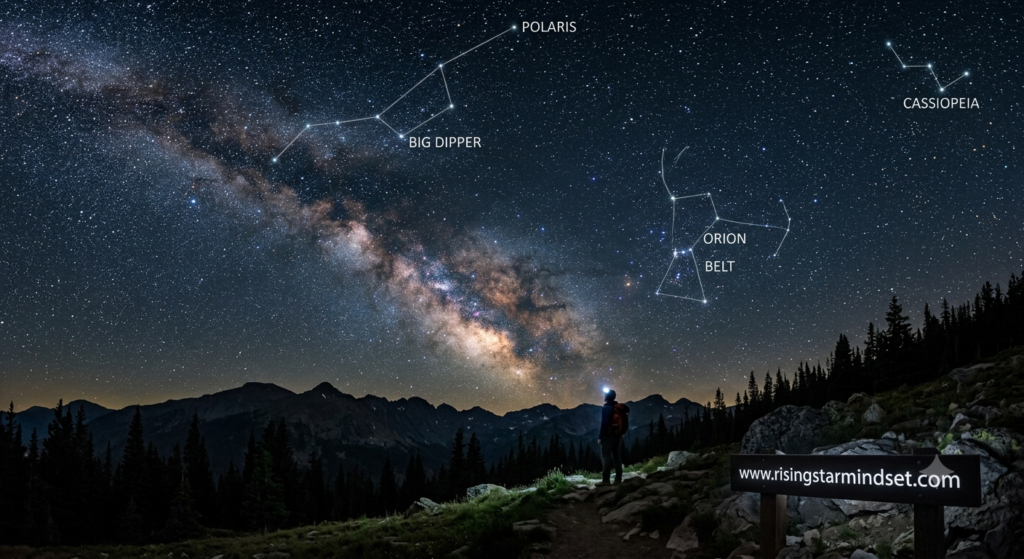
Groups of stars forming recognizable patterns are called constellations.
Hindi
तारों के ऐसे समूह जो विशेष आकृति बनाते हैं, उन्हें तारामंडल कहते हैं।
Examples
- Ursa Major (Saptarishi)
- Orion
- Cassiopeia
Pole Star | ध्रुव तारा
English
The Pole Star appears fixed in the northern sky and helps determine direction.
Hindi
ध्रुव तारा उत्तर दिशा में लगभग स्थिर दिखाई देता है और दिशा ज्ञात करने में सहायता करता है।
Calendar System | कैलेंडर प्रणाली
English
Calendars are based on the movement of the Earth around the Sun and the Moon around the Earth.
Hindi
कैलेंडर पृथ्वी की सूर्य के चारों ओर तथा चंद्रमा की पृथ्वी के चारों ओर गति पर आधारित होते हैं।
Key Points
| English | Hindi |
|---|---|
| Sun helps determine daytime | सूर्य दिन का समय बताने में मदद करता है |
| Sundial uses shadow | धूप घड़ी छाया का उपयोग करती है |
| Moon phases help measure months | चंद्रमा की कलाएँ महीनों का निर्धारण करती हैं |
| Pole Star indicates north direction | ध्रुव तारा उत्तर दिशा बताता है |
| Constellations are star patterns | तारामंडल तारों की आकृतियाँ हैं |
Important Abbreviations
| Abbreviation | Full Form |
|---|---|
| A.M. | Ante Meridiem |
| P.M. | Post Meridiem |
| UTC | Coordinated Universal Time |
| GPS | Global Positioning System |
Multiple Choice Questions (MCQs)
1. Which instrument uses the Sun’s shadow to tell time?
a) Clock
b) Watch
c) Sundial
d) Compass
✅ Answer: c) Sundial
2. Which star helps in finding the north direction?
a) Sirius
b) Pole Star
c) Vega
d) Betelgeuse
✅ Answer: b) Pole Star
3. The phases of the Moon help in measuring:
a) Days
b) Weeks
c) Months
d) Hours
✅ Answer: c) Months
4. Ursa Major is a:
a) Planet
b) Constellation
c) Galaxy
d) Satellite
✅ Answer: b) Constellation
5. Sundials cannot work during:
a) Summer
b) Winter
c) Cloudy Days
d) Morning
✅ Answer: c) Cloudy Days
HOTS (Higher Order Thinking Skills)
Q1. Why did ancient people rely on the sky for measuring time?
Answer:
Because clocks and watches were not available, people observed the Sun, Moon, and stars to estimate time and seasons.
Q2. Why is a sundial less useful than a modern clock?
Answer:
A sundial works only when sunlight is available, while modern clocks work anytime.
Q3. How do Moon phases help in creating calendars?
Answer:
The regular cycle of Moon phases provides a natural basis for dividing time into months.
Short Answer Questions
Q1. What is a sundial?
Answer:
A sundial is a device that measures time using the shadow cast by the Sun.
Q2. What are constellations?
Answer:
Constellations are groups of stars that form recognizable patterns in the sky.
Q3. What is the importance of the Pole Star?
Answer:
It helps locate the north direction.
Q4. Why does the shadow length change during the day?
Answer:
Because the Sun’s position changes throughout the day.
Long Answer Questions
Q1. Explain how ancient people measured time.
Answer:
Ancient people observed the movement of the Sun, Moon, and stars. The Sun’s position indicated daytime, Moon phases helped measure months, and stars helped determine seasons and directions.
Q2. Describe the importance of celestial bodies in timekeeping.
Answer:
Celestial bodies such as the Sun, Moon, and stars provided reliable natural cycles. They helped people measure days, months, years, seasons, and directions before modern instruments were developed.
Frequently Asked Questions (FAQs)
1. What is the main idea of Keeping Time with the Sky?
It explains how people used celestial objects to measure time.
2. What is a sundial?
A device that tells time using the Sun’s shadow.
3. Which star indicates north direction?
The Pole Star (Dhruva Tara).
4. What are Moon phases?
Different shapes of the Moon visible from Earth.
5. Why are constellations important?
They help identify stars and directions in the sky.
Conclusion ( Keeping Time with the Sky Class 8 )
English
Keeping Time with the Sky teaches us how ancient civilizations used the Sun, Moon, and stars to measure time and navigate. These observations laid the foundation for modern calendars and timekeeping systems.
Hindi
Keeping Time with the Sky अध्याय हमें सिखाता है कि प्राचीन सभ्यताएँ सूर्य, चंद्रमा और तारों की सहायता से समय और दिशा का निर्धारण करती थीं। यही अवलोकन आधुनिक कैलेंडर और समय मापन प्रणालियों की नींव बने।
Visit: www.risingstarmindset.com
Keep Learning, Keep Growing! 🚀
P Kumar | Rising Star Mindset
www.risingstarmindset.com
Together We Will Make The Difference