
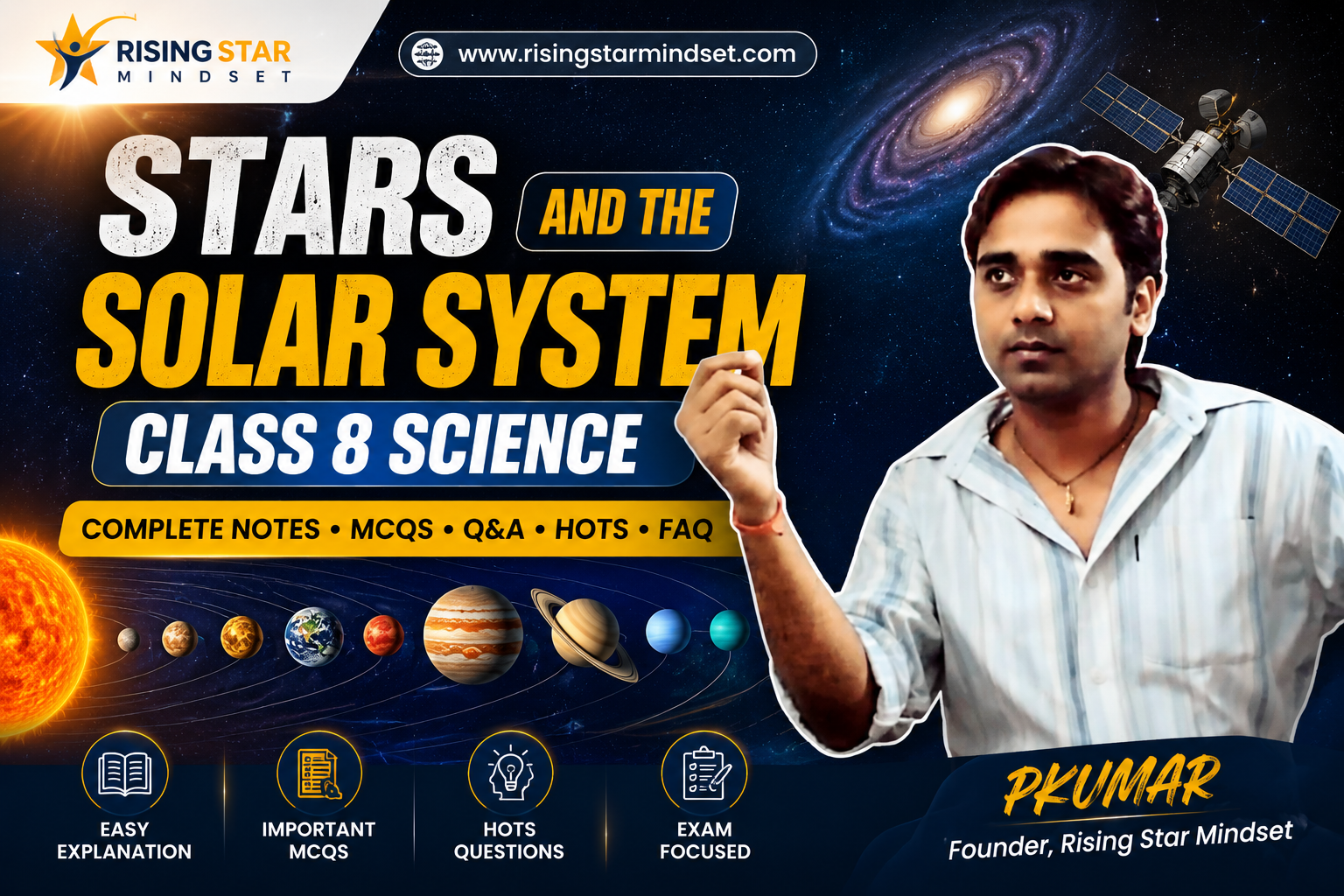
Stars and Constellations Class 8 Notes | Important Questions, MCQs & Hindi Explanation
Stars and the Solar System Class 8
The chapter Stars and the Solar System helps students understand celestial objects, stars, planets, constellations, the solar system, and artificial satellites. This chapter is very important for CBSE, State Boards, Olympiads, and competitive exams.
PREVIOUS TOPIC : Cell Structure And Function Notes
Table of Contents
- Introduction
- Important Abbreviations
- What are Celestial Objects?
- Stars and Constellations
- Pole Star
- The Solar System
- Planets and Their Features
- Asteroids
- Comets
- Meteors and Meteorites
- Artificial Satellites
- Key Points
- Important Question Answers
- HOTS Questions
- MCQs
- FAQs
- Conclusion
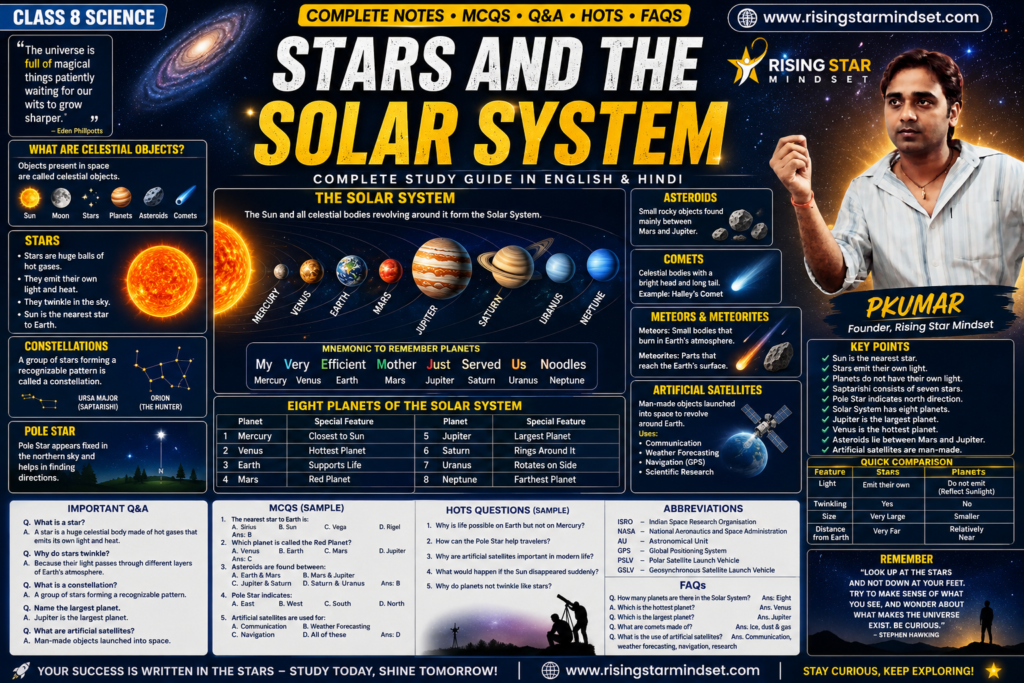
Important Abbreviations
| Abbreviation | Full Form |
|---|---|
| ISRO | Indian Space Research Organisation |
| NASA | National Aeronautics and Space Administration |
| AU | Astronomical Unit |
| GPS | Global Positioning System |
| PSLV | Polar Satellite Launch Vehicle |
| GSLV | Geosynchronous Satellite Launch Vehicle |
Introduction ( Stars and the Solar System )
English Explanation
At night, we see many shining objects in the sky. These include stars, planets, the Moon, and other celestial bodies. The study of these objects helps us understand the universe.
हिंदी व्याख्या
रात के समय आकाश में हमें अनेक चमकदार वस्तुएँ दिखाई देती हैं। इनमें तारे, ग्रह, चंद्रमा तथा अन्य खगोलीय पिंड शामिल हैं। इनका अध्ययन हमें ब्रह्मांड को समझने में सहायता करता है।
What are Celestial Objects?
English
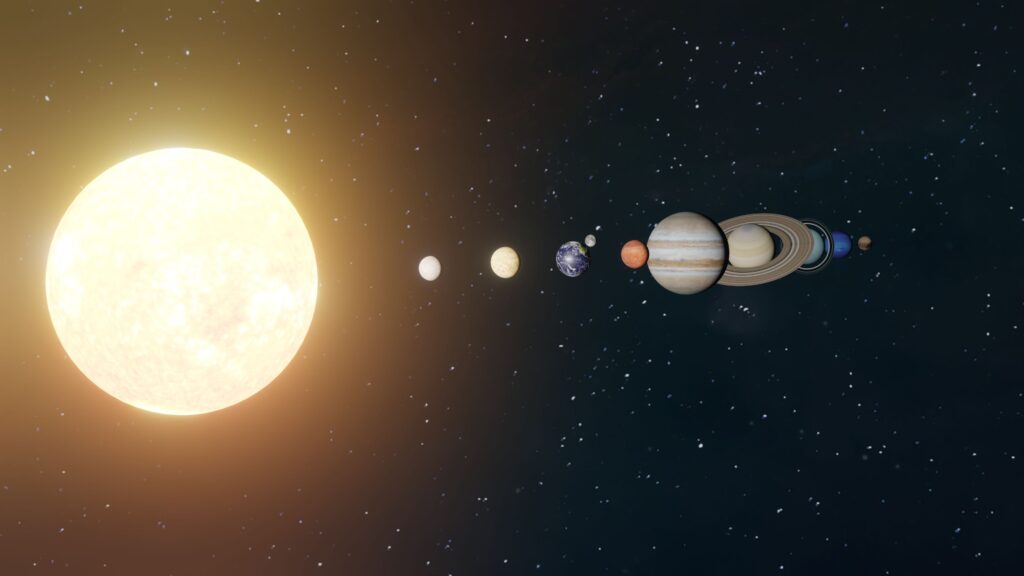
Objects present in space are called celestial objects.
Examples:
- Sun
- Moon
- Stars
- Planets
- Asteroids
- Comets
हिंदी
अंतरिक्ष में स्थित वस्तुओं को खगोलीय पिंड (Celestial Objects) कहा जाता है।
उदाहरण:
- सूर्य
- चंद्रमा
- तारे
- ग्रह
- क्षुद्रग्रह
- धूमकेतु
Stars
English
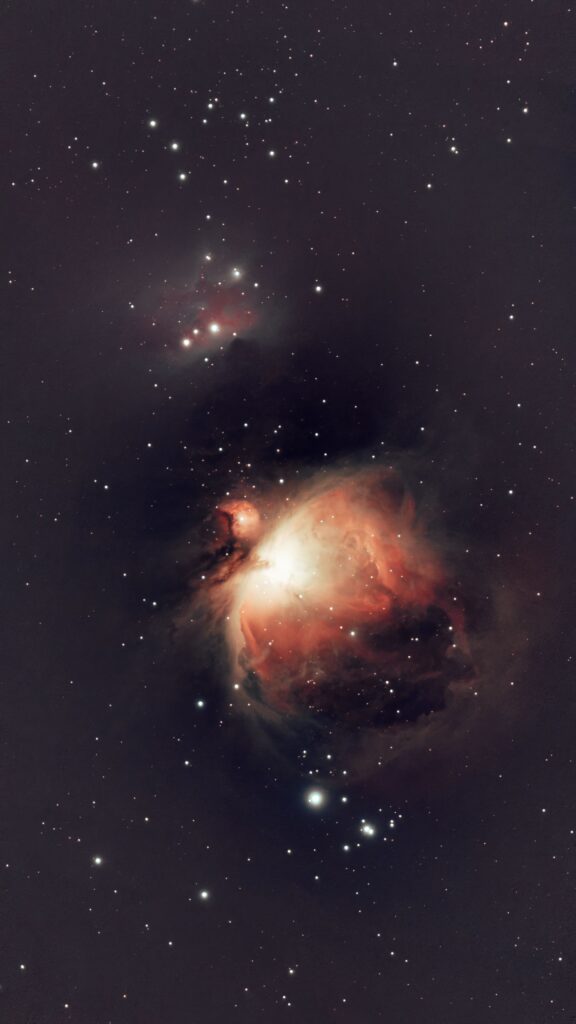
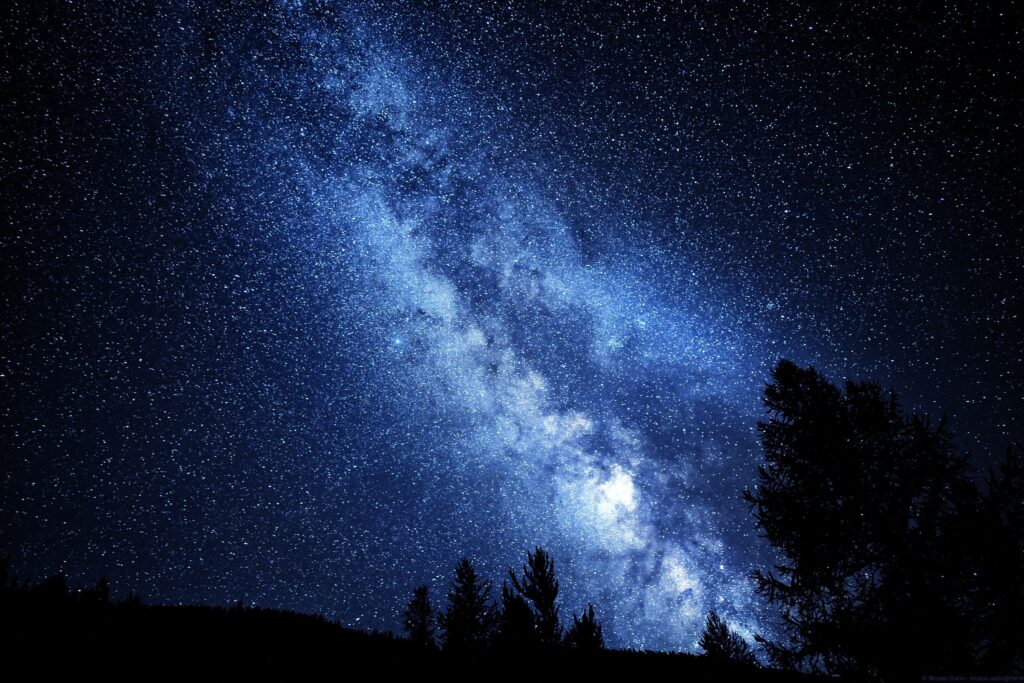
A star is a huge ball of hot gases that emits its own light and heat.
Example: Sun
Characteristics of Stars
- Have their own light.
- Very large and hot.
- Twinkle in the sky.
- Found at very large distances.
हिंदी
तारा गर्म गैसों का विशाल गोला होता है जो स्वयं प्रकाश और ऊष्मा उत्पन्न करता है।
उदाहरण: सूर्य
तारों की विशेषताएँ
- अपना प्रकाश स्वयं उत्पन्न करते हैं।
- अत्यंत गर्म और विशाल होते हैं।
- टिमटिमाते दिखाई देते हैं।
- पृथ्वी से बहुत दूर स्थित होते हैं।
Constellations
English
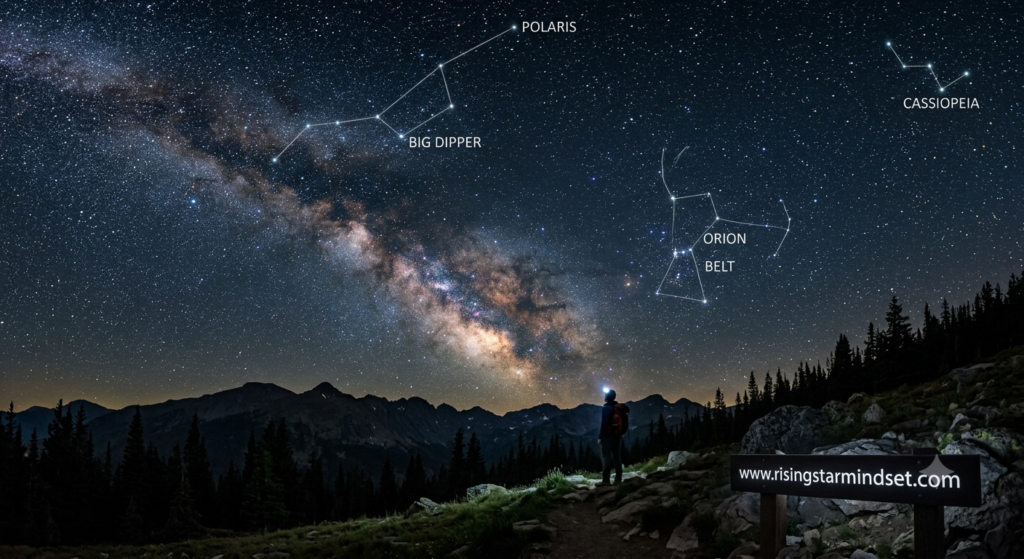
A group of stars forming a recognizable pattern is called a constellation.
Important Constellations
1. Ursa Major (Great Bear)
- Also called Saptarishi.
- Consists of seven bright stars.
2. Orion
- Known as the Hunter.
- Easily visible in winter.
हिंदी
तारों के समूह द्वारा बनाई गई आकृति को नक्षत्र (Constellation) कहते हैं।
प्रमुख नक्षत्र
- सप्तर्षि (Ursa Major)
- ओरायन (Orion)
Pole Star
English
Pole Star appears fixed in the northern sky and helps in finding directions.
हिंदी
ध्रुव तारा उत्तरी दिशा में लगभग स्थिर दिखाई देता है और दिशा ज्ञात करने में सहायता करता है।
The Solar System
English
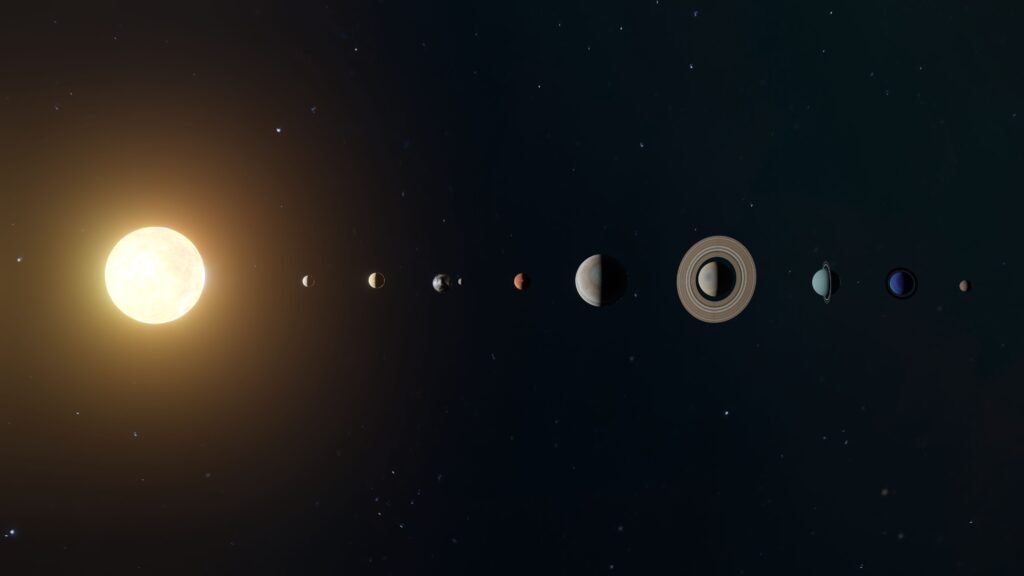
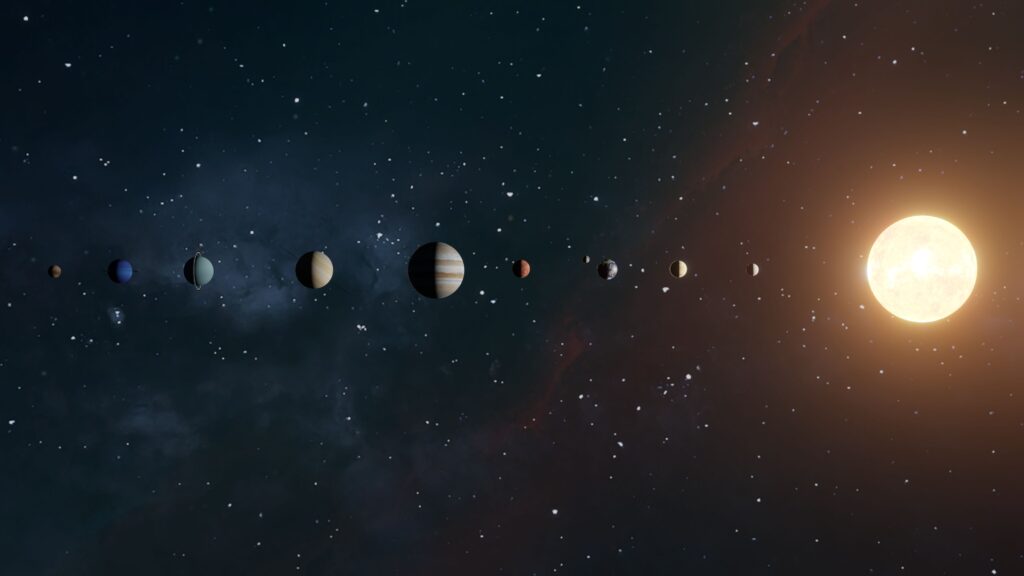
The Sun and all celestial bodies revolving around it form the Solar System.
Members of Solar System
- Sun
- Planets
- Satellites
- Asteroids
- Comets
- Meteors
हिंदी
सूर्य तथा उसके चारों ओर घूमने वाले सभी पिंड मिलकर सौरमंडल बनाते हैं।
Eight Planets of the Solar System
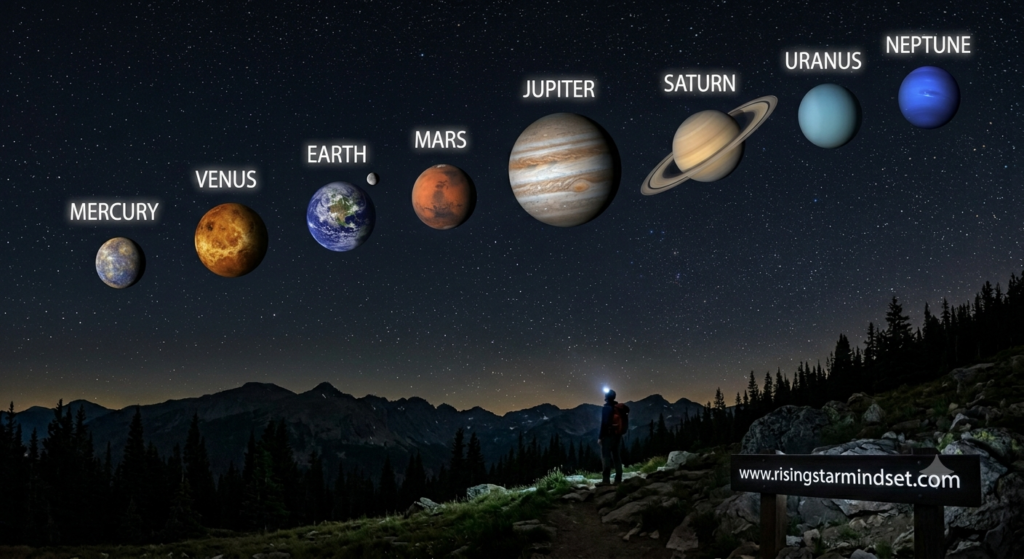
| Planet | Special Feature |
|---|---|
| Mercury | Closest to Sun |
| Venus | Hottest Planet |
| Earth | Supports Life |
| Mars | Red Planet |
| Jupiter | Largest Planet |
| Saturn | Rings Around It |
| Uranus | Rotates on Side |
| Neptune | Farthest Planet |
Mnemonic for Planets ( Stars and the Solar System )
My Very Efficient Mother Just Served Us Noodles
Mercury, Venus, Earth, Mars, Jupiter, Saturn, Uranus, Neptune
Asteroids
English
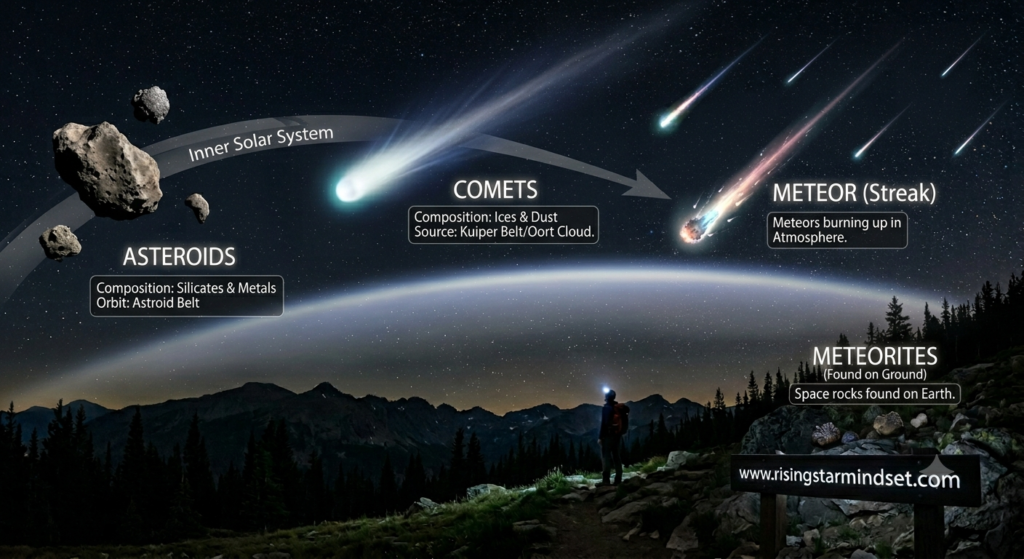
Small rocky objects found mainly between Mars and Jupiter.
हिंदी
मंगल और बृहस्पति के बीच पाए जाने वाले छोटे चट्टानी पिंड क्षुद्रग्रह कहलाते हैं।
Comets
English
Comets are celestial bodies with a bright head and long tail.
Example: Halley’s Comet
हिंदी
धूमकेतु ऐसे खगोलीय पिंड हैं जिनकी चमकीली पूंछ होती है।
उदाहरण: हैली धूमकेतु
Meteors and Meteorites
Meteors
Small bodies entering Earth’s atmosphere and burning due to friction.
हिंदी
पृथ्वी के वायुमंडल में प्रवेश कर जलने वाले पिंड उल्का (Meteor) कहलाते हैं।
Meteorites
Parts that reach the Earth’s surface.
हिंदी
जो भाग पृथ्वी तक पहुँच जाते हैं उन्हें उल्कापिंड (Meteorites) कहते हैं।
Artificial Satellites
English
Man-made objects launched into space to revolve around Earth.
Examples:
- INSAT
- GSAT
- Chandrayaan Missions
Uses
- Communication
- Weather Forecasting
- Navigation
- Scientific Research
हिंदी
मनुष्य द्वारा बनाए गए उपग्रह कृत्रिम उपग्रह कहलाते हैं।
उपयोग:
- संचार
- मौसम पूर्वानुमान
- नेविगेशन
- वैज्ञानिक अनुसंधान
Key Points for Quick Revision
| Sun is the nearest star to Earth. |
| Stars emit their own light. |
| Planets do not have their own light. |
| Saptarishi consists of seven stars. |
| Pole Star indicates north direction. |
| Solar System has eight planets. |
| Jupiter is the largest planet. |
| Venus is the hottest planet. |
| Asteroids lie between Mars and Jupiter. |
| Artificial satellites are man-made. |
Important Question Answers
Q1. What is a star?
Answer:
A star is a huge celestial body made of hot gases that emits its own light and heat.
हिंदी:
तारा गर्म गैसों का विशाल गोला होता है जो स्वयं प्रकाश और ऊष्मा उत्पन्न करता है।
Q2. Why do stars twinkle?
Answer:
Stars twinkle because their light passes through different layers of Earth’s atmosphere.
हिंदी:
पृथ्वी के वायुमंडल की विभिन्न परतों से गुजरने के कारण तारे टिमटिमाते दिखाई देते हैं।
Q3. What is a constellation?
Answer:
A group of stars forming a recognizable pattern is called a constellation.
Q4. Name the largest planet.
Answer:
Jupiter is the largest planet.
Q5. What are artificial satellites?
Answer:
Artificial satellites are man-made objects launched into space.
HOTS Questions
Q1.
Why is life possible on Earth but not on Mercury?
Answer: Earth has suitable temperature, water, and atmosphere, while Mercury is extremely hot and lacks a suitable atmosphere.
Q2.
How can the Pole Star help travelers?
Answer: It helps determine the north direction for navigation.
Q3.
Why are artificial satellites important in modern life?
Answer: They support communication, GPS, weather forecasting, and scientific studies.
Q4.
What would happen if the Sun disappeared suddenly?
Answer: Earth would become dark and extremely cold, making life impossible.
Q5.
Why do planets not twinkle like stars?
Answer: Planets reflect sunlight and appear as steady sources of light.
MCQs
1. The nearest star to Earth is:
A. Sirius
B. Sun
C. Pole Star
D. Vega
✅ Answer: B. Sun
2. Which planet is called the Red Planet?
A. Venus
B. Earth
C. Mars
D. Jupiter
✅ Answer: C. Mars
3. Which is the largest planet?
A. Earth
B. Mars
C. Saturn
D. Jupiter
✅ Answer: D. Jupiter
4. Saptarishi is also known as:
A. Orion
B. Ursa Major
C. Cassiopeia
D. Neptune
✅ Answer: B. Ursa Major
5. Artificial satellites are used for:
A. Communication
B. Weather Forecasting
C. Navigation
D. All of these
✅ Answer: D. All of these
6. Asteroids are found between:
A. Earth and Mars
B. Mercury and Venus
C. Mars and Jupiter
D. Jupiter and Saturn
✅ Answer: C. Mars and Jupiter
7. Which planet supports life?
A. Venus
B. Earth
C. Mars
D. Neptune
✅ Answer: B. Earth
8. Which planet has beautiful rings?
A. Saturn
B. Earth
C. Mercury
D. Mars
✅ Answer: A. Saturn
9. A meteor that reaches Earth is called:
A. Comet
B. Asteroid
C. Meteorite
D. Planet
✅ Answer: C. Meteorite
10. Pole Star indicates:
A. East
B. South
C. West
D. North
✅ Answer: D. North
Frequently Asked Questions (FAQs)
1. What is the Solar System?
The Solar System consists of the Sun and all objects revolving around it.
2. How many planets are there in the Solar System?
There are eight planets.
3. Which is the largest planet?
Jupiter is the largest planet.
4. Which is the hottest planet?
Venus is the hottest planet.
5. What are constellations?
Groups of stars forming recognizable patterns are called constellations.
6. What is the Pole Star?
A star appearing fixed in the northern sky used for navigation.
7. What are asteroids?
Small rocky bodies found mainly between Mars and Jupiter.
8. What are artificial satellites?
Human-made satellites launched into space for various purposes.
Conclusion ( Stars and the Solar System )
Stars and the Solar System is one of the most interesting chapters of Class 8 Science. It explains stars, constellations, planets, asteroids, comets, meteors, and artificial satellites. Understanding this chapter helps students develop scientific curiosity about the universe and prepares them for school exams, Olympiads, NTSE, and other competitive examinations.
Quick Exam Tip: Remember the order of planets, important constellations (Ursa Major and Orion), Pole Star, and differences between meteors, meteorites, and comets for scoring high marks in exams.
Keep Learning, Keep Growing! 🚀
P Kumar | Rising Star Mindset
www.risingstarmindset.com
Together We Will Make The Difference
Hi