
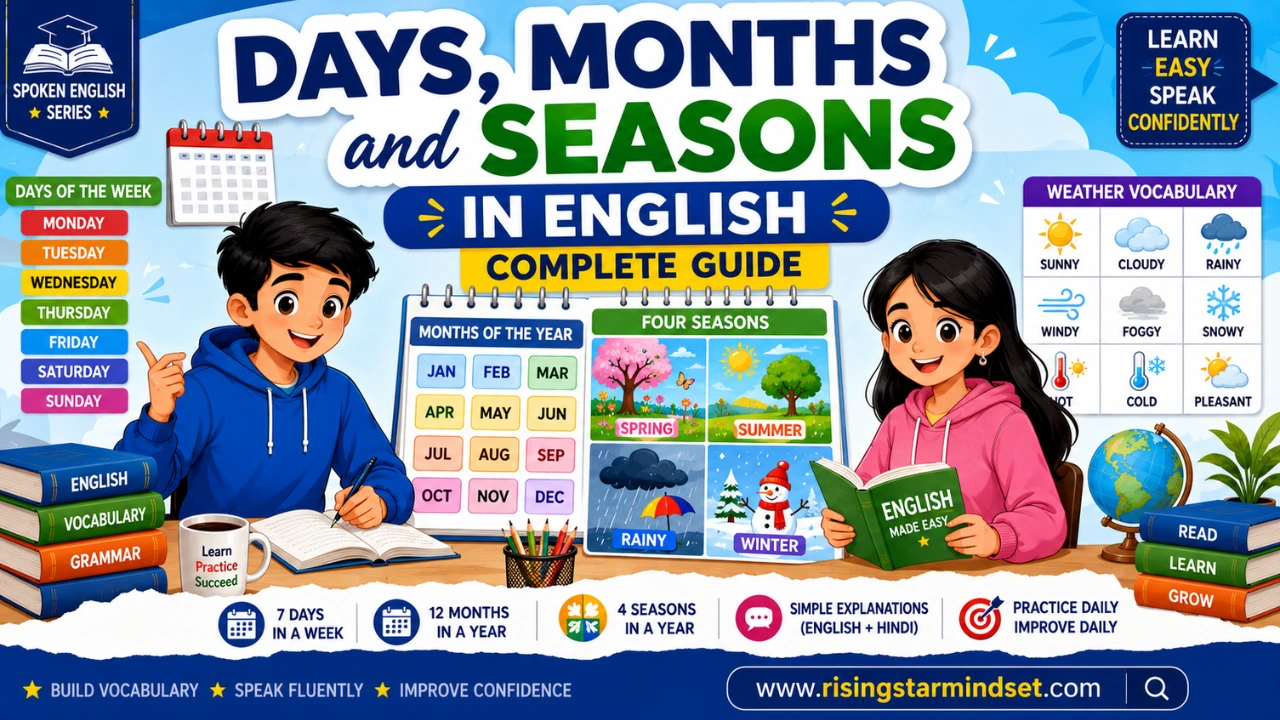
Days, Months and Seasons in English | Complete Guide
Table of Contents ( Days, Months and Seasons )
- Introduction
- What are Days, Months and Seasons?
- Days of the Week
- Months of the Year
- Four Seasons in English
- Weather Vocabulary
- Activities in Different Seasons
- Festivals by Season
- Daily Conversation Examples
- Speaking Practice
- Vocabulary Table
- Key Points
- MCQs
- HOTS Questions
- Fill in the Blanks
- Match the Following
- Question & Answers
- FAQs
- Conclusion
- Previous topic : Numbers, Dates and Time in English | Complete Beginner Guide
Abbreviations ( Days, Months and Seasons )
| Abbreviation | Full Form |
| Mon | Monday |
| Tue | Tuesday |
| Wed | Wednesday |
| Thu | Thursday |
| Fri | Friday |
| Sat | Saturday |
| Sun | Sunday |
| Jan | January |
| Feb | February |
| Mar | March |
| Apr | April |
| Jun | June |
| Jul | July |
| Aug | August |
| Sept | September |
| Oct | October |
| Nov | November |
| Dec | December |
Introduction ( Days, Months and Seasons )
What are Days, Months and Seasons?
English
Days, months and seasons are an essential part of everyday English. We use them while talking about dates, school schedules, holidays, birthdays, weather, travel plans, and daily conversations. Therefore, learning them correctly helps you communicate naturally and confidently.
Moreover, understanding the names of the days, months, and seasons allows you to describe time, make plans, and discuss weather in English. As a result, your spoken English becomes more fluent and practical.
In this complete guide, you will learn the names of all seven days, twelve months, four seasons, useful vocabulary, examples, exercises, and quizzes with simple explanations in both English and Hindi.
हिन्दी
Days (सप्ताह के दिन), Months (महीने) और Seasons (ऋतुएँ) अंग्रेज़ी सीखने का महत्वपूर्ण भाग हैं। इनका उपयोग हम तिथि बताने, मौसम की चर्चा करने, छुट्टियों, त्योहारों, यात्रा और दैनिक बातचीत में करते हैं।
इस अध्याय में आप सप्ताह के सातों दिन, वर्ष के बारहों महीने, चारों ऋतुएँ, मौसम से जुड़े शब्द और आसान उदाहरण हिन्दी एवं अंग्रेज़ी में सीखेंगे।
Why Learn Days, Months and Seasons?
English
Learning days, months, and seasons improves your communication skills. Furthermore, it helps you understand calendars, weather forecasts, travel plans, school timetables, and festivals. Consequently, you can speak English more accurately in everyday situations.
हिन्दी
Days, Months और Seasons सीखने से आपकी Communication Skills बेहतर होती हैं। साथ ही, आप Calendar, Weather Report, Timetable और Festivals को अंग्रेज़ी में आसानी से समझ और व्यक्त कर सकते हैं।
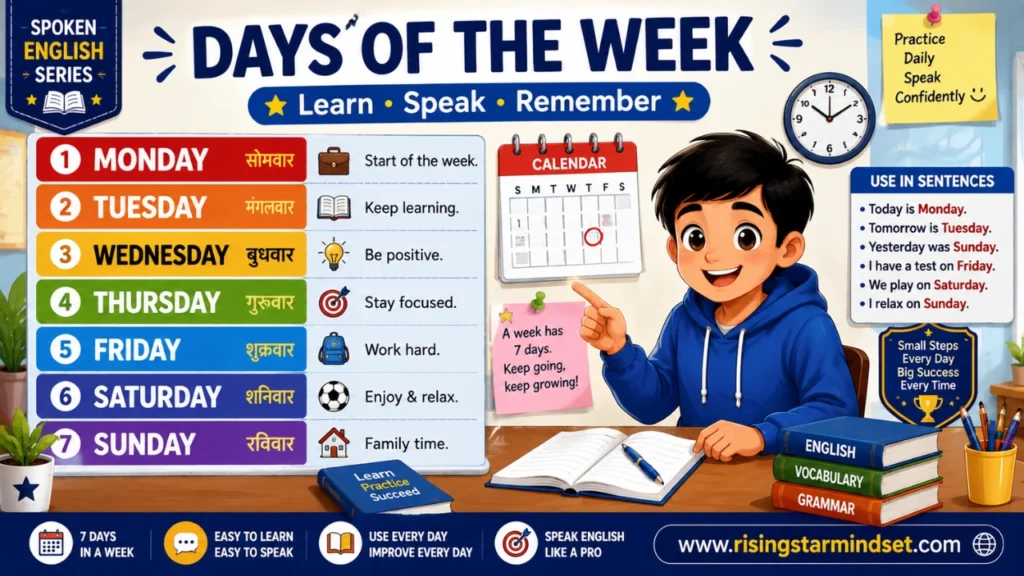
Days of the Week ( Days, Months and Seasons )
| Day | Pronunciation | हिन्दी |
| Monday | Mun-day | सोमवार |
| Tuesday | Tyooz-day | मंगलवार |
| Wednesday | Wenz-day | बुधवार |
| Thursday | Thurz-day | गुरुवार |
| Friday | Fry-day | शुक्रवार |
| Saturday | Sat-er-day | शनिवार |
| Sunday | Sun-day | रविवार |
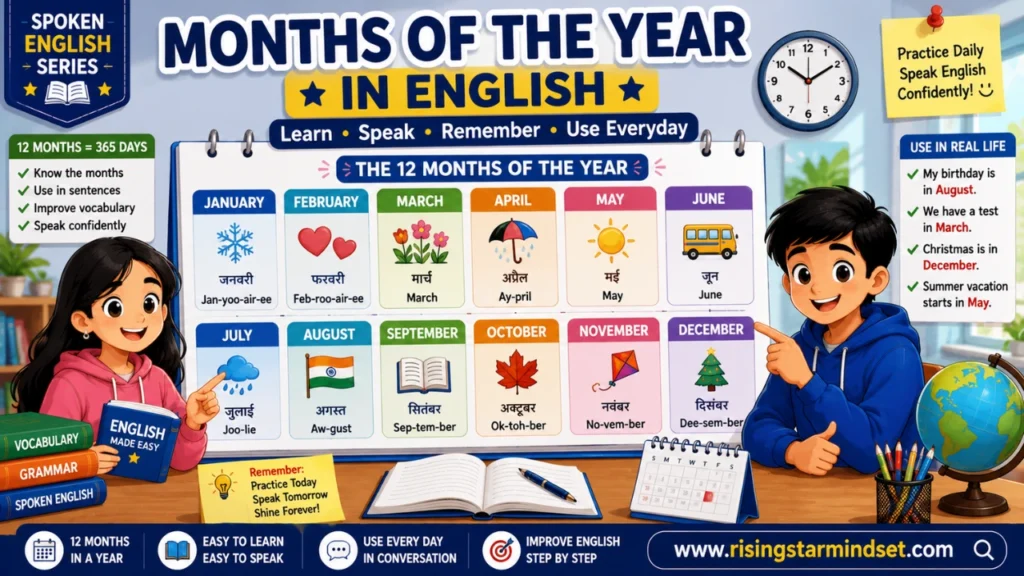
Months of the Year ( Days, Months and Seasons )
| Month | Pronunciation | हिन्दी |
| January | Jan-yoo-air-ee | जनवरी |
| February | Feb-roo-air-ee | फ़रवरी |
| March | March | मार्च |
| April | Ay-pril | अप्रैल |
| May | May | मई |
| June | Joon | जून |
| July | Joo-lie | जुलाई |
| August | Aw-gust | अगस्त |
| September | Sep-tem-ber | सितंबर |
| October | Ok-toh-ber | अक्टूबर |
| November | No-vem-ber | नवंबर |
| December | Dee-sem-ber | दिसंबर |
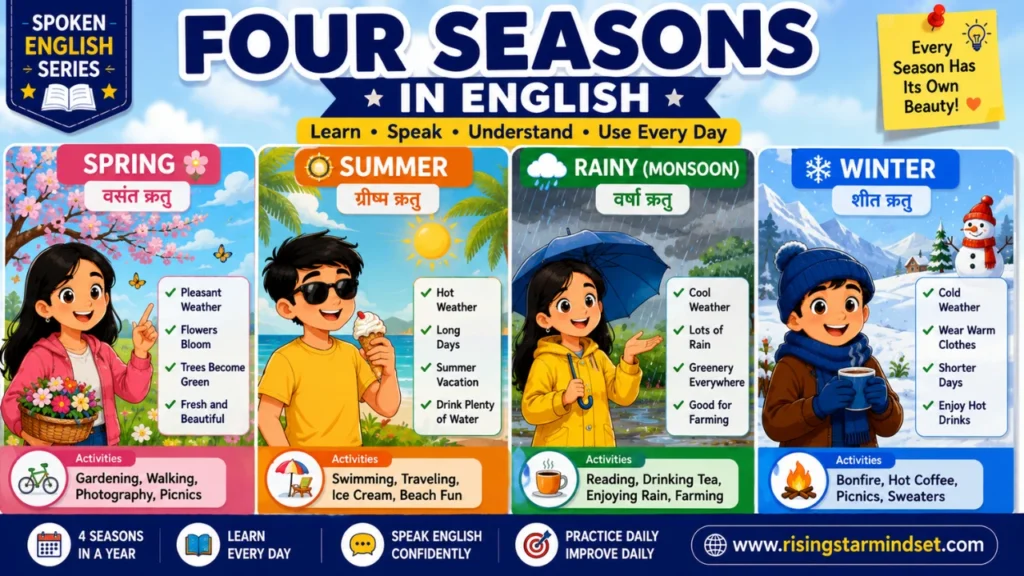
Four Seasons in English
| Season | हिन्दी | Typical Weather |
| Spring | वसंत | Pleasant and colorful |
| Summer | ग्रीष्म | Hot and sunny |
| Rainy (Monsoon) | वर्षा | Wet and rainy |
| Winter | शीत | Cold and foggy |
Weather Vocabulary ( Days, Months and Seasons )
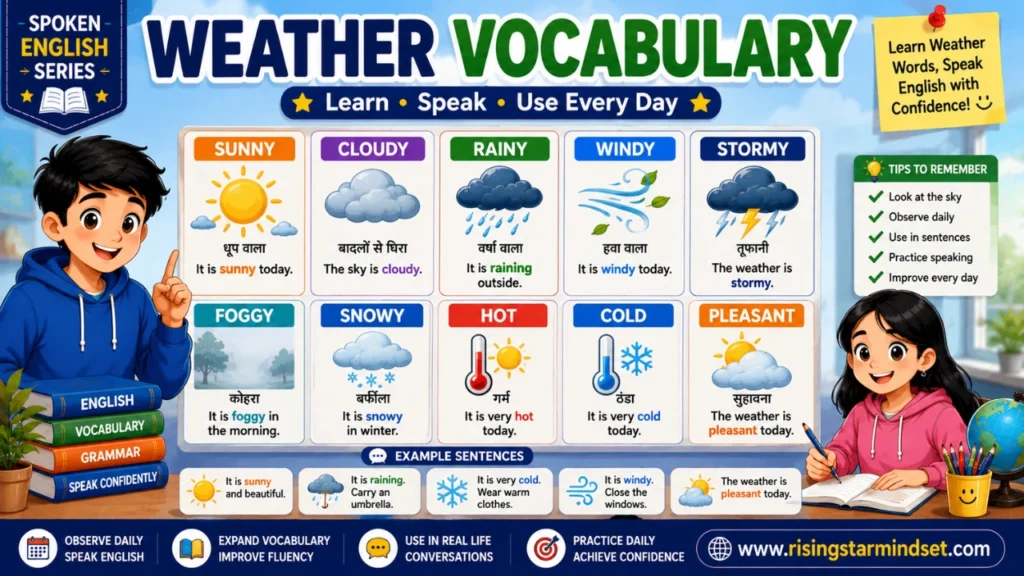
| English | हिन्दी |
| Sunny | धूप वाला |
| Cloudy | बादलों से घिरा |
| Rainy | वर्षा वाला |
| Windy | हवा वाला |
| Foggy | कोहरा |
| Stormy | तूफानी |
| Hot | गर्म |
| Cold | ठंडा |
| Warm | हल्का गर्म |
| Cool | ठंडक वाला |
Key Points ( Days, Months and Seasons )
- There are 7 days in a week.
- There are 12 months in a year.
- Learn the correct pronunciation of each day and month.
- Seasons help describe weather and climate.
- Weather vocabulary is useful in daily conversations.
- Practice speaking about today’s day, month, and season.
- Use complete English sentences while talking about weather.
- Daily practice improves fluency and confidence.
Days of the Week Explained
Every week has seven days. We use these days while talking about school, office, meetings, holidays, and daily routines.
Monday
English
Monday is the first working day of the week for most people. Schools, colleges, and offices usually begin their weekly activities on Monday.
हिन्दी
Monday सप्ताह का पहला कार्य दिवस माना जाता है। अधिकांश स्कूल, कॉलेज और कार्यालय इसी दिन से शुरू होते हैं।
Example
- Today is Monday.
- आज सोमवार है।
Tuesday
English
Tuesday is the second day of the working week. Many meetings and classes are scheduled on Tuesday.
हिन्दी
Tuesday सप्ताह का दूसरा कार्य दिवस है।
Example
- We have an English class on Tuesday.
- मंगलवार को हमारी अंग्रेज़ी की कक्षा होती है।
Wednesday
English
Wednesday comes in the middle of the week.
हिन्दी
Wednesday सप्ताह के बीच का दिन होता है।
Example
- Today is Wednesday.
- आज बुधवार है।
Thursday
English
Thursday is the fourth day of the week.
हिन्दी
Thursday सप्ताह का चौथा दिन है।
Example
- Our sports class is on Thursday.
- हमारी खेल की कक्षा गुरुवार को होती है।
Friday
English
Friday is usually the last working day before the weekend.
हिन्दी
Friday सप्ताहांत से पहले का अंतिम कार्य दिवस होता है।
Example
- We have a science test on Friday.
- शुक्रवार को विज्ञान की परीक्षा है।
Saturday
English
Saturday is a weekend for many schools and offices.
हिन्दी
Saturday कई स्थानों पर अवकाश का दिन होता है।
Example
- I play cricket on Saturday.
- मैं शनिवार को क्रिकेट खेलता हूँ।
Sunday
English
Sunday is generally a holiday.
हिन्दी
Sunday सामान्यतः अवकाश का दिन होता है।
Example
- My family goes on a picnic every Sunday.
- मेरा परिवार हर रविवार पिकनिक पर जाता है।
Months of the Year Explained
A year has twelve months.
January
- First month of the year.
- Usually cold in many places.
Example
My birthday is in January.
February
- Shortest month.
- Has 28 or 29 days.
Example
February has 28 days in most years.
March
- Beginning of spring in many countries.
Example
Flowers bloom in March.
April
- Pleasant weather.
Example
The weather is nice in April.
May
- Summer begins in many places.
Example
May is usually hot.
June
- Schools often reopen after vacation.
Example
Our school opens in June.
July
- Rainy season starts in many parts of India.
Example
It rains a lot in July.
August
- Independence Day is celebrated in India.
Example
India celebrates Independence Day in August.
September
- Pleasant weather after heavy rains.
Example
September is a beautiful month.
October
- Festival season begins.
Example
Many festivals are celebrated in October.
November
- Cool weather starts.
Example
The weather becomes cooler in November.
December
- Last month of the year.
Example
Christmas is celebrated in December.
Memory Trick for Days ( Days, Months and Seasons )
Remember this order:
Monday → Tuesday → Wednesday → Thursday → Friday → Saturday → Sunday
हिन्दी
क्रम याद रखने के लिए रोज़ सुबह इन सातों दिनों को ज़ोर से बोलने का अभ्यास करें।
Memory Trick for Months
January → February → March → April → May → June → July → August → September → October → November → December
हिन्दी
हर दिन Calendar देखकर महीनों के नाम अंग्रेज़ी में पढ़ने की आदत डालें।
Useful Expressions ( Days, Months and Seasons )
| English | हिन्दी |
| Today is Monday. | आज सोमवार है। |
| Tomorrow is Friday. | कल शुक्रवार होगा। |
| Yesterday was Sunday. | कल रविवार था। |
| My birthday is in August. | मेरा जन्मदिन अगस्त में है। |
| Summer starts in May. | मई में गर्मी शुरू होती है। |
| Winter is my favourite season. | सर्दी मेरा पसंदीदा मौसम है। |
| It is raining today. | आज बारिश हो रही है। |
| The weather is pleasant. | मौसम सुहावना है। |
| It is very hot today. | आज बहुत गर्मी है। |
| It is very cold today. | आज बहुत ठंड है। |
Daily Conversation ( Days, Months and Seasons )
Conversation 1
A: What day is today?
B: Today is Wednesday.
A: Do you have English class today?
B: Yes, I do.
हिन्दी
A: आज कौन-सा दिन है?
B: आज बुधवार है।
A: क्या आज आपकी अंग्रेज़ी की कक्षा है?
B: हाँ।
Conversation 2
A: Which month is your birthday?
B: My birthday is in November.
A: Great! Happy Birthday in advance.
हिन्दी
A: आपका जन्मदिन किस महीने में है?
B: मेरा जन्मदिन नवंबर में है।
A: अग्रिम शुभकामनाएँ।
Speaking Practice ( Days, Months and Seasons )
Read these sentences aloud every day.
- Today is a beautiful day.
- Tomorrow will be Friday.
- My birthday is in December.
- January is the first month of the year.
- Sunday is my favourite day.
- Summer is very hot.
- Winter is very cold.
- I enjoy the rainy season.
- Every month teaches us something new.
- Learning English every day improves my confidence.

Vocabulary Builder
| English | हिन्दी |
| Week | सप्ताह |
| Month | महीना |
| Season | ऋतु |
| Weather | मौसम |
| Holiday | अवकाश |
| Festival | त्योहार |
| Vacation | छुट्टी |
| Calendar | कैलेंडर |
| Temperature | तापमान |
| Climate | जलवायु |
Key Points
- A week has 7 days.
- A year has 12 months.
- Learn the correct order of days and months.
- Practice speaking the names aloud every day.
- Understand the weather in each season.
- Use complete English sentences while talking about days and months.
- Read calendars regularly to improve fluency.
- Consistent practice builds confidence.
Four Seasons in English
What are Seasons?
English
A season is a period of the year with particular weather conditions, temperature, and daylight hours. Every season has its own beauty, weather, festivals, and activities. Therefore, learning season-related vocabulary helps you speak English more naturally in everyday conversations.
Moreover, we often talk about seasons while discussing travel, holidays, clothes, food, and outdoor activities. As a result, understanding seasons improves both your vocabulary and communication skills.
हिन्दी
Season (ऋतु) वर्ष का वह भाग होता है जिसमें मौसम, तापमान और वातावरण लगभग समान रहता है। प्रत्येक ऋतु की अपनी विशेषताएँ होती हैं। इसलिए Seasons से जुड़े शब्द सीखना Spoken English के लिए बहुत महत्वपूर्ण है।
1. Spring Season 🌸
English
Spring is known as the season of flowers. During this season, trees become green, flowers bloom, and the weather remains pleasant.
हिन्दी
Spring (वसंत ऋतु) को फूलों की ऋतु कहा जाता है। इस समय मौसम सुहावना रहता है और पेड़-पौधों पर नई पत्तियाँ तथा फूल खिलते हैं।
Vocabulary
| English | हिन्दी |
| Flower | फूल |
| Bloom | खिलना |
| Green | हरा |
| Fresh | ताज़ा |
| Garden | बगीचा |
Example Sentences
- Flowers bloom in spring.
- Spring is my favourite season.
- The weather is pleasant in spring.
2. Summer Season ☀️
English
Summer is the hottest season of the year. People usually wear light clothes, drink cold beverages, and enjoy ice cream.
हिन्दी
Summer (गर्मी) वर्ष की सबसे गर्म ऋतु होती है। लोग हल्के कपड़े पहनते हैं और ठंडी चीज़ें पसंद करते हैं।
Vocabulary
| English | हिन्दी |
| Sun | सूर्य |
| Hot | गर्म |
| Heat | गर्मी |
| Ice Cream | आइसक्रीम |
| Holiday | छुट्टी |
Example Sentences
- Summer is very hot.
- I drink plenty of water in summer.
- We enjoy summer vacation.
3. Rainy Season 🌧️
English
The rainy season brings cool weather and plenty of rain. Farmers welcome this season because it is important for agriculture.
हिन्दी
Rainy Season (वर्षा ऋतु) में खूब बारिश होती है। यह खेती के लिए बहुत महत्वपूर्ण होती है।
Vocabulary
| English | हिन्दी |
| Rain | बारिश |
| Umbrella | छाता |
| Cloud | बादल |
| Thunder | गरज |
| Rainbow | इंद्रधनुष |
Example Sentences
- It is raining today.
- I carry an umbrella during the rainy season.
- Children enjoy playing in the rain.
4. Winter Season ❄️
English
Winter is the coldest season of the year. People wear warm clothes and enjoy hot drinks.
हिन्दी
Winter (सर्दी) वर्ष की सबसे ठंडी ऋतु होती है। लोग गर्म कपड़े पहनते हैं और गर्म पेय पदार्थ पसंद करते हैं।
Vocabulary
| English | हिन्दी |
| Cold | ठंड |
| Sweater | स्वेटर |
| Jacket | जैकेट |
| Blanket | कंबल |
| Fog | कोहरा |
Example Sentences
- Winter mornings are cold.
- I wear a sweater in winter.
- We drink hot tea in winter.
Seasonal Activities
| Season | Activities |
| Spring | Gardening, Walking, Photography |
| Summer | Swimming, Traveling, Ice Cream |
| Rainy | Reading, Drinking Tea, Farming |
| Winter | Bonfire, Hot Coffee, Picnic |
Weather Vocabulary
| English | हिन्दी |
| Sunny | धूप वाला |
| Cloudy | बादलों से घिरा |
| Windy | हवा चलना |
| Rainy | वर्षा वाला |
| Stormy | तूफानी |
| Foggy | कोहरा |
| Humid | उमस वाला |
| Warm | हल्का गर्म |
| Cool | ठंडक वाला |
| Freezing | अत्यधिक ठंडा |
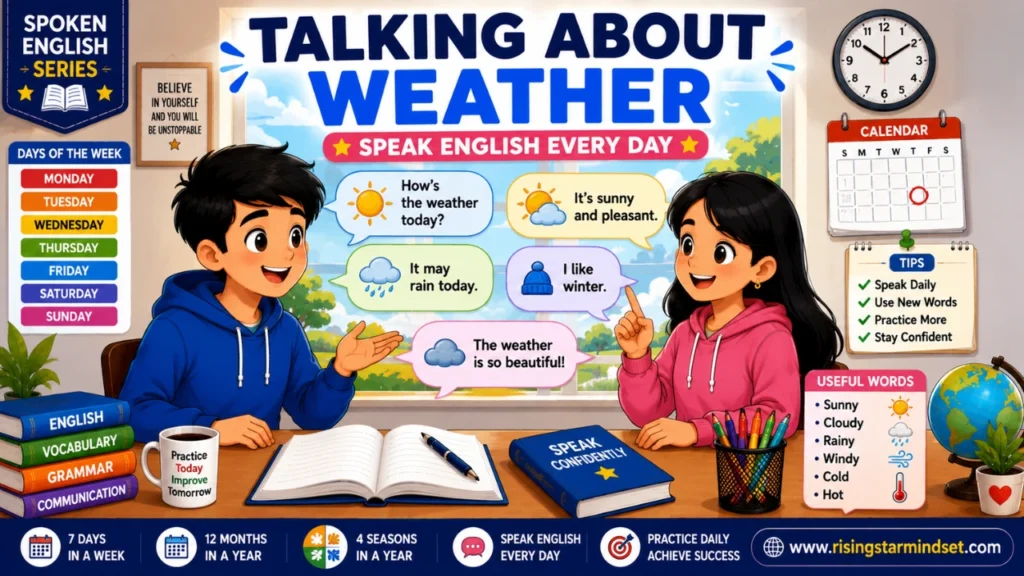
Talking About Weather
English
- It is sunny today.
- It is raining outside.
- The weather is very pleasant.
- It is extremely hot today.
- It is freezing cold.
- The sky is cloudy.
- A cool breeze is blowing.
- It may rain today.
- Winter has arrived.
- Summer vacation starts next week.
हिन्दी
- आज धूप है।
- बाहर बारिश हो रही है।
- मौसम बहुत सुहावना है।
- आज बहुत गर्मी है।
- आज कड़ाके की ठंड है।
- आसमान में बादल हैं।
- ठंडी हवा चल रही है।
- आज बारिश हो सकती है।
- सर्दी आ गई है।
- अगले सप्ताह गर्मी की छुट्टियाँ शुरू होंगी।
Daily Conversation
Conversation 1
A: Which season do you like the most?
B: I like winter because I enjoy cold weather.
A: That’s wonderful.
हिन्दी
A: आपको कौन-सी ऋतु सबसे अधिक पसंद है?
B: मुझे सर्दी पसंद है क्योंकि मुझे ठंडा मौसम अच्छा लगता है।
Conversation 2
A: How is the weather today?
B: It is cloudy and pleasant.
A: Shall we go for a walk?
B: Yes, let’s go.
हिन्दी
A: आज मौसम कैसा है?
B: मौसम बादलों वाला और सुहावना है।
A: क्या हम टहलने चलें?
B: हाँ, चलिए।
Speaking Practice
Read these sentences aloud every day.
- Spring is full of beautiful flowers.
- Summer is my vacation season.
- I always carry an umbrella during the rainy season.
- Winter mornings are very cold.
- The weather is pleasant today.
- I enjoy walking in the evening.
- Every season has its own beauty.
- I love learning English every day.
- Good weather makes me feel happy.
- Practice speaking English daily.
Fill in the Blanks
Choose the correct word.
- Spring is the season of ________. (Flowers / Snow)
- We use an ________ in the rainy season. (Umbrella / Sweater)
- Winter is very ________. (Cold / Hot)
- Summer is usually ________. (Hot / Cold)
- Farmers welcome the ________ season. (Rainy / Winter)
- We wear a ________ in winter. (Sweater / Cap only)
- The sky is full of ________. (Clouds / Chairs)
- Ice cream is popular in ________. (Summer / Winter)
- Flowers bloom in ________. (Spring / Rainy)
- We drink hot tea in ________. (Winter / Summer)
Answers
- Flowers
- Umbrella
- Cold
- Hot
- Rainy
- Sweater
- Clouds
- Summer
- Spring
- Winter

Multiple Choice Questions (MCQs)
1. How many days are there in a week?
A. 5
B. 6
C. 7
D. 8
✅ Answer: C
2. Which is the first day of the working week?
A. Sunday
B. Monday
C. Saturday
D. Friday
✅ Answer: B
3. Which month comes after March?
A. May
B. April
C. June
D. February
✅ Answer: B
4. How many months are there in a year?
A. 10
B. 11
C. 12
D. 13
✅ Answer: C
5. Which is the hottest season?
A. Winter
B. Spring
C. Summer
D. Rainy
✅ Answer: C
6. Which season is known as the season of flowers?
A. Summer
B. Rainy
C. Spring
D. Winter
✅ Answer: C
7. Which season brings heavy rainfall?
A. Winter
B. Summer
C. Rainy
D. Spring
✅ Answer: C
8. In which season do we wear sweaters?
A. Summer
B. Winter
C. Rainy
D. Spring
✅ Answer: B
9. Which of these is a weather word?
A. Cloudy
B. January
C. Monday
D. Garden
✅ Answer: A
10. Which month celebrates Christmas?
A. November
B. December
C. October
D. January
✅ Answer: B
11. Which season is best for swimming?
A. Winter
B. Summer
C. Rainy
D. Spring
✅ Answer: B
12. Farmers wait for the ______ season.
A. Spring
B. Summer
C. Rainy
D. Winter
✅ Answer: C
13. Which day comes after Friday?
A. Thursday
B. Saturday
C. Sunday
D. Monday
✅ Answer: B
14. Which month comes before August?
A. June
B. July
C. September
D. October
✅ Answer: B
15. Which season is the coldest?
A. Summer
B. Spring
C. Rainy
D. Winter
✅ Answer: D
16. Which day is usually a holiday?
A. Monday
B. Wednesday
C. Sunday
D. Thursday
✅ Answer: C
17. Which weather is suitable for an umbrella?
A. Sunny
B. Rainy
C. Windy
D. Hot
✅ Answer: B
18. Which month starts the year?
A. February
B. January
C. March
D. April
✅ Answer: B
19. Which season is pleasant with blooming flowers?
A. Spring
B. Summer
C. Rainy
D. Winter
✅ Answer: A
20. Which word means “मौसम“?
A. Climate
B. Weather
C. Temperature
D. Season
✅ Answer: B
21. Which month has the fewest days?
A. January
B. February
C. March
D. April
✅ Answer: B
22. Which season is famous for vacations?
A. Summer
B. Rainy
C. Winter
D. Spring
✅ Answer: A
23. Which weather is common in winter?
A. Hot
B. Cold
C. Sunny
D. Humid
✅ Answer: B
24. Which month is India’s Independence Day celebrated in?
A. July
B. August
C. September
D. October
✅ Answer: B
25. Which season is good for gardening?
A. Spring
B. Summer
C. Rainy
D. Winter
✅ Answer: A
26. There are ______ seasons in this lesson.
A. 2
B. 3
C. 4
D. 5
✅ Answer: C
27. Which season do we often drink hot tea?
A. Summer
B. Rainy
C. Winter
D. Spring
✅ Answer: C
28. Which day comes before Monday?
A. Friday
B. Saturday
C. Sunday
D. Tuesday
✅ Answer: C
29. Which month comes after November?
A. October
B. December
C. January
D. September
✅ Answer: B
30. The best way to remember days and months is—
A. Never Practice
B. Daily Speaking Practice
C. Memorize Once Only
D. Skip Revision
✅ Answer: B
Test Your Score
| Score | Performance |
| 27–30 | 🌟 Excellent |
| 22–26 | 🏆 Very Good |
| 17–21 | 👍 Good |
| 12–16 | 📘 Average |
| 0–11 | 📖 Keep Practicing |
HOTS (Higher Order Thinking Skills)
Q1. Why is it important to know the names of days and months in English?
Answer: They help us communicate about schedules, meetings, holidays, birthdays, and travel plans accurately.
Q2. Which season do you like the most and why?
Sample Answer: I like winter because the weather is cool, comfortable, and pleasant for outdoor activities.
Q3. How do seasons affect our daily life?
Answer: Seasons influence our clothes, food, travel, farming, festivals, and outdoor activities.
Q4. Why should we learn weather vocabulary?
Answer: Weather vocabulary helps us describe the climate and communicate naturally in daily conversations.
Q5. How can daily speaking practice improve your English?
Answer: Daily speaking builds confidence, improves pronunciation, increases vocabulary, and develops fluency.
Question and Answers
Q1. How many days are there in a week?
Answer: There are seven days in a week.
हिन्दी: एक सप्ताह में सात दिन होते हैं।
Q2. How many months are there in a year?
Answer: There are twelve months in a year.
हिन्दी: एक वर्ष में बारह महीने होते हैं।
Q3. How many seasons are explained in this lesson?
Answer: Four seasons are explained: Spring, Summer, Rainy, and Winter.
हिन्दी: इस पाठ में चार ऋतुओं का वर्णन किया गया है।
Q4. Which season is the hottest?
Answer: Summer is the hottest season.
हिन्दी: गर्मी (Summer) सबसे गर्म ऋतु होती है।
Q5. Which season is the coldest?
Answer: Winter is the coldest season.
हिन्दी: सर्दी (Winter) सबसे ठंडी ऋतु होती है।
Match the Following
| Column A | Column B |
| Monday | First working day |
| Sunday | Holiday |
| January | First month |
| December | Last month |
| Spring | Flowers bloom |
| Summer | Hot weather |
| Rainy | Umbrella |
| Winter | Sweater |
| Cloudy | Weather |
| Calendar | Months |
Answers
- Monday → First working day
- Sunday → Holiday
- January → First month
- December → Last month
- Spring → Flowers bloom
- Summer → Hot weather
- Rainy → Umbrella
- Winter → Sweater
- Cloudy → Weather
- Calendar → Months
Fill in the Blanks
- There are ______ days in a week.
- January is the ______ month of the year.
- Summer is very ______.
- We carry an ______ during the rainy season.
- Winter is the ______ season.
- Flowers bloom in ______.
- Christmas is celebrated in ______.
- Sunday is generally a ______.
- A year has ______ months.
- Daily ______ improves spoken English.
Answers
- seven
- first
- hot
- umbrella
- coldest
- spring
- December
- holiday
- twelve
- practice
Frequently Asked Questions (FAQs)
Q1. Why should I learn days and months in English?
They are used every day while talking about school, work, appointments, birthdays, holidays, and travel.
Q2. How many seasons are commonly taught in basic English?
This guide explains four seasons: Spring, Summer, Rainy, and Winter.
Q3. What is the easiest way to remember months?
Read a calendar every day, say the month names aloud, and use them in sentences.
Q4. How can I improve weather vocabulary?
Watch weather forecasts in English, read simple articles, and practice speaking weather-related sentences daily.
Q5. Is this topic useful for spoken English and competitive exams?
Yes. It is useful for Spoken English, school exams, interviews, and competitive exams such as SSC, Banking, Railways, and BPSC.
Key Points Revision
- A week has 7 days.
- A year has 12 months.
- Learn the correct pronunciation of days and months.
- Understand the characteristics of all four seasons.
- Use weather vocabulary in daily conversations.
- Practice speaking complete sentences every day.
- Revise regularly to improve fluency.
- Confidence comes through consistent practice.

English Conclusion
Learning Days, Months, and Seasons in English is an important step toward becoming a confident English speaker. Moreover, these words are used every day while discussing schedules, weather, travel, festivals, and daily routines. Therefore, mastering them will make your conversations more natural and meaningful.
Furthermore, practice speaking the names of the days, months, seasons, and weather expressions every day. In addition, use them in real-life conversations with your friends, teachers, or family members. Finally, remember that consistent practice, regular revision, and a positive attitude are the keys to improving your spoken English.
हिन्दी निष्कर्ष
Days, Months और Seasons अंग्रेज़ी भाषा के ऐसे विषय हैं जिनका उपयोग हम प्रतिदिन करते हैं। यदि आप इनके नाम, उच्चारण और प्रयोग को अच्छी तरह सीख लेते हैं, तो आपकी Spoken English अधिक प्रभावी और आत्मविश्वासपूर्ण बन जाएगी।
रोज़ाना कुछ मिनट अंग्रेज़ी में दिन, महीने और मौसम के बारे में बोलने का अभ्यास करें। नियमित अभ्यास, सही उच्चारण और लगातार पुनरावृत्ति से आप अंग्रेज़ी बोलने में तेज़ी से सुधार कर सकते हैं।
Next Chapter
Family Members and Relationships in English | Complete Guide
अगले अध्याय में आप सीखेंगे:
- 👨👩👧👦 Family Members Vocabulary
- 🌳 Family Tree
- 💬 Daily Conversations
- 📝 Speaking Practice
- 📚 English + Hindi Explanation
- ✅ MCQs & Exercises
- 🎯 HOTS Questions
- ❓ FAQs
- 📖 Complete Beginner-Friendly Guide
🌟 Final Call to Action
Did this guide help you?
- Share it with your friends and classmates.
- Bookmark this page for quick revision.
- Practice the exercises regularly.
- Explore more English Grammar lessons on www.risingstarmindset.com.
Keep Learning, Keep Growing! 🚀
P Kumar | Rising Star Mindset
www.risingstarmindset.com
Together We Will Make The Difference