
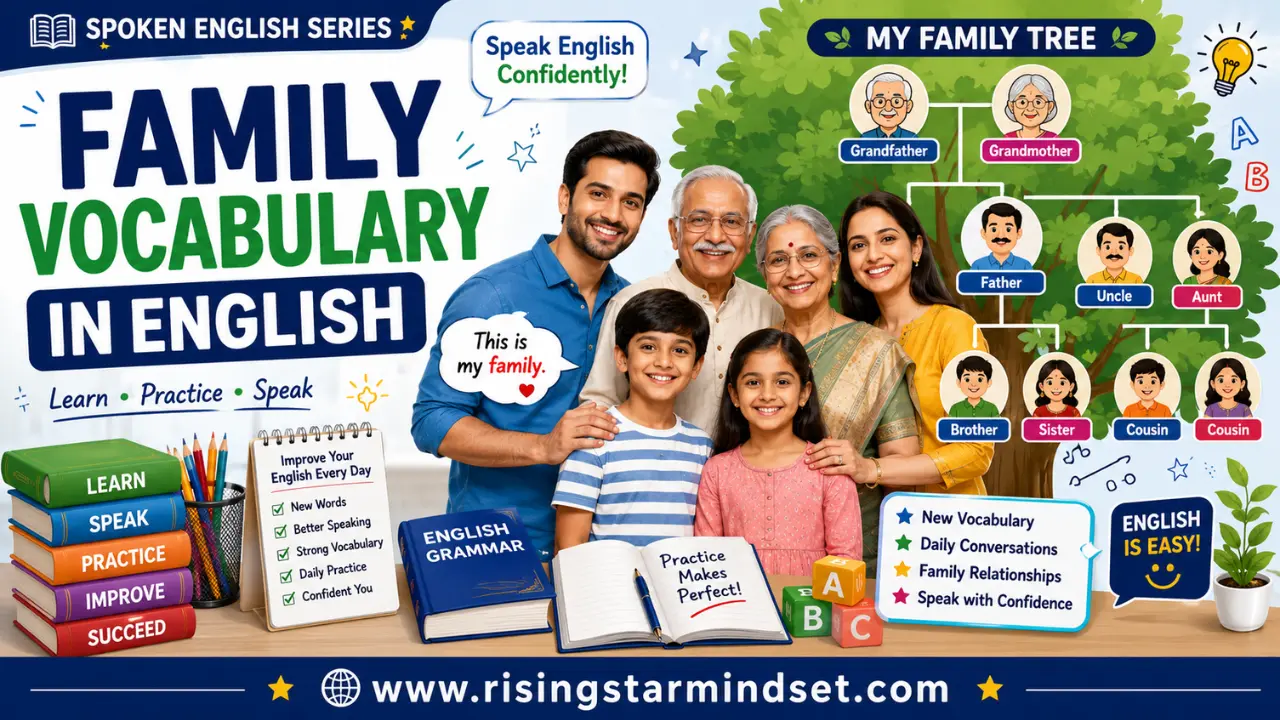
Family Vocabulary in English with Examples and Practice
Table of Contents ( Family Vocabulary in English )
- Introduction
- What is Family Vocabulary?
- Types of Family
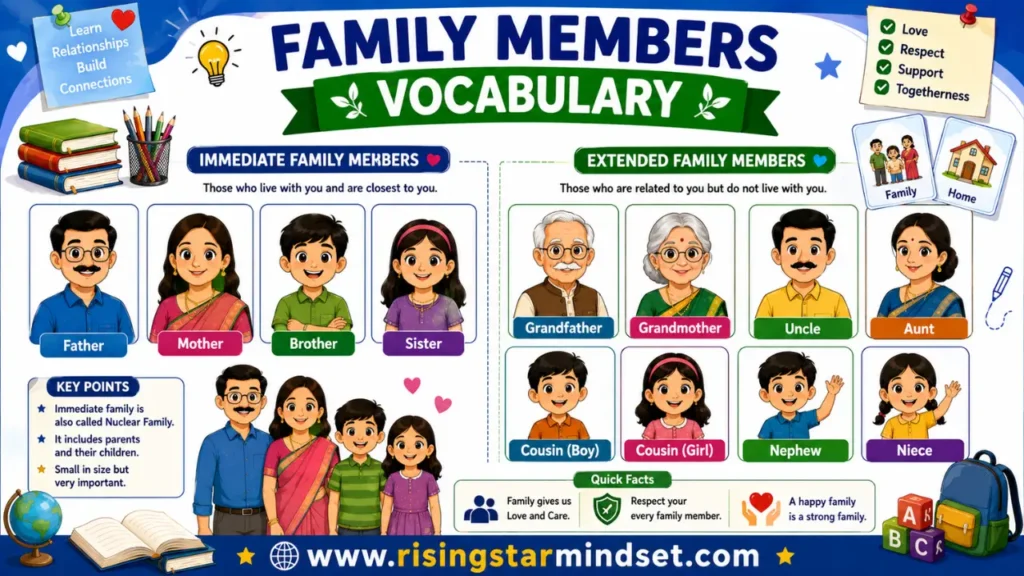
- Immediate Family Members
- Extended Family Members
- Family Tree
- Common Family Vocabulary
- Daily Use Family Sentences
- Key Points
- MCQs
- HOTS Questions
- Fill in the Blanks
- Match the Following
- Question & Answers
- FAQs
- Conclusion
- Previous topic : Days, Months and Seasons in English | Complete Guide
Abbreviations ( Family Vocabulary in English )
| Abbreviation | Full Form |
| Mr. | Mister |
| Mrs. | Mistress |
| Ms. | Miss |
| Jr. | Junior |
| Sr. | Senior |
| DOB | Date of Birth |
| Fam. | Family |
| Rel. | Relative |
Introduction ( Family Vocabulary in English )
What is Family Vocabulary?
English ( Family Vocabulary in English )
Family is one of the most important parts of our lives. Therefore, learning Family Vocabulary in English helps you introduce your family members, describe relationships, and communicate confidently in everyday conversations.
Moreover, family-related words are commonly used in schools, interviews, competitive exams, and spoken English. As a result, understanding these words improves both your vocabulary and communication skills.
In this complete guide, you will learn family member names, relationships, useful vocabulary, example sentences, conversations, exercises, and quizzes with easy explanations in both English and Hindi.
हिन्दी
परिवार हमारे जीवन का सबसे महत्वपूर्ण हिस्सा है। इसलिए Family Vocabulary in English सीखना आवश्यक है, ताकि आप अपने परिवार के सदस्यों का परिचय अंग्रेज़ी में आसानी से दे सकें।
इसके अलावा, परिवार से जुड़े शब्द स्कूल, इंटरव्यू, प्रतियोगी परीक्षाओं और दैनिक बातचीत में अक्सर उपयोग किए जाते हैं। इस अध्याय में आप परिवार के सदस्यों के नाम, रिश्तों के शब्द, उदाहरण, बातचीत और अभ्यास हिन्दी एवं अंग्रेज़ी दोनों में सीखेंगे।
What is a Family? ( Family Vocabulary in English )
English
A family is a group of people who are related by birth, marriage, or adoption. Family members love, support, and care for one another. They help us grow, learn values, and become responsible individuals.
हिन्दी
परिवार उन लोगों का समूह है जो जन्म, विवाह या गोद लेने के माध्यम से एक-दूसरे से जुड़े होते हैं। परिवार के सदस्य एक-दूसरे से प्रेम करते हैं, सहयोग करते हैं और जीवन के हर चरण में साथ रहते हैं।
Types of Family ( Family Vocabulary in English )
1. Nuclear Family ( Family Vocabulary in English )
English
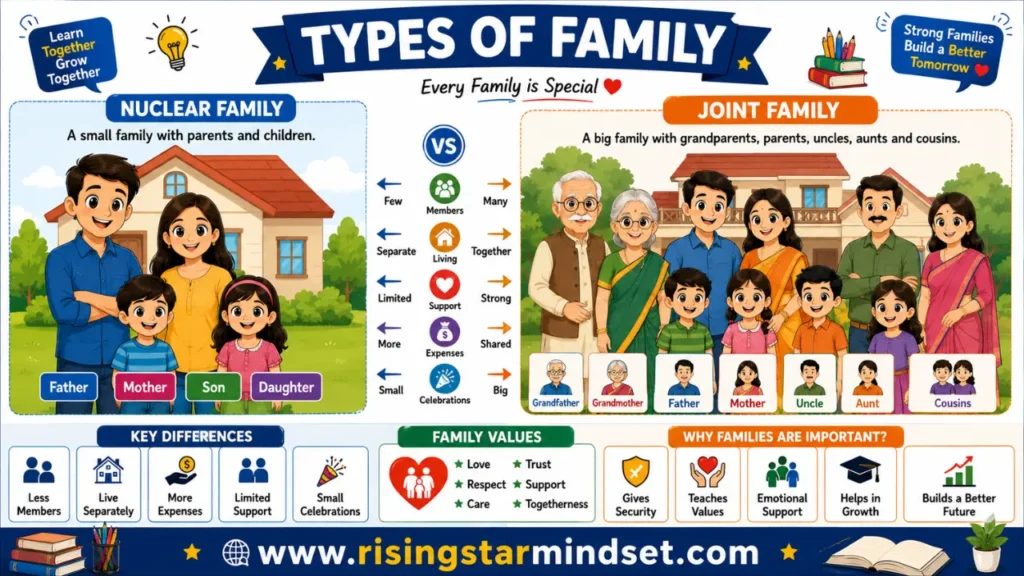
A nuclear family includes parents and their children living together.
हिन्दी
Nuclear Family में माता-पिता और उनके बच्चे शामिल होते हैं।
Example
- We live in a nuclear family.
- हम एक छोटे परिवार में रहते हैं।
2. Joint Family ( Family Vocabulary in English )
English
A joint family includes grandparents, parents, children, uncles, aunts, and cousins living together.
हिन्दी
Joint Family में दादा-दादी, माता-पिता, चाचा-चाची, भाई-बहन और अन्य रिश्तेदार एक साथ रहते हैं।
Example
- My grandparents live with us.
- मेरे दादा-दादी हमारे साथ रहते हैं।
Immediate Family Members
| English | हिन्दी |
| Father | पिता |
| Mother | माता |
| Parents | माता-पिता |
| Son | बेटा |
| Daughter | बेटी |
| Brother | भाई |
| Sister | बहन |
| Husband | पति |
| Wife | पत्नी |
| Child | बच्चा |
| Children | बच्चे |
Extended Family Members ( Family Vocabulary in English )
| English | हिन्दी |
| Grandfather | दादा / नाना |
| Grandmother | दादी / नानी |
| Uncle | चाचा / मामा |
| Aunt | चाची / मामी / बुआ |
| Cousin | चचेरा / ममेरा / फुफेरा भाई-बहन |
| Nephew | भतीजा / भांजा |
| Niece | भतीजी / भांजी |
| Father-in-law | ससुर |
| Mother-in-law | सास |
| Brother-in-law | जीजा / साला / देवर (संदर्भ अनुसार) |
| Sister-in-law | भाभी / ननद / साली (संदर्भ अनुसार) |
Common Family Vocabulary ( Family Vocabulary in English )
| English | हिन्दी |
| Relative | रिश्तेदार |
| Relationship | संबंध |
| Family Tree | वंश-वृक्ष |
| Generation | पीढ़ी |
| Ancestors | पूर्वज |
| Descendants | वंशज |
| Guardian | अभिभावक |
| Twins | जुड़वाँ |
| Siblings | भाई-बहन |
| Relative | रिश्तेदार |
Example Sentences
English
- My father is a teacher.
- My mother is a doctor.
- I have one brother and one sister.
- We are a happy family.
- My grandparents tell wonderful stories.
- I love spending time with my family.
- Family always supports us.
- Respect your elders.
- My uncle lives in Delhi.
- My cousin studies in college.
हिन्दी
- मेरे पिता शिक्षक हैं।
- मेरी माता डॉक्टर हैं।
- मेरा एक भाई और एक बहन है।
- हमारा परिवार खुशहाल है।
- मेरे दादा-दादी अच्छी कहानियाँ सुनाते हैं।
- मुझे अपने परिवार के साथ समय बिताना पसंद है।
- परिवार हमेशा हमारा साथ देता है।
- बड़ों का सम्मान करना चाहिए।
- मेरे चाचा दिल्ली में रहते हैं।
- मेरा चचेरा भाई कॉलेज में पढ़ता है।
Daily Conversation ( Family Vocabulary in English )
Conversation 1
A: How many members are there in your family?
B: There are five members in my family.
हिन्दी
A: आपके परिवार में कितने सदस्य हैं?
B: मेरे परिवार में पाँच सदस्य हैं।
Conversation 2
A: What does your father do?
B: He is an engineer.
हिन्दी
A: आपके पिता क्या करते हैं?
B: वे इंजीनियर हैं।
Speaking Practice ( Family Vocabulary in English )
Read these sentences aloud every day.
- This is my family.
- My father works in a bank.
- My mother cooks delicious food.
- I love my grandparents.
- We respect our elders.
- My sister helps me with my studies.
- My brother is my best friend.
- We celebrate festivals together.
- Family is our greatest strength.
- I am proud of my family.
Key Points
- Family members support and care for each other.
- Learn the names of immediate and extended family members.
- Practice introducing your family in English.
- Use complete sentences while speaking.
- Learn relationship vocabulary.
- Improve pronunciation through daily speaking practice.
- Revise family words regularly.
- Confidence grows with consistent practice.
Family Tree Explained
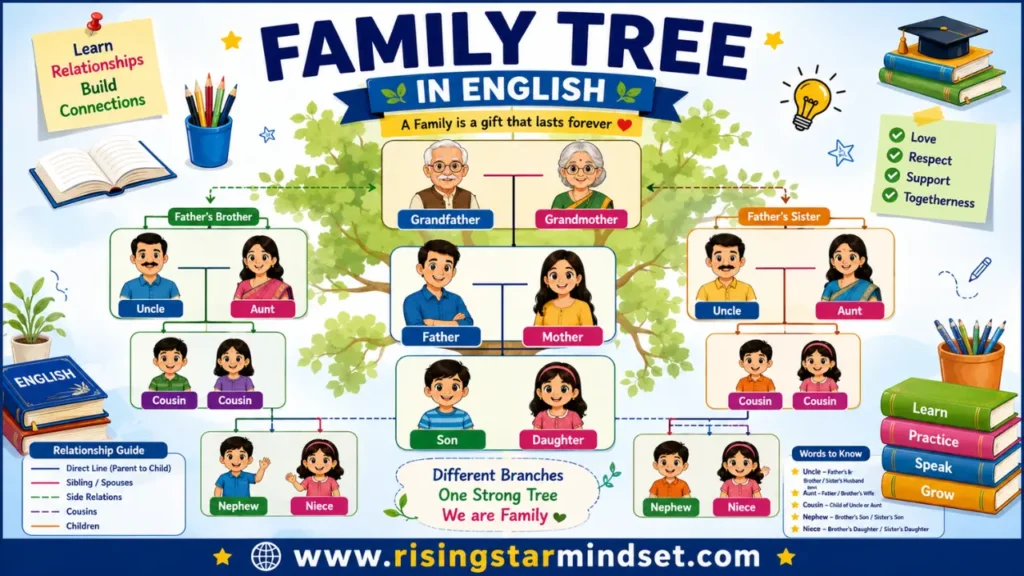
What is a Family Tree?
English
A Family Tree is a diagram that shows the relationships between family members across different generations. It helps us understand who belongs to the family and how each person is related.
Furthermore, a family tree is useful for introducing your family, learning relationship vocabulary, and improving your spoken English. Therefore, every English learner should know the basic family tree.
हिन्दी
Family Tree (वंश-वृक्ष) एक ऐसा चित्र या चार्ट होता है जो परिवार के सदस्यों और उनके रिश्तों को दर्शाता है। इससे हमें यह समझने में आसानी होती है कि कौन किस रिश्ते से जुड़ा हुआ है।
Simple Family Tree
Relationship Words
| English | हिन्दी |
| Father | पिता |
| Mother | माता |
| Parents | माता-पिता |
| Brother | भाई |
| Sister | बहन |
| Son | बेटा |
| Daughter | बेटी |
| Grandparents | दादा-दादी / नाना-नानी |
| Uncle | चाचा / मामा |
| Aunt | चाची / मामी / बुआ |
| Cousin | चचेरा / ममेरा / फुफेरा भाई-बहन |
| Nephew | भतीजा / भांजा |
| Niece | भतीजी / भांजी |
| Husband | पति |
| Wife | पत्नी |
Possessive Words for Family
Possessive words show ownership or relationship.
English Explanation
Words like my, your, his, her, our, their help us describe family relationships correctly. Therefore, they are very important in spoken English.
हिन्दी
My, Your, His, Her, Our, Their जैसे शब्द बताते हैं कि कोई व्यक्ति किसका है या किससे संबंधित है।
| Possessive Word | Example |
| My | My father is a doctor. |
| Your | Your sister is kind. |
| His | His mother is a teacher. |
| Her | Her brother is an engineer. |
| Our | Our family is happy. |
| Their | Their grandparents live in Patna. |
Introducing Your Family
English
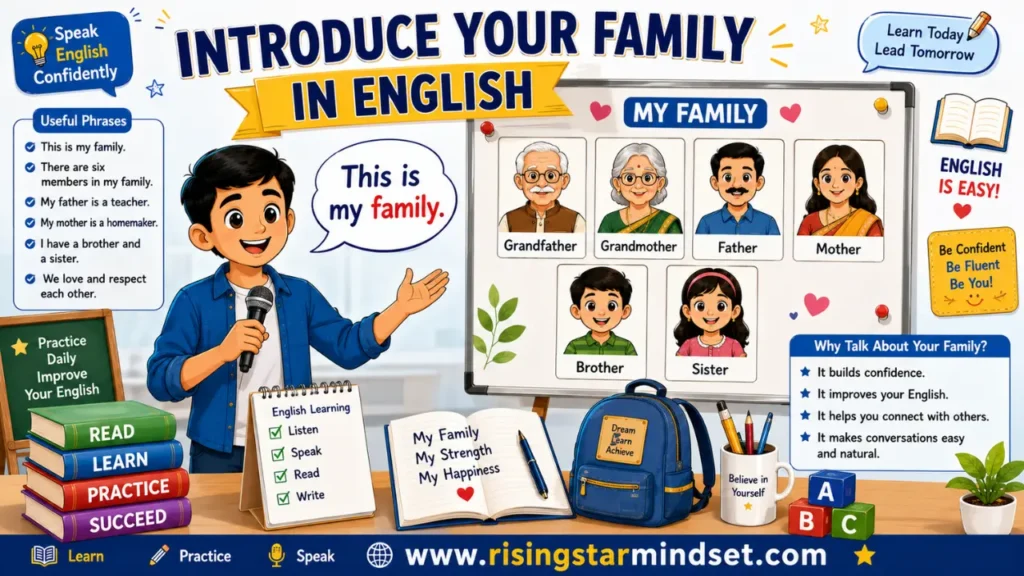
When you introduce your family, speak in simple and complete sentences. Moreover, describe each family member briefly. As a result, your introduction becomes more natural and confident.
Example 1
Hello!
My name is Rahul.
There are five members in my family.
My father is a businessman.
My mother is a teacher.
I have one younger sister.
We live in Patna.
I love my family very much.
हिन्दी
नमस्ते!
मेरा नाम राहुल है।
मेरे परिवार में पाँच सदस्य हैं।
मेरे पिता व्यवसायी हैं।
मेरी माता शिक्षिका हैं।
मेरी एक छोटी बहन है।
हम पटना में रहते हैं।
मुझे अपना परिवार बहुत प्रिय है।
Example 2
Good morning!
I belong to a joint family.
My grandparents live with us.
Moreover, my father is a government employee.
My mother is a homemaker.
I have two cousins.
We always celebrate festivals together.
हिन्दी
सुप्रभात!
मैं संयुक्त परिवार से हूँ।
मेरे दादा-दादी हमारे साथ रहते हैं।
मेरे पिता सरकारी कर्मचारी हैं।
मेरी माता गृहिणी हैं।
मेरे दो चचेरे भाई हैं।
हम सभी त्योहार साथ मनाते हैं।
Family Conversation
Conversation 1
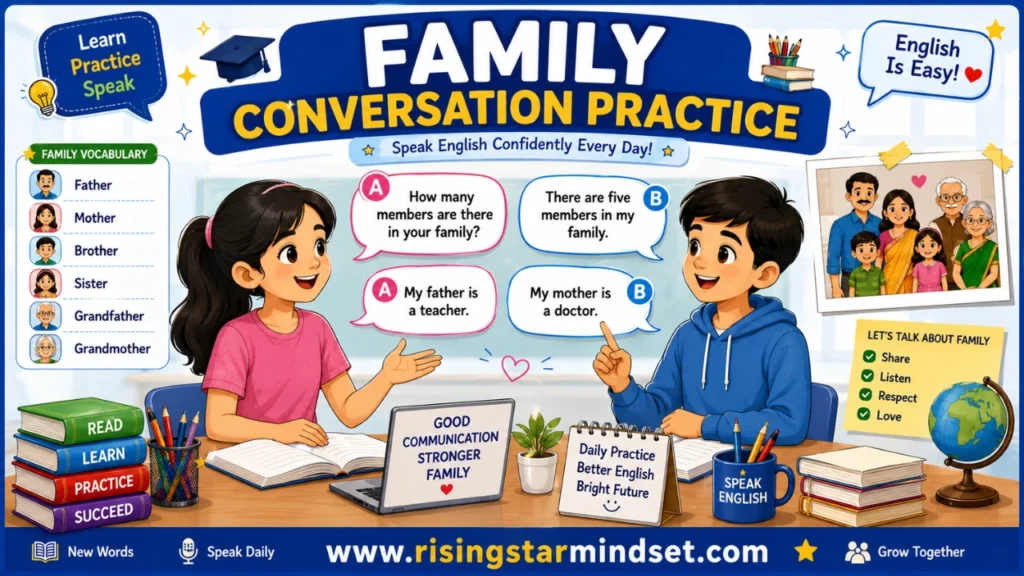
A: How many members are there in your family?
B: There are six members in my family.
A: Who is the eldest member?
B: My grandfather is the eldest member.
हिन्दी
A: आपके परिवार में कितने सदस्य हैं?
B: मेरे परिवार में छह सदस्य हैं।
A: सबसे बड़े सदस्य कौन हैं?
B: मेरे दादाजी सबसे बड़े सदस्य हैं।
Conversation 2
A: Do you have any siblings?
B: Yes. I have one brother and one sister.
A: What does your brother do?
B: He is a college student.
हिन्दी
A: क्या आपके भाई-बहन हैं?
B: हाँ, मेरा एक भाई और एक बहन है।
A: आपका भाई क्या करता है?
B: वह कॉलेज में पढ़ता है।
Family Vocabulary (31–60)
| English | हिन्दी |
| Relative | रिश्तेदार |
| Ancestor | पूर्वज |
| Descendant | वंशज |
| Generation | पीढ़ी |
| Guardian | अभिभावक |
| Family Name | उपनाम |
| Surname | सरनेम |
| Middle Name | मध्य नाम |
| First Name | पहला नाम |
| Married | विवाहित |
| Single | अविवाहित |
| Divorce | तलाक |
| Couple | दंपत्ति |
| Twins | जुड़वाँ |
| Baby | शिशु |
| Child | बच्चा |
| Teenager | किशोर |
| Adult | वयस्क |
| Elder | बड़ा |
| Younger | छोटा |
| Elder Brother | बड़ा भाई |
| Younger Brother | छोटा भाई |
| Elder Sister | बड़ी बहन |
| Younger Sister | छोटी बहन |
| Father-in-law | ससुर |
| Mother-in-law | सास |
| Brother-in-law | जीजा / साला / देवर (संदर्भ अनुसार) |
| Sister-in-law | भाभी / ननद / साली (संदर्भ अनुसार) |
| Family Reunion | पारिवारिक मिलन |
| Household | परिवार / गृहस्थी |
Speaking Practice
Read these sentences aloud every day.
- My family always supports me.
- I respect my parents every day.
- Moreover, my grandparents inspire me.
- Besides, my younger brother is very helpful.
- Also, my elder sister is a doctor.
- We enjoy spending quality time together.
- In fact, family teaches us love and respect.
- Therefore, we celebrate every festival together.
- Because of them, my family is my biggest strength.
- Finally, I am grateful for my family.
Key Points
- Learn family relationships in English.
- Use possessive words correctly.
- Practice introducing your family every day.
- Speak in complete sentences.
- Improve pronunciation through regular practice.
- Learn relationship vocabulary with examples.
- Use new words in daily conversations.
- Consistent practice improves spoken English.
Family Roles and Responsibilities
What are Family Roles?
English
Every family member has an important role and responsibility. Parents guide and support their children, children respect their elders, and grandparents share their experience and wisdom. Therefore, every member contributes to making the family happy and united.
Moreover, understanding family roles helps us become responsible individuals. As a result, we learn values such as love, respect, honesty, kindness, and teamwork.
हिन्दी
परिवार का प्रत्येक सदस्य अपनी एक महत्वपूर्ण भूमिका निभाता है। माता-पिता बच्चों का मार्गदर्शन करते हैं, बच्चे बड़ों का सम्मान करते हैं और दादा-दादी अपने अनुभव साझा करते हैं। इसलिए परिवार का हर सदस्य परिवार को खुशहाल बनाने में योगदान देता है।
Responsibilities of Family Members
| Family Member | Responsibility | हिन्दी |
| Father | Earns money and supports the family | परिवार का पालन-पोषण करते हैं |
| Mother | Takes care of the family | परिवार की देखभाल करती हैं |
| Grandparents | Share experience and values | अनुभव और संस्कार देते हैं |
| Brother | Helps family members | परिवार की सहायता करता है |
| Sister | Cares and supports everyone | सभी का सहयोग करती है |
| Children | Respect elders and study well | बड़ों का सम्मान करते हैं और पढ़ाई करते हैं |
Family Values
English
Strong families are built on good values. Therefore, every family should practice honesty, respect, kindness, responsibility, and cooperation.
Furthermore, these values improve relationships and create a peaceful home environment.
हिन्दी
एक मजबूत परिवार अच्छे संस्कारों पर आधारित होता है। इसलिए हर परिवार में ईमानदारी, सम्मान, सहयोग, दया और जिम्मेदारी जैसे गुण होने चाहिए।
Important Family Values
| English | हिन्दी |
| Love | प्रेम |
| Respect | सम्मान |
| Kindness | दयालुता |
| Honesty | ईमानदारी |
| Responsibility | जिम्मेदारी |
| Trust | विश्वास |
| Care | देखभाल |
| Sharing | बाँटना |
| Cooperation | सहयोग |
| Discipline | अनुशासन |
Daily Family Routine
English
A healthy family follows a daily routine together. Family members wake up early, eat meals together, help each other, complete their work, and spend quality time in the evening.
Additionally, following a routine improves discipline, communication, and family bonding.
हिन्दी
एक अच्छा परिवार नियमित दिनचर्या अपनाता है। सभी सदस्य समय पर उठते हैं, साथ भोजन करते हैं, एक-दूसरे की मदद करते हैं और शाम को साथ समय बिताते हैं।
Daily Routine Vocabulary
| English | हिन्दी |
| Wake up | जागना |
| Brush teeth | दाँत साफ करना |
| Take a bath | स्नान करना |
| Have breakfast | नाश्ता करना |
| Go to school | स्कूल जाना |
| Go to work | काम पर जाना |
| Cook food | भोजन बनाना |
| Have dinner | रात का भोजन करना |
| Watch TV | टीवी देखना |
| Sleep | सोना |
Daily Conversation
Conversation 1
A: Who cooks food in your family?
B: My mother usually cooks delicious food.
A: Do you help her?
B: Yes, I help her every evening.
हिन्दी
A: आपके परिवार में खाना कौन बनाता है?
B: मेरी माँ स्वादिष्ट खाना बनाती हैं।
A: क्या आप उनकी मदद करते हैं?
B: हाँ, मैं हर शाम उनकी मदद करता हूँ।
Conversation 2
A: What do you do on weekends?
B: We clean the house together and spend time with our grandparents.
A: That sounds wonderful.
हिन्दी
A: आप सप्ताहांत में क्या करते हैं?
B: हम सभी मिलकर घर की सफाई करते हैं और दादा-दादी के साथ समय बिताते हैं।
A: यह बहुत अच्छा है।
Common Family Idioms
| Idiom | Meaning | हिन्दी |
| Like father, like son | Son is similar to his father | जैसा बाप वैसा बेटा |
| Blood is thicker than water | Family is more important | परिवार सबसे महत्वपूर्ण है |
| Runs in the family | Common in family | परिवार में पीढ़ियों से चला आ रहा |
| Black sheep of the family | Different family member | परिवार का अलग स्वभाव वाला सदस्य |
| Home sweet home | Home is the best place | अपना घर सबसे अच्छा |
Family Vocabulary (61–90)
| English | हिन्दी |
| Home | घर |
| House | मकान |
| Relative | रिश्तेदार |
| Neighbor | पड़ोसी |
| Childhood | बचपन |
| Parenthood | मातृत्व / पितृत्व |
| Marriage | विवाह |
| Wedding | शादी |
| Anniversary | वर्षगाँठ |
| Birthday | जन्मदिन |
| Celebration | उत्सव |
| Blessing | आशीर्वाद |
| Advice | सलाह |
| Support | सहयोग |
| Protection | सुरक्षा |
| Happiness | खुशी |
| Together | साथ |
| Unity | एकता |
| Tradition | परंपरा |
| Culture | संस्कृति |
| Respect | सम्मान |
| Caring | देखभाल |
| Loving | प्रेमपूर्ण |
| Helpful | सहायक |
| Friendly | मिलनसार |
| Honest | ईमानदार |
| Responsible | जिम्मेदार |
| Patient | धैर्यवान |
| Polite | विनम्र |
| Generous | उदार |
Speaking Practice
Read these sentences every day.
- My family is my biggest support.
- I always respect my parents.
- My grandparents teach me good values.
- We eat dinner together every night.
- I help my mother in the kitchen.
- My father motivates me to work hard.
- My sister is very kind and helpful.
- We celebrate every festival together.
- Love and respect make a family strong.
- I feel proud of my family.
Fill in the Blanks
Choose the correct word.
- My ______ teaches me good values. (Grandparents / Shoes)
- We should always ______ our parents. (Respect / Ignore)
- My father goes to ______ every morning. (Work / Sleep)
- A happy family is built on ______. (Love / Anger)
- We celebrate festivals ______. (Together / Alone)
- My mother ______ delicious food. (Cooks / Sleeps)
- We should help our ______ members. (Family / Classroom)
- Honesty is an important family ______. (Value / Toy)
- My brother is very ______. (Helpful / Empty)
- Our family enjoys eating ______. (Together / Separately)
Answers
- Grandparents
- Respect
- Work
- Love
- Together
- Cooks
- Family
- Value
- Helpful
- Together
Key Points
- Every family member has responsibilities.
- Good values make families stronger.
- Respect and kindness build healthy relationships.
- Learn daily routine vocabulary.
- Practice family conversations every day.
- Use family idioms in advanced English.
- Speak confidently using complete sentences.
- Regular practice improves spoken English.
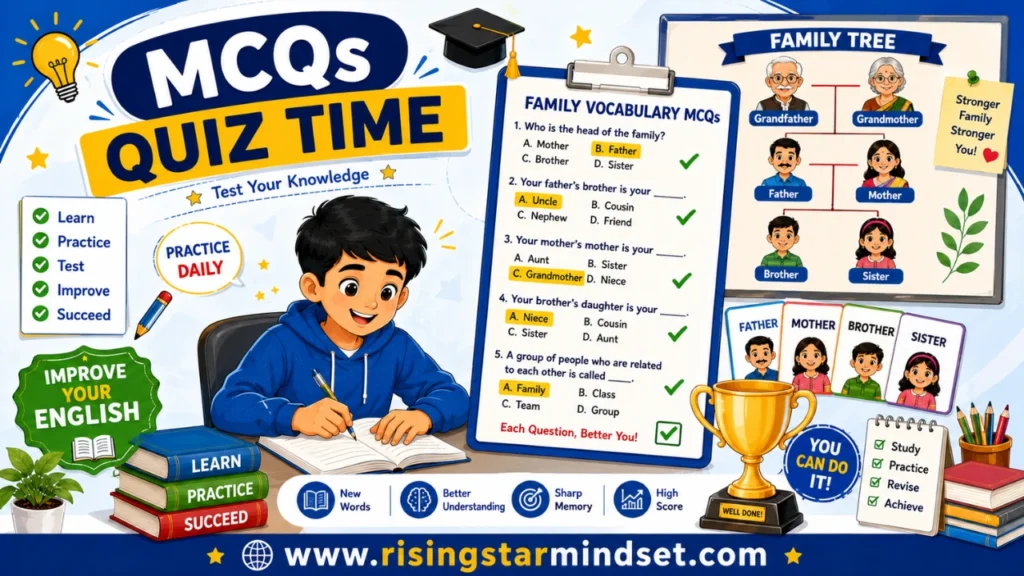
Multiple Choice Questions (MCQs)
1. Who is the head of a family in many households?
A. Friend
B. Father
C. Teacher
D. Neighbor
✅ Answer: B
2. Your mother’s mother is your—
A. Aunt
B. Grandmother
C. Sister
D. Cousin
✅ Answer: B
3. Your father’s brother is your—
A. Uncle
B. Cousin
C. Nephew
D. Brother
✅ Answer: A
4. Your brother’s daughter is your—
A. Aunt
B. Niece
C. Cousin
D. Mother
✅ Answer: B
5. Your sister’s son is your—
A. Nephew
B. Uncle
C. Cousin
D. Grandfather
✅ Answer: A
6. Parents and children together form a—
A. School
B. Nuclear Family
C. Office
D. Club
✅ Answer: B
7. Which family member gives us love and care?
A. Family Members
B. Driver
C. Shopkeeper
D. Stranger
✅ Answer: A
8. Which word means “रिश्तेदार”?
A. Relative
B. Neighbor
C. Student
D. Doctor
✅ Answer: A
9. Grandparents belong to the—
A. Younger Generation
B. Older Generation
C. School
D. Office
✅ Answer: B
10. Which word means “भाई-बहन”?
A. Parents
B. Siblings
C. Cousins
D. Relatives
✅ Answer: B
11. A person who takes care of a child is called—
A. Guardian
B. Teacher
C. Driver
D. Doctor
✅ Answer: A
12. Which member usually prepares food at home?
A. Mother
B. Uncle
C. Neighbor
D. Friend
✅ Answer: A
13. Which family value is the most important?
A. Anger
B. Respect
C. Jealousy
D. Laziness
✅ Answer: B
14. Which word means “ईमानदारी”?
A. Kindness
B. Honesty
C. Trust
D. Care
✅ Answer: B
15. We should always ______ our elders.
A. Respect
B. Ignore
C. Fight
D. Avoid
✅ Answer: A
16. Which family member is your father’s father?
A. Uncle
B. Grandfather
C. Cousin
D. Brother
✅ Answer: B
17. Which word means “वंश-वृक्ष”?
A. Family Tree
B. Family Name
C. Family Room
D. Family Book
✅ Answer: A
18. Which possessive word is correct?
A. My father
B. Me father
C. Mine father
D. Myself father
✅ Answer: A
19. Family members should always—
A. Help each other
B. Ignore each other
C. Fight daily
D. Stay unhappy
✅ Answer: A
20. Which family member is your mother’s sister?
A. Aunt
B. Cousin
C. Niece
D. Daughter
✅ Answer: A
21. The opposite of “Elder” is—
A. Younger
B. Bigger
C. Taller
D. Older
✅ Answer: A
22. A family teaches us—
A. Values
B. Hatred
C. Fear
D. Laziness
✅ Answer: A
23. Which family member is your uncle’s son?
A. Brother
B. Cousin
C. Nephew
D. Father
✅ Answer: B
24. We celebrate festivals with our—
A. Family
B. Bus
C. Market
D. Office
✅ Answer: A
25. Which word means “सहयोग”?
A. Cooperation
B. Celebration
C. Conversation
D. Competition
✅ Answer: A
26. A happy family is built on—
A. Love
B. Anger
C. Fear
D. Pride
✅ Answer: A
27. Which word means “पूर्वज”?
A. Ancestor
B. Descendant
C. Neighbor
D. Child
✅ Answer: A
28. Which word means “वंशज”?
A. Ancestor
B. Descendant
C. Relative
D. Guardian
✅ Answer: B
29. Which family member helps us learn good manners?
A. Parents
B. Driver
C. Stranger
D. Shopkeeper
✅ Answer: A
30. The best way to improve Family Vocabulary is—
A. Daily Speaking Practice
B. Never Practice
C. Only Reading Once
D. Avoid Conversation
✅ Answer: A
Test Your Score
| Score | Performance |
| 27–30 | 🌟 Excellent |
| 22–26 | 🏆 Very Good |
| 17–21 | 👍 Good |
| 12–16 | 📘 Average |
| 0–11 | 📖 Keep Practicing |
HOTS (Higher Order Thinking Skills)
Q1. Why is family important in our life?
Answer: Family provides love, care, emotional support, guidance, and values that help us become responsible and confident individuals.
Q2. How can family values improve society?
Answer: Strong family values encourage honesty, kindness, respect, and cooperation, which help create a peaceful and responsible society.
Q3. Why should children respect their elders?
Answer: Elders have valuable experience and wisdom. Respecting them helps maintain healthy relationships and good family traditions.
Q4. How does daily communication with family improve spoken English?
Answer: Speaking with family members every day increases confidence, improves pronunciation, builds vocabulary, and develops fluency.
Q5. What qualities make a happy family?
Answer: Love, trust, respect, honesty, responsibility, and cooperation make a family happy and united.
Question and Answers
Q1. What is a family?
Answer: A family is a group of people related by birth, marriage, or adoption.
हिन्दी: परिवार उन लोगों का समूह है जो जन्म, विवाह या गोद लेने के माध्यम से जुड़े होते हैं।
Q2. What is a nuclear family?
Answer: A nuclear family includes parents and their children.
हिन्दी: Nuclear Family में माता-पिता और उनके बच्चे शामिल होते हैं।
Q3. What is a joint family?
Answer: A joint family includes grandparents, parents, children, uncles, aunts, and cousins living together.
हिन्दी: Joint Family में कई पीढ़ियाँ एक साथ रहती हैं।
Q4. Why should we learn family vocabulary?
Answer: Family vocabulary helps us introduce family members and communicate confidently in English.
हिन्दी: Family Vocabulary सीखने से हम अपने परिवार का परिचय अंग्रेज़ी में आसानी से दे सकते हैं।
Q5. What are the important family values?
Answer: Love, respect, honesty, kindness, trust, and responsibility.
हिन्दी: प्रेम, सम्मान, ईमानदारी, दयालुता, विश्वास और जिम्मेदारी।
Match the Following
| Column A | Column B |
| Father | Parent |
| Mother | Parent |
| Brother | Sibling |
| Sister | Sibling |
| Grandfather | Grandparent |
| Grandmother | Grandparent |
| Uncle | Relative |
| Aunt | Relative |
| Cousin | Relative |
| Family Tree | Relationships |
Answers
- Father → Parent
- Mother → Parent
- Brother → Sibling
- Sister → Sibling
- Grandfather → Grandparent
- Grandmother → Grandparent
- Uncle → Relative
- Aunt → Relative
- Cousin → Relative
- Family Tree → Relationships
Fill in the Blanks
- My ______ is my father’s father.
- My ______ is my mother’s sister.
- We should always ______ our parents.
- A ______ family includes parents and children.
- Family teaches us good ______.
- My brother is my ______.
- My father’s brother is my ______.
- We should always help our ______.
- A family is built on ______ and respect.
- Daily ______ improves spoken English.
Answers
- Grandfather
- Aunt
- Respect
- Nuclear
- Values
- Sibling
- Uncle
- Family
- Love
- Practice
Frequently Asked Questions (FAQs)
Q1. Why is Family Vocabulary important?
It helps you introduce family members, describe relationships, and communicate confidently in daily English.
Q2. What is the difference between a nuclear family and a joint family?
A nuclear family includes parents and children, while a joint family includes grandparents and other relatives living together.
Q3. How can I remember family vocabulary easily?
Practice speaking daily, create a family tree, and use new words in simple sentences.
Q4. Is Family Vocabulary useful for competitive exams?
Yes. It is useful for school exams, Spoken English, interviews, SSC, Banking, Railways, and BPSC.
Q5. How can I improve my spoken English using family topics?
Talk about your family every day in English, describe family members, and practice short conversations.
Key Points Revision
- Learn the names of immediate and extended family members.
- Understand family relationships through a family tree.
- Use possessive words like my, your, his, her, our, and their correctly.
- Practice introducing your family in English.
- Use family-related vocabulary in daily conversations.
- Respect and care are the foundation of a happy family.
- Revise vocabulary regularly to improve fluency.
- Daily speaking practice builds confidence.
English Conclusion
Learning Family Vocabulary in English is an essential step toward improving your spoken English. Moreover, these words help you introduce your family, describe relationships, and communicate naturally in everyday situations. Therefore, make it a habit to practice family-related vocabulary every day.
Furthermore, use these words while talking with friends, teachers, or family members. In addition, revise the vocabulary, complete the exercises, and practice the conversations regularly. Finally, remember that consistent practice, confidence, and patience are the keys to becoming a fluent English speaker.
हिन्दी निष्कर्ष
Family Vocabulary in English सीखना आपकी Spoken English को मज़बूत बनाने का एक महत्वपूर्ण कदम है। परिवार से जुड़े शब्दों का सही प्रयोग करने से आप अपने परिवार का परिचय आत्मविश्वास के साथ अंग्रेज़ी में दे सकते हैं।
रोज़ाना नए शब्द सीखें, उनका वाक्यों में प्रयोग करें और परिवार के बारे में अंग्रेज़ी में बोलने का अभ्यास करें। नियमित अभ्यास, पुनरावृत्ति और सही उच्चारण आपको बेहतर English Speaker बनने में मदद करेंगे।
🌟 Final Call to Action
Did this guide help you?
- Share it with your friends and classmates.
- Bookmark this page for quick revision.
- Practice the exercises regularly.
- Explore more English Grammar lessons on www.risingstarmindset.com.
Keep Learning, Keep Growing! 🚀
P Kumar | Rising Star Mindset
www.risingstarmindset.com
Together We Will Make The Difference