
National Unity Day 2026: History, Sardar Patel’s Legacy and the Power of Unity in Diversity

Different languages, different traditions, different beliefs—but one shared identity. What makes millions of people feel connected as one nation?
Imagine a country where people celebrate different festivals, speak different languages, wear different traditional clothes and follow different customs. Despite these differences, they share a common national identity and work towards a common future. ( National Unity Day 2026 )
That country is India.
India’s greatest strength is not that everyone is the same. Its real strength lies in the ability of people with different backgrounds, cultures and beliefs to live together with mutual respect.
Every year, National Unity Day, also known as Rashtriya Ekta Diwas, reminds us of this important responsibility. Observed on 31 October, the day marks the birth anniversary of Sardar Vallabhbhai Patel, one of the most important leaders in India’s journey towards national integration.
National Unity Day 2026 gives us another opportunity to understand India’s history, appreciate the contribution of its leaders and ask an important question:
Are we doing enough to protect the unity and harmony of our society?
Let us explore the history, significance, lessons and modern-day relevance of this important national observance.
PREVIOUS POST : World Stroke Day 2026: Warning Signs, Symptoms & Prevention
1. National Unity Day 2026: Important Information at a Glance
Before exploring the history, here are the essential facts about Rashtriya Ekta Diwas.
| Particular | Information |
| Name | National Unity Day |
| Hindi Name | Rashtriya Ekta Diwas |
| Date | 31 October 2026 |
| Day | Saturday |
| Associated personality | Sardar Vallabhbhai Patel |
| Popular title | Iron Man of India |
| First observed | 31 October 2014 |
| Main purpose | Promote national unity and integration |
| Famous landmark | Statue of Unity |
| Location of Statue of Unity | Ekta Nagar, Gujarat |
| Central message | Unity in Diversity |
National Unity Day is not simply a celebration of a historical personality. It is also a reminder that the strength of a country depends on the cooperation, trust and responsibility of its citizens.
2. Why Is National Unity Day Celebrated on 31 October?

National Unity Day is celebrated on 31 October because this date marks the birth anniversary of Sardar Vallabhbhai Patel.
He was born on 31 October 1875 in Nadiad, Gujarat. He became an influential freedom fighter, political leader and administrator.
After India’s independence in 1947, the country faced an extremely complicated political situation. British India included provinces under direct British administration and hundreds of princely states governed by their own rulers.
The integration of these territories was essential for creating a politically united country.
Sardar Patel, who served as India’s first Deputy Prime Minister and Home Minister, played a central role in this historic process.
To recognise his contribution and promote national integration, the Government of India introduced National Unity Day in 2014.
Since then, 31 October has become an important occasion for remembering Patel’s contribution and encouraging citizens to strengthen national unity.
3. Who Was Sardar Vallabhbhai Patel? The Iron Man of India ( National Unity Day 2026 )
Sardar Vallabhbhai Patel was one of the most influential personalities in modern Indian history.
He was born into a farming family and later became a successful lawyer. His involvement in India’s freedom movement brought him into contact with Mahatma Gandhi and other national leaders.
Patel became known for his organisational ability, determination and practical approach to difficult political situations.
His contribution to India’s freedom movement ( National Unity Day 2026 )
Patel participated in several important movements against British rule.
Bardoli Satyagraha, 1928: One of the most significant movements associated with Patel was the Bardoli Satyagraha in Gujarat. Farmers protested against an increase in land revenue. Patel organised the movement and helped lead the peaceful resistance. His leadership earned him the title “Sardar”.
Non-Cooperation Movement: Patel supported the national movement led by Mahatma Gandhi and encouraged people to participate in the struggle for independence.
Civil Disobedience Movement: He also participated in the wider freedom struggle and faced imprisonment for his involvement in political activities.
His contribution after independence ( National Unity Day 2026 )

Patel’s role became even more important after India gained independence in 1947.
He served as:
- India’s first Deputy Prime Minister.
- The first Home Minister of independent India.
- A key leader responsible for the integration of princely states.
- An important figure in strengthening India’s administrative structure.
His work demonstrated that national unity requires strong leadership, negotiation, patience and a clear vision.
4. How Did Sardar Patel Help Unite India After Independence? ( National Unity Day 2026 )
One of the greatest challenges after independence was the integration of princely states.
At that time, more than 560 princely states existed across the subcontinent. These states had different rulers, administrative arrangements and political circumstances.
Their future relationship with independent India was a major concern.
If these territories remained politically disconnected, the process of building a stable and united country could become extremely difficult.
The role of the Instrument of Accession ( National Unity Day 2026 )
The Instrument of Accession was an important legal mechanism through which princely states could join India.
Sardar Patel worked closely with V. P. Menon, a senior civil servant, to negotiate with rulers and facilitate the accession of princely states.
Their efforts combined diplomacy, political negotiation and practical decision-making.
Several princely states joined India through this process. Some complicated cases required additional political and administrative measures.
Why was this integration important? ( National Unity Day 2026 )
The integration of princely states helped:
- Establish a more unified political structure.
- Reduce the possibility of territorial fragmentation.
- Strengthen national administration.
- Support communication and economic connections.
- Create a stronger foundation for independent India.
This historical achievement is one of the main reasons Patel is remembered as the Iron Man of India.
Important lesson: Building a nation is not only about winning independence. It is also about bringing people and institutions together to create a stable future.
5. What Does Unity in Diversity Really Mean? ( National Unity Day 2026 )

The phrase Unity in Diversity describes one of the most important features of Indian society.
India is home to numerous languages, religions, cultural traditions, regional identities and lifestyles.
However, people from different backgrounds share a constitutional and national framework.
Unity in diversity does not mean that everyone must think alike or follow the same customs. Instead, it means accepting differences while respecting the rights and dignity of others.
Examples of India’s diversity ( National Unity Day 2026 )
| Area | Examples of diversity |
| Languages | Hindi, Bengali, Tamil, Telugu, Marathi, Gujarati, Punjabi and many others |
| Festivals | Diwali, Eid, Christmas, Gurpurab, Pongal, Onam and Bihu |
| Food | Idli, dosa, dhokla, litti-chokha, biryani, dal-baati and regional dishes |
| Clothing | Sarees, dhotis, turbans, traditional dresses and regional garments |
| Art and culture | Classical dance, folk music, theatre, painting and handicrafts |
| Geography | Mountains, deserts, forests, coastal regions and plains |
These differences make India’s cultural identity rich and distinctive.
Why should we respect cultural differences? ( National Unity Day 2026 )
Respecting different cultures helps people understand one another.
For example, a student who learns about another state’s language or festival may develop a better understanding of that region. Similarly, neighbours who participate respectfully in one another’s celebrations can build friendship and trust.
Therefore, diversity should not be treated as a reason for division. It should be recognised as an opportunity to learn from one another.
6. Why Is National Unity Important for a Country? ( National Unity Day 2026 )
National unity has an important role in the development, security and stability of a country.
A country can have natural resources, modern infrastructure and a strong economy. However, long-term progress becomes difficult when communities do not trust one another.
Here are some important reasons why national unity matters.
1. It strengthens national security
Citizens who feel connected to their country are more likely to support its security and stability.
National unity also encourages cooperation during emergencies, natural disasters and other difficult situations.
2. It supports economic development
When people, states and institutions cooperate, they can work towards common development goals.
Trade, education, infrastructure and employment opportunities benefit from stability and cooperation.
3. It encourages social harmony
Respect between communities reduces unnecessary conflict and promotes peaceful relationships.
A society becomes stronger when people can express their identities without disrespecting others.
4. It strengthens democracy
Democracy depends on participation, equality, dialogue and respect for different opinions.
Citizens do not always have to agree with one another. However, they should respect constitutional principles and peaceful ways of expressing disagreement.
5. It creates a better environment for future generations
Children learn social behaviour from their families, schools and communities.
When adults practise tolerance and respect, young people are more likely to develop these values.
7. National Unity Day 2026: How Is the Day Observed?
National Unity Day is observed through activities that highlight national integration, public participation and Sardar Patel’s contribution.
Common activities associated with the observance include:
- Run for Unity: Participants take part in runs or walks to promote national integration.
- Unity pledge: Citizens and public officials take a pledge supporting national unity and integrity.
- Educational programmes: Schools and colleges organise speeches, quizzes, essay competitions and discussions.
- Cultural performances: Students and artists present the traditions of different Indian regions.
- Tributes to Sardar Patel: People remember his contribution through ceremonies and educational events.
- Public awareness activities: Programmes encourage citizens to understand their role in maintaining social harmony.
The Statue of Unity at Ekta Nagar, Gujarat, is an important landmark associated with the observance.
The nature and scale of activities may vary across states, institutions and local communities.
8. Statue of Unity: A Landmark Dedicated to National Integration ( National Unity Day 2026 )

The Statue of Unity is one of India’s most recognisable monuments.
Located near the Narmada River in Gujarat, it is dedicated to Sardar Vallabhbhai Patel.
The statue was inaugurated on 31 October 2018, on Patel’s 143rd birth anniversary.
Its height is 182 metres, making it the world’s tallest statue.
The monument is more than an architectural achievement. It represents the historical contribution of a leader who played a central role in integrating princely states after independence.
Important facts about the Statue of Unity ( National Unity Day 2026 )
| Fact | Detail |
| Dedicated to | Sardar Vallabhbhai Patel |
| Location | Ekta Nagar, Gujarat |
| Inaugurated | 31 October 2018 |
| Height | 182 metres |
| River | Narmada |
| Significance | Tribute to national integration |
| Nearby region | Kevadia, Gujarat |
The monument has also become a major tourism destination. Visitors can learn about Patel’s life, the freedom movement and the integration of India.
For students, it provides an opportunity to connect historical knowledge with a real place and national heritage.
9. National Unity in the Digital Age: A New Challenge ( National Unity Day 2026 )
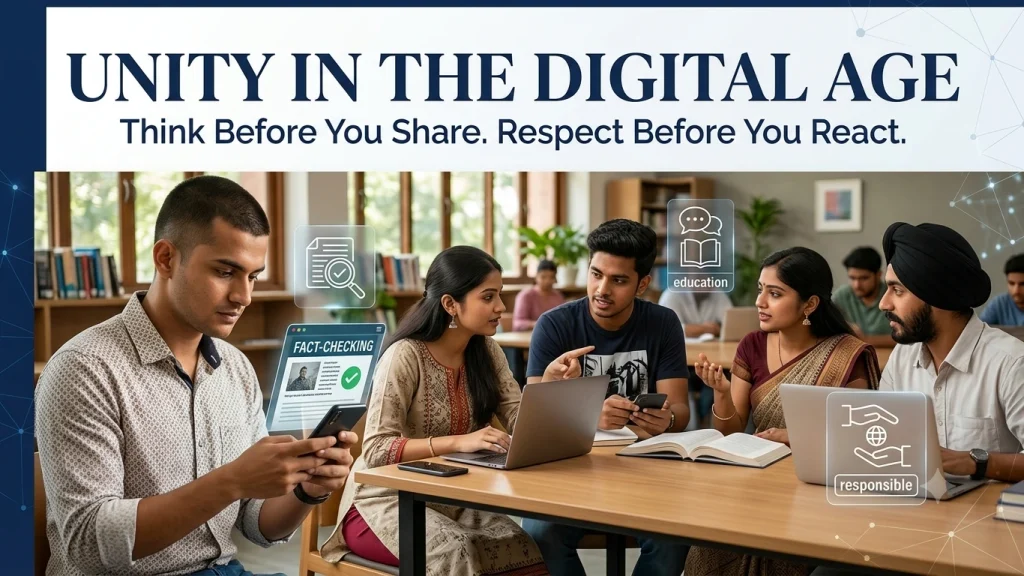
The meaning of national unity has not changed, but the way people communicate has changed significantly.
Today, social media platforms, messaging applications and online news services influence how people understand events and interact with one another.
A useful message can reach thousands of people in a short time. At the same time, false information can spread quickly and create unnecessary fear or misunderstanding.
How can digital platforms support national unity?
Share verified information: Check reliable sources before forwarding news, photographs or videos.
Respect different opinions: People may have different political, cultural or social views. Disagreement should not become personal abuse.
Avoid hateful content: Do not create or share messages that encourage discrimination or hostility.
Promote educational content: Share information about Indian history, culture, science, achievements and social development.
Think before commenting: A respectful response can prevent an online discussion from becoming an argument.
Digital citizenship is now an important part of responsible citizenship.
The internet can become a positive space when users choose facts, respect and constructive communication over rumours and hostility.
10. Seven Practical Ways to Promote National Unity in Daily Life ( National Unity Day 2026 )
National unity is not limited to national celebrations. It begins with our behaviour at home, school, workplaces and public places.
Here are seven practical actions that everyone can follow.
1. Respect every language
Do not make fun of someone because of their accent or mother tongue.
Language is an important part of personal and cultural identity.
2. Learn about different cultures
Read about the festivals, food, history and traditions of other Indian states.
Learning about others helps reduce misunderstandings.
3. Help people without discrimination
Offer assistance to people based on their needs, not their religion, caste, language or region.
Humanity should come before prejudice.
4. Follow constitutional values
Respect equality, freedom, justice, dignity and the rule of law.
These values provide a foundation for a peaceful and democratic society.
5. Avoid spreading rumours
Do not forward unverified messages, especially those that may create tension between communities.
6. Participate in community activities
Take part in cleanliness drives, blood donation awareness, educational programmes and local development activities.
Working together builds trust.
7. Teach children the value of respect
Children should learn that different backgrounds are not a reason to treat anyone unfairly.
Families and schools can play a major role in developing these values.
11. What Can Students Do on National Unity Day 2026?

Students are important participants in building India’s future.
Schools and colleges can use National Unity Day to teach history, citizenship, cooperation and cultural understanding.
Here are some meaningful activities for students.
| Activity | Learning outcome |
| Essay writing | Develops understanding of national integration |
| Speech competition | Builds confidence and communication skills |
| Unity pledge | Encourages responsibility |
| Cultural presentation | Introduces regional traditions |
| Quiz competition | Improves historical knowledge |
| Poster-making | Encourages creative awareness |
| Group discussion | Teaches respectful disagreement |
| Run for Unity | Promotes participation and teamwork |
Suggested speech topic On National Unity Day 2026
“Unity in Diversity: The Real Strength of India”
Students can explain how different cultures contribute to India’s identity and why mutual respect is essential for national progress.
Suggested essay topic On National Unity Day 2026
“The Role of Young Citizens in Building a United India”
An essay can discuss education, digital responsibility, constitutional values and cooperation among communities.
These activities make the occasion more meaningful than simply remembering a date.
12. Five Real-Life Situations That Show the Meaning of Unity ( National Unity Day 2026 )
Sometimes, the meaning of unity becomes clearer through ordinary situations.
Situation 1: Students working together
Imagine a classroom where students come from different states. They work together on a science project and respect each other’s ideas.
Their success demonstrates teamwork despite differences.
Situation 2: Neighbours helping during a flood
During a flood or other natural disaster, people may help neighbours regardless of their background.
Such cooperation demonstrates humanity and shared responsibility.
Situation 3: Celebrating different festivals
A family may visit neighbours during Eid, exchange greetings on Diwali or participate in a Christmas celebration.
Respectful participation creates friendship.
Situation 4: Helping someone in a public place
A person may help an elderly citizen, an injured stranger or someone who has lost their way.
This simple act shows that kindness is not limited by language or identity.
Situation 5: Responsible social media behaviour
A user checks the authenticity of a message before sharing it and refuses to spread hateful content.
This is a small but meaningful contribution to social harmony.
These situations remind us that unity is not always demonstrated through large public events. It is often visible in simple daily decisions.

13. National Unity and the Indian Constitution
The Indian Constitution provides an important foundation for national unity.
It establishes principles that help people from different backgrounds live together as equal citizens.
Some important constitutional values include:
Justice: Every individual should have access to justice and fair treatment.
Liberty: Citizens enjoy important freedoms, subject to constitutional limitations.
Equality: The Constitution recognises equality before the law and equal protection of the laws.
Fraternity: Citizens are encouraged to promote a sense of brotherhood while respecting individual dignity and national integrity.
Fundamental Duties and national unity ( National Unity Day 2026 )
Article 51A of the Indian Constitution lists the Fundamental Duties of citizens.
Some duties are particularly relevant to national integration:
- To abide by the Constitution and respect its ideals and institutions.
- To uphold and protect the sovereignty, unity and integrity of India.
- To promote harmony and the spirit of common brotherhood among all people.
- To value and preserve the rich heritage of India’s composite culture.
- To develop scientific temper, humanism and the spirit of inquiry and reform.
These duties remind citizens that national unity is not only the responsibility of the government. It also requires public participation and responsible behaviour.
14. Challenges to National Unity in Modern India
Although India has a strong tradition of cultural diversity, maintaining social harmony requires continuous effort.
Some challenges include:
Communal misunderstanding
Misunderstanding between religious or cultural communities can create distrust.
Education, dialogue and responsible public communication can help address these problems.
Regional prejudice
People sometimes face unfair treatment because they belong to a particular state or region.
Respecting every region and recognising its contribution can strengthen national belonging.
Caste-based discrimination
Discrimination based on caste damages equality and social trust.
A fair society must protect the dignity and rights of every individual.
Misinformation
False messages and manipulated media can create unnecessary conflict.
Media literacy and fact-checking are important tools for responsible citizenship.
Lack of understanding
People may develop stereotypes about communities they know very little about.
Education, travel, cultural exchange and personal interaction can reduce such misunderstandings.
The solution is not to ignore differences. The solution is to address disagreements through respect, equality, dialogue and constitutional principles.
15. National Unity Day 2026 and the Responsibility of the Youth
Young people have a significant role in shaping the future of India.
They are active users of digital platforms, participants in educational institutions and future leaders of society.
Their everyday decisions can influence the way communities interact.
Young citizens can contribute by:
- Learning about India’s freedom movement and national history.
- Respecting people from different linguistic and cultural backgrounds.
- Avoiding online bullying and hateful communication.
- Participating in community development activities.
- Supporting equal opportunities in education.
- Promoting scientific thinking and verified information.
- Practising teamwork in schools, colleges and workplaces.
The youth should understand that national pride does not require disrespecting another country, culture or community.
True confidence comes from appreciating one’s own identity while respecting the dignity of others.
16. Important Lessons We Can Learn from Sardar Vallabhbhai Patel ( National Unity Day 2026 )
Patel’s life offers several lessons that remain relevant today.
| Lesson | Meaning in everyday life |
| Strong leadership | Take responsibility and guide others constructively |
| Determination | Continue working towards meaningful goals |
| Cooperation | Respect teamwork and collective effort |
| Practical thinking | Focus on solutions rather than unnecessary conflict |
| National responsibility | Put shared interests above narrow divisions |
| Courage | Face difficult situations with confidence |
His contribution also reminds us that important national achievements are rarely the work of one person alone.
Patel worked with officials, administrators, political leaders and others during the integration process.
This shows the importance of cooperation in achieving large goals.
17. Did You Know? Interesting Facts About National Unity Day ( National Unity Day 2026 )
Here are some facts that students and general readers may find interesting.
- National Unity Day is also called Rashtriya Ekta Diwas.
- It is observed on 31 October every year.
- The occasion marks the birth anniversary of Sardar Vallabhbhai Patel.
- Patel was born in 1875.
- He played a major role in the integration of princely states after independence.
- He served as India’s first Deputy Prime Minister and Home Minister.
- The Statue of Unity was inaugurated in 2018.
- The Statue of Unity is 182 metres tall.
- The monument is located in Gujarat near the Narmada River.
- National Unity Day was first observed in 2014.

18. Quick Knowledge Check: Test Your Understanding ( National Unity Day 2026 )
Try answering these questions before checking the answer key.
Q1. When is National Unity Day celebrated in India?
A. 15 August
B. 26 January
C. 31 October
D. 2 October
Q2. Who is popularly known as the Iron Man of India?
A. Mahatma Gandhi
B. Sardar Vallabhbhai Patel
C. Jawaharlal Nehru
D. Subhas Chandra Bose
Q3. In which year was National Unity Day first observed?
A. 1947
B. 2000
C. 2010
D. 2014
Q4. Where is the Statue of Unity located?
A. Jaipur
B. Mumbai
C. Ekta Nagar, Gujarat
D. New Delhi
Q5. What was one of Patel’s major contributions after independence?
A. Leading the space programme
B. Integrating princely states
C. Establishing the Indian railways
D. Writing the Constitution alone
Q6. What does unity in diversity mean?
A. Everyone must follow the same traditions.
B. Different communities can live together with mutual respect.
C. People should avoid learning about other cultures.
D. Differences should never be discussed.
Answer Key: 1-C, 2-B, 3-D, 4-C, 5-B, 6-B.
19. Frequently Asked Questions (FAQs) ( National Unity Day 2026 )
Q1. What is National Unity Day?
National Unity Day, also known as Rashtriya Ekta Diwas, is an annual observance in India that promotes national integration and honours Sardar Vallabhbhai Patel.
Q2. When is National Unity Day 2026?
National Unity Day 2026 is observed on 31 October 2026.
Q3. Why is National Unity Day celebrated on Sardar Patel’s birthday?
The day is observed on Patel’s birth anniversary to recognise his major contribution to India’s political integration and national unity.
Q4. Who started National Unity Day in India?
The Government of India introduced National Unity Day in 2014.
Q5. Why is Sardar Vallabhbhai Patel called the Iron Man of India?
He is popularly known by this title because of his firm leadership, determination and important role in integrating princely states into the Indian Union.
Q6. What is the Statue of Unity?
The Statue of Unity is a 182-metre monument dedicated to Sardar Vallabhbhai Patel. It is located in Ekta Nagar, Gujarat, and was inaugurated on 31 October 2018.
Q7. What is the main message of National Unity Day?
Its main message is to promote national integration, respect cultural diversity, protect national integrity and encourage cooperation among citizens.
Q8. How can schools celebrate National Unity Day?
Schools can organise unity pledges, essay competitions, speeches, quizzes, cultural programmes, poster-making activities and discussions about India’s diversity.
Q9. What is the meaning of unity in diversity?
Unity in diversity means that people with different languages, cultures, religions and traditions can live together with mutual respect and a shared sense of belonging.
Q10. Why is national unity important for young people?
It helps young people develop respect, cooperation, responsible citizenship and an understanding of India’s cultural and constitutional values.
20. English Explanation: The Meaning and Importance of National Unity Day 2026
National Unity Day is observed in India on 31 October every year. It marks the birth anniversary of Sardar Vallabhbhai Patel, who played a major role in bringing princely states together after independence.
When India became independent in 1947, the integration of more than 560 princely states was an important challenge. Patel worked with V. P. Menon and other officials to facilitate this process through negotiation and political leadership.
Today, National Unity Day reminds citizens that a country becomes stronger when people cooperate and respect one another.
India has many languages, religions, festivals, food traditions and regional identities. These differences make the country culturally rich. However, unity requires more than simply living in the same country. It requires equality, understanding, mutual respect and a willingness to work together.
Students can promote national unity by respecting classmates from different backgrounds, learning about other cultures and avoiding discrimination.
Adults can contribute by behaving responsibly, helping others and sharing verified information.
National Unity Day teaches us that unity is not about removing differences. It is about building a society where differences are respected and everyone can contribute to a common future.
21. हिंदी में विस्तार से समझिए: राष्ट्रीय एकता दिवस क्यों जरूरी है?
राष्ट्रीय एकता दिवस भारत में हर साल 31 अक्टूबर को मनाया जाता है। यह दिन भारत के लौह पुरुष सरदार वल्लभभाई पटेल की जयंती के अवसर पर मनाया जाता है।
भारत को 1947 में आजादी मिलने के बाद देश के सामने एक बड़ी चुनौती थी। उस समय भारत में 560 से अधिक रियासतें थीं। इन रियासतों को एक राजनीतिक व्यवस्था में जोड़ना आसान काम नहीं था।
सरदार वल्लभभाई पटेल ने वी. पी. मेनन और अन्य अधिकारियों के साथ मिलकर इस ऐतिहासिक प्रक्रिया में महत्वपूर्ण भूमिका निभाई। उनके प्रयासों से भारत के एकीकरण को मजबूत आधार मिला।
राष्ट्रीय एकता का वास्तविक अर्थ क्या है? ( National Unity Day 2026 )
राष्ट्रीय एकता का मतलब यह नहीं है कि देश के सभी लोग एक ही भाषा बोलें, एक ही तरह के कपड़े पहनें या एक ही परंपरा का पालन करें।
इसका वास्तविक अर्थ है कि अलग-अलग भाषा, धर्म, संस्कृति और विचार रखने वाले लोग एक-दूसरे का सम्मान करें और देश की प्रगति में मिलकर योगदान दें।
भारत में दीपावली, ईद, क्रिसमस, गुरुपर्व, पोंगल, ओणम और बिहू जैसे अनेक त्योहार मनाए जाते हैं। अलग-अलग राज्यों की भाषा, खान-पान और वेशभूषा हमारी सांस्कृतिक पहचान को समृद्ध बनाती है।
आज के समय में राष्ट्रीय एकता क्यों जरूरी है?
आज सोशल मीडिया और इंटरनेट के माध्यम से जानकारी बहुत तेजी से फैलती है। अच्छी जानकारी लोगों को जोड़ सकती है, लेकिन गलत खबरें और अफवाहें समाज में गलतफहमियां भी पैदा कर सकती हैं।
इसलिए हर नागरिक की जिम्मेदारी है कि वह किसी भी खबर को साझा करने से पहले उसकी सत्यता जांचे।
हमें किसी व्यक्ति के साथ उसकी भाषा, जाति, धर्म या क्षेत्र के आधार पर भेदभाव नहीं करना चाहिए।
विद्यार्थी राष्ट्रीय एकता में क्या योगदान दे सकते हैं?
- दूसरे राज्यों की संस्कृति और परंपराओं के बारे में जानें।
- अपने सहपाठियों के साथ सम्मान और सहयोग का व्यवहार करें।
- स्कूल में राष्ट्रीय एकता से जुड़े कार्यक्रमों में भाग लें।
- सोशल मीडिया पर गलत जानकारी साझा करने से बचें।
- जरूरतमंद लोगों की सहायता करें।
- संविधान में दिए गए मूल्यों का सम्मान करें।
राष्ट्रीय एकता केवल सरकार या किसी एक नेता की जिम्मेदारी नहीं है। यह देश के प्रत्येक नागरिक की साझा जिम्मेदारी है।
22. A Message for Every Indian: Unity Begins With Us
Sardar Vallabhbhai Patel’s contribution to India’s integration is an important chapter in our national history.
However, remembering his legacy should also encourage us to think about our own responsibilities.
We may have different languages, different food habits, different traditions and different opinions. Yet, we can work together for education, peace, equality, development and a better future.
A strong nation is not built only through buildings, roads, technology or economic growth. It is also built through trust, cooperation, respect and responsible citizens.
This National Unity Day, let us make a simple promise:
- We will respect every community.
- We will not encourage discrimination.
- We will verify information before sharing it.
- We will help people whenever possible.
- We will teach the next generation the value of unity.
A united nation is not created in a single day. It is built through millions of small acts of respect, kindness and responsibility.
Final Thought On National Unity Day 2026
“Our differences make us unique, but our unity gives us strength. Let us build an India where every individual feels respected, valued and connected.”
Think High • Rise Higher
RISING STAR MINDSET
www.risingstarmindset.com
Disclaimer: This article is intended for general educational and awareness purposes. Historical information is presented for learning and does not constitute political endorsement.
Website: https://risingstarmindset.com/