
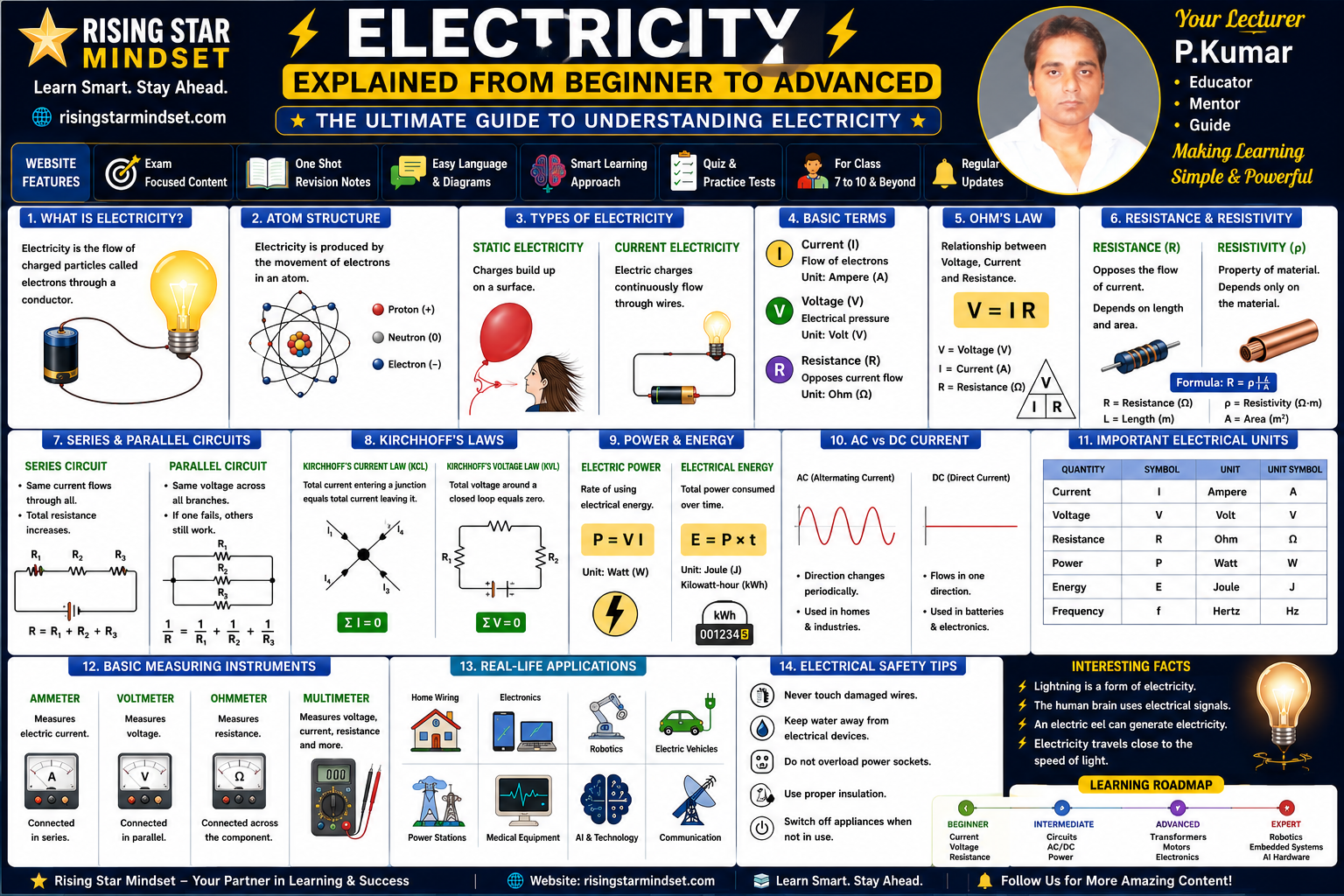
Electricity powers our modern world — from smartphones and laptops to satellites and electric cars. But have you ever wondered what electricity actually is and how it works? ( (Electricity Explained from the ultimate Beginner to Advanced )
In this guide, we will explain electricity from beginner to advanced level in a simple and easy-to-understand way for students, beginners, and technology enthusiasts worldwide.
🔌 What is Electricity?
Electricity is the flow of tiny charged particles called electrons through a conductor such as a wire.
Everything around us uses electrical energy:
- Mobile phones
- Fans
- Computers
- Internet routers
- Electric vehicles
- Home appliances
Without electricity, modern life would stop.
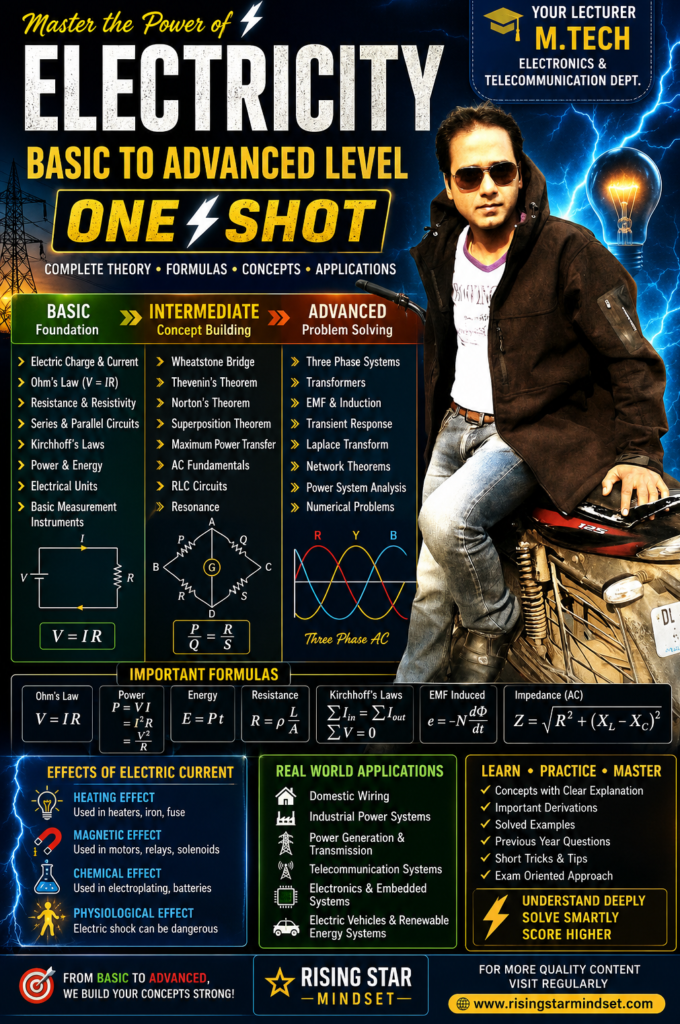
⚛️ Basic Structure of an Atom
Every material is made of atoms.
An atom contains:
- Protons (+)
- Neutrons (0)
- Electrons (-)
Electricity is mainly produced by the movement of electrons.
⚡ Types of Electricity
1. Static Electricity
Electric charges build up on a surface.
Example:
Rubbing a balloon on hair.
2. Current Electricity
Electric charges continuously flow through wires.
This powers homes and electronic devices.
🔋 What is Electric Current?
Electric current is the rate of flow of electrons.
It is measured in:
- Ampere (A)
Symbol:
- I
Formula:
I=tQ
Where:
- I = Current
- Q = Charge
- t = Time
🔌 What is Voltage?
Voltage is the electrical pressure that pushes electrons through a wire.
Measured in:
- Volt (V)
Think of voltage like water pressure in a pipe.
🧲 What is Resistance?
Resistance opposes the flow of electric current.
Measured in:
- Ohm (Ω)
Higher resistance means less current flow.
⚙️ Ohm’s Law
One of the most important laws in electricity.
One of the most important laws in electricity.
Formula:
V = I × R
This law explains the relationship between voltage, current, and resistance in an electrical circuit.
Where:
- V = Voltage
- I = Current
- R = Resistance
This law helps engineers design electrical circuits safely.
⚡ Resistance vs Resistivity
Many students confuse resistance and resistivity, but both are different concepts.
| Resistance | Resistivity |
|---|---|
| Opposes electric current flow | Property of material |
| Depends on length and area | Depends only on material |
| Symbol: R | Symbol: ρ (rho) |
| Unit: Ohm (Ω) | Unit: Ohm-meter (Ω·m) |
Formula:
R = ρL / A
Where:
- R = Resistance
- ρ = Resistivity
- L = Length of conductor
- A = Area of conductor
Example:
Copper has low resistivity, so it is widely used in electrical wiring.
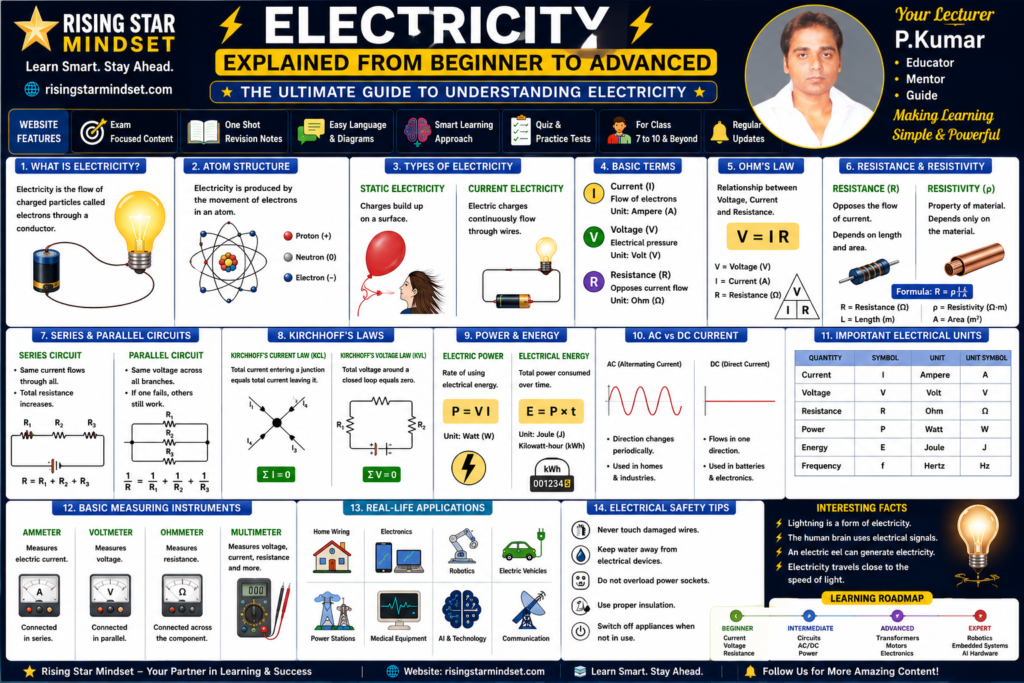
🔌 Series and Parallel Circuits
Electrical components can be connected in two main ways.
1. Series Circuit
In a series circuit:
- Components are connected one after another.
- Same current flows through all devices.
Features:
- If one bulb fails, all bulbs stop working.
- Total resistance increases.
Formula:
R = R₁ + R₂ + R₃
Example:
Old decorative lights.
2. Parallel Circuit (Electricity Explained from the ultimate Beginner to Advanced )
In a parallel circuit:
- Components are connected in separate branches.
- Voltage remains same across branches.
Features:
- If one device fails, others continue working.
- Used in household wiring.
Formula:
1/R = 1/R₁ + 1/R₂ + 1/R₃
⚖️ Kirchhoff’s Laws
Kirchhoff’s laws help analyze complex electrical circuits.
1. Kirchhoff’s Current Law (KCL)
Total current entering a junction equals total current leaving it.
Formula:
ΣI = 0
2. Kirchhoff’s Voltage Law (KVL)
Total voltage around a closed loop equals zero.
Formula:
ΣV = 0
These laws are widely used in electronics and circuit design.
🔄 AC vs DC Current (Electricity Explained from the ultimate Beginner to Advanced )
| Feature | AC Current | DC Current |
|---|---|---|
| Full Form | Alternating Current | Direct Current |
| Direction | Changes direction | Flows in one direction |
| Used In | Homes & industries | Batteries & electronics |
Examples:
- AC → Household electricity
- DC → Mobile battery
💡 Conductors and Insulators
Conductors
Allow electricity to pass easily.
Examples:
- Copper
- Aluminum
- Silver
Insulators
Block electric current.
Examples:
- Rubber
- Plastic
- Wood
⚡ Electric Power and Energy (Electricity Explained from the ultimate Beginner to Advanced )
Electric Power
Electric power is the rate at which electrical energy is used.
Formula:
P = V × I
Unit:
- Watt (W)
Electrical Energy
Electrical energy is the total power consumed over time.
Formula:
Energy = Power × Time
Unit:
- Kilowatt-hour (kWh)
Example:
Electricity bills are calculated in kWh.
🌍 Real-Life Applications of Electricity
Electricity is used in:
- Medical equipment
- Artificial Intelligence systems
- Space technology
- Communication systems
- Robotics
- Smart homes
- Electric vehicles
⚠️ Electrical Safety Tips
- Never touch damaged wires
- Keep water away from electrical devices
- Do not overload power sockets
- Use proper insulation
- Switch off appliances when not in use
🚀 Beginner to Advanced Learning Roadmap
| Level | Topics |
|---|---|
| Beginner | Current, Voltage, Resistance |
| Intermediate | Circuits, AC/DC, Power |
| Advanced | Transformers, Motors, Electronics |
| Expert | Robotics, Embedded Systems, AI Hardware |
🔢 Important Electrical Units ( Electricity Explained from the ultimate Beginner to Advanced )
| Quantity | Symbol | Unit |
|---|---|---|
| Current | I | Ampere (A) |
| Voltage | V | Volt (V) |
| Resistance | R | Ohm (Ω) |
| Power | P | Watt (W) |
| Energy | E | Joule (J) |
| Frequency | f | Hertz (Hz) |
🧪 Basic Electrical Measuring Instruments
Electrical instruments help measure different quantities in circuits.
1. Ammeter
Measures electric current.
Connected:
- In series
2. Voltmeter
Measures voltage.
Connected:
- In parallel
3. Ohmmeter
Measures resistance.
4. Multimeter
Can measure:
- Voltage
- Current
- Resistance
Widely used by electricians and engineers.
🌍 Real-World Importance of These Concepts
These electrical concepts are used in:
Artificial Intelligence hardware
Home wiring
Mobile charging systems
Robotics
Electronics
Electric vehicles
Power stations
🧠 Interesting Facts About Electricity
- Lightning is a form of electricity.
- The human brain also uses electrical signals.
- An electric eel can generate electricity.
- Electricity travels close to the speed of light.
📌 Conclusion
Electricity is one of the greatest discoveries in human history. Understanding its basics opens the door to electronics, engineering, robotics, and modern technology.
Whether you are a school student or a technology enthusiast, learning electricity is the first step toward understanding the future.