
Introduction
Before starting the chapter Control and Coordination, let us take a quick glance at the previous chapter Life Processes. In Life Processes, we studied how living organisms perform essential activities such as nutrition, respiration, transportation, and excretion to stay alive. Those processes explained what functions are necessary for survival.
Now in this chapter, we will understand how the body controls and coordinates all these life processes together smoothly and efficiently.
For example:
- How does the body react immediately when we touch a hot object?
- How do muscles, glands, and organs work together?
- How does the brain send instructions to different body parts?
- How do plants respond to sunlight, gravity, and touch without having a brain?
The answers to all these questions are explained in the chapter Control and Coordination.
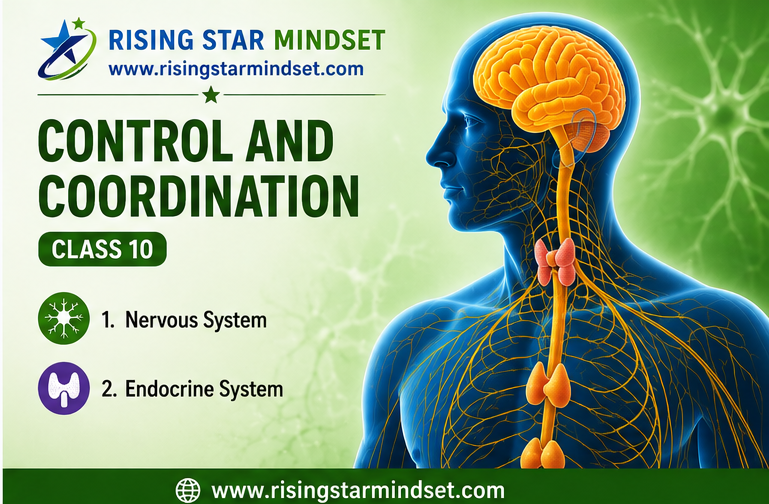
In humans and animals, coordination mainly occurs through:
- Nervous System
- Endocrine System (Hormonal System)
In plants, coordination occurs through:
- Chemical coordination
- Plant hormones
- Tropic movements
This chapter is very important for CBSE Board Exams because it builds the foundation for advanced biology concepts such as neurobiology, hormones, reflex actions, and body regulation systems.
Table of Contents
| Section | Topics Covered |
|---|---|
| 1 | Introduction to Control and Coordination |
| 2 | Need for Control and Coordination |
| 3 | Nervous System in Animals |
| 4 | Neuron Structure and Function |
| 5 | Reflex Action and Reflex Arc |
| 6 | Human Brain and Its Parts |
| 7 | Central Nervous System (CNS) |
| 8 | Peripheral Nervous System (PNS) |
| 9 | Endocrine System and Hormones |
| 10 | Major Human Hormones |
| 11 | Coordination in Plants |
| 12 | Plant Movements |
| 13 | Plant Hormones |
| 14 | Important Differences |
| 15 | Important Abbreviations |
| 16 | Board Important Points |
| 17 | Advanced Level Concepts |
| 18 | Conclusion |
1. Introduction to Control and Coordination
English Explanation
Control and coordination help living organisms respond properly to changes in their environment. In humans and animals, this process is mainly controlled by the nervous system and endocrine system.
The body receives stimuli, processes information, and gives responses through muscles or glands.
हिंदी व्याख्या
Control and Coordination वह प्रक्रिया है जिसके द्वारा जीव अपने आसपास के वातावरण में होने वाले परिवर्तनों के अनुसार प्रतिक्रिया देते हैं। मनुष्य में यह कार्य मुख्य रूप से Nervous System और Endocrine System द्वारा किया जाता है।
2. Need for Control and Coordination
Important Points
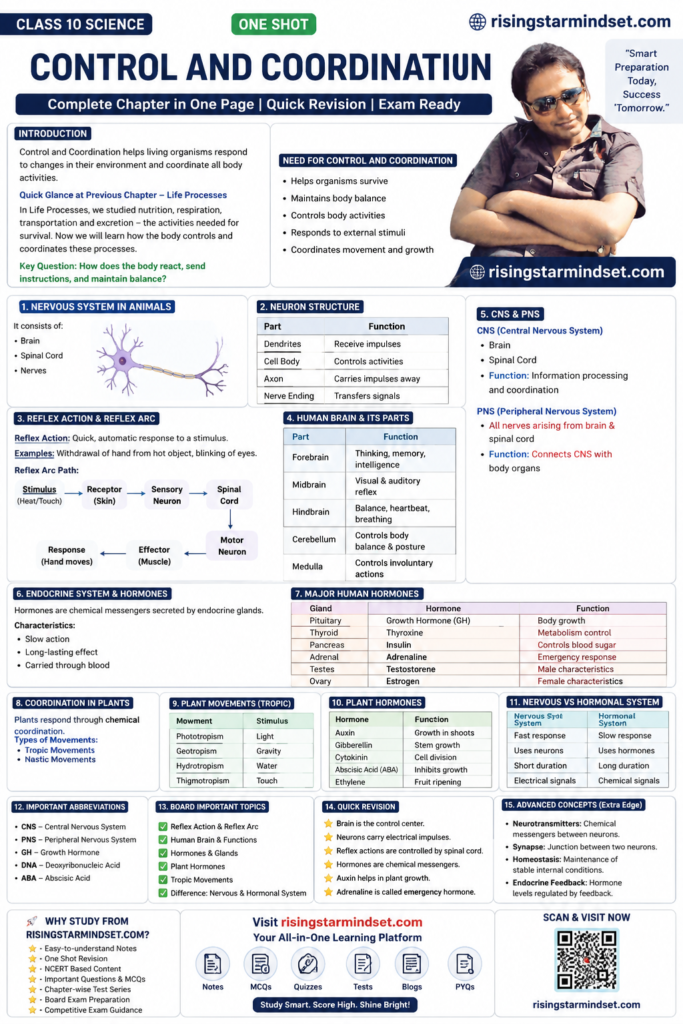
- Helps organisms survive.
- Maintains body balance.
- Controls body activities.
- Responds to external stimuli.
- Coordinates movement and growth.
हिंदी में
- जीवित रहने में सहायता करता है।
- शरीर का संतुलन बनाए रखता है।
- सभी अंगों को नियंत्रित करता है।
- बाहरी उत्तेजनाओं पर प्रतिक्रिया देता है।
- वृद्धि एवं विकास को नियंत्रित करता है।
3. Nervous System in Animals
The nervous system consists of:
- Brain
- Spinal Cord
- Nerves
Functions
- Receives information
- Processes signals
- Sends instructions
- Controls voluntary and involuntary actions
4. Neuron Structure and Function ( Control and Coordination )
Definition
Neuron is the structural and functional unit of the nervous system.
Parts of Neuron
| Part | Function |
| Dendrites | Receive impulses |
| Cell Body | Controls activities |
| Axon | Carries impulses away |
| Nerve Ending | Transfers signals |
हिंदी में
Neuron तंत्रिका तंत्र की मूल इकाई है जो संदेशों का आदान-प्रदान करती है।
5. Reflex Action and Reflex Arc
Reflex Action
A quick automatic response to a stimulus.
Example
- Hand withdrawal from hot object
- Blinking of eyes
Reflex Arc
Path followed during reflex action.
Stimulus → Receptor → Sensory Neuron → Spinal Cord → Motor Neuron → Effector
6. Human Brain and Its Parts
| Brain Part | Function |
| Forebrain | Thinking, memory, intelligence |
| Midbrain | Visual and auditory reflex |
| Hindbrain | Balance, heartbeat, breathing |
Important Points
- Cerebellum controls body balance.
- Medulla controls involuntary actions.
- Brain acts as the control center of body.
7. Central Nervous System (CNS)
Includes
- Brain
- Spinal Cord
Functions
- Information processing
- Coordination of body activities
8. Peripheral Nervous System (PNS)
Includes
All nerves arising from brain and spinal cord.
Functions
Connects CNS with body organs.
9. Endocrine System and Hormones
Hormones
Chemical messengers secreted by endocrine glands.
Characteristics
- Slow action
- Long-lasting effect
- Carried through blood
10. Major Human Hormones
| Gland | Hormone | Function |
| Pituitary | Growth Hormone | Body growth |
| Thyroid | Thyroxine | Metabolism control |
| Pancreas | Insulin | Controls blood sugar |
| Adrenal | Adrenaline | Emergency response |
| Testes | Testosterone | Male characteristics |
| Ovary | Estrogen | Female characteristics |
11. Coordination in Plants
Plants do not have nerves, but they respond through chemical coordination.
Types of Plant Movements
- Tropic Movement
- Nastic Movement
12. Plant Movements
| Movement | Stimulus |
| Phototropism | Light |
| Geotropism | Gravity |
| Hydrotropism | Water |
| Thigmotropism | Touch |
13. Plant Hormones
| Hormone | Function |
| Auxin | Growth in shoots |
| Gibberellin | Stem growth |
| Cytokinin | Cell division |
| Abscisic Acid | Inhibits growth |
| Ethylene | Fruit ripening |
14. Important Differences ( Control and Coordination )
Nervous System vs Hormonal System
| Nervous System | Hormonal System |
| Fast response | Slow response |
| Uses neurons | Uses hormones |
| Short duration | Long duration |
| Electrical signals | Chemical signals |
15. Important Abbreviations
| Abbreviation | Full Form |
| CNS | Central Nervous System |
| PNS | Peripheral Nervous System |
| GH | Growth Hormone |
| DNA | Deoxyribonucleic Acid |
| ABA | Abscisic Acid |
16. Board Important Points ( Control and Coordination )
Most Important Topics
- Reflex Action
- Reflex Arc Diagram
- Human Brain Functions
- Hormones and Glands
- Plant Hormones
- Tropic Movements
- Difference between Nervous and Hormonal Coordination
17. Advanced Level Concepts
Neurotransmitters
Chemical substances that help in transmission of nerve impulses between neurons.
Synapse
Junction between two neurons.
Homeostasis
Maintenance of stable internal body conditions.
Endocrine Feedback Mechanism
Hormone levels are regulated by feedback systems.
Quick Revision Notes ( Control and Coordination )
- Brain is the control center of body.
- Neurons carry electrical impulses.
- Reflex actions are controlled by spinal cord.
- Hormones are chemical messengers.
- Auxin helps in plant growth.
- Adrenaline is called emergency hormone.
Conclusion ( Control and Coordination )
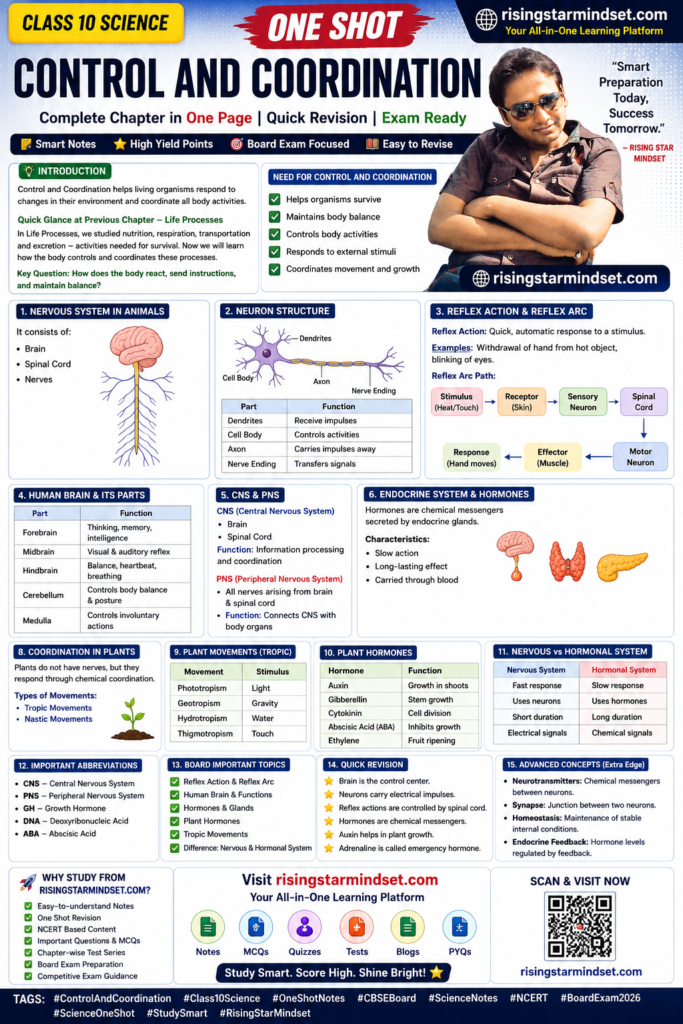
Control and Coordination is one of the most important chapters of Class 10 Science because it explains how living organisms respond and survive in changing environments. Understanding neurons, brain functions, hormones, reflex actions, and plant responses helps students build strong concepts for board exams as well as higher-level biology studies.
📘 Regularly visit risingstarmindset.com for detailed notes, one-shot explanations, MCQs, board preparation materials, and advanced learning content for Class 10 Science and competitive exams.
1 thought on “Control and Coordination One Shot Notes with Important Query”