

Spoken English for Beginners (English)
English is one of the most widely spoken languages in the world. Whether you are a student, job seeker, teacher, entrepreneur, or traveller, spoken English can open many new opportunities. The good news is that anyone can learn spoken English with regular practice. ( Spoken English for Beginners )
This guide is specially designed for beginners. Even if you have never spoken English before, you can start learning step by step from this series.
- STUDY NOTES- 10 TH CLASS
- CLASS NOTES- 9 TH CLASS
- STUDY NOTES- 8 TH CLASS
- STUDY NOTES – 7 TH CLASS
शुरुआती विद्यार्थियों के लिए स्पोकन इंग्लिश (हिन्दी)
आज के समय में अंग्रेज़ी केवल एक भाषा नहीं बल्कि शिक्षा, नौकरी, व्यवसाय और अंतरराष्ट्रीय संचार का एक महत्वपूर्ण माध्यम बन चुकी है।
यदि आपकी English कमजोर है, तो चिंता करने की आवश्यकता नहीं है।
यह Spoken English Series बिल्कुल Basic से शुरू होगी और धीरे-धीरे आपको Advanced Level तक ले जाएगी।
📚 Table of Contents ( Spoken English for Beginners )
- What is Spoken English?
- Why is Spoken English Important?
- Common Myths
- Benefits of Learning Spoken English
- How to Learn English Faster
- Daily Practice Routine
- Beginner Mistakes
- Tips for Success
- Key Points
- MCQs
- HOTS Questions
- Fill in the Blanks
- Match the Following
- Viewer Practice Task
- FAQs
- Conclusion
Abbreviations ( Spoken English for Beginners )
| Abbreviation | Full Form |
|---|---|
| ESL | English as Second Language |
| EFL | English as Foreign Language |
| IELTS | International English Language Testing System |
| TOEFL | Test of English as a Foreign Language |
| CEFR | Common European Framework of Reference |
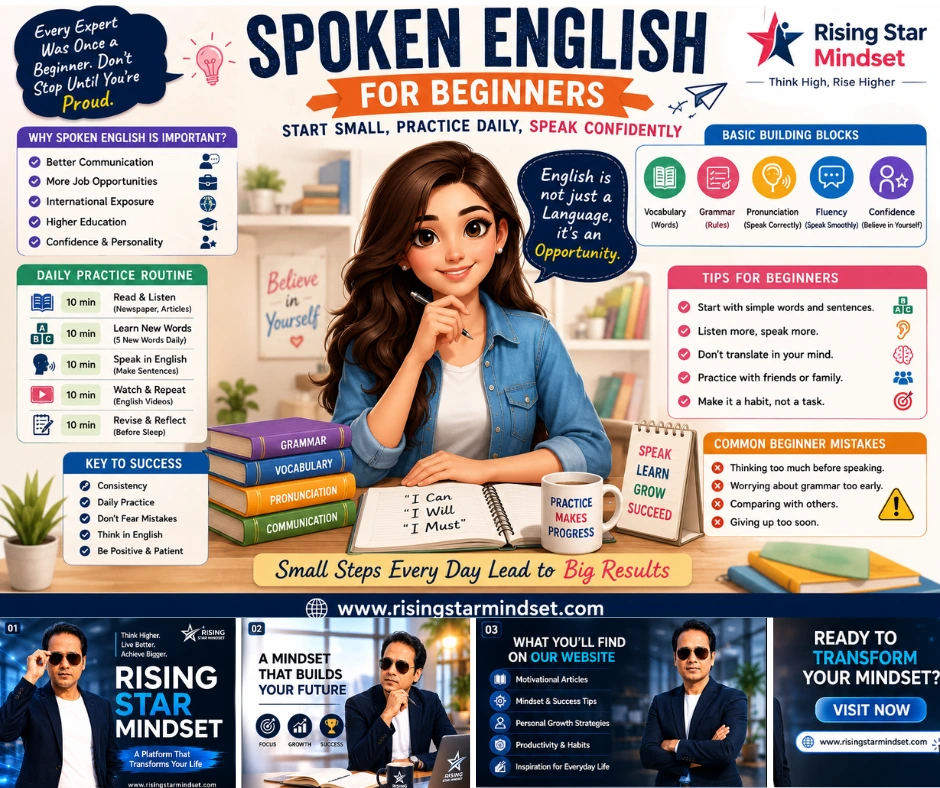
What is Spoken English?
Spoken English means communicating in English through speaking rather than writing.
It includes:
- Correct pronunciation
- Vocabulary
- Grammar
- Confidence
- Fluency
Spoken English क्या है?
Spoken English का अर्थ है अंग्रेज़ी भाषा को बोलकर प्रभावी ढंग से व्यक्त करना।
इसमें केवल Grammar ही नहीं बल्कि Pronunciation, Vocabulary, Confidence और Fluency भी शामिल होती है।
Why is Spoken English Important?
English
Learning spoken English helps you:
- Get better job opportunities
- Crack interviews
- Travel confidently
- Communicate internationally
- Study abroad
- Improve personality
हिन्दी ( Spoken English for Beginners )
Spoken English सीखने के प्रमुख लाभ
- बेहतर नौकरी
- इंटरव्यू में सफलता
- विदेश यात्रा
- आत्मविश्वास
- Personality Development
- Global Communication
Common Myths About Spoken English
Myth 1
“I need perfect grammar before speaking.”
❌ Wrong
Speak first, improve grammar gradually.
Myth 2
“I am too old to learn English.”
❌ Wrong
People learn languages at every age.
Myth 3
“English medium students speak better.”
❌ Wrong
Practice is more important than school background.
Daily Practice Routine
Morning (10 Minutes)
✔ Read newspaper headlines
✔ Learn five new words
Afternoon (10 Minutes)
✔ Make five simple sentences
Evening (15 Minutes)
✔ Watch English videos
✔ Repeat loudly
Night (10 Minutes)
✔ Revise vocabulary
✔ Speak for two minutes in front of a mirror
10 Golden Rules ( Spoken English for Beginners )
- Speak every day.
- Don’t fear mistakes.
- Read English daily.
- Learn vocabulary.
- Watch English videos.
- Listen carefully.
- Think in English.
- Speak slowly.
- Practice with friends.
- Never stop learning.
Beginner Mistakes
- Translating every sentence
- Fear of speaking
- Memorizing without practice
- Ignoring pronunciation
- No daily practice
Key Points ( Spoken English for Beginners )
| English is a skill. |
| Fluency comes through practice. |
| Grammar is important but not everything. |
| Confidence is more important than perfection. |
| Daily practice builds success. |
MCQs (1–10)
Q1. Spoken English mainly improves
A) Writing
B) Speaking
C) Drawing
D) Singing
✅ Answer: B
Q2. Confidence comes from
A) Fear
B) Practice
C) Luck
D) Silence
✅ Answer: B
Q3. Which language is widely used internationally?
A) Hindi
B) English
C) Sanskrit
D) Tamil
✅ Answer: B
Q4. Daily practice helps improve
A) Fluency
B) Fear
C) Laziness
D) Confusion
✅ Answer: A
Q5. Vocabulary means
A) Collection of words
B) Grammar
C) Pronunciation
D) Translation
✅ Answer: A
Q6. Which of the following improves your English the fastest?
A) Sleeping
B) Daily Practice
C) Watching TV only
D) Playing Games
✅ Answer: B) Daily Practice
Q7. Which skill is most important in Spoken English?
A) Drawing
B) Speaking
C) Dancing
D) Painting
✅ Answer: B) Speaking
Q8. What should beginners do first?
A) Speak simple sentences
B) Learn difficult grammar
C) Memorize a dictionary
D) Stop practicing
✅ Answer: A) Speak simple sentences
Q9. Which habit improves pronunciation?
A) Reading silently
B) Listening and repeating
C) Sleeping more
D) Ignoring mistakes
✅ Answer: B) Listening and repeating
Q10. Which language is widely used for international communication?
A) Hindi
B) English
C) Bengali
D) Tamil
✅ Answer: B) English
Q11. What should you do when you make a mistake while speaking?
A) Stop speaking
B) Feel embarrassed
C) Learn from the mistake
D) Never try again
✅ Answer: C) Learn from the mistake
Q12. Vocabulary means:
A) Collection of words
B) Grammar rules
C) Writing style
D) Handwriting
✅ Answer: A) Collection of words
Q13. Fluency comes through:
A) Luck
B) Practice
C) Age
D) Talent only
✅ Answer: B) Practice
Q14. Which activity helps improve listening skills?
A) Watching English videos
B) Sleeping
C) Watching cartoons without sound
D) Playing games only
✅ Answer: A) Watching English videos
Q15. Which is the best way to build confidence?
A) Avoid speaking
B) Speak every day
C) Wait for perfection
D) Memorize everything
✅ Answer: B) Speak every day
Q16. The best time to start learning Spoken English is:
A) Tomorrow
B) Next year
C) Today
D) After graduation
✅ Answer: C) Today
Q17. Which one is a good daily habit?
A) Learn five new English words
B) Watch TV all day
C) Skip practice
D) Avoid reading
✅ Answer: A) Learn five new English words
Q18. Which of the following is NOT necessary for learning Spoken English?
A) Daily Practice
B) Confidence
C) Fear of making mistakes
D) Listening Skills
✅ Answer: C) Fear of making mistakes
Q19. Which of the following helps improve English speaking?
A) Speaking in front of a mirror
B) Never speaking
C) Avoiding conversations
D) Only reading grammar books
✅ Answer: A) Speaking in front of a mirror
Q20. What is the key to becoming fluent in English?
A) Daily Practice and Consistency
B) Memorizing difficult words only
C) Speaking once a week
D) Waiting for the perfect time
✅ Answer: A) Daily Practice and Consistency
HOTS Questions
Q1. Why is confidence more important than perfect grammar while speaking English?
Q2. How can daily speaking practice improve fluency faster than memorizing grammar rules?
Q3. Explain why making mistakes is necessary while learning Spoken English.
Fill in the Blanks
- English is an ______ language.
Answer: International
- Practice makes us ______.
Answer: Confident
- Spoken English improves ______ skills.
Answer: Communication
- We should learn new ______ every day.
Answer: Words
- Fluency comes with ______.
Answer: Practice
Match the Following
| Column A | Column B |
|---|---|
| Vocabulary | Collection of words |
| Grammar | Rules of language |
| Pronunciation | Correct speaking |
| Fluency | Smooth speaking |
| Confidence | Self-belief |
Practice Questions
Short Answer
- What is Spoken English?
- Why should students learn English?
- What is vocabulary?
Long Answer
Explain the importance of Spoken English in modern life.
Daily Speaking Task
Speak these five sentences loudly three times
- My name is ______.Every morning,
- I read English for ten minutes.
- Learning English is becoming easier every day.
- Confidence grows through regular practice.
- Success comes with consistency and patience.
Vocabulary Booster
| Word | Hindi | Sentence |
|---|---|---|
| Improve | सुधारना | I improve every day. |
| Practice | अभ्यास | Practice makes perfect. |
| Confidence | आत्मविश्वास | Confidence leads to success. |
| Learn | सीखना | I learn English daily. |
| Speak | बोलना | Speak clearly. |
Today’s Challenge
🎯 Record your voice for one minute introducing yourself in English.
FAQs
Q1. Can I learn Spoken English without coaching?
Yes. Daily practice and proper guidance are enough.
Q2. How many months are required?
Generally, 4–6 months of regular practice can produce noticeable improvement.
Q3. Is grammar compulsory?
Grammar helps, but regular speaking practice is equally important.
Q4. Can Hindi medium students become fluent?
Absolutely. Many fluent English speakers started from Hindi-medium backgrounds.
Q5. What should I do every day?
Read, listen, speak, write, and revise vocabulary.
Conclusion (English)
Learning Spoken English is a journey of daily practice and confidence. Start with simple words, speak every day, and never be afraid of making mistakes. Small improvements each day lead to great fluency over time.
निष्कर्ष (हिन्दी)
Spoken English सीखना किसी जादू से नहीं बल्कि नियमित अभ्यास, सही मार्गदर्शन और आत्मविश्वास से संभव है। प्रतिदिन थोड़ा-थोड़ा अभ्यास करें और धीरे-धीरे आपकी अंग्रेज़ी बोलने की क्षमता बेहतर होती जाएगी।
🎤 Record Yourself Challenge
Record your voice while speaking today’s five sentences. Listen to your recording, identify one pronunciation mistake, and repeat the sentences again with improved confidence.
Keep Learning, Keep Growing! 🚀
P Kumar | Rising Star Mindset
www.risingstarmindset.com
Together We Will Make The Difference
.NICE
.. GOOD
good