

Sound Class 9 Notes
Complete Notes with Hindi & English Explanation
Sound is an important topic in Class 9 Science. It explains how sound is produced, how it travels, and how we hear it. These notes cover all important concepts from basic to advanced level. ( Sound Class 9 Notes )
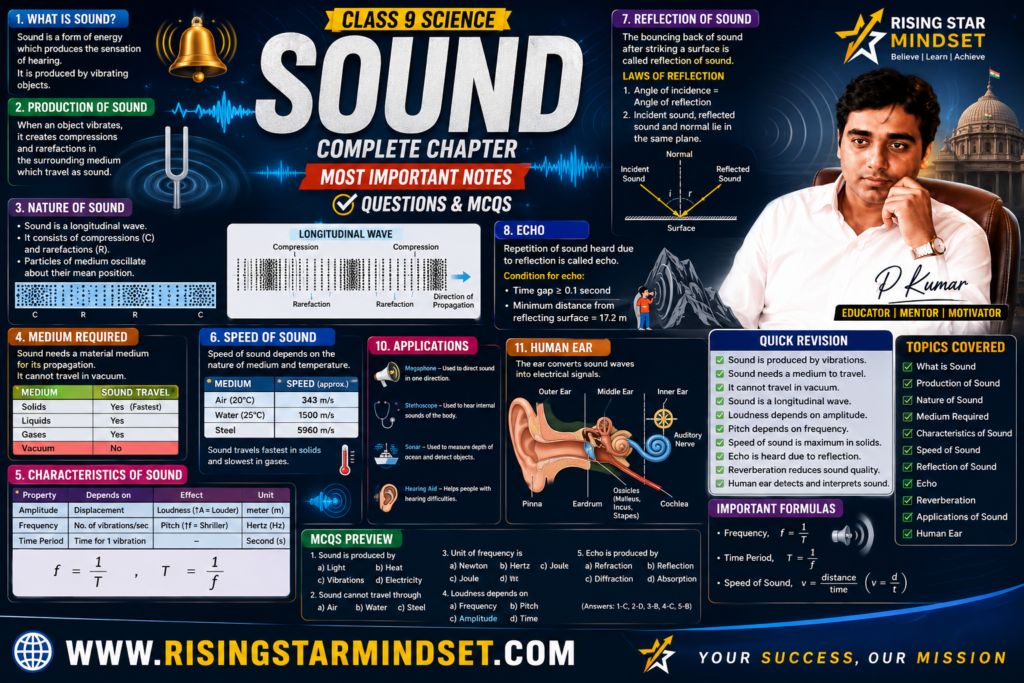
Table of Contents
- Introduction to Sound
- What is Sound?
- Production of Sound
- Propagation of Sound
- Medium Required for Sound
- Characteristics of Sound
- Speed of Sound
- Reflection of Sound
- Echo
- Reverberation
- Applications of Reflection of Sound
- Human Ear
- Abbreviations
- Key Points
- Important Questions and Answers
- HOTS Questions
- MCQs
- FAQs
1. Introduction to Sound
English Explanation
Sound is a form of energy that produces the sensation of hearing.
Hindi Explanation
ध्वनि (Sound) ऊर्जा का एक रूप है जो हमें सुनने की अनुभूति कराती है।
2. What is Sound?
English Explanation
Sound is produced by vibrating objects. When an object vibrates, it creates disturbances in the surrounding medium.
Hindi Explanation
ध्वनि कंपन (Vibration) करने वाली वस्तुओं से उत्पन्न होती है। कंपन के कारण माध्यम में विक्षोभ पैदा होता है जो ध्वनि के रूप में यात्रा करता है।
Examples
- Ringing bell
- Guitar string
- Drum
- Human vocal cords
3. Production of Sound
English Explanation
Sound is produced due to vibration.
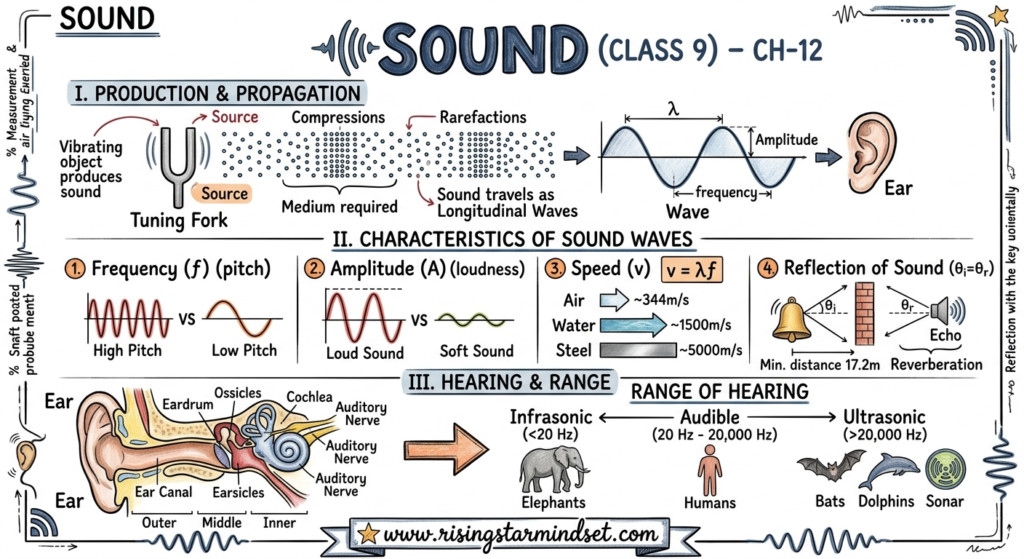
When a tuning fork vibrates, it creates compressions and rarefactions in air.
Hindi Explanation
ध्वनि कंपन के कारण उत्पन्न होती है। जब कोई वस्तु कंपन करती है तो वह आसपास की हवा में संपीड़न (Compression) और विरलन (Rarefaction) बनाती है।
4. Propagation of Sound
English Explanation
Sound travels through a medium as longitudinal waves.
Particles of the medium do not move from one place to another permanently. They only oscillate.
Hindi Explanation
ध्वनि अनुदैर्ध्य तरंगों (Longitudinal Waves) के रूप में चलती है। माध्यम के कण केवल आगे-पीछे कंपन करते हैं।
Compression
Region of high pressure and high density.
Hindi
उच्च दाब और अधिक घनत्व वाला क्षेत्र।
Rarefaction
Region of low pressure and low density.
Hindi
कम दाब और कम घनत्व वाला क्षेत्र।
5. Medium Required for Sound
English Explanation
Sound requires a material medium for propagation.
Hindi Explanation
ध्वनि के संचरण के लिए माध्यम आवश्यक है।
Sound Can Travel Through
| Medium | Sound Travels |
|---|---|
| Solid | Yes |
| Liquid | Yes |
| Gas | Yes |
| Vacuum | No |
Important Fact
Sound cannot travel in vacuum.
Hindi
निर्वात (Vacuum) में ध्वनि का संचरण नहीं होता।
6. Characteristics of Sound
A. Amplitude
English
Maximum displacement from mean position.
Hindi
माध्य स्थिति से अधिकतम विस्थापन।
Unit
Meter (m)
Effect
Greater amplitude = Louder sound
B. Frequency
English
Number of vibrations per second.
Hindi
प्रति सेकंड होने वाले कंपन की संख्या।
Unit
Hertz (Hz)
Formula
C. Time Period
English
Time taken for one complete vibration.
Hindi
एक पूर्ण कंपन करने में लगा समय।
Formula
D. Pitch
English
Pitch depends on frequency.
High frequency = High pitch
Hindi
पिच आवृत्ति पर निर्भर करती है।
E. Loudness
English
Loudness depends on amplitude.
Hindi
ध्वनि की तीव्रता आयाम पर निर्भर करती है।
7. Speed of Sound
English Explanation
The speed of sound depends on the medium and temperature.
Hindi Explanation
ध्वनि की चाल माध्यम तथा तापमान पर निर्भर करती है।
Approximate Values
| Medium | Speed |
|---|---|
| Air | 343 m/s |
| Water | 1500 m/s |
| Steel | 5960 m/s |
Important Fact ( Sound Class 9 Notes )
Sound travels fastest in solids.
8. Reflection of Sound
English Explanation
The bouncing back of sound after striking a surface is called reflection of sound.
Hindi Explanation
किसी सतह से टकराकर ध्वनि का वापस लौटना ध्वनि का परावर्तन कहलाता है।
Laws of Reflection
- Angle of incidence = Angle of reflection
- Incident sound, reflected sound and normal lie in the same plane.
9. Echo
English Explanation
Repeated sound heard after reflection is called echo.
Hindi Explanation
परावर्तन के बाद पुनः सुनाई देने वाली ध्वनि को प्रतिध्वनि (Echo) कहते हैं।
Condition for Echo
Minimum distance from reflecting surface:
Important Fact
Time interval should be at least 0.1 second.
10. Reverberation
English Explanation
Persistence of sound due to repeated reflections.
Hindi Explanation
बार-बार परावर्तन के कारण ध्वनि का कुछ समय तक बने रहना प्रतिध्वनि विस्तार (Reverberation) कहलाता है।
Methods to Reduce Reverberation
- Curtains
- Carpets
- Acoustic panels
- False ceilings
11. Applications of Reflection of Sound
Megaphone
Directs sound in one direction.
Stethoscope
Used by doctors to hear internal body sounds.
Sound Board
Used in auditoriums.
Hearing Aid
Helps people with hearing difficulties.
12. Human Ear
Main Parts
Outer Ear
Collects sound waves.
Middle Ear
Contains eardrum and ossicles.
Inner Ear
Converts vibrations into nerve impulses.
Working of Ear
- Sound enters outer ear.
- Eardrum vibrates.
- Ossicles amplify vibrations.
- Cochlea converts vibrations into signals.
- Brain interprets the sound.
Abbreviations ( Sound Class 9 Notes )
| Abbreviation | Full Form |
|---|---|
| Hz | Hertz |
| m/s | Meter per Second |
| dB | Decibel |
| SI | International System of Units |
| cm | Centimeter |
Key Points Revision ( Sound Class 9 Notes )
| Sound is produced by vibrations |
| Human ear converts sound into nerve impulses. |
| Sound requires a medium. |
| Echo is produced due to reflection. |
| Sound cannot travel in vacuum. |
| Pitch depends on frequency. |
| Sound travels fastest in solids. |
| Loudness depends on amplitude. |
| Sound travels as longitudinal waves. |
| Frequency is measured in Hertz. |
Important Questions and Answers
Q1. What is sound?
Answer: Sound is a form of energy that produces the sensation of hearing.
Q2. Why cannot sound travel in vacuum?
Answer: Sound requires particles for propagation. Vacuum has no particles.
Q3. What is frequency?
Answer: Number of vibrations completed in one second.
Q4. Define amplitude.
Answer: Maximum displacement from the mean position.
Q5. What is echo?
Answer: Repetition of sound due to reflection.
Q6. Which medium carries sound fastest?
Answer: Solids.
Q7. What is reverberation?
Answer: Persistence of sound due to multiple reflections.
Q8. What is pitch?
Answer: Characteristic that helps distinguish shrill and deep sounds.
HOTS Questions
Q1.
Why does sound travel faster in steel than in air?
Answer: Particles in steel are closely packed and transfer vibrations quickly.
Q2.
Astronauts cannot talk directly on the Moon. Why?
Answer: The Moon has no atmosphere. Sound cannot travel in vacuum.
Q3.
Why are curtains used in auditoriums?
Answer: They absorb sound and reduce reverberation.
Q4.
Why does a mosquito produce a sharper sound than a bee?
Answer: Mosquito wings vibrate at a higher frequency, producing a higher pitch.
Q5.
Why is thunder heard after lightning is seen?
Answer: Light travels much faster than sound.
MCQs
1. Sound is produced by
A. Light
B. Heat
C. Vibrations
D. Electricity
Answer: C
2. Unit of frequency is
A. Newton
B. Hertz
C. Joule
D. Watt
Answer: B
3. Sound cannot travel through
A. Air
B. Water
C. Steel
D. Vacuum
Answer: D
4. Loudness depends on
A. Frequency
B. Pitch
C. Amplitude
D. Time
Answer: C
5. Pitch depends on
A. Amplitude
B. Frequency
C. Speed
D. Distance
Answer: B
6. Echo is produced by
A. Refraction
B. Reflection
C. Diffusion
D. Absorption
Answer: B
7. Human ear detects sound through
A. Retina
B. Cochlea
C. Cornea
D. Lens
Answer: B
8. Sound travels fastest in
A. Air
B. Water
C. Vacuum
D. Steel
Answer: D
9. Frequency is measured in
A. Meter
B. Pascal
C. Hertz
D. Newton
Answer: C
10. Reverberation is caused by
A. Absorption
B. Reflection
C. Refraction
D. Diffraction
Answer: B
FAQs
1. What is sound in simple words?
Sound is a form of energy that helps us hear different things.
2. Can sound travel in space?
No. Space is nearly a vacuum, so sound cannot travel.
3. What is the SI unit of frequency?
Hertz (Hz).
4. What is an echo?
A reflected sound heard again after a short delay.
5. Which chapter is important for exams?
Characteristics of sound, echo, reflection of sound, and human ear are highly important for CBSE, BPSC, and school examinations.
Final Exam Booster
Most Important Topics for Board Exams
| Production of Sound |
| Longitudinal Waves |
| Compression and Rarefaction |
| Frequency and Time Period |
| Loudness and Pitch |
| Speed of Sound |
| Echo and Conditions of Echo |
| Reverberation |
| Reflection of Sound |
| Human Ear Diagram and Working |
Sound Class 9 Notes chapter is one of the most scoring chapters in Science. Learn definitions, formulas, diagrams, and numerical concepts carefully for maximum marks in exams.
Keep Learning, Keep Growing! 🚀
P Kumar | Rising Star Mindset
www.risingstarmindset.com
Together We Will Make The Difference