
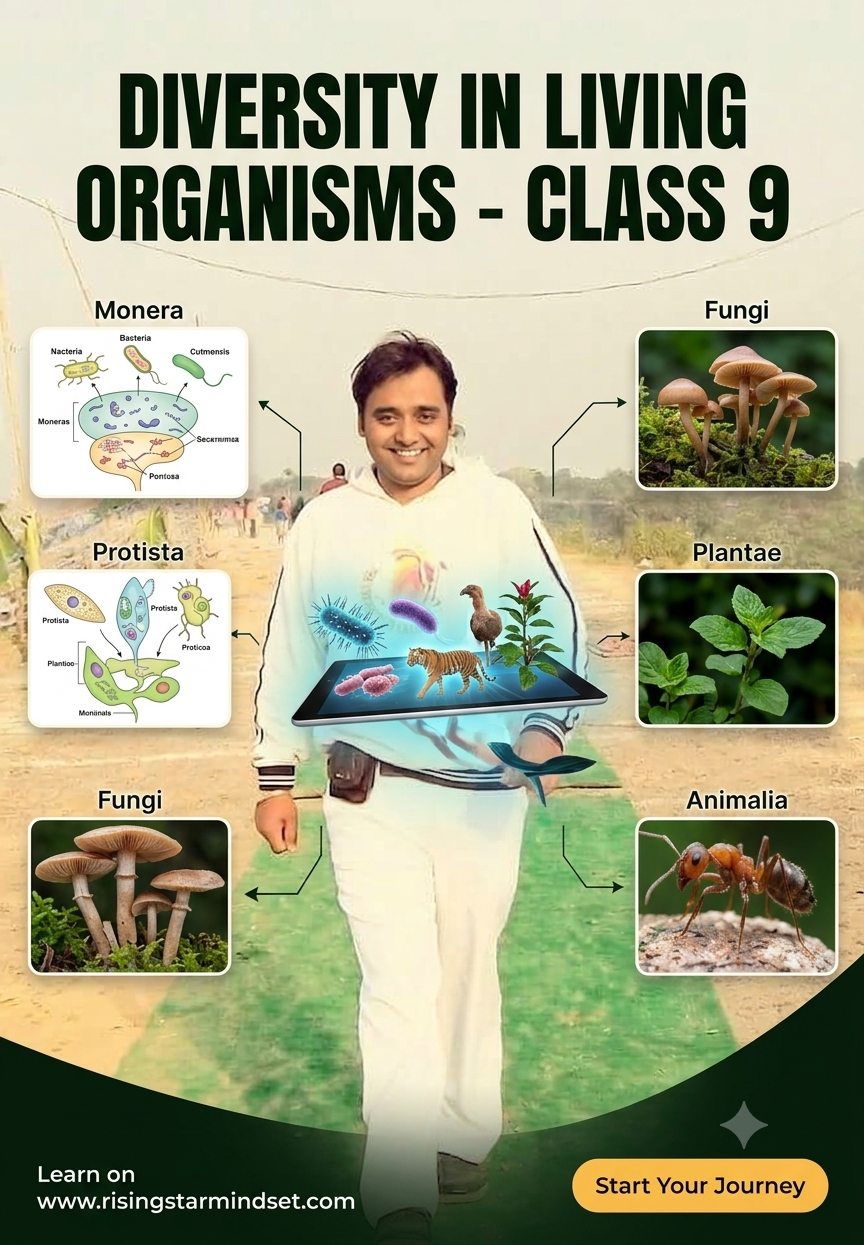
Complete Notes with English & Hindi Explanation
Website: www.risingstarmindset.com ( Diversity in Living Organisms )
Table of Contents ( Diversity in Living Organisms)
- Introduction
- What is Diversity?
- Why Classification is Necessary?
- Basis of Classification
- Two Major Groups of Organisms
- Five Kingdom Classification
- Plant Kingdom
- Animal Kingdom
- Binomial Nomenclature
- Important Scientists
- Abbreviations
- Key Points
- Frequently Asked Questions (FAQs)
- Conclusion
Introduction ( Diversity in Living Organisms )
The Earth is home to millions of living organisms. These organisms differ in size, shape, habitat, food habits, and body structure. Studying each organism separately is difficult, so scientists classify them into different groups.
हिंदी में
पृथ्वी पर लाखों प्रकार के जीव पाए जाते हैं। ये जीव आकार, बनावट, रहने के स्थान, भोजन तथा शारीरिक संरचना में एक-दूसरे से भिन्न होते हैं। इसलिए वैज्ञानिकों ने इनके अध्ययन को आसान बनाने के लिए इन्हें विभिन्न समूहों में वर्गीकृत किया।
What is Diversity?
Diversity means the presence of different kinds of living organisms on Earth.
English Explanation
Living organisms vary greatly from microscopic bacteria to giant whales. This variation is called biodiversity or diversity in living organisms.
हिंदी व्याख्या
पृथ्वी पर सूक्ष्म जीवाणुओं से लेकर विशाल व्हेल तक अनेक प्रकार के जीव पाए जाते हैं। जीवों में पाई जाने वाली यह विभिन्नता ही जैव विविधता कहलाती है।
Why Classification is Necessary?
English
Classification helps us:
- Study organisms easily.
- Understand similarities and differences.
- Identify new organisms.
- Understand evolutionary relationships.
हिंदी
वर्गीकरण हमें:
- जीवों का अध्ययन आसान बनाता है।
- समानता और भिन्नता समझने में सहायता करता है।
- नए जीवों की पहचान करने में मदद करता है।
- विकासक्रम (Evolution) को समझने में सहायता करता है।
Basis of Classification
Scientists classify organisms based on:
| Basis | Explanation |
|---|---|
| Cell Type | Prokaryotic or Eukaryotic |
| Cell Number | Unicellular or Multicellular |
| Nutrition | Autotrophic or Heterotrophic |
| Body Organization | Simple or Complex |
| Evolutionary Relationship | Common Ancestors |
हिंदी
जीवों का वर्गीकरण निम्न आधारों पर किया जाता है:
- कोशिका का प्रकार
- कोशिकाओं की संख्या
- पोषण का तरीका
- शरीर की संरचना
- विकासीय संबंध
Two Major Groups of Organisms
1. Prokaryotes
- No true nucleus.
- Simple organisms.
- Example: Bacteria
हिंदी
- वास्तविक केन्द्रक नहीं होता।
- सरल जीव होते हैं।
- उदाहरण: जीवाणु
2. Eukaryotes
- True nucleus present.
- Complex organisms.
- Example: Plants and Animals
हिंदी
- वास्तविक केन्द्रक उपस्थित होता है।
- जटिल जीव होते हैं।
- उदाहरण: पौधे एवं जन्तु
Five Kingdom Classification
The classification system was proposed by R. H. Whittaker in 1969.
| Kingdom | Examples |
|---|---|
| Monera | Bacteria |
| Protista | Amoeba |
| Fungi | Mushroom |
| Plantae | Mango Plant |
| Animalia | Human Being |
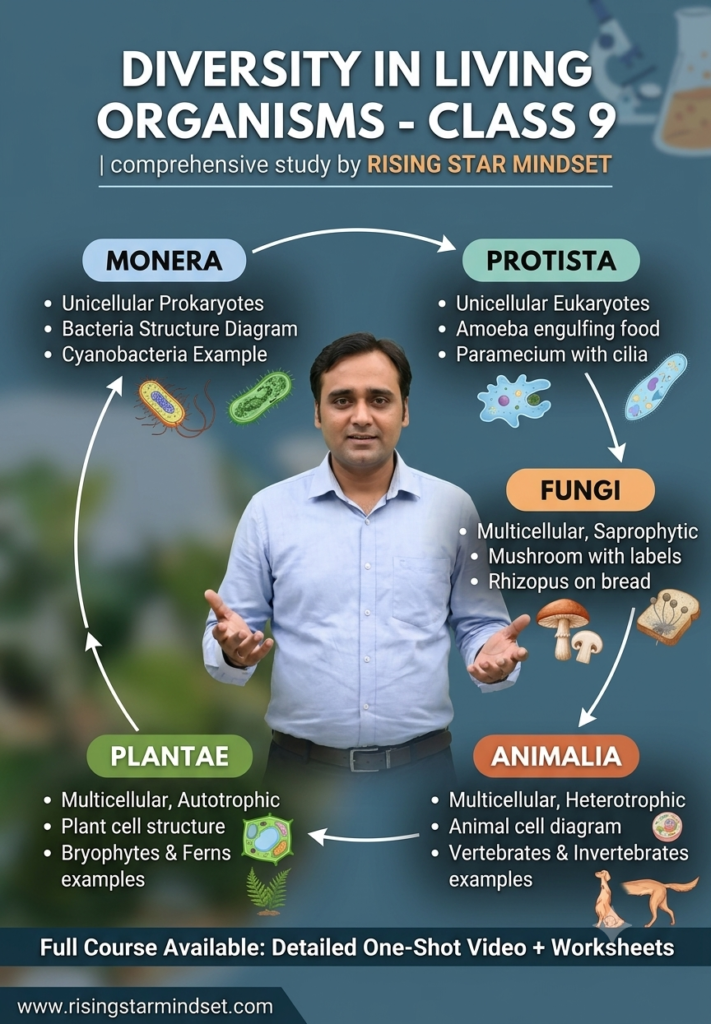
Five Kingdom Diagram
Kingdom Monera
English
- Unicellular organisms.
- Prokaryotic cells.
- No membrane-bound nucleus.
Examples
- Bacteria
- Cyanobacteria
हिंदी
- एककोशिकीय जीव।
- प्रोकैरियोटिक कोशिका।
- केन्द्रक झिल्ली नहीं होती।
Kingdom Protista
English
- Mostly unicellular.
- Eukaryotic organisms.
- Found in water.
Examples
- Amoeba
- Paramecium
- Euglena
हिंदी
- अधिकांश एककोशिकीय।
- यूकैरियोटिक जीव।
- जल में पाए जाते हैं।
Kingdom Fungi
English
- Heterotrophic organisms.
- Obtain food from dead matter.
- Cell wall made of chitin.
Examples
- Mushroom
- Yeast
हिंदी
- परपोषी जीव।
- मृत पदार्थों से भोजन प्राप्त करते हैं।
- कोशिका भित्ति काइटिन की बनी होती है।
Kingdom Plantae
English
- Multicellular organisms.
- Autotrophic nutrition.
- Perform photosynthesis.
Examples
- Mango
- Neem
- Rose
हिंदी
- बहुकोशिकीय जीव।
- स्वपोषी होते हैं।
- प्रकाश संश्लेषण करते हैं।
Plant Kingdom Classification ( Diversity in Living Organisms )
1. Thallophyta
- Simplest plants.
- No roots, stems, leaves.
Example: Algae
हिंदी
सबसे सरल पौधे, जिनमें जड़, तना और पत्तियाँ नहीं होतीं।
2. Bryophyta
- Called Amphibians of Plant Kingdom.
- Live on land but require water for reproduction.
Example: Moss
हिंदी
पादप जगत के उभयचर कहलाते हैं।
3. Pteridophyta
- First vascular plants.
- Well-developed roots and stems.
Example: Fern
हिंदी
ये पहले संवहनी पौधे हैं।
4. Gymnosperms
- Naked seeds.
- No fruits.
Example: Pine
हिंदी
बीज नग्न होते हैं और फल नहीं बनते।
5. Angiosperms
- Flowering plants.
- Seeds enclosed within fruits.
Example: Mango
हिंदी
फूल वाले पौधे जिनके बीज फलों के अंदर होते हैं।
Kingdom Animalia ( Diversity in Living Organisms )
English
Animals are multicellular and heterotrophic organisms.
Main Groups
Non-Chordates
- No backbone.
Examples:
- Earthworm
- Cockroach
Chordates
- Backbone present.
Examples:
- Fish
- Birds
- Humans
हिंदी
जन्तु बहुकोशिकीय और परपोषी होते हैं।
अकशेरुकी (Non-Chordates): रीढ़ नहीं होती।
कशेरुकी (Chordates): रीढ़ उपस्थित होती है।
Binomial Nomenclature ( Diversity in Living Organisms )
The scientific naming system was introduced by Carl Linnaeus.
Rules
- Scientific names have two words.
- Genus starts with a capital letter.
- Species starts with a small letter.
Example
Human = Homo sapiens
हिंदी
वैज्ञानिक नामकरण की दो-नाम पद्धति को द्विनाम पद्धति कहते हैं।
Important Scientists
| Scientist | Contribution |
|---|---|
| Aristotle | Early Classification |
| Carl Linnaeus | Binomial Nomenclature |
| R. H. Whittaker | Five Kingdom System |
Abbreviations ( Diversity in Living Organisms )
| Abbreviation | Full Form |
|---|---|
| DNA | Deoxyribonucleic Acid |
| RNA | Ribonucleic Acid |
| ATP | Adenosine Triphosphate |
| H₂O | Water |
| CO₂ | Carbon Dioxide |
Key Points for Revision ( Diversity in Living Organisms )
- Diversity means variety of living organisms.
- Classification makes study easier.
- Organisms are classified based on cell structure and nutrition.
- Five Kingdom Classification was proposed by R.H. Whittaker.
- Monera contains prokaryotic organisms.
- Protista contains unicellular eukaryotes.
- Fungi are heterotrophic.
- Plants are autotrophic.
- Animals are heterotrophic and multicellular.
- Binomial nomenclature was developed by Carl Linnaeus.
Frequently Asked Questions (FAQs)
Q1. What is biodiversity?
English: Variety of living organisms present on Earth.
हिंदी: पृथ्वी पर पाए जाने वाले जीवों की विविधता को जैव विविधता कहते हैं।
Q2. Who proposed Five Kingdom Classification?
English: R.H. Whittaker in 1969.
हिंदी: आर. एच. व्हिटेकर ने 1969 में।
Q3. Why is classification important?
English: It helps in easy study and identification of organisms.
हिंदी: यह जीवों के अध्ययन और पहचान को सरल बनाता है।
Q4. Which kingdom contains bacteria?
English: Monera.
हिंदी: मोनेरा।
Q5. What is binomial nomenclature?
English: Scientific naming system using two names.
हिंदी: दो शब्दों पर आधारित वैज्ञानिक नामकरण प्रणाली।
Conclusion
Diversity in Living Organisms is one of the most important chapters of Class 9 Science. It explains how millions of organisms are classified into different groups based on similarities and differences. Understanding classification helps students learn biology systematically and builds a strong foundation for higher studies.
हिंदी निष्कर्ष
जीवों में विविधता अध्याय हमें बताता है कि पृथ्वी पर पाए जाने वाले लाखों जीवों को उनकी समानताओं और भिन्नताओं के आधार पर अलग-अलग समूहों में कैसे वर्गीकृत किया जाता है। यह अध्याय जीव विज्ञान की मजबूत नींव तैयार करता है और आगे की पढ़ाई में अत्यंत उपयोगी है।
“Nature’s diversity is not just beautiful—it is the foundation of life itself.”
© Prepared for www.risingstarmindset.com
Author: P Kumar
1 thought on “Complete Notes on Diversity in Living Organisms Class 9”