
Electricity Class 10 Notes | विद्युत (Electricity) Complete Notes, MCQs, HOTS & Questions Answers
Table of Contents
- Introduction to Electricity
- What is Electric Charge?
- Electric Current (विद्युत धारा)
- Potential Difference and Electric Potential
- Electric Circuit
- Ohm’s Law
- Factors Affecting Resistance
- Resistivity
- Series and Parallel Combination of Resistors
- Heating Effect of Electric Current
- Electric Power
- Important Formula Chart
- Abbreviations
- MCQs
- HOTS Questions
- Short Answer Questions
- Long Answer Questions
- Key Points for Revision
- Conclusion
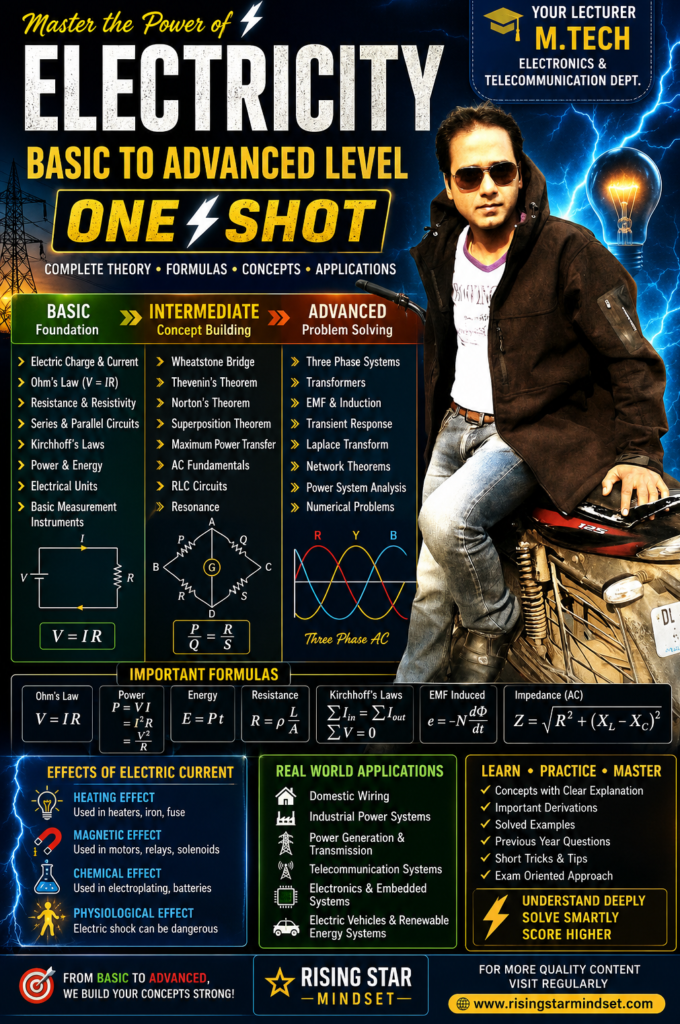
Electricity Class 10
Electricity is one of the most important forms of energy used in our daily life. It helps us operate fans, lights, computers, televisions, and many other devices. Therefore, understanding electricity is essential for both exams and practical life. ( Electricity Class 10 )
विद्युत क्या है?
विद्युत ऊर्जा का एक महत्वपूर्ण रूप है जो हमारे दैनिक जीवन में उपयोग होती है। इसके माध्यम से पंखे, बल्ब, कंप्यूटर और अन्य उपकरण चलते हैं। इसलिए विद्युत का अध्ययन बहुत महत्वपूर्ण है।
1. Electric Charge (विद्युत आवेश)
Charge is the basic property of matter responsible for electrical phenomena.
Types of Charge
| Type | Symbol |
|---|---|
| Positive Charge | + |
| Negative Charge | − |
हिंदी में
विद्युत आवेश पदार्थ का वह गुण है जिसके कारण विद्युत प्रभाव उत्पन्न होता है।
SI Unit
Coulomb (C)
2. Electric Current (विद्युत धारा)
Electric current is the flow of electric charge through a conductor.
Formula
Where,
- I = Current
- Q = Charge
- t = Time
SI Unit
Ampere (A)
हिंदी में
किसी चालक में आवेश के प्रवाह की दर को विद्युत धारा कहते हैं।
3. Electric Potential Difference ( Electricity Class 10 )
Potential difference is the work done in moving a unit charge from one point to another.
Formula
Where,
- V = Potential Difference
- W = Work Done
- Q = Charge
Unit
Volt (V)
हिंदी में
एकांक आवेश को एक बिंदु से दूसरे बिंदु तक ले जाने में किए गए कार्य को विभवांतर कहते हैं।
4. Electric Circuit (विद्युत परिपथ)
An electric circuit is a closed conducting path through which current flows.
Components
- Battery
- Switch
- Bulb
- Connecting Wires
हिंदी में
विद्युत धारा के प्रवाह के लिए बने बंद मार्ग को विद्युत परिपथ कहते हैं।
5. Ohm’s Law (ओम का नियम) ( Electricity Class 10 )
According to Ohm’s Law, at constant temperature, current is directly proportional to potential difference.
Formula
Where,
- V = Voltage
- I = Current
- R = Resistance
हिंदी में
स्थिर तापमान पर विभवांतर धारा के समानुपाती होता है।
6. Resistance (प्रतिरोध)
Resistance is the property of a conductor that opposes the flow of current.
Unit
Ohm (Ω)
Factors Affecting Resistance
- Length of conductor
- Area of cross-section
- Material of conductor
- Temperature
Formula
7. Resistivity (प्रतिरोधकता)
Resistivity is the intrinsic property of a material.
Unit
Ohm metre (Ωm)
हिंदी में
किसी पदार्थ की विद्युत धारा का विरोध करने की क्षमता को प्रतिरोधकता कहते हैं।
8. Combination of Resistors
Series Combination
Current remains same.
Formula
Characteristics
- Same current
- Different voltage
Parallel Combination
Voltage remains same.
Formula
Characteristics
- Same voltage
- Different current
9. Heating Effect of Electric Current
When electric current passes through a conductor, heat is produced.
Joule’s Law
Applications
- Electric Iron
- Heater
- Toaster
- Geyser
हिंदी में
जब चालक में धारा प्रवाहित होती है, तब ऊष्मा उत्पन्न होती है।
10. Electric Power (विद्युत शक्ति)
Electric power is the rate of consumption of electrical energy.
Formula
Also,
Unit
Watt (W)
Commercial Unit
Kilowatt-hour (kWh)
1 kWh
= 1 Unit of Electricity
Important Formula Chart
| Quantity | Formula |
|---|---|
| Current | I = Q/t |
| Voltage | V = W/Q |
| Ohm’s Law | V = IR |
| Resistance | R = ρL/A |
| Heat | H = I²Rt |
| Power | P = VI |
| Energy | E = Pt |
Abbreviations ( Electricity Class 10 )
| Abbreviation | Full Form |
|---|---|
| A | Ampere |
| V | Volt |
| Ω | Ohm |
| W | Watt |
| kW | Kilowatt |
| kWh | Kilowatt-hour |
| DC | Direct Current |
| AC | Alternating Current |
| SI | International System of Units |
MCQs
1. SI unit of current is:
A. Volt
B. Ampere
C. Ohm
D. Watt
✅ Answer: B
2. Ohm’s Law is:
A. V = IR
B. P = VI
C. I = Q/t
D. H = I²Rt
✅ Answer: A
3. Resistance is measured in:
A. Volt
B. Ampere
C. Ohm
D. Watt
✅ Answer: C
4. Commercial unit of electrical energy is:
A. Joule
B. Watt
C. kWh
D. Volt
✅ Answer: C
5. Electric bulb works on:
A. Magnetic Effect
B. Chemical Effect
C. Heating Effect
D. Mechanical Effect
✅ Answer: C
6. Unit of power is:
A. Watt
B. Volt
C. Ohm
D. Ampere
✅ Answer: A
7. 1 kWh equals:
A. 100 J
B. 1000 J
C. 3.6 × 10⁶ J
D. 36 J
✅ Answer: C
8. In parallel combination:
A. Current is same
B. Voltage is same
C. Resistance is maximum
D. None
✅ Answer: B
9. Current depends on:
A. Charge
B. Time
C. Both A and B
D. None
✅ Answer: C
10. Resistivity depends upon:
A. Material
B. Length
C. Area
D. Shape
✅ Answer: A
HOTS Questions
Q1. Why are household appliances connected in parallel?
Answer: Because each appliance gets the same voltage supply and works independently.
Q2. Why are heating elements made of nichrome?
Answer: Nichrome has high resistance and high melting point.
Q3. Why is copper used in electrical wiring?
Answer: Copper has low resistivity and excellent conductivity.
Q4. Why does a bulb filament become hot?
Answer: Due to the heating effect of electric current.
Q5. Why is fuse wire made thin?
Answer: It melts quickly when excess current flows.
Short Answer Questions
Q1. Define electric current.
Electric current is the rate of flow of electric charge.
Q2. State Ohm’s Law.
At constant temperature, current is directly proportional to voltage.
Q3. What is resistance?
Resistance is the opposition offered by a conductor to current flow.
Q4. Define electric power.
Electric power is the rate at which electrical energy is consumed.
Q5. What is resistivity?
Resistivity is the characteristic property of a material.
Long Answer Questions
Q1. Explain Ohm’s Law with formula.
Ohm’s Law states that current flowing through a conductor is directly proportional to the potential difference across its ends, provided temperature remains constant.
Formula:
V = IR
This law helps calculate voltage, current, and resistance in electrical circuits.
Q2. Differentiate between Series and Parallel Combination.
| Series | Parallel |
|---|---|
| Same Current | Same Voltage |
| Resistance Increases | Resistance Decreases |
| One device failure affects all | Devices work independently |
Key Points for Revision
| Current flows from higher potential to lower potential. |
| SI unit of resistance is Ohm. |
| Ohm’s Law: V = IR. |
| SI unit of current is Ampere. |
| Heating Effect follows Joule’s Law. |
| Commercial unit of energy is kWh. |
| Household wiring uses parallel connection. |
| Copper is widely used in electrical wiring. |
| Nichrome is used in heating appliances. |
Conclusion
Electricity is an important chapter for CBSE Class 10 Board Exams. Moreover, it forms the foundation for higher studies in Physics and Engineering. Therefore, students should thoroughly understand electric current, resistance, Ohm’s Law, electric power, and heating effect. In addition, regular practice of MCQs, HOTS questions, and numerical problems will improve conceptual clarity and exam performance.
Keep Learning, Keep Growing! 🚀
P Kumar | Rising Star Mindset
www.risingstarmindset.com
Together We Will Make The Difference
1 thought on “Electricity Class 10 One Shot Notes With Important Questions”