
Introduction ( Cell Structure and Functions )
Cell is the basic structural and functional unit of life. Every living organism is made up of cells. Some organisms consist of a single cell, while others are made up of millions of cells. Understanding the structure and functions of cells is one of the most important topics in Class 8 Science and is frequently asked in school examinations, Olympiads, and competitive exams. ( Cell Structure and Functions )
In this post, you will find MCQs, Fill in the Blanks, Very Short Answer Questions, Short Answer Questions, Long Answer Questions, and Extra Long Answer Questions based on NCERT Class 8 Science Chapter “Cell – Structure and Functions.”
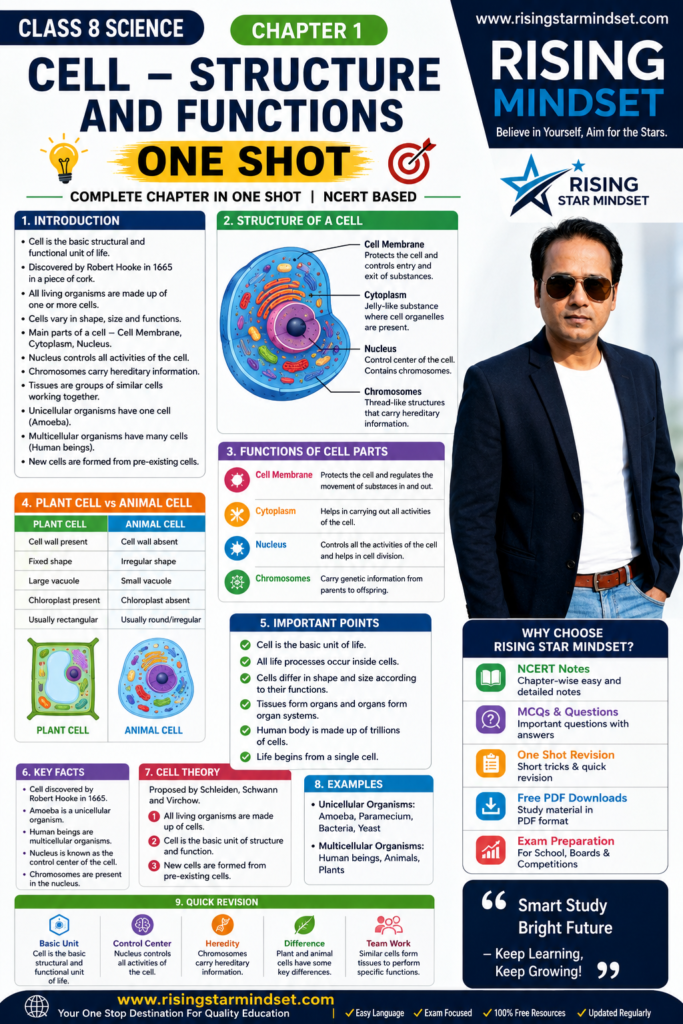
Table of Contents
- Introduction
- Important Definitions
- MCQs
- Fill in the Blanks
- Very Short Answer Questions
- Short Answer Questions
- Long Answer Questions
- Extra Long Answer Questions
- Important Exam Tips
- Conclusion
Important Definitions
| Term | Definition |
|---|---|
| Cell | Basic structural and functional unit of life |
| Nucleus | Control center of the cell |
| Cytoplasm | Jelly-like substance inside the cell |
| Cell Membrane | Outer protective covering of the cell |
| Tissue | Group of similar cells performing a specific function |
| Organism | A living being made up of one or more cells |
| Chromosomes | Thread-like structures carrying hereditary information |
Multiple Choice Questions (MCQs)
1. Who discovered cells?
A) Newton
B) Darwin
C) Robert Hooke
D) Einstein
✅ Answer: C) Robert Hooke
2. The basic unit of life is:
A) Tissue
B) Organ
C) Cell
D) Organ system
✅ Answer: C) Cell
3. Which part of the cell controls all activities?
A) Cytoplasm
B) Nucleus
C) Cell membrane
D) Vacuole
✅ Answer: B) Nucleus
4. The jelly-like substance inside the cell is called:
A) Nucleus
B) Cell wall
C) Cytoplasm
D) Chromosome
✅ Answer: C) Cytoplasm
5. Plant cells have:
A) Cell wall
B) Cell membrane
C) Nucleus
D) All of these
✅ Answer: D) All of these
6. Which cells do not have a nucleus?
A) Nerve cells
B) Red blood cells
C) Muscle cells
D) Skin cells
✅ Answer: B) Red blood cells
7. Amoeba is:
A) Multicellular
B) Unicellular
C) Tissue
D) Organ
✅ Answer: B) Unicellular
8. Chromosomes are present in:
A) Cytoplasm
B) Cell membrane
C) Nucleus
D) Vacuole
✅ Answer: C) Nucleus
9. Human body is made up of:
A) One cell
B) Two cells
C) Many cells
D) No cells
✅ Answer: C) Many cells
10. The smallest unit of life is:
A) Organ
B) Cell
C) Tissue
D) Organ system
✅ Answer: B) Cell
Fill in the Blanks
- The basic unit of life is ________.
- Cell
- Robert Hooke discovered cells in ________.
- 1665
- The nucleus controls all ________ of a cell.
- activities
- The jelly-like substance present inside the cell is called ________.
- cytoplasm
- Chromosomes are found inside the ________.
- nucleus
- Amoeba is a ________ organism.
- unicellular
- Plant cells possess a ________ in addition to the cell membrane.
- cell wall
- Groups of similar cells form a ________.
- tissue
- Human beings are ________ organisms.
- multicellular
- Cells vary in ________ and size.
- shape
Very Short Answer Questions
Q1. What is a cell?
Answer: A cell is the basic structural and functional unit of life.
Q2. Who discovered cells?
Answer: Robert Hooke discovered cells in 1665.
Q3. What is the function of the nucleus?
Answer: The nucleus controls all activities of the cell.
Q4. Name the living substance of a cell.
Answer: Cytoplasm.
Q5. What are chromosomes?
Answer: Chromosomes are thread-like structures that carry hereditary information.
Q6. Give an example of a unicellular organism.
Answer: Amoeba.
Q7. What is a tissue?
Answer: A group of similar cells performing a specific function.
Q8. Which cell organelle controls the cell?
Answer: Nucleus.
Short Answer Questions
Q1. Why are cells called the basic units of life?
Answer: Cells are called the basic units of life because all living organisms are made up of cells. Every life process takes place inside cells.
Q2. What is the function of the cell membrane?
Answer: The cell membrane protects the cell and controls the movement of substances into and out of the cell.
Q3. Differentiate between unicellular and multicellular organisms.
| Unicellular Organisms | Multicellular Organisms |
|---|---|
| Made up of one cell | Made up of many cells |
| Example: Amoeba | Example: Human beings |
| One cell performs all functions | Different cells perform different functions |
Q4. What is cytoplasm?
Answer: Cytoplasm is a jelly-like substance present inside the cell membrane. It contains various cell organelles and helps in carrying out cellular activities.
Q5. Why do cells differ in shape and size?
Answer: Cells differ in shape and size according to the functions they perform. Different functions require different cell structures.
Long Answer Questions
Q1. Explain the structure of a cell.
Answer:
A cell mainly consists of three parts:
1. Cell Membrane
- Protective outer covering.
- Controls entry and exit of substances.
2. Cytoplasm
- Jelly-like material inside the cell.
- Contains cell organelles.
3. Nucleus
- Controls all cellular activities.
- Contains chromosomes.
Together, these parts help the cell perform all life functions efficiently.
Q2. Write the differences between plant cells and animal cells.
| Plant Cell | Animal Cell |
|---|---|
| Cell wall present | Cell wall absent |
| Fixed shape | Irregular shape |
| Larger vacuole | Smaller vacuole |
| Chloroplast present | Chloroplast absent |
| Usually rectangular | Usually round or irregular |
Q3. Explain chromosomes and their importance.
Answer:
Chromosomes are thread-like structures found inside the nucleus. They contain genes which carry hereditary information from parents to offspring.
Importance:
- Transfer traits from parents to children.
- Control inheritance.
- Help in growth and development.
Extra Long Answer Questions
Q1. Explain cell discovery and cell theory in detail.
Answer:
In 1665, Robert Hooke observed a thin slice of cork under a microscope. He noticed tiny box-like structures and named them “cells.”
Later, scientists such as Anton van Leeuwenhoek, Schleiden, Schwann, and Virchow contributed to the development of cell theory.
Main Points of Cell Theory:
- All living organisms are made up of cells.
- The cell is the basic unit of structure and function.
- New cells arise from pre-existing cells.
Importance of Cell Theory:
- Explains the organization of living organisms.
- Helps understand growth and reproduction.
- Forms the foundation of modern biology.
Q2. Describe the nucleus and its functions in detail.
Answer:
The nucleus is a dense, spherical structure usually located near the center of the cell. It is often called the “brain of the cell.”
Functions of Nucleus:
- Controls all activities of the cell.
- Regulates growth and reproduction.
- Stores hereditary information.
- Contains chromosomes and genes.
- Directs protein synthesis.
Without the nucleus, a cell cannot function properly for a long time.
Q3. Explain the importance of cells in living organisms.
Answer:
Cells are essential because they perform all life processes. Every organism starts life from a single cell.
Importance of Cells:
- Provide structure to living organisms.
- Carry out respiration and nutrition.
- Help in growth and repair.
- Enable reproduction.
- Store genetic information.
- Form tissues, organs, and organ systems.
Thus, cells are considered the building blocks of life.
Important Exam Tips
✅ Learn definitions of Cell, Tissue, Nucleus, Cytoplasm, and Chromosome.
✅ Practice diagrams of:
- Plant Cell
- Animal Cell
✅ Remember:
- Robert Hooke → Discovered Cells (1665)
- Nucleus → Control Center
- Chromosomes → Hereditary Information
✅ Revise differences between Plant Cell and Animal Cell.
Conclusion
Cell – Structure and Functions is one of the most important chapters of Class 8 Science. A strong understanding of cells helps students build a solid foundation for higher classes in Biology and Life Sciences. Regular practice of MCQs, short answers, and long answers can significantly improve exam performance.
📚 For more NCERT Notes, MCQs, Question Answers, One-Shot Revision Notes, Science, Maths, GK, BPSC, UPSC, and Competitive Exam Study Materials, keep visiting Rising Star Mindset regularly and stay connected for daily educational updates. 🚀
Keep Learning, Keep Growing! 🚀
P Kumar | Rising Star Mindset
www.risingstarmindset.com
Together We Will Make The Difference

Thank you for your guidance
Nice
Good one
Acha hai
Nice