
Introduction ( Class 8 Metals and Non-Metals )
Metals and Non-Metals Class 8 विज्ञान का एक महत्वपूर्ण अध्याय है। इस अध्याय में विद्यार्थियों को धातुओं (Metals) और अधातुओं (Non-Metals) के गुण, उपयोग, रासायनिक अभिक्रियाएँ तथा दैनिक जीवन में उनके महत्व के बारे में जानकारी मिलती है। प्रतियोगी परीक्षाओं और स्कूल परीक्षाओं में इस अध्याय से अक्सर प्रश्न पूछे जाते हैं। ( Class 8 Metals and Non-Metals )
इस पोस्ट में आपको NCERT आधारित MCQ, Short Answer, Long Answer तथा Extra Long Answer Questions मिलेंगे जो परीक्षा की तैयारी के लिए अत्यंत उपयोगी हैं।
Table of Contents ( Class 8 Metals and Non-Metals )
- Introduction
- Important Concepts
- MCQ Questions and Answers
- Short Answer Questions
- Long Answer Questions
- Extra Long Answer Questions
- Important Exam Tips
- Conclusion
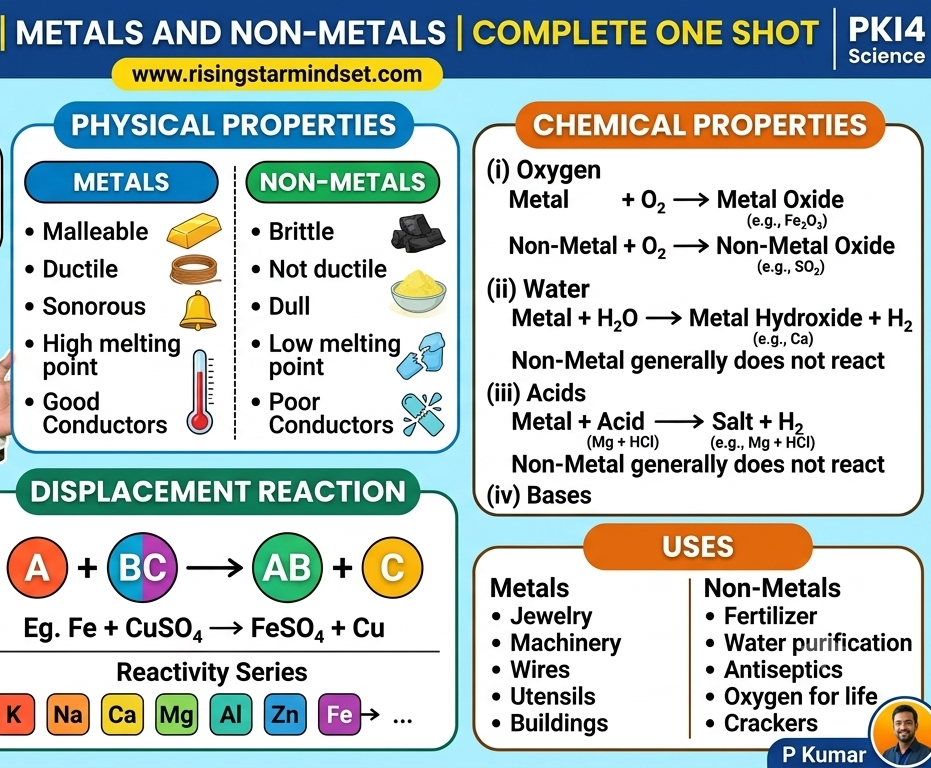
Important Concepts of Metals and Non-Metals (Class 8 Metals and Non-Metals )
| Metals (धातुएँ) | Non-Metals (अधातुएँ) |
|---|---|
| चमकदार होते हैं | सामान्यतः चमकदार नहीं होते |
| ऊष्मा एवं विद्युत के अच्छे चालक | ऊष्मा एवं विद्युत के कुचालक |
| तन्य (Ductile) होते हैं | तन्य नहीं होते |
| आघातवर्धनीय (Malleable) होते हैं | आघातवर्धनीय नहीं होते |
| ध्वन्यात्मक (Sonorous) होते हैं | ध्वन्यात्मक नहीं होते |
Important Examples
Metals: Iron, Copper, Aluminium, Silver, Gold, Zinc
Non-Metals: Sulphur, Carbon, Oxygen, Nitrogen, Phosphorus
MCQ Questions and Answers ( Class 8 Metals and Non-Metals )
1. Which metal is liquid at room temperature?
A) Iron
B) Copper
C) Mercury
D) Aluminium
✅ Answer: C) Mercury
2. Which of the following is a non-metal?
A) Iron
B) Copper
C) Sulphur
D) Zinc
✅ Answer: C) Sulphur
3. Metals are generally:
A) Soft and dull
B) Good conductors of electricity
C) Poor conductors of heat
D) Transparent
✅ Answer: B) Good conductors of electricity
4. Which property allows metals to be drawn into wires?
A) Malleability
B) Sonority
C) Ductility
D) Hardness
✅ Answer: C) Ductility
5. Which gas is produced when metals react with dilute acids?
A) Oxygen
B) Carbon dioxide
C) Hydrogen
D) Nitrogen
✅ Answer: C) Hydrogen
6. Which of the following is sonorous?
A) Sulphur
B) Phosphorus
C) Iron
D) Carbon
✅ Answer: C) Iron
7. The green coating on copper is known as:
A) Rust
B) Copper Sulphate
C) Basic Copper Carbonate
D) Copper Oxide
✅ Answer: C) Basic Copper Carbonate
8. Rusting occurs mainly in:
A) Copper
B) Gold
C) Iron
D) Silver
✅ Answer: C) Iron
9. Which non-metal is essential for respiration?
A) Nitrogen
B) Carbon
C) Oxygen
D) Sulphur
✅ Answer: C) Oxygen
10. Graphite is a good conductor of:
A) Heat only
B) Electricity only
C) Water
D) Air
✅ Answer: B) Electricity only
Short Answer Questions (2–3 Marks)
Q1. What are metals?
Answer:
Materials that are generally hard, shiny, sonorous, malleable and good conductors of heat and electricity are called metals.
Q2. Define non-metals.
Answer:
Substances that generally lack metallic properties such as lustre, malleability and conductivity are called non-metals.
Q3. What is rusting?
Answer:
The formation of a reddish-brown coating on iron due to the reaction of iron with oxygen and moisture is called rusting.
Q4. Why are copper and aluminium used in electrical wires?
Answer:
Copper and aluminium are good conductors of electricity and can be drawn into thin wires due to their ductility.
Q5. What is sonority?
Answer:
The property of producing a ringing sound when struck is called sonority.
Q6. Name two metals and two non-metals used in daily life.
Answer:
Metals:
- Iron
- Aluminium
Non-metals:
- Oxygen
- Carbon
Long Answer Questions (4–5 Marks) ( Class 8 )
Q1. Explain the physical properties of metals.
Answer:
Metals generally possess the following physical properties:
- Metals are lustrous (shiny).
- They are malleable.
- Metals are ductile.
- It conduct heat and electricity.
- They produce sound when struck.
- Most metals are hard and strong.
Examples: Iron, Copper, Silver, Gold.
Q2. Explain the physical properties of non-metals.
Answer:
Non-metals generally have the following properties:
- Non metals are dull in appearance.
- They are brittle.
- Non metals are not malleable.
- They are poor conductors of heat and electricity.
- And last they do not produce a ringing sound.
Examples: Sulphur, Carbon, Oxygen.
Q3. How do metals react with acids?
Answer:
When metals react with dilute acids, hydrogen gas is released and a salt is formed.
Example:
Metal + Acid → Salt + Hydrogen Gas
Iron + Hydrochloric Acid → Iron Chloride + Hydrogen
This reaction is commonly used to identify metals.
Q4. Why is oxygen important for living organisms?
Answer:
Oxygen is a non-metal that is essential for respiration. Living organisms use oxygen to break down food and release energy required for life processes. Without oxygen, survival is impossible for most organisms.
Extra Long Answer Questions (6–8 Marks)
Q1. Differentiate between metals and non-metals.
Answer:
| Property | Metals | Non-Metals |
| Appearance | Lustrous | Generally dull |
| Conductivity | Good conductors | Poor conductors |
| Malleability | Malleable | Brittle |
| Ductility | Ductile | Non-ductile |
| Sonority | Sonorous | Non-sonorous |
| State | Mostly solids | Solid, liquid or gas |
Examples:
Metals:
- Iron
- Copper
- Gold
Non-Metals:
- Oxygen
- Sulphur
- Carbon
Q2. Explain the uses of metals and non-metals in daily life.
Answer:
Uses of Metals
- Iron is used in construction.
- Copper is used in electrical wiring.
- Aluminium is used in utensils and aircraft.
- Gold and silver are used in jewellery.
- Steel is used in machines and vehicles.
Uses of Non-Metals
- Oxygen is used for breathing.
- Nitrogen is used in fertilizers.
- Carbon is used in fuels.
- Chlorine is used for water purification.
- Phosphorus is used in matchsticks and fertilizers.
Thus, both metals and non-metals play an important role in human life.
Q3. Describe rusting and methods to prevent it.
Answer:
Rusting is the process in which iron reacts with oxygen and moisture to form iron oxide.
Conditions Required:
- Presence of oxygen
- Presence of water or moisture
Harmful Effects:
- Weakens iron structures
- Damages bridges and vehicles
- Causes economic loss
Prevention Methods:
- Painting
- Oiling and greasing
- Galvanization
- Alloy formation
- Plastic coating
These methods protect iron from air and moisture.
Important Exam Tips
Learn definitions carefully.
Remember examples of metals and non-metals.
Understand properties instead of memorizing them.
Practice NCERT questions regularly.
Focus on rusting and its prevention.
Revise comparison tables before exams.
Conclusion
Metals and Non-Metals is one of the most important chapters of Class 8 Science. Understanding their properties, uses, and reactions helps students build a strong foundation for higher classes and competitive examinations. Regular practice of MCQs and descriptive questions can significantly improve exam performance.
📚 Keep Learning with Rising Star Mindset
For more NCERT Notes, MCQs, Question Banks, One-Shot Revision Notes, BPSC/UPSC Study Materials, Science Notes, Mathematics Formulas, and Daily Quiz Updates, regularly visit:
Stay connected with Rising Star Mindset and make your learning journey smarter, stronger, and more successful!
1 thought on “Class 8 Metals and Non-Metals Most Important Questions”