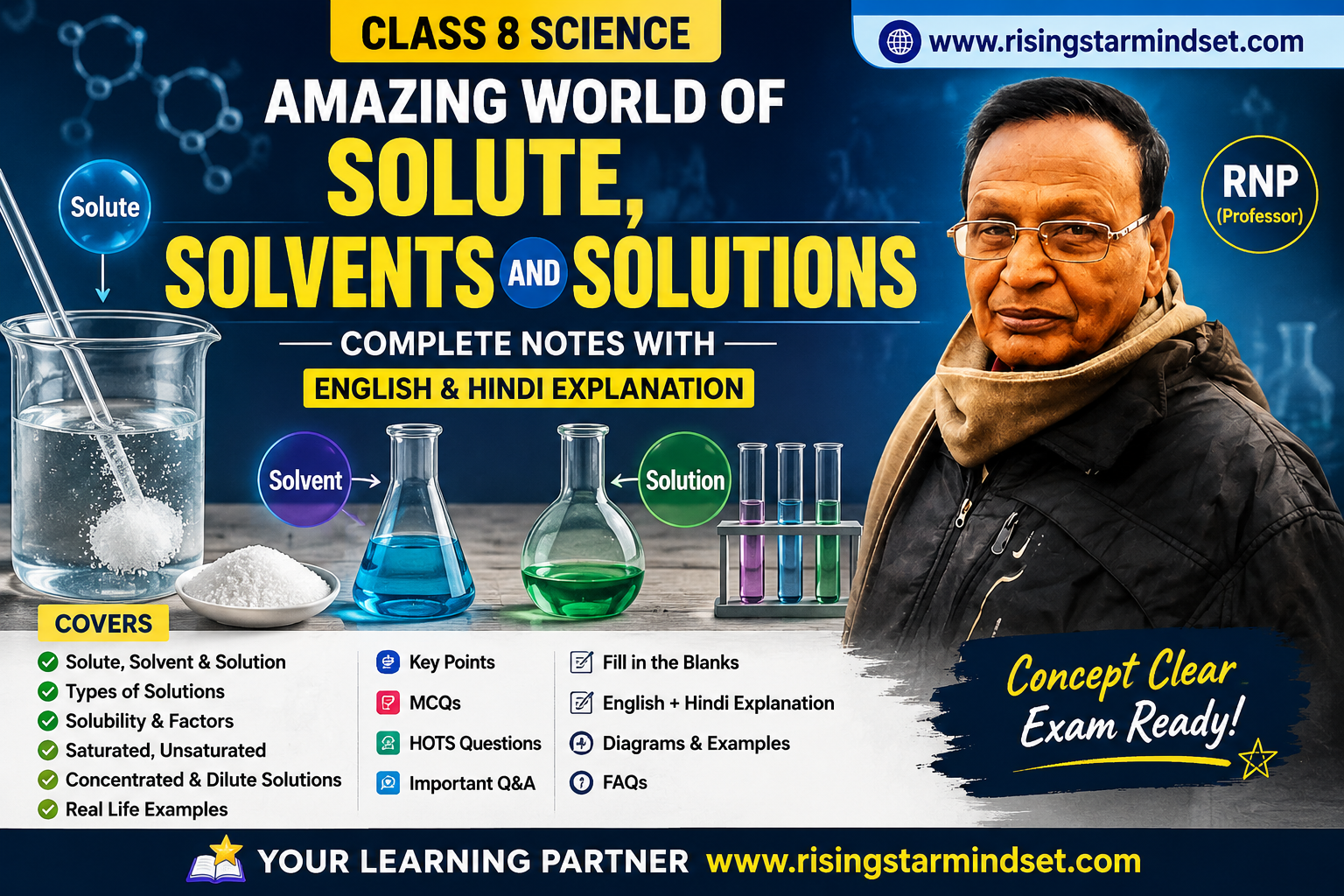
Amazing World of Solute Solvents and Solutions Class 8 Notes
(English + Hindi Explanation)
Understanding solute, solvent, and solution is the foundation of chemistry. We see solutions everywhere in our daily life—from sugar dissolved in tea to salt dissolved in water. This chapter explains how substances mix together and what factors affect the process of dissolving.( Amazing World of Solute Solvents and Solutions Class 8 ) PREVIOUS TOPIC: NATURE OF MATTER
यह अध्याय घुलनशील पदार्थ (Solute), विलायक (Solvent) और विलयन (Solution) के बारे में बताता है। हमारे दैनिक जीवन में चाय, नींबू पानी, शरबत, दवा आदि सभी विलयन के उदाहरण हैं।
Table of Contents ( Amazing World of Solute Solvents and Solutions Class 8 )
- Introduction
- What is Solute?
- Define Solvent
- What is Solution?
- Types of Solutions
- Solubility
- Factors Affecting Solubility
- Saturated and Unsaturated Solutions
- Concentrated and Dilute Solutions
- Everyday Examples
- Abbreviations
- Key Points
- MCQs
- HOTS Questions
- Important Questions & Answers
- Fill in the Blanks
- FAQs
- Conclusion
Introduction ( Amazing World of Solute Solvents and Solutions Class 8 )
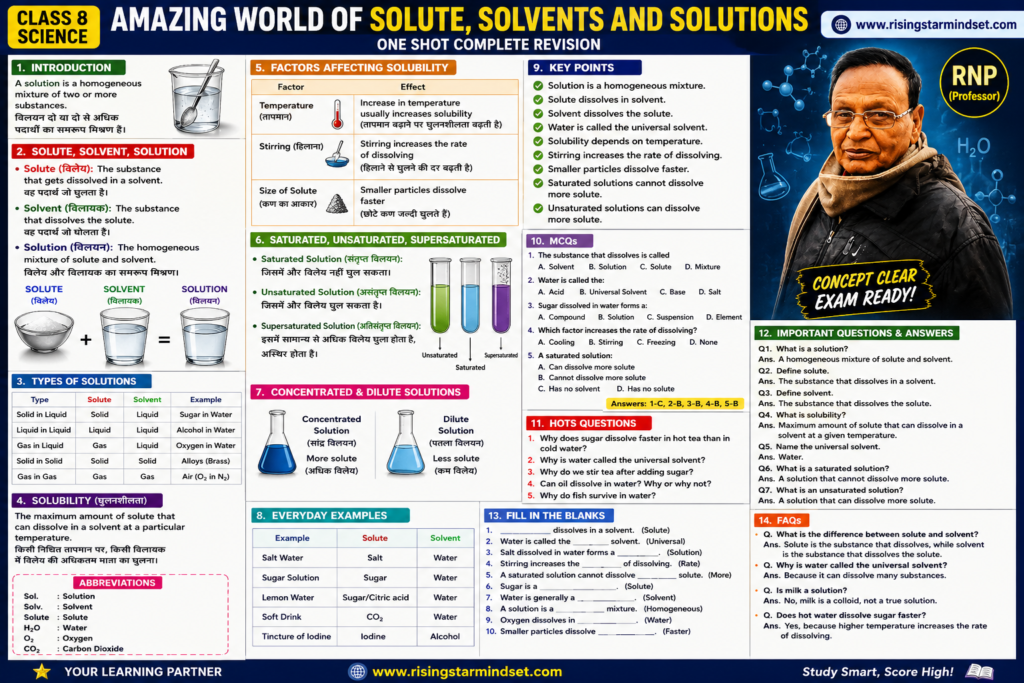
A solution is formed when one substance dissolves in another.
जब एक पदार्थ दूसरे पदार्थ में घुल जाता है, तब विलयन (Solution) बनता है।
Example:
- Sugar + Water = Sugar Solution
- Salt + Water = Salt Solution
What is Solute?
English
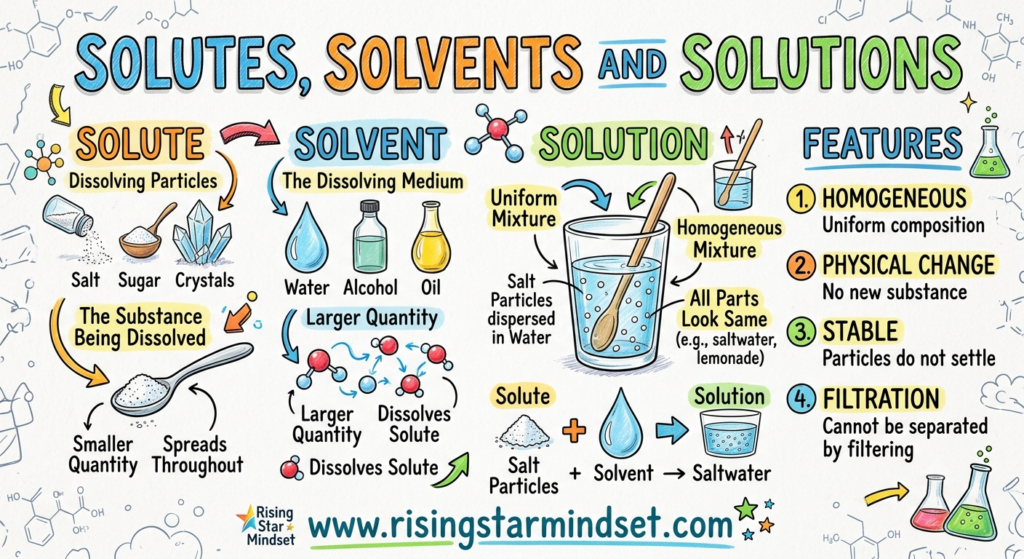
A solute is the substance that gets dissolved in a solvent.
Hindi
जो पदार्थ घुलता है उसे विलेय (Solute) कहते हैं।
Examples
- Sugar
- Salt
- Glucose
- Copper Sulphate
What is Solvent?
English
A solvent is the substance that dissolves the solute.
Hindi
जो पदार्थ दूसरे पदार्थ को घोलता है, उसे विलायक (Solvent) कहते हैं।
Examples
- Water
- Alcohol
- Petrol
- Acetone
Water is known as the Universal Solvent because it dissolves many substances.
जल को सार्वत्रिक विलायक (Universal Solvent) कहा जाता है।
What is Solution?
English
A solution is a homogeneous mixture of solute and solvent.
Hindi
विलेय तथा विलायक के समान मिश्रण को विलयन (Solution) कहते हैं।
Example
Salt + Water = Salt Solution
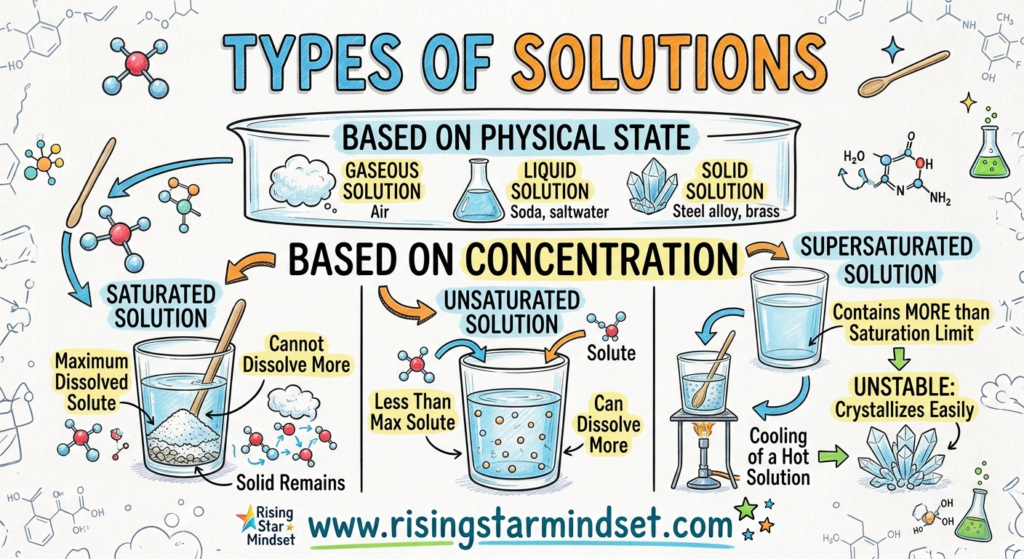
Types of Solutions
| Type | English | Hindi | Example |
|---|---|---|---|
| Solid in Liquid | Sugar in water | ठोस + द्रव | Sugar Solution |
| Liquid in Liquid | Alcohol in water | द्रव + द्रव | Alcohol Solution |
| Gas in Liquid | Oxygen in water | गैस + द्रव | Aquatic Water |
Solubility
English
Solubility is the maximum amount of solute that can dissolve in a solvent at a particular temperature.
Hindi
किसी निश्चित तापमान पर किसी विलायक में घुलने वाली विलेय की अधिकतम मात्रा को घुलनशीलता (Solubility) कहते हैं।
Factors Affecting Solubility
| Factor | Effect |
|---|---|
| Temperature | Higher temperature usually increases solubility. |
| Stirring | Faster dissolving |
| Size of Solute | Smaller particles dissolve faster. |
Hindi
- तापमान बढ़ाने पर घुलनशीलता बढ़ती है।
- हिलाने से पदार्थ जल्दी घुलता है।
- छोटे कण जल्दी घुलते हैं।
Saturated Solution
English
A solution that cannot dissolve any more solute is called a saturated solution.
Hindi
जिस विलयन में और अधिक विलेय नहीं घुल सकता, उसे संतृप्त विलयन कहते हैं।
Unsaturated Solution
English
A solution that can dissolve more solute is called an unsaturated solution.
Hindi
जिस विलयन में अभी और विलेय घुल सकता है, उसे असंतृप्त विलयन कहते हैं।
Concentrated Solution
Contains a large amount of solute.
इसमें विलेय अधिक मात्रा में होता है।
Dilute Solution
Contains a small amount of solute.
इसमें विलेय कम मात्रा में होता है।
Everyday Examples
| Example | Solute | Solvent |
|---|---|---|
| Tea | Sugar | Water |
| Lemon Water | Sugar | Water |
| Salt Water | Salt | Water |
| Soft Drink | Carbon dioxide | Water |
Abbreviations ( Amazing World of Solute Solvents and Solutions Class 8 )
| Abbreviation | Full Form |
|---|---|
| Sol. | Solution |
| Solv. | Solvent |
| Sol. (Chem.) | Solute |
| H₂O | Water |
| CO₂ | Carbon Dioxide |
| O₂ | Oxygen |
Key Points ( Amazing World of Solute Solvents and Solutions Class 8 )
- Solution is a homogeneous mixture.
- Solute dissolves.
- Solvent dissolves the solute.
- Water is the universal solvent.
- Solubility depends upon temperature.
- Stirring increases dissolving speed.
- Saturated solutions cannot dissolve more solute.
- Unsaturated solutions can dissolve more solute.
MCQs ( Amazing World of Solute Solvents and Solutions Class 8 )
1. The substance that dissolves is called
A. Solvent
B. Solution
C. Solute
D. Mixture
Answer: C
2. Water is called
A. Acid
B. Universal Solvent
C. Base
D. Salt
Answer: B
3. Sugar dissolved in water forms
A. Compound
B. Solution
C. Suspension
D. Element
Answer: B
4. Which factor increases dissolving?
A. Cooling
B. Stirring
C. Freezing
D. None
Answer: B
5. Salt is a
A. Solvent
B. Solute
C. Gas
D. Liquid
Answer: B
6. Which is a solvent?
A. Sugar
B. Salt
C. Water
D. Sand
Answer: C
7. A saturated solution
A. Can dissolve more solute
B. Cannot dissolve more solute
C. Has no solvent
D. Has no solute
Answer: B
8. Small particles dissolve
A. Slowly
B. Faster
C. Never
D. None
Answer: B
9. Oxygen dissolved in water helps
A. Humans
B. Fish
C. Plants only
D. Rocks
Answer: B
10. Lemon water is an example of
A. Solution
B. Compound
C. Element
D. Suspension
Answer: A
HOTS Questions
Q1.
Why does sugar dissolve faster in hot tea than in cold water?
Answer:
Because higher temperature increases the rate of dissolving.
Q2.
Why is water called the universal solvent?
Answer:
Because it dissolves many different substances.
Q3.
Why do we stir tea after adding sugar?
Answer:
To increase the rate of dissolving.
Q4.
Can oil dissolve in water? Why?
Answer:
No. Oil is insoluble in water.
Q5.
Why do fish survive in water?
Answer:
Because oxygen is dissolved in water.
Important Questions and Answers
Q1. What is a solution?
Answer:
A homogeneous mixture of solute and solvent.
Q2. Define solute.
Answer:
The substance that dissolves.
Q3. Define solvent.
Answer:
The substance that dissolves the solute.
Q4. What is solubility?
Answer:
Maximum amount of solute dissolved at a given temperature.
Q5. Give two examples of solutions.
Answer:
- Sugar solution
- Salt solution
Q6. Name the universal solvent.
Answer:
Water.
Q7. What is a saturated solution?
Answer:
A solution that cannot dissolve more solute.
Q8. What is an unsaturated solution?
Answer:
A solution that can dissolve more solute.
Fill in the Blanks
- ______ dissolves in a solvent. (Solute)
- Water is called the ______ solvent. (Universal)
- Salt dissolved in water forms a ______. (Solution)
- Stirring increases the ______ of dissolving. (Rate)
- A saturated solution cannot dissolve ______ solute. (More)
- Sugar is a ______. (Solute)
- Water is generally a ______. (Solvent)
- A solution is a ______ mixture. (Homogeneous)
- Oxygen dissolves in ______. (Water)
- Smaller particles dissolve ______. (Faster)
Frequently Asked Questions (FAQs)
1. What is the difference between solute and solvent?
A solute is the substance that gets dissolved, while a solvent is the substance that dissolves the solute.
विलेय घुलता है, जबकि विलायक उसे घोलता है।
2. Why is water called the universal solvent?
Because it can dissolve many substances.
3. What is a solution?
A homogeneous mixture of solute and solvent.
4. What is a saturated solution?
A solution that cannot dissolve any more solute.
5. Name three examples of solutions.
- Salt water
- Sugar water
- Lemon water
6. What affects solubility?
- Temperature
- Stirring
- Particle size
7. Does hot water dissolve sugar faster?
Yes.
8. Is milk a solution?
Milk is a colloid, not a true solution.
Conclusion
The chapter Amazing World of Solute, Solvents and Solutions helps students understand how substances dissolve to form homogeneous mixtures and introduces key concepts such as solute, solvent, solution, solubility, saturated solution, and unsaturated solution. Mastering these basics is essential for higher-level chemistry and for understanding many everyday phenomena.
Keep Learning, Keep Growing! 🚀
P Kumar | Rising Star Mindset
www.risingstarmindset.com
Together We Will Make The Difference