

Chandrayaan-1: How India’s First Moon Mission Changed Lunar Science | चंद्रयान-1 की ऐतिहासिक कहानी

A special science and history feature by Rising Star Mindset (Chandrayaan-1)
On 22 October 2008, India took an important step towards exploring the Moon. But what makes Chandrayaan-1 truly remarkable is not just its journey into space—it is the scientific knowledge it helped uncover.
चंद्रयान-1 की कहानी सिर्फ अंतरिक्ष में पहुँचने की कहानी नहीं है। यह उस जिज्ञासा, मेहनत और वैज्ञानिक सोच की कहानी है, जिसने चंद्रमा के बारे में हमारी समझ को बेहतर बनाया।
1. The Big Question: What Was India Looking for on the Moon? ( Chandrayaan-1 )

Imagine looking at the Moon every night and wondering: What lies beneath its craters? What minerals are present on its surface? Could there be signs of water?
These were some of the questions that made lunar exploration important.
Chandrayaan-1 was India’s first mission to the Moon, developed by the Indian Space Research Organisation (ISRO). Its scientific instruments were designed to map the lunar surface and study its chemical and mineral composition.
हिंदी में समझें: चंद्रयान-1 का उद्देश्य केवल चंद्रमा की तस्वीरें लेना नहीं था। इसके जरिए वैज्ञानिक चंद्रमा की सतह, वहाँ मौजूद खनिजों और उसकी भौगोलिक संरचना का अध्ययन करना चाहते थे।
The mission also contributed significantly to scientific evidence of water and hydroxyl molecules on the Moon.
2. Chandrayaan-1 at a Glance | एक नजर में चंद्रयान-1
| Mission Detail | जानकारी |
| Mission name | Chandrayaan-1 |
| Launch date | 22 October 2008 |
| Launch vehicle | PSLV-C11 |
| Launch location | Satish Dhawan Space Centre, Sriharikota |
| Space agency | ISRO |
| Scientific instruments | 11 |
| Lunar orbit | Approximately 100 km above the Moon initially |
| Major scientific contribution | Evidence of water and hydroxyl molecules on the lunar surface |
These details are based on ISRO’s official mission information.
3. The Journey: From Earth to the Moon | पृथ्वी से चंद्रमा तक का सफर

22 October 2008 — The Beginning
Chandrayaan-1 was launched aboard the PSLV-C11 rocket from Sriharikota.
हिंदी: इसी दिन भारत ने अपने पहले चंद्र मिशन को अंतरिक्ष में भेजा। यह भारतीय अंतरिक्ष अनुसंधान के इतिहास में एक महत्वपूर्ण उपलब्धि थी।
8 November 2008 — Reaching Lunar Orbit
The spacecraft entered lunar orbit, bringing it closer to the scientific observations it was designed to perform.
हिंदी: चंद्रमा की कक्षा में पहुँचने के बाद यान ने अपने वैज्ञानिक उपकरणों की मदद से चंद्रमा का अध्ययन शुरू किया।
14 November 2008 — A Historic Moment
Chandrayaan-1 released its Moon Impact Probe, which struck the lunar surface near the south polar region.
The probe carried the Indian tricolour as part of the mission.
हिंदी: इस चरण ने भारत की चंद्र अन्वेषण यात्रा को एक नई पहचान दी। चंद्रमा की सतह के बारे में महत्वपूर्ण जानकारी जुटाने में इस मिशन ने योगदान दिया।
2009 — Scientific Findings
Data collected by Chandrayaan-1 instruments helped scientists establish evidence of water-related molecules on the lunar surface.
हिंदी: चंद्रयान-1 से प्राप्त वैज्ञानिक आँकड़ों ने चंद्रमा पर पानी से संबंधित अणुओं के प्रमाण को मजबूत करने में महत्वपूर्ण भूमिका निभाई।
Source: ISRO mission records and NASA’s चंद्रयान-1 mission overview.
4. The Discovery That Changed Our Understanding | पानी से जुड़ी महत्वपूर्ण खोज

For many years, scientists investigated whether the Moon was completely dry or contained water-related substances.
चंद्रयान-1 carried instruments that helped scientists detect evidence of water and hydroxyl molecules on the lunar surface. NASA’s Moon Mineralogy Mapper, one of the instruments aboard the mission, played an important role in this finding.
हिंदी में समझें: चंद्रमा पर पानी की खोज का अर्थ यह नहीं है कि वहाँ पृथ्वी की तरह नदियाँ और झीलें मौजूद हैं। वैज्ञानिकों ने चंद्रमा की सतह पर पानी और हाइड्रॉक्सिल से संबंधित अणुओं के प्रमाण पाए। पानी किस रूप में मौजूद है और कहाँ पाया जा सकता है, यह वैज्ञानिक अध्ययन का अलग विषय है।
This discovery helped reshape scientific thinking about the Moon and future lunar exploration.
5. Five Interesting Facts About Chandrayaan-1
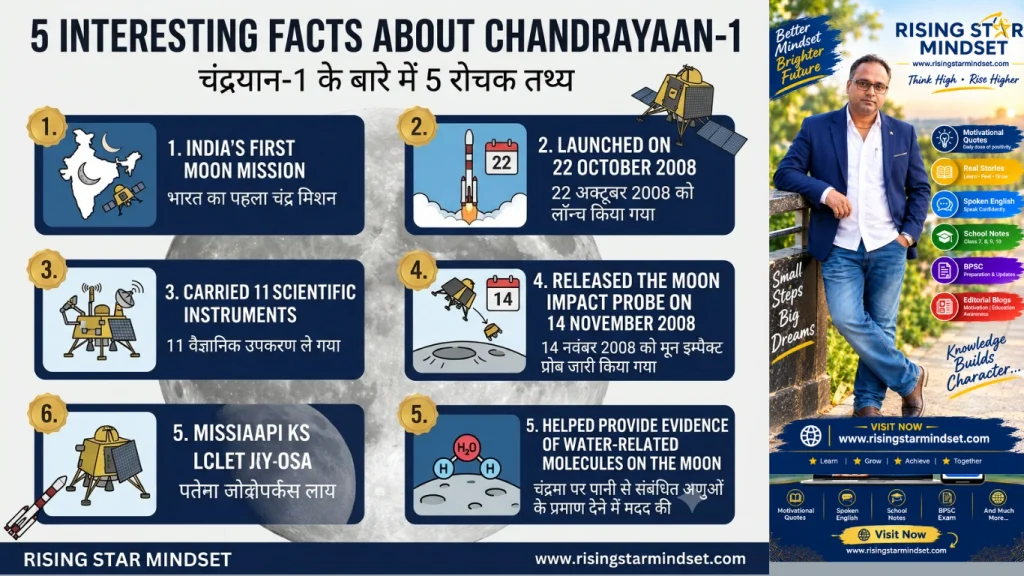
Fact 1: It was India’s first lunar mission.
भारत ने पहली बार अपना चंद्र मिशन भेजकर चंद्रमा के वैज्ञानिक अध्ययन में कदम रखा।
Fact 2: The spacecraft carried 11 scientific instruments.
इन उपकरणों को भारत और अन्य देशों के वैज्ञानिकों ने विकसित किया था।
Fact 3: It studied the Moon from orbit.
यान ने चंद्रमा की सतह का मानचित्रण और वैज्ञानिक अवलोकन किया।
Fact 4: The mission helped provide evidence of lunar water.
इससे चंद्रमा पर पानी से संबंधित अणुओं के प्रमाण सामने आए।
Fact 5: Its work supported future space exploration.
चंद्रयान-1 से प्राप्त अनुभव और वैज्ञानिक आँकड़े भविष्य के चंद्र अभियानों के लिए उपयोगी साबित हुए।
6. English Vocabulary: Learn Through Space Science

| English Word | Hindi Meaning | Example Sentence |
| Exploration | खोज / अन्वेषण | Space exploration helps us understand the universe. |
| Discovery | खोज | The discovery changed scientific thinking. |
| Orbit | कक्षा | The spacecraft entered the Moon’s orbit. |
| Surface | सतह | Scientists studied the lunar surface. |
| Evidence | प्रमाण | Researchers examined the evidence carefully. |
| Mission | अभियान | Chandrayaan-1 was a historic mission. |
Speaking practice: Read these sentences aloud and try to explain each one in your own words. इससे आपकी English reading, vocabulary और speaking confidence को बेहतर बनाने में मदद मिल सकती है।
7. What Can Students Learn from Chandrayaan-1?

Chandrayaan-1 teaches us three important lessons:
1. Ask questions. Scientific progress begins with curiosity.
2. Learn from evidence. Good science depends on observation, testing and reliable data.
3. Keep improving. Every mission contributes experience that can help future research.
हिंदी: चंद्रयान-1 हमें सिखाता है कि बड़े लक्ष्य हासिल करने के लिए सवाल पूछना, प्रमाणों के आधार पर सीखना और लगातार सुधार करना जरूरी है। यही सिद्धांत पढ़ाई, करियर और जीवन में भी उपयोगी हैं।
8. Frequently Asked Questions (FAQs) (Chandrayaan-1)

When was Chandrayaan-1 launched?
Chandrayaan-1 was launched on 22 October 2008.
चंद्रयान-1 किसने बनाया था?
चंद्रयान-1 भारतीय अंतरिक्ष अनुसंधान संगठन (ISRO) के नेतृत्व में विकसित किया गया था।
Did Chandrayaan-1 discover water on the Moon?
The mission provided important scientific evidence of water and hydroxyl molecules on the lunar surface. NASA’s Moon Mineralogy Mapper played a key role in this finding.
चंद्रयान-1 का मिशन कब समाप्त हुआ?
यान से संपर्क 29 अगस्त 2009 को खो गया था। इस समय तक मिशन अपने कई प्रमुख वैज्ञानिक उद्देश्यों को पूरा कर चुका था।
Why is Chandrayaan-1 important today?
Its scientific findings and mission experience helped advance lunar science and contributed to the knowledge base for later exploration.
Conclusion: A Mission That Inspired a Nation

Chandrayaan-1 reminds us that scientific achievements begin with curiosity and grow through careful research, teamwork and determination.
चंद्रयान-1 ने दिखाया कि अंतरिक्ष की खोज केवल तकनीक की उपलब्धि नहीं, बल्कि ज्ञान की सीमाओं को आगे बढ़ाने का प्रयास भी है।
At Rising Star Mindset, we believe that every great discovery begins with a question—and every curious mind has the potential to learn something extraordinary.
Think High • Rise Higher
Visit: https://risingstarmindset.com/
Official Sources & Further Reading
- ISRO — Chandrayaan-1 mission
- ISRO — Chandrayaan-1 science and findings:
- NASA — Chandrayaan-1 / Moon Impact Probe
🌐 Website: www.risingstarmindset.com