

Nature of Matter Class 8 Notes | Complete Hindi & English Guide
Introduction | परिचय
Everything around us is made of matter. The air we breathe, water we drink, books, trees, animals, and even our body are all made of matter. ( Nature of Matter Class 8 )
हमारे आसपास की प्रत्येक वस्तु पदार्थ (Matter) से बनी होती है। हवा, पानी, पेड़-पौधे, जानवर, किताबें तथा हमारा शरीर भी पदार्थ से बने हैं।
Understanding the Nature of Matter helps students learn Physics and Chemistry in an easy way. PREVIOUS TOPIC : FRICTIONS
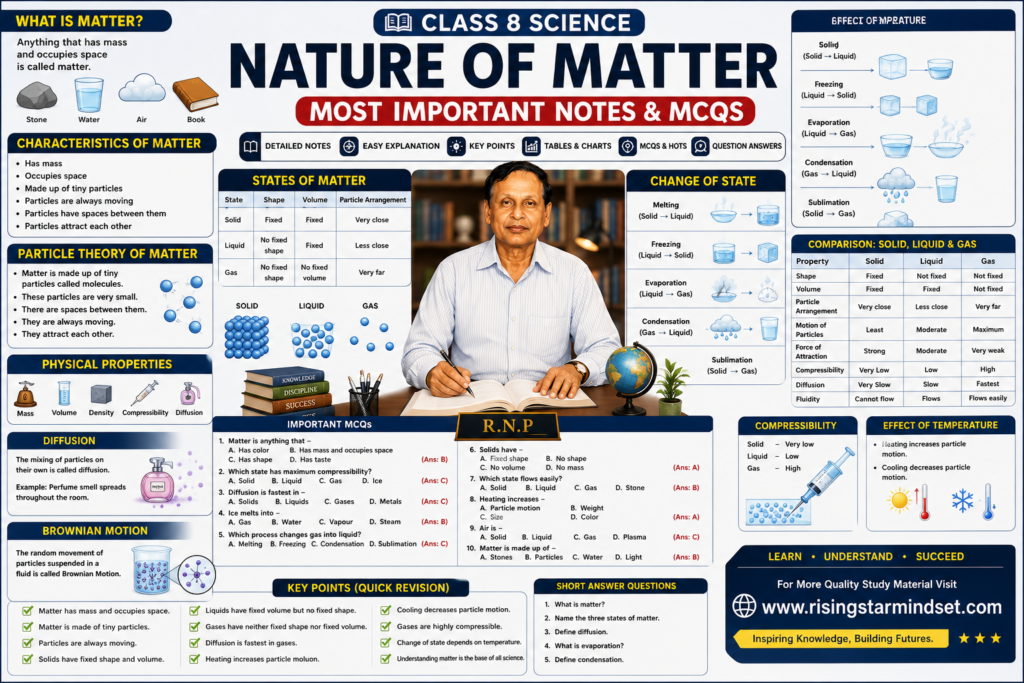
Table of Contents ( Nature of Matter Class 8 )
- What is Matter?
- Characteristics of Matter
- Particle Theory of Matter
- States of Matter
- Physical Properties
- Changes in States of Matter
- Diffusion
- Brownian Motion
- Compressibility
- Comparison Table
- Abbreviations
- Key Points
- Important MCQs
- HOTS Questions
- Short & Long Questions
- Frequently Asked Questions
- Conclusion
What is Matter? | पदार्थ क्या है?
English
Matter is anything that has mass and occupies space.
हिन्दी
जो वस्तु द्रव्यमान (Mass) रखती है तथा स्थान (Space) घेरती है, उसे पदार्थ (Matter) कहते हैं।
Examples
- Air (हवा)
- Water (पानी)
- Stone (पत्थर)
- Wood (लकड़ी)
- Iron (लोहा)
Characteristics of Matter | पदार्थ के गुण
| English | हिन्दी |
|---|---|
| Has mass | द्रव्यमान होता है |
| Occupies space | स्थान घेरता है |
| Made of tiny particles | सूक्ष्म कणों से बना होता है |
| Particles are always moving | कण लगातार गति करते हैं |
| Particles attract each other | कणों में आकर्षण बल होता है |
Particle Theory of Matter | पदार्थ का कण सिद्धांत
English
Matter is made up of tiny particles called molecules or atoms.
These particles
- are very small
- have spaces between them
- are always moving
- attract each other
हिन्दी
पदार्थ अत्यंत छोटे-छोटे कणों से बना होता है।
इन कणों की विशेषताएँ—
- बहुत छोटे होते हैं।
- इनके बीच रिक्त स्थान होता है।
- लगातार गति करते हैं।
- एक-दूसरे को आकर्षित करते हैं।
States of Matter | पदार्थ की अवस्थाएँ
| State | Shape | Volume | Particle Arrangement |
|---|---|---|---|
| Solid | Fixed | Fixed | Very close |
| Liquid | No fixed shape | Fixed | Less close |
| Gas | No fixed shape | No fixed volume | Very far |
हिन्दी
ठोस (Solid)
- निश्चित आकार
- निश्चित आयतन
- कण बहुत पास-पास
द्रव (Liquid)
- आकार निश्चित नहीं
- आयतन निश्चित
- कण थोड़े दूर
गैस (Gas)
- आकार नहीं
- आयतन नहीं
- कण बहुत दूर
Physical Properties of Matter
English
- Mass
- Volume
- Density
- Compressibility
- Diffusion
हिन्दी
- द्रव्यमान
- आयतन
- घनत्व
- संपीड्यता
- विसरण
Change of State
| Process | From | To |
|---|---|---|
| Melting | Solid | Liquid |
| Freezing | Liquid | Solid |
| Evaporation | Liquid | Gas |
| Condensation | Gas | Liquid |
| Sublimation | Solid | Gas |
हिन्दी
- गलन
- जमना
- वाष्पीकरण
- संघनन
- ऊर्ध्वपातन
Diffusion | विसरण
English
The mixing of particles on their own is called diffusion.
Example
Perfume smell spreads throughout the room.
हिन्दी
कणों का स्वतः मिलना विसरण कहलाता है।
उदाहरण—
इत्र की खुशबू पूरे कमरे में फैल जाती है।
Brownian Motion
Random movement of particles suspended in a fluid.
हिन्दी
द्रव या गैस में कणों की अनियमित गति को ब्राउनियन गति कहते हैं।
Compressibility
| Matter | Compressibility |
|---|---|
| Solid | Very low |
| Liquid | Low |
| Gas | High |
Comparison Between Solid, Liquid and Gas
| Property | Solid | Liquid | Gas |
|---|---|---|---|
| Shape | Fixed | Not fixed | Not fixed |
| Volume | Fixed | Fixed | Not fixed |
| Motion | Least | Moderate | Maximum |
| Force of attraction | High | Medium | Low |
| Compressibility | Very low | Low | High |
Important Abbreviations
| Abbreviation | Full Form |
|---|---|
| SI | International System of Units |
| kg | Kilogram |
| g | Gram |
| cm | Centimetre |
| m | Metre |
| L | Litre |
| mL | Millilitre |
Key Points (Exam Revision)
| Matter has mass and occupies space. |
| Matter is made of tiny particles. |
| Particles are always moving. |
| Solids have fixed shape. |
| Liquids flow. |
| Gases are highly compressible. |
| Diffusion is fastest in gases. |
| Heating increases particle motion. |
Important MCQs ( Nature of Matter Class 8 )
1. Matter is anything that
A. Has colour
B. Has mass and occupies space
C. Has smell
D. Has taste
✅ Answer: B
2. Which state has maximum compressibility?
A. Solid
B. Liquid
C. Gas
D. Ice
✅ Answer: C
3. Diffusion is fastest in
A. Solids
B. Liquids
C. Gases
D. Metals
✅ Answer: C
4. Ice melts into
A. Gas
B. Water
C. Vapour
D. Steam
✅ Answer: B
5. Matter is made up of
A. Stones
B. Particles
C. Water
D. Light
✅ Answer: B
6. Which process changes gas into liquid?
A. Melting
B. Freezing
C. Condensation
D. Sublimation
✅ Answer: C
7. Solids have
A. Fixed shape
B. No shape
C. No volume
D. None
✅ Answer: A
8. Which state flows easily?
A. Stone
B. Iron
C. Liquid
D. Wood
✅ Answer: C
9. Heating increases
A. Particle motion
B. Weight
C. Size
D. Colour
✅ Answer: A
10. Air is
A. Solid
B. Liquid
C. Gas
D. Plasma
✅ Answer: C
HOTS Questions
Q1
Why does perfume spread faster in summer?
Answer
Higher temperature increases particle movement and diffusion.
हिन्दी
गर्मी में कण अधिक तेजी से चलते हैं, इसलिए खुशबू जल्दी फैलती है।
Q2
Why are gases easily compressed?
Answer
Gas particles have large empty spaces.
Q3
Why does ice float on water?
Answer
Ice has lower density than water.
Q4
Why does wet cloth dry faster on a windy day?
Answer
Wind increases evaporation.
Q5
Why can LPG be stored in cylinders?
Answer
Because gases can be compressed.
Short Answer Questions
Q1 What is matter?
Matter is anything having mass and occupying space.
Q2 Name three states of matter.
Solid, Liquid and Gas.
Q3 Define diffusion.
Diffusion is the spontaneous mixing of particles.
Q4 What is evaporation?
Liquid changing into gas.
Q5 Define condensation.
Gas changing into liquid.
Long Answer Questions
Explain the Particle Theory of Matter.
Matter consists of tiny particles.
The particles have spaces.
They are always moving.
They attract one another.
Their motion increases with temperature.
Compare Solids, Liquids and Gases.
- Shape
- Volume
- Motion
- Compressibility
- Force of attraction
Frequently Asked Questions (FAQs)
What is matter?
Matter is anything having mass and occupying space.
What are the three states of matter?
Solid, Liquid and Gas.
Which state diffuses fastest?
Gas.
Why do gases occupy the whole container?
Because their particles move freely in all directions.
What is the SI unit of mass?
Kilogram (kg).
Conclusion ( Nature of Matter Class 8 )
Matter forms the basis of everything around us. Understanding its particle nature, physical properties, and states helps students build a strong foundation for higher science studies. By revising the key points, comparison tables, MCQs, HOTS, and question answers regularly, Class 8 students can confidently prepare for school exams, Olympiads, and other competitive tests.
Keep Learning, Keep Growing! 🚀
P Kumar | Rising Star Mindset
www.risingstarmindset.com
Together We Will Make The Difference