
Geography Series – Part 14
Indian Rivers, Soil and Agriculture Complete Notes for BPSC
Series Name: Geography Series ( Indian Rivers Soil Agriculture )
Part No.: 14
Previous Topic: Atmosphere, Winds & Climate
Current Topic: Indian Rivers, Soil & Agriculture
Next Topic: Industries
Table of Contents ( Indian Rivers Soil Agriculture )
- Introduction
- Indian Rivers (भारतीय नदियाँ)
- Classification of Indian Rivers
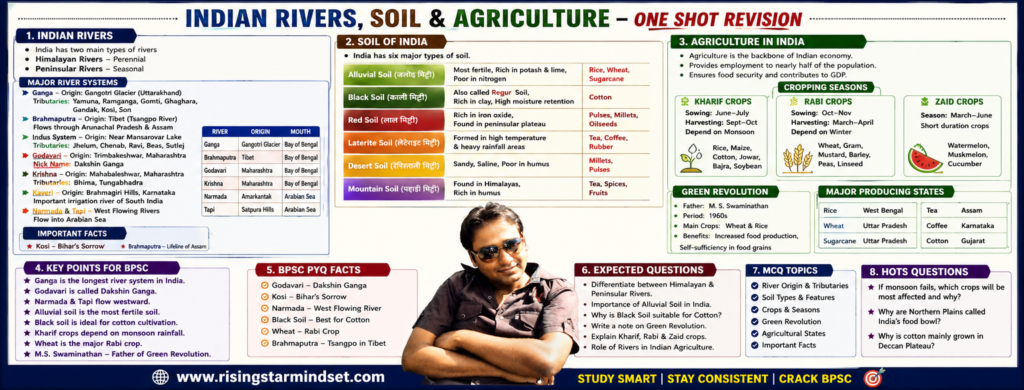
- Major River Systems of India
- Important Facts About Rivers
- Soil of India (भारत की मिट्टी)
- Types of Soil in India
- Agriculture in India (भारतीय कृषि)
- Cropping Seasons
- Green Revolution
- Agriculture and Economy
- Important Abbreviations
- Key Points for BPSC
- BPSC Previous Year Questions (PYQ)
- Expected Questions for BPSC
- HOTS Questions
- MCQs Practice Set
- FAQs
- Conclusion
Introduction ( Indian Rivers Soil Agriculture )
India is an agricultural country. Rivers provide water for farming and daily life. Soil supports crop growth. Agriculture gives jobs to millions of people.
First, let us understand the river systems of India. Next, we will study different soil types. Finally, we will discuss agriculture.
हिंदी में:
भारत एक कृषि प्रधान देश है जहाँ नदियाँ, मिट्टी और कृषि देश की अर्थव्यवस्था की रीढ़ हैं। नदियाँ जल उपलब्ध कराती हैं, मिट्टी फसलों को पोषण देती है और कृषि करोड़ों लोगों को रोजगार प्रदान करती है।
1. Indian Rivers (भारतीय नदियाँ) ( Indian Rivers Soil Agriculture )
What is a River?
A river is a natural flowing stream of water moving towards an ocean, sea, lake, or another river.
नदी क्या है?
नदी जल की एक प्राकृतिक धारा है जो किसी समुद्र, झील या अन्य नदी में जाकर मिलती है।
Classification of Indian Rivers ( Indian Rivers Soil Agriculture )
1. Himalayan Rivers
- Perennial (flow throughout the year)
- Snow-fed and rain-fed
- Large drainage basin
Examples
- Ganga
- Yamuna
- Brahmaputra
- Indus
2. Peninsular Rivers
- Seasonal in nature
- Depend mainly on rainfall
- Older rivers with broad valleys
Examples
- Godavari
- Krishna
- Kaveri
- Mahanadi
- Narmada
- Tapi
Major River Systems of India ( Indian Rivers Soil Agriculture )
Ganga River System
Origin
Gangotri Glacier (Uttarakhand)
Length
Approximately 2525 km
Tributaries
Left Bank
- Ramganga
- Gomti
- Ghaghara
- Gandak
- Kosi
Right Bank
- Yamuna
- Son
Importance
- Most fertile plain of India
- Supports dense population
Brahmaputra River
Origin
Tibet (Tsangpo River)
States
- Arunachal Pradesh
- Assam
Important Fact
Known as the “Lifeline of Assam.”
Indus River
Origin
Tibet near Mansarovar Lake
Tributaries
- Jhelum
- Chenab
- Ravi
- Beas
- Sutlej
Godavari River
Origin
Trimbakeshwar, Maharashtra
Length
1465 km
Nickname
Dakshin Ganga (Ganga of South India)
Krishna River
Origin
Mahabaleshwar, Maharashtra
Tributaries
- Bhima
- Tungabhadra
Kaveri River
Origin
Brahmagiri Hills, Karnataka
Importance
Important irrigation river of South India.
Important River Facts ( Indian Rivers Soil Agriculture )
| River | Origin | Mouth |
|---|---|---|
| Ganga | Gangotri Glacier | Bay of Bengal |
| Brahmaputra | Tibet | Bay of Bengal |
| Godavari | Maharashtra | Bay of Bengal |
| Krishna | Maharashtra | Bay of Bengal |
| Narmada | Amarkantak | Arabian Sea |
| Tapi | Satpura Hills | Arabian Sea |
2. Soil of India (भारत की मिट्टी)
Definition
Soil is the uppermost layer of the earth that supports plant growth.
मिट्टी पृथ्वी की ऊपरी परत है जिसमें पौधे उगते हैं।
Types of Soil in India ( Indian Rivers Soil Agriculture )
1. Alluvial Soil (जलोढ़ मिट्टी)
Features
- Most fertile soil
- Rich in potash and lime
- Poor in nitrogen
Found In
- Northern Plains
- River valleys
Crops
- Rice
- Wheat
- Sugarcane
2. Black Soil (काली मिट्टी)
Also Called
Regur Soil
Found In
- Maharashtra
- Gujarat
- Madhya Pradesh
Suitable For
Cotton cultivation
Special Feature
High moisture retention capacity.
3. Red Soil (लाल मिट्टी)
Found In
- Tamil Nadu
- Karnataka
- Andhra Pradesh
Rich In
Iron oxide
4. Laterite Soil
Found In
- Western Ghats
- Eastern Ghats
Crops
- Tea
- Coffee
- Rubber
5. Desert Soil
Found In
- Rajasthan
Characteristics
- Sandy
- Saline
6. Mountain Soil
Found In
- Himalayan Region
Crops
- Tea
- Spices
- Fruits
3. Agriculture in India (भारतीय कृषि)
Importance
- Provides employment
- Contributes to GDP
- Ensures food security
Cropping Seasons in India
1. Kharif Crops
Sowing
June-July
Harvesting
September-October
Examples
- Rice
- Maize
- Cotton
- Jowar
2. Rabi Crops
Sowing
October-November
Harvesting
March-April
Examples
- Wheat
- Gram
- Mustard
- Barley
3. Zaid Crops
Season
March to June
Examples
- Watermelon
- Muskmelon
- Cucumber
Green Revolution
Father of Green Revolution in India
M. S. Swaminathan
Main Crops
- Wheat
- Rice
Benefits
- Increased food production
- Reduced food imports
Major Agricultural Producing States
| Crop | Leading State |
|---|---|
| Rice | West Bengal |
| Wheat | Uttar Pradesh |
| Sugarcane | Uttar Pradesh |
| Tea | Assam |
| Coffee | Karnataka |
| Cotton | Gujarat |
Abbreviations
| Abbreviation | Full Form |
|---|---|
| GDP | Gross Domestic Product |
| ICAR | Indian Council of Agricultural Research |
| NABARD | National Bank for Agriculture and Rural Development |
| MSP | Minimum Support Price |
| FCI | Food Corporation of India |
| HYV | High Yielding Variety |
Key Points for BPSC
| Ganga is India’s longest river system. |
| Brahmaputra is known as Tsangpo in Tibet. |
| Godavari is called Dakshin Ganga. |
| Narmada and Tapi flow westward. |
| Alluvial soil is the most fertile soil. |
| Black soil is ideal for cotton cultivation. |
| Kharif crops depend on monsoon rainfall. |
| Wheat is the major Rabi crop. |
| M.S. Swaminathan is known as the Father of Green Revolution. |
| Agriculture employs nearly half of India’s workforce. |
BPSC Previous Year Questions (PYQ)
Q1. Which river is known as Dakshin Ganga?
A. Krishna
B. Godavari
C. Kaveri
D. Mahanadi
Answer: B. Godavari
Q2. Which soil is best for cotton cultivation?
A. Red Soil
B. Laterite Soil
C. Black Soil
D. Desert Soil
Answer: C. Black Soil
Q3. Which river flows into the Arabian Sea?
A. Godavari
B. Krishna
C. Narmada
D. Brahmaputra
Answer: C. Narmada
Expected Questions for BPSC 2026
1.
Explain the differences between Himalayan and Peninsular Rivers.
2.
Discuss the importance of alluvial soil in Indian agriculture.
3.
Why is black soil called cotton soil?
4.
Write a note on Green Revolution.
5.
Explain Kharif, Rabi, and Zaid crops with examples.
6.
Discuss the role of rivers in Indian agriculture.
HOTS Questions
1.
If monsoon rainfall decreases significantly, which cropping season will be most affected and why?
Answer:
Kharif crops because they depend heavily on monsoon rainfall.
2.
Why are the Northern Plains considered India’s food bowl?
Answer:
Due to fertile alluvial soil, abundant river water, and favorable climate.
3.
Why is cotton mainly grown in the Deccan Plateau?
Answer:
Because black soil retains moisture and is highly suitable for cotton cultivation.
MCQ Practice Set
1. Which river is called Bihar’s Sorrow?
A. Gandak
B. Kosi
C. Son
D. Punpun
Answer: B. Kosi
2. Which is the longest tributary of the Ganga?
A. Yamuna
B. Son
C. Gandak
D. Gomti
Answer: A. Yamuna
3. Black soil is rich in:
A. Nitrogen
B. Humus
C. Clay
D. Iron
Answer: C. Clay
4. Tea is mainly grown in:
A. Black Soil
B. Laterite Soil
C. Desert Soil
D. Saline Soil
Answer: B. Laterite Soil
5. Wheat is a:
A. Kharif Crop
B. Zaid Crop
C. Rabi Crop
D. Plantation Crop
Answer: C. Rabi Crop
6. Which river originates from Amarkantak?
A. Krishna
B. Godavari
C. Narmada
D. Kaveri
Answer: C. Narmada
7. Which state is the largest producer of coffee?
A. Kerala
B. Karnataka
C. Tamil Nadu
D. Assam
Answer: B. Karnataka
8. The Green Revolution is mainly associated with:
A. Cotton
B. Wheat
C. Tea
D. Coffee
Answer: B. Wheat
9. Which river forms the world’s largest delta?
A. Indus
B. Godavari
C. Ganga-Brahmaputra
D. Krishna
Answer: C. Ganga-Brahmaputra
10. Which soil is rich in iron oxide?
A. Black Soil
B. Red Soil
C. Desert Soil
D. Alluvial Soil
Answer: B. Red Soil
FAQs
Q1. Which is the longest river in India?
Answer: Ganga is considered the longest river system in India.
Q2. Which soil is called Regur Soil?
Answer: Black Soil.
Q3. Which crop is known as the Golden Fibre?
Answer: Jute.
Q4. What is the main source of irrigation in India?
Answer: Rivers, canals, wells, and tube wells.
Q5. Who is known as the Father of Green Revolution in India?
Answer: M. S. Swaminathan.
Conclusion
Rivers, soil, and agriculture are important parts of Indian geography. These topics are frequently asked in BPSC exams. Regular revision can help students score better marks.
Viewer Challenge 🎯
Can you answer these?
- Why is Kosi called the “Sorrow of Bihar”?
- Which soil is best suited for sugarcane cultivation?
- Name two west-flowing rivers of India.
- Why is alluvial soil highly fertile?
- Which crop benefited the most from the Green Revolution?
Write your answers in the comments and check your preparation level for BPSC!
Website: www.risingstarmindset.com
Keep Learning, Keep Growing! 🚀
P Kumar | Rising Star Mindset
www.risingstarmindset.com
Together We Will Make The Difference
Sorrow of Bihar ,Kosi
It cannot be express in words as i native place in that region .
That is absolutely correct.