
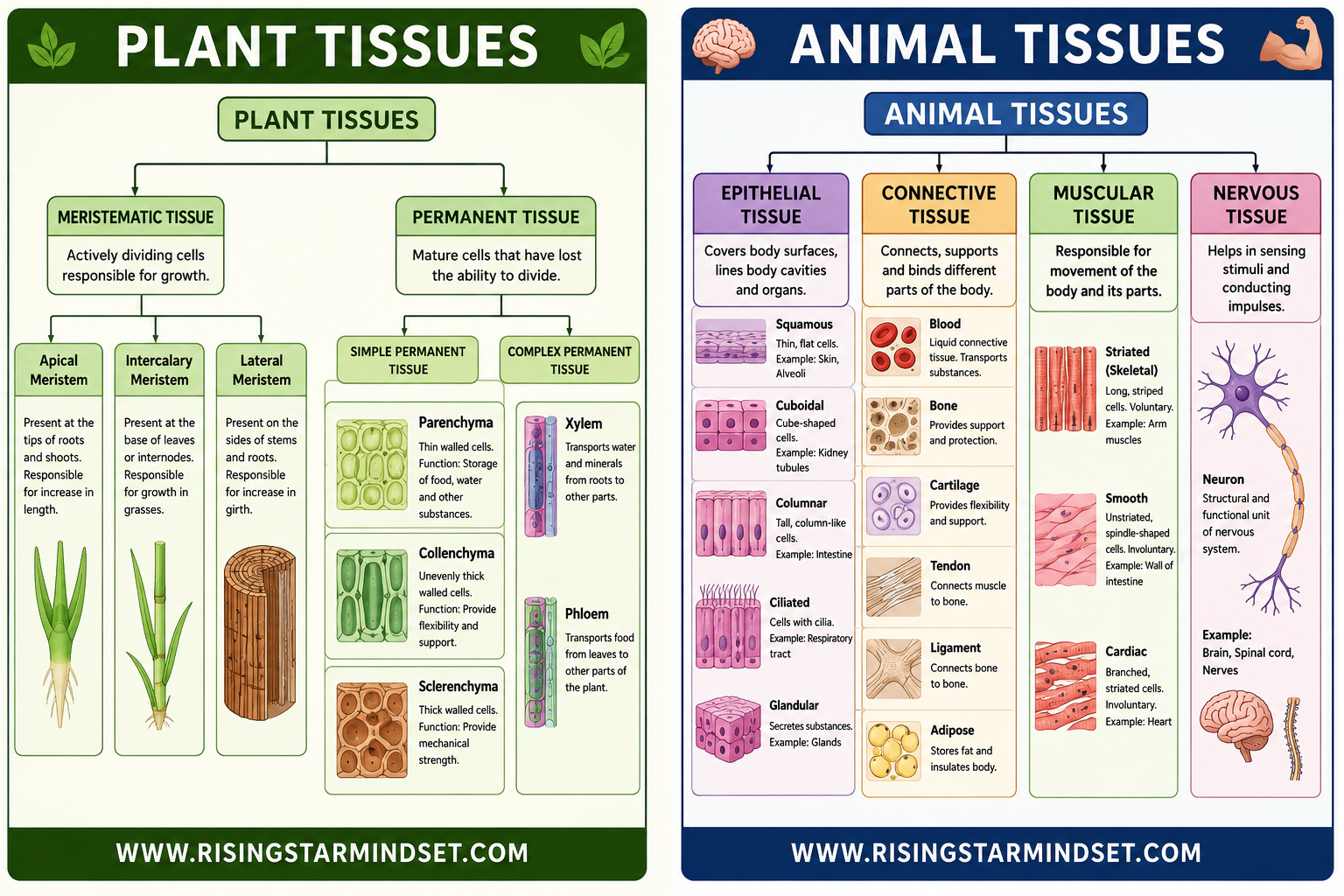
Table of Contents
- Introduction to Tissues
- What is a Tissue?
- Why Do Organisms Need Tissues?
- Plant Tissues
- Meristematic Tissue
- Permanent Tissue
- Animal Tissues
- Epithelial Tissue
- Connective Tissue
- Muscular Tissue
- Nervous Tissue
- Difference Between Plant and Animal Tissues
- Important Diagrams
- Abbreviation List
- Key Facts for Quick Revision
- Frequently Asked Questions
- MCQs for Practice
- Summary & Conclusion
1. Introduction to Tissues
Every living organism is made up of cells. Similar cells combine together to perform a specific function and form a tissue. ( Master Tissues Class 9 )
हिंदी में
प्रत्येक जीवित जीव कोशिकाओं (Cells) से बना होता है। समान प्रकार की कोशिकाएँ मिलकर एक विशेष कार्य करती हैं और ऊतक (Tissue) बनाती हैं।
2. What is a Tissue? ( Master Tissues Class 9 )
English Definition
A tissue is a group of similar cells that work together to perform a specific function.
Hindi Definition
समान संरचना एवं कार्य वाली कोशिकाओं के समूह को ऊतक (Tissue) कहते हैं।
Examples
- Muscle Tissue
- Nervous Tissue
- Xylem
- Phloem
3. Why Do Organisms Need Tissues?
Advantages
| English | Hindi |
|---|---|
| Division of Labour | कार्य विभाजन |
| Efficient Functioning | कार्य कुशलता |
| Faster Growth | तेज वृद्धि |
| Better Organization | बेहतर संगठन |
Example
In humans, muscles help in movement while nerves control body activities.
4. Plant Tissues ( Master Tissues Class 9 )
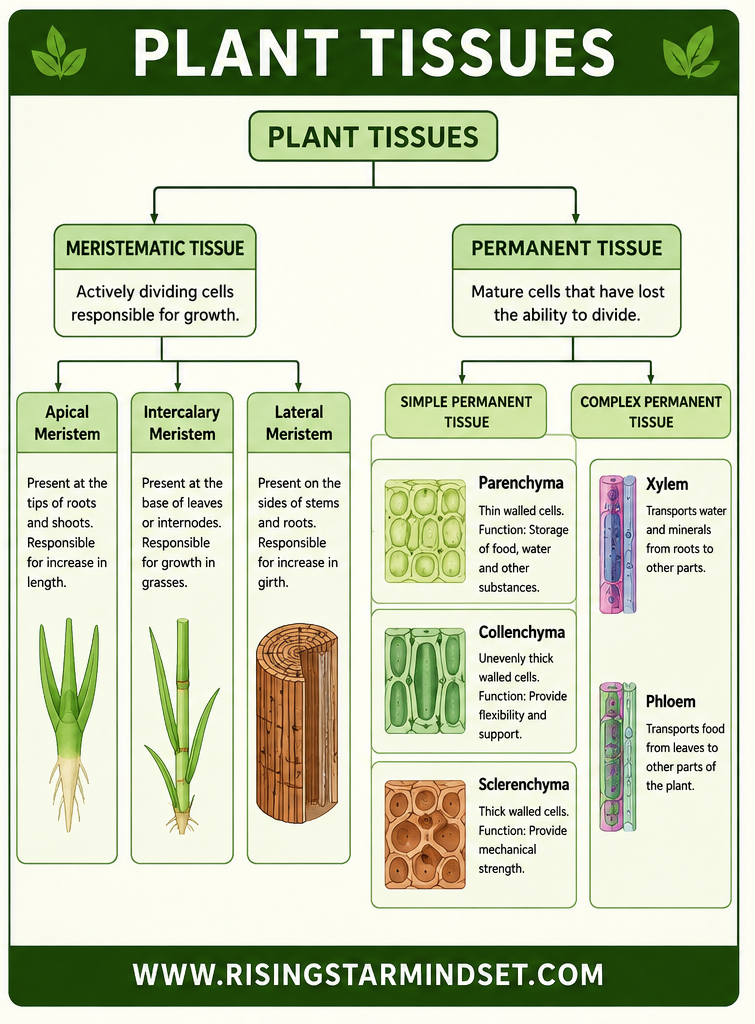
Plants have two major categories of tissues:
A. Meristematic Tissue
These tissues continuously divide and help in growth.
Characteristics
- Living cells
- Dense cytoplasm
- Thin cell wall
- No vacuoles
Types
| Type | Location | Function |
|---|---|---|
| Apical Meristem | Root and Shoot Tip | Increase Length |
| Intercalary Meristem | Base of Leaves | Growth in Grasses |
| Lateral Meristem | Stem and Root Sides | Increase Girth |
हिंदी
मेरिस्टेमेटिक ऊतक लगातार विभाजित होकर पौधों की वृद्धि करते हैं।
B. Permanent Tissue
Cells lose the ability to divide and become specialized.
Types
1. Simple Permanent Tissue
| Tissue | Function |
|---|---|
| Parenchyma | Storage |
| Collenchyma | Flexibility |
| Sclerenchyma | Mechanical Strength |
Hindi
- पैरेंकाइमा → भोजन संग्रह
- कोलेनकाइमा → लचीलापन
- स्क्लेरेनकाइमा → मजबूती
2. Complex Permanent Tissue
| Tissue | Function |
|---|---|
| Xylem | Water Transport |
| Phloem | Food Transport |
Plant Tissue Diagram
5. Animal Tissues ( Master Tissues Class 9 )
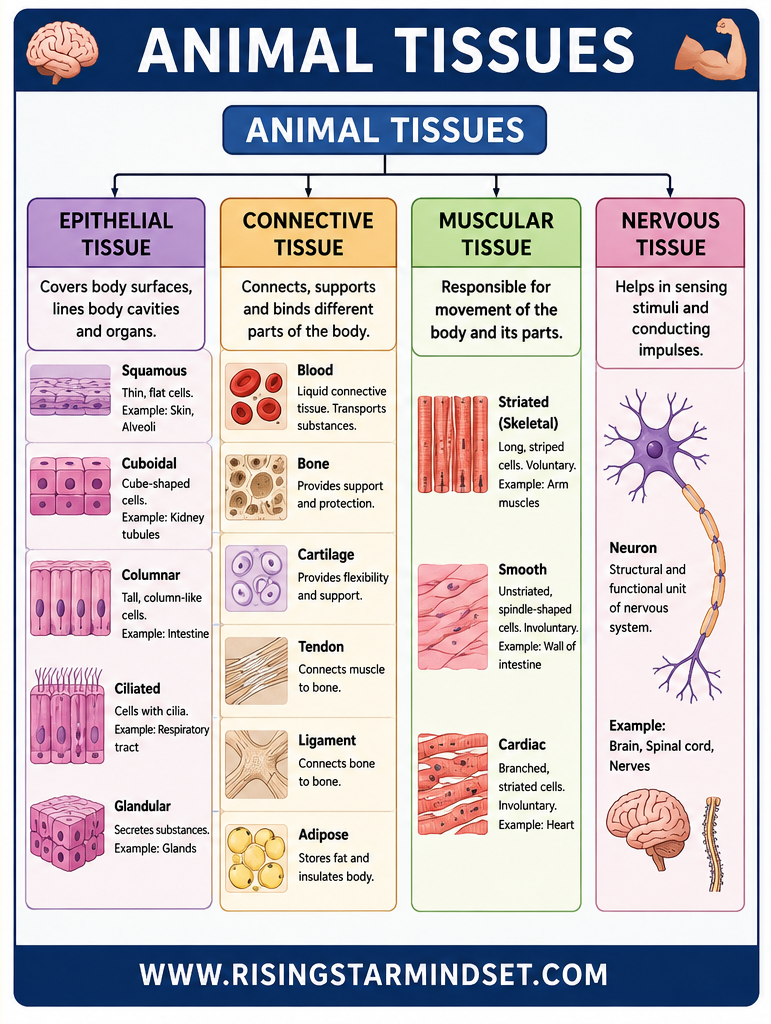
Animals have four major tissue types.
A. Epithelial Tissue
Function
- Protection
- Absorption
- Secretion
Types
| Type | Location |
|---|---|
| Squamous | Skin, Alveoli |
| Cuboidal | Kidney Tubules |
| Columnar | Intestine |
| Ciliated | Respiratory Tract |
| Glandular | Glands |
हिंदी
एपिथीलियल ऊतक शरीर की बाहरी एवं आंतरिक सतहों को ढकता है।
B. Connective Tissue
Connects body parts.
Types
| Tissue | Function |
|---|---|
| Blood | Transport |
| Bone | Support |
| Cartilage | Flexibility |
| Tendon | Muscle to Bone |
| Ligament | Bone to Bone |
| Adipose | Fat Storage |
Difference
| Tendon | Ligament |
|---|---|
| Muscle to Bone | Bone to Bone |
| Less Elastic | More Elastic |
C. Muscular Tissue
Responsible for movement.
Types
| Type | Example |
|---|---|
| Striated | Skeletal Muscles |
| Smooth | Stomach |
| Cardiac | Heart |
Hindi
मांसपेशीय ऊतक शरीर की गति एवं गतिविधियों के लिए जिम्मेदार होता है।
D. Nervous Tissue
Function
- Receives Stimuli
- Sends Messages
- Controls Body Functions
Main Cell
Neuron
Animal Tissue Diagram
6. Difference Between Plant and Animal Tissues
| Plant Tissue | Animal Tissue |
|---|---|
| Growth at specific regions | Growth throughout body |
| More supporting tissues | More muscular tissues |
| Less energy requirement | High energy requirement |
| Mostly dead supporting cells | Mostly living cells |
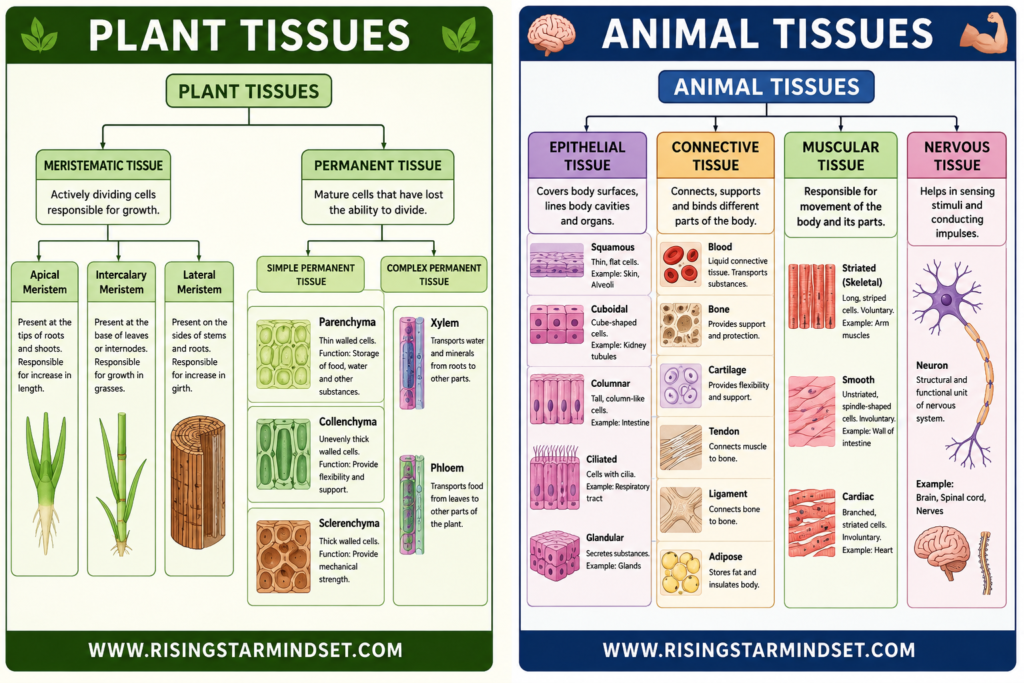
7. Important Figure (One-Shot Revision)
8. Abbreviation List ( Master Tissues Class 9 )
| Abbreviation | Full Form |
|---|---|
| DNA | Deoxyribonucleic Acid |
| RNA | Ribonucleic Acid |
| ATP | Adenosine Triphosphate |
| NCERT | National Council of Educational Research and Training |
| CBSE | Central Board of Secondary Education |
9. Key Facts for Quick Revision
English
Tissue = Group of similar cells
Plant tissues are of two types:
- Meristematic
- Permanent
Xylem transports water.
Phloem transports food.
Animal tissues are of four types.
Blood is a connective tissue.
Heart contains cardiac muscles.
Neuron is the structural and functional unit of the nervous system.
हिंदी
ऊतक समान कोशिकाओं का समूह है।
पौधों में दो प्रमुख ऊतक होते हैं।
जाइलम जल का परिवहन करता है।
फ्लोएम भोजन का परिवहन करता है।
रक्त संयोजी ऊतक है।
हृदय में कार्डियक मांसपेशियाँ पाई जाती हैं।
न्यूरॉन तंत्रिका तंत्र की मूल इकाई है।
10. Frequently Asked Questions
Q1. What is a tissue?
A group of similar cells performing a specific function.
ऊतक समान कोशिकाओं का समूह है जो एक विशेष कार्य करता है।
Q2. Why are tissues important?
They provide division of labour and increase efficiency.
Q3. Which tissue transports water?
Xylem
Q4. Which tissue transports food?
Phloem
Q5. What is the functional unit of the nervous system?
Neuron
11. MCQs for Practice
1. Which tissue transports water?
A. Phloem
B. Xylem
C. Blood
D. Bone
✅ Answer: B
2. Which tissue connects muscle to bone?
A. Ligament
B. Tendon
C. Blood
D. Cartilage
✅ Answer: B
3. Blood is a:
A. Muscular Tissue
B. Nervous Tissue
C. Connective Tissue
D. Epithelial Tissue
✅ Answer: C
4. Heart contains:
A. Smooth Muscle
B. Cardiac Muscle
C. Striated Muscle
D. Nervous Tissue
✅ Answer: B
5. Which tissue is responsible for growth in plants?
A. Permanent Tissue
B. Meristematic Tissue
C. Xylem
D. Phloem
✅ Answer: B
Chapter Summary
English
Tissues are groups of similar cells performing specific functions. Plant tissues are divided into Meristematic and Permanent tissues, while Animal tissues are Epithelial, Connective, Muscular, and Nervous tissues. Understanding tissues helps students learn how multicellular organisms function efficiently.
हिंदी
ऊतक समान कोशिकाओं का समूह है जो विशेष कार्य करता है। पौधों में मेरिस्टेमेटिक एवं स्थायी ऊतक पाए जाते हैं, जबकि जंतुओं में एपिथीलियल, संयोजी, मांसपेशीय एवं तंत्रिका ऊतक पाए जाते हैं। यह अध्याय बहुकोशिकीय जीवों की कार्यप्रणाली को समझने की आधारशिला है।
Visit Regularly
अधिक NCERT Notes, Competitive Exam Preparation, GK, Science Notes और Quiz के लिए विजिट करें:
Copyright © P Kumar | Rising Star Mindset